
Introduction
The use of technology and tools in career guidance stretches back to the birth of the field (Hooley et al., 2015). Watts (2002) and Harris-Bowlsbey (2013) have both provided historical accounts of the use of information and communication technologies (ICT) in career guidance since the 1960s. More recently, numerous studies have explored aspects of online and digital career guidance (e.g. Bimrose, 2016; Galliott, 2017; Nota et al., 2016). There have also been several attempts to create an overview of this research, to summarise its value for policy and practice (e.g. CEDEFOP, 2018; Hooley et al., 2015; Vigurs et al., 2017) and to draw out key ethical issues (Sampson & Makela, 2014). See also Buchanan (2018), Duffy and Chan (2019), Gandini and Pais (2018), Holm and Haahr (2018), Hooley and Staunton (2021), Selwyn (2016) and Utz (2016) for further discussion of this area.
The literature which addresses the interaction of career, career guidance and new technologies has increasingly recognised that our digital and physical careering are intertwined. One theorisation of this is ‘integrated guidance’ (Bakke et al., 2018; Bakke & Hooley, 2023), which conceptualises career guidance as comprising of a range of activities delivered across a variety of modes and approaches that support career learning and which aim to support the development of career knowledge and competence. As such, integrated guidance draws heavily on e-learning and blended learning approaches (e.g. Akçayır, G., & Akçayır, 2018, Bersin, 2004; Bonk & Graham, 2012) and applies these concepts and techniques to the activity of career guidance.
Integrated guidance is built on a critical and non-hierarchical ontology, which positions career as a lifelong and life-wide activity; it then understands career learning as a social process and therefore adopts social and collaborative forms of pedagogy (Bakke & Hooley, 2023). Finally, integrated career guidance draws on instructional design as an approach to creating integrated career learning, particularly the work of Salmon (2000, 2002) to give integrated career guidance its practical structure.
This concept of integrated guidance emerged from the Norwegian policy context ass part of a policy commitment to digitising public services (Norwegian Ministries, 2012) and the development and strengthening of the country’s domestic career guidance service. The Norwegian government has driven interest in digital and integrated guidance (Hooley et al., 2015; Ministry of Education and Research, 2015) and developed an increasingly ‘integrated career guidance’ approach which combines more traditional face-to-face career services with a fully digital service named karriereveiledning.no (Bakke et al., 2018). This led to the government funding a new course at the Inland Norway University (INN), which provided the authors of this article with the opportunity to develop the integrated guidance concept further. However, integrated guidance remains primarily a theoretical proposition with little direct empirical evidence supporting its implementation or impact. This study hopes to address this by looking at how Norwegian careers practitioners view integrated guidance and their role in it through the concept of pedagogical stance.
Data for this study were collected in spring 2023 in the aftermath of the pandemic, which, amongst a range of other impacts, had served to transform many individuals’ relationship with online technologies, including by introducing them to new forms of technologically mediated professional practice (Kung & Steptoe, 2023; Qiao et al., 2021). This resulted in a shift in career guidance practice, accelerating the long-standing traditions of technological adoption in the field and turning online forms of guidance into the ‘new normal’ (Šapale et al., 2021). Careers practitioners in Norway, including the study participants, had to orient themselves to these new technologies and find ways to provide good quality career guidance online, in many cases finding new ways to use audiovisual tools and social media platforms for both synchronous and asynchronous guidance (Bolstadbråten & Bråten, 2021).
Careers practitioners’ attitudes to digital technologies
This study addresses how practitioners understand and work with new technologies in guidance practice. Much existing research on the use of technologies in career guidance, assumes that the tool is the thing, focusing on what it does and how it should be used and rarely turning the telescope around to look at the people using it. Kettunen and her colleagues’ work on this subject is an important exception (Kettunen et al., 2013, Kettunen, Sampson et al., 2015; Kettunen, Vuorinen, et al., 2015).
Across a body of work, Kettunen et al. argued that digital technologies transform the relationship between the career guidance practitioner and the client. This transformation goes beyond the capability of individuals to self-serve (Watts, 2002), and addresses the increasing connectedness of practitioners and their clients. They advocate for practitioners to move away from focusing on the delivery of information, to take a non-hierarchical and learner-centred approach and recognise that learners are using digital tools autonomously, drawing on a range of online resources for their career. Kettunen et al. have been critiqued by Hooley and Staunton (2021), who argue that they fail to recognise the power dynamics and inequalities inherent in internet use for both careering and career guidance. However, their focus on the practitioner and how digital tools and technologies are experienced is an important area of research that this study seeks to continue.
More recently this issue has been picked up by other researchers with for example Margevica-Grinberga and Šmitina (2021) discussing the level of adoption of digital technologies by careers professionals in Latvia in the aftermath of the pandemic. While in general they found that careers professionals were becoming increasingly competent in this area, they also found that many were relatively conservative in their use of online tools and tended to use the most common and familiar approaches, rather than innovating. Moore (2021) makes similar points about the adoption of digital technologies by careers professionals in the UK.
More theoretically orientated work also raises questions about the potential negative consequences of a rush to adopt digital tools (Fusco et al., 2020) and makes the argument that there needs to be a stronger theorisation of how these tools are adopted into practice. This point has also been made in empirical work which emphasises the need for training and ethical and theoretically informed approaches to digital practice alongside a deeper consideration of what the implications for the profession itself are (Moore & Czerwinksa, 2019). It is hoped that the current article can contribute to these debates.
Practitioners’ approach to being a career educator
Kettunen (2017) identifies five approaches that careers educators can take: passive; information-centred; communication-centred; collaborative career exploration; and co-careering. In this typology, Kettunen links attitudes to the technical aspects of digital adoption with pedagogic ones, arguing that more competency and positive attitudes towards social media in career guidance are related to a more open, community-oriented and integrated guidance philosophy. Such an analysis organises differences in attitudes, competence and approach along a linear scale, which moves across a series of dimensions in a parallel manner from negative to positive (e.g. from viewing social media as unnecessary to viewing it as indispensable).
Integrated guidance’s central idea is that career guidance is a learning activity where the careers practitioner facilitates career learning through the careful organisation of digital and face-to-face career learning activities (Bakke & Hooley, 2023). To do this the careers practitioner has to make decisions about how to integrate different technologies and what they hope to achieve and this is underpinned by their beliefs about the learner, about the methods, tools and approaches used and their own role as educator. This can be understood as a stance which positions the subject (e.g. the teacher) in relation to an object (their teaching) and other subjects (the learners) (DuBois, 2007; Englebretson, 2007; Jaffe, 2009). When used in education, pedagogical stance is understood as ‘the position taken, the role assumed, the image projected and the type of social behaviour performed’ in the interaction with the learner (D’Errico et al., 2012, p. 926).
An educator’s stance is a function of personal factors like personality, experience, education, attitudes and personal philosophy, and external and transient factors like situation, tasks and the individual(s) they interact with. This means that a pedagogical stance is not necessarily a permanent position or type but rather situationally dependent and transient, and whether digital approaches are viewed positively or negative is just one of many factors. D’Errico et al. (2012) see four factors as especially important for stance: the teacher’s view of their professional role, the teacher’s learning and teaching theory, the teacher’s model of the student, and the teacher’s personality.
Method
This study uses Q-method to explore career practitioners’ viewpoints on integrated guidance. Q-method is a research approach designed to examine the possible variety of subjective views on a particular topic in a defined population. We have drawn on Watt and Stenner’s (2012) approach to Q-method, but we also recognise a broader literature using Q-method which we have found useful and inspiring (Lundberg, 2019; McKeown & Thomas, 2013; Shabila et al., 2021). By combining qualitative and quantitative techniques into a structured research framework, Q-methodology allows for discovering groups of people with shared opinions and viewpoints within a chosen population.
Item sampling and generation of the Q-set
The Q-sample consists of items that represent the diverse range of opinions and viewpoints on integrated guidance. Items, which in this study consist of statements, are extracted from a concourse – a communication universe that ideally contains all possible opinions and viewpoints on a chosen subject. In principle, all kinds of sources can constitute the concourse (Stephenson, 1986). To capture the variety of possible viewpoints on integrated guidance that has emerged after the pandemic, the concourse in this study was constructed by combining two sources of input: relevant literature and students’ written assignments.
In the study’s first phase, we collected statements from students that participated in a module focused on integrated career guidance at INN. We sampled phrases and sentences from the first assignments they were given in the course that provided insights on their approach to, and attitudes about, integrated guidance. This assignment asks them to discuss their digital literacy and experiences using digital tools and strategies in career guidance. They are encouraged to reflect on what they find challenging and to set out their learning aims for the course. We also sampled statements from the literature on integrated career guidance (Bakke et al., 2018; Bakke & Hooley, 2023) and from the wider literature on the use of digital technologies in career guidance (e.g. Bimrose, 2016; Galliott, 2017; Hooley & Staunton; 2021; Kettunen, 2017, 2023; Kettunen & Sampson, 2019; Vigurs et al., 2017).
The sampling process resulted in the identification of 96 statements. These were entered into Excel and a simple thematic analysis (Johnson & Christensen, 2014) was undertaken. Through this thematic analysis, we clustered the statements into three categories (called effects in Q-method) that could be used to create the basis of the concourse. The categories were:
approaches to guidance;
the digital environment; and
professional competence.
For study participants to be able to express their opinions, each of these categories must be represented as a scale summarising the possible opinions or viewpoints (levels) that can be held about each of these categories. These levels are developed as part of the thematic analysis of the statements. The first category (approaches to guidance) was divided into three levels: a) physical, b) integrated and c) digital. They describe the difference between career guidance as being an activity primarily done in the physical presence of each other, via being an activity where physical and digital strategies are combined or integrated, to being a primarily digital activity.
The second category (the digital environment) was given two levels: d) hostile and e) friendly. They describe the digital environment as either something that is challenging, volatile and needs to be used with caution or as a manageable, benevolent environment where activities online are more likely to have a positive outcome.
The third category (professional competence) was also divided into two levels: f) able to adapt, and g) concerned about adapting. They show the variation between seeing oneself as someone capable of handling the digital environment, e.g. through developing new skills, learning new tools or creating new approaches to practice, and seeing oneself as not being able to adapt as easily to the digital environment.
Fisher’s (1960) balanced block design (Table 1) was used to construct a balanced Q-set based on the categories and levels that emerged through the thematic analysis of items sampled. The balanced block design ensures a balanced Q-set in which all concepts receive equal coverage. The block design was created by choosing or composing statements that contain the twelve possible different combinations of levels from every category. Statements were expressed in Norwegian to ensure easy access for the research population (see appendix for the complete list of statements and their translations).
Table 1
Fisher’s balanced block design.
| CATEGORY | LEVELS | ||
|---|---|---|---|
| Approaches to guidance | a) Physical | b) Integrated | c) Digital |
| The digital environment | d) Hostile | e) Friendly | |
| Professional competence | f) Able to adapt | g) Concerned about adapting | |
The statements in the Q-set were reviewed by a group of three practitioners and a researcher familiar with the method. The number and construction of the statements were adjusted according to their feedback. This resulted in a Q-set with 36 statements.
Participant sampling
The objective of using Q-methodology is to reveal and understand key viewpoints in the population in qualitative detail, not to ascertain how many people in a population exemplify a particular viewpoint. Heterogeneity in the participant sample is then of key importance. Participants were recruited from a diverse population of practitioners by inviting current and former students at INN University, posting open invitations on various Norwegian career counselling networks and distributing invitations via key intermediaries within the Norwegian career guidance community. To be able to monitor diversity in the sample, a demographic survey was attached to the Q-sort, asking about career guidance experience from a variety of sectors, duration of work experience and degree of confidence in the use of integrated guidance (see Table 2). Watts and Stenner (2012) argue that 20 to 40 participants in a Q-study is normal. In this study 41 participants were recruited to ensure that the sample represented a diverse population of practitioners.
Table 2
Demographics.
| YEARS OF PRACTICE | CONFIDENCE IN USING DIGITAL TOOLS | SECTOR | |||
|---|---|---|---|---|---|
| Less than a year | 1 | 1 (Not confident) | 1 | Regional career service | 19 |
| 2–4 years | 7 | 2 | 3 | High school | 8 |
| 5–10 years | 15 | 3 | 18 | Higher education | 5 |
| More than ten years | 16 | 4 (Very confident) | 17 | Public employment services | 3 |
| Elementary school | 2 | ||||
| Criminal reform | 1 | ||||
| Other | 1 | ||||
Participants were asked to sort the 36 statements into a predefined distribution matrix to best express their views on the integrated guidance subject, on a scale ranging from ‘strongly disagree’ to ‘strongly agree’. Data were collected through Wired Solution’s Q-method Software. Because our University’s policies are based on the European Union’s general data protection, we opted not to collect personal data, thus avoiding data protection issues.
Analysis
The objective of the Q-study is to see how career counsellors perceive their approach to guidance, the digital environment they work in, and their professional competence. Different viewpoints emerge from the study through a factor analysis (Watts & Stenner, 2012). The analysis visualises how the career counsellors situate themselves within the three categories. This allows us to see a pattern in how they express their approaches to career guidance (do they feel that their approaches are mainly digital, blended or face-to-face), how they express their ability to adapt (do they feel that they can adapt to and master their digital work environment) and how they express their view about the potential change that digital technologies bring to the experience of careering (do they see the emergence of digital technology as filled with potential or fraught).
The 41 Q-sorts produced by the participants were intercorrelated and subjected to a by-Q sort factor analysis using Spearman’s factor analytic method (Watts & Stenner (2012, p. 7). This was done using Q-method Software. Seven centroid factors were extracted. Considering the different factors’ Eigenvalues (Table 3), the Scree plot of the factors and how many Q sorts that loaded significantly on each factor, three factors were kept for rotation.
Table 3
Statistical information.
| FACTOR 1 | FACTOR 2 | FACTOR 3 | FACTOR 4 | FACTOR 5 | FACTOR 6 | FACTOR 7 | |
|---|---|---|---|---|---|---|---|
| Eigenvalues | 20.16182 | 2.71335 | 1.37783 | 1.33884 | 1.08951 | 0.23214 | 1.04227 |
| % Explained Variance | 49 | 7 | 3 | 3 | 3 | 1 | 3 |
| Cumulative % Explained Var | 49 | 56 | 59 | 62 | 65 | 66 | 68 |
| Humphrey’s Rule | 0.7653 | 0.37312 | 0.1406 | 0.12207 | 0.12165 | 0.02341 | 0.13555 |
| Standard Error | 0.05 | 0.05 | 0.05 | 0.05 | 0.05 | 0.05 | 0.05 |
Q-sorts that load significantly on each of the three factors are Q-sorts by participants with similar sorting patterns. This means the configuration they created by placing the statements into the sorting matrix resembles the other participants’ configurations. Varimax rotation was employed to ensure that the maximal variations in these factors would appear as clearly as possible. The three factors kept for rotation explain 59% of the study variance. Thirty-two Q sorts loaded significantly on one or other of the three factors, twenty on factor one, and six on factors two and three. Factor loadings ±0.46 and above were significant at the p < 0.01 level (Table 4).
Table 4
Factor characteristics.
| FACTOR CHARACTERISTICS | FACTOR 1 | FACTOR 2 | FACTOR 3 |
|---|---|---|---|
| Number of defining variables (Q sorts) | 20 | 6 | 6 |
| Average relational coefficient | 0.8 | 0.8 | 0.8 |
| Composite reliability | 0.98765 | 0.96 | 0.96 |
| Standard error of factor Z-scores | 0.11111 | 0.2 | 0.2 |
The three factors identified were then visualised by creating a single ideal-typical Q sort for each factor (composite Q-sort). The composite Q-sorts need to be interpreted carefully and holistically. In addition to qualitatively analysing and discussing the factor arrays, Watts and Stenner (2012) argue that it is useful to create crib sheets as a systematic way of contrasting and comparing the factors differences and similarities. This was also done as part of our analysis. The factors’ unique viewpoints and opinions do not only emerge through the separate analysis of the composite Q-sorts, but also through contrasting and comparing the factors’ rankings of statements. The different factors’ rankings of statements higher or lower than other factors can therefore bear as much significance as the rank given itself in understanding the factors’ unique stances.
Results
The three factors identified through the analysis have some shared understandings of integrated guidance (Table 5). All participants were open to the use of digital tools and technologies, and all integrate the internet as either a career learning resource or communication platform. With respect to their approaches to guidance all three groups agreed that ‘the internet is a great asset for people’s career development, so of course, I use it for career guidance’Statement 16 (Factor 1 ranked as 3, Factor 2 as 2, and Factor 2 as 3).
Table 5
Statement rankings by factor.
| STATEMENT RANKINGS BY FACTORS | F1 | F2 | F3 | |
|---|---|---|---|---|
| 1 | I can teach the client how to use the internet in a safer way when we meet in person. | 0 | 3 | –1 |
| 2 | It is better to meet in person when using assessment tools to map personality, abilities and interests in career guidance. | 0 | 1 | 1 |
| 3 | I can’t stay updated, so it’s difficult to work closely with clients with little digital competence. | –4 | 0 | –5 |
| 4 | I want to learn more about using the internet as an asset when I give career guidance face-to-face. | 2 | 2 | 1 |
| 5 | Digital career guidance is more effective, so I want to learn how to become an excellent digital career counsellor. | 0 | –2 | 0 |
| 6 | The quality of career guidance becomes better when we use digital platforms than when we meet in person for career guidance or education. | –1 | –4 | –3 |
| 7 | I prefer giving career guidance face-to-face because many clients don’t have much digital competence and need help. | –1 | 4 | 0 |
| 8 | Videocalls work well in career guidance, but you must be careful in case the client is not alone and cannot speak freely. | 1 | –1 | 1 |
| 9 | I personally follow up with my clients because I’m worried they might have negative experiences on social media. | –3 | –3 | –1 |
| 10 | I’m comfortable having career guidance conversations face-to-face. | 3 | 5 | 5 |
| 11 | The internet is a good and helpful resource in career education, but I find it hard to adapt to digital career guidance formats. | –3 | 0 | –4 |
| 12 | It’s not ethical to use social media for career guidance conversations or career education because people’s digital skills vary. | –3 | –1 | –1 |
| 13 | I’m happy to adapt and give career guidance both through the Internet and face-to-face. | 5 | 3 | 3 |
| 14 | I’m not sure how to combine digital and face-to-face guidance. | –4 | –2 | –2 |
| 15 | The pace of digital development is frightening. | –1 | 1 | –1 |
| 16 | The internet is a great asset for people’s career development, so of course, I use it for career guidance. | 3 | 2 | 3 |
| 17 | Digital technologies can strengthen and improve career learning processes. | 4 | 2 | 2 |
| 18 | People’s careers are developing in a digital world, so I will continue combining physical and digital guidance the way I do. | 0 | –1 | 1 |
| 19 | The internet is amazing, and I think all career guidance will soon be digital and online. | –2 | –5 | –3 |
| 20 | Communicating through digital channels is not as efficient as communicating face-to-face. | 1 | 3 | 2 |
| 21 | I agree that it’s valuable that integrated guidance can help people get better at using the internet, but I don’t think I can adapt how I give career guidance. | –2 | –2 | –3 |
| 22 | The internet helps people build their careers, and combining physical and digital resources can have many positive effects. | 3 | 2 | 0 |
| 23 | New technology can make it easier to develop new forms of career guidance. | 4 | 0 | 4 |
| 24 | I prefer not to use digital resources in career guidance. | –5 | –2 | –4 |
| 25 | Online synchronous guidance is fine if the technology works well, but technical problems can be distracting. | 1 | 1 | 2 |
| 26 | There are many strange things to be found on the internet, but I often try new platforms and technologies in career guidance without testing them very thoroughly. | –1 | –4 | –1 |
| 27 | If the digital tools or platforms are not helpful to me in my job, then I don’t use them. | 0 | 0 | 3 |
| 28 | You can become more digitally competent and learn how to use digital tools in career guidance when “learning by doing”. | 2 | 1 | 4 |
| 29 | It may be that we’ll go back to giving career guidance mostly face-to-face after the pandemic, but that is negative for the development and/or access to the services for the future. | 1 | –3 | –2 |
| 30 | We see many clients who are not digitally literate, so we must adapt our strategies to keep career guidance relevant for them. | 2 | 4 | 0 |
| 31 | There is a lot of information and technical stuff out there, but it’s not necessary to learn or use everything. | 0 | 1 | 2 |
| 32 | The pace of digital/technological developments is quite high, but I still think I can keep up. | 2 | –1 | 1 |
| 33 | It feels like there is no limit to what we will have to learn; new digital resources appear constantly. | –1 | 0 | –2 |
| 34 | I think employers understand that people’s appearance on social media mainly shows their private selves. | –2 | –3 | 0 |
| 35 | It’s essential to be aware of how we appear on social media because mistakes here can seriously affect an individual’s career development. | 1 | 0 | 0 |
| 36 | I think many people will be unable to keep up with the developments in digital technology. | –2 | –1 | –2 |
In regard to professional competence, they all disagree with the statement: ‘I agree that it’s valuable that integrated guidance can help people get better at using the internet, but I don’t think I can adapt how I give career guidance’21 (F1:–2, F2:–2, F3:–3). Statement 21 can be read as ambiguous, but the rest of the data suggests that all factors are fairly confident about their professional competence and can adapt to integrate internet and digital tools and technologies in their practice, at least to some extent. They all, however, ‘want to learn more about using the internet as a resource when I give career guidance face-to-face’4 (F1:2, F2:2, F3:1).
They also agree that practising career guidance in digital environments is not necessarily the best way to facilitate career learning. For instance, they all agree that ‘online synchronous guidance is fine if the technology works well, but technical problems can be distracting’25 (F1:1, F2:1, F3:2). They are all uncertain about whether ‘it is better to meet in person when using assessment tools to map personality, abilities and interests in career guidance’2 (F1:0, F2:1, F3:1) or not. Neither have they entirely decided whether ‘it is essential to be aware of how we appear on social media because mistakes here can seriously affect an individual’s career development’35 (F1:1, F2:0, F3:0).
Despite these areas of agreement, we find that three different philosophies exist among the participants in this study. These emerge from the factor analysis and are represented by composite Q-sorts. In this section, we will review the composite Q-sorts one by one to describe the three different groups of practitioners (factors) by presenting the most distinguishing statements for the factor.
Factor 1: Enthusiasts
Factor 1 (Figure 1) was the most common of the factors. In total 20 Q-sorts load significantly on Factor 1. The demographic information that is used here to elaborate on the qualitative characteristics of this group of people suggests that the length of their experience vary from less than a year to more than ten years. Most are however experienced practitioners, and all report confidence in using digital technologies in career guidance. The factor consists of practitioners from variety of sectors including regional career services, all levels of education, public employment services and privately owned career services, which suggest the particular viewpoint the factor represents can be held by practitioners across sectors.
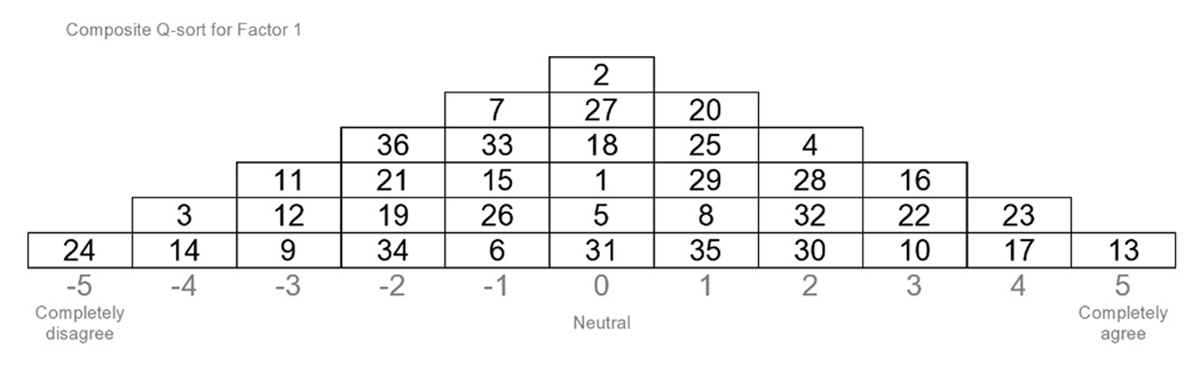
Figure 1
Composite Q-sort for factor 1 (Enthusiasts).
Approach to guidance
Participants grouped into this factor were positive about integrated guidance and strongly agree that they are ‘happy to adapt and give career guidance both through the Internet and face-to-face’13(5), scoring this statement higher than any other factor. In contrast they completely disagree that they ‘prefer not to use digital resources in career guidance’24 (–5), scoring this lower than any other statement. They give the statements: ‘digital technologies can strengthen and improve career learning processes’17 (4) and ‘new technology can make it easier to develop new forms of career guidance’23 (4) high scores.
The enthusiasts disagree that they ‘prefer giving career guidance face-to-face because many clients don’t have much digital competence and need help’7 (–1), although they are ‘comfortable having career guidance conversations face-to-face’10 (3), even if they are less comfortable than the other groups. They disagree that ‘The quality of career guidance becomes better when we use digital platforms than when we meet in person for career guidance or education6’ (–1), showing that they are not pushing digital approaches regardless of client needs. However, they are less concerned about this than the other groups. They are also less convinced than the others that ‘you can become more digitally competent and learn how to use digital tools in career guidance when learning by doing’28 (1).
The digital environment
In comparison to the other groups, the enthusiasts are positive about the idea that ‘the internet helps people build their careers, and combining physical and digital resources can have many positive effects’22 (3), scoring it higher than any other group. They also believe most strongly that ‘it may be that we’ll go back to giving career guidance mostly face-to-face after the pandemic, but that is negative for the development and/or access to the services for the future’29 (1). Even though they agree that ‘communicating through digital channels is not as efficient as communicating face-to-face’20 (1), they also believe that it is less important ‘to meet in person when using assessment tools to map personality, abilities and interests in career guidance’2 (0) than the other groups. Even though they recognise that there can be some practical issues that can make using the digital environment for career guidance purposes more demanding, they remain more positive about the use of digital technologies in career guidance than the other groups.
Professional competence
The enthusiasts are generally confident about their ability to adapt to the digital environment and believe they have appropriate professional competence for this task. For example, they disagree that they ‘can’t stay updated, so it’s difficult to work closely with clients with little digital competence’3 (–4) and also disagree that they are ‘not sure how to combine digital and face-to-face guidance’14 (–4), which can be understood as an expression of confidence in their competence as practitioners and the way that they use digital tools and technologies in career guidance.
They disagree that ‘it’s not ethical to use social media for career guidance conversations or career education because people’s digital skills vary’12 (–3), rating this lower than either of the other groups, perhaps suggesting that they remain unconvinced by debates about a digital divide. This is further suggested by the fact that the enthusiasts disagree that they need to ‘personally follow up with my clients because I’m worried they might have negative experiences on social media’9 (–3). They do, however, still ‘see many clients who are not digitally literate30 […]’ and feel they ‘[…]must adapt our strategies to keep career guidance relevant for them’30 (2).
Summary of the enthusiasts
The enthusiasts build on a long-standing tradition of research and practice which views technology as a boon for career guidance practice (Hooley et al., 2015; Watts, 2002). They are confident they have the technical skills to utilise new technologies and effectively combine them with existing careers practice to create new and innovative approaches. They are not simply technophiles who endorse everything digital but rather, view technology as an integral part of what they do. As such, they no longer view ICT and career guidance skills as two separate domains in the way Bimrose et al. (2010) described over a decade ago. They are also confident about their ability to learn new skills and master new technological tools in service of their practice. They so should be understood as having a high level of technological self-efficacy (Wang et al., 2013).
In addition to their belief in their skills and ability to integrate digital technologies with career guidance, the enthusiasts also have a positive perspective on the role of digital technologies in individuals’ career building. For this group, digital technologies are tools that can help individuals build their careers, find information and promote themselves to potential employers and others (Utz, 2016). In general, they are interested in helping people to engage with the digital environment and to make the most of it in their careers.
The demographic information shows that enthusiasts with all levels of experience can be found throughout all sectors.
Factor 2: The human connectors
Six Q-sorts load significantly on Factor 2 (Figure 2) (the human connectors). The demographics suggest that this group consists of very experienced career practitioners, all stating in the survey that they have worked with career counselling for more than ten years. None of them states that they are very confident in using digital technologies in career counselling. One of the participants has not stated where they work, but, three work in public careers services and two in school, either elementary school or high school. These are all sectors where face-to-face interaction is a common approach.
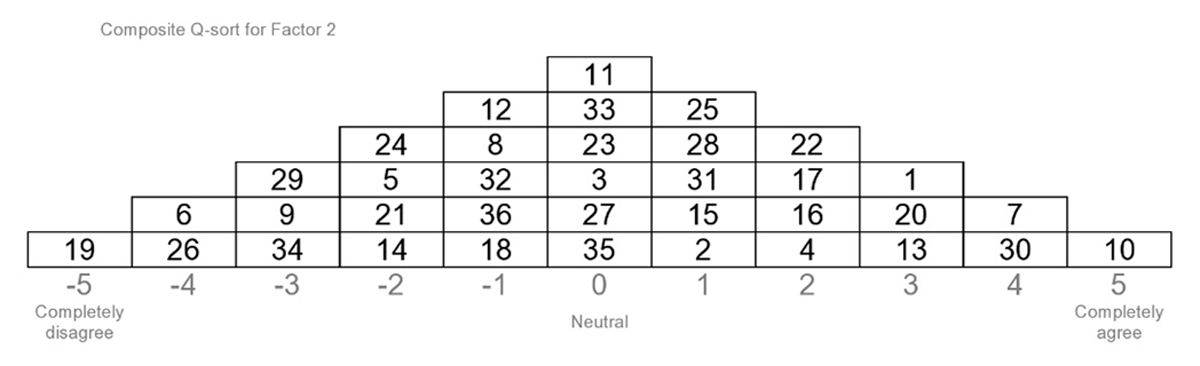
Figure 2
Composite Q-sort for Factor 2 (human connectors).
Approach to guidance
The strongest conviction amongst the human connectors group is that they are ‘comfortable having career guidance conversations face-to-face’10 (5). This may be because of their extensive experience as career practitioners working in the face-to-face mode. They also seem very concerned about their clients’ needs and do not assume that everyone is digitally literate. For instance, they agree more strongly than the other groups that they ‘prefer giving career guidance face-to-face because many clients don’t have much digital competence and need help’7 (4), and that they ‘see many clients who are not digitally literate’30[…] and choose to adapt their ‘[…] strategies to keep career guidance relevant for them’30” (4).
They express more strongly than the other factors that they feel they can teach the client how to use the internet in a safer way when we meet in person’1. (3), and that ‘communicating through digital channels is not as efficient as communicating face-to-face’20 (3). The human connectors disagree that ‘there are many strange things to be found on the internet, but I often try new platforms and technologies in career guidance without testing them very thoroughly’7 (–4) and hence show some caution regarding which tools or strategies they use. Even though statement 7 can be understood as ambiguous, this might express the importance of thoroughly assessing digital tools and platforms to the human connectors.
The digital environment
The human connectors disagree most strongly that ‘the internet is amazing, and I think all career guidance will soon be digital and online’19 (–5) and that ‘the quality of career guidance becomes better when we use digital platforms than when we meet in person for career guidance or education’6 (–4). They are also less convinced than the others that ‘new technology can make it easier to develop new forms of career guidance’23 (0), but unlike the others, they also don’t believe that ‘it may be that we’ll go back to giving career guidance mostly face-to-face after the pandemic, but that is negative for the development and/or access to the services for the future’29 (–3). This suggests they are confident that face-to-face guidance is the most effective way to support clients’ career development.
Some of their answers suggest that they are not interested in the details of the digital environment and online practice. For example, they do not seem concerned that ‘video calls work well in career guidance, but you must be careful in case the client is not alone and cannot speak freely’8 (–1), nor do they ‘personally follow up with my clients because I’m worried they might have negative experiences on social media’9 (–3). However, they do have concerns about social media, saying that they do not ‘think employers understand that people’s appearance on social media mainly shows their private selves’34 (–3).
Professional competence
The human connectors agree most strongly out of all the groups that ‘the internet is a good and helpful resource in career education, but I find it hard to adapt to digital career guidance formats’11 (0) and disagree that ‘the pace of digital/technological developments is quite high, but I still think I can keep up32’ (–1). Unlike the others, they disagree that ‘digital career guidance is more effective, so I want to learn how to become an excellent digital career counsellor’5 (–2). Still, they are ‘happy to adapt and give career guidance both through the Internet and face-to-face’13 (3), and they do not think they cannot figure out ‘how to combine digital and face-to-face guidance’14 (–2). They agree more strongly than the other groups that they experience ‘the pace of digital development’15 as ‘frightening’15 (1) and that ‘there is no limit to what we will have to learn; new digital resources appear constantly’33 (0).
Summary of the human connectors
The human connectors express a strong preference for face-to-face forms of practice. This does not mean they are unwilling or unable to use digital approaches, but this is not their preference. Such a position aligns with at least some of the literature in the field, with Whiston (2021) arguing that face-to-face, one-to-one career counselling interventions have the most substantial evidence of efficacy and Vigurs et al.’s (2017) review of online careers work finding at best-mixed evidence of efficacy. Such studies are unlikely to be the final word on the effectiveness of online careers practice. However, in the absence of more robust evidence, the human connectors’ reluctance to throw out existing models of practice can perhaps be understood.
The human connectors also express concerns about their ability to master new technologies and keep up with rapidly changing tools, technologies and approaches. This raises the importance of ensuring that careers professionals have good access to training and development, a call frequently made in the literature (Sampson et al., 2020). However, the issue of ‘technology fatigue’ has been observed in other educational settings, and also perhaps merits further study in relation to career guidance practice (Halupa & Bolliger, 2020).
Finally, it is important to recognise that the human connectors are wary about the possibilities the digital environment offers their clients for developing their careers. They recognise the digital divide as an important motivator for service differentiation (Lythreatis et al., 2022), express concern about employer surveillance (Duffy & Chan, 2019) and believe that career guidance must actively build people’s digital skills and capability to manage this environment (Buchanan, 2018).
Factor 3: The critical pragmatists
Six Q-sorts load significantly on Factor 3 (Figure 3). The demographic information shows that their experience in career counselling varies; four have been career practitioners for five to ten years, and two for two to four years. They state that they are either ‘very confident’ or ‘confident’ in using digital tools in career counselling. Two of them work in public careers services, two in higher education and two in high schools. This suggests that the stance they express might be as much founded on their digital competence as their practical experience with integrated guidance.
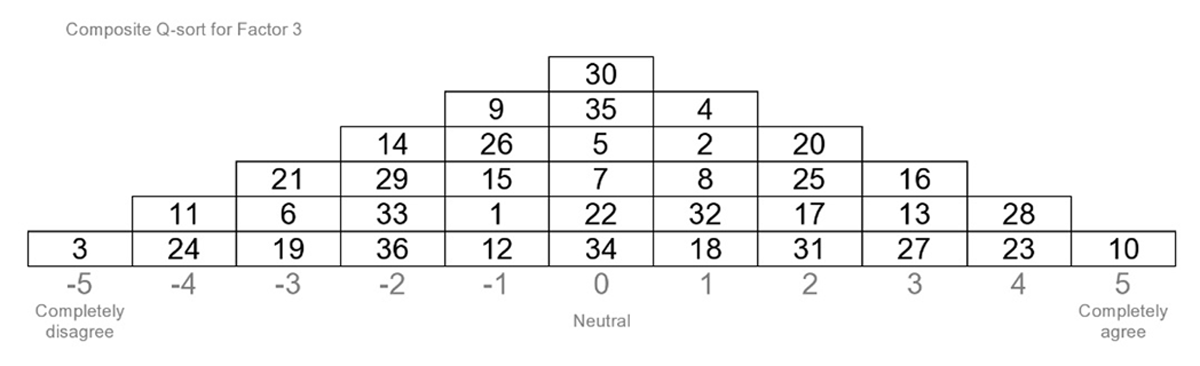
Figure 3
Composite Q-sort for Factor 3 (critical pragmatists).
Approach to guidance
The critical pragmatists agree most strongly that they are ‘comfortable having career guidance conversations face-to-face’10 (5). However, they rate ‘I prefer giving career guidance face-to-face because many clients don’t have much digital competence and need help’7 (0) and ‘we see many clients who are not digitally literate, so we must adapt our strategies to keep career guidance relevant for them’30 (0) lower than other groups. This perhaps suggests that they do not see their clients’ existing digital literacy as an absolute barrier to the use of digital approaches to guidance.
As well as being positive about face-to-face approaches, they are also positive about digital approaches, strongly disagreeing with the statement ‘I prefer not to use digital resources in career guidance’24 (–4). The critical pragmatists’ confidence in both face-to-face and digital approaches potentially leads them to be more flexible and responsive to circumstances and client needs in how they work. They agree more strongly than the other groups that ’if the digital tools or platforms are not helpful to me in my job, then I don’t use them’27 (3), but they also agree that ‘the internet is a great asset for people’s career development’16, and ’so of course, I use it for career guidance’16 (3). More than the other factors, they agree that ‘people’s careers are developing in a digital world, so I will continue combining physical and digital guidance the way I do’18 (1). In sum, by looking at their highest-rated statements in configuration to each other, we understand that they are ‘happy to adapt and give career guidance both through the Internet and face-to-face’13 (3).
The digital environment
The critical pragmatists do not believe that ‘the quality of career guidance becomes better when we use digital platforms’6 (–3), or that ‘the internet is amazing’19 and that ‘all career guidance will soon be digital and online’19 (–3). However, they agree more strongly than the other groups that they should ‘personally follow up with my clients because I’m worried they might have negative experiences on social media’9 (–1). This might suggest they are more aware of the potential hostility clients can meet on social media. They are also more cautious about social media as a suitable channel for clients to promote their employability. They rate the statement ‘I think employers understand that people’s appearance on social media mainly shows their private selves’34 (0) lower than the other groups.
Professional competence
The critical pragmatists are not concerned that they ‘can’t stay updated’3, so it’s difficult to work closely with clients with little digital competence’3 (–5). They strongly agree that ‘you can become more digitally competent and learn how to use digital tools in career guidance when “learning by doing”’28 (4) and that ‘new technology can make it easier to develop new forms of career guidance’ (4), suggesting that they are confident that they either have or can acquire the digital skills needed to develop new forms of practice. Statements 21 (–3) and 11 (–4) are ambiguously formulated, which makes the basis for interpretation somewhat unclear. This could express that the critical pragmatists agree that it is valuable that integrated guidance can help people get better at using the internet21 and that it is ‘a good and helpful resource in career education’11 but disagree that they cannot adapt how they give career guidance 21, 11. They do not make learning ‘more about using the internet as a resource when (they) give career guidance face-to-face’4 (1) as much of a priority as the other factors, perhaps because they already rate themselves as competent in using digital technologies.
Summary of the critical pragmatists
The critical pragmatists are the closest in philosophy to integrated guidance (Bakke & Hooley, 2023). They are comfortable using both face-to-face and digital approaches and adapting their practice to different contexts and client needs.
The critical pragmatists take a critical stance on digital technologies and do not view them as an unconditional good. However, they feel confident that they are competent to use digital technologies as part of their guidance practice.
Discussion
The analysis so far has demonstrated a range of differences in how career practitioners understand, relate to and respond to the digital world. While all participants agreed that there was value in using digital tools, they responded in different ways to the opportunities offered by the digital world.
We are not the first researchers to identify differences in responses to technology by career guidance and other educational practitioners. Often such observations draw on Rogers’s (2003) innovation diffusion theory, which argues that there are five temporally differentiated modes of engagement: innovators, early adopters, early majority, late majority and laggards. However, it is not possible to understand our data in terms of being ‘ahead’ or ‘behind’ as most participants were experienced with digital technologies.
In other work, engagement with technology is understood as essentially a matter of competence, with practitioners divided by their capability to use the technology (Dela Fuente & Biñas, 2020; Fernández-Batanero et al., 2021). Again, this approach seems inadequate to understand our data as it imposes a narrow hierarchical view on technological acquisition, with the implicit assumption that what constitutes technological competence within pedagogic settings is uncontested and that more technological competence is always a good thing. Kettunen et al.’s (2013) model of competence is more sophisticated and uses a range of linked but distinct factors (e.g. attitude, perception, guidance paradigm and role of the practitioner) to understand variations in practitioner engagement with technology. However, it retains a hierarchical perspective, with differentiation between practitioners essentially understood as a gradation between negative and positive. Again, our data resists this kind of organisation, with our three groups each representing experienced, thoughtful practitioners with legitimate perspectives on the incorporation of new technologies into their practice.
Using D’Errico et al.’s (2012) concept of pedagogical stances, we will describe the pedagogical stances we see in our data using three factors: role, theory, and student model, as we do not have sufficient data on participant personality. Table 6 summarises the analysis of pedagogic stance in our study.
Table 6
Pedagogical stances of the three groups.
| ENTHUSIASTS | HUMAN CONNECTORS | CRITICAL PRAGMATISTS | |
|---|---|---|---|
| Professional role | Mavens | Custodians | Evaluators |
| Theory | Co-careering | Humanistic | Integrated guidance |
| Student model | Digital careerists | Digitally challenged | Digital learners |
Starting with their professional role, the enthusiasts view themselves as proactive innovators seeking to engage both their clients and the wider profession in the value of digital technologies. They are mavens keen to drive the field of career guidance forward in its engagement with technology. In contrast, the human connectors act as custodians of established practices within the field of guidance. They question how useful technologies are, highlight challenges for those on the other side of the digital divide and attend carefully to their ethical responsibilities. The critical pragmatists view their professional role as one of discernment and design. Technologies are neither all good nor all bad; they are evaluators who can weigh up what works and what does not work and help clients to navigate their careers.
Moving on to theory, the enthusiasts are influenced by optimistic online learning theories like connectivism (Downes, 2022; Siemens, 2004) and their translation into career guidance concepts like co-careering (Kettunen et al., 2015). Technologies are viewed as an expansion of the opportunity structure, so the purpose of career guidance is to facilitate clients’ and learners’ exploration of the digital environment. In contrast, the human connectors draw primarily on a range of more conventional career counselling theories and approaches that emphasise what Sultana (2017) describes as humanistic and developmental approaches to practice. However, the human connectors also have an implied critique of digital technologies, which potentially aligns them with theorists who take a more critical perspective on how career guidance should help people interact with the digital world (Buchanan, 2018). Finally, the critical pragmatists align themselves with the theoretical perspective of integrated guidance (Bakke & Hooley, 2023) both in terms of a level of scepticism about the possibilities of online careering and through the articulation of a pedagogy that draws on instructional design (Akçayır, G., & Akçayır, 2018; Bersin, 2004; Bonk & Graham, 2012).
Finally, it is useful to consider how the different groups construct a model of their student or client. For the enthusiasts, clients are understood as competent and literate digital careerists who can navigate the digital environment with relatively little help from the careers practitioner. In contrast, the human connectors are deeply concerned about their clients’ digital literacy. They recognise that many of their clients are digitally challenged and may need help accessing digital opportunities or even offered an alternative to digital approaches. Finally, the critical pragmatists see their clients as digital learners on a journey to competence and understanding. As such, they do not make assumptions about how competent learners are, nor do they see them as irrevocably on the other side of the digital divide. Instead, careers practice is viewed as a process of engaging with learners and developing them in terms of their technical capabilities, career management skills and their ability to think critically about the digital opportunity structure.
Conclusions and further work
This article has explored Norwegian career practitioners’ perspectives on integrated guidance. Unsurprisingly we have found various perspectives within the Norwegian career guidance community. Practitioners are variously enthusiasts, human connectors or critical pragmatists. We have resisted the temptation to view these different pedagogic stances hierarchically, instead viewing them all as legitimate responses to some of the issues that emerge in integrated guidance. At the level of the community of practice, there is undoubtedly value in different perspectives, with practitioners variously pushing for development, grounding practices in tried and tested approaches and values, and searching for a middle way capable of resolving these dilemmas.
We believe there is much more to say about practitioner understandings, perspectives and practices around integrated guidance. We hope others will build on this research in other contexts and using other research methods. Understanding the intersection between theory and practice is about understanding how individual practitioners make sense of different ideas and contexts, align them with their world views and transform them into practices. We believe this area has received too little attention in career guidance research and hope that this paper adds to this literature.
Finally, we would also like to encourage others to consider using Q-method within career guidance research. This methodology is rarely used within career guidance, or even within educational research. We hope that this study has demonstrated some of the potential of Q-method and believe that the literature in the field would be enriched by further experimentation with this approach.
Additional File
The additional file for this article can be found as follows:
Appendix
Original statements in Norwegian with English translations. DOI: https://doi.org/10.16993/njtcg.76.s1
Funding Information
One of the authors, has been an editorial board member of NJTCG journal since 2021. This research was funded by the Inland Norway University where all three authors are employed and teach a module which addresses integrated guidance. None of the authors received any benefit or advantage for undertaking this research. However, they are personally and professionally committed to the development of integrated guidance and the continued existence of training and development opportunities for careers practitioners in this area.
Competing Interests
The authors have no competing interests to declare.