
Table 1
Design principles and meta-principles linked to the use of ubiquitous computing tools from the DPD (Design Principles Database website, n.d.).
| Principles | Meta-principles/concepts |
|---|---|
| Build on student ideas | Make contents accessible |
| Connect to personally relevant contexts | |
| Engage learners in complex projects | |
| Create a clear and engaging flow of activities | |
| Provide students with templates to help reasoning | |
| Reduce visual complexity to help learners recognize salient information | |
| Create a clear and engaging flow of activities | Make student thinking visible |
| Enable manipulation of factors in models and simulations | |
| Enable virtual navigation for exploring complex physical systems | |
| Model scientific thinking | |
| Provide knowledge representation and organisation tools | |
| Provide students with templates to help reasoning | |
| Reduce visual complexity to help learners recognize salient information | |
| Scaffold the process of generating explanations | |
| Support student-initiated modelling of complex science | |
| Use multiple representations | |
| Encourage reflection | Promote autonomous lifelong learning |
| Engage learners as critics | |
| Establish a generalized inquiry process | |
| Engage learners in complex projects | |
| Promote productive interactions | Help students learn from each other |
| Scaffold the process of generating explanations |
Table 2
Titles, origins and references of the analyzed UMI learning scenarios.
| Scenario number and title | Origin | URL/Reference | |
|---|---|---|---|
| 1. | Tiles IoT design workshop | UMI-Sci-Ed project platform | http://umi-sci-ed.eu/ |
| 2. | Anyboard | UMI-Sci-Ed project platform | http://umi-sci-ed.eu/ |
| 3. | What is a sensor? | OER commons platform | https://www.oercommons.org/courses/what-is-a-sensor/view |
| 4. | Smart chicken coop (in Greek) | ODS project platform &the OSOS project | http://portal.opendiscoveryspace.eu/en/osos_authoring_tool/view/850608/847214 |
| 5. | Smart Traffic Lights Leros | ODS project platform & the OSOS project | http://portal.opendiscoveryspace.eu/en/osos_authoring_tool/view/850211/847214 |
| 6. | The smart home (in Greek) | UMI-Sci-Ed project platform, University of the Aegean (IoT Samos Group) | http://umi-sci-ed.eu/ (Gaitanis & Kossivas, 2018) |
| 7. | App Inventor: Teaching Programming Developing Mobile Applications (in Greek) | Aesop platform | http://aesop.iep.edu.gr/node/13460 |
| 8. | Introduction to Object-Oriented Game Programming: The Case of Greenfoot (in Greek) | Aesop platform | http://aesop.iep.edu.gr/node/15856/4083 |
| 9. | Power Sensor Glove (in Greek) | ODS project platform & the OSOS project | https://portal.opendiscoveryspace.eu/en/osos_authoring_tool/view/850185/847214 |
| 10. | Happy..hour (In Greek) | ODS project platform & the OSOS project | https://portal.opendiscoveryspace.eu/en/osos_authoring_tool/view/850162/847214 |
Table 3
Frequencies of design concepts/meta-principles in the selected scenarios.
| Design meta-principles (concepts) | Frequency |
|---|---|
| Make contents accessible | 13 |
| Make thinking visible | 12 |
| Promote autonomous lifelong learning | 8 |
| Help students learn from each other | 5 |
Table 4
Frequencies of design principles in the selected scenarios.
| Number | Design principles | Frequency | Appearance in scenarios |
|---|---|---|---|
| 1 | Connect to personally relevant contexts | 6 | 3, 4, 5, 6, 9, 10 |
| 2 | Scaffold the process of generating explanations | 5 | 3, 6, 7, 8, 9 |
| 3 | Engage learners in complex projects | 4 | 1, 2, 4, 5 |
| 4 | Enable manipulation of factors in models and simulations | 4 | 5, 6, 7, 8 |
| 5 | Establish a generalized inquiry process | 2 | 3, 9 |
| 6 | Provide knowledge representation and organisation tools | 2 | 1, 2 |
| 7 | Encourage reflection | 1 | 1 |
| 8 | Promote productive interactions | 1 | 2 |
| 9 | Model scientific thinking | 1 | 7 |
| 10 | Build on student ideas | 1 | 4 |
| 11 | Create a clear and engaging flow of activities | 1 | 8 |
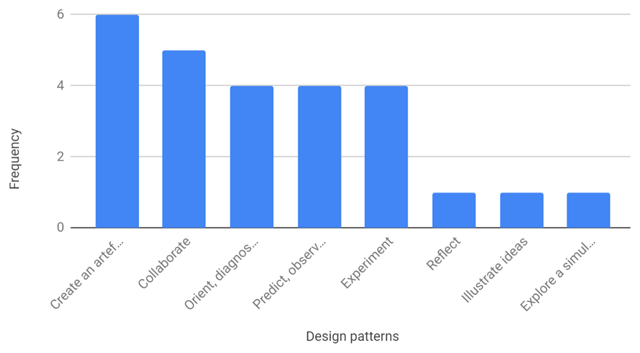
Figure 1
Frequencies of design patterns in the selected scenarios.