
Introduction
Established in 2012 through a collaboration between the University of Lethbridge’s School of Graduate Studies, the English Department and the University of Lethbridge Library, the Lethbridge Journal Incubator (JI) represents a pioneering model designed to enhance the university’s research profile by attracting high‑quality publications, securing external funding and amplifying scholarly impact (Cowan, 2013; Esau et al., 2018; O’Donnell et al., 2015). Since its inception, the JI has relied on student labor as a cornerstone of its operations, integrating graduate education with hands‑on editorial training. Students’ involvement is made possible through funding primarily from the School of Graduate Studies (SGS), the Social Sciences and Humanities Research Council (SSHRC) and the Alliance of Digital Humanities Organizations (ADHO), totaling more than CAD 500,000 since 2009. To date, the JI has facilitated the publication of over 400 articles across peer‑reviewed open access journals such as the Canadian Journal of Netherlandic Studies (2011–2018), Digital Medievalist (2010–2024) and Digital Studies/Le champ numérique (2010–present), engaging more than 20 graduate students in editorial workflows ranging from peer‑review management to copy‑editing and digital production. These students have come from a diverse range of academic backgrounds, including PhD programs in the humanities, social sciences and sciences, and master’s programs in management, economics, sociology, French, English, history and others. For over 15 years, the Lethbridge Journal Incubator (JI) has provided high‑value, work‑integrated training in scholarly publishing by embedding graduate students in real‑world editorial workflows.
As previous studies show (Cowan, 2013; O’Donnell et al., 2015), the JI offers a sustainable model for aligning gold open access publishing with the educational and research missions of the public university. By embedding graduate students in editorial workflows, the JI transforms open access publishing from a cost center into a high‑impact training platform that supports graduate professionalization and addresses the financial and pedagogical challenges of sustaining open access journals. In so doing, the JI training model has contributed to efforts to address what Esau et al. (2018) describe as a persistent problem in graduate education: that students complete advanced degrees without understanding the mechanisms of scholarly peer review and editorial decision‑making and, in particular, how this process is different from the evaluation of work by their instructors, committee members and supervisors. Graduate students frequently go through what is, in essence, a multi‑year apprenticeship without acquiring a strong sense of how the referee process works and editorial decisions are made – a disconnect further exacerbated by the rise of online and open access forms of publication, which Esau and colleagues describe as one of the most significant transformations in scholarly communication since the rise of the academic journal (Esau et al., 2018). The JI training explicitly targets this long‑standing problem by enhancing competencies through structured, real‑world editorial training within an open access publication ecosystem. While journals – at least in the humanities – have traditionally used graduate student assistance to carry out production tasks, the JI provides a structured alternative to these ad hoc practices, offering formalized training in digital publishing, editorial management and research dissemination. The result is a model that improves both graduate student preparation and the overall quality and efficiency of journal workflows.
This practice article presents a significant evolution of the training offered by the JI: the introduction of a ‘Sub‑editor’ workflow that enables students not just to observe but to test themselves against the standards of the discipline. (Throughout the paper, we employ the terms ‘Sub‑editor’ and ‘Editor’ or ‘Senior Editor’ to indicate two roles specific to the JI workflow, primarily in the review process, as their meaning diverges from common English usage, where a sub‑editor might only be a copy‑editor and the term ‘editor’ might refer to various roles. In our usage and practice, the Sub‑editor is equivalent to a junior academic editor not yet matriculated, and an Editor is a senior academic editor or editor‑in‑chief of a journal.) While the JI’s earlier iterations introduced students to these processes through back‑office and editorial tasks, aiming at helping graduate students demystify the various stages of the publication process, this new approach brings the JI closer to its original intent of providing students with professionalization opportunities and demystifying the publication process. By documenting the Sub‑editor model and its structure, this paper provides both a case study and a potential framework for institutions seeking to adjust graduate education in response to the demands of interdisciplinary knowledge production, the demands of the academic job market and evolving scholarly communication practices. This form of hands‑on engagement functions as a version of the learn‑by‑doing principle. Under the supervision of the Editor, Sub‑editors must read manuscripts, predict likely referee responses, summarize actual referee reports, analyse editorial decisions and assess the adequacy of author revisions. The Sub‑editors also make their own editorial recommendations, which they present – along with the other review materials – to the academic Editor. This takes place during a feedback loop in which they observe the Senior Editor reacting to and interacting with the Sub‑editors’ work and making their final decisions. In other words, students are not just exposed to publishing – they are challenged by it, forced to measure their editorial judgments against real decisions in real time.
By modeling the publication process under the supervision of senior academic editors, students internalize the logic of revision, peer review and scholarly argumentation in a way that simulates authorship itself. At the same time, this model respects the boundary between editorial authority and pedagogical engagement – it does not hand over final editorial control to students but uses their predictions and assessments to support decision‑making and improve turnaround time. What this model offers, then, is not a replacement for existing professionalization courses or graduate publishing opportunities, but a versatile operational model that aligns training with scholarly production in a way that is mutually beneficial to students, journals and the wider academic community. What makes the new approach distinctive is how it embeds students in a recursive editorial process.
Academic apprenticeship, or a literature review
The JI, like other models of academic training, is based on a work‑integrated learning apprenticeship model. Apprenticeship is first and foremost a model of learning (Dziallas et al., 2021; Fuller & Unwin, 2011; Guile & Young, 1998; Guile & Young, 1999) – one that has shaped occupational development throughout human history. Long before formal education systems existed, individuals developed skills through observation, imitation and practice – what scholars term ‘mimetic’ learning (Billett, 2016). For millennia, this was how societies transmitted the knowledge needed to sustain agriculture, craftsmanship, medicine and governance without formal instruction (e.g. see Jordan, 1989; Lave & Wenger, 1991). Smith et al. (2023) note that, despite shifts in educational paradigms, ‘throughout the centuries apprenticeships have survived as a meaningful educational approach for the development and transfer of occupational skills, knowledge, and understanding’ (Smith et al., 2023, p. 208). Historically, apprenticeship has shown how structured work‑based learning has evolved, providing a foundational example of work‑based learning that aligns with principles of scholarly communication. This learning system traces back to craft guilds in the medieval period, when apprenticeship constituted the passage to guild membership. Smith et al. (2023) argue that this was shaped by how ‘standards of training, professional conduct, and compliance’ were regulated (Smith et al., 2023, p. 208). In this system, learners acquired technical expertise and were immersed in the professional networks and ethical norms of the industry or community of practice as they trained.
To understand how apprenticeship could transform graduate training, one must recognize its multidimensional nature. Outside of academia, these apprenticeship systems have evolved and formalized, and they have increasingly become subject to government oversight and regulation. Within academia, however, large parts of the professionalization associated with scholarly apprenticeship remain unstructured and informal. Following Fuller and Unwin’s (2011) framework, apprenticeship functions as a vehicle for learning through four interconnected dimensions:
Pedagogical: A social theory of learning that integrates guided instruction, feedback and gradual skill development, fostering both practical expertise and theoretical understanding.
Occupational: Initiation into a professional community, where shared knowledge, values and practices – along with formal certification – solidify identity and competence.
Locational: The relationship between institutions offering apprenticeships and their broader communities, embedding learning within real‑world organizational and social contexts.
Social: The perceived value of apprenticeships in facilitating transitions into professional independence, shaped by employer reputation and community investment.
Currently, academia’s approach to apprenticeship in scholarly communication fails across all four dimensions. According to Brown (2012), graduate students learn to publish, review and edit not through systematic training but by imitating senior academics who themselves were never formally taught these skills – and, just as importantly, given the speed of developments in scholarly communications over the last three decades, acquired their experience in older models of publication. This reliance on legacy norms continues to shape institutional policies; for example, the American Historical Association in 2013 recommended allowing embargoes on digital dissertations, citing concerns about future publication prospects, despite broader movements toward open access (AHA, 2013). The result is that senior academics are ill‑equipped to train graduate students to navigate the scholarly publication system and its (fast‑changing) conventions. Graduate training defaults to an informal, piecemeal process of imitation, where key competencies – such as navigating peer review or understanding editorial decision‑making – are absorbed unevenly, if at all, further perpetuating the problem. Unlike many other professions, in academia, there is often little formal initiation into the meta practices of scholarly communication: professionalization courses are as a rule taught by disciplinary experts rather than specialists in scholarly communication or science and technology studies, and instruction on what to expect is (often) provided based on the experience of those who have undergone review rather than those who do the reviewing or establish the conventions of publication.
Since the nineteenth century, work‑integrated learning (WIL) has emerged as a formalized evolution of traditional apprenticeship models, now widely adopted across professional education (Goulter & Patrick, 2010, p. 141). WIL offers a more structured approach to apprenticeship that has gained traction at the graduate level since it addresses the problems we have seen so far by treating scholarly communication as the professional practice it is – one requiring deliberate pedagogy, guided skill development and hands‑on experience. A revitalized apprenticeship model of this kind for scholarly publishing integrates graduate students into publishing operations – not as passive observers but as active, legitimate participants. Levin (2015) outlines core capacities fostered in WIL environments: initiative, cooperation, group work, peer learning, evaluation, reasoning, problem‑solving, decision‑making, information use, planning, learning strategies and intercultural competence. WIL provides students with direct exposure to real‑world work environments by blending theoretical instruction with practical application while they pursue their studies (Mabungela & Mtiki, 2024). Their development has shaped modern WIL governance structures, which Davy and Frankenberg (2018) classify into three forms: ‘Institution and employer shared governance’ with equal time split between academic and workplace settings; ‘Institution‑led governance’ where work‑based learning is integrated into the curriculum through internships; and ‘Employer‑led governance’ where learning dominates, with minimal formal education time (Davy & Frankenberg, 2018, p. 15). This model has gained significant scholarly attention as a means of bridging the divide between academic learning and professional practice. WIL addresses these persistent gaps in graduate preparedness through the integration of real‑world experiences into academic training, which helps to equip students with both the technical and soft skills needed to navigate the complexities and succeed in the labor market. Depending on a student’s discipline or career aspiration, WIL can take various forms such as internships, co‑op programs, industry projects, and practicum placements, and it has been widely adopted across diverse academic fields (Jackson, 2015). The dominant discourse on WIL has focused on enhancing graduate employability outside of academia by embedding non‑academic workplace experiences within academic programs (Rafiq et al., 2024). These experiences range from structured internships to project‑based collaborations within an industry (Winchester‑Seeto et al., 2024). Mentorship is considered one of, if not the, major component of WIL as it helps students receive guided exposure to and in professional environments (Chsherbakova & Kudysheva, 2024).
The solution to this problem is for academia to formalize its apprenticeship in scholarly communication through a deliberate and structured model. One major component of WIL is experiential learning, which emphasizes active engagement and reflection. This approach enhances cognitive development and facilitates professional socialization, enabling students to bridge the gap between academic training and professional practice expectations. Experiential learning is a foundational principle of WIL, emphasizing active engagement and reflection (e.g. see Kolb, 1984). Studies on WIL consistently demonstrate that hands‑on experiences significantly enhance student learning and career readiness. In the case of the JI, trainees are immersed in the editorial process, engaging in preliminary manuscript evaluation, peer‑review coordination and preparation for editorial decision‑making. The effectiveness of experiential learning in academic publishing can be analysed through two key dimensions: cognitive development and professional socialization. From a cognitive perspective, participation in the publishing process enables students to critically assess scholarly work, improving their ability to produce high‑quality research. Empirical studies on WIL confirm that students who engage in structured, project‑based work demonstrate higher levels of analytical thinking and research proficiency (Mabungela & Mtiki, 2024). Professional socialization is equally crucial given that immersion in professional environments fosters identity formation and career preparedness (Billett et al., 2018), which in turn fosters career‑ready skills by bridging the gap between academic training and professional expectations (Chsherbakova & Kudysheva, 2024).
Mentorship is a fundamental component of WIL because it provides students with guided exposure to professional environments (Chsherbakova & Kudysheva, 2024). As WIL gains traction as a structured learning approach (depending on the leadership and management style of the handlers), mentorship plays an important role in helping students acquire technical skills, develop their critical thinking and enhance their problem‑solving abilities; these skills are essential for general professional success and academic publishing (e.g. see Ferns & Zegwaard, 2014). In traditional WIL settings, industry mentors play an important role in facilitating student learning by providing real‑world tasks and feedback (Jackson, 2015). However, in the context of academic publishing, mentorship structures are often less formalized despite evidence that structured mentorship significantly improves learning outcomes. For example, when mentors actively scaffold students’ experiences, they foster deeper engagement and skill acquisition (Billett et al., 2018). This is consistent with most of the WIL literature emphasizing mentorship as a key factor that improves critical thinking and problem‑solving, especially in decision‑making roles (Ferns & Zegwaard, 2014). Beyond mentorship, however, the effectiveness of WIL depends both on the structure of the learning experience and the alignment between the tasks undertaken and the assessment methods. As Brentnall et al. note, ‘Alignment between what is valued in the activities of a WIL experience and the tasks of assessment can positively influence how learners value WIL, contributing to sustainable assessment.’ (Brentnall et al., 2023, p. 478). This means that the assessment strategies employed in WIL should not be merely evaluative but should also enhance the learning process. Efficient assessment frameworks incorporate several key elements, ‘involve learners in constructing the assessments; […] engage in communities of practice; use authentic activities and criteria; […] portray outcomes to external stakeholders; and provide for learners to take initiative’ (Brentnall et al., 2023, p. 478). These components encourage a deeper engagement with WIL by embedding assessment as an integral part of the experiential learning process.
Building on theoretical foundations that integrate behaviorist and constructivist models of learning, recent research promotes interdisciplinary WIL approaches that prioritize hands‑on engagement, reflection and adaptability (see Carpendale & Mitchell, 2023, pp. 53–4). From a behaviorist perspective, WIL uses feedback as a learning driver: students perform tasks, receive structured responses from instructors or the work environment and adjust their actions based on those responses. From a constructivist view, WIL treats real‑world problems as the site of learning itself. Rather than applying pre‑learned theory, students build the necessary knowledge in response to the demands of the task. In this model, the problem defines the curriculum. Theories are tested, revised and often generated through practice. This recursive movement – acting, reflecting, theorizing and re‑acting – produces not only technical competence but also adaptability, critical thinking and the ability to transfer knowledge across domains.
While WIL has traditionally been discipline‑specific, recent research advocates for interdisciplinary approaches that integrate multiple perspectives (Kligyte et al., 2024). Interdisciplinary WIL programs have been shown to foster adaptability and innovation (Polk & Knutsson, 2008). By working within a transdisciplinary editorial team, students develop competencies that extend beyond their primary research focus. This interdisciplinary engagement is especially valuable in academic publishing, where collaboration across fields is increasingly emphasized. However, challenges arise in balancing disciplinary depth with interdisciplinary exposure. Studies suggest that WIL programs must carefully design learning objectives to ensure that students gain specialized expertise while also developing cross‑disciplinary skills (Winchester‑Seeto et al., 2024). Despite the potential of WIL to meaningfully transform graduate training, significant challenges remain in trying to integrate it into existing academic publishing models. Issues such as inconsistent mentorship, lack of standardized training and systemic barriers like access and equity must be addressed to ensure that WIL programs are inclusive and effective. One of the most pressing issues is the general lack of standardized training for faculty mentors. Unlike industry settings, where mentors receive structured professional development, academic mentorship often relies on informal, ad hoc arrangements. This inconsistency not only affects the quality of mentorship but also limits students’ ability to fully engage in experiential learning. Addressing this gap requires the development of structured training programs within graduate WIL initiatives, ensuring that mentors are equipped to provide effective guidance. Beyond mentorship, broader systemic barriers hinder the effective implementation of WIL in academic publishing. Issues such as access, equity and institutional constraints further exacerbate disparities in opportunities for students.
Traditional WIL programs often favor those with existing networks and financial resources, disproportionately limiting access for underrepresented groups (Mabungela & Mtiki, 2024). Scholars advocate for virtual and hybrid WIL models to mitigate these disparities, which expand accessibility by reducing geographic and financial barriers (Rafiq et al., 2024). Institutional constraints also pose challenges. Many universities lack formalized WIL structures for academic training, leading to inconsistent implementation across programs (Chsherbakova & Kudysheva, 2024). Without clear policies and support systems, WIL opportunities remain fragmented and under‑utilized. To address this, researchers propose integrating WIL into graduate curricula through credit‑bearing courses or mandatory publishing internships (Ferns & Zegwaard, 2014), ensuring that experiential learning becomes an essential component of academic training rather than an optional supplement. Despite the established benefits of WIL and the recognized need for better training in scholarly publishing, a significant gap remains in implementing effective, scalable WIL modes designed explicitly for academic publishing contexts. Existing approaches often fail to balance authentic editorial experience with appropriate scaffolding for graduate students. Instead, they either create overly simplified learning experiences or overwhelm students with responsibilities beyond their current abilities. While Kligyte et al. (2024) critique traditional expert–novice hierarchies, their solutions remain mostly theoretical. The JI approach addresses this gap by offering a structured and authentic framework that integrates graduate students into real editorial workflows while maintaining appropriate oversight and mentorship. With its emphasis on collaborative authorship and editorial roles, the JI offers a practical pathway to flattening these hierarchies and allows its interns to engage and learn as peers, thereby enhancing both interdisciplinary collaboration and professional socialization. In response to these challenges, the Sub‑editor model – discussed below – provides a practical and innovative approach to WIL in academic publishing.
Sub‑editor model integration in the editorial workflow
Aligned with most WIL programs, the JI provides structured WIL learning within academia, i.e. it prepares students for a position outside academia in order to prepare them for one – at least potentially – within it. Although the JI’s training model has been discussed previously and recognized by participants as successful, recent developments with the work‑integrated Sub‑editor model have pushed this model even further. The model introduces graduate students to academic editorial processes as Sub‑editors under the tutelage of Editors, involving them directly in critical publishing activities in an authentic editorial environment. Students remain in a relationship of apprenticeship with experienced academic editors, combining formalized training with practical, real‑world publishing tasks. As a site of experiential learning, this work‑integrated approach is central to the JI’s mission, serving as both a pedagogical intervention and a platform for advancing open access scholarship.
The Sub‑editor model differs from the earlier model and perhaps other similar editorial operations in that, beyond the typical training and experience in back‑office work and copy‑editing, the model now emphasizes direct student engagement in scholarly decision‑making. The model also requires graduate students not only to manage journal administration but also to anticipate and critically evaluate the decisions their academic mentors make. The model is designed and implemented to work within the standard editorial workflow stages of most journals (desk review, peer review and editorial decision‑making), enhancing rather than replacing them. However, the key difference lies in how Sub‑editors interact with the workflow: their interplay reshapes the process while leaving its structure intact. At each stage, Sub‑editors receive structured feedback from Senior Editors through a combination of forms, correspondence and editorial meetings. Senior Editors may reject or renegotiate the advice of the student, providing valuable information about areas for improvement, or they may accept the advice with minimal changes, highlighting areas in which the student has begun to master the larger professional tasks involved. In this way, the process not only sharpens editorial judgment but also creates a detailed forensic record of each manuscript’s progression, which reinforces transparency, reflection and pedagogical continuity.
The Sub‑editor model owes its conceptual foundation to Virgil Grandfield, who, acting as the journal manager, synthesized insights derived from their diverse professional roles. Central to this synthesis was their experience as a medical Spanish interpreter in the late 1990s within the Harris County Hospital District in Houston (TX), where they worked at the Ben Taub Hospital Trauma Center – a primary training site for Baylor College of Medicine residents and students. This role demanded not only precision in communication but also the ability to navigate cross‑cultural boundaries and adapt to high‑pressure environments. This experience was further complemented by their role as an Overseas Delegate for the International Federation of Red Cross and Red Crescent Societies (IFRC), where they served as an emergency communication officer, including during the 2004 Indian Ocean tsunami. In this capacity, they were tasked with coordinating multidisciplinary teams during disaster response operations, ensuring effective collaboration and information flow among stakeholders as well as training and mentoring local counterparts as part of the International Federation’s foundational capacity‑building mission. The parallels between their experiences in emergency response and the demands of academic publishing at the JI are evident in their shared emphasis on informed decision‑making, trust and delegation, balancing instructional priorities with operational efficiency and structured yet adaptive teamwork. Both fields rely on straightforward communication to drive rapid and effective decision‑making. In this model, the Senior academic Editor – akin to a hospital chief resident – leads and refines the decision‑making process while empowering Sub‑editors to contribute meaningfully. At the same time, they ensure the efficient dissemination of knowledge, maintaining both rigour and speed in scholarly publishing.
These lessons, and especially Grandfield’s close observations of the WIL model adopted by the Baylor College of Medicine at Ben Taub Hospital, shaped a new ‘Sub‑editor model’ for all the stages of the review process, creating a framework that prioritizes clear, actionable decisions to streamline editorial efficiency while also serving as a hands‑on training tool for graduate students, bridging theory with real‑world application. In the Sub‑editor model’s enhanced editorial workflow approach, graduate students function similarly to medical interns, who propose diagnoses to supervising physicians who then either act on those recommendations or correct them as part of ongoing training, providing feedback to the interns at each stage. This intensified engagement significantly deepens student involvement, better preparing them for professional roles within and beyond academia and addressing long‑standing gaps in graduate student preparation for scholarly publishing.
As detailed in Figure 1, the Sub‑editor model is operationalized through a multiple‑stage process designed to ensure the quality of the submission. This process is formalized through a multi‑stage worksheet structure that guides each submission through the three preliminary stages of the standard editorial workflow. At the desk review, the Sub‑editors provide initial, triage‑like assessments employing a two‑part evaluation: a quality check that includes plagiarism as well as AI‑generated content screening and a content review to tentatively assess the manuscript’s disciplinary fit with the journal’s scope. At the peer‑review stage, the Sub‑editor is involved in more intensive manuscript scrutiny for both form and content, to assist the Senior editor in evaluating whether the submission contributes to the scholarly discussion. At the initial and final Editorial Decision stages – often deemed the crux of the editorial workflow – the Sub‑editors synthesize and interpret referee reports and reconcile conflicting evaluations to present a coherent and analytical recommendation to the editors.
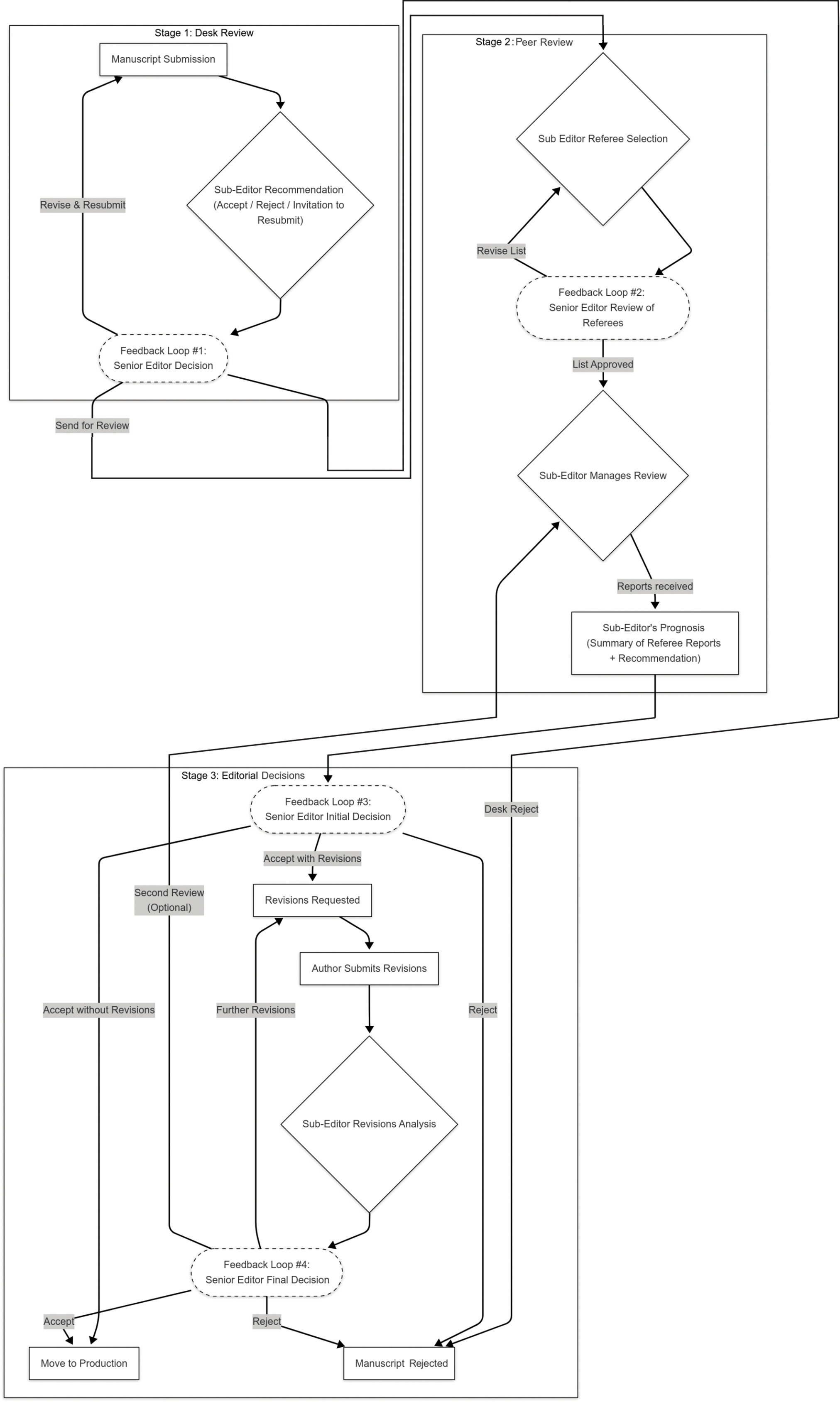
Figure 1.
Flowchart outlining stages (depicted as subgraphs) from initial desk review to final publication decision
Sub‑editor role at desk‑review stage
The desk‑review step of the editorial process involves an initial assessment by the Sub‑editor, who performs a suitability evaluation and a combined plagiarism and cursory AI check. In the suitability check, the Sub‑editor uses the submission’s title, abstract and any accompanying author notes to try to assess whether the manuscript aligns with the journal’s aims and overall thematic focus. The Sub‑editor then initiates an iThenticate plagiarism scan, which helps point out instances where the text closely resembles existing sources without appropriate paraphrasing or citation. Guided by regular instruction and feedback from the Senior Editor on previous assignments, the Sub‑editor then analyses the iThenticate results and flags for the Senior Editor any potential problems with documentation or plagiarism. At the same time, the Sub‑editor also uses the iThenticate results to assist with a cursory AI check. This step has the Sub‑editor quickly read through and around the iThenticate flags to evaluate whether it seems the author(s) might have used AI in some form to write or conceptualize the submission. The Sub‑editor then compares that evaluation with the author’s own AI declaration required at the journal’s submission stage. At times, while reading through the iThenticate analysis, the Sub‑editor might also discover that the manuscript has drastic structural, compositional or conceptual problems that might make the submission wholly unsuitable for peer review in its current form.
At the end of the desk‑review stage, the Sub‑editor provides the Senior Editor with a record of all the above checks and analyses on a chart‑like worksheet and offers them a desk‑review recommendation. If the Sub‑editor discovers undeclared or otherwise illegitimate AI usage but the submission might otherwise be suitable for the journal, they consult with the Editor on how to address the problem – whether to reject the submission, require an amended or more detailed AI declaration or offer the author ‘piloting’ advice on more legitimate AI usage. The Editor reads the Sub‑editor’s reports against the manuscript’s abstract or the journal and decides whether the manuscript moves to the review stage or is declined. After reviewing and discussing all desk‑review comments and flags and with the Sub‑editor comparing those against the submission abstract and other information, the Senior Editor decides whether to authorize the Sub‑editor to move the submission to review due to its suitability and lack of major issues; reject the submission outright as it is wholly unsuitable for the journal; or reject the submission but also offer the author the opportunity of a pre‑emptive revise and resubmit as it is wholly unsuitable in its current form. During and at the end of this stage, the Senior Editor provides the Sub‑editor with feedback on their methods and results and makes recommendations for improvements which they can apply to future submissions. At times where both Sub‑editor and Senior Editor are uncertain of a decision, the Senior Editor may also prompt the Sub‑editor to undertake a more careful examination of the submission by conducting a full ‘Sub‑editor’s Preview’ – which is defined and described here below – to be looped back for an ‘enhanced’ desk‑review decision.
Having the Sub‑editor conduct cursory AI screening at the desk‑review stage rather than later in the workflow is intentional, as there has been an increase in submissions with undeclared or otherwise non‑compliant AI usage, especially since early 2024. Between 2024 and 2025, Editors – after more careful investigations prompted by Sub‑editors at the desk‑review stage – rejected nearly 25 per cent of new submissions. Illegitimate, undeclared or nonconforming AI usage was also detected in a significant number of the other 25 per cent of articles, which were rejected outright due to their subject matter being unsuitable for the journal. This pre‑empts the need for the more careful investigation of AI signatures, which would have yielded a higher overall percentage of new submissions with unacceptable AI usage. Referring to the approximately 50 per cent of submissions that were moved directly from desk review to the peer‑review stage, Sub‑editors – with the guidance of Senior Editors – could have helped an undetermined number of authors revisit their AI statements, enabling them to provide appropriate or fuller descriptions of AI usage. Sub‑editors could also ‘pilot’ authors to ensure AI usage in their submissions is legitimate in terms of genuine contributions to scholarly communication and is compliant with the AI‑usage policy of the journal. With generative tools increasingly embedded in scholarly writing workflows, early detection enables journals to engage authors as partners in maintaining academic integrity – before peer review begins and long before production. This early intervention helps avoid downstream issues of conflict, embarrassment or non‑compliance with ethical standards and allows time for dialog and revision when needed. This process enables authors to address major issues early, avoiding delays and reducing the burden on reviewers and editors. It also protects academic reputations, stewards scarce publishing resources and fosters a more collaborative, transparent and educational editorial environment – key principles of the JI’s work‑integrated learning model.
This stage also reduces unnecessary strain on peer reviewers and upholds both quality and relevance to the journal’s mission. Given the increasing constraints on scholarly publishing resources, a rigorous and efficient desk review serves as a strategic checkpoint to identify misaligned or inappropriate submissions before they progress further. Studies show that rejected papers are frequently resubmitted with few substantive revisions and then accepted at journals of comparable prestige (Weller, 2001). Campanario and Acedo (2007) and Gans and Shepherd (1994) both document cases in which rejected papers – some later highly cited or even prize‑winning – were only eventually accepted after multiple rounds of review, incurring duplicated effort across editorial teams and referees. Gordon and Poulin (2009) even argue that for Canada’s NSERC (Natural Sciences and Engineering Research Council of Canada) funding program, the cost of peer review and grant preparation may exceed the value gained in terms of outcome selection, suggesting that more efficient mechanisms could outperform current peer‑reviewed adjudication. In our workflow, while Sub‑editors conduct this initial evaluation, the final decision on a manuscript’s suitability remains with the editor, thereby concentrating labor and creating opportunities for efficiency gains.
Sub‑editor role at the peer‑review stage
If a manuscript satisfies all desk‑review checks and Editors do not require further clarifications or preliminary revisions, the submission advances to the peer‑review stage. Here, the Sub‑editor will first perform a preliminary ‘Preview’ step before beginning the traditional peer‑review process. In their preview reports, the Sub‑editor reads the manuscript in its entirety to develop a prognosis for the submission based on its assessed scholarly relevance and merit. The preview also serves as an innovative pedagogical exercise involving the students more directly, along with the Senior Editor. Simultaneously, Sub‑editors also perform a closer reading of the text for AI signatures that might have been missed in the cursory AI screening at desk review, especially where authors have declared no AI usage at all. The heart of the Preview is its prognostic phase, where Sub‑editors anticipate possible referee feedback, not for the benefit of the Senior Editor but to form a basis for comparison between their own work and thinking and the reviewer reports, which are received later from referees. Here, Sub‑editors conduct a thorough analysis of the manuscript’s core arguments, methodology and contribution to existing scholarship. Sub‑editors engage in predictive analysis, anticipating the key areas of critique that referees may highlight. The Sub‑editor writes a couple of paragraphs of observations and their one‑sentence prognosis on the submission worksheet. In the prognosis, the Sub‑editor predicts whether they think the future reviewers will recommend minor or major changes or full acceptance or rejection. There is no immediate feedback from the Editor here because the Sub‑editor keeps the Preview for themselves, to compare later to reports when they arrive and to discuss with the Editor at the later Editorial Decision stage.
After this close reading of the manuscript, if the Sub‑editor has uncovered no other major, potentially disqualifying concerns to flag for the Editor, they prepare for the Senior Editor a reviewer list of three to six potential referees, which the Sub‑editor has researched and selected for their expertise and relevance to the manuscript’s topic. Sub‑editors systematically identify suitable referees using platforms such as Google Scholar, ResearchGate, Academia and Semantic Scholar. As illustrated in Figure 2, the Sub‑editor ranks referees based on subject‑matter expertise, methodological rigor and relevance to the submission’s research area. Additional factors such as gender diversity and geographic representation are also considered to ensure a multiplicity of perspectives in the review process. In its commitment to fostering inclusivity and equity in the peer‑review process, the review work is designed to mitigate biases, particularly in the selection of reviewers, ensuring that voices from diverse academic communities – such as francophone, Hispanic, Eastern European and Global South scholars – are actively included, rather than relying solely on the existing networks of reviewer candidates that Editors might be a part of.
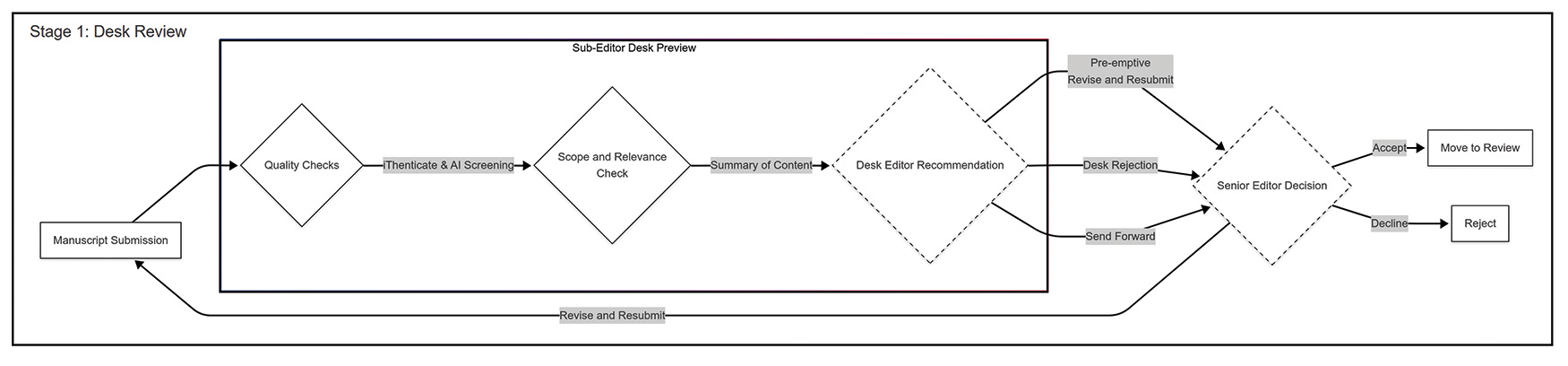
Figure 2.
Flowchart representing the first stage of the Sub‑editor workflow
The Senior Editor then evaluates and finalizes the Sub‑editor’s reviewer list to ensure that the selected referees align with both the journal’s evaluative criteria and the manuscript’s thematic focus. The Editors hold final authority over referee selection; they review the Sub‑editor’s recommendations, ensuring that the chosen experts align with the academic standards and the manuscript’s specific needs, and propose additional referees as required. Once the referee list is confirmed, the Sub‑editors take charge of initiating contact, tracking responses and following up to ensure timely evaluations. They manage correspondence, send out reminders and collect reports, which often culminate in revision requests for the authors. (See Figure 3.)
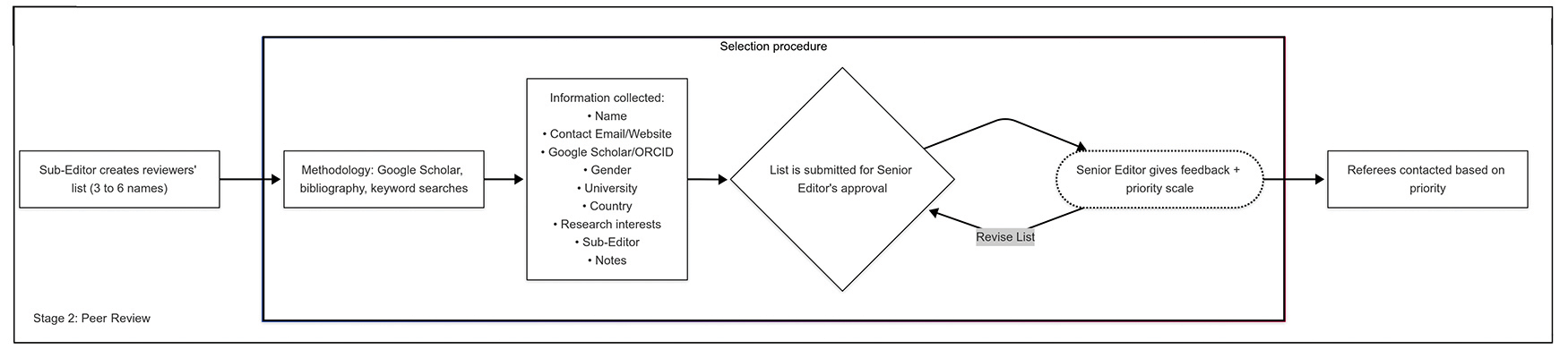
Figure 3.
Flowchart of the second stage of the Sub‑editor workflow
One beneficial result of this process is the fact that the referee pools for each journal are widened considerably under the new system. In a 2014 internal report, one of the JI’s partner journals, Digital Studies/Le champ numérique, indicated that approximately 45% of the reviews received in the previous three years had come from six referees, with several writing five or more assessments. In a similar report written in 2021 – several years after the implementation of the Sub‑editor reviewer‑search process – the same journal reported that approximately only 6% of referees had been responsible for more than one report in the preceding three years, and none had written more than two reports for the journal in that time.
Sub‑editor role at editorial decision stage
The final stage of the Sub‑editor model culminates the pre‑production process with an intensive, well‑prepared and thoroughly collaborative Editorial Decision phase in which they assist, contribute to and learn from and with the Editor, benefiting from the senior partner’s thinking and decision‑making process and decision‑making process. When the Sub‑editor receives all reviewer reports, for pedagogical reasons, they compare their observations and recommendations to the observations and prognosis they made in their preview reports. The Sub‑editor then distills referees’ key criticisms and methodological concerns from the reports into a structured summary to present to the Senior Editor the next time they meet. This summary provides the Senior Editor with a high‑level overview of the referees’ feedback, identifying areas of consensus or disagreement and noting any unresolved concerns. (See Figure 4.)
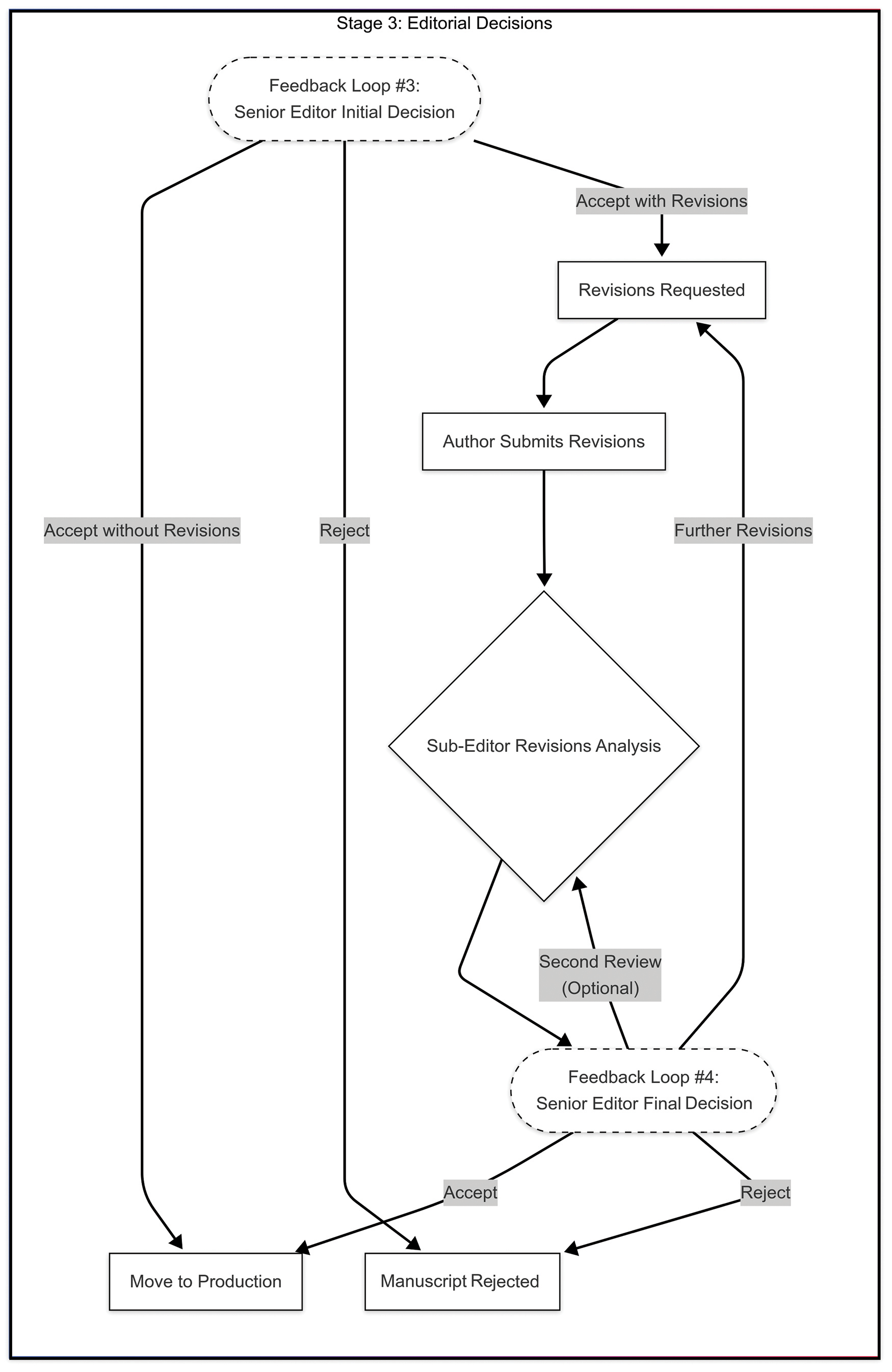
Figure 4.
Flowchart representing the third stage of the Sub‑editor workflow
The Senior Editor then makes an initial decision of whether to accept, further revise or reject the manuscript. If revisions are requested – as is the case for the majority of submissions – the Senior Editor composes a list of issues to be addressed in the incoming revisions, usually compiling the list in discussion with the Sub‑editor in order to show the student the thinking process behind their decision and request. Once the author submits their revisions, the Sub‑editor conducts a line‑by‑line assessment of the author’s changes while referring to the Editor’s original revision request, evaluating and flagging for the Senior Editor what has been changed. As part of their role, the Sub‑editor provides an assessment of whether the core criticisms have been addressed, methodological adjustments are sufficient and the revised manuscript aligns with the referees’ expectations. This assessment ensures that all revisions are properly evaluated, enabling the Senior Editor to make a final decision on whether the manuscript is ready for publication or requires further refinement, which would then lead to a new set of recommendations for the author.
The nature and relevance of the model shift
The JI began over 15 years ago with a clear goal: to train graduate students in scholarly publishing by embedding them in the editorial workflows of real journals, and from the beginning, it has been a high‑impact program. Students gained hands‑on experience corresponding with authors and reviewers and managing the production of articles for publication, with tasks ranging from copy‑editing to typesetting through layout and styling. As confirmed by follow‑up studies, the training was well‑received, and students who had worked in the JI were measurably better prepared for the peer‑review process than those who had not (Cowan, 2013; Esau et al., 2018; O’Donnell et al., 2015). However, the original model stopped short of its full pedagogical potential. While students learned how the system worked, they were not yet being asked to work with the articles themselves – to exercise editorial judgment, make evaluative predictions, or practice the kind of reasoning required of reviewers and editors. Specifically, this lacuna was identified by Esau et al. (2018), who note that even within schools with strong professionalization training, the difference between writing for publication and understanding what a peer‑review report or editorial decision means can be quite large (Esau et al., 2018). Perhaps most crucially, these issues are not solved by success (or failure) on their own. For example, as a new assistant professor with several successful publications behind him, one of the authors of this paper – O’Donnell – initially misunderstood a request for ‘minor revisions’ from a major disciplinary journal as a polite form of rejection, putting the manuscript aside until the editors contacted him a year later to ask whether they were planning to resubmit (cf. the experiences recounted in Esau et al., 2018). A few years after its outset, O’Donnell et al. (2015) likewise noted that while the JI was already improving training outcomes in project management and digital skills, graduate students still lacked opportunities to test themselves against disciplinary standards of review and editorial judgment.
Even as the original apprenticeship model at the JI demystified the process, this experience had not yet given students the opportunity to test themselves against it. This fact constituted passive exposure to the process rather than active engagement with it since, at that time, students working within the JI were close to – but still removed from – the decision‑making process. The subsequent development of the Sub‑editor model, which was partly done in response to a need to speed up editorial decision‑making, assigned graduate students a more direct role in manuscript assessment. The new model also implied participatory observation during the decision in process, rather than acceptance as a fait accompli. As such, Sub‑editors are now trained to carry out a range of core editorial tasks:
predict what referees are likely to say by engaging with submissions
summarize and interpret actual referees’ recommendations
record and process Senior Editor feedback to authors
assess author compliance and quality of revisions in relation to editorial requests
prepare and present a decision package engaging with the workflow
interact, observe and understand feedback from the Editor’s decision‑making process.
The Sub‑editor model thus places students within the editorial workflows, turning editorial practice into a method of reflective learning. The implications of this change operate at multiple levels. At the macro level, it has the potential to restructure academic apprenticeship to address long‑standing challenges in graduate training. On the micro level, there are operational benefits: improved journal management, streamlined editorial decision‑making and more consistent turnaround times. But even setting those aside, the pedagogical value of the Sub‑editor model stands on its own. It improves students’ understanding of scholarly publishing not just by showing them what happens behind the scenes but by giving them a structured way to think like scholars – before they are asked to act like them. This is a real, recursive experience of evaluative judgment, with real feedback from experienced editors and real consequences.
The promises of the Sub‑editor model address the implications of unstructured apprenticeship. Unlike other forms of professional apprenticeship, in fact, academic training lacks formal instruction in its core professional output: publication. There is consensus that graduate programs fail to train students adequately in academic publishing. Scholars have noted this across decades: Purdy (1979) observed that recent PhD graduates were unaware of the realities of academic life; Lumsden (1984) highlighted early‑career scholars’ unfamiliarity with how to ‘break into scholarly print’; Mullen (1999) found that students lacked training in academic writing; and Belcher (2009) noted that even in the humanities, few graduate students received mentorship on the difference between writing for the classroom and writing for publication. Generally, students are expected to learn how scholarly communication works by imitation – modeling the practices of supervisors and committee members who may have begun their careers decades earlier, before many of the most significant changes to publishing systems had taken place (Bourne et al., 2012). Few faculty members receive explicit training in contemporary scholarly communication, even within their own disciplines. As a result, graduate students are taught to publish not through structured pedagogy but through tacit transmission: doing what worked for their mentors, not what is currently understood as best practice. This reliance on tacit knowledge creates a gap in academic meta‑preparation. Students may be trained to write articles but are rarely taught how those articles are evaluated – e.g. how peer review works, what editorial decisions mean, or how publication infrastructures function. Supervisors may be experts in their subject areas, but they sometimes lack core competencies in emerging areas of information literacy (Carlson et al., 2011; Genoni et al., 2006). And for students working within large research teams, direct involvement in publishing may be minimal or absent altogether (Lei & Chuang 2009). This gap is compounded by a broader structural contradiction in graduate education: the simultaneous problems of underprofessionalization, discipline‑only professionalization and hyperprofessionalization. On one side, students receive little guidance in transferable skills or preparation for non‑academic careers. On the other hand, students are often trained to treat publication as a proxy for academic legitimacy – producing CV lines rather than scholarly contributions. This has led to well‑documented distortions in academic practice that do not make any meaningful contribution: gaming behaviors (i.e. manipulating metrics), ‘salami slicing’ (i.e. splitting studies into different publications), inflated authorship (i.e. adding authors who did not contribute meaningfully to the work) and, in some cases, outright research misconduct (i.e. plagiarism, falsification and fabrication).
As Moore et al. (2017) have shown with regard to the related rhetoric of ‘excellence’, this ‘narrative […] of scarcity and competition,’ which is at the heart of recent issues with scientific reproducibility, fraud and lack of diversity, is both internally imposed and produces a ‘hyper‑competition’ that is ‘completely at odds with the qualities of good research’. But we also show that this rhetoric is an internal, and not primarily an external, imposition. This transformation has unrealistically raised professional standards (resulting in unethical academic practices to artificially increase the publication and citation counts for individual research results; see Moore et al., 2017 and Bastalich et al., 2014 for a review of the literature) and neglects the working conditions of most (i.e. contingent) academic non‑contingent workers (Bérubé, 1998; Graff, 2000; Nelson, 2000; Schell, 1998). At the same time, these conditions contributed to an increased pressure on post‑secondary institutions to ensure that their graduates acquire both disciplinary knowledge and soft skills that can be transferred and add value to employment outside of traditional research‑and‑teaching positions in the sector (Andrews & Higson, 2008; Succi & Canovi, 2020).
Since the implementation of the Sub‑editor model in 2024, submission‑to‑publication times for JI articles have decreased by half, from an average of 15 months before implementation to only 7.5 months afterwards. The number of articles published over the same period has more than doubled. Grandfield originally designed a basic version of the Preview form with just observations and prognosis elements for use by guest and senior editors of the journal. They did so as a way of reducing what they saw as ‘artificial delays’ in submission‑to‑publication times for articles, especially during the peer‑review stage. In their first two years as a trainee graduate student at the JI, they noted that those times were as long as 27 months, with durations often averaging 15 months, close to the industry‑wide 17.3‑month average for humanities journals (Björk & Solomon, 2013). Grandfield realized that in a typical peer‑review and decision process, editors will initiate a search for editors without having read a submission. The search for two referees would then often take between three and six months, after which time the Senior Editor would have to wait several more months for both reports to come in. There would then be an additional delay of weeks or months before the Senior editor could carve out the time to read the full manuscript in order to be able to assess it alongside the reviewer reports and submit a decision. Delays would again balloon when editors required authors to submit revisions, as is far more typical than not.
When Grandfield became the JI manager a short time later, besides instituting what would become the Sub‑editor reviewer‑search model, they prioritized shortening the submission‑to‑publication time by developing a plan that might at least reduce or eliminate the delay between receiving reviewer reports and an editor’s final decision. Grandfield began having senior editors or guest editors read the submission in its entirety and write a quick paragraph of their thoughts before or right after beginning the process of inviting referees. Editors would then be able to immediately refer to the Previews they had produced many months before as aides‑mémoires to inform their decisions as soon as reviewer reports arrived. The implementation of this process and several other related innovations, when adopted by editors, shortened submission‑to‑publication times by approximately three months within the first year. As there were difficulties in ensuring editors and guest editors adopted the Preview process, Grandfield later adapted the Preview for the Sub‑editor model, adding more functions such as AI scanning and reviewer searches for practical and pedagogical reasons. Adding the Preview model yielded significant benefits in the later Editorial Decision stage by vastly improving graduate training, enhancing the quality of decisions and ultimately reducing publication times even further.
Suggestions for editors
This practice article has examined a new ‘Sub‑editor model’, which represents an effective approach to structuring apprenticeship in scholarly publishing by applying the principles of WIL. Through a structured three‑stage process, graduate students gain hands‑on experience in manuscript assessment, referee selection and critical evaluation while contributing meaningfully to the journal’s operations. The JI’s approach provides one way of explicitly training graduate students in contemporary scholarly communication practices, addressing persistent gaps in graduate preparation identified over decades of research. The model offers multiple benefits to various stakeholders: graduate students gain clarity on scholarly publishing, build confidence in academic writing and develop transferable skills essential for diverse career pathways, while senior academic editors receive structured support that enhances workflow efficiency without compromising editorial integrity. Furthermore, the JI’s emphasis on transferable soft skills, such as critical analysis, project management and interdisciplinary communication, responds to the ‘employability imperative’ underscored by Andrews and Higson (2008) and Succi and Canovi (2020) but also has far‑reaching implications for the development and dissemination of knowledge. While disciplinary knowledge remains foundational, the global labor market increasingly demands adaptability and operational fluency in cross‑cutting competencies. Students in the JI, for instance, learn to negotiate editorial feedback, meet production deadlines and articulate decisions – experiences that align with employer priorities for problem‑solving and teamwork. This dual focus on scholarly rigor and professional agility challenges the inherent conservatism of apprenticeship models, which often conflate specialization with preparedness.
At all levels, the Sub‑editor model serves to bridge long‑standing gaps in graduate training. Contributing to its success is also a year‑long restructuring of the production process. The JI functions both as a publishing platform and as a structured apprenticeship; it facilitates open access publication while integrating graduate students into editorial workflows to build concrete competencies in scholarly communication and publishing. As Golde & Walker (2006) argues, the ideal graduate acts as a ‘steward of the discipline’, responsible for transmitting and adapting disciplinary knowledge through both publication and teaching. Yet scholarly publishing – central to this role – is also one of the most rapidly evolving and least formally taught aspects of academic life. We do not claim that the Sub‑editor model is the only way to teach these skills. Many legitimate and effective platforms exist, including workshops, mentorship, simulation‑based review and peer‑run journals. What the Sub‑editor model offers, however, is a structured, scalable and work‑integrated method of apprenticeship – one that places students inside the evaluative core of scholarly publishing without compromising editorial authority or scholarly standards. Most important, however, is the enthusiastic embrace of the Sub‑editor model by graduate student apprentices who, for reasons including those described in the following section, took and ran with the model and made it their own.
The Sub‑editor model presents a valuable work‑integrated learning opportunity that bridges academic training with real‑world professional experience. By actively participating in the editorial process, Sub‑editors gain hands‑on exposure to the complexities of scholarly publishing – from evaluating submissions and predicting referee reports to facilitating communication between authors, reviewers and editors. This model not only improves their domain‑specific expertise by aligning tasks with their research interests but also cultivates transferable research‑related skills. The predictive aspect of the Sub‑editor role – where Sub‑editors anticipate referee feedback and editorial decisions – serves as a practical exercise in understanding editorial judgment, allowing individuals to assess and develop their decision‑making competencies to prepare them for future roles in academic publishing or related fields. Moreover, the collaborative nature of the process, involving multiple professionals (two referees, one or more Sub‑editors and the senior academic editor), ensures a more robust evaluation of submissions than previous approaches. This experiential learning opportunity not only accelerates the peer‑review process but also positions Sub‑editors as potential future senior academic editors. The involvement of students in roles traditionally held by professional editors and reviewers, however, is not without limits, including perceptions that students might act as replacements. While we maintain confidence in our apprenticeship model, it is important to acknowledge some limitations inherent to this approach. Student participants are still acquiring the skills and experience necessary for professional editorial judgment, and thus their contributions naturally carry constraints. However, our model actively addresses these limitations through rigorous supervision, clearly defined responsibilities and continuous evaluation against established professional standards guaranteed by several feedback loops at every stage. Students collaborate closely with experienced Editors, ensuring that professional oversight remains central at all times. Rather than outsourcing editorial functions, this structured apprenticeship model enhances learning opportunities for students while safeguarding the quality and integrity of our editorial processes.
From a graduate student’s perspective, the Sub‑editor model addresses critical gaps in traditional academic training, which often overlooks essential skills such as academic writing, scholarly communication and an understanding of publishing workflows. This model offers an invaluable insider’s view of the journal publication process, demystifying the often‑opaque mechanisms behind scholarly publishing and equipping students with practical knowledge that directly enhances their own future submissions. By integrating publishing workflows into graduate training, the JI demonstrates how graduate programs can bridge the divide between subject mastery and the dynamic literacies required for success in academia and broader knowledge economies. The transferable skills developed through this work‑integrated framework – ranging from critical engagement with submissions to effective communication among team members – address a significant shortfall in traditional training, which often fails to prepare students for the practical demands of academic careers and other professional pathways. Another aspect of this model is that students, through their work, are able to stay updated with the latest developments in the field. The Sub‑editor model effectively turns this challenge into an opportunity by creating a constant ‘comps’‑like situation environment. In the practice of North American graduate programs, comprehensive exams (or comps) are an unavoidable milestone. Through comps, students must demonstrate mastery of their field by engaging deeply with a vast body of literature to synthesize complex debates. In the Sub‑editor model, this process is not a one‑time event but an ongoing practice. By constantly reviewing, summarizing and analyzing new submissions, Sub‑editors engage with the latest scholarship in their discipline just as they would when preparing for comps. However, instead of studying for their own research, they do so in an applied, professional setting, and by doing that, they are able to remain at the forefront of our disciplines. This continuous engagement with the latest scholarship is perhaps the most significant advantage of the model, as it not only deepens their expertise but also positions them as informed and active contributors to their fields. Despite its relatively short‑term nature, for students, this structured apprenticeship model functions as a training ground to become future academic editors. It cultivates professionals who are well‑connected, deeply knowledgeable and trusted by key players in the academic publishing ecosystem – editors, guest editors, authors and referees who have the opportunity to interact with them. Through constant exchange with experts, Sub‑editors build a network that would otherwise take decades to develop. By the time they leave the JI, they have a level of institutional knowledge and connections comparable to those of a seasoned academic.
Moreover, this model extends its benefits to Editors, creating a symbiotic relationship that enhances both editorial efficiency and professional development. It ensures that Editors maintain oversight without becoming overburdened, while fostering a collaborative environment that encourages mentorship and growth. Central to this process is a structured feedback loop, where Sub‑editors present their desk‑review analyses to the Editor, who provides constructive feedback. This iterative process not only improves the quality of editorial decisions but also allows Sub‑editors to refine their skills through guided practice. The Editors retain final authority, ensuring that all decisions align with the journal’s rigorous standards, while simultaneously mentoring Sub‑editors. Throughout this process, continuous feedback loops ensure that experiential learning is paired with a pedagogy focused on professional growth, enabling Sub‑editors to evolve into capable, independent scholars. This model also proves to be highly versatile and scalable, ensuring its sustainability beyond its initial training function. By incorporating editorial board members or experienced scholars in place of student Sub‑editors, the framework retains its effectiveness while adapting to diverse institutional structures and publishing environments. Its flexibility allows it to support both mentorship‑based training and long‑term editorial workflows, making it a valuable model for scholarly publishing at various levels. More broadly, the success of this model underscores the need for institutions to rethink graduate training in response to the evolving demands of academia. Another important dimension of the model is that it reconfigures the editorial workflow of a humanities journal to function more like that of a science journal. In scientific publishing, the ownership of the workflow is structured differently: professional, not academic, editors manage the process (see e.g. Eve et al., 2021; Mark et al., 2023; Noel, 2022). They review referee reports, make preliminary assessments, coordinate communication among stakeholders and guide manuscripts through the editorial pipeline. Academic editors are consulted at key points to confirm readiness for publication or to advise on complex cases. Major science journals rely on teams of professional editors who assume primary responsibility for the workflow, involving academics selectively. The Sub‑editor model adapts elements of this structure by building professional capacity with graduate academics who bring subject expertise to the work to assist senior academic editors in a way that a professional editor simply cannot do. In doing so, the model not only shifts aspects of workflow management to trained Sub‑editors and Editors working within a professionalized framework but also accelerates decision‑making processes and introduces efficiencies that are more typical of scientific publishing. While modest, this adjustment marks a significant innovation for editorial practices in the humanities. The traditional pathways to scholarly expertise and professional development must adapt to a disrupted publishing landscape. Institutions must now take the lead in reimagining graduate training for a disrupted scholarly sphere. By embracing innovative models like the Sub‑editor framework, academic programs can better prepare students for the evolving demands of academia and beyond. The Sub‑editor model represents an example of how to structure graduate training in the field of scholarly publishing to address these demands, offering the significant lateral benefit of preparing graduate students for broader academic or non‑academic careers.
Acknowledgements
The authors would like to thank all past and current Journal Incubator staff, senior and guest editors of Digital Studies/Le champ numérique (DSCN), Simon Everett and others at Open Library for the Humanities (OLH), Canadian Society for Digital Humanities (CSDH) President, Prof. Barbara Bordalejo, the Social Sciences and Humanities Research Council (SSHRC) and the University of Lethbridge Library and School of Graduate Studies for their support.
Abbreviations and Acronyms
A list of the abbreviations and acronyms used in this and other Insights articles can be accessed here – click on the following URL and then select the ‘full list of industry A&As’ link: http://www.uksg.org/publications#aa.
Competing interests
The authors have declared no competing interests.