
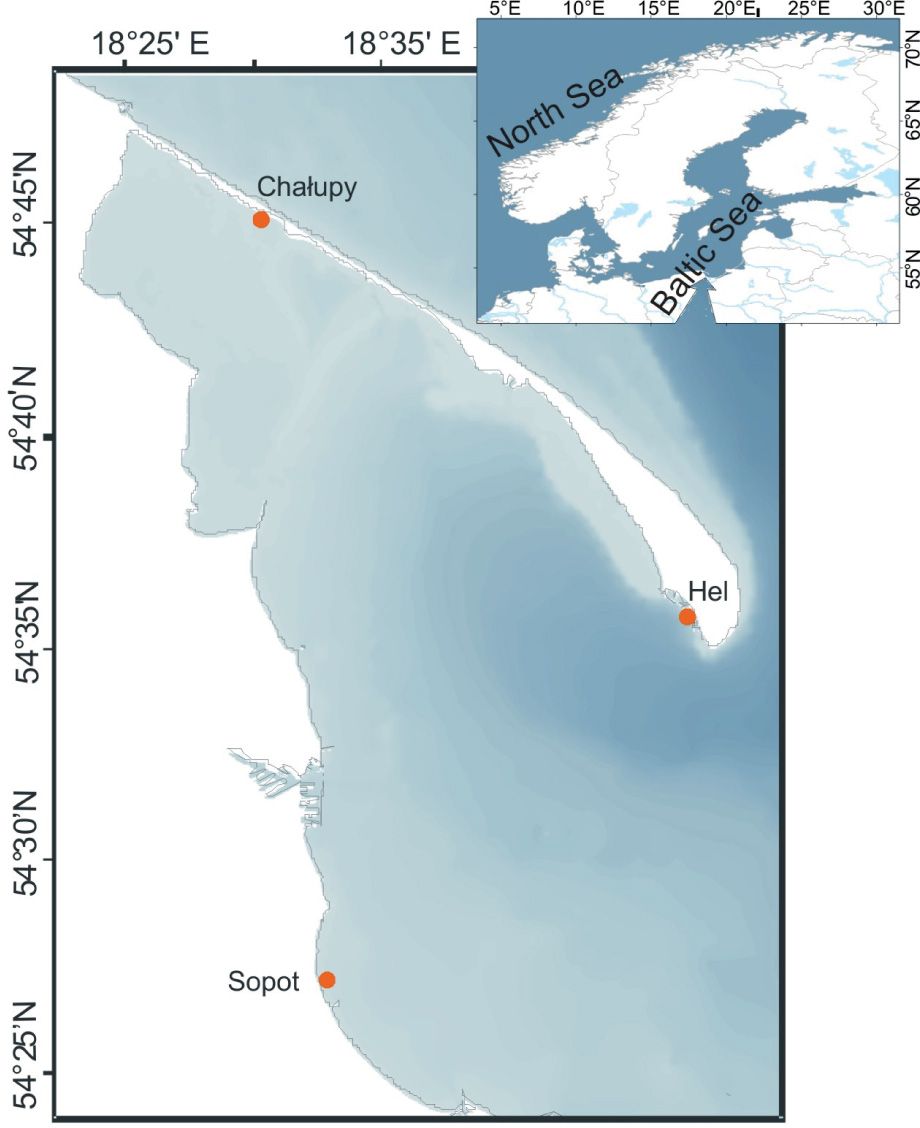
Figure 1
Location of the study area and sampling sites in the western part of the Gulf of Gdańsk
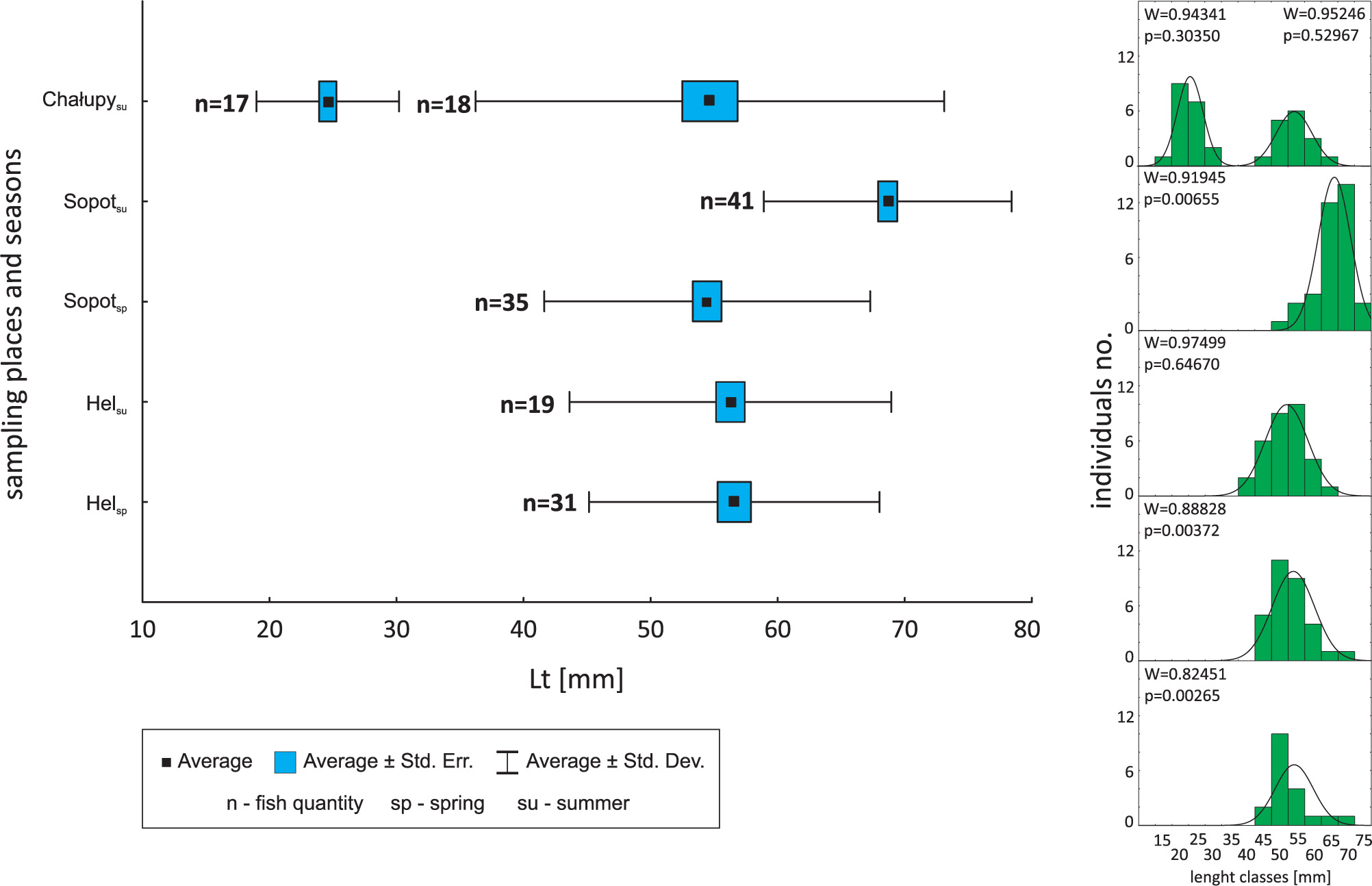
Figure 2
Total length of G. aculeatus individuals and the Shapiro-Wilk test for normality
Table 1
Food items and frequency of their occurrence in the guts of three-spined sticklebacks
| Food items | ecological formation | Sampling sites and seasons | ||||
|---|---|---|---|---|---|---|
| Hel | Sopot | Chalupy | ||||
| spring | summer | spring | summer | summer | ||
| Crustacea undet. | 3 | 50 | 73 | |||
| Copepoda undet. | p | 100 | 37 | 41 | 78 | 69 |
| Calanoida | p | 94 | 42 | 6 | 80 | |
| Cyclopoida | p | 74 | 21 | 3 | 17 | |
| Harpacticoida | b | 97 | 21 | 6 | 34 | |
| Cladocera | p | 94 | 47 | 10 | 14 | |
| Evadne sp. | p | 65 | 21 | |||
| Podon sp. | p | 42 | 26 | |||
| Bosmina sp. | p | 42 | ||||
| Mysidacea undet. | p | 19 | ||||
| Mysis sp. | p | 3 | ||||
| Neomysis integer | p | 6 | 5 | |||
| Ostracoda | b | 2 | ||||
| Amphipoda undet. | b | 16 | 32 | 28 | ||
| Gammarus sp. | b | 17 | 3 | |||
| Batyporeia sp. | b | 42 | 28 | 27 | ||
| Pontoporeia sp. | b | 6 | 11 | 3 | 3 | |
| Idotea sp. | b | 2 | 3 | |||
| Bryozoa | b | 3 | 6 | |||
| Chirodomidae larva | b | 29 | 9 | |||
| Gonothyrea sp. | b | 26 | 3 | 2 | ||
| Nematoda | b | 74 | 17 | |||
| Annelida undet. | b | 13 | 6 | 3 | ||
| Hediste diversicolor | b | 16 | 14 | |||
| Insecta undet. | 23 | 37 | 63 | 22 | 14 | |
| Pisces undet. | 3 | 3 | ||||
| Copepoda eggs | p | 94 | 32 | 41 | 24 | 14 |
| fish eggs | 19 | 58 | 44 | 7 | 17 | |
| plants | 26 | 5 | 46 | 14 | ||
| sand* | 26 | 37 | 31 | 80 | 20 | |
| p – planktonic, b – benthic, * – non-organic food item but frequently observed | ||||||
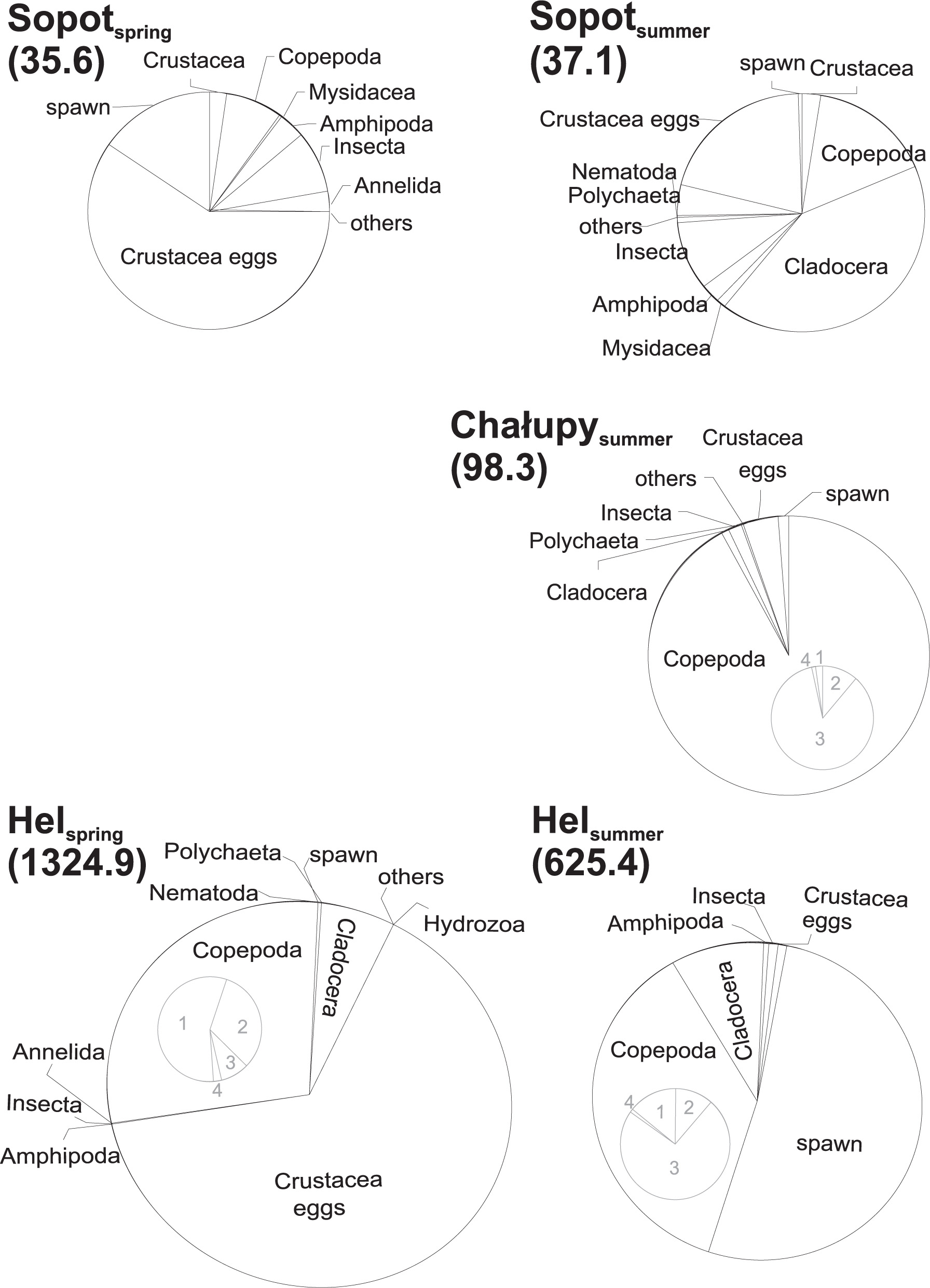
Figure 3
Percentage of food items in stomachs of three-spined sticklebacks. In brackets – the average number of specimens per stomach. The grey color graph shows the composition of Copepoda divided into orders: 1 – Harpacticoida, 2 – Copepoda undet., 3 – Calanoida, 4 – Cyclopoida
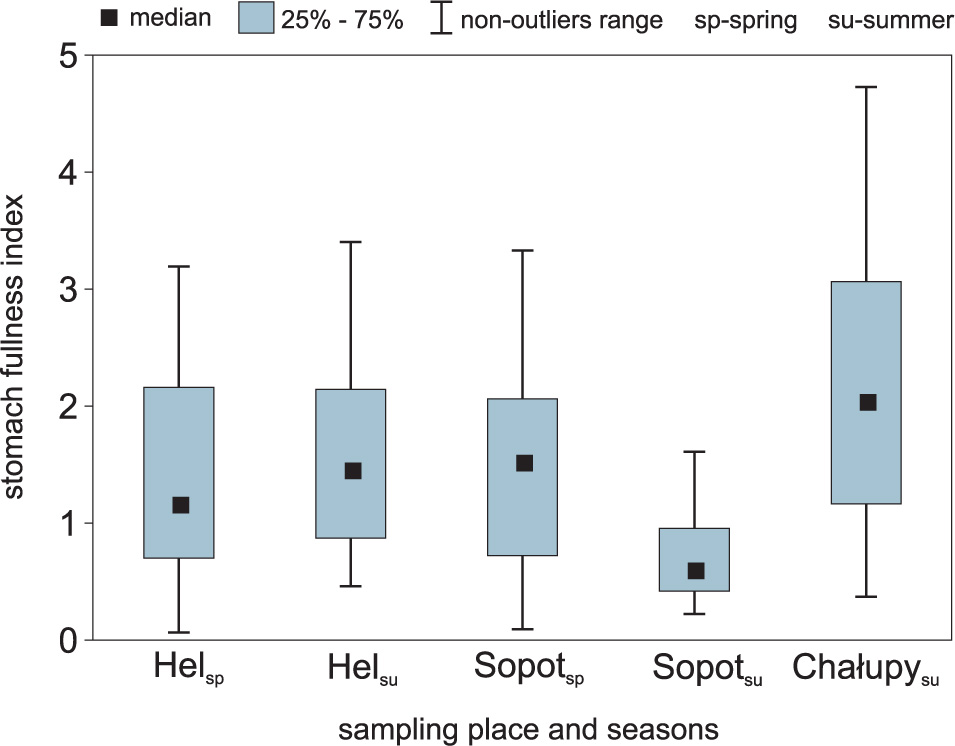
Figure 4
G. aculeatus stomach fullness index
Table 2
Food selectivity indices (Ivlev 1955) for fish caught in the region of Hel (spring, summer) and Sopot (spring)
| Sopot | Hel | Hel | |
|---|---|---|---|
| spring | summer | ||
| Copepoda | 0.000 | -0.074 | -0.041 |
| Cladocera | 0.951 | 0.205 | |
| Nematoda | -0.650 | ||
| Crustacea | |||
| Mysidacea | |||
| Amphipoda | |||
| Insecta | |||
| Hydrozoa | No data on specimens in the environmental samples from a similar time of the year | ||
| Annelida | |||
| Polychaeta | |||
| Bryozoa | |||
| Pisces | |||
| Arthropoda eggs | |||
| Fish eggs | |||
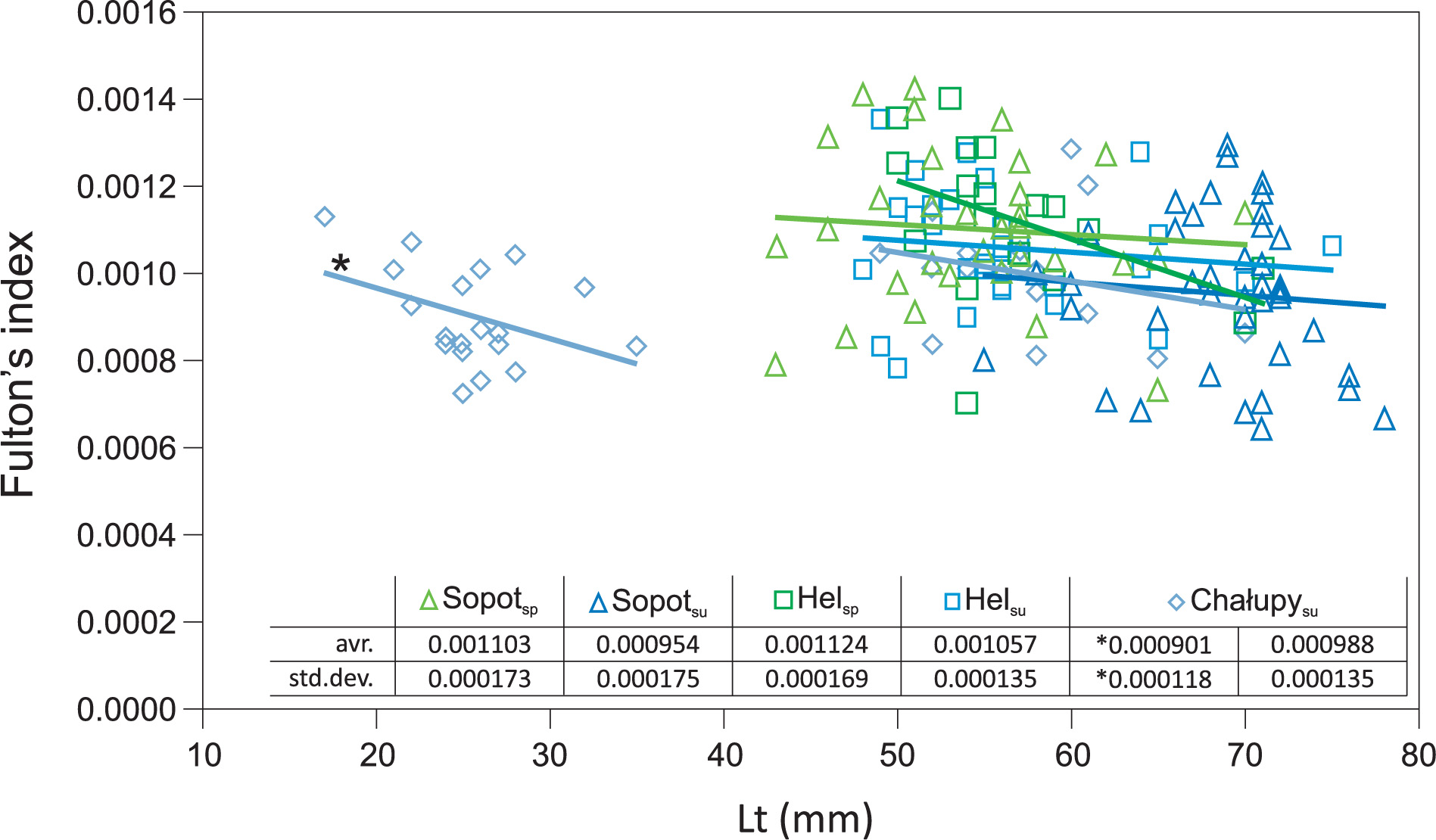
Figure 5
Body condition index of fish caught during sampling (figures – sampling sites; colors – seasons: green – spring, blue – summer; * – group of smaller fish from Chałupy site); average and standard deviation of the Fulton index for fish from sampling sites