
Integrating the STEM method within the Education 5.0 framework can markedly improve 21st-century skills in high school pupils by unifying science, technology, engineering, and mathematics into a comprehensive learning plan. Education 5.0 is an educational concept that aims to prepare individuals to face the Society 5.0 Era (Ahmad et al. 2023). This methodology corresponds to the objectives of Education 5.0, which prioritizes equipping students to navigate the complexities of the contemporary world by cultivating critical thinking, problem-solving, creativity, and digital literacy. The STEM approach cultivates these talents and motivates students to utilize their knowledge in real-world scenarios, thus closing the divide between theoretical education and practical implementation. The STEM approach effectively cultivates critical thinking and problem-solving abilities by prompting students to confront intricate, real-world challenges that require imaginative solutions (Fadillah et al. 2024; Rarastika et al. 2024). Research shows that STEM-based education significantly improves learning results, as seen by a large effect size that indicates students are more engaged and better understand the material. The STEM approach fosters creativity and innovation by combining many scientific fields, enabling students to investigate and experiment with novel concepts (Rarastika et al. 2024; Laila et al. 2024). The implementation of integrated STEM models, including project-based learning and interactive media, enhances creative thinking and innovation (Ningtyas et al. 2024). STEM education prioritizes technology utilization, essential for cultivating digital literacy and technological competencies required in the 21st century (Chasokela 2024; Rarastika et al. 2024). The integration of STEM learning technology equips students to use their knowledge in practical contexts, thereby improving their preparedness for future difficulties (Chasokela 2024). The collaborative aspect of STEM projects promotes communication and teamwork, which are vital competencies for success in the contemporary workforce (Ningtyas et al. 2024; Rarastika et al. 2024). Collaborations with the community and stakeholders in STEM programs augment students’ collaborative experiences (Chasokela 2024).
The incorporation of digital technology in STEM education by Education 5.0 markedly improved 21st-century competencies among high school pupils. This method cultivates critical thinking, creativity, and problem-solving while equipping pupils for the evolving challenges of contemporary society. The efficacy of this integration is bolstered by diverse instructional frameworks and digital instruments that improve learning experiences and results. The STEM-oriented methodology in mathematics education has demonstrated enhancement in critical thinking and problem-solving abilities, which are vital for tackling intricate global issues (Rarastika et al. 2024). Project-oriented problem-based learning (PoPBL) in STEM education markedly improves students’ problem-solving and creative thinking abilities by involving them in authentic problem-solving scenarios (Tiken et al. 2023). Digital information and communication technologies (DICT) are essential for cultivating vital 21st-century competencies, including digital literacy, creativity, and cooperation (Paulo et al. 2024). The STEM-EDELCY paradigm has demonstrated efficacy in cultivating 21st-century capabilities, surpassing alternative learning models in improving students’ competencies (Herianto et al. 2024).
Implementing the STEM learning paradigm grounded in Education 5.0 poses both obstacles and opportunities for the enhancement of 21st-century abilities in high school student. Education 5.0 underscores the amalgamation of technology and multidisciplinary methodologies to equip students for a swiftly evolving environment. The STEM approach corresponds to these principles by promoting critical thinking, problem-solving, and collaborative abilities. Nonetheless, its implementation faces challenges, including the complexity of curriculum integration and the readiness of educators. Notwithstanding these limitations, substantial potential exists to augment student involvement and skill development via new ways. Incorporating STEM into current curricula is intricate, necessitating a unified strategy that conforms to educational standards while fostering interdisciplinary education (Yang and Oh 2024). There is a significant deficiency in professional development for educators, which is essential for the efficient implementation of STEM education. A significant number of educators perceive themselves as inadequately equipped to instruct in STEM subjects, thereby affecting the quality of education (Sharma 2024). Restricted access to essential resources and technology might impede the inclusion of STEM programs, especially in poor schools (Sharma 2024). Current ways of evaluating STEM education may not fully measure the skills students gain, so we need to create new tools that better assess critical thinking and problem-solving abilities. STEM education offers students the opportunity to utilize their knowledge in practical settings, hence increasing engagement and fostering skill development (Chasokela 2024). Establishing collaborative environments fosters teamwork and communication, which are vital elements of 21st-century competencies (Sharma 2024). Models such as STEM-EDELCY have demonstrated efficacy in enhancing students’ competencies by providing a systematic framework for incorporating engineering design into education (Herianto et al. 2024). The early introduction of STEM topics can cultivate enduring enthusiasm and skill enhancement, equipping pupils for future problems (Sharma 2024). The main novelty of this research lies in the integration of three crucial concepts that have never been comprehensively researched: STEM, Education 5.0, and 21st-century skills. While previous studies have discussed the effectiveness of STEM in increasing student engagement or highlighted the importance of Education 5.0 in addressing future challenges, no research has explicitly positioned STEM as a catalyst for achieving Education 5.0 goals. Furthermore, this research will fill a gap in the literature by focusing on a college-aged population, which differs from most STEM research that targets students at the elementary and secondary levels. By analyzing how the implementation of STEM in a college context can directly foster vital 21st-century skills such as critical thinking, problem-solving, and collaboration, this research offers original insights into how to design curricula that are not only academically relevant but also practically relevant to meet the demands of the future job market. This study aims to identify and highlight some research publications that examine STEM as a catalyst for Education 5.0 to improve 21st-century skills in college students. This study attempts to answer the research questions.
-
How can implementing the STEM approach within the Education the 5.0 framework enhances the development of 21st-century skills in high school students?
-
To what extent is the integration of digital technology in STEM learning based on Education 5.0 effective in improving 21st-century skills in high school students?
-
What are the challenges and opportunities in implementing the STEM learning model based on Education 5.0 to improve 21st-century skills in high school students?
This research employs a qualitative methodology using a literature review technique.
This research methodology is a literature review regularly designed to discover, assess, and integrate all pertinent, high-quality research material about a certain research question. The study commenced with the formulation of three research questions. We conducted a search for pertinent papers, screened and identified them, selected potential articles using the PRISMA diagram, performed qualitative analysis and synthesis of the findings, and concluded with a research report. We performed an extensive literature review in prominent electronic databases, such as Scopus, Web of Science, and Google Scholar. We picked publications from 2016 to 2024 to compile the latest findings. We performed a literature search using keywords including “STEM,” “education 5.0,” “learning,” “educational technology,” “educational innovation,” and “21st century.”
An initial literature search of three major databases: Scopus (108 articles), Web of Science (96 articles), and Google Scholar (115 articles), resulted in a total of 319 broadly relevant articles. The next step in the process was to manage and filter this large dataset. This process began by exporting all references into reference management software (Zotero) to regularly remove duplicates, a crucial step given the significant overlap between these databases, particularly with Google Scholar. Once duplicates were removed, the remaining articles underwent a rigorous and transparent two-stage screening process. The first stage involved two independent reviewers simultaneously evaluating each article based on its title and abstract to determine its initial relevance to the established inclusion criteria. Articles that passed the initial screening stage progressed to the second stage, where their full texts were read and evaluated in depth. Any articles excluded at this stage were documented with specific reasons, such as not being relevant to the research question, lacking a clear methodology, or not focusing on higher education. The entire process was documented using a PRISMA flowchart to ensure transparency, reliability, and repeatability of the research results (Figure 1).
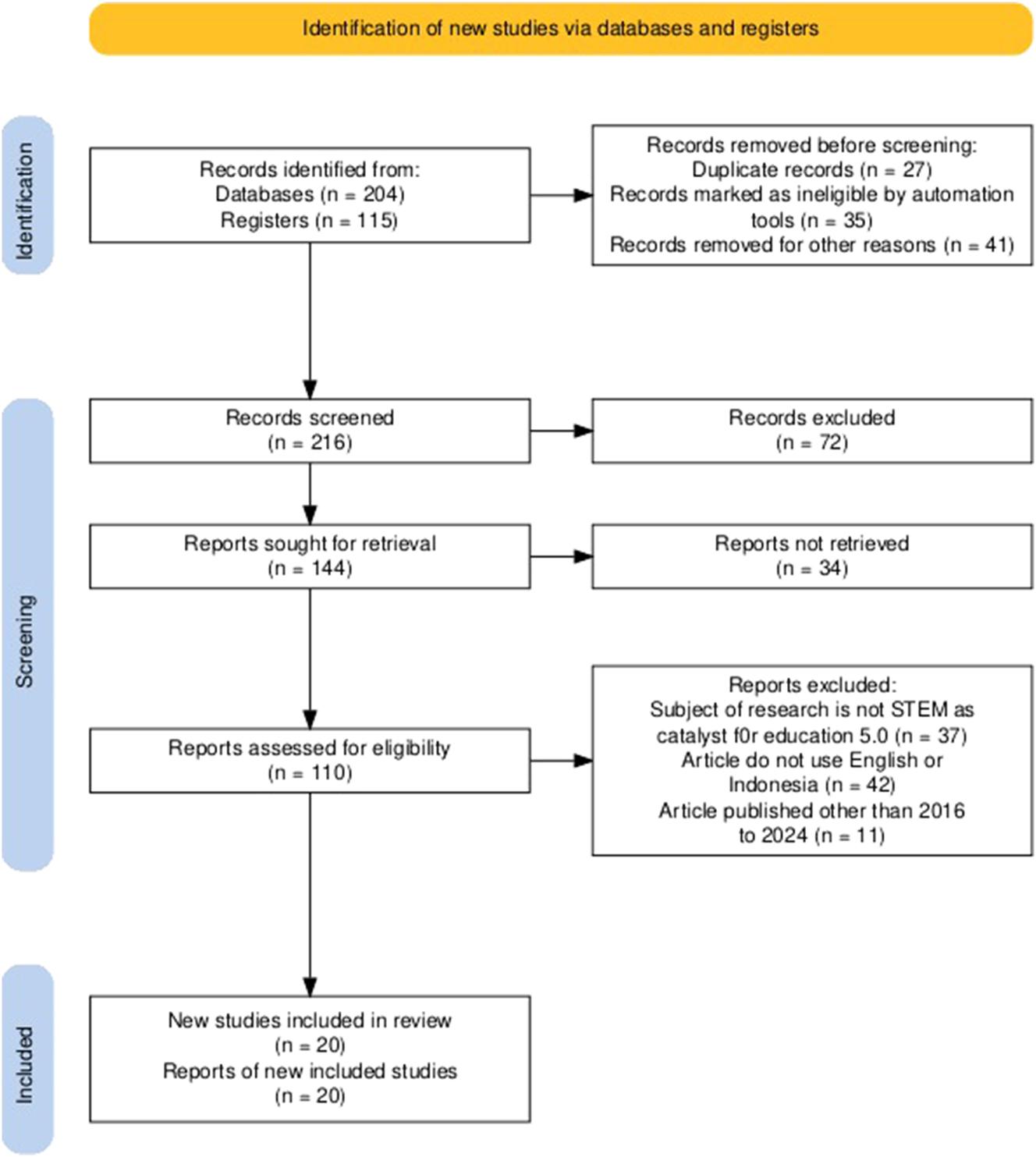
PRISMA flowchart.
The potential selection of articles is carried out of using the PRISMA diagram, as shown in Figure 1 (Haddaway et al. 2022). This process is divided into three main phases: identification, screening, and inclusion. In the identification phase, as many as 27 articles were identified as duplicates, 35 did not meet the requirements, and 42 others were excluded, leaving 216 articles for the screening stage. Furthermore, in the screening phase, 106 articles were deleted, consisting of 144 excluded article records, 34 inaccessible reports, and 90 articles that were eliminated for various reasons. After going through this process, 20 potential articles were successful obtained to be included in a literature review and further analyzed to obtain a comprehensive insight related to research topics.
Articles were carefully selected based on the title, abstract, and full text, following the inclusion and exclusion criteria outlined in Table 1. This process was crucial to ensure that only the most relevant and high-quality studies were included in the literature review, thus ensuring the accuracy and credibility of the findings. These inclusion and exclusion criteria are not simply tools but fundamental elements of a systematic review, serving as a roadmap to guide the scope and relevance of the research. They ensure that the studies included in the review are not only relevant but also meet stringent quality standards, ultimately significantly enhancing the validity and reliability of the results (McElroy and Ladner 2014). In other words, this screening process acts as a filter that separates credible and reliable data from less relevant information, ensuring that the conclusions are based on strong evidence.
Inclusion and exclusion criteria.
| Inclusion criteria | Exclusion criteria |
|---|---|
| The research subjects are STEM as a catalyst for education 5.0 | The subject of the study did not examine STEM as a catalyst for education 5.0 |
| Articles are harvested from databases: Scopus, web of science, and google scholar | Articles are from the ResearchGate, semantic, and ERIC databases |
| Articles examine STEM, education 5.0, learning, educational technology, educational innovation, and 21st-century. | Articles do not discuss STEM, education 5.0, learning, educational technology, educational innovation, and 21st-century. |
| Articles published in the period 2016 to 2024 | Articles published outside the period 2016 to 2024 |
| Articles already have a digital object identifier (DOI) | Articles do not have a digital object identifier (DOI) |
| Investigation utilizing quantitative data derived from experimental outcomes | Investigations do not utilize quantitative data obtained from experimental results |
| Conduct research with quantitative methodologies, including descriptive surveys, experiments, or a combination of both. | Conducting research without quantitative methodology, including descriptive surveys, experiments, or a combination of both. |
This review primarily focuses on three sections.
-
Implementing the STEM approach within the Education 5.0 framework enhances the development of 21st-century skills in high school students.
-
Integrating digital technology in STEM learning based on Education 5.0 is effective in improving 21st-century skills in high school students.
-
Challenges and opportunities in implementing the STEM learning model based on Education 5.0 to improve 21st-century skills in high school students.
Given the limited number of studies and significant diversity in research designs, we decided not to conduct a quantitative meta-analysis. Instead, we chose a narrative synthesis approach, which is more appropriate for systematically synthesizing findings. This approach allowed us to analyze and integrate data from diverse studies in terms of methodology, context, and outcomes without imposing nonexistent homogeneity. In doing so, we were able to provide a more holistic and richer picture of the relationship between STEM, Education 5.0, and 21st-century skills. This enabled us to identify key themes, patterns, and knowledge gaps emerging from the entire literature, offering in-depth and credible insights despite the heterogeneity of the data. This approach not only aggregates findings but also provides a thorough interpretation of their implications, ultimately enriching the conclusions we present.
The use of the STEM methodology within the Education 5.0 framework markedly improved certain essential 21st-century competencies. These skills are essential for students to adequately manage the intricacies of contemporary life and the evolving global challenges they encounter. The STEM approach integrates science, technology, engineering, and mathematics, cultivating a learning environment that prioritizes critical thinking, problem-solving, creativity, communication, teamwork, and digital literacy. These qualities are crucial for kids to evolve into productive and technologically efficient citizens. The following sections outline the specific competencies enhanced by STEM integration within the Education 5.0 framework.
-
Critical Thinking and Problem-Solving: STEM education fosters critical thinking by involving students in intricate problem-solving activities that require analytical and systemic reasoning. This methodology promotes students’ capacity to articulate problems and convey ideas professionally, resulting in enhanced problem-solving skills (Hazana 2024; Rarastika et al. 2024). Project-oriented, problem-based learning (PoPBL) in STEM education engages students in authentic problem-solving scenarios, thereby improving their capacity to address intricate issues.
-
Creativity and innovation: STEM activities markedly enhance creativity and innovation by prompting students to generate imaginative and contemplative answers to scientific principles. Teachers achieve this benefit by providing stimulating and entertaining educational experiences that foster scientific curiosity and long-lasting motivation (Yıldız and Ecevit 2024). The incorporation of mind mapping in STEM education aids students in organizing ideas and concepts, therefore improving their creative thinking abilities.
-
Communication and cooperation. STEM education enhances communication and teamwork abilities by engaging students in cooperative learning settings. These competencies are essential for efficient collaboration and are cultivated through activities that require students to collaborate and articulate their ideas clearly (Hazana 2024; Yıldız and Ecevit 2024). The STEM-EDELCY model effectively enhances students’ communication and collaboration skills, as indicated by superior posttest results in these domains relative to alternative learning methods (Herianto et al. 2024).
-
Digital literacy and technological proficiencies: The incorporation of information and communication technology (ICT) in STEM education is essential for improving digital literacy. Learning management systems and course/module software enable students to apply their abilities in practical contexts (Chasokela 2024). STEM education enhances students’ technological proficiency, equipping them for the requirements of the digital era (Rarastika et al. 2024). Five.) Motivation and Engagement: STEM activities integrated into the 5E teaching paradigm enhance the educational experience by fostering scientific curiosity and continuous motivation. The students’ appeals for analogous activities in different classes highlight the beneficial effects and lasting attractiveness of these interventions (Yıldız and Ecevit 2024). Interactive media, including virtual laboratories and mobile augmented reality, in STEM education improves student engagement and motivation, rendering learning more entertaining and successful (Ningtyas et al. 2024). The incorporation of STEM into the Education 5.0 framework improves numerous 21st-century talents; yet, it is crucial to acknowledge the limitations related to its execution. The problems include the need for teachers to get more training, the need to include STEM technology in current lessons, and the need to build community partnerships to make real-world learning possible (Chasokela 2024.4). Confronting these problems is essential for optimizing the advantages of STEM education and guaranteeing that students have the requisite abilities for success in the contemporary world.
The STEM approach enables high school students to apply theoretical knowledge in practical contexts by combining science, technology, engineering, and mathematics into a unified learning framework. This multidisciplinary approach promotes students’ comprehension of academic topics and gives them practical skills essential for real-world problem-solving. The STEM method integrates hands-on projects and collaborative activities, connecting classroom learning with practical application and equipping students for future difficulties in a technology-driven environment. The subsequent sections elucidate how the STEM method facilitates this integration.
-
Augmenting practical competencies via experiential learning as an example, the STEM method stresses hands-on learning by having students help put together and use IoT devices, as seen in projects like monitoring air quality. This approach enables students to implement theoretical knowledge in realistic scenarios, such as data transmission and AI modeling, thus improving their practical abilities and enthusiasm to learn (Lee et al. 2024). Engineering-oriented learning activities, such as constructing a mousetrap car, allow students to implement scientific principles such as friction and aerodynamics in a tangible context. The result promotes a methodical approach to problem-solving, successfully combining scientific and mathematical subjects (Widiastuti et al. 2023).
-
Promoting critical thinking and problem-solving: STEM education fosters critical thinking and problem-solving abilities by involving students in project-based activities that need to address real-world issues. This methodology fosters creative and analytical thinking in pupils, equipping them for the intricacies of the 21st-century labor market (Siregar et al. 2024). The incorporation of STEM in science education enhances students’ creativity, problem-solving skills, and their capacity to apply scientific concepts in everyday situations. This comprehensive strategy also improves collaboration and communication abilities among students (Hazana 2024).
-
Interdisciplinary education and conceptual comprehension: The STEM approach integrates academic principles with practical experiences, enhancing understanding of the interrelations among many fields. This multidisciplinary education is essential for cultivating a thorough understanding of intricate concepts and their applications (Indriyani et al. 2022). The STEM methodology prioritizes the cultivation of factual, conceptual, procedural, and metacognitive knowledge via the engineering design process, a fundamental element of STEM education (Safitri 2023).
-
Equipping students for future challenges: The STEM approach is instrumental in preparing students for future challenges by integrating various scientific disciplines and enhancing cognitive, psychomotor, and affective skills. This approach equips pupils to meet the requirements of the contemporary workforce and cultivates an interest in science and technology (Laila et al. 2024). According to Derevyanchuk et al. (2025), STEM programs like 3D modeling with AutoCAD help students develop technical and methodological skills that are important for future professional positions. The STEM approach has some benefits when it comes to putting theoretical knowledge into practice, but it also has some problems, such as the fact that STEM projects need skilled teachers and enough resources to be done well. Furthermore, there is a growing need for diversity and inclusion in STEM fields, so ongoing work is needed to make sure that all students have equal access to STEM education (Siregar et al. 2024; Dimitrova 2024). These problems underscore the necessity for ongoing research and modification of the STEM methodology to address the changing demands of education and society, like project-based learning (PjBL).
Project-based learning (PjBL) within the STEM framework is an effective pedagogical method that cultivates creativity and innovation in high school pupils. Through hands-on, inquiry-based projects, project-based learning (PjBL) helps students develop skills like critical thinking, problem-solving, and working together, all of which are necessary for creativity and innovation. This approach not only improves students’ comprehension of STEM topics but also equips them for real-world difficulties by fostering a more profound engagement with the subject matter. The subsequent sections examine the diverse methods by which project-based learning (PjBL) fosters creativity and innovation in STEM education.
-
Augmenting creative thinking abilities: Empirical Evidence: Research indicates that PjBL markedly improves creative thinking abilities. Research involving high school students indicated a significant enhancement in creative thinking skills, with students in Project-Based Learning (PjBL) environments surpassing their counterparts in conventional educational settings (Babalola and Keku 2024; Wulandari et al. 2024).
-
Creative dimensions: Project-based learning cultivates multiple aspects of creativity, such as fluency, flexibility, originality, and elaboration. These competencies are essential for innovative thinking and are cultivated through the iterative process of planning, testing, and refining ideas (Papilaya and Salhuteru 2024).
-
Fostering innovation via practical applications:
-
Contextual learning: PjBL promotes the application of knowledge through the integration of real-world situations into the curriculum, fostering creative solutions among students. Projects such as the production of briquettes from durian peel waste not only impart chemical principles but also foster environmental consciousness and practical creativity (Siti Marfu’ah et al. 2024). Integration of Ethno-STEM Integrating cultural knowledge with scientific investigation, exemplified in Ethno-STEM projects, renders learning more pertinent and interesting, therefore augmenting students’ capacity for creative thinking and imaginative problem-solving (Babalola and Keku 2024).
-
It fosters a culture of collaboration and communication. Teamwork and Collaboration: Project-Based Learning (PjBL) prioritizes collaborative learning, where students collaborate in teams to address intricate problems. This collaborative setting fosters creativity by enabling students to exchange varied perspectives and ideas (Sangwaranatee et al. 2024).
-
Communication skills: Through project presentations and peer evaluations, students cultivate fundamental communication skills crucial for articulating new ideas and solutions (Mcharo and Wandela 2024).
-
Surmounting conventional educational constraints a.) Active engagement: Project-Based Learning (PjBL) transitions the emphasis from rote memory to active learning, facilitating profound student interaction with the material. This involvement is essential for cultivating creativity since it motivates students to investigate and experiment with novel concepts (Andriyanto and Rahdiyanta 2025; Yu 2024). Student-centered learning: Project-based learning (PjBL) empowers students to take charge of their education, which increases their natural desire to come up with new ideas (Fitri et al. 2024) by putting them at the center of the learning process. PjBL provides various advantages in fostering creativity and innovation; however, it also poses problems, including resource constraints and the necessity for educator professional development. These problems could make it harder to use PjBL correctly, which means it needs more help and resources to reach its full potential. The efficacy of PjBL relies significantly on instructors’ capacity to devise and implement projects that are both demanding and relevant to students’ interests and real-world scenarios (Mcharo and Wandela 2024; Yu 2024).
The incorporation of digital technology in STEM education under Education 5.0 substantially impacts the cultivation of critical thinking abilities in high school pupils. This integration promotes an interactive and collaborative learning environment, which is vital for cultivating critical thinking. Digital tools like e-learning platforms, educational games, and personalized learning modules powered by AI give students the opportunity to do higher-order thinking tasks, analyze data, and have group discussions, all of which are important for developing critical thinking skills. The shift toward a human-centered educational paradigm in the 5.0 era underscores the necessity of teaching students the skills to analyze, assess, and resolve intricate problems, thus preparing them for the challenges of the digital age. Education 5.0 represents a transformative paradigm that merges cutting-edge technologies with innovative teaching methodologies to meet the evolving demands of society. At its core, it establishes a student-centered learning environment that is inclusive, adaptive, and aligned with the competencies required for the 21st century. This educational framework aims to cultivate crucial skills such as critical thinking, creativity, and socio-emotional intelligence, preparing pupils for a rapidly changing world. A key feature is its emphasis on value-based and experiential learning, moving beyond mere knowledge acquisition to foster ethics and practical problem-solving through real-world projects (Babu 2024). Furthermore, cutting-edge technology, including artificial intelligence, virtual reality, and the Internet of Things, is fundamental to Education 5.0. These tools create personalized learning environments that boost student engagement and motivation (Abrahão et al. 2024; Naraidoo et al. 2024). This approach also seeks to ensure equitable opportunities for all, regardless of their background, by promoting diverse teaching methods and fostering inclusive educational settings (Abrahão et al. 2024). Ultimately, the curriculum is structured to align with the demands of Industry 5.0 and Society 5.0, guaranteeing that students gain vital skills for future job markets, including teamwork and emotional intelligence (Naraidoo et al. 2024; Vieira et al. 2023). The entire methodology is outcome-based, with the success of the educational process measured by the skills and competencies students acquire, rather than just the knowledge they memorize (Babu 2024).
Digital technology fosters interactive and collaborative learning environments that enhance critical thinking skills. Tools such as educational games and e-learning platforms encourage students to engage actively with content and collaborate with peers, enhancing their analytical and problem-solving abilities (Fitriani and Prodjosantoso 2024). The use of technology in education allows for the personalization of learning experiences, which can cater to individual student needs and promote self-regulated learning, a key component of critical thinking development (Angelianawati et al. 2024; Angelianawati et al. 2024; Setiyawan et al. 2024). Research has demonstrated that the integration of learning technology significantly influences cognitive growth and creativity, both of which have intricate connections to critical thinking. Research demonstrates that digital tools significantly account for variations in educational achievements, underscoring their pivotal role in improving critical thinking and problem-solving abilities. Technology-based teaching methods, including interactive simulations and online teamwork platforms, have been proven to greatly improve critical thinking skills by encouraging analysis and creativity (Angelianawati et al. 2024; Karuru et al. 2024). In areas such as Latin America, where educational systems encounter obstacles like the digital divide, artificial intelligence and digital tools present opportunities to improve critical thinking abilities. While these technologies have the potential to customize learning and improve educational outcomes, they also present ethical and practical challenges that require attention (Castillo 2024). The flipped classroom paradigm, using digital technology, enhances students’ critical thinking skills by fostering individual learning and self-regulation, which are vital elements of critical thinking (Setiyawan et al. 2024). E-books focused on information literacy and STEM-integrated problem-based learning (PBL) methodologies have been shown to be useful in enhancing critical thinking skills. These methods empower students to reflect on and analyze information critically, enhancing their ability to collaborate and communicate effectively (Cintamulya et al. 2024). Using digital technology in STEM subjects as part of Education 5.0 has many benefits for improving critical thinking skills. However, it is important to be aware of the problems that could arise, such as unequal access and gaps in technological knowledge. Ensuring equitable access to digital tools and providing adequate teacher training are crucial for maximizing the benefits of technology in education. The ethical ramifications of AI and digital tools in education require careful examination to ensure they promote rather than obstruct the growth of critical thinking (Angelianawati et al. 2024; Castillo 2024).
Digital tools significantly enhance problem-solving skills in high school pupils participating in STEM education. These tools provide a more participatory and engaging educational atmosphere, essential for cultivating critical thinking and problem-solving abilities. The incorporation of digital technologies in STEM education enhances cognitive development while promoting creativity and innovation. Digital technologies facilitate the connection between theoretical knowledge and practical application by granting students access to varied resources and interactive platforms, thereby augmenting their problem-solving abilities. Digital tools profoundly influence cognitive growth and creativity in pupils. A study revealed that technology education significantly enhances critical thinking and problem-solving skills, accounting for 46 % and 52 % of the variance in cognitive development and creativity, respectively. The incorporation of instructional robots and artificial intelligence in STEM classrooms fosters a practical learning environment, augmenting students’ cognitive skills and problem-solving orientation (Gaur and Kalita 2024). Digital technologies enhance student engagement and autonomy, which are crucial for effective problem-solving. A thorough review indicated that digital technologies enhance student autonomy and involvement, resulting in improved academic achievement (Abildinova et al. 2024). According to Pagutayao and Paglinawan (2024), the presence of digital learning tools is moderately strongly positively related to students’ interest in science. This indicates that these tools significantly influence students’ interest in science. Digital curriculum advances, such as virtual laboratories and adaptive learning systems, individualize educational experiences and improve engagement, which is essential for cultivating problem-solving abilities (Kehinde 2023). Most of the research that has looked it supports the use of digital books with interactive elements like pictures, graphs, and animations to help students learn how to solve problems in physics (98 % of the studies that were looked at). Kavoura et al. (2023) say that projects that use technology, like making websites and journals, help people learn how to communicate, work together, and manage projects – all the skills that are needed to solve problems in the real world. Digital tools in mathematical modeling enable students to concentrate on strategic planning rather than computations, broadening the spectrum of issue scenarios they can address. Although digital technologies provide various advantages in improving problem-solving skills, it is crucial to recognize the difficulties related to their use. For example, uneven technology, complicated content, and the need for carefully thought-out plans can make it difficult to use digital tools effectively in education (Abildinova et al. 2024). Furthermore, students might use tools that aren’t necessary or don’t properly use collaborative features. This instance shows how important it is to use teaching methods that encourage metacognitive activities and the best use of tools. Confronting these difficulties necessitates cooperation among educators, policymakers, and stakeholders to provide fair access to technology and assistance for educators in incorporating digital tools into STEM instruction.
Guaranteeing equal access to digital technology in STEM education necessitates a cooperative effort among educational stakeholders, consisting of educators, policymakers, technology suppliers, and community organizations. This collaboration is crucial to closing the digital divide and improving STEM education results by equipping all students with the requisite skills and resources for success. The incorporation of technology in education enriches learning experiences and fosters fairness by broadening access to educational resources. Stakeholders must prioritize investments in digital infrastructure to guarantee that all kids have access to essential gadgets and dependable internet connectivity, both at school and at home. This process entails supplying digital gadgets, including laptops and tablets, to marginalized groups (Adeleye et al. 2024; Eden et al. 2024). Creating community centers or digital hubs can provide students and community members access to technology and assistance for digital literacy requirements, especially in underserved regions (Adeleye et al. 2024). Digital Literacy Initiatives: Incorporating digital literacy education into the curriculum across all educational levels is essential. This process entails the creation of instructional programs that prepare students to adequately navigate digital platforms and critically assess online material (Adeleye et al. 2024). Teacher Training: Educators should be afforded professional development opportunities to improve their capacity to conduct effective digital literacy instruction and incorporate technology into their pedagogical practices (Adeleye et al. 2024). Policymakers, educators, and technology providers must collaborate to establish policies that emphasize digital inclusion and tackle the digital divide. This process encompasses the development of inclusive educational experiences and accessible materials (Ahuja 2023; Memon and Memon 2024). Obtaining financial resources for digital education initiatives and socio-cognitive research can facilitate the creation of inclusive and adaptive learning environments, especially in STEM education (Nixon et al. 2024). STEM education can utilize artificial intelligence to customize learning experiences and enhance accessibility. AI technologies that adhere to Universal Design for Learning (UDL) can assist in bridging achievement disparities principles and aiding students with impairments (Kohnke and Zaugg 2025). Generative AI can improve diversity and inclusion in STEM teams by organizing group assessments and supporting personalized learning plans. Although these techniques underscore the potential for collaboration to improve equitable access to digital technology in STEM education, they are crucial to address the obstacles and ethical issues related to technology integration. Concerns such as algorithmic bias and data privacy threats must be resolved to guarantee that AI and other technologies foster equity instead of intensifying disparities (Kohnke and Zaugg 2025). Furthermore, continuous study and assessment are essential to enhance these tools and techniques to address the varied requirements of all pupils.
Incorporating the STEM learning model into the current high school curriculum poses a complex array of obstacles for educators. These issues arise from the necessity to reconcile conventional educational methodologies with the innovative, interdisciplinary strategies required by STEM education. The integration process is complicated by factors such as curriculum design, teacher readiness, resource availability, and evaluation methodologies. Incorporating STEM into current curricula necessitates a transition from conventional subject-oriented instruction to an interdisciplinary methodology. The transition may be challenging due to the necessity of aligning STEM activities with established educational standards and learning objectives (Dubek et al. 2024). Educators frequently encounter challenges in reconciling the necessity for disciplinary rigor with the multidisciplinary characteristics of STEM. This tension may result in difficulties in curriculum preparation and implementation (Dubek et al. 2024). Adequate training for educators in STEM disciplines is sometimes insufficient, impeding the integration process. Opportunities for professional development are frequently constrained, resulting in instructors being inadequately equipped to implement new pedagogical methods (Hossain et al. 2024). Educators’ convictions on STEM education and their proficiency in imparting STEM content can profoundly influence the integration process. Educators may have challenges in adjusting to novel pedagogical approaches and technologies (Aslam et al. 2023; Hai et al. 2023). Insufficient Facilities and Equipment: A major obstacle to STEM integration is the absence of appropriate educational resources and infrastructure. Educational institutions frequently encounter resource constraints, hindering the implementation of hands-on and practical learning activities essential to STEM education. The use of technology in STEM education is essential; however, several schools have difficulties concerning internet accessibility and infrastructure. Such challenges may constrain the efficacy of technology-enhanced learning experiences (Saldívar-Almorejo et al. 2024). Conventional assessment techniques may insufficiently reflect the abilities and competencies acquired through STEM education. New evaluation tools are required to measure transdisciplinary learning and critical thinking skills (Salvetti et al. 2023). The emphasis on standardized testing and examination outcomes may contradict the objectives of STEM education, which prioritizes creativity and problem-solving rather than rote memorization. Although these problems are considerable, they also offer opportunities for innovation and improvement in instructional methodologies. Teachers can increase the effectiveness of STEM education and better prepare students for future challenges by resolving these issues. Nonetheless, it is crucial to recognize that the incorporation of STEM education is not a universal remedy. Various schools and areas may encounter distinct issues influenced by their surroundings, necessitating customized responses. The effective integration of STEM education necessitates collaboration among diverse stakeholders, including educators, policymakers, and the community, to build a conducive climate for transformation.
The restricted accessibility of resources can profoundly affect the efficacy of STEM programs in high schools by limiting the availability of crucial tools, materials, and opportunities required for thorough STEM instruction. This constraint can impede student involvement, educational performance, and enthusiasm in STEM disciplines, especially in under-resourced and underrepresented communities. The accessibility of laboratory materials is essential for student involvement in STEM disciplines. A study found a strong link between having access to lab resources and student participation, indicating that not having enough resources can lower interest and involvement in science activities (Lazaro and Paglinawan 2025). The utilization of diverse and experiential instructional tools improves students’ comprehension of abstract and technical material. Scarce resources may hinder the provision of experiential learning opportunities, consequently impacting students’ receptiveness and learning efficacy. Students from historically underprivileged populations frequently encounter restricted access to STEM programs, potentially intensifying existing educational disparities. Informal STEM initiatives demonstrate potential in bridging these gaps by offering genuine research experiences and networking opportunities with STEM professionals, even with limited resources (Ludwig et al. 2024). Students in rural areas and low-income communities often have insufficient access to vital STEM talent-development programs, resulting in diminished enrollment and completion rates in post-secondary STEM fields. Programs such as the STEM Excellence Initiative seek to address these disparities by offering specialized support and resources (Assouline et al. 2023). Effective STEM initiatives in resource-constrained environments frequently depend on smart collaborations and outreach activities. A high school robotics team created a STEM education program via community collaboration and personal relationships, illustrating that excellent programs may be established with fewer resources (Kazemnia et al. 2023). Utilizing cultural and social resources helps mitigate resource constraints by enhancing relevance and involvement in STEM education. Educators can modify curricula to align with students’ cultural contexts and community concerns, thereby improving educational experiences. Inaccessible educational settings can impede the learning of students with impairments. Creating accessible web resources and approaches can mitigate these obstacles, guaranteeing that all students possess equitable opportunity to excel in STEM disciplines (Todorov et al. 2024). Students with blindness and low vision encounter numerous obstacles due to the scarcity of accessible STEM resources. Such barriers may discourage their pursuit of STEM degrees, underscoring the necessity for more inclusive educational resources (Knaeble et al. 2023). Although restricted access to resources presents considerable obstacles to the efficacy of STEM programs in high schools, creative techniques and community collaborations can alleviate some of these effects. By using cultural and social resources, creating accessible materials, and cultivating strategic partnerships, educators and communities may improve STEM education even in resource-limited settings. Addressing these difficulties necessitates a unified effort to provide equal access to STEM opportunities for all students, especially those from marginalized and underrepresented groups.
Innovative techniques to augment student involvement in STEM education are essential for tackling current difficulties, including resource limitations, insufficient teacher training, and low retention rates. These initiatives seek to establish a more inclusive and dynamic educational environment that promotes critical thinking, creativity, and collaboration. Integrating technology, multidisciplinary methodologies, and emotional intelligence can substantially enhance student engagement and achievement in STEM disciplines. Play activities have been recognized as useful instruments for engaging children in STEM education, especially in rural schools with limited resources. These activities augment motivation, collaboration, and retention of STEM concepts, offering a pragmatic answer to geographical isolation and resource limitations (Salame et al. 2024). Utilizing play-based learning helps address disparities in STEM education by promoting fair learning experiences and enhancing student results in under-resourced regions (Salame et al. 2024). Machine-learning-based digital teaching assistants, like EngagEd’s Scoutlier, can autonomously collect and assess student engagement data. This technology offers actionable insights for educators to tailor training and enhance STEM learning outcomes (Hendrik et al. 2025). Integrating these digital tools with current Learning Management Systems enables educators to effectively track and improve student engagement without increasing their burden (Hendrik et al. 2025). Incorporating creative projects into STEM education enhances intrinsic motivation, collaboration, and problem-solving abilities. These initiatives integrate experiential, inquiry-based learning with collaborative methodologies, providing students with vital 21st-century competencies. The interdisciplinary approach, shown through STEAM, encourages creativity and critical thinking by combining art, design, and technology with traditional STEM subjects. Digital tools like virtual labs, personalized learning systems, and game-like elements help students remember what they learn by making education more engaging and tailored to their needs. These platforms offer adaptable access to educational resources, promoting student achievement and cultivating a sustainable STEM workforce (Kehinde 2023). Incorporating emotional intelligence and counseling methodologies into STEM education can enhance resilience, concentration, interpersonal abilities, and motivation in students (Oyebola Olusola Ayeni et al. 2024). Teacher training and professional development are vital for enabling educators to integrate these strategies into their instructional practices, fostering a comprehensive learning environment (Ayeni et al. 2024). Innovative technologies like the Infento Kit, 3D printing, and augmented reality (AR) can transform STEM education by offering immersive, hands-on learning experiences (Valerio et al. 2024). These tools foster enhanced engagement and enable students to become perpetual learners and innovators (Valerio et al. 2024). Although these initiatives present viable ways to improve student involvement in STEM education, it is crucial to acknowledge the wider cultural and institutional obstacles that may affect their implementation. Gender gaps, resource accessibility, and societal attitudes persistently obstruct the efficacy and inclusion of STEM education. Confronting these difficulties necessitates cooperative efforts among educators, policymakers, and stakeholders to establish a unified national vision that emphasizes fairness and inclusion in STEM education (Sarihan et al. 2024; Sharma 2024).
This research can offer insightful perspectives on educational advancement and serve as a practical guide for educators. This paper summarizes significant advances in education, from the shift toward integrated learning approaches like STEM to the evolution toward an adaptive, individual-focused Education 5.0. Beyond a curriculum, this paper explains why developing 21st-century skills like critical thinking, problem-solving, and collaboration are key measures of success in modern education. For educators, this paper serves as a roadmap. By reading it, they can understand why and how STEM should be considered a teaching method, not just a subject. They will also find guidance on adapting Education 5.0 principles, leveraging technology to facilitate student-centered learning, and designing activities that directly train essential skills for the future. In short, this paper is not just theory but a comprehensive compendium that can serve as a foundation for educators to continuously innovate and improve the quality of their teaching.
Implementing STEM education in varied environments, especially in underfunded schools, poses numerous problems that can obstruct the successful delivery and integration of STEM programs. These difficulties are complex, involving educational, infrastructure, and socio-economic aspects. Resolving these difficulties necessitates a thorough understanding of the obstacles and the formulation of strategic solutions tailored to the specific requirements of these educational settings. Educators frequently lack the requisite training and assurance to professionally impart STEM education. Their ideas toward STEM, which may not coincide with educational objectives, exacerbate the issue, resulting in inadequate teaching methodologies (Aslam et al. 2023; Hai et al. 2023). It is important to create an innovative learning environment that promotes inquiry and critical thinking. This entails employing varied and genuine pedagogical approaches while fostering inclusive settings that address the unique requirements of students (Salvetti et al. 2023). Numerous underfunded schools lack the requisite facilities and equipment to facilitate STEM teaching, including laboratories and technical resources. The scarcity of resources constitutes a substantial impediment in developing nations. Innovative methods, such as the utilization of inexpensive materials for DIY projects, are essential to surmount these limitations (Nawaz et al. 2024). Students from economically disadvantaged communities frequently encounter obstacles stemming from their supplementary socio-economic origins, which might influence their involvement and performance in STEM disciplines (Hai et al. 2023). Cultural attitudes and parental differences over the significance of STEM education can present substantial hurdles, influencing student motivation and engagement (Hai et al. 2023). Partnerships between educational institutions and other entities, such as non-profit research groups, can offer essential resources and expertise to improve STEM teaching. Partnerships have demonstrated the ability to enhance student engagement and understanding in STEM via planned STEM days (Kaggwa et al. 2023). Play- and project-based learning can improve student engagement and comprehension of STEM ideas, especially in rural and under-resourced environments (Salame et al. 2024). Ongoing professional development and training for educators are essential to provide them with the skills and confidence necessary for effective STEM education (Aslam et al. 2023; Nawaz et al. 2024). The hurdles of integrating STEM instruction in under-resourced schools are considerable, but not insurmountable. Utilizing new teaching methods, cultivating collaborations, and tackling socio-economic obstacles can establish an inclusive and effective STEM educational setting. It is crucial to acknowledge that these solutions require ongoing effort and dedication from all stakeholders, including educators, politicians, and the community, to guarantee long-term success and equity in STEM education.
Policymakers must establish legislation that includes STEM across several disciplines into the national curriculum, while also allocating specific funds and incentives for creative institutions to foster a transformative education ecosystem. These policies should promote robust collaborations between business and academics via internship programs and collaborative projects, thus ensuring the curriculum’s alignment with employment market demands. Simultaneously, curriculum designers should transition from conventional models to integrated project-based learning (PjBL), where in collaborating students in teams to address intricate, real-world challenges. Incorporating modern technologies, such as AI and IoT, is essential when addressing their ethical implications. Ultimately, educators must evolve into facilitators and mentors through continuous professional development in integrated STEM pedagogy and by promoting student-centered instructional approaches. They must also establish safe and cooperative educational environments that enable kids to experiment, learn from their mistakes, and cultivate essential skills for the future.
The paper wraps up by summarizing how combining STEM education with the Education 5.0 approach can improve important skills like problem-solving, critical thinking, creativity, and teamwork in college students. The paper concludes that STEM education significantly enhances critical 21st-century skills such as problem-solving, critical thinking, creativity, and collaboration among college students. By engaging in hands-on projects and collaborative activities, students are better prepared to face real-world challenges and complexities in their future careers. A critical takeaway is the necessity for ongoing teacher training and adequate resources to effectively implement STEM education. The paper emphasizes that without skilled educators and sufficient materials, the potential benefits of STEM initiatives may not be fully realized. The conclusion highlights the importance of addressing disparities in access to STEM education, particularly in underserved communities. It calls for collaborative efforts among educators, policymakers, and community organizations to ensure equitable access to digital technology and resources, which are essential for effective STEM learning. The paper suggests that future research should focus on developing innovative assessment tools that measure transdisciplinary learning and critical thinking skills, moving beyond traditional standardized testing methods. Policymakers must establish legislation that includes STEM across several disciplines into the national curriculum, while also allocating specific funds and incentives for creative institutions to foster a transformative education ecosystem. These policies should promote robust collaborations between business and academics via internship programs and collaborative projects, thus ensuring the curriculum’s alignment with employment market demands. This shift is crucial for accurately reflecting the competencies gained through STEM education. Ultimately, the paper asserts that integrating STEM education into the Education 5.0 framework enriches the learning experience and equips students with the necessary skills to thrive in a technology-driven world. By overcoming existing challenges and leveraging the opportunities presented by STEM, educators can significantly enhance student engagement and success. In summary, the conclusion reinforces the transformative potential of STEM education in preparing students for the demands of the 21st century while addressing the challenges and disparities that exist within educational systems. It is recommended that further research be directed at STEM collaboration with PJBL to further improve students’ habit of mind in higher education.