
Introduction
Heritage stones play a special role in human culture, reflecting regional tradition and identity, and are fundamental to both the local community and tourism, being important geoarchives of geological information (Siegesmund, Snethlage 2014). In past centuries, towns were built with the use of locally available one kind of stone, which resulted in the development of cultural landscapes that are characterised solely by the type of stone used (Siegesmund, Snethlage 2014). Local stone was also used to build representative buildings, mainly temples, which should be characterised by centuries-old durability. Rare decorative stones like marble were transported from regions located far from local masonry centres.
According to Siegesmund and Snethlage (2014), the most important role is played by colour, decor, structural pattern, and the macroscopic appearance of stones, which is fundamentally defined by the fabric (i.e., texture) and by rock-forming geological processes, physical properties, such as compressive strength, porosity, flexural strength, and water absorption.
The usage of building and decorative stones in architecture ideally follows contemporary geotourism and geoeducation development trend and was the subject of science investigations many national and international researchers such as Król et al. (2004), Rajchel (2004), Łannik et al. (2008), Zagożdżon, Śpiewak (2011), Huber, Mroczek (2012), Ruszkowski, Wiszniewska (2018), Górska-Zabielska, Zabielski (2019), Jawecki (2019), Wolniewicz (2019), Kuba-líková et al. (2020), Kubalíková, Zapletalová (2021), Miraj, Plesiński (2023), Rasiņa et al. (2024) and Skoczylas (2024). Similar works but devoted to the Sandomierz Upland were written by Samsonowicz (1926), Urban, Gągol (1994), Wardzyński (2013), Jędrychowski (2014), Dworzak (2016), Myśliński (2017), Skoczylas, Jochem-czyk (2018), Fijałkowska-Mader et al. (2022), Janowski (2022), Kossakowski (2022), Bromo-wicz, Magiera (2023a), and Bromowicz, Magiera (2023b). Comparative analysis of the stones used in the Holy Cross region architecture facilitated works of Barcicki (2014), Jędrychowski (2014), Szczepanik (2015), Złonkiewicz, Fijał-kowska-Mader (2018), Fijałkowska-Mader et al. (2019), and Król, Fijałkowska-Mader (2023).
Preliminary investigations revealed that most of the secular and sacral objects were built with the use of locally extracted so-called soft rocks, e.g., sandstones and limestones, which can usually be easily processed. Material exploited in historical stone masonry centres was used to build representative sacral objects, local parish churches, walls and tombstones on the graveyards, houses and agricultural buildings as well as small sacral and secular architecture, whereas decorative elements of the churches apart from local material were made with usage of stones, mainly marbles, which represent the Holy Cross and the Sudetes Mountains as well as the Kraków-Częstochowa Upland regions with considerable share of Dębnik ‘marble’ as an important decorative stone in 17–18th century. The whole is complemented by imported foreign heritage stones. The main aim of this article is characteristic of natural and cultural values of the local stone masonry centres of the Sandomierz Upland, as well as the geological aspects of the investigated cultural objects, in order to estimate their adequacy for geotourism and geoeducational potential development and promoting local heritage.
Study area
The Sandomierz Upland covers the eastern part of the Kielce Upland situated within the central Poland uplands strip, and is bordered by the Vistula and Kamienna river valleys (Richling et al. 2021). The characteristic feature of the geological structure of the region is loess cover (Makowski 1976, Lindner et al. 1999, Gałka 2018). The Sandomierz Upland is a monocline with Palaeozoic geological foundation as a continuation of the folded range of the Holy Cross Mountains outcropping near Sandomierz in the form of the unique Pepper Mountains. The eastern part of this foundation is covered by the Miocene deposits. The main source area of local building and decorative stones is the Mesozoic margin of the Holy Cross Mountains, where mainly Cretaceous limestones, Triassic sandstones and limestones, and Jurassic sandstones were excavated in local quarries (Fig. 1). According to geographical division the region of historic exploitation is situated on the border line of the north margin of the Sandomierz Upland and the Iłża Foreland, within marginal zone of the Kamienna river valley (Richling et al. 2021).
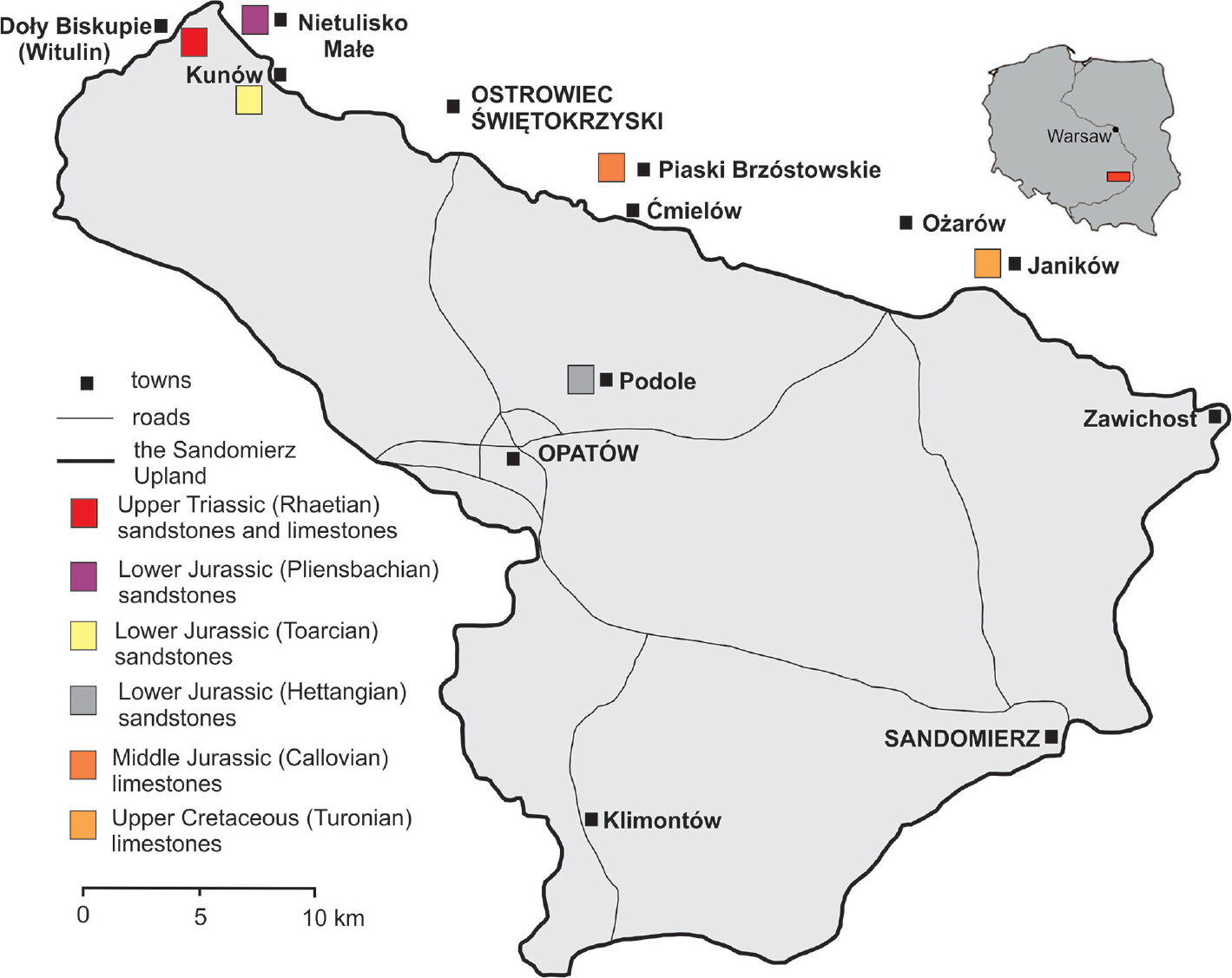
Fig. 1.
Location and geological structure of the historical quarries located within the north margin of the Sandomierz Upland.
Characteristic of the historic stone masonry centres of the Sandomierz Upland
Stone masonry as an important feature of the geoheritage of the Sandomierz Upland has a long tradition dating back to the Middle Ages. The genesis of the mining activity developed within the Mesozoic margin of the Holy Cross Mountains, as well as the north margin of the Sandomierz-Opatów loess plateau, should be attributed to access to the natural outcrops occurring within the sides of the escarpment zone and confluences of the Kamienna and Czyżówka river valleys (Urban, Gągol 1994, Gałka 2014, Fijałkowska-Mader et al. 2022). Churches, home and agricultural buildings, including contemporary seldom occurring cellars, wayside shrines and crosses, graveyards with historic tombstones, were made of Triassic sandstones and limestones exploited in Doły Biskupie, Jurassic sandstones exploited in Kunów, Nietulisko and Podole, Middle Jurassic (Callovian) pelitic rusty brown limestones excavated among others in Piaski Brzóstowskie, as well as Cretaceous limestones from Janików (Fig. 1).
Jurassic sandstones from Kunów were the subject of exploitation since 12–19th century (Urban, Gągol 1994, Gałka 2014). The whole town could be named as ‘sandstone town’ because all representative buildings were built with usage of this kind of stone, for instance Church of Saint Władysław from 17th century with sculptures of Saint Wojciech and Saint Stanisław and bas-reliefs, bell tower designed by Wojciech Gerson, wall with embedded stations of the cross and sculptures, graveyard, monuments in the town square, numerous roadside shrines and crucifixes. This material was excavated from contemporary inactive and afforested quarries situated south of the town. In Kunów, the parish church, apart from Jurassic sandstones, used many other decorative stones. The floor is a mosaic composed of Devonian Bolechowice and Szewce limestones with well-preserved calcite veins, sponge and other fossils, Jurassic Morawica limestones, as well as Permian Sigismundus conglomerate. In the presbytery, in the floor and balustrade, we can find different varieties of granite. The pulpit represents a combination of dark-green Indian Verde Guatemala marble and beige Italian Botticino Classico contemporary decorative marbles. Facing the lowest part of the wall, the threshold of presbytery and pedestal of side altars and font were covered with the use of Breccia Sarda marble excavated near Orosei (Sardinia, Italy). Numerous epitaphs and stoup were made with the use of Devonian Bolechowice limestone. Beautiful font and epitaphs were carved in Devonian Dębnik marble. Other epitaphs placed inside the church and in the stations of the cross were cut in white-grey Jurassic Carrara marble.
Historic tombstones made of Jurassic sandstone from Kunów can be admired in numerous graveyards, for example, in Waśniów, Kunów, Szewna, Wszechświęte, Ruszków, Ćmielów, and Wojciechowice localities. The famous Krzyżtopór Castle in Ujazd was built with the use of 300 m3 of Kunów sandstone. Triassic limestones and sandstones from Doły Biskupie (Witulin) exploited since the beginning of the 17th to the 20th century were also used in local and regional architecture, for instance in a complex represented by historical buildings, watermills, paper mill, and cardboard factory in the same locality (Urban, Gągol 1994, Fijałkowska-Mader et al. 2022). The quarry in Nietulisko Kamienne closed in the early 90s, and was the last active in the region. The trial of its reactivation didn’t bring the desired effect.
Jurassic sandstones exploited in quarry in Podole village situated 5 km from the Opatów town were used to erect nearby unique rural Romanesque/Gothic fortified church in Ptkanów from the 14th to 15th century dedicated to Saint Giles (Fig. 2). Uniqueness of this object apart from performed defensive functions lies in architectural details such as Romanesque apotropaic reliefs carved within the bell tower, stoup and font in the church, as well as sundial (Jędrychowski 2014). As a base of the altar and pulpit used Devonian Bolechowice limestone and imported brown Spanish Emperador Dark marble. In the case of the altar the Bolechowice limestone is surrounded by Jurassic limestone from Morawica. For the upper part of the altar and pulpit, a popular in Poland decorative warm beige Breccia Sarda marble. In the pulpit, additional applied commercial Italian Botticino Classico marble. In the main nave and presbytery, epitaphs were carved in Devonian Bolechowice and Dębnik as well as Jurassic Carrara marbles. White Marianna limestone from the Sudetes Mountains was used in small amounts as a base for the cross. In Podole, we can also come across preserved in a good state sandstone cellars used for storing vegetables and food. Tombstones in the graveyard located adjacent to the church were sculpted in the Upper Cretaceous limestone from Janików, where, within the borderland between the Sandomierz Upland and the Iłża Foreland, in a periodically active quarry as well as in old inactive quarries, Lower Turonian fine-detrital granular limestones occur with diversifed fossils of European importance. Carbonate rocks contain inoceramids, and contain inoceramids, ammonites, organodetritic/detritic layers with remnants of bryozoans, echinoderms, molluscs, and brachiopods, as well as a mixture of quartz and glauconite. A rich array of 22 species of foraminifers has been found here (Alexandrowicz, Alexandrowicz 2004). These quarries together with Janików village represent high archaeological, historic, cultural, scientifc and didactic value. Janików, with frst traces of flint exploitation in the Neolithic period, started to develop as a stonemasonry and sculpture centre in the 17th century. It is a precious, contemporary forgotten pearl hidden in the felds, which deserve on more attention and should be anew discovered. Excavated limestones were the main source of stone used in the Janików and surrounding towns and villages. In Janików, this material was applied in local wayside shrines and crosses, houses, agricultural buildings and Saint Anne’s church dating from the 19th century, with its altars and fgures surrounded by walls and graveyard with unique stonework (Fig. 3). The walls of the palace in Czyżów Szlachecki, parish church and bell tower in Wojciechowice, churches in Bidziny and Ożarów, the graveyards in Lasocin, Obrazów, Przybysławice (with tombstone of the Polish writer Witold Gombrowicz’s family), Stodoły, Bidziny, Gierczyce, Wojciechowice, Ożarów, Opatów, Sandomierz, the graveyard in Czyżów Plebański included into Central Register of Geosites in Poland (CRGP) and fnally column situated next to parish church in Ćmielów (Jędrychowski 2014) were all built from this kind of limestone. The most famous sculptor who worked in Janików workshops in the 18th century was Tomasz Hutter, author of the famed sculptural décor of the façade of the Czyżów Szlachecki palace.
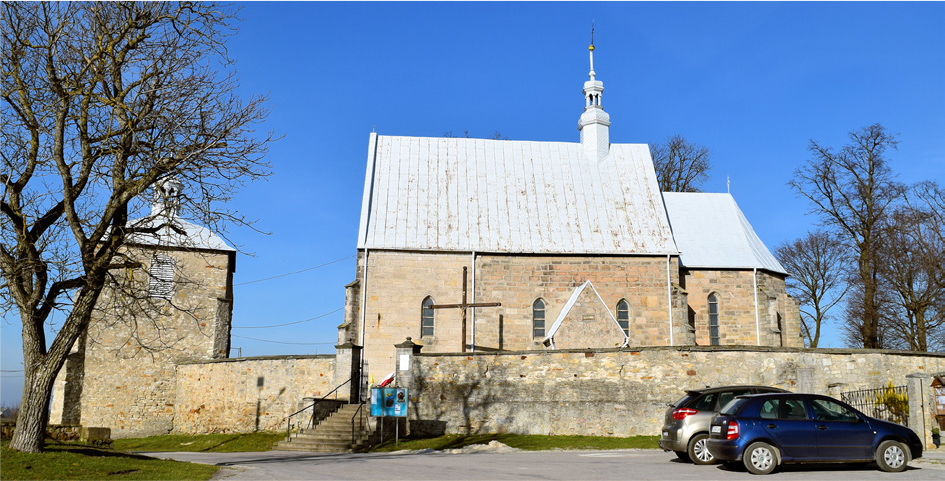
Fig. 2.
Fortified church in Ptkanów built of Jurassic sandstone from Podole.
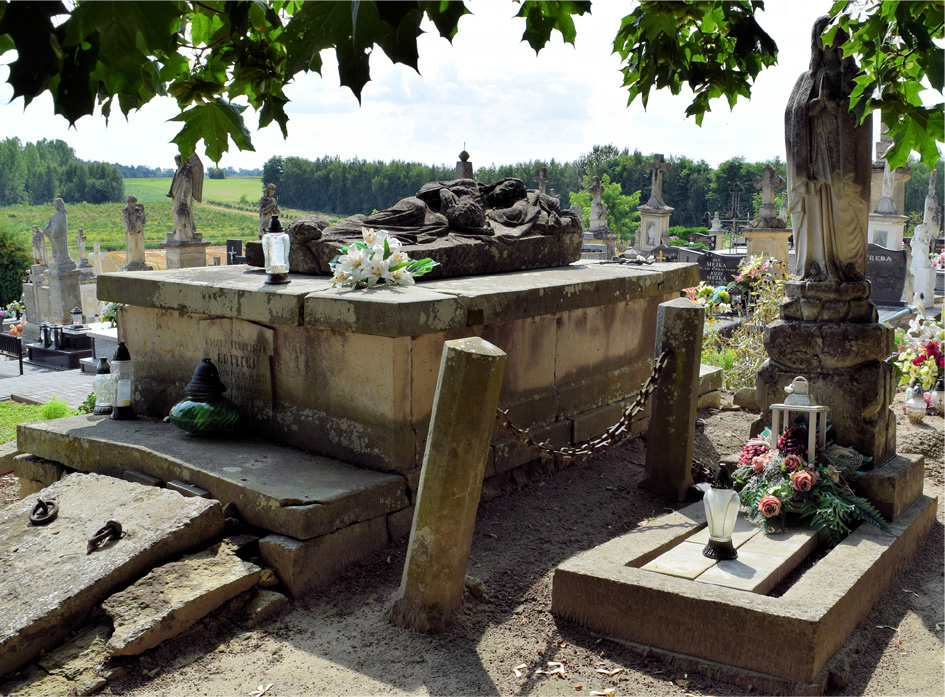
Fig. 3.
Sculptures in the graveyard in Janików carved in Upper Cretaceous limestone.
Interesting example of usage of local stone in the architecture of small towns and rural areas of the north margin of the Sandomierz Upland are the Middle Jurassic (Callovian) pelitic rusty brown limestones with a mixture of quartzitic sand and belemnites exploited in numerous quarries between Denków and Ożarów within the Iłża Foreland (Samsonowicz 1926). The aesthetic value of this kind of limestone is rather low, but previously it was an important building material for the local community. Old houses, agricultural buildings, and walls in Denków, Bodzechów, Brzóstowa, Ćmielów, and Drygulec, as well as the cemetery chapel and walls in Ćmielów, are built with the use of this stone. Nowadays, locally scattered quarries, some of them hidden in the forest, with preserved traces of exploitation in Piaski Brzóstowskie quarry geosite, are precious monuments of mining. Lower Triassic red sandstones from Lipowa and Czerwona Góra were seldom applied in the architecture of the Sandomierz Upland.
Local and regional stone in the architecture of the Sandomierz Upland
In representative cultural edifices, and especially in the old historic churches, apart from the material described above, we can come across material extracted from small local quarries as well as transported from other regions of Świętokrzyskie Voivodeship and Poland, even from abroad. In the case of the Sandomierz cathedral church of the Nativity of the Blessed Virgin Mary from the 14th century (Historic Monument), Devonian Dębnik limestone was applied in the beautiful two fonts, epitaphs, floor, portals, four candlesticks situated in the presbytery, and the Chapel of the Adoration of the Holy Sacrament and two stoups located in the western entrance hall. In the cathedral floor next to black Devonian Dębnik limestone, we can notice the usage of creamy Upper Jurassic limestones from Kraków surroundings, which were together with black marble and Paczółtowice rose-like vein calcite transported from Kraków to Sandomierz in the 18th century by the Vistula river (Dworzak 2016). In main representative altar, next to Dębnik marble and vein calcite from Paczółtowice, in monumental columns applied seldom occurring in architecture because of its rarity creamy marble of Blessed Salomea – Upper Jurassic limestone, called in archival materials ‘grodzisko marble’ (Dworzak 2016) from the place of its excavation Grodzisko Hill situated next to Skała in the Ojców National Park which was also transported by the Vistula river with stony material mentioned above (Fig. 4). Lavabo in sacristy, altar and pulpit as well as the Chapel of the Adoration of the Holy Sacrament reflect decorative combination of Devonian Dębnik marble and Paczółtowice rose-like vein calcite. Sandstone from Szydłowiec was used to erect the lower, darker parts of the pillars of the cathedral; upper, brighter parts of the pillars were made of Miocene limestone from Pińczów (two of them are built entirely of Miocene limestone). The interior of the cathedral leads to the 17th-century external western portal, in which we can distinguish weathered Devonian Dębnik marble. Material used for architectural details decorating the top of the façade is Jurassic sandstone from Kunów (zabytek.pl). Many architectural elements of the regarded object are artistic works of famous sculptors, for example, the portal leading to the sacristy from the presbytery, framed with the use of Devonian Dębnik marble, is an artwork of Sebastian Sala, whereas the epitaph of Canon Sebastian Kokwiński placed in the presbytery was executed with the use of Dębnik marble and Paczółtowice roselike calcite by Sebastian Sala and Bartholomeo Stopano (Wardzyński 2013, Jędrychowski 2014, Dworzak 2016, Myśliński 2017, Janowski 2022, Kossakowski 2022, own observations). The old preserved floor of the western entrance hall was covered mainly of brown Ordovician limestones from Oland Island with preserved remains of orthoceratites fossils. Several slabs of the Ordovician limestones applied also in the floor of the altar of the Chapel of the Adoration of the Holy Sacrament. Stairs leading to the crypts were covered with Devonian Bolechowice limestone. In Devonian Bolechowice limestone cut epitaph placed in the Chapel of the Adoration of the Holy Sacrament. in Dwikozy (Miocene Sarmatian or-ganodetritic limestones from Góry Wysokie and closest surroundings), in Żabno (probably Upper Miocene organodetritic limestones from Wólka Żabna (previously Żabna Wólka) and Podmaleniec localities near Staszów or sand and gravel from Żabno locality, and Opoczka quarries near Annopol (Turonian limestones (opokas)) (Dworzak 2016).
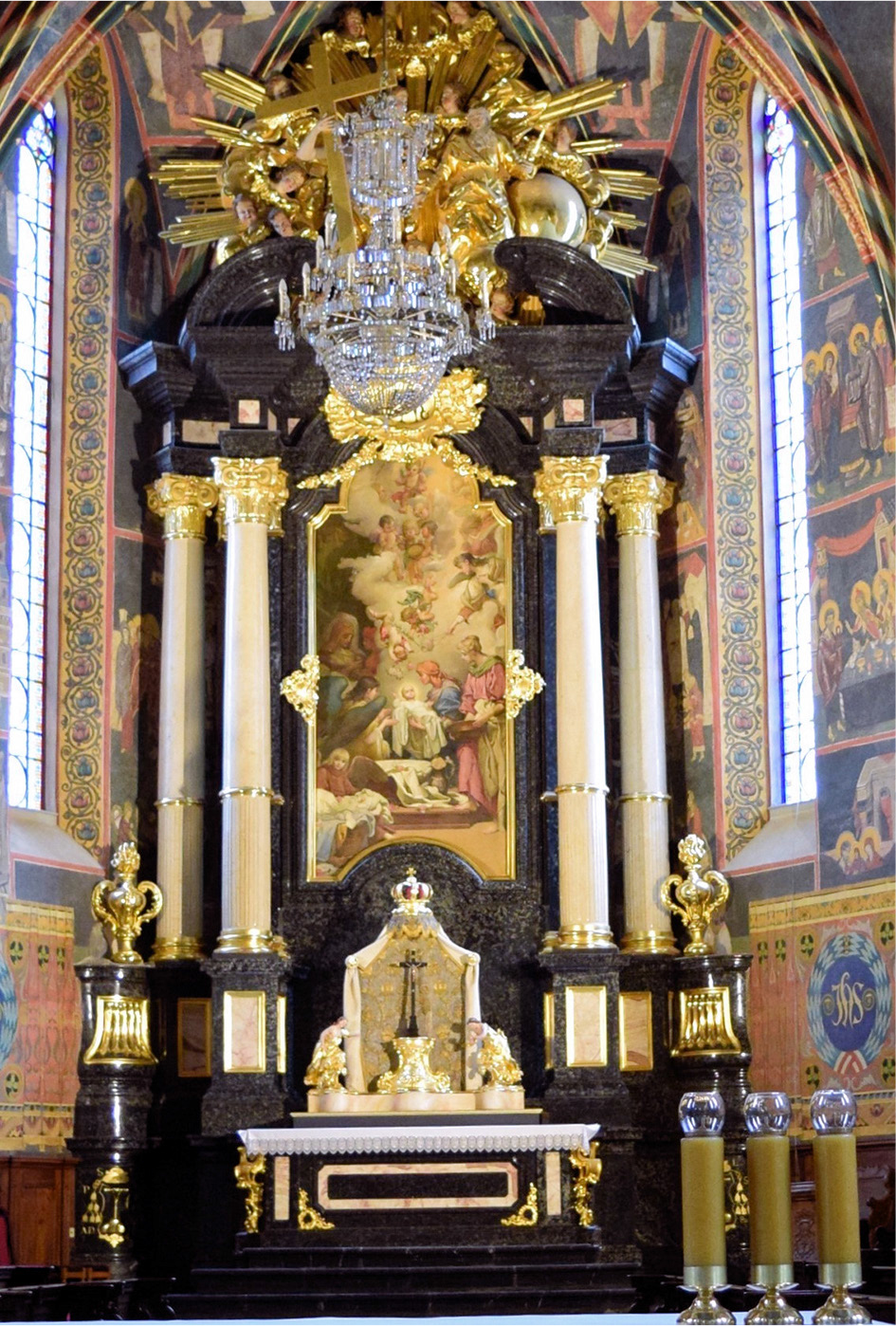
Fig. 4.
Blessed Salomea marble, Devonian Dębnik limestone, and rose-like Paczółtowice calcite applied in the main altar in the Sandomierz cathedral.
In Saint Paul’s conversion church in the same locality, the floor is made of dark Jurassic Morawica limestone in the church, with a decorative combination of White Marianna marble in the main nave and single slabs in the entrance hall. The door and step leading to the sacristy were framed with the use of Permian Sigismundus conglomerate. In the first stoup, a unique decorative white-rose-green rose-like Zelejowa calcite, seldom occurring in figural sculptures (only one of such kind found within the Sandomierz Upland), the second stoup in the entrance hall was carved in Jurassic Carrara marble (Fig. 5). Devonian Dębnik marble was used in the epitaph. In the architectural detail of the object, sandstone was also implemented.
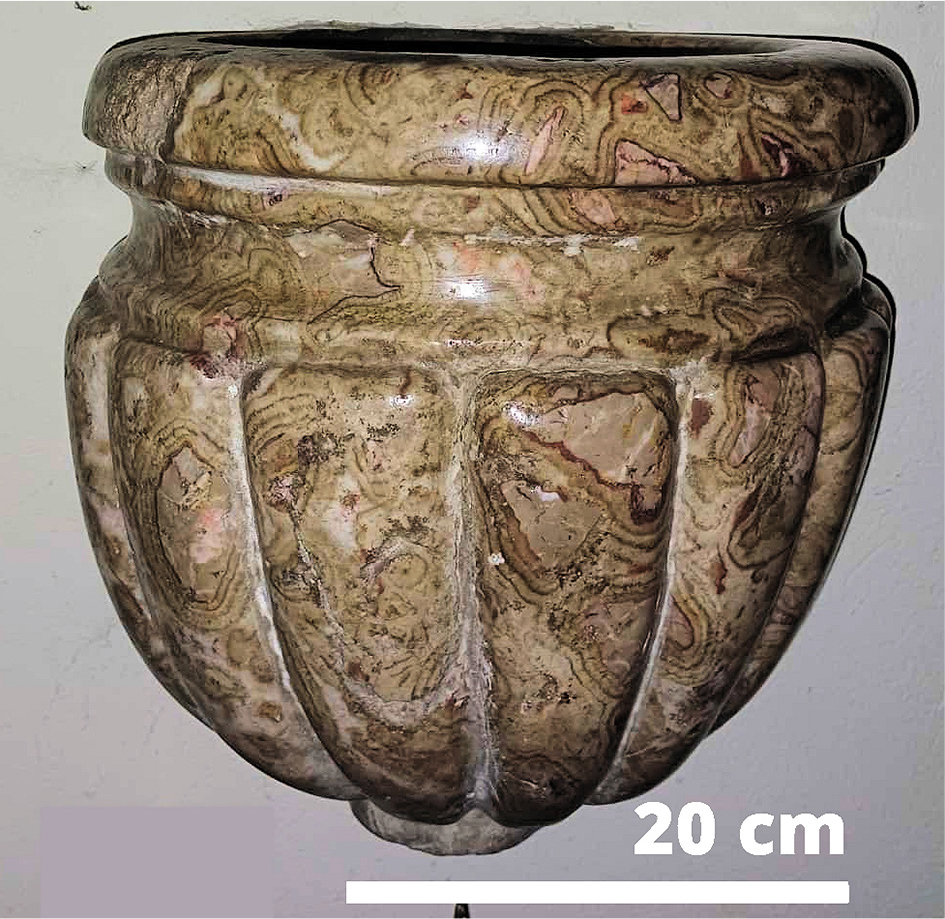
Fig. 5.
Stoup carved in rose-like Zelejowa calcite in Saint Paul’s conversion church in Sandomierz.
Sandomierz, together with Skotniki, Koprzywnica, Klimontów, Opatów, and Szewna, are localities where we can come across on chessboard floor composed mainly of red and grey Ordovician limestones from Oland Island with well-preserved orthoceratites fossils. Presence of this kind of foreign heritage stone, transported on a large scale from the 16th to 18th century on ships from the Baltic Island, typical for architecture of northern and western Poland (for example Gdańsk, Toruń, św. Lipka, Poznań, Gniezno towns) (Król et al. 2004), is a result of convenient localisation of the Sandomierz town close to the Vistula river and in the case of Szewna, it’s the Kamienna river confluence as an important way of transport. In the Saint Michel, the Archangel church in Sandomierz, from the 17th century mentioned fossils are visible in the flooring not only inside but also outside of the object, close to the entrance. Apart from limestones from Oland in this church, beige and dark Jurassic limestones from Morawica in the floor, and Devonian Bolechowice limestone in the epitaph. In the Saint Joseph church, also from the 17th century, located nearby, next to the same Ordovician limestones, epitaphs carved in Devonian Bolechowice and Dębnik marbles can be found. The last church in Sandomierz, where in the presbytery we can find well-preserved orthoceratites fossils in limestone from Oland in the so-called ‘swedish floor’ is Dominican’s Saint James church (Fig. 6). Side left chapel in this church was paved with unique combination of Devonian Bolechowice limestone and rose-like Zelejowa calcite. The second-floor combination comprises Devonian Bolechowice and Morawica Jurassic limestones. White Jurassic Morawica limestone was used to carve an altar and pulpit. Additionally, in the pedestal of the altar used Devonian Szewce limestone. In the presbytery as a pedestal and in epitaphs applied Devonian Bolechowice limestone with big stro-matoporas in the presbytery, in the remaining epitaphs used Devonian Dębnik marble and other black contemporary marbles. Sandstone served as a building material in foundations, architectural detail, and other elements of the Dominican church (Kamińska et al. 2023).
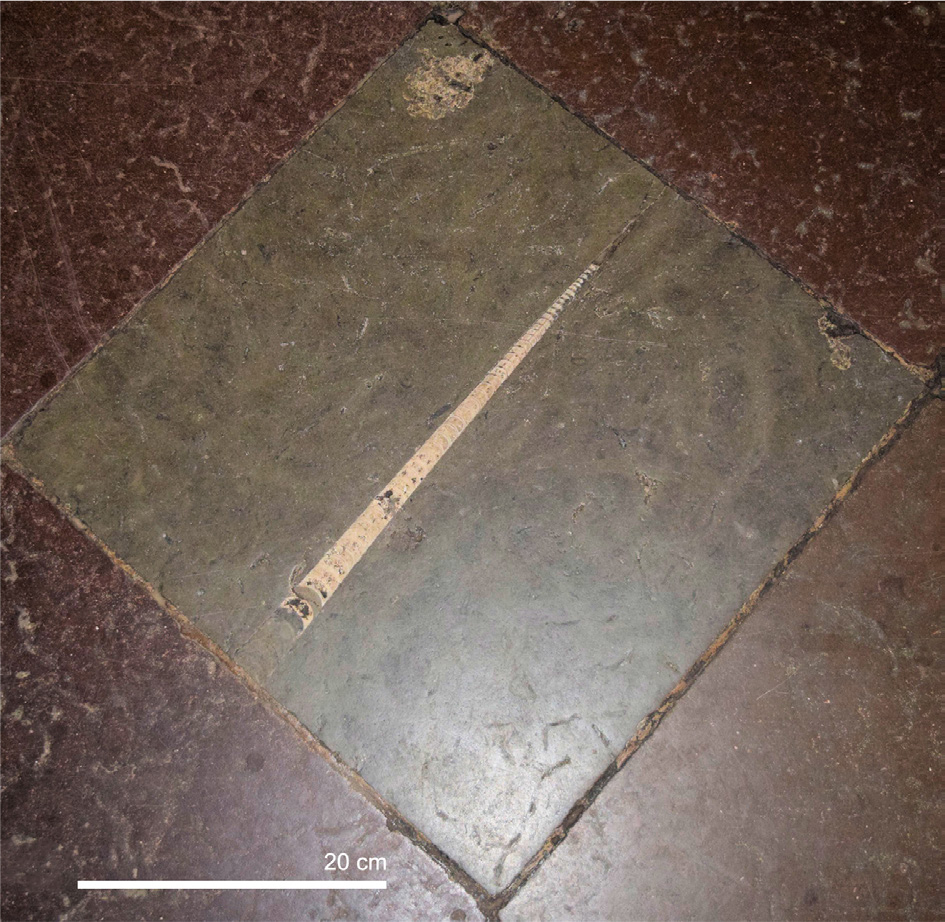
Fig. 6.
Ordovician limestones from Oland Island with orthoceratites fossils applied in the floor of the Saint James (Dominican’s) church in Sandomierz.
In the Zawichost old Franciscan Church, at present the rectoral Church of Saint John the Baptist from the 13th century, the effigy of Zofia of Bobrek Słupecka (died in 1632), executed by Sebastiano Venosta, the effigy of Stanisław Opocki and Anna Opocka, as well as the epitaph, were made of Devonian Bolechowice limestone (Wardzyński 2013; Fig. 7). The first-mentioned effigy has additionally inscriptions written in Devonian Dębnik marble. The floor of the object was paved with sandstone and different varieties of Morawica Jurassic limestone. Altarpiece, altar, and pulpit, as well as font, were carved in Cretaceous limestone from Janików. In the second church in Zawichost, in the Holy Trinity Church from the 13th century, Permian Sigismundus conglomerate was used in the stoup and as a frame of an epitaph cut in Devonian Bolechowice limestone. Other epitaphs were made in Devonian Dębnik and black contemporary marbles. In the second stoup carved in Devonian Bolechowice limestone, amphipora can be found. Two other epitaphs are distinguished by usage of original combination of Bolechowice and Szewce Devonian limestones (Fig. 8). In the old floor in the main nave and new floor in sacrysty and two entrance halls in the same church applied Devonian Bolechowice limestones with visible calcite veins and Megalodon species together with Jurassic limestones from Morawica with cross-sections of ammonite fossils in new floor as well as single slabs of the Devonian Szewce limestone (Fig. 9). Rich in fossils of stromatoporas and amphiporas identified in Devonian Bolechowice limestone in the floor in the last church in Zawichost from 18th century, of the Assumption of the Blessed Virgin Mary (Fig. 10). The same floor in presbitery and nave apart from Devonian Bolechowice limestones was paved with White Marianna marble from Stronie Śląskie, bright to dark Jurassic limestones from Morawica as well as small amount of Devonian Szewce limestone and Permian Sigismundus conglomerate. Floor in sacrysty was paved with Jurassic limestone from Morawica and White Marianna marble. White Marianna marble was also applied in the altar, pulpit, and original font. Two weathered epitaphs were carved in Devonian Bolechowice limestone. Outside the church, Cretaceous limestones from the Janików served as a decorative sculptoral material for two bas-reliefs and slabs.
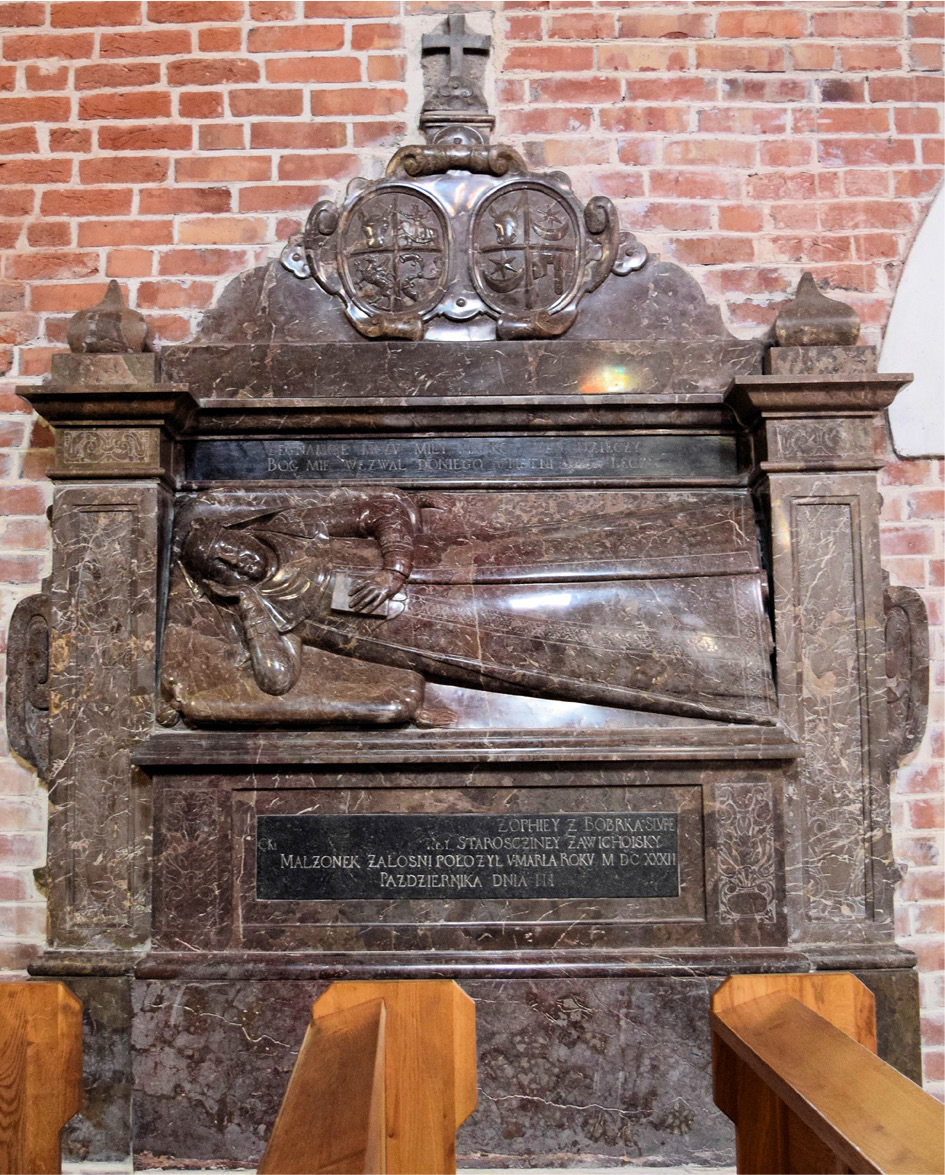
Fig. 7.
Effigy of Zofia of Bobrek Słupecka in the rectoral church of Saint John the Baptist in Zawichost made of Devonian Bolechowiece limestone.
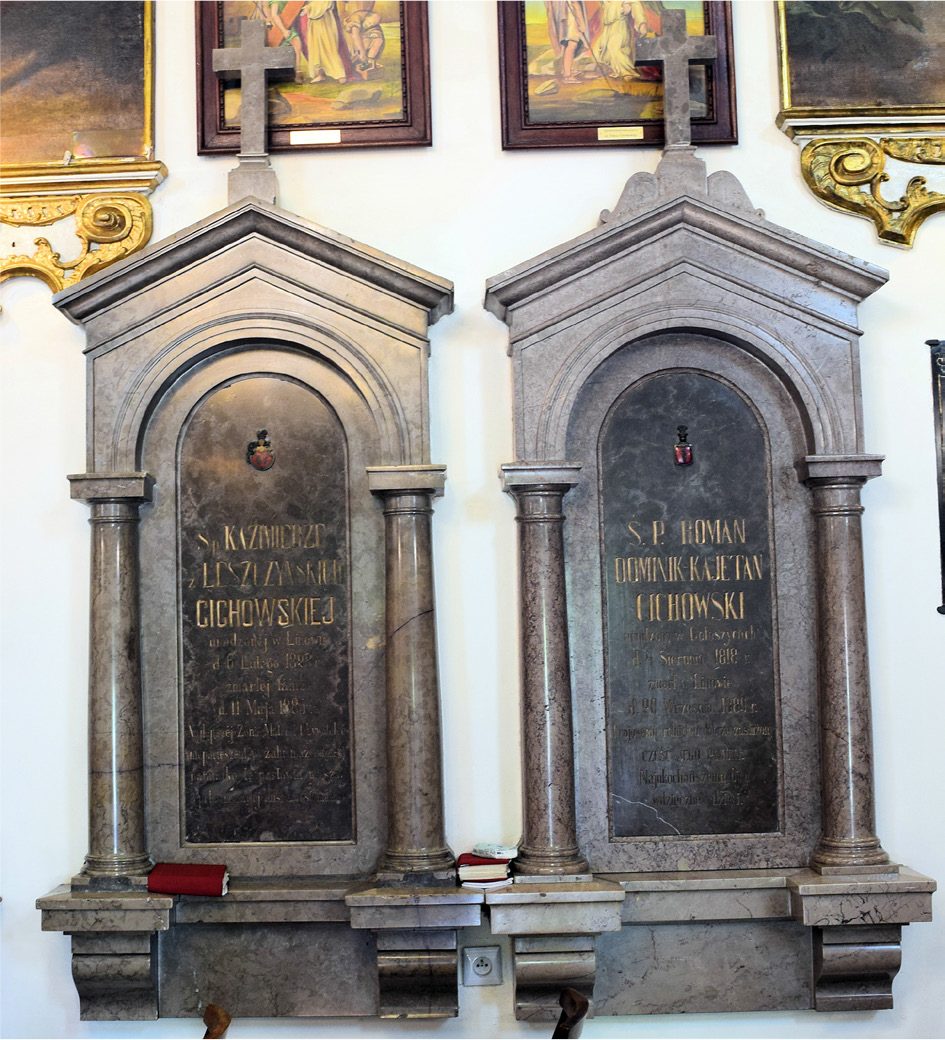
Fig. 8.
Epitaphs made of Devonian Bolechowice and Szewce limestones in the Holy Trinity church in Zawichost.
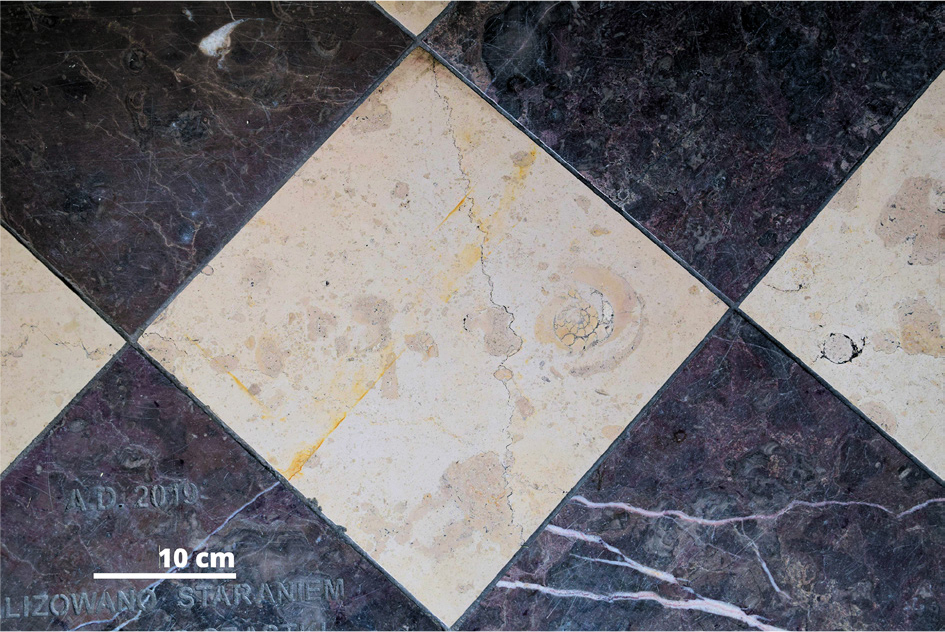
Fig. 9.
Floor in the Holy Trinity church in Zawichost made of Devonian Bolechowice limestones with calcite veins and Megalodon species and Jurassic limestones from Morawica with ammonite fossil, stylolithes and tuberoid spots.
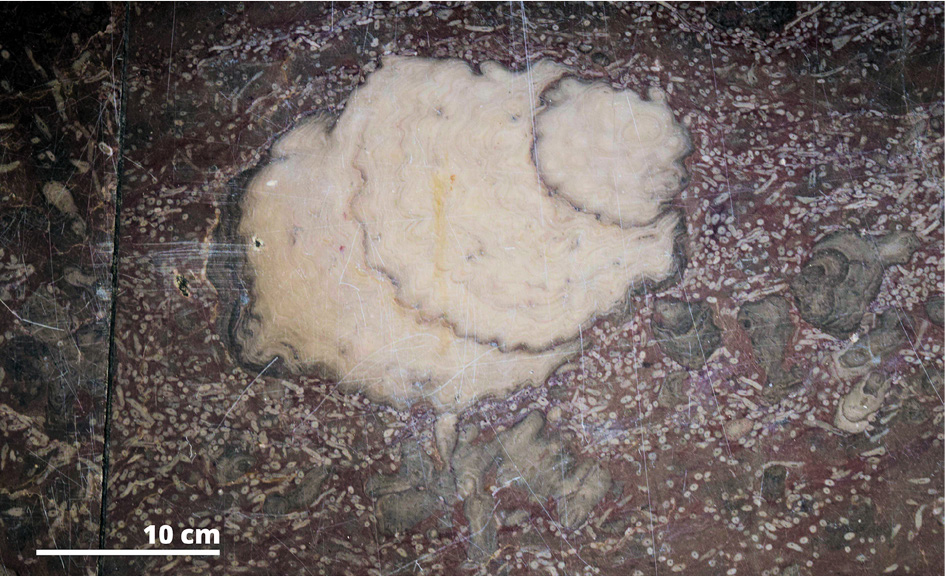
Fig. 10.
Bolechowice Devonian limestone with visible oval stromatopora and amphiporas in the church of the Assumption of the Blessed Virgin Mary in Zawichost.
Between the Assumption of the Blessed Virgin Mary church and the old rectoral church in Zawichost, during archaeological excavations, a present invisible Romanesque Saint Maurice’ chapel (tetraconch) was discovered, which was built of dark-rose (dark brown) quarztitic sandstone from Wąchock, Tumlin or Suchedniów (plate construction) and grey sandstone from the Holy Cross Mountains margin quarries located in Ostrowiec Świętokrzyski surroundings, Kunów, Starachowice, Szydłowiec or Opatów (Skoczylas, Jochemczyk 2018).
The Opatów Romanesque collegiate church of Saint Martin from the 12th century (Historic Monument) could be regarded as a valuable cultural geosite because of the use of many kinds of decorative and building stones in its architecture. In the foundations of the object applied big erratic boulders (Bryła-Mazurkiewicz, Jedynak 2025). Walls of collegiate were erected with usage of Lower Jurassic sandstones from Podole, red Lower Triassic sandstones from Lipowa, Lower Triassic red sandstones from Czerwona Góra and Jurassic sandstones from Kunów (Bromowicz, Magiera 2023a, b; Fig. 11). Inside the object we can admire unique Szydłowiecki’ chapel together with Zofia Szydłowiecka’s effigy (1536) made of Hungarian Tardos limestone, designed and executed by Bernardino Zanobi de Gianotis (Wardzyński 2013; Fig. 12). Candlestick, font and portals of the church were carved in Devonian Dębnik marble, whereas epitaphs with usage of Devonian Bolechowice limestone.
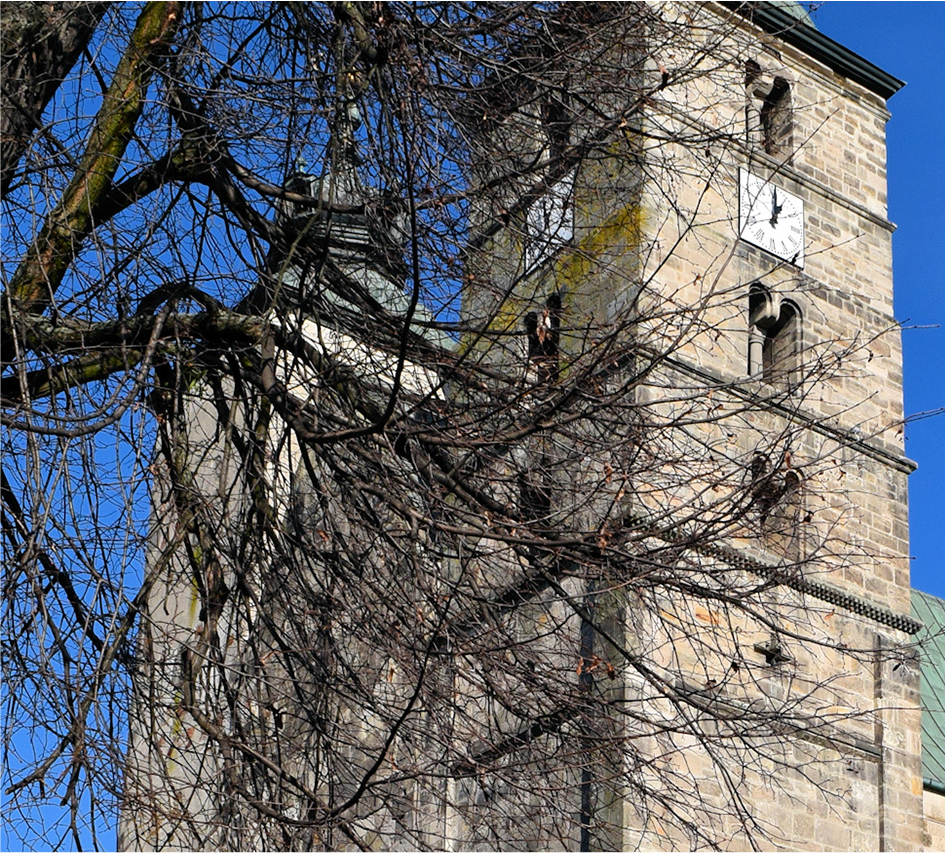
Fig. 11.
Walls of the Romanesque collegiate church of Saint Martin in Opatów built with the use of different kinds of local sandstones.
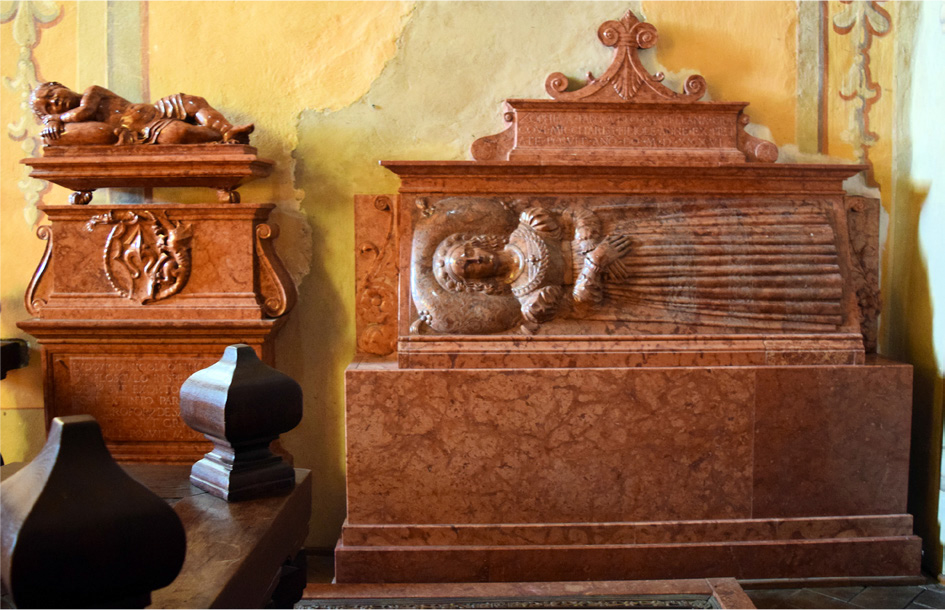
Fig. 12.
Zofia Szydłowiecka’s effigy made of Hungarian Tardos limestone in the Saint Martin collegiate in Opatów.
Jurassic sandstone from Podole was used in the stoup; red Triassic sandstone from the Holy Cross region creates the portal. The floor is tiled with Devonian Szewce limestone, rich calcite veins, and cross-sections of shells of Megalodon sp occur. In the entrance hall epitaph was placed made of Jurassic Carra marble. By the entrance to the collegiate church, on the left, there is a monument devoted to Michał Karski of Włostów. In its lower section, in Morawica Jurassic limestone a preserved ammonite is visible. Devonian Bolechowice and Dębnik marbles were also used in remain elements of this object. In the Chapel of the Adoration of the Holy Sacrament, Cretaceous limestone from Janików and red (Spanish Rojo Alicante) and brown (Spanish Emperador Dark) varieties of contemporary decorative marbles, as well as Italian beige ceramic imitation of stone occur.
Staying in Opatów, in the Bernardine Church of the Assumption of the Blessed Virgin Mary from the 15th century, we can admire the epitaph for Zygmunt Lanckoroński (1651) designed and executed by Augustin van Oyen or Piotr Januszowicz, and the epitaph of Felicjanna from Jarmuszewicz Reklewska from Małoszyce made of Devonian Bolechowice limestone (Wardzyński 2013). Devonian Bolechowice limestone was also used in the stoup as well as in the remaining epitaphs. Epitaph of Aleksander Boksa from Drzewica Drzewiecki is a unique artwork carved in Devonian Dębnik limestone. Candlestick and font were carved in Cretaceous limestone from Janików by ‘Dąbrowski Brothers Artistic Workshop’. Flooring in the main nave was paved mainly of red and grey Ordovician limestones from Oland with orthoceratites fossils. The floor of the church, close to the main entrance, is a mosaic composed of Devonian Bolechowice, Devonian Szewce, and Jurassic Morawica limestones.
Apart from leading sacral objects in historical centres such as Sandomierz, Zawichost, and Opatów within the Sandomierz Upland and neighbourhood areas, there are many interesting examples of local, regional, and even foreign stones being used in the architecture of sacral and secular buildings in small villages and towns. The Cistercian Romanesque cloister and church of Saint Florian in Koprzywnica, from the 13th century, was recognised as a Historic Monument. Columns in the chapter house were carved in Jurassic sandstone from Kunów, and the walls of the complex and the walls of the chapter house were erected of calcareous Cretaceous limestone from Janików. Walls of the church were also built using Miocene (Sarmatian) detritic limestone. Miocene Pińczów limestone was used in the walls of the complex as well as the tombstone of brothers Stanislaus and Martin Niedrzwiecki and the sarcophagus of Stanislaus Niedrzewiecki, both made by the famous artist Santi Gucci (Wardzyński 2013, Jędrychowski 2014, Bromowicz, Magiera 2023b) (Fig. 13). A stony fence as well as a bell tower were built of Miocene detritic limestone. Devonian Bolechowice limestone served as the basis for decorative elements such as epitaphs, a floor combined with Morawica Jurassic limestone with belemnite rostrum fossils, and two carved columns. Flooring in the sacristy was paved with Devonian Bolechowice and Jurassic Morawica limestone with belemnite fossils, as well as a small amount of Ordovician limestone from Oland. Devonian Dębnik marble occurs in a unique lavabo in the sacristy, stoup, as a platform of altars, in the floor of the presbytery and side chapels where creates black and white combination with Jurassic Morawica limestone, in right side chapel with rich calcite veins (Fig. 14). Permian Sigismundus conglomerate with calcite and Devonian Szewce limestone were recognised as single slabs in the floor.
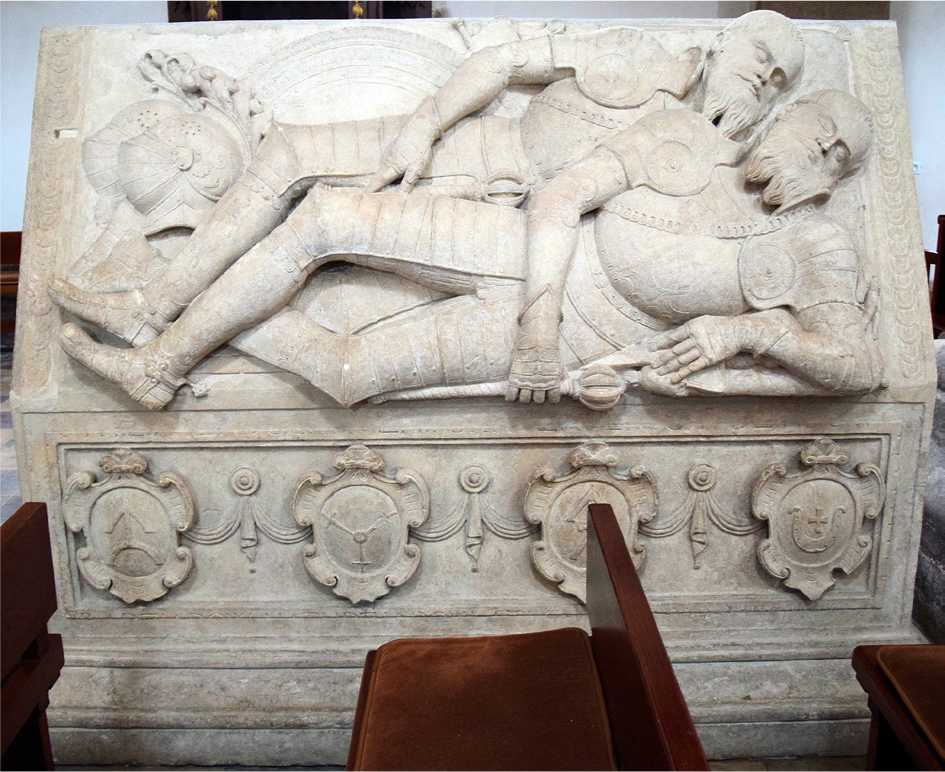
Fig. 13.
Miocene Pińczów limestone used in the tombstone of brothers Stanislaus and Martin Niedrzwiecki in the Cisterian Romanesque church of Saint Florian in Koprzywnica.
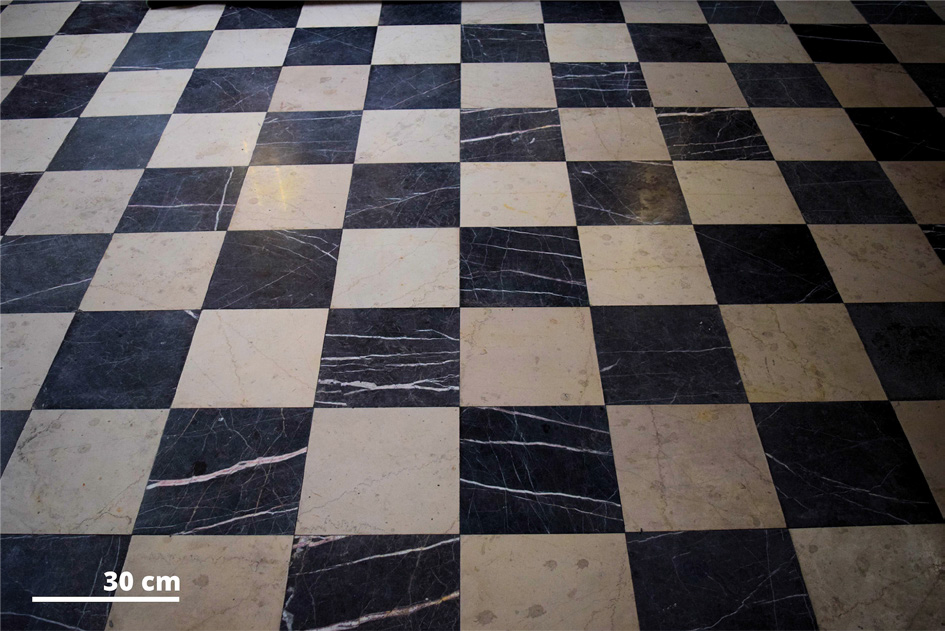
Fig. 14.
Floor of the side chapel in the Cisterian Romanesque church of Saint Florian in Koprzywnica made of Dębnik Devonian and Morawica Jurassic limestone with visible calcite veins and stylolithes.
In the same locality in the Parish church of Our Lady of the Rosary from 19th century within 17th-century preserved Rosary side chapel’s representative entrance portal (1693-4) we can admire Devonian Dębnik limestone combined with rose-like Paczółtowice vein calcite, designed and executed by Michał Poman (Wardzyński 2013; Fig. 15). Portal to the sacristy, epitaph as well as stoup (previously lavabo) were made with usage of Devonian Dębnik marble, Devonian Bolechowice limestone was applied in epitaph and in the floor, which was also paved with bright to dark Morawica Jurassic limestone.
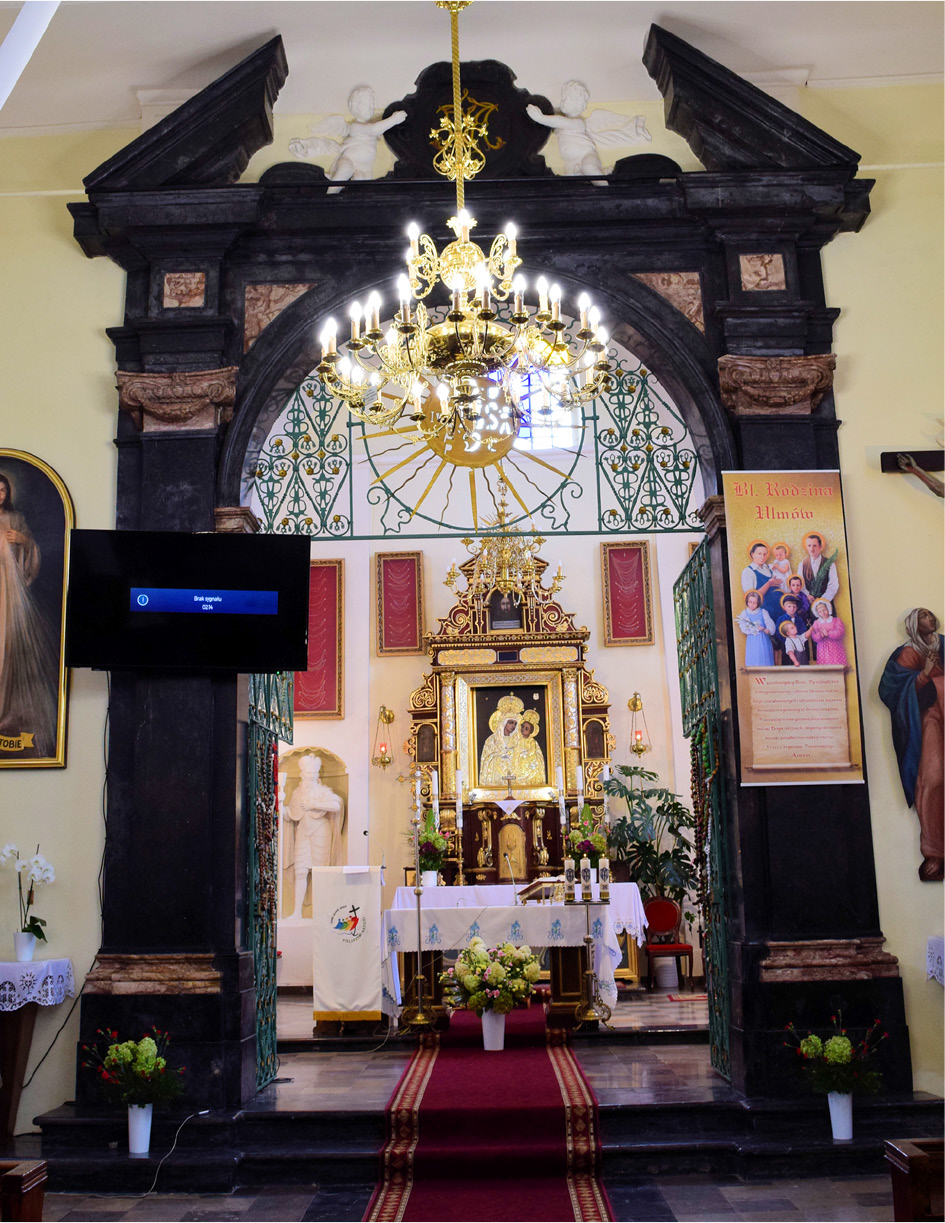
Fig. 15.
Portal in the Parish church of Our Lady of the Rosary in Koprzywnica, carved in Devonian Dębnik limestone and Paczółtowice rose-like calcite.
Collegiate from the 17th century in Klimontów, dedicated to Saint Joseph, designed by Wawrzyniec Senes and modelled on Roman architecture, is a unique Baroque church built on an oval plan. For the building’s western façade, applied Jurassic sandstones from Kunów (Bochnak 1925). Stoups, epitaphs, and a pair of portals, two of them with an Axe coat of arms executed by Sebastian Sala, were made of Devonian Dębnik limestone. In the entrance to the church, we can notice doors framed with the use of Devonian Bolechowice limestone, floor paved with Jurassic limestones from Morawica, and a small admixture of Devonian Bolechowice limestone as a decorative strip. In the main church and presbytery on the floor, we can distinguish Devonian Dębnik, Bolechowice with cross-sections of Megalodon species and Szewce limestones, Morawica Jurassic limestones, as well as in the presbytery, a small amount of rose-like calcite, Permian Sigismundus conglomerate occurring together with the balustrade and pedestal of the altar, creamy Upper Jurassic limestones from the Kraków area, and Ordovician limestones from Oland (Fig. 16). White-grey-yellowish White Marianna marble from the Sudetes Mountains was applied in the flooring as an octagonal badge combined with Devonian Dębnik marble as well as single decorative belts in the main nave. Collegiate in Klimontów is the place where, during the carried-out inventory, epitaphs cut in Jurassic Carrara marble were identified devoted to, among others, the Ledóchowski family (Fig. 17). Remaining epitaphs and font were carved with usage of Devonian Bolechowice limestone (Janowski 2022, own observations).
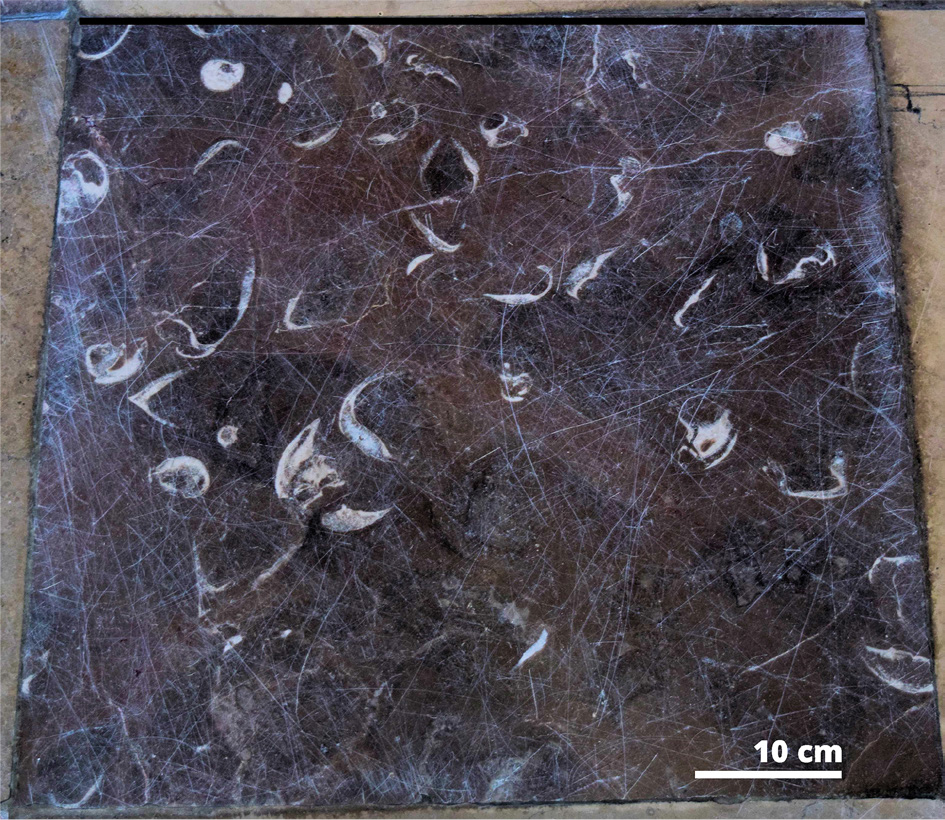
Fig. 16.
Cross-sections of Megalodon species visible within floor made of Devonian Bolechowice limestone in Saint Joseph Baroque church in Klimontów.
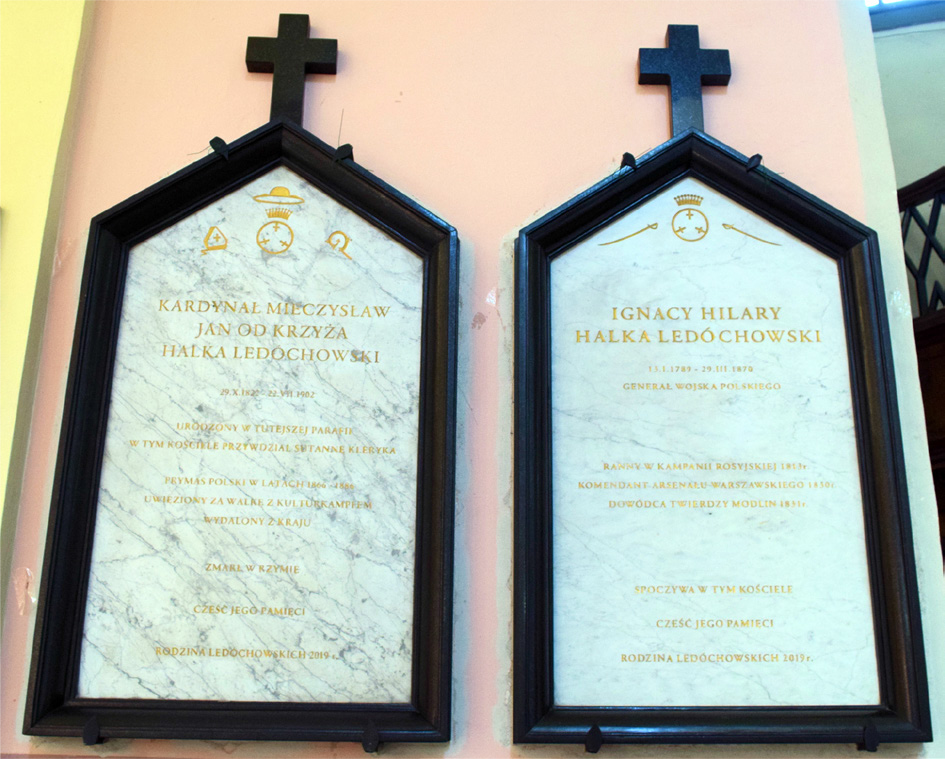
Fig. 17.
Epitaphs made of Jurassic Carrara marble in Saint Joseph Baroque church in Klimontów.
In Goźlice, the Romanesque Church of the Assumption of the Blessed Virgin Mary from the 13th century walls of the church were erected with the use of Miocene (Sarmatian and Badenian) detritic limestones (Bromowicz, Magiera 2023b), according to diecezjasandomierska.pl web page from Smerdyna quarries. From the same kind of limestone next to the church bell tower was erected. According to Jamroz (1977), the church was also built with the use of rocks of calcareous-sandy structure transported from nearby łoniów quarry. The most valuable architectural element inside the church is the tombstone of Hieronim Ossoliński (1576), probably carved by Santi Gucci in Miocene Pińczów limestone. Font (17th century) and floors in the entrance hall and sacristy were made of Devonian Bolechowice limestone. Flooring in the side chapels, presbytery, and main nave was paved with dark grey and brown-beige Devonian Sławniowice marble from the Sudetes Mountains (the same material was applied in the parish church in Dwikozy in the altar and stairs of the presbytery and side chapel). Door frames of the main entrance hall were carved in grey Jurassic Kunów sandstone (Jamroz 1977, zabytek.pl).
In the entrance hall, we can notice preserved in a bad state the upper part of the stoup made of historical French Rosso Francia marble placed on a platform covered with slabs cut in White Marianna marbles, both placed on a black red granite base, as well as a commemorative plaque carved in Jurassic Carrara marble. In the presbytery above the entrance door to the sacristy, black Devonian Dębnik marble is applied in an epitaph. As decorative elements in presbytery in altars and pulpit used Brazilian Giallo Vittoria granite and red Italian Rosso Verona marble, applied also in the church of the Mother of God, the Queen of Poland, in Sandomierz. Worth noticing is a sandstone copy of Our Lady with Infant Jesus from the 13th century, previously placed inside the Romanesque portal of the church in Dulcimer. The original sandstone sculpture is stored in the Diocesan Museum in Sandomierz, being one of the most precious exhibits.
The Włostów church from the 13th century was built of crushed sandstone. The floor in the main nave, presbytery, and two entrance halls was paved with red Spanish Rojo Alicante marble. On the floor of the side nave, together with stars leading on the pulpit, dark Jurassic Morawica limestone was applied. Bright Morawica Jurassic limestone was used to carve the font. All epitaphs in the church and stoup in the eastern entrance hall were carved in Devonian Bolechowice limestone. In the southern entrance, the hall stoup was made of alabaster. The church used small amounts of red sandstone from the Holy Cross Mountains.
Church of Saint Adalbert in Momina (14th century), located near the Czerwona Góra quarry, is the second geosite apart from the Opatów collegiate, where red Triassic sandstone from this locality is visible also in the form of conglomerates. Decorative elements of the elevation and entrance were cut in the red Triassic sandstone from the Holy Cross Mountains. Flooring of the object was paved with Jurassic Morawica, Devonian Bolechowice, and Szewce limestones with amphiporas, stromatoporas, and Megalodon species fossils. Epitaphs represent Jurassic Carrara marble (also applied in a cross placed on the wall), Devonian Bolechowice and Dębnik limestones. Outside the church, behind the wall, we can find an erratic boulder with a commemorative plaque devoted to Pope John Paul the second. Some architectural details were made of local Jurassic sandstone.
Special attention deserves the Szewna church from the 18th century, dedicated to Saint Nicholas, where for stoups, font, and portals applied Devonian Dębnik marble. Floor of the presbytery was covered with Ordovician limestone from Oland, so-called ‘Swedish flooring’, represented by a mosaic of colours typical for this kind of limestone with orthoceratites fossils, but not so well preserved as in Sandomierz. For the stairs, Devonian Bolechowice limestone was applied. Epitaphs of canon Jan Hilary Kasztulski (died in 1679) as well as other epitaphs, were also carved with the use of Devonian Bolechowice limestone (Wardzyński 2013). The upper part of the two-piece epitaph devoted to Marcin Popiel, priest, was cut in Jurassic Carrara marble, the lower in white-grey decorative marble. Remaining epitaphs placed inside the church and on elevation were made of weathered Breccia Sarda, Jurassic Carrara marbles, and sandstone.
Upper Miocene organodetritic limestones from Smerdyna near Staszów were commonly used in the Sandomierz surroundings, for instance, to build the wall of the old cholera graveyard from 1814 situated between Gierczyce and Kaliszany, which includes only a new monument made of granite rocks devoted to all those who died fighting in the 20th century and a monument devoted to all those who died in an air catastrophe in 2010 (erratic boulder) situated next to the old one from 1867 constructed from Cretaceous limestone from Janików. Miocene organodetritic limestones were also applied in the Sandomierz cathedral, Cisterian complex, and stony fence, as well as the bell tower in Koprzywnica and Goźlice church and bell tower walls, as described above, and walls located along the road leading from the cathedral to the castle in the Sandomierz town, in the church in Jankowice, the chapel of blessed Wincenty Kadłubek in Karwów situated next to a spring, as well as the Bethlehem chapel in Ossolin.
Erratic boulders are widely used in the architecture of the Sandomierz Upland and its neighbourhood areas, especially as a decoration of walls and home gardens and as a pedestal of numerous historic and war monuments, for instance in monument devoted to victims of World War II located between cathedral and castle in Sandomierz, in previously mentioned old cholera graveyard or pedestal of monument of Saint Francis situated in the front of the Bernardine Church in Opatów and its wall. The casing of the spring in Karwów, the foundations of the collegiate in Opatów, and the parish church in Dwikozy, as well as the walls in the Olbierzowice parish church, were created using post-glacial material, i.e., Scandinavian erratics. Defence buildings, mainly castles in Międzygórz, Ossolin, and Konary (at present ruins), a church in Olbierzowice, and other churches, walls, and foundations of homes and agricultural buildings were erected of Palaeozoic (Cambrian and Devonian) sandstones and quartzites exploited in local quarries located in Opatów and Sandomierz surroundings (Samsonowicz 1926, Bromowicz, Magiera 2023a, Tercjak et al. 2026). Walls of the Opatów town and the Bernardine church in the same locality were built with the use of this kind of stone.
Apart from distinguishing objects described above there are many local and parish churches such as rectoral church of Saint Spirit in Sandomierz (14th century), Dwikozy (20th century), Sobótka (18th century), Bidziny (18th century), Ożarów (19th century) church and tomb chapel in Gierczyce (18th century), Wojciechowice (14th century), Ruszków (18–19th century) and Waśniów (17th century) where numeral epitaphs and architectural elements were made of Devonian Dębnik marble and Devonian Bolechowice limestone and flooring of Devonian Bolechowice and Szewce limestone commonly compiled in one pattern with Jurassic Morawica limestone. On the border between the Sandomierz Upland and the Iłża Foreland in Ćmielów parish church (14th century), Permian Sigismundus conglomerate and Devonian Bolechowice limestone with rich amphipora can be found used in epitaphs and stoup, grey Jurassic and red Triassic sandstones from the Holy Cross Mountains applied in pyramid-shaped wall monument of Antonina from Rzewuscy Małachowska, red Triassic sandstone from the Holy Cross region was also used in carved font. The second stoup placed in the western entrance hall was carved in Jurassic Carrara marble. The remaining epitaphs were cut in black, Breccia Sarda, and Jurassic Carrara marble.
Within the same geographical location in Czyżów Szalchecki parish church (15th century), similarly Devonian Bolechowice limestone with rich stromatoporas and amphiporas are visible in the floor of the side chapel together with White Marianna marble as a single belt as well as in two stoups, in one of them with visible stromatoporas, and epitaphs. In the epitaphs, Devonian Dębnik limestone was additionally applied. Altar, pulpit, and pedestals of side altars were carved in contemporary imported green Indian Verde Guatemala marble.
In Ożarów, the parish church’s monumental main altar was erected with the use of Bolechowice Devonian limestone and facing of the lowest part of the walls, which was covered with the use of Jurassic Morawica limestone with cross-sections of ammonite fossils. In Denków (18th century), we can admire epitaphs made of Devonian Dębnik marble, stoup and epitaphs cut in Devonian Bolechowice limestone, and a stately font placed on a posthumous carved in the same material – Permian Sigismundus conglomerate.
The last kind of rock used as a decorative element, in graveyards or historical monuments, is red Triassic sandstone from the Holy Cross region. It occurs very occasionally, for example, in Saint Martin collegiate in Opatów (portal), font in Cisterian church and stairs in front of the gate leading to the Parish church of Our Lady of the Rosary in Koprzywnica, in Szewna, Denków, Ptkanów, Ćmielów, Stodoły-Wieś, Gierczyce as a graveyards or in Małoszyce in the form of the monument devoted to famous Polish writer Witold Gombrowicz, executed by regional sculptor Gustaw Hadyna, monument devoted to Władysław Belina-Prażmowski in Ruszkowiec made in Bodzechów in stone workshop, stoups in Saint Joseph church in Sandomierz as well as in crypts in cathedral in Sandomierz and the Assumption of the Blessed Virgin Mary church in Zawichost, and war monument in Świątniki and finally in monument in Ostrowiec Świętokrzyski devoted to all those who died in Katyń.
A tabular summary of representative decorative and building stones used in the architecture of the Sandomierz Upland, described in this article, is attached below (Table 1). The table includes short characteristics of geological structures as well as physical, technical, and decorative properties in geological, chronological order, with locality of their occurrence, which could serve as a practical research and educational tool.
Table 1.
Tabular summary of the representative rock types used in secular and sacral architecture of the Sandomierz Upland (according to Matyja 1977, Urban, Gągol 1994, Złonkiewicz 1994, Rajchel 2008, Jędrychowski 2014, Bromowicz, Figarska-Warchoł 2016, Sermet et al. 2016, Gągol et al. 2020, Jewuła et al. 2022, Central Register of Geosites in Poland (CRGP).
| Quarring site | Rock type/name of stone | Geological period | Geological structures | Fossils | Physical and decorative properties | Examples of architectural use |
|---|---|---|---|---|---|---|
| Stronie Śląskie | White Marianna limestone | Proterozoic? – Cambrian | Medium and coarse-grained calcite marbles | None | High quality, excellent polish, physical properties, and aesthetic values, high frost resistance, compared with Carrara marble | Collegiate in Klimontów, parish church in Goźlice, the Assumption of the Blessed Virgin Mary church in Zawichost, parish churches in Ptkanów and Czyżów Szlachecki, the Saint Paul’s conversion church in Sandomierz, Saint Michel the Archangel church in Ostrowiec Świętokrzyski |
| Oland Island | Limestones | Ordovician | Differ in colour from the red varieties to brownish and grey, represents a proximal ramp tectonic setting | Orthoceratites | Aesthetic values connected with a mosaic of colours, numerous orthoceratites and other fossils, and bedding enables a very exploitable thickness of slabs | Cathedral in Sandomierz, Saint Joseph, Saint Michel the Archangel, and Saint James (Dominicans) churches in Sandomierz, Cisterian church in Koprzywnica, parish church in Skotniki, collegiate in Klimontów, Bernardine church in Opatów, parish church in Szewna |
| Sławniowice | Limestones, dolomites | Devonian | Beige, yellow, brown, white to light grey, light blue, blue-grey, brownish-purple, greenish-grey to dark grey coloured, coarse and medium grained | None | Very good technical properties connected with a high rate of recrystallisation, very resistant to weathering, high decorative values connected with a palette of colours and striped, spotted and folded patterns, excellent sculptor material, easy to process and polish | Parish church in Goźlice, parish church in Dwikozy |
| Dębnik | Limestones | Middle-Upper Devonian | Black to grey coloured, the thickness of the limestone beds usually ranges between 40 cm and 60 cm | Amphiporas, stromatoporas, corals, brachiopods, pelecypods, crinoids, and gastropods | Good physical and technical properties, suitable for being polished, resulting in glassy mirror-like surfaces, susceptible to weathering, presence of calcite veins, sparite calcite, and fossils | Cathedral church of the Nativity of the Blessed Virgin Mary in Sandomierz, Cisterian church and the parish church of Our Lady of the Rosary in Koprzywnica, the Saint Martin collegiate and Bernardine church in Opatów, churches in Klimontów, Szewna, Bidziny, the Saint James and the Saint Paul’s conversion churches in Sandomierz, parish churches in Gożlice, Kunów, Momina, Ptkanów, and Czyżów Szlachecki |
| Szewce | Limestones | Upper Devonian | Light beige and brown coloured with a pink hue, occur in the form of medium or coarse beds, formed in the lagoon of the forereef area | Cross-sections of Megalodon species, amphiporas, stromatoporas | Good physical and technical properties, suitable for polishing, high decorative values connected with the presence of violet calcite veins, stylolithes, and fossils, good resistance to atmospheric influence | The Saint Martin collegiate and Bernardine church in Opatów, the Holy Trinity and the Assumption of the Blessed Virgin Mary churches in Zawichost, Saint James church in Sandomierz, parish churches in Momina, and Kunów, collegiate in Klimontów, floor in the Sandomierz castle |
| Bolechowice | Limestones | Upper Devonian | Brown-chocolate coloured, formed in the lagoon of the fore-reef area | Amphiporas, stro-matoporas, cross-sections of Megalodon species, Tetracoralla corals, Lexonema gastropods | Excellent polish, physical properties, and aesthetic values, presence of white and pink calcite veins, fossils, and stylolithes, weak resistance to atmospheric influence resulted in grey colour | Cathedral church of the Nativity of the Blessed Virgin Mary, Saint Joseph, Saint Michel the Archangel, rectoral and Saint James churches in Sandomierz, Cisterian church and the Parish church of Our Lady of the Rosary in Koprzywnica, the Saint Martin collegiate and Bernardine church in Opatów, churches in Zawichost, Klimontów, Szewna, Gożlice, Włostów, Czyżów Szlachecki, Bidziny, Gierczyce, Wojciechowice, Ptkanów, Ćmielów, Denków, Ruszków, Momina, Kunów, Waśniów, Dwikozy, Ożarów, floor in the Sandomierz castle |
| Paczółtowice | Rose-like semicris-tallised vein calcite | Lower Carboniferous (Tournasian) | Veins filled with red, rose, and milk white (polish onyx) calcite, a locally red variety, have a breccia structure | None | High decorative values, excavated in the form of small blocks, used as cladding material and fillings in the form of mosaics, usually together with black Dębnik limestone | Cathedral church of the Nativity of the Blessed Virgin Mary in Sandomierz, the Parish church of Our Lady of the Rosary in Koprzywnica |
| Czerwona Góra | Sigismundus conglomerate | Upper Permian | Red marine nearshore delta fans sediments, red, pink, brown, and cream conglomerate, which consists of middle to very good coated, light gray and beige pebbles and crumbs of Devonian limestone carbonate rocks and dolomites, with clayey-carbonate-ferrous binding | Amphiporas, stromatoporas | Very high decorative values, conglomerate structure with a characteristic ‘brawn’ pattern and white and honey calcite veins, low abrasiveness and resistance to atmospheric influence, presence of fossils | The Holy Trinity and the Assumption of the Blessed Virgin Mary churches in Zawichost, parish churches in Klimontów, Denków, Ćmielów, Kunów, and the St. Paul’s conversion church in Sandomierz, Saint Michel the Archangel church in Ostrowiec Świętokrzyski |
| Zelejowa Mountain | Rose-like Zelejowa calcite | Permian-Triassic | White-rose and green hydrothermal coarse crystalline veined calcite | None | High decorative values, because of its fragility and low blockability, are seldom applied in figural sculptures, used as fillings in the form of mosaics | The St. Paul’s conversion church in Sandomierz, Saint James church in Sandomierz |
| The Holy Cross mountains region | Sandstones | Lower Triassic | River or eolian red sediments from Tumlin, Wąchock, and Suchedniów of delta and lagoon genesis | None | Thick-bedded, easy to process | Church in Kunów, Saint Martin collegiate in Opatów, Cisterian church in Koprzywnica, parish churches in Ćmielów, Koprzywnica, and Momina, Szewna, Ptkanów, Ćmielów, Stodoły-Wieś, Gierczyce as a graveyard, monument devoted to Polish writer Witold Gombrowicz in Małoszyce, monument devoted to Władysław Belina-Prażmowski in Ruszkowiec, monument in Ostrowiec Świętokrzyski devoted to all those who died in Katyń, war monument in Świątniki, stoups in Saint Joseph church as well as in crypts in cathedral in Sandomierz and the Assumption of the Blessed Virgin Mary church in Zawichost |
| Biskupie Doły (Witulin) | Sandstones and limestones | Upper Triassic (Rhaetian) | Light-cream coloured, medium-grained sea, inshore sediments arising in shallow, waving waters, in the lower part of the wall, coarse beds of Rhaetian sandstones are visible, in the upper part of the wall, there are complex limestones of the Lower, Middle, and the lowest part of the Upper Shell Limestone | Bivalves, brachiopods, shells of gastropods, cephalopods, and fish remnants. | Easy to process, good technical and physical properties | A complex of historical buildings, watermills, a paper mill, and a cardboard factory in Biskupie Doły |
| Kunów | Sandstones | Lower Jurassic (Toarcian) | Inshore (lagoonal) sediments, from shallow and quiet bodies of water, white, light grey, and yellowish, cream coloured with iron dripstones, fine and medium-grained with siliceous binding material, occur in the form of fine, medium, or coarse beds | None | Good block properties, good technical qualities, easy to process, exploit, and have good resistance to atmospheric influence | Church of Saint Władysław with sculptures of Saint Wojciech and Saint Stanisław and bas-reliefs, bell tower, stations of the cross, graveyard, monuments in the town square, private houses, numerous roadside shrines and crucifixes in Kunów, graveyards in nearby towns, cathedral church of the Nativity of the Blessed Virgin Mary in Sandomierz, collegiate in Klimontów, the Saint Martin collegiate in Opatów, Cisterian cloister in Koprzywnica, parish church in Goźlice, the Krzyżtopór Castle in Ujazd |
| Nietulisko | Sandstones | Lower Jurassic (Pliensbachian) | Similar properties to Kunów sandstones, but with clayey material binding | None | Good technical qualities – separateness, blockability, easy to process, exploit, have weak durability, and resistance to atmospheric influence | Elevation material for Warsaw’s destroyed Old Town and Warsaw’s Palace of Culture and Science as well as ripraps for the Marshal Residential District estate and the W – Z route in Warsaw |
| Podole | Sandstones | Lower Jurassic (Hettangian) | Thick-bedded, grey to light grey quartzitic sandstones of inshore and terrestrial genesis, with horizontal and diagonal bedding | Molluscs, traces of dinosaurs, fossil flora, and soils | Easy to exploit and process, it occurs in the form of blocks, with weak resistance to aggressive weathering factors | Fortified church in Ptkanów with a wall, bell tower, as well as sundial, the Saint Martin collegiate in Opatów, and local cellars in Podole |
| Carrara | Limestones | Lower Jurassic (Hettangian) (protolith) | Fine-grained and homogeneous with a compact texture, background colour can vary from off-white to light grey with dense dark grey/black veins | None | High water absorption, flexural and compressive strength, high resistance and density, good thermal conductivity, smooth and polished appearance with high aesthetic value connected with luster that gives it a bright, reflective quality, purity of the background, the presence or absence of veins, and their appearance | Epitaphs in Klimontów collegiate, collegiate in Opatów, Goźlice, Ćmielów, Szewna, Kunów, Ptkanów, and Momina parish churches, the church of the Mother of God, the Queen of Poland in Sandomierz |
| Szydłowiec | Sandstones | Lower Jurassic (Pliensbachian) | White and yellow coloured, fine-and medium-grained, formed in shallow water reservoirs near the mainland or islands, at the mouths of slowly flowing, calm rivers, with weak silica and silica-clayey binding material | None | Very good separateness, blockability, and frost resistance, high decorative values, covered with a grey patina layer | Cathedral church of the Nativity of the Blessed Virgin Mary in Sandomierz, two sandstone lions as a decorative part of the entrance gate to the Wielopolski Palace in the Częstocice district of Ostrowiec Świętokrzyski |
| Bánya-hegy near Tardos | Limestone | Lower Jurassic | Red compact limestone | Ammonites | Frost resistance, low water absorption, and high compressive strength, workability, and high decorative values | Szydłowiecki’s chapel in the Saint Martin collegiate in Opatów |
| Area between Denków and Ożarów within Iłża Foreland | Limestones | Middle Jurassic (Callovian) | Pelitic, rusty brown, medium and coarse bedded with admixture of quartzitic sand, presence of cherts in the lower parts of the profile | Ammonites, belemnites, bivalves, teeth of crocodiles, and fish | Low aesthetic values serve as an important building material, the presence of fossils | Houses, walls, and agricultural buildings in Denków, Bodzechów, Brzóstowa, Ćmielów, and Drygulec |
| Morawica | Limestones | Upper Jurassic (Middle and Upper Oxfordian) | Light-grey to darkbeige sparry and micritic limestones with rich organic remains, deposited on a carbonate platform | Ammonites, belemnites, sponges, bivalves, brachiopods, foraminifers, echinoids | Presence of stylolithic structures and fossils as well as flints, easy to process, recommended usage inside the objects because of small resistance to weathering processes, suitable for being polished | Rectoral Church of Saint John the Baptist, the Holy Trinity and the Assumption of the Blessed Virgin Mary churches in Zawichost, Cisterian church and the Parish church of Our Lady of the Rosary in Koprzywnica, collegiate in Klimontów, collegiate of Saint Martin and Bernardine church in Opatów, parish churches in Szewna, Kunów, Ruszków, Momina, Ptkanów, Ożarów, Włostów, Saint Michel the Archangel, Saint James, rectoral and St. Paul’s conversion churches in Sandomierz |
| Grodzisko Hill next to Skała | Limestones called Blessed Salomea marble | Upper Jurassic | White to yellow coloured, specific variety of rocky limestones with a large amount of micrite | Sponges, ammonites, gastropods, bryozoans, brachiopods | Ability to take polish, possibilities of cutting very large blocks, and ability to be carved for figural and ornamental sculpture resulted from the homogeneity caused by the large amount of micrite, the presence of stylolithes | Cathedral church of the Nativity of the Blessed Virgin Mary in Sandomierz |
| Orosei, Italy | Breccia Sarda | Jurassic-Cretaceous | Light beige with irregular veins, formed in warm, shallow seas | Shells | Used in sculptures and inlays, streaky structure similar to travertine, soft and absorbent material, presence of fossils, veins of calcite, and onyx foils | Parish churches in Ptkanów, Szewna, Ćmielów and Kunów |
| Janików | Limestones with black siliceous cherts | Upper Cretaceous (Lower Turonian) | Bedded limestones are divided by levels of black and brown cherts | Foraminifers, inoceramids, ammonites, bryozoans, echinoderms, molluscs (oysters), brachiopods | Very soft, easy to slice after excavation, similar to Pińczów limestone but rougher and sandier, both difficult to distinguish after covering by a patina layer | The Saint Anne’s church in Janików, surrounded by walls and a graveyard with unique stonework, walls and façade of the palace in Czyżów Szlachecki, parish church and bell tower in Wojciechowice, churches in Bidziny and Ożarów, the graveyards in Obrazów, Przybysławice, Stodoły, Bidziny, Gierczyce, Wojciechowice, the graveyard in Czyżów Plebański, column situated next to parish church in Ćmielów, Bernardine Church and collegiate in Opatów, rectoral Church of Saint John the Baptist and the Assumption of the Blessed Virgin Mary churches in Zawichost |
| Smerdyna near Staszów | Limestones | Middle Miocene (Sarmatian and Badenian) | Creamy and yellowish coarsegrained with high CaCO3 content, in the upper part organodetritic, thick-bedded and massive, in the lower part lithothamnium with diagonal bedding | Molluscs’ shells: oysters and scallops, coquina shells | Possess high porosity and absorption. After excavation are soft and fragile. After drying, the surface of limestone is covered by a hard patina layer, serving as a decorative element for building purposes, mainly walls | Parish church and bell tower in Goźlice, cholera graveyard in Kaliszany |
| Pińczów | Limestones | Middle Miocene (Lower Badenian) | Shallow-water detrital limestones, formed from accumulated detritus of the algae Lithothamnium sp. and fragmented calcareous skeletons of other marine organisms, with an admixture of quartz grains and clays | Gastropods, bryozoans, bivalves, brachiopods, anthozoans, echinoids, crinoids, crabs, fish, and shark teeth, bones of dolphins and whales | High porosity and low bulk density, frost resistance, light weight, and increased hardness after losing natural moisture, the ability to patinate, susceptibility to processing after extraction, during dressing it does not take polish | Cathedral church of the Nativity of the Blessed Virgin Mary in Sandomierz, Cisterian church in Koprzywnica, parish church in Goźlice |
Assessment of geological and geocultural objects for their adequacy for geotourism and geoeducational potential development
In order to assess described objects for their adequacy for geotourism and geoeducational potential development, geotourism valorisation was carried out by using science, added, tourists, and conservation values criteria according to Kubalíková et al. (2020) method that is also applicable for geocultural objects. Value from 0 to 1 without weight was attributed (max. 15 points) separately for queries and cultural objects (Tables 2 and 3). According to the carried-out valorisation of the quarries, the highest score was achieved by the quarry located in Doły Biskupie as a result of high geodiversity, legal protection, and presence of geotourism development (Table 2). Similarly, a high note was also calculated for the Janików quarry geosite, which possesses distinctive scientific values. The third-place quarry in Podole with recognised paleogeographical significance reflected in the diversity of the Earth science features (outcrops of sandstones and siltstones with traces of dinosaurs, fossil flora, and soils). Quarry in Kunów possesses high geodiversity connected with Jurassic sandstones and Pleistocene cover occurrence as well as historical aspect as an important stone masonry centre. Above mentioned objects are also distinguished by a high diversity of Earth science features, exemplarity and rep-resentativness as well as historical and cultural connotations. The lowest score was assigned for the quarries located in Piaski Brzóstowskie and Nietulisko because of low geological and geoed-ucational values with comparison to other evaluated objects, low rarity, and paleogeographical significance. Quarries in Doły Biskupie, Janików, and Podole with the highest geodiversity and geotourism potential achieved >10 points, and according to Kubalíková (2020) method, they possess proper geological and geoeducational potential relevant for geotourism development. Quarries in Kunów were placed on the border of 10 points. Tourism development, management, and promotion of the post-exploitation objects connected with centuries-old sandstone exploitation within the Kunów area can significantly increase the value of the region. Quarry in Piaski Brzóstowskie with 9.50 points can perform tourism and educational functions only after the removal of trees and geotourism development. Quarry in Nietulisko, which is inaccessible, a closed private area, achieved the lowest score, and at present state is not a suitable geosite for the realisation of geotourism and educational activities.
Table 2.
Results of the valuation of quarry sites according to the methods of Kubalíková et al. (2020).
| Geosite/criteria | Janików | Kunów | Nietulisko | Podole | Piaski Brzóstowskie | Doły Biskupie |
|---|---|---|---|---|---|---|
| Scientific values | ||||||
| Integrity and current status | 1.00 | 1.00 | 1.00 | 1.00 | 1.00 | 1.00 |
| Diversity of the Earth science features | 1.00 | 0.75 | 0.50 | 1.00 | 0.50 | 0.75 |
| Rarity | 1.00 | 0.50 | 0.50 | 0.75 | 0.50 | 0.75 |
| Exemplarity and representativeness | 1.00 | 1.00 | 1.00 | 1.00 | 1.00 | 1.00 |
| Paleogeographical significance | 1.00 | 1.00 | 0.75 | 1.00 | 0.50 | 1.00 |
| Added values | ||||||
| Ecological aspect | 0.25 | 0.25 | 0.25 | 0.25 | 0.25 | 0.25 |
| Historical aspect | 1.00 | 1.00 | 1.00 | 0.50 | 0.50 | 1.00 |
| Diversity of other cultural aspects | 1.00 | 1.00 | 1.00 | 1.00 | 1.00 | 1.00 |
| Aesthetic aspect | 0.50 | 0.50 | 0.50 | 0.50 | 0.50 | 0.50 |
| Tourist values | ||||||
| Accessibility | 0.75 | 0.50 | 0.00 | 1.00 | 1.00 | 0.50 |
| Safety | 0.75 | 0.50 | 1.00 | 1.00 | 1.00 | 0.50 |
| Tourist infrastructure and facilities | 0.00 | 0.00 | 0.00 | 0.00 | 0.00 | 0.75 |
| Visibility of geodiversity features | 1.00 | 1.00 | 1.00 | 1.00 | 1.00 | 1.00 |
| Conservation values | ||||||
| Legislative protection | 0.00 | 0.00 | 0.00 | 0.00 | 0.00 | 1.00 |
| Current threats | 0.75 | 0.75 | 0.50 | 0.75 | 0.75 | 0.75 |
| Points | 11.00 | 9.75 | 9.00 | 10.75 | 9.50 | 11.75 |
From among 17 chosen representative geocultural sacral objects with the highest geodiversity and geoheritage, the maximum score was assigned to collegiate in Opatów and cathedral in Sandomierz as a result of high rate of science, added and tourists values as well as rarity (presence of Blessed Salomea and Trados Hungrian limestones) (Table 3). Also, high score was calculated for collegiate in Klimontów, Bernardine church in Opatów and parish churches in Goźlice and Momina where many different species of heritage stone occur but with lowest rarity as well as lowest historical and cultural aspect of the evaluated objects. Significant value of Cisterian complex in Koprzywnica resulting from many examples of local and regional buidling and decorative material used, further diversity of the Earth science features, paleogeographic signifcance and cultural and historical connotations decreses aesthetic aspect connected with bad state of the preservation of architectural elements of the church. Parisch churches in Szewna, Kunów and Włostów as well as Dominican’s church in Sandomierz with lowest rarity, diversity of the Earth science features and added values achieved medium score. The lowest amount of points counted for parisch church in Koprzywnica, Saint John the Baptist, Assumption of the Blessed Virgin Mary and Holy Trinity churches in Zawichost, churches in Ptkanów and Ćmielów. Being representative geocultural objects, they also possess high geodiversity of the Earth science features and paleogeographic signifcance paleogeographic.
Table 3.
Results of the valuation of the geocultural objects according to the methods of Kubalíková et al. (2020).
| Geosite/criteria | Cathedral in Sandomierz | Cisterian complex in Koprzywnica | Collegiate in Opatów | Collegiate in Klimontów | Parish church in Koprzywnica | Bernardine church in Opatów | Saint John the Baptist church in Zawichost | Assumption of the Blessed Virgin Mary church in Zawichost | Holy Trinity Church in Zawichost | Parish church in Goźlice | Parish church in Ptkanów | Parish church in Kunów | Parish church in Szewna | Dominican church in Sandomierz | Parish church in Ćmielów | Parish church in Momina | Parish church in Włostów |
|---|---|---|---|---|---|---|---|---|---|---|---|---|---|---|---|---|---|
| Scientific values | |||||||||||||||||
| Integrity and current status | 0.75 | 0.50 | 0.75 | 0.75 | 1.00 | 1.00 | 0.75 | 0.75 | 0.75 | 0.75 | 0.75 | 0.75 | 0.75 | 0.75 | 0.75 | 1.00 | 0.75 |
| Diversity of the Earth science features | 1.00 | 1.00 | 1.00 | 1.00 | 0.50 | 0.75 | 0.50 | 0.75 | 0.50 | 1.00 | 1.00 | 1.00 | 0.75 | 0.75 | 1.00 | 0.75 | 0.50 |
| Rarity | 1.00 | 0.75 | 1.00 | 0.75 | 0.75 | 0.75 | 0.50 | 0.75 | 0.50 | 1.00 | 0.75 | 0.75 | 0.75 | 0.75 | 0.75 | 0.75 | 1.00 |
| Exemplarity and representativeness | 1.00 | 1.00 | 1.00 | 1.00 | 1.00 | 1.00 | 1.00 | 1.00 | 1.00 | 1.00 | 1.00 | 1.00 | 1.00 | 1.00 | 1.00 | 1.00 | 1.00 |
| Paleogeographical significance | 1.00 | 1.00 | 1.00 | 1.00 | 0.75 | 1.00 | 0.75 | 1.00 | 0.75 | 1.00 | 1.00 | 1.00 | 0.75 | 1.00 | 0.75 | 1.00 | 0.50 |
| Added values | |||||||||||||||||
| Ecological aspect | 0.00 | 0.00 | 0.00 | 0.00 | 0.00 | 0.00 | 0.00 | 0.00 | 0.00 | 0.00 | 0.00 | 0.00 | 0.00 | 0.00 | 0.00 | 0.00 | 0.00 |
| Historical aspect | 1.00 | 1.00 | 1.00 | 1.00 | 0.50 | 0.75 | 1.00 | 0.50 | 0.50 | 0.75 | 0.50 | 0.50 | 0.75 | 1.00 | 0.50 | 0.75 | 1.00 |
| Diversity of other cultural aspects | 1.00 | 1.00 | 1.00 | 1.00 | 0.50 | 0.75 | 0.75 | 0.75 | 0.75 | 0.75 | 0.75 | 0.75 | 1.00 | 1.00 | 0.75 | 0.75 | 1.00 |
| Aestethic aspect | 1.00 | 0.75 | 1.00 | 0.75 | 1.00 | 1.00 | 1.00 | 0.75 | 0.75 | 0.75 | 1.00 | 0.75 | 0.75 | 0.75 | 1.00 | 1.00 | 1.00 |
| Tourists values | |||||||||||||||||
| Accessibility | 1.00 | 1.00 | 1.00 | 1.00 | 1.00 | 1.00 | 1.00 | 1.00 | 1.00 | 1.00 | 1.00 | 1.00 | 1.00 | 1.00 | 1.00 | 1.00 | 1.00 |
| Safety | 1.00 | 1.00 | 1.00 | 1.00 | 1.00 | 1.00 | 1.00 | 1.00 | 1.00 | 1.00 | 1.00 | 1.00 | 1.00 | 1.00 | 1.00 | 1.00 | 1.00 |
| Tourist infrastructure and facilities | 0.50 | 0.50 | 0.50 | 0.50 | 0.25 | 0.50 | 0.50 | 0.50 | 0.25 | 0.50 | 0.50 | 0.50 | 0.50 | 0.50 | 0.25 | 0.50 | 0.50 |
| Visibility of geodiversity features | 1.00 | 1.00 | 1.00 | 1.00 | 1.00 | 1.00 | 1.00 | 1.00 | 1.00 | 1.00 | 1.00 | 1.00 | 1.00 | 1.00 | 1.00 | 1.00 | 1.00 |
| Conservation values | |||||||||||||||||
| Legislative protection | 1.00 | 1.00 | 1.00 | 1.00 | 1.00 | 1.00 | 1.00 | 1.00 | 1.00 | 1.00 | 1.00 | 1.00 | 1.00 | 1.00 | 1.00 | 1.00 | 1.00 |
| Current threats | 0.75 | 1.00 | 1.00 | 1.00 | 1.00 | 1.00 | 1.00 | 1.00 | 1.00 | 1.00 | 0.50 | 1.00 | 1.00 | 1.00 | 1.00 | 1.00 | 1.00 |
| Points | 13.00 | 12.50 | 13.25 | 12.75 | 11.25 | 12.50 | 11.75 | 11.75 | 10.75 | 12.5 | 11.75 | 12.25 | 12.00 | 12.5 | 11.75 | 12.50 | 12.25 |
All evaluated cultural geosites achieved >10 points, which means that according to Kubalíková (2020) method, they possess adequate geological and geoeducational potential relevant for urban, and considering agricultural specifcity of the region, rural geotourism development.
Discussion
According to carried out inventory material exploited in historical stone masonry centres of the Sandomierz Upland such as Upper Crecateous limestone from Janików, the Middle Jurassic (Callovian) pelitic rusty brown limestones from Piaski Brzóstowskie, Kunów Jurassic sandstone, Jurassic sandstone from Podole and Nietulisko, Triassic limestone and sandstone from Doły Biskupie, Miocene organodetritic limestone from Dwikozy area, Palaeozoic sandstones and quartzites, Lower Triassic sandstone from Lipowa and Lower Triassic red sandstone from Czerwona Góra was used to build local parish churches, representative buildings, castles, walls and tombstones on the graveyards, houses and agricultural objects as well as small sacral and secular architecture. This resulted in the development of cultural landscapes that are characterised solely by the particular type of stone used. Whereas decorative features of the churches and single objects were made with the use of stones which represent mainly the Holy Cross Mountains region, such as Bolechowice Devonian limestone, Devonian Szewce limestone, Permian Sigismundus conglomerate, Morawica Jurassic limestone, Szydłowiec Jurassic sandstone, red Triassic sandstone from the Holy Cross Mountains, rose-like Zelejowa calcite, Upper Miocene organodetritic limestone from Smerdyna and Podmaleniec near Staszów, with a small share of Pińczów Miocene limestone. The most ‘exotic’ materials used in sacral objects are Devonian black Dębnik ‘marble’, the Upper Jurassic limestones from Kraków surroundings, including Blessed Salomea marble, rose-like Paczółtowice vein calcite, Devonian Sławniowice and White Marianna marbles from the Sudetes Mountains, Ordovician limestone from Oland, Hungarian Tardos limestone, Jurassic Italian Carrara and other contemporary imported marbles as well as erratic boulders. Together, locally and regionally exploited material constitutes an important point of reference to geological history, structure, and geoheritage of the Sandomierz Upland, shown against the background of the Holy Cross area geological settings.
In comparison with other works devoted to building and decorative stones used in the architecture of the Świętokrzyskie Voivodoship, the Sandomierz Upland distinguish occurrence of stones which were exploited and are commonly used in the Holy Cross Mountains and nearby regions such as Bolechowice, Szewce, Morawica, Pińczów limestones, rose-like Zelejowa calcite, sandstones from Mesozoic margin of the Holy Cross region (Szydłowiec, Kunów, Doły Biskupie, Wąchock) and Sigismundus conglomerate (Barcicki 2014, Jędrychowski 2014, Szczepanik 2015, Złonkiewicz, Fijałkowska-Mader 2018, Fijałkowska-Mader et al. 2019, Król, Fijałkowska-Mader 2023). At the same time, these kinds of stone were also used in the architecture of the main Polish towns such as Kraków, Poznań, Wrocław, Lublin, Tarnów or Warsaw and even abroad, which underlines their national rank resulting from their good technical and physical properties as well as decorative values (Sygietyńska 1978, Rajchel 2004, Łannik et al. 2008, Zagożdżon, Śpiewak 2011, Huber, Mroczek 2012, Ruszkowski, Wiszniewska 2018, Skoczylas 2024, Wolniewicz 2024). Heritage stones from the Sudetes Mountains are represented by Devonian Sławniowice and White Marianna marbles. The Kraków-Częstochowa Upland was the main source material for the Devonian Dębnik and Upper Jurassic limestones including Blessed Salomea as well as Carboniferous rose-like Paczółtowice vein calcite. The main difference lies in locally available building stones which were applied only nearby place of its excavation such as Middle Jurassic (Callovian) pelitic rusty brown limestones between Denków and Ożarów, red Triassic sandstones from Czerwona Góra and Lipowa or Podole Jurassic sandstones which are typical for the architecture of the Sandomierz Upland. Rare foreign decorative stones found in architecture of Poland, such as limestones from Oland, Hungarian Tardos limestone, Carrara, Breccia Sarda, and other contemporary excavated marbles, were also recognised in the Sandomierz Upland (Rajchel 2004, Szczepanik 2015, Skoczylas 2024, Wolniewicz 2024).
Despite predominance of local and regional stones used in geocultural objects of the investigated region they possess high geotourism and geoeducational value reflected in diversification in age and type of stones mainly sandstones and limestones but also erratic boulders, visible physical weathering processes and sedimentary structures, presence of apotropaic reliefs as well as anthropogenic and natural carvings, unique Romanesque stonework, colour of stones, original floor mosaics and combinations as well as occurrence of geological structures including calcite veins, sparite calcite, stylolithes and fossils such as ammonites, belemnites, stromatoporas and amphiporas, sponges, orthoceratites, inoceramids, bryozoans, echinoderms, molluscs and brachiopods. Some kinds of rock, such as Permian Sigismundus conglomerate, Devonian Szewce marble, and White Marianna marble from Stronie Śląskie are not excavated anymore, which underlines their historical value. Also, presence of foreign marbles increases rank of the stony material used in sacral and secular objects of the Sandomierz Upland.
Sacral objects located within the Sandomierz Upland fill the role of architectural dominants in the loess upland landscape and represent diversifed architectural styles ranging from Romanesque, Gothic, Renaissance, Baroque, to modern architecture. Three of them, Gothic cathedral church of the Nativity of the Blessed Virgin Mary in Sandomierz, the Romanesque collegiate of Saint Martin in Opatów, and the Cisterian Romanesque cloister and church of Saint Florian in Koprzywnica, were recognised as Historic Monuments. Architectural details such as monuments, main flooring, altars, portals, fonts, stoups and epitaphs reflect artistic workshops such famous architects and sculptors as Wawrzyniec Senes, Santi Gucci, Sebastian Sala, Bartholomeo Stopano, Michał Poman, Bernardino Zanobi de Gianotis, Sebastiano Venosta, Tomasz Hutter, Wojciech Gerson, and Gustaw Hadyna.
Inactive historical afforested quarries in Kunów, Doły Biskupie, Nietulisko, Podole, and Janików, graveyard in Czyżów Plebański, and quarry in Piaski Brzóstowskie are key geosites of the Sandomierz Upland and Iłża Foreland included into CRGP. These historical centres, together with their stonemasonry traditions, as well as described cultural objects, constitute an excellent in situ and ex situ base for geotourism and geoeducation development, as well as promotion of geoheritage among local inhabitants, tourists, school children, and students. Visiting the family home and open-air exhibition of sculptures of Gustaw Hadyna in Wola Grójecka, who carved in local and regional material such as sandstone, marble, and granite or ‘Dąbrowski Brothers Artistic Workshop’ in Janików and other smaller local stone workshops could be an interesting science and didactic experience linking an attractive form of dissemination of geological knowledge with popularisation of local mining and sculptural traditions.
The main obstacles limiting geotourism and geoeducation development within the Sandomierz Upland area is firstly afforestation of historical quarries as a result in most cases lack of proper management and promotion of their geological values by private persons and local authorities and their legal protection in form of geological nature reserves, monuments of inanimate nature (apart from Doły Biskupie quarry) and scientific documentation sites, which causing difficult access to the geosites and problems with their geoconservation and assessment of its geological structure and distinguishing features, the same lowering its science, didactic, tourism and aesthetic values. Only quarries located in the Kunów town surroundings and in the Świślina river valley are situated under two aerial forms of protection: Protected Landscape Area in the Kamienna Valley and Natura 2000 area Kunów Hills. Geological structure, tectonics and preserved traces of exploitation techniques of investigated quarries after proper tourism development in the form of small architecture, information boards with explanation of their geological history, ways of exploitation, physical and technical properties and usage in the architecture placed on thematic trail devoted to stones used in the regional architecture should be exposed to the broader public excluding quarries in the Świślina river valley located on newly created geotourism trail.
The present state of preservation of heritage stones in secular and sacral objects of the Sandomierz Upland is good. They are covered by the legal conservation protection through the registration of the monuments of Świętokrzyskie voivodeship, including roadside shrines and crosses as well as historic tombstones and regularly renovated (for instance, renovation of elevation and its architectural details of the Opatów collegiate in 2014–2020, conservation of stonework in the Sandomierz cathedral in 2018–2019). The most endangered on destruction inside the objects are stones used in floorings, which were exchanged, for instance, in the Holy Trinity church in Zawichost, the Parish church of Our Lady of the Rosary in Koprzywnica, and the Ruszków church with preservation of the traditional Bolechowice and Morawica limestone pattern. Some architectural elements, such as the floor, columns, stoup, and epitaphs of the Cisterian church in Koprzywnica, original epitaphs in Ćmielów church made of Permian Sigismundus conglomerate in the presbytery and in the entrance hall made of Devonian Bolechowice limestone, epitaph in Bidziny church, and font in Klimontów collegiate, both made of Bolechowice Devonian limestone, elements in Szewna church also need restoration. External parts of buildings are most exposed to destruction by weathering processes visible especially in the Sandomierz cathedral walls, where we can notice the weathered main western entrance portal and dense spherical weathering structures in his close proximity in the foundation.
Access to the cultural, sacral, and secular geosites is also good. They are situated next to the main provincial, county, and municipal asphalt roads, and according to their performed tourism and religious functions, in the majority of cases, they are developed with car parks. The most famous sacral geosites cathedral in Sandomierz, the collegiate in Opatów, and the Cisterian cloister in Koprzywnica, in the summer season are usually open for pilgrims and tourists. Small parish churches known to local inhabitants and regional tourist organisations are open for visiting only before or between the masses. Some of them, like churches in Zawichost, Klimontów, Goźlice, Ptkanów, Denków, Kunów, Włostów, Momina, Cisterian cloister in Koprzywnica, Dominicans’ and Saint Pauls’ conversion churches in Sandomierz, further Janików, Podole and Tudorów villages, collegiate and Bernardine church in Opatów, ruins of castles in Ossolin and Międzygórz, chapel in Ossolin, and chapel and spring in Karwów, possess information boards devoted to the history of the localities and architecture of the objects. The parish church in Kunów with a small informative table placed in the entrance hall mentions that it was built with the use of the local sandstone excavated near the town. Similarly, the tourism board situated next to the collegiate in Opatów has short information that it was built mainly of sandstone from Podole. Unfortunately, in the case of the church in Denków and Momina, the Warsaw Gate in Opatów, or the altar in Goźlice church, the geotourism aspect is limited to the statement that they were made of ‘stone’ without indicating a particular kind. Other terms used: ‘stone blocks’ (collegiates in Opatów and Klimontów); ‘crush stone’ (ruins of the castle in Międzygórz), ‘stone blocks’ as well as ‘crush sandstone’ (church in Włostów), and ‘square stone’ (pillar in the Assumption of the Blessed Virgin Mary church in Zawichost). Despite high diversification of decorative stones used for construction of architectural elements especially sacral objects and presence of fossils they are very seldom mentioned on informative boards except for marble font and stoup in Goźlice church, red sandstone base for the column in Saint Maurice’ early Romanesque church in Zawichost and marble font and tombstones in Szydłowiecki’ chapel in Opatów collegiate and sandstone (in fact limestone from Janików) Saint Martin figure located outside the object, but also without clarifcation what kind of marble or limestone was used. As a negative example, the information board in Podole, according to which the Opatów collegiate was built of Lower Devonian sandstones excavated for architecture purposes, whereas it was constructed using local Jurassic sandstone found nearby. Devonian quartzitic sandstones from Podole were not used in architecture (Jędrychowski 2014). A new informative board placed in 2025 in the centre of Janików village focuses on the history of Janików as an important stone masonry centre as well as its sculptors and their works. Geological knowledge is incorporated only in one sentence informing that the main sculptor material is Cretaceous limestone, commonly called sandstone, located behind, north of the village, being an excellent sculptor material and a leading former source of economic activity.
The service base, including restaurants and shops with local souvenirs and products, is good and accessible in Sandomierz and Opatów towns from spring to late autumn. These towns are also the places of concentration of the most intense tourism traffic. Underground route developed within loess rock (158,353 visitors) and Opatów Gate (102,029 visitors) were the top tourist attractions in Sandomierz and the whole Świętokrzyskie voivodship, taking 12th and 18th place respectively in 2024. The cathedral in Sandomierz is visited by 80,000 visitors annually. For comparison, Opatów town in 2022 had 25,000 visitors. Only Sandomierz town has proper conditions to accommodate a larger number of tourists. However, agritourism, based in many cases on enotourism in Sandomierz (30 vineyards) and Opatów surroundings, is a very interesting alternative during visiting geocultural attractions of the Sandomierz Upland.
Promotion of the geoheritage, especially heritage stones of the Sandomierz Upland in urban and rural areas through geotourism and geoeducation, is very limited. Kunów town, located on Flint Trail, thanks to the activity of the local association from August 2015 to June 2016, realised the Swiss Contribution project devoted to local stone masonry traditions. During this time this association organised sculptural workshops for local schools, 1-week camp in Chocimów, excursions devoted to stony architecture to collegiate in Opatów and Ujazd castle and local monuments, Small Gallery with stony workshops and exhibition hall (still active), local stony trail, folder, promotional film, conference promoting local sculptors and regionalists as well as integration and artistic activities, meetings and discussions. Kunów town possesses articles devoted to regional geology, sculpture, architecture, and traditions based on Jurassic sandstone and Triassic limestone and sandstone excavation. In 2025, thanks to the initiative and realisation of the ‘Dąbrowski Brothers Artistic Workshop’, a new informative board mentioned above, and a new monument made of Cretaceous limestone from Janików devoted to local stone and people involved in stone masonry traditions were placed in Janików village. Cretaceous limestones from Janików are also used as a main sculptor material during organised local and traditional plein-air workshops in Nowe near the Vistula river.
Apart from proposal of geotourism development of cultural geosites and quarries with thematic geotourism trail and educational boards, the local authorities, regional tourism associations and organisations should include profound geological information concerning described quarries and objects available at present in small amount on web pages, elaborate guide books, folders, leaflets, questings or geoquises accessible to tourists in geocultural and tourism attractions and information points. Geotourism also promotes active and cognitive tourism, which could be realised in the form of geotours/geopicnics/geofestivals enriched with geological lectures and workshops dedicated to the geology of the visited regions and objects. The Museum of the Royal Castle in Sandomierz with a small lapidarium, an archaeological exposition devoted to, among others, different kinds of stone found within sites of the Sandomierz Upland (Świeciechów, chocolate and stripped flint, obsidian, quartzite, sandstones, chalcedonite, granitoides, chalk, shists, limestone, pebbles or erratics) as well as an underground stripped flint jewellery exhibition, is an excellent place where the geology of the Sandomierz Upland and the Holy Cross Mountains as well as local and regional stone could be exposed and promoted. Worth considering is a return to previously organising all of Poland’s Sculpture Plein-air Workshops in Nietulisko Duże within the 19th-century mill, especially after its upcoming renovation and adaptation to the tourists’ needs. Also, a new geotourism trail in the Świślina river valley with its high geotourism and geoeducational potential, tourism development, and an elaborated guidebook should be more intensively used in the geoeducation of local inhabitants, tourists, school children, and students. Finally, the complex of preserved buildings in Doły Biskupie, after restoration, could serve as a valuable historical space for organising geological exhibitions, workshops, picnics, and lectures.
Conclusions
Historical stone masonry centres, as well as sacral and secular objects of the Sandomierz Upland, could be regarded as interesting geosites with promising high geotourism and geoeducational potential. In combination with geological history and structure of the Holy Cross Mountains region, including omnipresent loess cover, there are also precious elements of the regional geodiversity and geoheritage. After their proper geotourism development, they could significantly increase regional tourism attractiveness and successfully promote local stone mining history and tradition.
Acknowledgements
The author wishes to thank the reviewers for their valuable comments and suggestions to improve the quality of this paper as well as to Professor Anna Fijałkowska-Mader and Dr Eng. Zbigniew Złonkiewicz from Polish Geological Institute in Kielce for their help in identifying the most problematic kinds of stones.