
Table 1.
Benefits and problems of rail electrification based on Harvey (1977), Amos and Galbraith (1985), Krastev et al. (2016), Zhan (2024).
| Impact | Cause | |
|---|---|---|
| Benefits of electrification for | railway system | - reduced operating costs for carriers (easier maintenance of rolling stock and less susceptibility to breakdowns) - increased efficiency through better acceleration and deceleration capabilities - ability to operate at higher speeds and accommodate more trains |
| carrier | - lower energy consumption (higher energy efficiency) - stable and continuous power source - eliminating the need to stop for refuelling | |
| environment | - reduction of air pollutant emissions (particulate matter, greenhouse gases and others) and noise pollution | |
| customers | - improving service quality (travel time, travel comfort) | |
| Challenges and problems | high initial capital costs | - construction of overhead line installations and power substations - electrification of existing lines may require their reconstruction, especially within engineering structures (bridges, viaducts, tunnels) in order to install overhead catenary while maintaining the applicable railway gauge - the need to expand the power grid to supply energy to traction substations |
| infrastructure maintenance costs | - the need for regular maintenance of equipment such as transformers and converters | |
| dependence on electricity supply | - the need to ensure continuity of electricity supply for traction purposes - environmental benefits may vary depending on how electricity is generated | |
| tailored to transport requirements | - electrification is economically justifiable on high-traffic routes | |
Table 2.
The railway electrification level and power systems in Europe in 2023 based on Eurostat database and Open Rail Map.
| Traction power systems | Electrification level of railway network in 2023 | |||
|---|---|---|---|---|
| 75.0–100% | 50.0–74.9% | 25.0–49.9% | 1.0–24.9% | |
| 1.5 kV DC | – | – | – | Irelandb |
| 3 kV DC | – | Poland, Slovenia | – | Latviab, Estoniab |
| 15 kV. 16.7 Hz AC | Liechtenstein, Switzerland, Swedena | Austriaa, Germanya | – | – |
| 25 kV 50 Hz AC | Luxembourg | Bulgaria, Croatia, Finlanda, b, Montenegro, Bosnia and Herzegovina | Hungary, Greece, Croatia, Romania, Serbia, North Macedonia | Lithuaniab |
| 3 kV DC 25 kV 50 Hz AC | Belgiuma | Italya, Portugalb, Spaina, b, Ukraineb | Slovakia, Czechia, | – |
| 1.5/1.7 kV DC 25 kV 50 Hz AC | – | Netherlandsa, Francea | Denmarka | – |
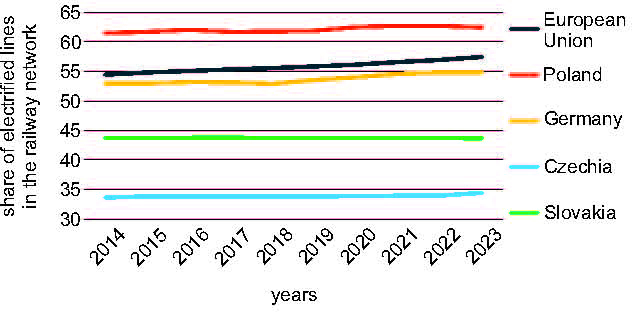
Fig. 1.
The electrification level of the railway network in Poland, compared to the EU and neighbouring countries in 2014–2023 based on Eurostat database.
Table 3.
The electrified railway network in Poland, according to network managers, in 2024 (based on Railway data by Office Rail Transport, Raport Roczny 2024, 2025a, b, Jastrzębska Spółka Kolejowa S.A., PMT Linie Kolejowe Sp. z o.o., Infra Silesia S.A.).
| Railway network operator | Length (km) | Percentage of network |
|---|---|---|
| Total | 12,251 | 62.3 |
| PKP Polskie Linie Kolejowe S.A. | 12,150 | 64.2 |
| Warszawska Kolej Dojazdowa Sp. z o.o.* | 34.5 | 91.6 |
| PKP Szybka Kolej Miejska w Trójmieście Sp. z o.o.* | 32.4 | 100.0 |
| Pomorska Kolej Metropolitalna S.A. | 18.3 | 100.0 |
| Jastrzębska Spółka Kolejowa Sp. z o.o. | 10.2 | 25.1 |
| PMT Linie Kolejowe Sp. z o.o. | 1.8 | 4.5 |
| Infra Silesia S.A. | 1.7 | 5.9 |
| Other managers | 2.1 | no data |
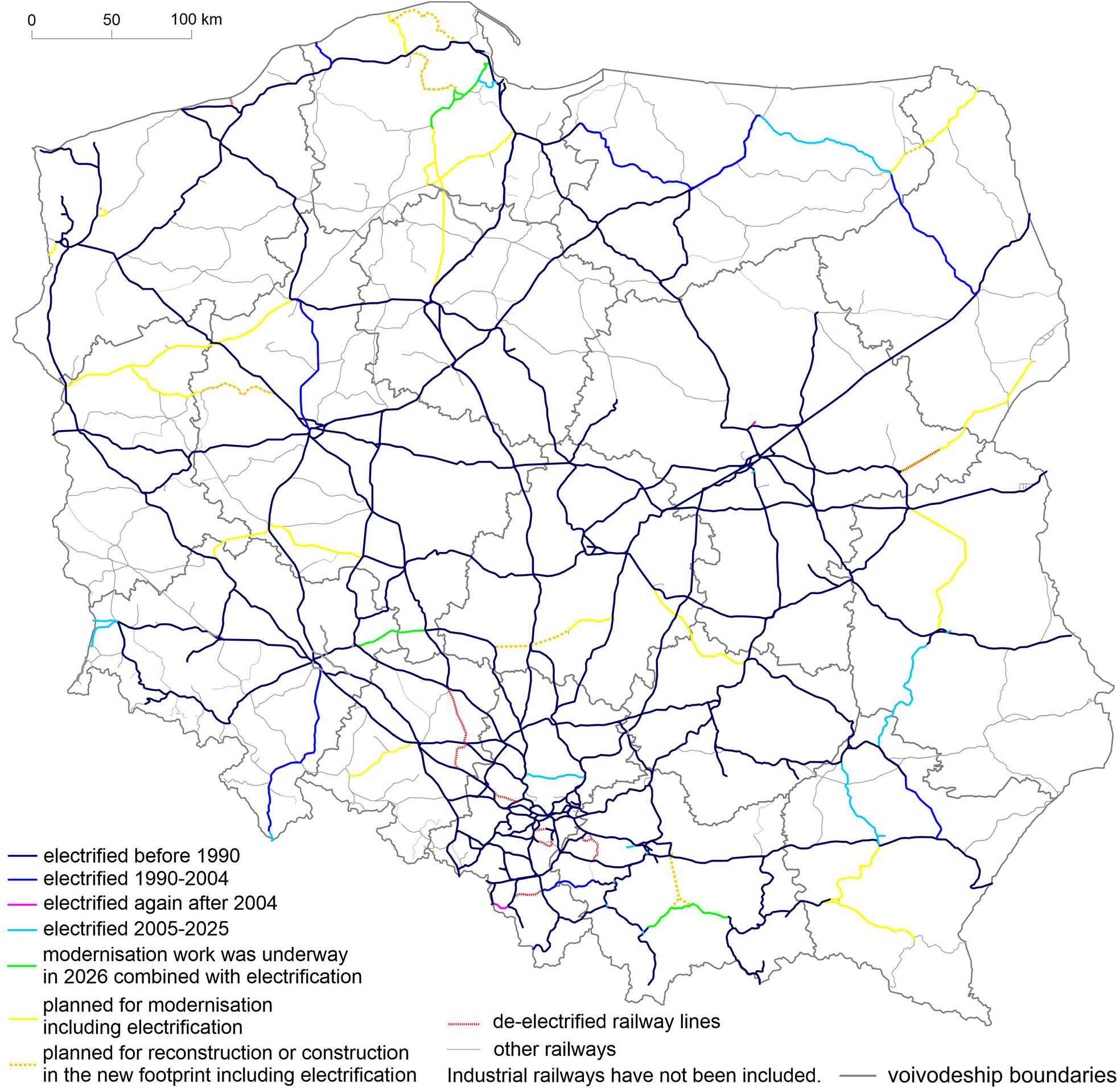
Fig. 2.
Electrification of the rail network in Poland – situation in the mid-2026 (based on press information of PKP Polskie Linie Kolejowe S.A., Open Rail Map, Taylor (2007), Stankiewicz and Stiasny (2014), Resolution 218/2023).
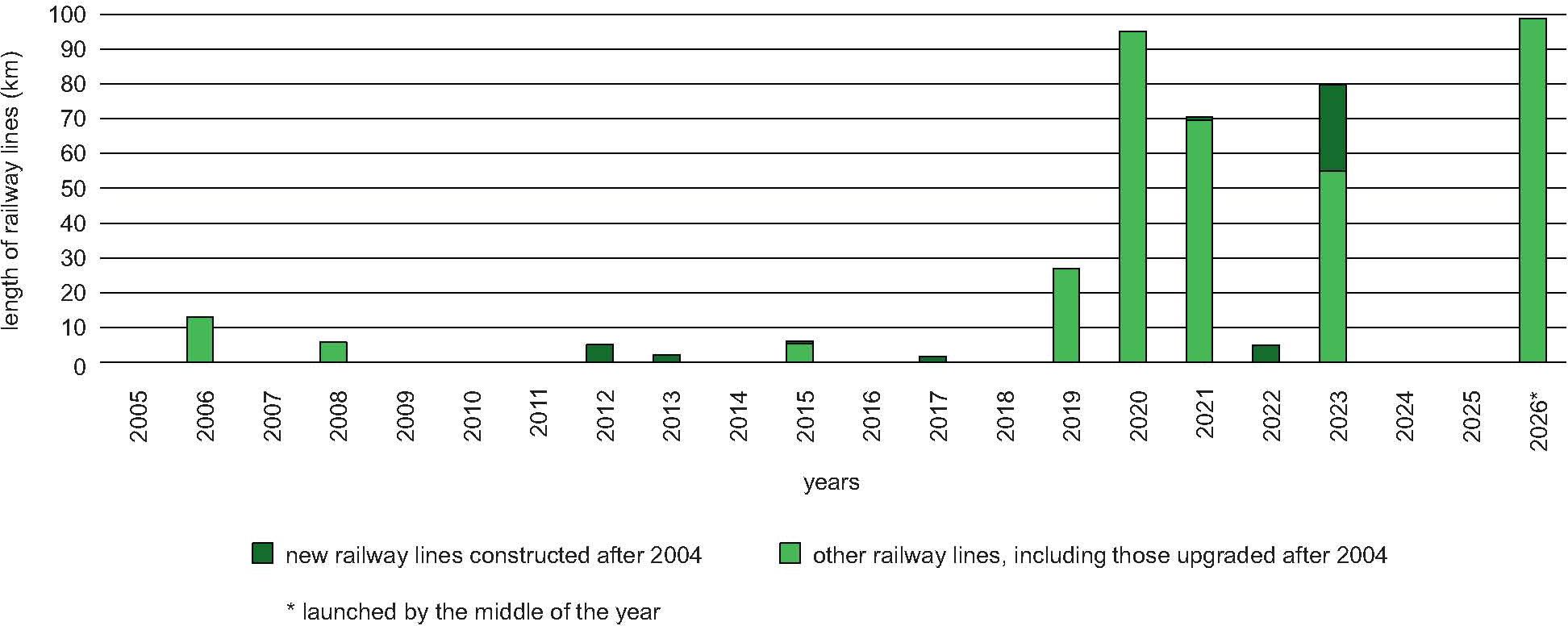
Fig. 3.
Railway lines in Poland that were electrified between 2005 and 2024 (based on Press information of PKP Polskie Linie Kolejowe S.A.).
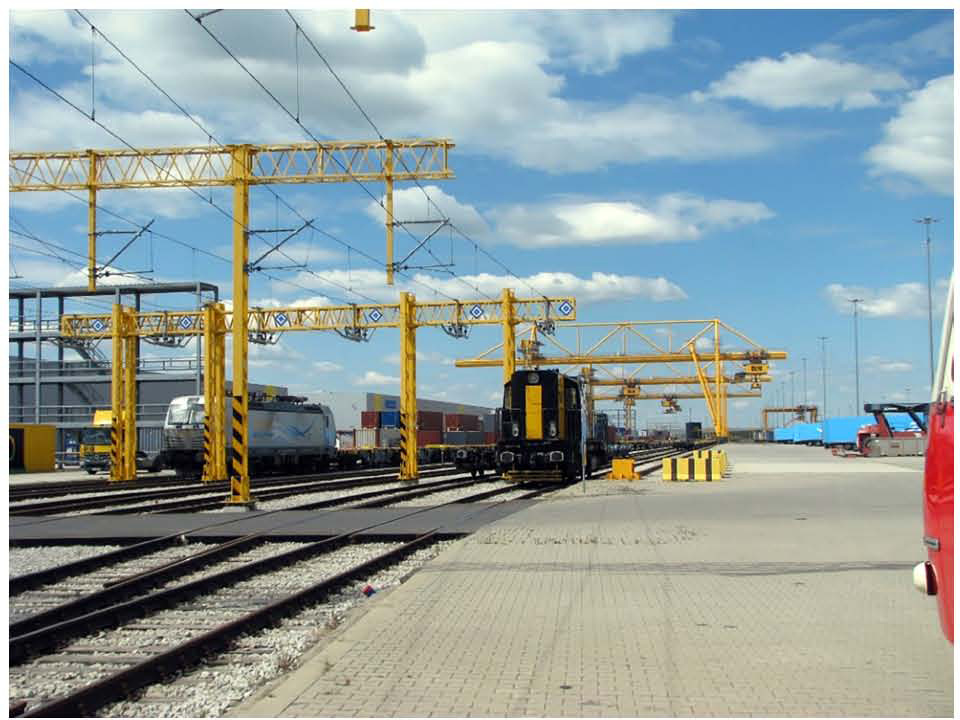
Fig. 4.
Electrified siding of the CLIP Swarzędz intermodal terminal, May 2025 (photo by the author).