
Introduction
Rail transport is characterised by low external costs and at the same time enables the relatively fast movement of large volumes of goods and passengers. In addtition, it shows high susceptibility to the use of electric propulsion, which further reduces its environmental impact. The electrification of rail transport is recognised as a key factor in the implementation of the European Union’s sustainable transport goals (Clausecker et al. 2010, Robinson, Schut 2014, Colovic et al. 2021, Ramos da Silva et al. 2023, Zhan 2024). Rail transport accounts for 3% of total CO2 emissions in transport, and electrification will contribute to further emission reductions, especially considering the use of renewable energy sources (Robinson, Schut 2014). Previous studies point to the need to invest in electrification to increase the sustainability and efficiency of rail transport. This will lead to environmental improvements and transport efficiency across Europe (Dolinayová, Morihladko 2024). It was also pointed out that electrification enhances the competitiveness of railways compared to other modes of transport and improves passenger satisfaction (Amos, Galbraith 1985, Colovic et al. 2021). Attention was also drawn to the need to extend electrification to include hydrogen or battery-powered traction on less busy lines (e.g., Wasserstoff für den Schienenverkehr, 2022, Zenith et al. 2024). An important issue addressed in publications on railway electrification concerns the technical aspects of the implementation and operation of overhead contact lines (e.g., Hooper, McCormack 2010, Stephan, Zweig 2013).
Electrification has numerous benefits but it also comes with some challenges and significant infrastructure construction and maintenance costs. Table 1 summarises the benefits and problems associated with rail electrification that were most frequently identified in the literature.
Table 1.
Benefits and problems of rail electrification based on Harvey (1977), Amos and Galbraith (1985), Krastev et al. (2016), Zhan (2024).
| Impact | Cause | |
|---|---|---|
| Benefits of electrification for | railway system | - reduced operating costs for carriers (easier maintenance of rolling stock and less susceptibility to breakdowns) - increased efficiency through better acceleration and deceleration capabilities - ability to operate at higher speeds and accommodate more trains |
| carrier | - lower energy consumption (higher energy efficiency) - stable and continuous power source - eliminating the need to stop for refuelling | |
| environment | - reduction of air pollutant emissions (particulate matter, greenhouse gases and others) and noise pollution | |
| customers | - improving service quality (travel time, travel comfort) | |
| Challenges and problems | high initial capital costs | - construction of overhead line installations and power substations - electrification of existing lines may require their reconstruction, especially within engineering structures (bridges, viaducts, tunnels) in order to install overhead catenary while maintaining the applicable railway gauge - the need to expand the power grid to supply energy to traction substations |
| infrastructure maintenance costs | - the need for regular maintenance of equipment such as transformers and converters | |
| dependence on electricity supply | - the need to ensure continuity of electricity supply for traction purposes - environmental benefits may vary depending on how electricity is generated | |
| tailored to transport requirements | - electrification is economically justifiable on high-traffic routes | |
What has been observed is a much higher intensity of use of electrified lines (Dolinayová, Morihladko 2024). Catenary-powered vehicles still remain the most effective option. This technique allows the delivery of high power to run traffic, and thus achieve high speeds1 (Szeląg 2020). At the same time, it should be noted that electrification is most justified on lines characterised by large volumes of passenger or freight traffic. Operational criteria such as the creation of fully electrified lines, the electrification of sections complementing the system served by electric traction or the electrification of lines in environmentally valuable areas provide additional justification for the investment decision (Pokrzycka 1999). The non-electrification of some sections of the railway network in Poland has been identified as one of the factors limiting the network’s capacity (Piotrowski 2016). In conclusion, the need for and the merits of railway electrification are determined by both economic, and technical and operational factors (Pokrzycka 1999).
The importance of electrification and the use of low-emission rolling stock in rail transport has become increasingly important in recent years. This is related to the limitation of subsidies for the purchase of diesel rolling stock. In the financial perspective of the European Union for 2021–2027, it is no longer possible to obtain funds for the purchase of diesel-powered vehicles. In Poland, more than 7000 kilometres, which is about 38% of the rail network, is non-electrified. Providing modern rolling stock for these lines is therefore becoming increasingly problematic, making hydrogen or battery-electric vehicles a potential alternative. However, their production and use is not widespread, which makes them much more expensive to acquire and maintain. This problem can be partially solved by further electrification of the rail network.
The history of the electrification of the railway network in Poland up to the mid-1990s was described, among others, by Pokrzycki (1999) and was the subject of geographical research by Koziarski (1985); it was also included in the analyses of the overall railway network development (e.g. Lijewski, Koziarski 1995, Taylor 2007). However, there is a lack of publications analysing the modern development of electrification in Poland – one can find only publications about individual investments. The issue of the electrification of industrial railways and selected sidings is discussed in the study of Ciechański (2013).
The aim of the research is to identify current factors and trends for change in the electrification of the railway network in Poland. The course of the electrification of railway lines in Poland in 2005–2024 was analysed. After a decade of stagnation (1996–2005), further railway electrification in Poland was resumed. The process accelerated in the following years. Plans for the coming years include electrification of modernised and newly built rail lines (Rösler 2025).
Study area
The research covered the rail network on the territory of the Republic of Poland.
Materials and methods
The research procedure included:
analysing the electrification level of the rail network in Poland compared to other European countries. The electrification level indicator and the power supply systems used were taken into account.
analysing the proportion of electrified railway lines in Poland and changes in this proportion over selected years. Data on the length of electrified lines and their share of the railway networks of individual infrastructure managers were also presented.
identifying railway lines electrified in the surveyed years and those planned for electrification by 2030, followed by calculating the length of electrified railway lines according to the year in which electric rolling stock entered service.
summarising the conducted research and indicating projected changes in the electrification of the rail network in Poland.
For international comparisons, data published by Eurostat (Eurostat database, 2025) were used. Yearbooks Transport activity results from 2004–2024 published by Statistics Poland (Transport…, 2024) were used to collect data on the length and share of electrified railway lines. It should be noted that Office of Rail Transport (ORT) has been publishing data on rail infrastructure since 2014 (Railway data by Office Rail Transport). At the same time, some differences in the values reported by Statistics Poland and ORT were noticeable. It should be remembered that the changes in the length of active railway lines and the share of electrified lines in the years under study were also affected by line closures. Therefore, additionally, the length of electrified rail lines in the years studied was calculated. Official press releases published by PKP Polskie Linie Kolejowe S.A. (Press information of…) were used for this purpose. Information published by individual railway infrastructure managers was also used, including their annual reports (Raport Roczny, 2025a, b).
Results
The rail network and its electrification in the European Union
The active rail network was located in 38 of 43 European countries, 34 of which had electrified railways. In 10 European countries, some lines were powered by direct current (DC) and others by alternating current (AC). The most popular rail power system in Europe was alternating current (AC) 25 kV 50 Hz, which was used in 24 countries (Table 2). Significant disparities in the degree of electrification of the rail network in individual countries were apparent. At the same time, a gradual increase in the proportion of electrified lines in Europe has been noticeable in recent years (Dolinayová, Morihladko 2024).
Table 2.
The railway electrification level and power systems in Europe in 2023 based on Eurostat database and Open Rail Map.
| Traction power systems | Electrification level of railway network in 2023 | |||
|---|---|---|---|---|
| 75.0–100% | 50.0–74.9% | 25.0–49.9% | 1.0–24.9% | |
| 1.5 kV DC | – | – | – | Irelandb |
| 3 kV DC | – | Poland, Slovenia | – | Latviab, Estoniab |
| 15 kV. 16.7 Hz AC | Liechtenstein, Switzerland, Swedena | Austriaa, Germanya | – | – |
| 25 kV 50 Hz AC | Luxembourg | Bulgaria, Croatia, Finlanda, b, Montenegro, Bosnia and Herzegovina | Hungary, Greece, Croatia, Romania, Serbia, North Macedonia | Lithuaniab |
| 3 kV DC 25 kV 50 Hz AC | Belgiuma | Italya, Portugalb, Spaina, b, Ukraineb | Slovakia, Czechia, | – |
| 1.5/1.7 kV DC 25 kV 50 Hz AC | – | Netherlandsa, Francea | Denmarka | – |
In contrast, the percentage of electrified lines in the European Union increased by 3 percentage points (p.p.). An analysis of the electrification level among European countries showed that between 2014 and 2023, the largest increases in the share of electrified lines occurred in: Greece (by 18.4 p.p.), Denmark (by 10.2 p.p.), Slovenia (by 8.7 p.p.), Portugal (by 6.8 p.p.), France (by 6.6 p.p.), Spain (by 5.7 p.p.), Serbia (by 5.2 p.p.) (Eurostat database, 2025). In Poland, this indicator increased by 1 p.p., whilst in neighbouring countries such as Germany it increased by 1.9 p.p. and in the Czech Republic by 0.8 p.p.; in Slovakia, however, there was a slight decrease of 0.1 p.p. (Fig. 1). Electrification of the railway network was required for lines forming part of the TEN-T network: “the railway infrastructure of the comprehensive network is fully electrified as regards main lines and, to the extent necessary for electric train operations, as regards sidings” (Regulation (EU) 2024/1679, Article 15(2a)). Furthermore, in individual countries, other factors also contributed to the increase in the proportion of electrified lines. The level of electrification of the railway network in Poland was more than five percentage points higher than the EU average. Fluctuations in this level resulted not only from the electrification of further sections of the network, but also from the reopening of non-electrified lines.
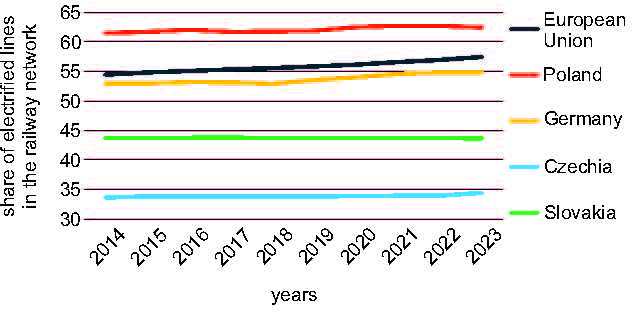
Fig. 1.
The electrification level of the railway network in Poland, compared to the EU and neighbouring countries in 2014–2023 based on Eurostat database.
Electrification of the railway network in Poland
In Poland, a 3 kV DC power supply system has been adopted for the rail network, which allows speeds of up to 220–250 km/h. In the future, a power supply system of 2 × 25 kV 50 Hz that will allow increasing the speed of trains on new adapted lines to over 300 km/h is expected to enter service on selected lines. Such a power supply system is widely used on high-speed railways also in countries where another basic power supply system was previously adopted (e.g. Italy, Spain, Belgium, the Netherlands). This system is to be implemented on new high-speed rail (HSR) lines and, in the long run, on the existing Central Railway Line2 (Szeląg, Maciołek 2015, Bocheński 2024).
The electrification of railways was a major achievement of Polish People’s Republic (Szeląg et al. 2020). The process continued after the political and economic transition between 1990 and 1994 and then came to a halt. Between 1946 and 1990, 11,387 km of railways were electrified, and between 1991 and 1995 another 372 km (Pokrzycka 1999). The end of the 20th century and the beginning of the 21st century in Poland was marked by a significant regression of the rail network. Primarily non-electrified lines were decommissioned, which indirectly led to a slight increase in the level of electrification. However, there were also cases of de-electrification3 and closure of electrified lines (Taylor 2007). After Poland’s accession to the European Union in 2004, the process of modernising railway infrastructure began, supported by European funds. Earlier plans for further electrification of the rail network were also revisited. In total, as of the end of 2024, there were 12,251 km of electrified railway lines in Poland, which accounts for 62.3% of the active railway network. The traction network was installed on railway lines managed by several operators (Table 3), but the power infrastructure – i.e., the traction network, supply substations and connections to the national power grid – is maintained by a separate entity: PGE Energetyka Kolejowa S.A. (formerly PKP Energetyka). It should be noted, however, that, like the vast majority of the railway network, most of the electrified lines were managed by the national operator PKP Polskie Linie Kolejowe S.A., whilst other operators managed only 101 km (0.8%) of electrified railway lines in Poland.
Table 3.
The electrified railway network in Poland, according to network managers, in 2024 (based on Railway data by Office Rail Transport, Raport Roczny 2024, 2025a, b, Jastrzębska Spółka Kolejowa S.A., PMT Linie Kolejowe Sp. z o.o., Infra Silesia S.A.).
| Railway network operator | Length (km) | Percentage of network |
|---|---|---|
| Total | 12,251 | 62.3 |
| PKP Polskie Linie Kolejowe S.A. | 12,150 | 64.2 |
| Warszawska Kolej Dojazdowa Sp. z o.o.* | 34.5 | 91.6 |
| PKP Szybka Kolej Miejska w Trójmieście Sp. z o.o.* | 32.4 | 100.0 |
| Pomorska Kolej Metropolitalna S.A. | 18.3 | 100.0 |
| Jastrzębska Spółka Kolejowa Sp. z o.o. | 10.2 | 25.1 |
| PMT Linie Kolejowe Sp. z o.o. | 1.8 | 4.5 |
| Infra Silesia S.A. | 1.7 | 5.9 |
| Other managers | 2.1 | no data |
Most of the railway lines electrified in Poland since 2004 are located in eastern Poland (Podkarpackie, Lubelskie and Warmińsko-Mazurskie Voivodeships) – a total of around 270 km by 2026. Among the most important electrification projects, which have significantly improved long-distance passenger services in particular, was the completion of the electrification of the following routes: Olsztyn–Białystok via Korsze and Ełk, Lublin–Stalowa Wola and Tarnobrzeg–Rzeszów – making it possible, among other things, to travel by electric train between Lublin and Rzeszów. Furthermore, substantial investments in this area are planned there, including in Podlaskie Voivodeship (Fig. 2). A specific situation has arisen in Górny Śląsk (Upper Silesia), where both de-electrification and, currently, electrification have taken place, including the re-electrification – the case of the Cieszyn–Goleszów line. Pomorskie Voivodeship is also worth noting, where ongoing and planned works stem from both the need to improve cargo transport to and from the port in Gdynia and the construction of a nuclear power plant. Planned investments in Lubuskie and Wielkopolskie Voivodeships are aimed at improving the rail link to Gorzów Wielkopolski – the only voivodeship capital without access to an electrified railway line (Fig. 2). The electrification projects connected previously electrified lines. This improved the coherence of the network and made it easier to organise services, particularly on longer routes. The electrification of cross-border connections with Germany is also of great importance, as it facilitates international transport, for example on the Węgliniec–Horka railway, as well as the planned Zgorzelec–Görlitz and Szczecin-Angermünde railway.
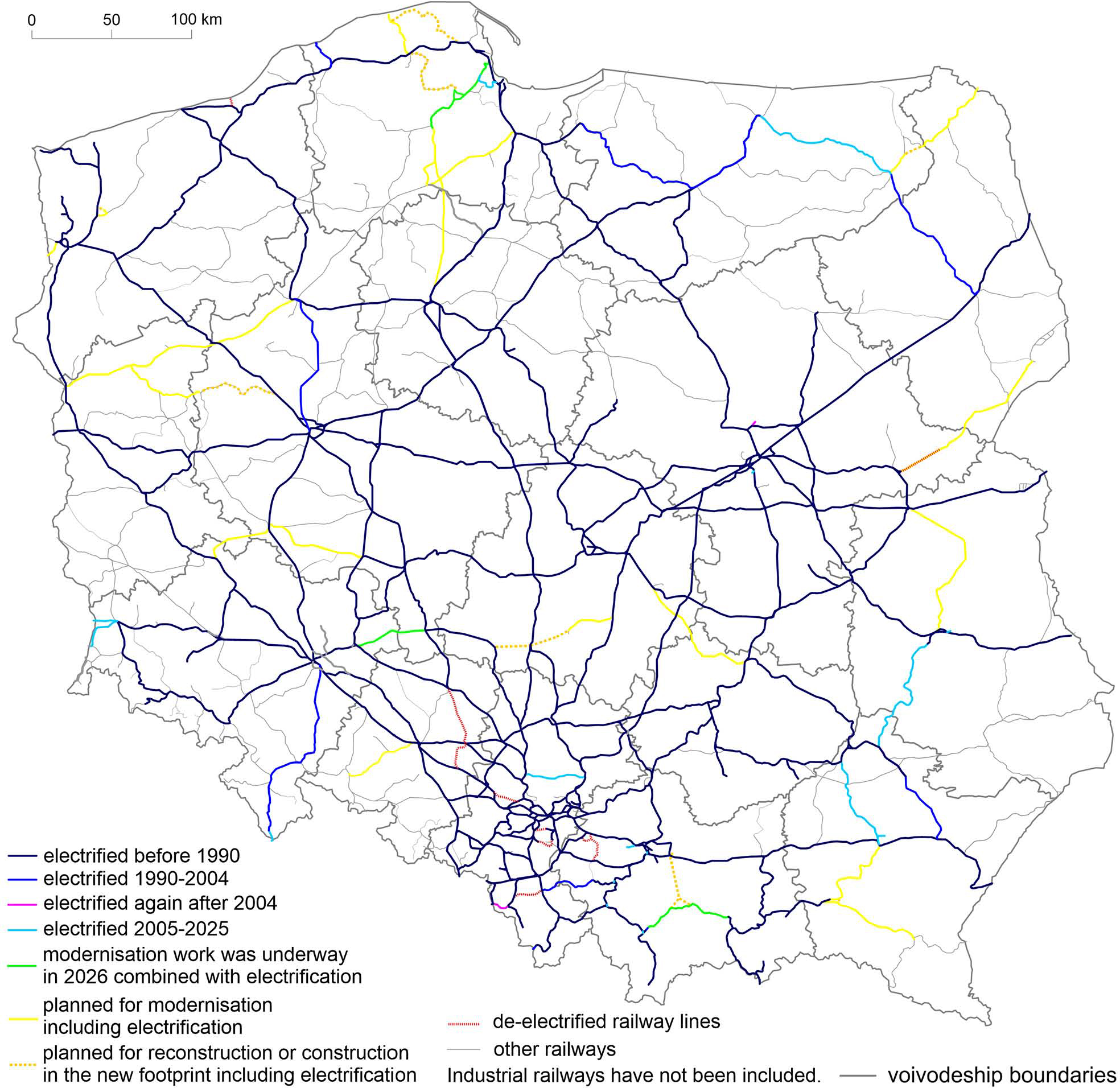
Fig. 2.
Electrification of the rail network in Poland – situation in the mid-2026 (based on press information of PKP Polskie Linie Kolejowe S.A., Open Rail Map, Taylor (2007), Stankiewicz and Stiasny (2014), Resolution 218/2023).
The electrification of the rail network in Poland after 2004 included both existing lines and a small number of newly constructed lines (Fig. 3). Based on the analysis it was calculated that between 2005 and 2024 overhead contact lines were put into service on 271 km of previously non-electrified railway lines and on 40 km of newly constructed lines – a total of 311 km. In addition, around 18 km of decommissioned lines were brought back into service and electrified again. Modern electrification in Poland has primarily focused on the TEN-T network lines. However, 40 km of newly built lines (constructed after 2004) have been electrified, and there are plans to electrify a further 650 km of railway lines outside the TEN-T network.
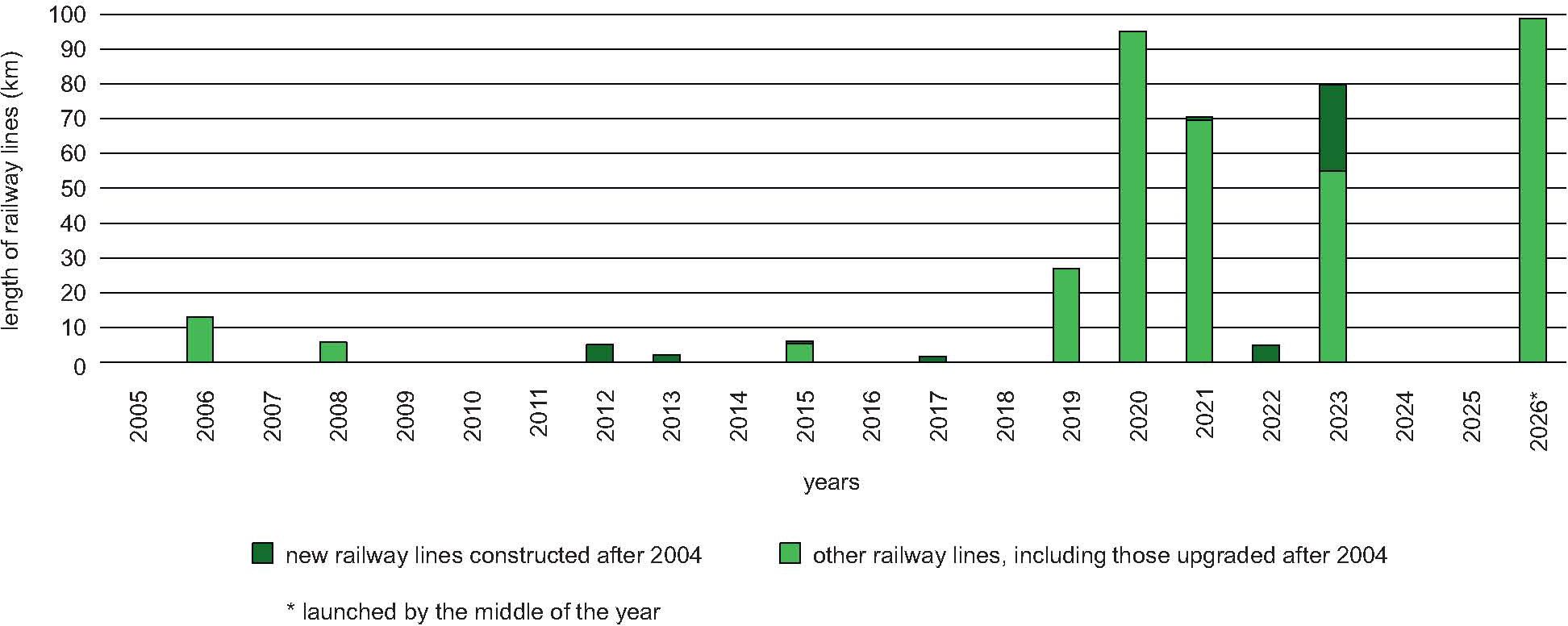
Fig. 3.
Railway lines in Poland that were electrified between 2005 and 2024 (based on Press information of PKP Polskie Linie Kolejowe S.A.).
In 2026, electrification work was underway on additional railway lines with a total length of around 130 km, out of more than 1,300 km planned for electrification (Rösler 2025, Press information of…, Resolution 218/2023). In addition, the construction of new electrified lines was planned, including High Speed Rail.
In addition to the public rail network, sidings also play an important role in the operation of rail transport. In this case, the level of electrification was limited. The sidings leading to rolling stock plants for the operation of electric vehicles were electrified, while sidings to loading points and terminals were predominantly non-electrified4. In the past, some industrial railways and sidings were electrified – particularly within the Upper Silesian Industrial Region. As a result of declining freight volumes and the deterioration of these lines5, most of them were de-electrified by 2005 (Ciechański 2013). Industrial railways associated with the Konin lignite mine6 (about 25 km in operation in 2025) and Adamów lignite mine (closed along with the mine in 2020) were also electrified. These networks operated largely in isolation from the public railways and were electrified at 2.4 kV DC (Ciechański 2013, Malesza 2022).
After 2020, electrification included previously non-electrified access to the seaports in Gdynia and Szczecin and the intermodal terminals at these ports (Baltic Container Terminal in Gdynia and DB Cargo Port Szczecin), as well as to the largest land-based intermodal terminal at the CLIP logistics centre in Swarzędz in the Poznań agglomeration. The traction network has been connected to the loading tracks at the above-mentioned terminals (Nowy układ. 2021, Press information of…, Fig. 4). The solution adopted makes it possible to eliminate the need for shunting locomotives (usually diesel) or double shunting locomotives, and to place a train set directly on the loading tracks using a line (train) electric locomotive supplied from the traction network (Fig. 4).
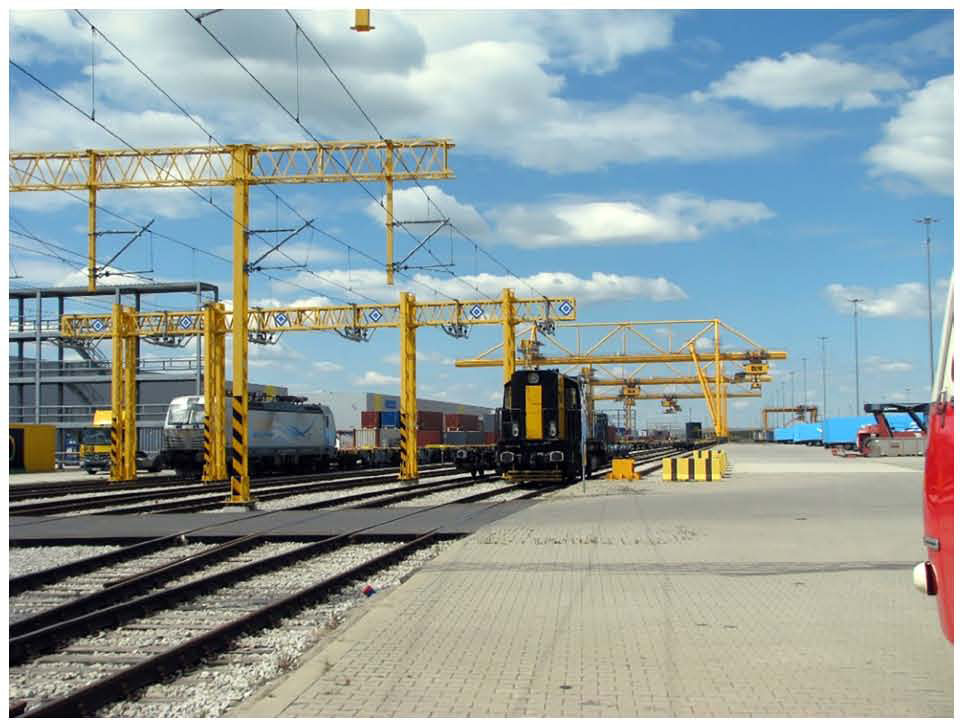
Fig. 4.
Electrified siding of the CLIP Swarzędz intermodal terminal, May 2025 (photo by the author).
Conclusion and discussion
The railway network in Poland has been largely electrified. Further electrification is an important part of modernising and extending the existing railway network. What is particularly important is the electrification of missing sections within the TEN-T transport corridors. There has been a return to the implementation of investments planned several decades earlier (Bocheński 2024). As recently as the early 21st century, there was a trend towards the decline of the railway network and the de-electrification of certain sections of railway lines and sidings. Currently, there is a noticeable trend towards the electrification of both railway lines and sidings leading to seaports and dry ports (intermodal terminals). The installation of an electric traction system facilitates and reduces the costs of operating long-distance passenger and freight services. In recent years, the process of electrification as part of the modernisation of further railway lines in Poland has become more intensive. This trend is expected to continue in the coming years, aided by the construction of new, mostly electrified railway lines as part of the Integrated Railway Network7 programme. The construction of the Warsaw-Łódź-Poznań/Wrocław HSR line will involve the commissioning of a 25 kV 50 Hz AC power supply system.
Poland’s growing share of electrified lines is consistent with the general European trend and the requirements for the decarbonisation of transport and the adaptation of lines to TEN-T standards. In neighbouring Germany, the plan was to have 75% of the rail network electrified by 2030, whilst for routes where electrification via an overhead line is not cost-effective, the plan is to introduce hydrogen traction (Wasserstoff für den Schienenverkehr, 2022). The use of alternatives to the expansion of the traction network was also analysed in the Czech Republic, which has a significantly lower proportion of electrified lines than Poland. Technical and economic analyses on selected lines showed higher electrification costs compared to the use of hydrogen or battery traction, depending on the route under consideration (Zenith et al. 2024). It should be noted, however, that in the Czech Republic there are still many short sections in operation that serve towns and villages off the main routes (Król, Taczanowski 2016). Electrification of such lines is often less economically viable due to lower passenger demand. In Poland, tests were also carried out on the use of hydrogen traction on non-electrified lines and railway sidings (eg. Testy wodorowej lokomotywy, 2025).
The analysis carried out has shown that, following a period of stagnation at the end of the 20th century and the beginning of the 21st century, the electrification of the railway network in Poland has regained momentum. Investments in this area are supported by the EU’s climate and transport policies, as well as opportunities to secure funding from European funds. Electrification facilitates transport operations, particularly over long distances – in both passenger and freight services. This leads to increased efficiency and competitiveness of rail transport.
A possible direction for further research could be a comparative analysis of the intensity of use of electrified and non-electrified railway lines in Poland. Dolinayová and Morihladko (2024) indicate that the former are more heavily utilised. However, in the case of Poland, analyses of train traffic such as those by Bocheński (2024) show high traffic intensity on some non-electrified lines. This also demonstrates the potential for further electrification of the railway network in Poland.
Further electrification of the railway network in Poland is expected in the near future, as part of its modernisation and expansion. Priority should be given to connecting all large and medium-sized towns and cities in Poland to the electrified railway network. The development of the HSR network will be linked to the introduction of lines powered by alternating current. In the longer term, in addition to the main routes, it is likely that regional lines serving high passenger volumes to and from the largest cities will be electrified. Cooperation with Germany on the electrification of cross-border connections is also an important issue.
Notes
[4] Contributed by Author’s contribution
The research and preparation of this article was carried out entirely by one author.
During the preparation of this manuscript, the author used SciSpaceSM Academic AI Detector for the purposes of literature review. The author has reviewed and edited the output and takes full responsibility for the content of this publication.
[5] The current speed record for an electric train was set in France in 2007 on the TGV line and is 574.1 km/h.
[6] The line connecting the Warsaw agglomeration with the Upper Silesia-Zagłębie conurbation opened in 1977 with parameters modelled on the Italian ferrovia direttissima Firenze-Roma, which was built at the same time. After modernisation in 2015, it became the first HSR line in Poland.
[7] Dismantling of the overhead line to reduce maintenance costs on lines where there has been a significant reduction in services.
[8] Owing to the lack of available data on this subject, an accurate determination of the electrification level of sidings was not possible. This statement is based on the author’s many years of research and observation.
[9] These were coal mining railways and sand railways, some of which were converted into public railways. However, as mines were closed down, their use declined, leading to the removal of electrification and, subsequently, the complete closure of some of them (Ciechański 2013).
[11] A long-term programme for the development of the railway network in Poland (Zintegrowana Sieć Kolejowa, 2026).