

1. Introduction
Recently, global warming has become one of the biggest challenges facing the whole world. To reduce pollution, manufacturers and governments have made great efforts to generate electricity from various renewable energy sources [1,2]. Amongthese alternatives are electric vehicles (EVs), which generate lower carbon emissions and thus aim to replace traditional internal combustion engines (ICEs). EVs have increasingly emerged as an effective solution to the challenges of energy consumption and environmental pollution [3]. EVs have many advantages over ICEs, including powerful acceleration, quiet and smooth operation, energy efficiency, and leaving the air cleaner [4]. However, despite these positive features of EVs, typical customers are less likely to gravitate toward these vehicles. This is because of limited travelling distance, they can cover a distance of only 50 km in the best traffic conditions.
To adapt to the above limitation, EV charging infrastructures must be established at many different locations. However, developing such infrastructure faces numerous challenges, such as limited space, high initial costs, repair and maintenance requirements, and outdated technology [5,6].
One effective method to enhance the energy efficiency of EVs and extend their travel range is by implementing a regenerative braking system. This approach means that the mechanical energy of the rotating part of the vehicle is converted into electrical energy and charges the battery while the vehicle is braking. This means that the vehicle’s engine operates in two different modes: as a generator during braking to store energy back into the battery, and as a motor to move the vehicle during acceleration. This stands in contrast to internal combustion engine vehicles, which waste the vehicle’s kinetic energy as heat due to frictional forces between the vehicle’s wheel and brake disc. The driving range of electric vehicles can be increased by up to 25% by implementing a good regenerative braking system [7,8].
The speed control system is the most important element in determining the efficiency of the regenerative braking system. There are several approaches to controlling the speed, and each method varies depending on the application and the tasks accomplish. Proportional integral derivative (PID) controllers have been designed for a regenerative braking system based on a brushless DC (BLDC) motor [9,10]. However, despite the simplicity of the PID controller and its suitability for real world applications, this controller is linear and limited to a single point in the operating state. Therefore, a PID controller is not the best choice for nonlinear systems with variable speed processes. In addition, the PID controller has other drawbacks, such as overshoot, oscillation and slow response times.
Control systems with Artificial intelligence (AI) have been widely used in various industrial applications due to their unique characteristics [11]. Controller-based AI can detect exceptions and subtle variations that are often difficult to identify in non-linear systems, and which can also prove challenging to control using a fixed-gain PID controller. There are various advanced control techniques AI-based algorithms have adopted for the regenerative braking system. Fuzzy control is one ofthemostimportantcontrol tools in artificial intelligence.
It is a technique based on fuzzy logic, and is ideal for nonlinear, imprecise, and indeterminate systems. Fuzzy control does not require a mathematical model; instead, it operates within ranges of values, interpreting them using linguistic variables. This makes it ideal for controlling systems where precise relationships are difficult to define or maintain, and eliminates the need for constant supervision by a qualified operator. Various research areas have used fuzzy logic controllers for electric vehicles [12, 13]. In [14], fuzzy logic control was proposed to control the motor speed for regenerative braking energy. Three inputs namely, battery charge, braking force and motor speed and one output namely, the control signal were used. Ning et al. [15] proposed a fuzzy control technique that led to a 5.4% increase in the effective recovery rate of regenerative braking energy. Zhao et al. developed a fuzzy optimization algorithm that reduced the battery usage by approximately 1.22% [16].
In this study, an effective and highly efficient control method is proposed to optimize the battery energy storage for a regenerative braking system. The proposed control system consists of a fuzzy PID speed controller and a hysteresis current control loop. The motor speed is evaluated under various operating conditions during acceleration and braking. Compared to other studies the results indicate that the actual speed closely followed the desired speed, with a shorter settling time and without any overshot in the response.
2. Regenerative Braking System
In electric vehicles, the aim of the regenerative braking system is to recover braking energy by distributing it evenly while confirming braking safety. The vehicle’s kinetic energy can be stored in the battery after being converted into electrical energy through an energy extraction process called regenerative braking technology [17]. The regenerative braking system has two operating modes, acceleration and deacceleration as shown in Figure 1. In the first mode, the motor can generate kinetic energy from the electrical power of the battery. The resulting reverse electromotive force opposes the vehicle’s motion according to Lenz’s law, increasing the strength of the magnetic field and accelerating the vehicle. In the second mode, when the vehicle brakes, the battery is charged by converting kinetic energy into electrical energy. In this mode, the machine acts as a generator, which reduces the strength of the magnetic field and decreases the vehicle speed profile [18].
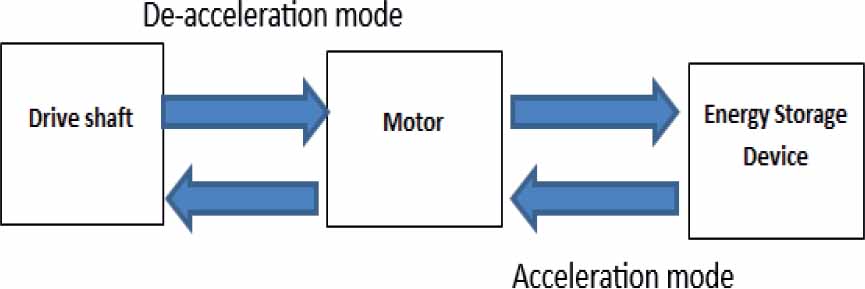
Figure 1.
Regenerative braking system operating modes
There are four main components of regenerative braking technology, as shown in Figure 2. The electric motor/generator is the key component for converting electrical energy into kinetic energy during acceleration, and vice versa during braking. This component acts as a generator during deceleration and as a motor during acceleration.
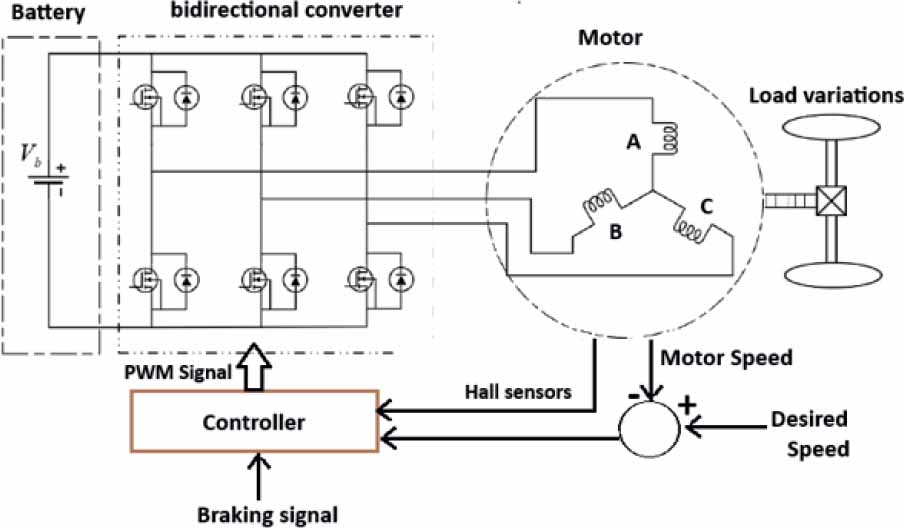
Figure 2.
Main components of a regenerative braking system
The bidirectional converter circuit is the second component, and is used to manage the flow of electrical power between the motor and generator, switching the operating modes of the regenerative braking system. The battery is the third component, and it stores electrical energy generated during braking for later use. This stored energy powers the vehicle or supports the main propulsion system during acceleration. The regenerative braking controller is the final component, controlling the regenerative braking operation mode and coordinating the operation of the battery pack, bi-directional converter, and electric motor/generator to optimize energy recovery during braking.
3. Proposed Controller
The main function of the controller in a regenerative braking system is to recover energy in electric vehicles that may be lost during braking. The controller design aims to ensure the durability and stability for the regenerative braking system. Regenerative braking control is applied to verify the type of operating mode, which determines the vehicle speed and torque estimation. In acceleration mode, this unit increases the engine speed by increasing the applied voltage, which is controlled by the pulse width as applied to the bidirectional switches. While in braking mode, this unit reduces the engine speed by reducing the applied voltage, and reverses the rotation to operate in generating mode so that it can store energy back into the battery. The regenerative braking system can be optimized with proper control unit selection, resulting in reduced braking time and increased battery efficiency.
In this study, the proposed controller consists of the speed and current controllers, as shown in Figure 3. The speed controller is based on fuzzy logic algorithm, while the current controller is based on a Hysteresis current control loop.
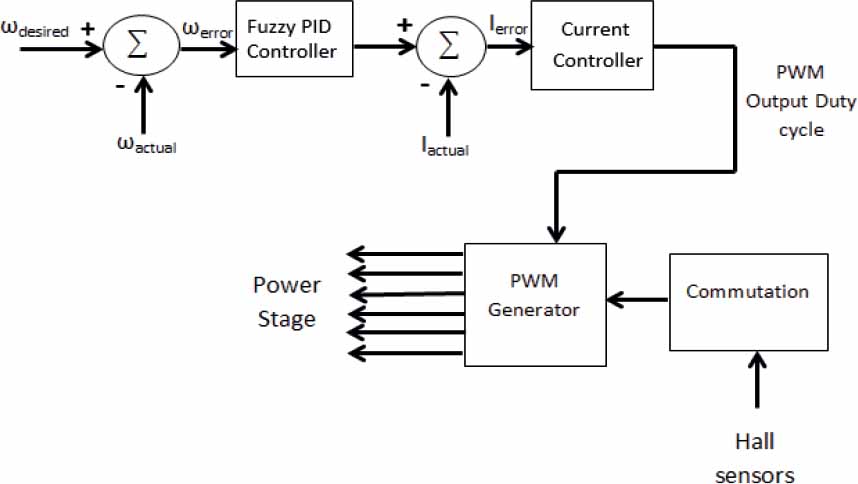
Figure 3.
Proposed control of the regenerative braking system
3.1. Fuzzy Logic Controller
Fuzzy logic is a branch of AI that uses the linguistic terms to analyze and interpret inaccurate information. It has been in use since 1965, and it remains popular due to its reliability in solving nonlinear and complex applications. Fuzzy logic control systems are flexible enough to handle different applications, and can be combined with other control algorithms to optimize control systems [19]. In this study, fuzzy logic control is used to tune the PID coefficients in order to control the motor speed under different operating conditions. Figure 4 shows the proposed Fuzzy-PID controller which consists of three fuzzy logic blocks for Kp, Ki and Kd of PID coefficients, where Kp, Ki and Kd are the proportional, integral and differential gains, respectively. The inputs of each block are the same namely, error and delta error while the outputs are Kp, Ki and Kd. The PID control then processes these outputs to adjust the voltage applied to the motor.
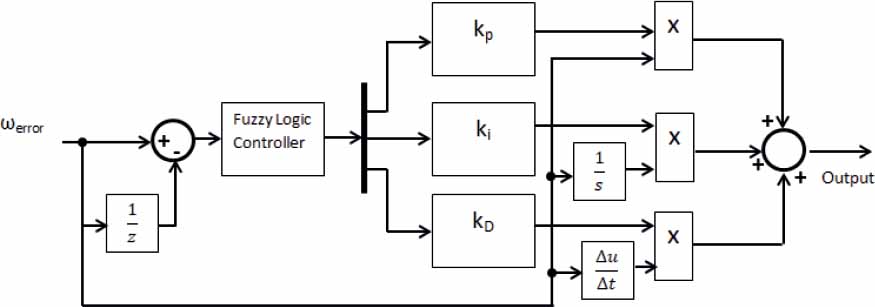
Figure 4.
Block diagram of proposed Fuzzy-PID controller
The fuzzy logic controller is illustrated in Figure 5. All input variables have five fuzzy subsets, which are NB, NS, ZZ, PS, PB, where N is for negative, B is for big, S is for small, ZZ is for zero and P is for positive. A trimf (triangular membership function) is selected with the Mamdani method. Each input has five fuzzy memberships; therefore, there are 25 rules, as can be seen in Table 1.

Figure 5.
Block diagram of Fuzzy logic controller
3.2. Hysteresis Current Control Loop
This control system is applied to control the flow of motor currents through the system. It compares the actual current value with the control signal received from the fuzzy PID controller, adjusting system parameters to maintain the desired current level. The hysteretic loop creates a tolerance range within which the current can vary without requiring any control action. This method is simple and fast-response, making it suitable for applications requiring precise current control.
The duty cycle of the pulse-width modulation (PWM) pulses varies according to the output of this controller, as illustrated in Figure 6 [20].
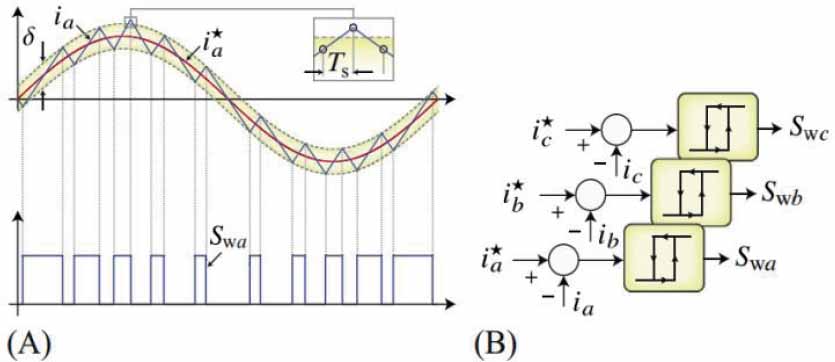
Figure 6.
Principle operation of hysteresis current control loop
The function of the hysteresis current controller is to generate gated signals for the bidirectional switches. The measured motor currents (ia, ib, ic) are compared with the reference currents (ia*, ib*, ic*). The comparator is fed by the calculated error between the reference and actual currents with a prescribed hysteresis band, as shown in Figure 6(b). Any switch is turned off when the actual current attempts to exceed a set value that corresponds to the reference current as shown in Figure 6(a). Despite the simple implementation of the hysteresis current controller, the switching frequency varies with the reference currents and does not remain constant.
4. Results and Discussion
A MATLAB Simulink software was used in this study to design a regenerative braking system with the proposed controller to improve energy storage efficiency. Figures 7, 8, 9, 10 and 11 provide the simulation blocks of the proposed system based on a Fuzzy-PID control method in MATLAB Simulink. The design consists of four main components: the BLDC motor, the bidirectional drive circuit, lithium battery and the proposed controller. Table 2 shows the BLDC motor parameters used in the implementation. To clearly display the system operating modes, the 2-second operating time is divided into two steps; a 1-second period represents the acceleration mode, while the rest of the period is the braking mode. The vehicle speed started at 3,000 rpm up to 1 second in acceleration mode and then slowed down to zero for the rest of the period in braking mode. The load torque varied according to the operating mode; it was a positive value (4N.m) in acceleration mode and a negative value (—4N.m) in braking mode.
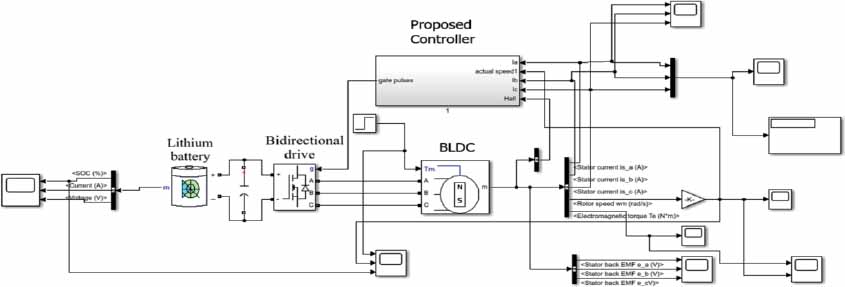
Figure 7.
The proposed regenerative braking system in MATLAB Simulink
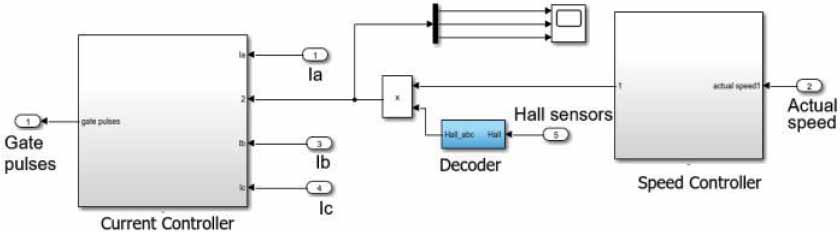
Figure 8.
The proposed controller subsystem in MATLAB Simulink
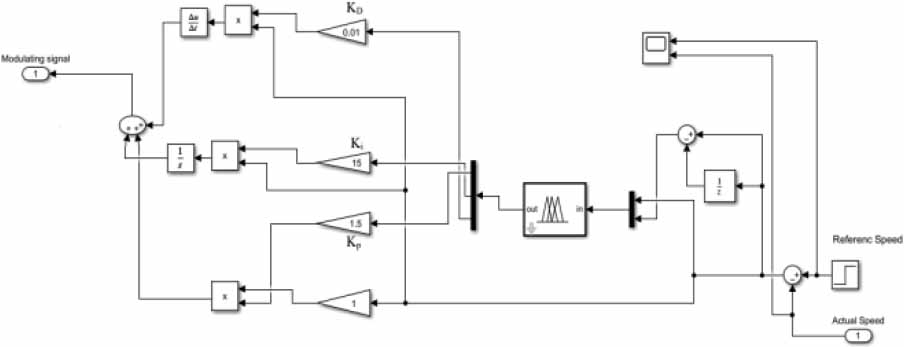
Figure 9.
The speed controller subsystem in MATLAB Simulink
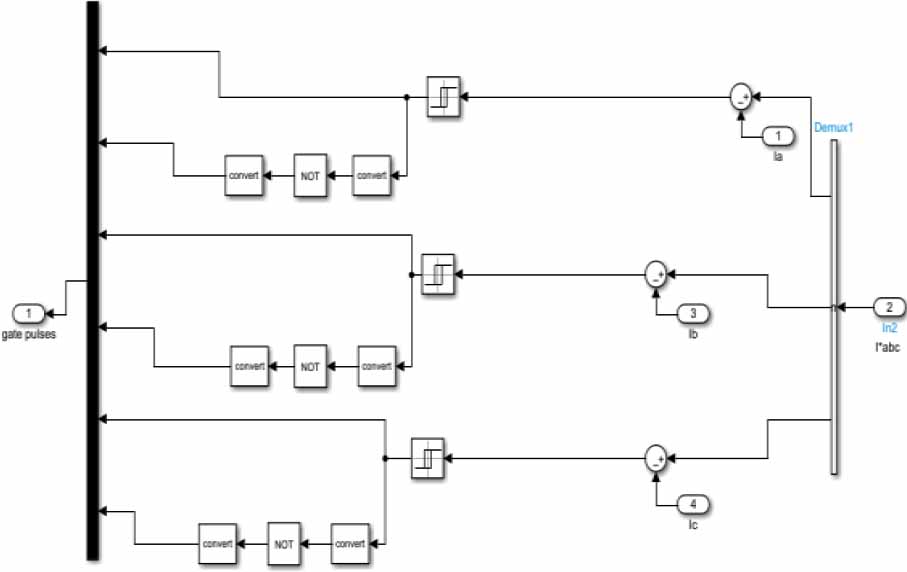
Figure 10.
The current controller subsystem in MATLAB Simulink
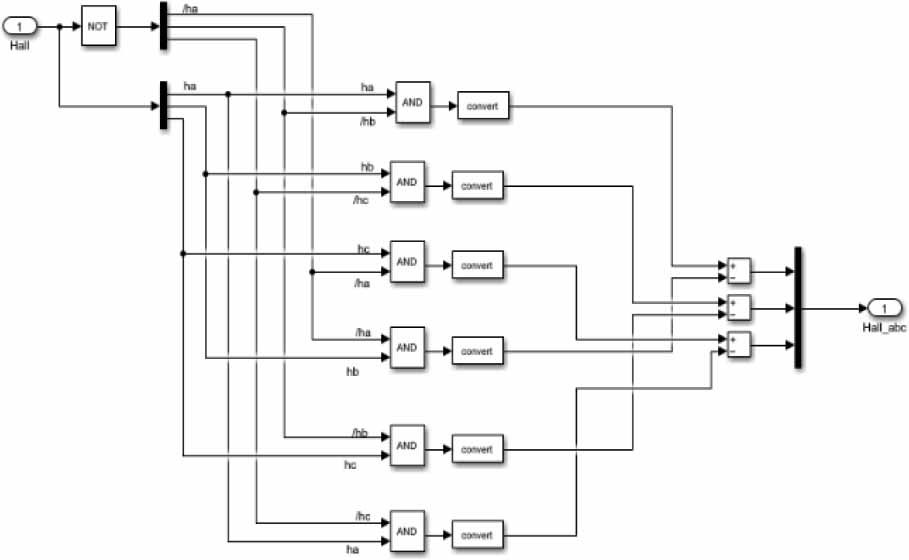
Figure 11.
The decoder block in MATLAB Simulink
Table 2.
Selected parameters of BLDC [21]
| Rating | Symbol | Value |
|---|---|---|
| Inductance | L | 0.0144 mH |
| DC resistance | R | 0.0065? |
| Number of poles | P | 8 |
| Rated voltage | V | 48 v |
| Moment of inertia | J | 0.00019 kg.m2 |
| Motor torque coefficient | Kt | 0.095 N.m/A |
| Viscous damping | F | 1*10−6N.m.s |
| Flux linkage | ϕ | 0.0059375 V.s |
| Load torque | TL | 4 N.m |
The first parameter to investigate in our study was the battery state of charge (SOC). Two different initial battery charge states 90% and 10% are used to evaluate the proposed system under various conditions. The battery discharging and charging are shown in Figures 12 and 13 at SOC 90% and 10%, respectively. The simulation indicates that the battery discharges for 1 second during acceleration mode, and starts charging after 1 second when braking mode is activated. This demonstrates that the proposed system charges the battery at any initial battery charge.
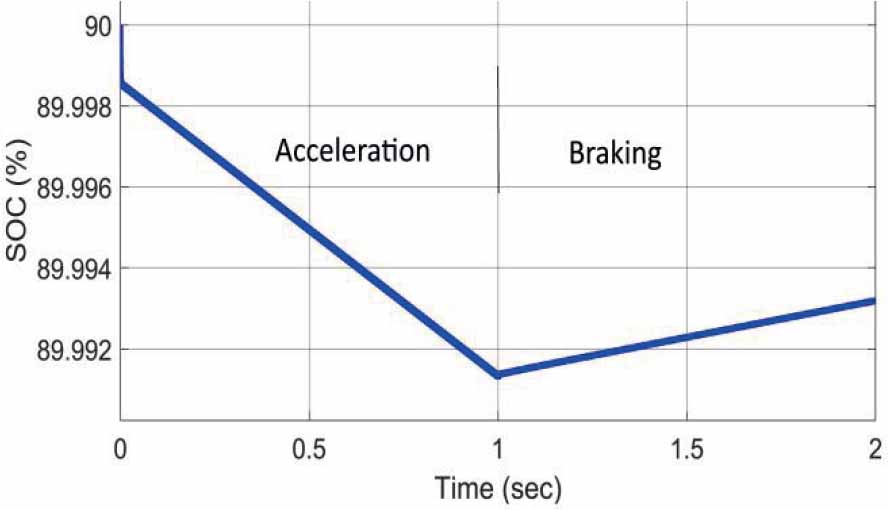
Figure 12.
Variation of SOC with time at 90% of initial battery charge state
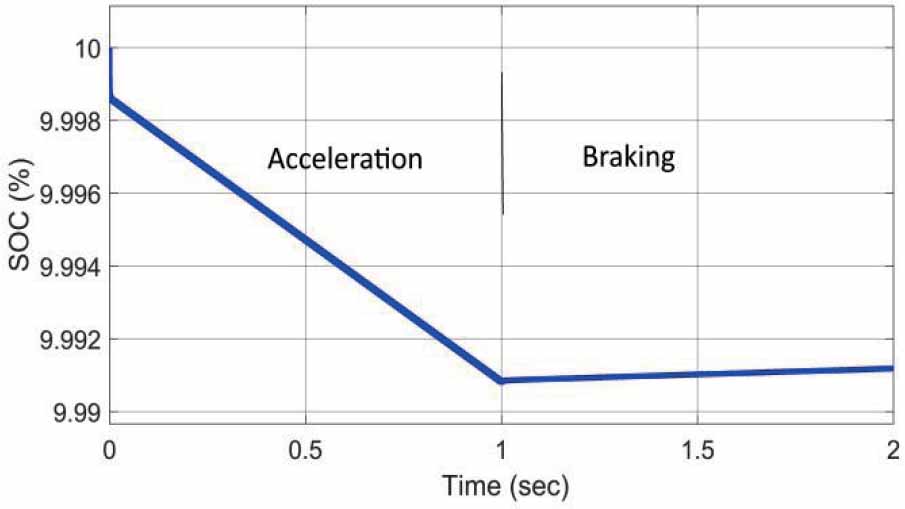
Figure 13.
Variation of SOC with time at 10% of initial battery charge state
The motor speed was the next parameter to be investigated in the simulation under different operating modes. The required speed was 3,000 rpm when accelerating and 0 rpm when braking. Figure 14 shows how the motor speed changes over time, in response to different input conditions. The actual speed of the motor followed the required response without any overshoot. This means that the motor response exceeds the final steady-state value. Settling time is defined as the time required for a system to settle within a certain percentage of the desired output, and it is calculated at about 15 ms.
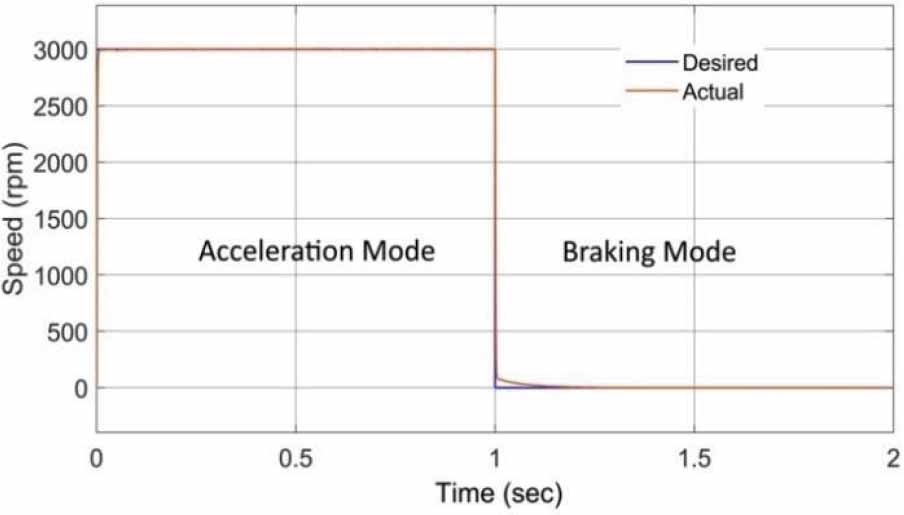
Figure 14.
The variation of desired and actual motor speed with time under accelerating and braking modes
The performance of the proposed system was investigated under load fluctuations. Figure 15 illustrates BLDC motor performance under a sudden change in the load torque. The load was suddenly increased from 4 N.m to 10 N.m at 1 s with motor speed held constant. The simulation result indicates that the undershoot value is approximately equal to 28 rpm with 75 ms of settling time when the load torque is suddenly changed to 10 N.M at 1 sec.
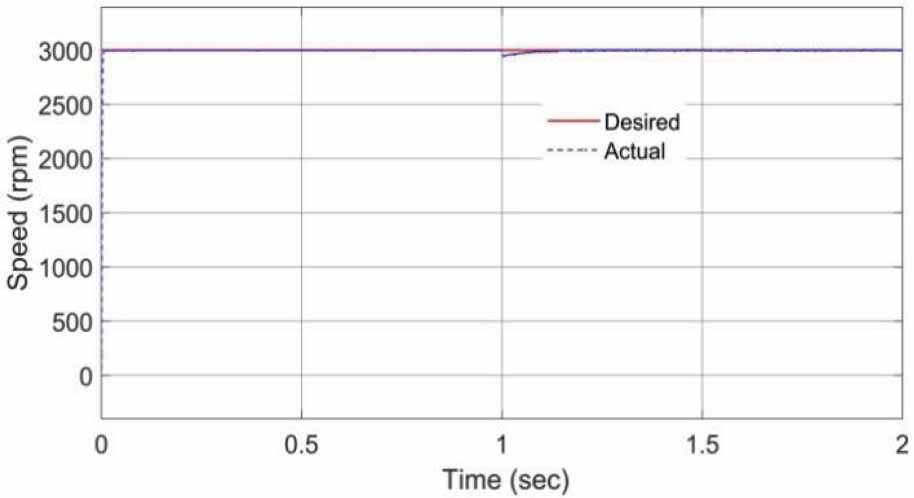
Figure 15.
The variation of the actual motor speed with time under sudden change in load in accelerating mode
A comparative analysis was conducted to evaluate the effectiveness of the proposed model compared to other existing models. Table 3 shows the comparative analysis conducted for the proposed model with the prevailing methods in terms of overshoot and settling time. These results demonstrate that the proposed controller has a much faster response than the existing controllers, meaning it reaches the desired operating speed slightly faster. Thus, the proposed controller provides more efficient and stable control of regenerative braking systems and is more suitable for EV applications.
5. Conclusion
In this study, the regenerative braking technique was investigated in terms of its potential to enhance energy storage in electric vehicles. A BLDC motor is used to power the vehicles. The main advantages of this type of motor are that it is quieter in operation, and that it requires less maintenance due to its commutator and brushless operation. A combination of a fuzzy PID controller and a hysteresis current control loop was proposed to control the motor speed. A MATLAB Simulink program was developed to implement the proposed system while achieving different output simulations.
The battery state of charge (SOC) was studied at both 10% and 90% of the initial charge. Simulation results indicated that the advantages of the proposed system lie in its ability to charge the battery to any initial charge value. Motor speed was evaluated under various operating conditions during acceleration and braking. The actual speed was close to the desired speed, with a shorter settling time compared to other studies. Furthermore, simulation results showed that the proposed control system can improve regenerative braking performance by increasing battery storage power.
This proposal offers good braking performance in terms of efficiency, robustness, and simplicity, proving it to be the best choice for EVs.