

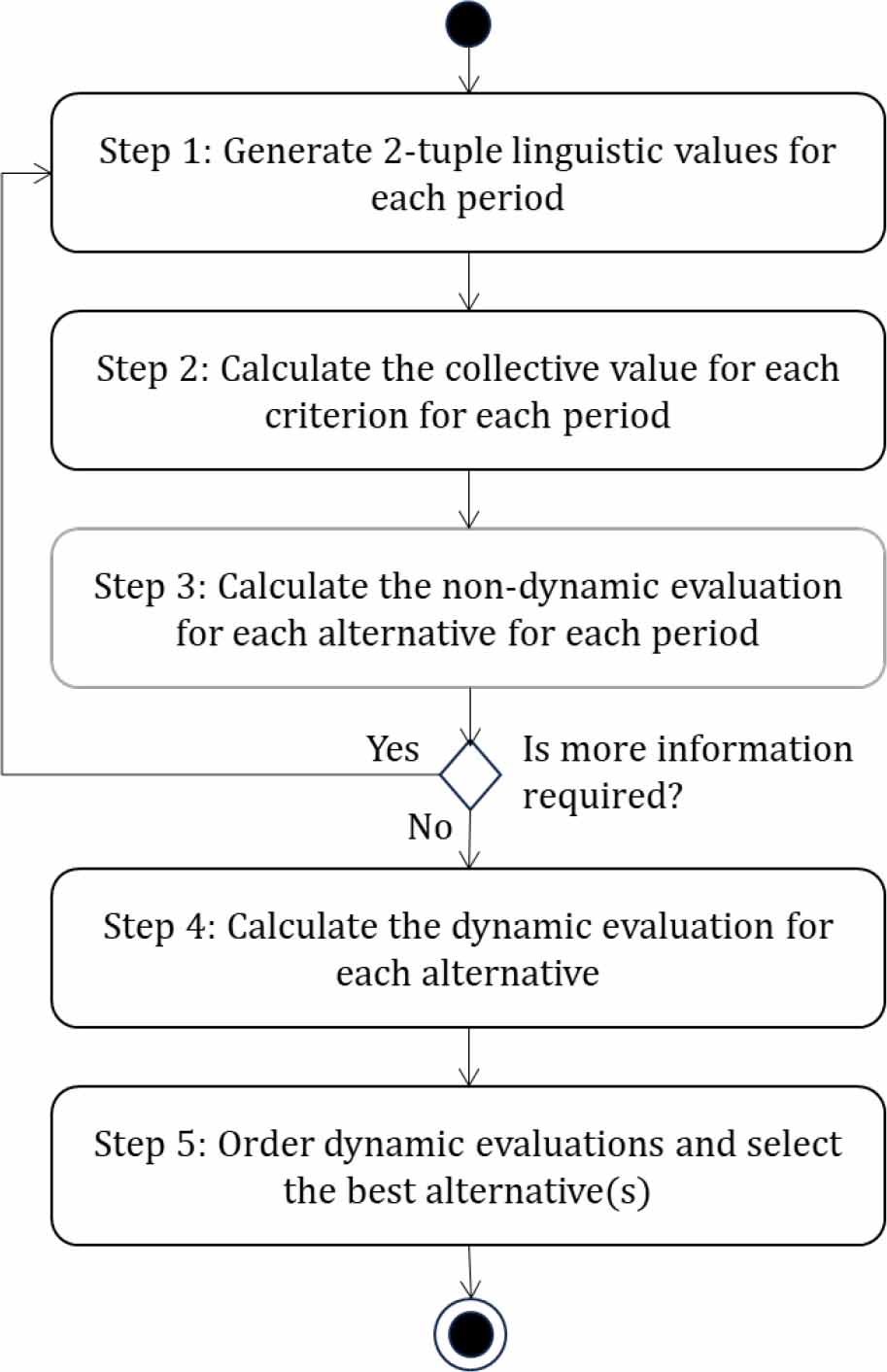
Figure 1.
The flowchart of the proposed approach
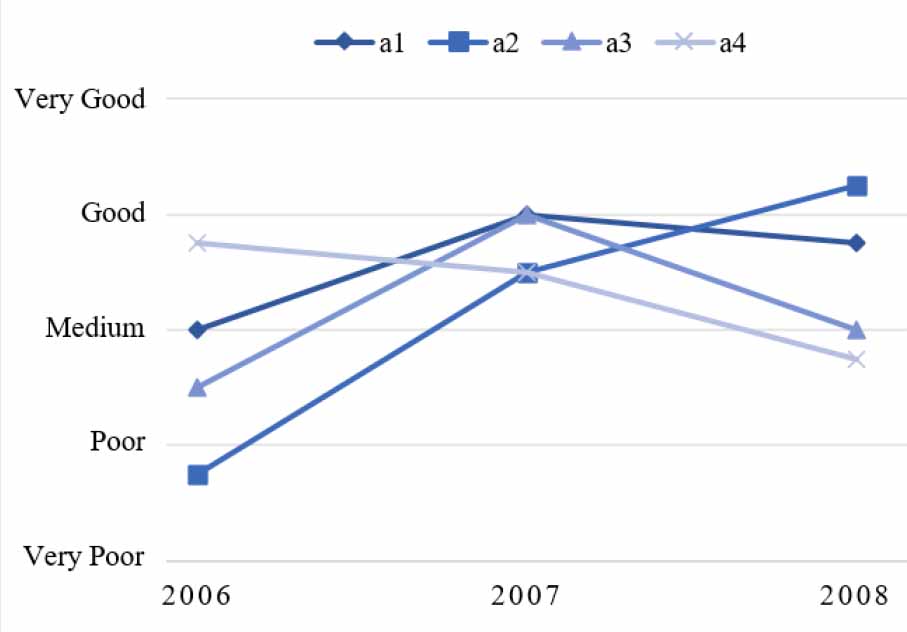
Figure 2.
Non-dynamic 2-tuple linguistic evaluation of alternatives
Table 1.
xijk linguistic values for period t1
| ek | ai | c1 | c2 | c3 | c4 |
|---|---|---|---|---|---|
| e1 | a1 | VP | P | G | M |
| a2 | M | EP | M | VP | |
| a3 | EP | VP | VG | G | |
| a4 | M | VG | VG | M | |
| e2 | a1 | G | P | M | G |
| a2 | P | VP | P | VP | |
| a3 | EP | EP | EG | P | |
| a4 | VG | G | M | G | |
| e3 | a1 | VP | VG | VG | P |
| a2 | G | VP | VP | P | |
| a3 | VP | M | G | G | |
| a4 | G | G | M | P |
Table 2.
xijk linguistic values for period t2
| ek | ai | c1 | c2 | c3 | c4 |
|---|---|---|---|---|---|
| e1 | a1 | M | G | VG | M |
| a2 | P | VG | G | G | |
| a3 | M | G | VG | G | |
| a4 | G | VG | G | M | |
| e2 | a1 | G | G | M | G |
| a2 | G | M | M | G | |
| a3 | G | VG | EG | P | |
| a4 | P | G | P | VG | |
| e3 | a1 | M | M | EG | EG |
| a2 | G | M | VP | VG | |
| a3 | P | G | VG | G | |
| a4 | M | G | M | M |
Table 3.
xijk linguistic values for period t3
| ek | ai | c1 | c2 | c3 | c4 |
|---|---|---|---|---|---|
| e1 | a1 | VP | V | G | M |
| a2 | G | G | M | G | |
| a3 | VP | P | V | G | |
| a4 | M | G | P | VP | |
| e2 | a1 | P | P | E | G |
| a2 | VG | V | G | VG | |
| a3 | M | V | E | P | |
| a4 | P | M | M | G | |
| e3 | a1 | VP | V | E | EG |
| a2 | G | V | M | VG | |
| a3 | VP | M | G | G | |
| a4 | G | P | P | M |
Table 4.
non-dynamic 2-tuple linguistic evaluation of alternatives for each period.
| ai | t1 | t2 | t3 |
|---|---|---|---|
| a1 | (s3,0) | (s4,0) | (s4,–0.25) |
| a2 | (s2,–0.25) | (s4,–0.50) | (s4, 0.25) |
| a3 | (s3,–0.50) | (s4,0) | (s3,0) |
| a4 | (s4,–0.25) | (s4,–0.50) | (s3,–0.25) |
Table 5.
outputs for different ℓ = 0 values in the 2TDOWAWAV,W
| ℓ | a1 | a2 | a3 | a4 |
|---|---|---|---|---|
| 0 | (s4, –.25) | (s4, –.22) | (s3, .25) | (s3,.08) |
| 0.1 | (s4, –.25) | (s4, –.25) | (s3, .27) | (s3, .12) |
| 0.2 | (s4, –.25) | (s4, –.27) | (s3, .28) | (s3, .16) |
| 0.5 | (s4,–.26) | (s4, –.35) | (s3,.33) | (s3.28) |
| 0.8 | (s4,–.27) | (s4,–.42) | (s3,.37) | (s3, .40) |
| 0.9 | (s4,–.27) | (s4, –.45) | (s3, .39) | (s3, .44) |
| 1.0 | (s4,–.27) | (s4, –.47) | (s3,.40) | (s3, .48) |
| 2TDWA | (s4,–.25) | (s4,–.22) | (s3, .25) | (s3, .08) |
| 2TDOWA | (s4,-^7) | (s4, –.47) | (s3,.40) | (s3, .48) |
| 2TDWG [23] | (s4,–.26) | (s4, –.33) | (s3, .21) | (s3,.05) |
| 2TDWHA [23] | (s4,–.27) | (s4, –.48) | (s3,.17) | (s3,.03) |
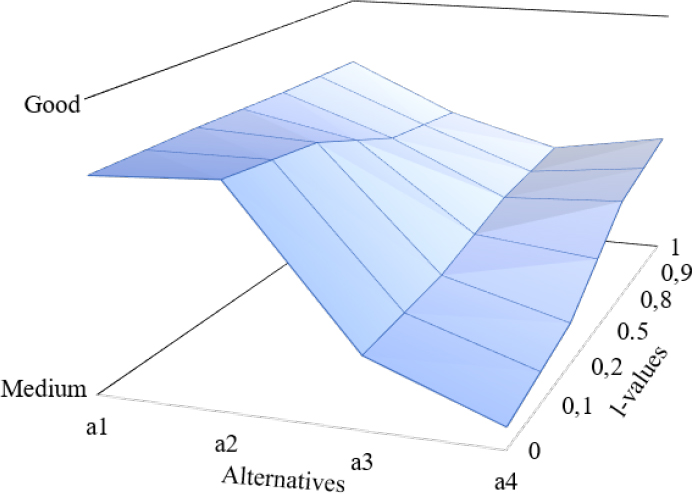
Figure 3.
Dynamic 2-tuple linguistic evaluation of alternatives using different ℓ values