
Table 1
Factors impacting on student retention on online courses (adapted from Lee and Choi, 2011).
| FACTORS | SUB-CATEGORIES | INCLUDED FACTORS |
|---|---|---|
| Student Factor | Academic backgrounds | GPA, previous academic performance, SAT math score |
| Relevant experiences | Educational level, number of previous courses completed online and distance learning courses, previous experience in the relevant field, involvement in professional activities in relevant field | |
| Relevant skills | Time management, underestimation of the time required to balance their academic and professional obligations, ability to juggle roles/balancing multiple responsibilities, strong coping strategies, resilience, relevant prior computer training, computer confidence | |
| Psychological attributes | Locus of control, motivation, goal commitment, love of learning, self-efficacy, satisfaction | |
| Course/Program Factor | Course Design | Team-building activities, program quality |
| Institutional supports | Administrative support, student support infrastructure, orientation, tutorial attendance | |
| Interactions | Inter-student interaction, faculty interaction with students, student participation | |
| Environmental Factor | Work commitments | Employment status, work commitments, increased pressure of work, changes in work responsibilities and environments |
| Supportive study environments | Financial aid, support from family, emotional support, supporting environments allowing study time, life circumstances, challenges and events |
Table 2
Search string.
| CONCEPT | SEARCH TERMS WITH BOOLEAN OPERATORS |
|---|---|
| Dropout | (dropout OR drop-out OR retention OR persistence OR attrition OR disengage*) N5 student* |
| Digital context | AND (online* OR distanc* OR blend* OR mobile OR technology-enhance*) N3 (learn* OR teach* OR study* OR studie* OR degree) |
| Higher Education | AND (“higher education” OR universit* OR college* OR “postsecondary education” OR “tertiary education” OR undergrad* OR postgrad*) |
Table 3
Inclusion and exclusion criteria.
| CRITERIA | INCLUSION | EXCLUSION |
|---|---|---|
| Publication year | 2010–2022 | before 2012 |
| Language | English | Not in English |
| Education level | Digital higher education, distance, open, online, hybrid, or blended learning | face to face only, MOOCs that are not a part of a formal university programme |
| Research type | Empirical research | Literature reviews, conceptional papers |
| Publication type | Peer-reviewed academic journal articles indexed in Scopus, WoS, and Education Source | Not a journal article (e.g., books, book chapters, conference proceedings, introductions, grey literature) |
| Study population | Undergraduate students, master’s students | K-12, PhD students, adult learners in lifelong learning programs |
| Study scope | Papers report on student retention, attrition, persistence, dropout | Not on student retention, attrition, persistence, dropout (out of scope) |
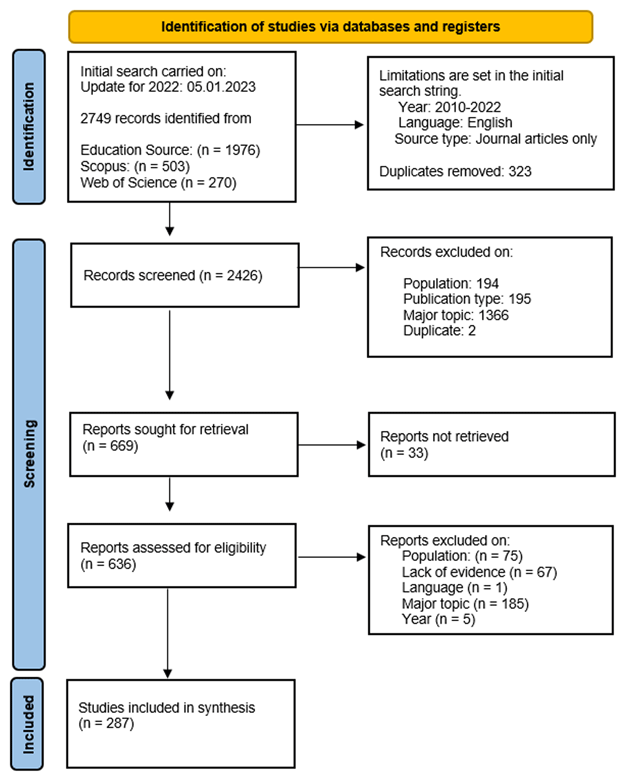
Figure 1
PRISMA diagram (slightly modified from Moher, et al., 2015).
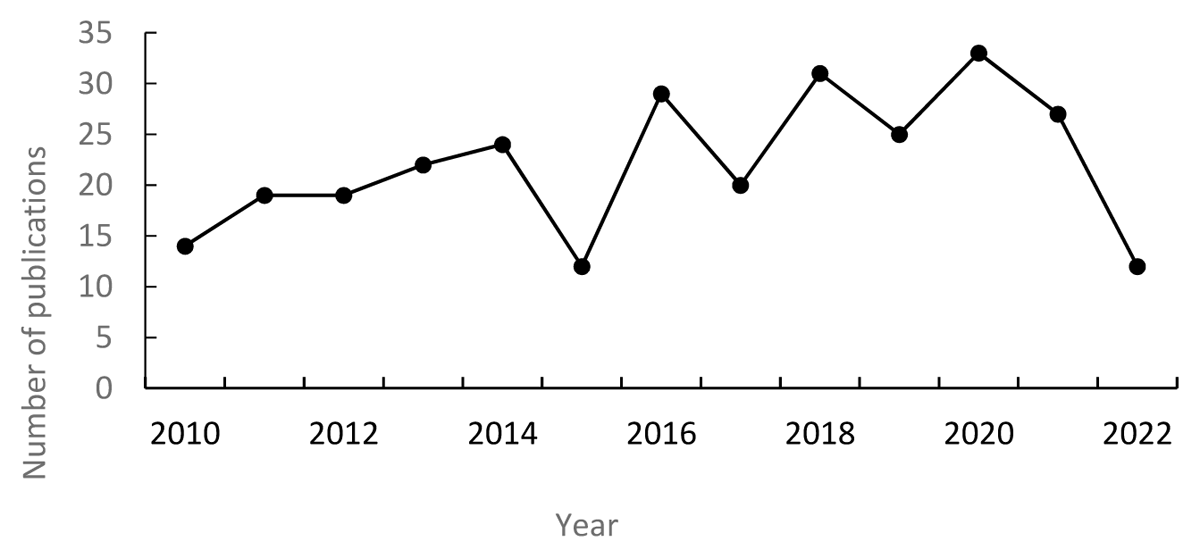
Figure 2
Publications per year (N = 287).
Table 4
Number of included articles in the top ten journals.
| JOURNAL | n |
|---|---|
| Online Journal of Distance Learning Administration | 12 |
| Online Learning | 10 |
| Journal of Educators Online | 9 |
| International Review of Research in Open & Distance Learning | 8 |
| Distance Education | 8 |
| Computers & Education | 7 |
| Open Learning | 7 |
| American Journal of Distance Education | 6 |
| Internet & Higher Education | 6 |
| Journal of College Student Retention: Research, Theory & Practice | 6 |
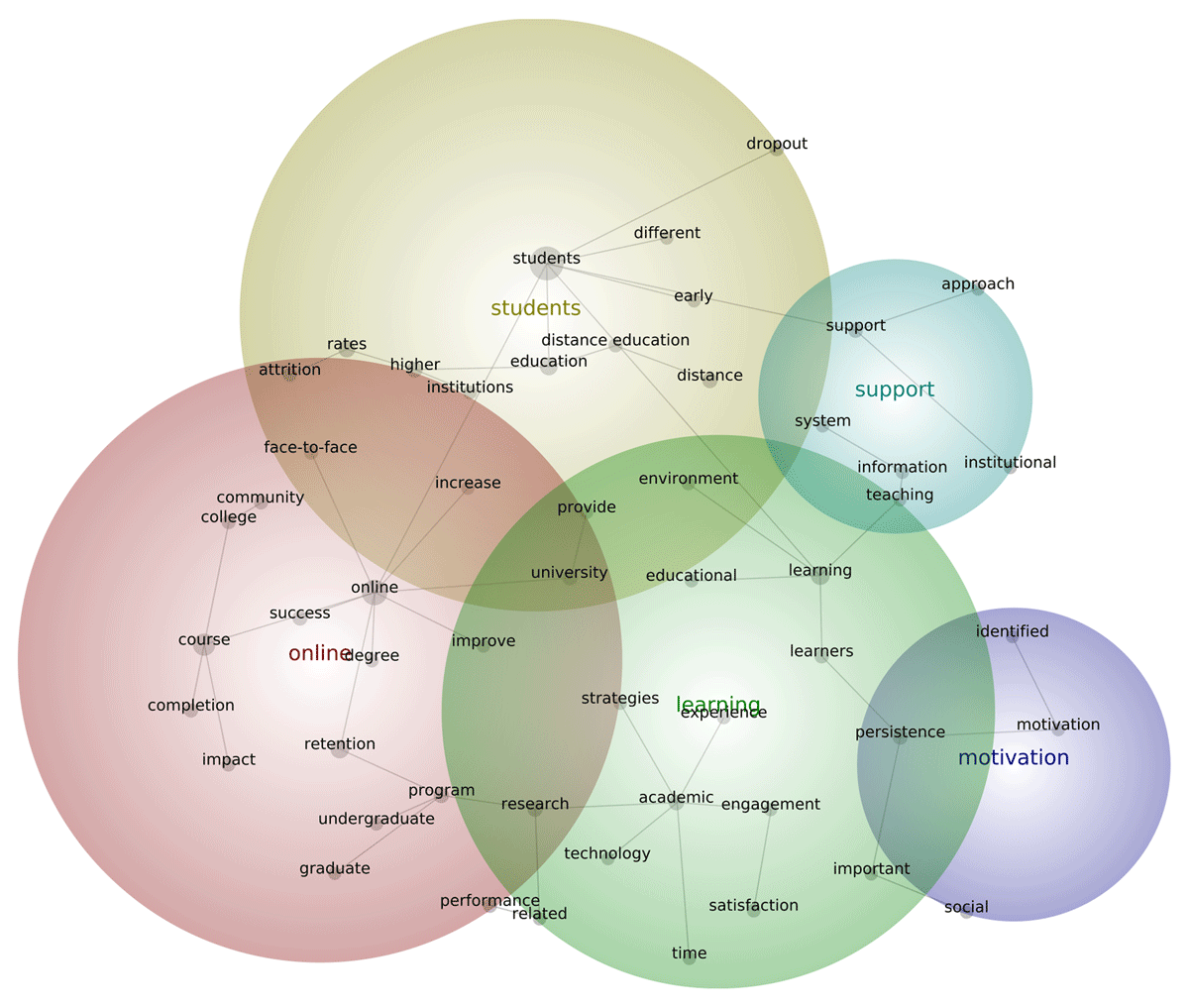
Figure 3
Concept map of the dropout phenomenon from 2010 to 2022 (N = 287).