
1 Introduction
Student attrition has been a major area of concern in higher education (HE) throughout the years and various theoretical models have explored the dimensions and factors that result in student retention or attrition (Spady, 1971; Tinto, 1975; Rovai, 2003). However, in the field of open and distance education, and subsequently online and digital education, the dropout phenomenon became a major concern because student attrition rates have long been reported as higher in open and distance education than in face-to-face, on-campus education (Quayyum et al., 2019; Radovan, 2019; Simpson, 2013).
After the establishment of open and distance education institutions in the late 1960s and 1970s, their institutional consolidation and massive growth into mega-universities (Daniel, 1999) over the next two decades, quality problems emerged and became evident through high dropout rates. Zawacki-Richter and Naidu (2016) showed that the growing rate of attrition from distance education and quality assurance became a major issue in distance education research in the early 1990s. These considerations led to student support being acknowledged as a “critical link in distance education” (Dillon et al., 1992, p. 29). Therefore, research dealing with the design and evaluation of student support systems to address the needs of distance learners saw growing interest from the mid-1990s. Around this time, distance educators were already fascinated by the enormous opportunities that the World Wide Web, networked computers, and especially computer-mediated communication afford for teaching and learning in online environments to overcome the notion of distance education as an isolated form of learning (see Naidu, 1997). The ‘new media’ was seen as potentially enhancing the quality of open and distance education (Kirkwood, 1998).
In light of this vast body of research, learning from previous experiences and evidence in open and distance education is essential to inform current practices and policies in digital education today. As the advancement of educational technology and the demand for HE continue to grow (Arnhold & Bassett, 2021), the context is subject to change, too. The long-established boundaries between conventional brick-and-mortar institutions versus dedicated distance education providers are blurring as technology-driven education is moving into the mainstream of higher education. The rapidly increasing speed of technological development has made digital education, either online or technology-enhanced, a preferred option in higher education (Allen & Seeman, 2017). Online or distance learning has become a viable option for HE institutions looking for prevalence in more and wider student recruitment (Nakamura, 2017). The COVID-19 pandemic has further propelled this trend and proved that teaching through online modalities is a resilient option amidst the crisis. Although there are numerous publications that report the difficulties and limits of online education, digital learning and new developments around generative AI technologies continue to reshape education (U.S. Office of Educational Technology, 2023).
Within this transformation, sustaining the quality of higher education and improving student retention is important, which is one of the quality criteria of HE. However, it is questionable if the old concepts and practices of quality assurance and student support to prevent retention and dropout are still valid in the current digital transformation. In order to inform current practices, it is crucial to attain an in-depth understanding of the dropout phenomenon and explore the phenomenon with evidence from the research literature. Therefore, this study serves as a preliminary analysis of a literature review corpus from 2010 up to the end of the COVID-19 pandemic in 2022. The year 2010 was taken as a starting point for the spread of online education to wider communities through various advancements such as massive open, online courses (MOOCs) and open education resources (OER; see Zawacki-Richter & Naidu, 2016).
In this context, this study aims to address the following research questions:
RQ1 Publication patterns: How are the publications on dropout distributed between 2010 and 2022 according to years and journals?
RQ2 Content analysis: What is the thematic scope of dropout research in ODDE between 2010 and 2022, and how do the research topics relate to each other?
By means of a systematic mapping review and content analysis, this study reveals the reasons, factors, or results that affect student dropout or retention among undergraduate or master’s level students in ODDE settings. Such analyses can enrich the literature by providing information on the selected study field and guidance for future studies and directions (Petticrew & Roberts, 2008).
2 Theoretical foundations and literature review
According to an early definition, dropout is the failure of an individual to continue their engagement in the registered program and disengagement from the academic institution due to socially and/or academically unfavorable experiences (Tinto, 1975). The failure to integrate either one or both of these phases leads the student to depart from the learning journey. Tinto contends that an academic institution needs to provide a learning flow for the student in which the learner will academically and socially be able to continue their initial goal commitment they bring along.
Bean and Metzner (1985) propose a Non-traditional Undergraduate Student Attrition Model building on Spady’s (1971) and Tinto’s (1975) work, which highlights the role of the academic institution and organization. Learners in ODDE are more prone to social integration to that entity since learning at a distance may hinder effective communication with the teaching organization (Bean, 1980). The integration and social interaction between learners and the teaching institutions were added as the “environment” factor in this model.
Kember (1995) builds upon the previous models and emphasizes the external factors that learners in ODDE bring along. These learners have to integrate their family, work, and other social responsibilities into their learning efforts.
Rovai (2003) develops a compound model that unites Bean and Metzner’s (1985) Non-traditional Undergraduate Student Attrition Model with Tinto’s Student Integration Model. They argue that the needs of distance learners, unlike face-to-face learners, are significantly affected by the external factors in their private, social, and professional contexts affects as much as or even more than the academic and social integration with the academic institution. Furthermore, the model introduces the time dimension to the model as “prior to admission” and “after admission”.
Lee and Choi (2011) reviewed 35 empirical studies from 1999 to 2009 and identified 44 factors that are related to non-completion in online distance education. These factors are categorized under three dimensions: student factors, course factors, and environment factors (see Table 1). Their findings clearly indicate how factors that affect student retention and attrition in ODDE “are complex, multiple and inter-related” (Willging & Johnson, 2009, p. 108).
Table 1
Factors impacting on student retention on online courses (adapted from Lee and Choi, 2011).
| FACTORS | SUB-CATEGORIES | INCLUDED FACTORS |
|---|---|---|
| Student Factor | Academic backgrounds | GPA, previous academic performance, SAT math score |
| Relevant experiences | Educational level, number of previous courses completed online and distance learning courses, previous experience in the relevant field, involvement in professional activities in relevant field | |
| Relevant skills | Time management, underestimation of the time required to balance their academic and professional obligations, ability to juggle roles/balancing multiple responsibilities, strong coping strategies, resilience, relevant prior computer training, computer confidence | |
| Psychological attributes | Locus of control, motivation, goal commitment, love of learning, self-efficacy, satisfaction | |
| Course/Program Factor | Course Design | Team-building activities, program quality |
| Institutional supports | Administrative support, student support infrastructure, orientation, tutorial attendance | |
| Interactions | Inter-student interaction, faculty interaction with students, student participation | |
| Environmental Factor | Work commitments | Employment status, work commitments, increased pressure of work, changes in work responsibilities and environments |
| Supportive study environments | Financial aid, support from family, emotional support, supporting environments allowing study time, life circumstances, challenges and events |
Bağrıacık Yılmaz and Karataş (2022) conducted semi-structured interviews with 40 students, instructors, and administrators in open and distance education about the reasons for drop-out. They identified four main dimensions of Rovai’s (2003) model with 37 sub-factors: internal reasons, external reasons, student characteristics, and student skills (p. 12).
De Oliveira et al. (2021) focused on the dropout subject in particular focus on preventing dropout in HE via learning analytics. This study examines scientific production in this domain through a bibliometric and systematic review of research indexed in Clarivate Analytics’ Web of Science and Elsevier’s Scopus. The analysis explores how learning analytics has been applied globally, identifying key data types, techniques, and methodologies. A feature classification is proposed, categorizing student-related attributes into personal and academic data, while external factors encompass institutional, environmental, and support-related variables.
A scoping review of 138 studies by Xavier & Meneses (2020) highlighted inconsistent definitions and models, with most research focusing on risk factors, namely, course support, student motivation, time management and financial/time constraints, The study called for standardized terminology, improved methodologies, and evidence-based interventions to enhance retention.
By means of a bibliometric network analysis and text-mining based on 164 publications Elibol and Bozkurt (2023) discussed the different interpretations of the concept of dropout and the limitations of algorithmic prediction models for dropouts in distance education with a special focus on Massive Open Online Courses (MOOCs).
Finally, Rahmani et al. (2024) conducted a comprehensive systematic review on dropout in online education based on a corpus of 110 articles. Their results confirmed the previous findings of dropout factors related to course quality, support services, academic preparations, satisfaction and motivation. They conclude that future research should focus on the quantitative impact of interventions on student retention, asking for more robust statistical analysis, including randomized controlled trials and longitudinal studies.
The literature demonstrates that dropout remains an enduring issue, perpetually unresolved yet saturated with recurring and intertwined factors. Based on the background of open and distance education, this study aims to provide a holistic view of the multi-layered structure composed of tangled factors in the era of digital education. The study will be useful to inform current practices to design tailored interventions and strategies in ODDE and also to identify student retention research desiderata.
3 Method and sample
3.1 Content analysis via text-mining software
Analyses of trends and conceptual themes are important to picture the progress of a certain research area and make evidence-based projections about the field of the studied subject (Lee et al., 2004). An example of this is a content analysis by Zawacki-Richter and Latchem (2018), in which they map four decades of educational technology research. Exploring the thematic clusters based on large body of texts enables a broad understanding of trends and themes within the field under investigation (Krippendorff, 2013). A crucial point of the method is the need for well-informed interpretation of the data. With this aim, this paper adopts content analysis of systematically selected literature on student dropout and retention between January 2010 and December 2022.
Content analysis examines the conceptual structure of text-based information and detects the most frequently occurring themes within large amounts of text (Krippendorff, 2013). Content analysis is a labor-intensive process as it requires the validation of codebooks, glossaries, and inter-rater reliability, as these factors increase the risk of bias of the authors. Fisk et al. (2012) concluded that computer-aided content analysis is a suitable method by which to map a field of research. For the purpose of this study, the text-mining tool, LeximancerTM (https://www.leximancer.com), was used. The text-mining approach decreases interpreter coding bias, generates automated semantic relations and outlines the major themes and topics discussed in the research literature.
The software locates core concepts within textual data (conceptual analysis) and identifies how these concepts relate to each other (relational analysis) by the frequency with which words co-occur in the text. LeximancerTM then produces a concept map, which clusters similar concepts that co-occur in close proximity. Thematic regions are formed depending on the connectedness of concepts and are named by the most prominent concept in that thematic region.
The abstracts and titles of 287 research articles published between 2010 and 2022 were collected from three literature databases (see section 3.1). Titles and abstracts are considered appropriate for such content analysis since they are “lexically dense and focus on the core issues presented in articles” (Cretchley et al., 2010, p. 319).
The text-mining tool analyzed the entire data set from 2010 to 2022. As the data was extracted automatically from the original literature database CSV file of the included studies, they were checked for and cleaned by removing stopwords as well as words, lexicons, and/or expressions irrelevant to the analysis (e.g., automatic indication of copyright).
3.2 Data curation through systematic literature search
Although Leximancer is well-received for its stable results, it is important to have a reliable corpus, which is not randomly selected. Therefore, the abstracts and titles that will be used in the analysis were collected systematically. For the curation of the corpus, the steps of a systematic review was adopted (see Zawacki-Richter et al., 2020) adhering to the PRISMA for searching (Rethlefsen et al., 2021) and protocols (Moher et al., 2015; Page et al., 2021) with adaptation to the current study. In general, systematic reviews follow three main, consecutive steps, namely: a) identification of the major research publications, b) critical appraisal of the obtained studies, c) synthesis of findings in the final corpus based on the evidence (Gough et al., 2017). To establish a robust research corpus and ensure that the included studies accurately represented the topic under examination, the authors followed a systematic process to refine and finalize the corpus for concept mapping analysis. First, they developed a search string through multiple iterations, ultimately determining the one yielding the most representative results (Table 2). To enhance rigor, interrater reliability (Cohen, 1960) was assessed, and reconciliation meetings were conducted before allocating title and abstract screening tasks. Normally, at this stage of SRs, the abstract and title screening does not prioritize specificity over sensitivity. Given that concept mapping analysis does not require full-text screening, screeners retrieved full texts for ambiguous abstracts to verify alignment with the inclusion and exclusion criteria. All screening decisions were documented in research logs, which are available upon request.
Table 2
Search string.
| CONCEPT | SEARCH TERMS WITH BOOLEAN OPERATORS |
|---|---|
| Dropout | (dropout OR drop-out OR retention OR persistence OR attrition OR disengage*) N5 student* |
| Digital context | AND (online* OR distanc* OR blend* OR mobile OR technology-enhance*) N3 (learn* OR teach* OR study* OR studie* OR degree) |
| Higher Education | AND (“higher education” OR universit* OR college* OR “postsecondary education” OR “tertiary education” OR undergrad* OR postgrad*) |
Articles were retrieved from three databases: Education Source, Scopus, and Web of Science, using the search string given in Table 2 and the inclusion and exclusion criteria given in Table 3.
Table 3
Inclusion and exclusion criteria.
| CRITERIA | INCLUSION | EXCLUSION |
|---|---|---|
| Publication year | 2010–2022 | before 2012 |
| Language | English | Not in English |
| Education level | Digital higher education, distance, open, online, hybrid, or blended learning | face to face only, MOOCs that are not a part of a formal university programme |
| Research type | Empirical research | Literature reviews, conceptional papers |
| Publication type | Peer-reviewed academic journal articles indexed in Scopus, WoS, and Education Source | Not a journal article (e.g., books, book chapters, conference proceedings, introductions, grey literature) |
| Study population | Undergraduate students, master’s students | K-12, PhD students, adult learners in lifelong learning programs |
| Study scope | Papers report on student retention, attrition, persistence, dropout | Not on student retention, attrition, persistence, dropout (out of scope) |
The initial corpus, after the elimination of duplicates (N = 2426), was screened based on the titles and abstracts. Inter-rater reliability between three raters was calculated (k = .70), indicating good agreement. Of these abstracts screened, 669 articles were selected for full-text screening. After the final exclusion and inclusion assessment, 287 studies were included in the final corpus for further analysis (see PRISMA flowchart in Figure 1). The .csv file with bibliographic information of 287 articles for this mapping review was registered and published on the platform of Open Science Framework (OSF) (https://osf.io/) and is available via the following link: https://osf.io/uzw7v.
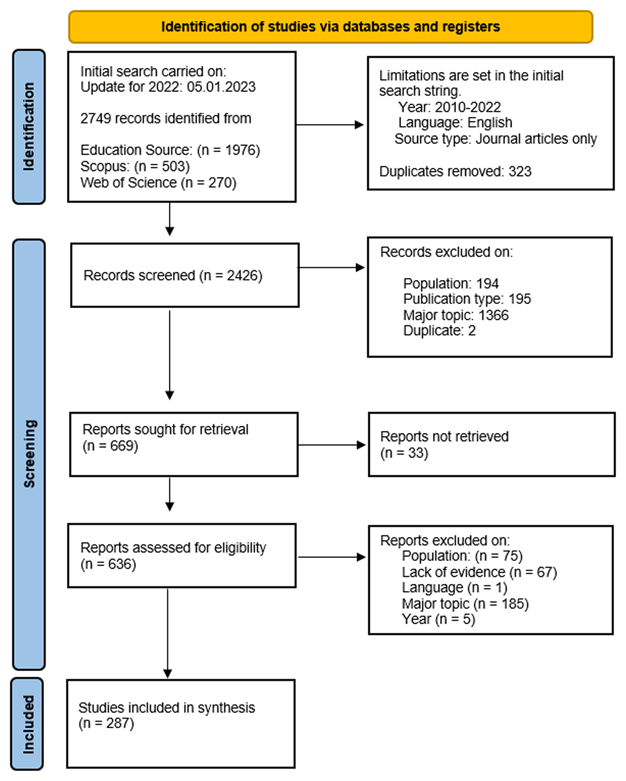
Figure 1
PRISMA diagram (slightly modified from Moher, et al., 2015).
3.3 Limitations
This study is limited to journal articles, three databases, and English-only publications. Although the selection of data was subject to the wide inclusion of three big databases that include high-ranking journals, the publication of journal articles is limited by the editorial processes and the scope of the journals. In addition, conference papers and book chapters were not included. MOOCs, unless a part of formal degree programs are also excluded from this study as the reasons for dropping out from MOOCs are diverse and may not show the same pattern of disengagement from institutional, formal-learning environments. This study is also limited to the semantic relation of themes based on computer-based algorithms and the researcher’s iterations. Although Leximancer has been found to produce valid evidence for content analysis (e.g., Zawacki-Richter & Naidu, 2016), it “…is not a panacea and requires analytical sensitivity and judgment in its interpretation.” (Harwood et al., 2015, p. 1041). Also, while Scopus and Web of Science provide standardized indexing and restrict the use of arbitrary keywords, the Education Source database allows authors to create their keywords, which may lead to less precise expressions.
4 Results and discussion
4.1 RQ1: Publication patterns in dropout research
Articles per year
The publication trend per year reveals interesting results regarding its slightly fluctuating but generally increasing line until 2020. From the year 2020 on, there is a notable decline, which may be due to several reasons. The publication interest during the COVID-19 pandemic (2020–2022) may have shifted to more acute problems due to emergency remote teaching practices such as equality, inclusive education, and other constraints being experienced. Figure 2 shows the trend in the number of publications from 2010 to 2022.
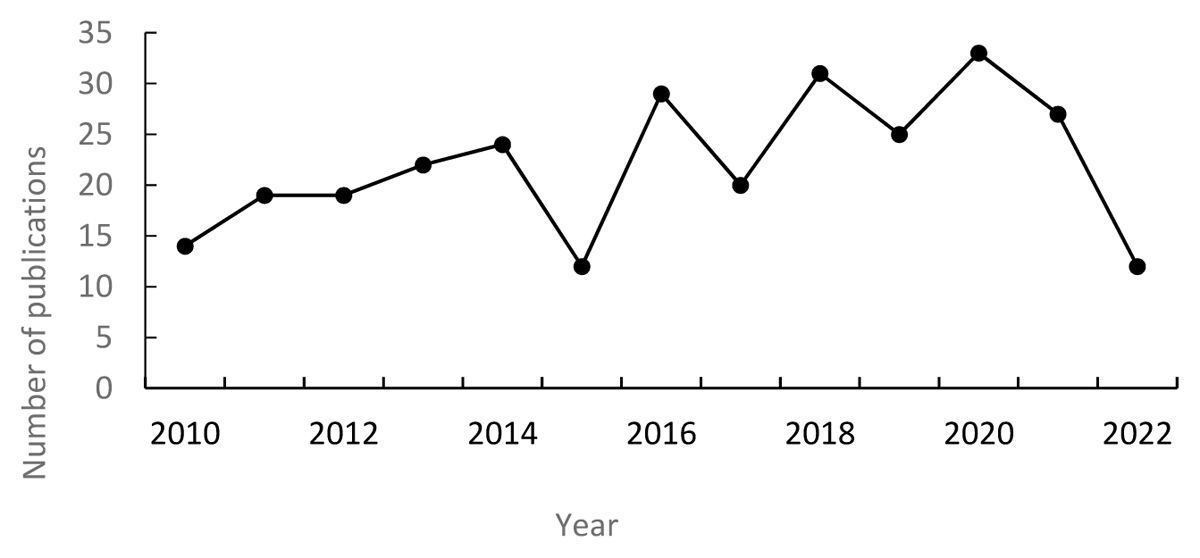
Figure 2
Publications per year (N = 287).
Journals
The included articles came from 133 different journals. It stands out that the highest number of articles were published in journals from the field of ODDE, e.g. the Online Journal of Distance Learning Administration ranks first (n = 12), followed by Online Learning (n = 10), the Journal of Educators Online (n = 9), the International Review of Research in Open & Distance Learning (n = 8), and Distance Education (n = 8). The list of the top ten journals is presented in Table 4.
Table 4
Number of included articles in the top ten journals.
| JOURNAL | n |
|---|---|
| Online Journal of Distance Learning Administration | 12 |
| Online Learning | 10 |
| Journal of Educators Online | 9 |
| International Review of Research in Open & Distance Learning | 8 |
| Distance Education | 8 |
| Computers & Education | 7 |
| Open Learning | 7 |
| American Journal of Distance Education | 6 |
| Internet & Higher Education | 6 |
| Journal of College Student Retention: Research, Theory & Practice | 6 |
Based on the 3M-Framework, which groups research themes in three layers of micro, meso, and macro levels (Zawacki-Richter, 2009; Zawacki-Richter & Bozkurt, 2023), the dropout issue is considered on the meso-level of HE institutions. Drop-out and student retention rates are widely considered connected to institutional quality assurance and management strategies, which is also a meso-level issue. Therefore, it is not surprising that the journal with the highest number of articles on drop-out and retention is the Online Journal of Distance Learning Administration, with a focus on the meso-level of educational management and organization.
4.2 RQ 2: Development of dropout research trends
Overall scope of journal publications (2010–2022)
The text-mining content analysis was run for the whole corpus including all 287 papers based on titles and abstracts. Figure 3 displays the concept map of all articles published between 2010 and 2022.
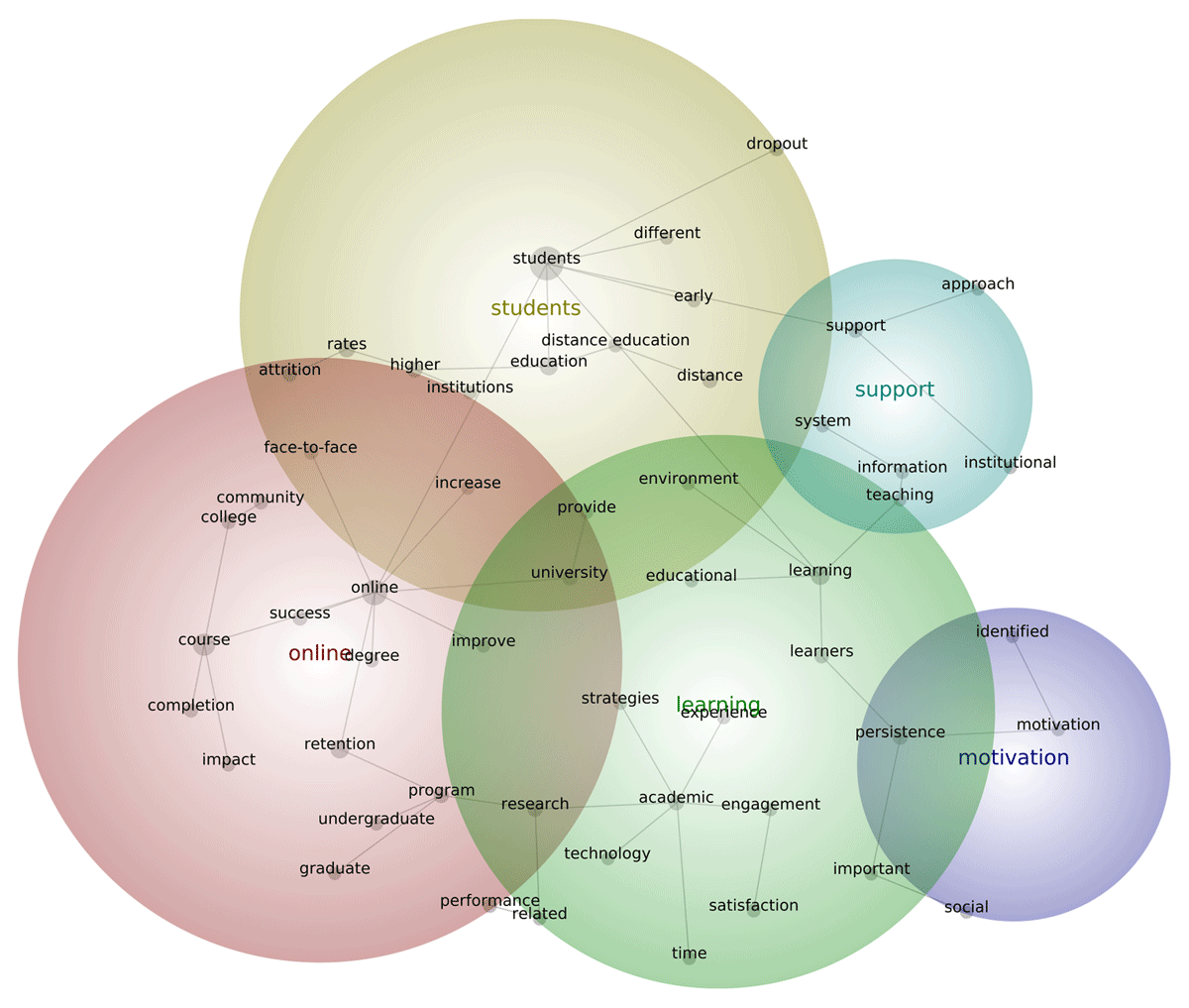
Figure 3
Concept map of the dropout phenomenon from 2010 to 2022 (N = 287).
The concept map shows five thematic regions that are named after the concept with the highest number of mentions in the corpus, namely: students (with 1238 mentions), online (968), learning (829), support (267), and motivation (125). Thus, the overall concept map reveals that the major focus of the research publications is placed on the student’s online learning experiences in relation to their course/program completion or drop-out. The institutional student support system on the meso level and motivation on the individual micro-level related to learners – persistence stand out as thematic regions of their own.
The central thematic region of learning is the sole area connecting all other four major themes. Many factors of dropout, based on Rovai’s (2003) internal factors and Tinto’s (1975) academic factors, are dominant in this circle. For example, the relation of learning experience to academic strategies and engagement, and thus to satisfaction, is one highlight among the semantic connections (see concept path satisfaction – engagement – academic – experience). These are all linked to retention in online learning.
Students learning at a distance and course completion
The thematic region of students covers three prominent topics in the ODDE literature in general: 1) dropout rates are a major concern in distance education (e. g. Radovan, 2019; Xavier & Meneses, 2020; see concept path distance – education – higher – attrition;); 2) as well as online learning (e. g. Ashby et al., 2011; Ferguson, 2020; completion – course – success – online); 3) often compared with face-to-face learning (e.g. Ferguson, 2020; Wavle & Ozogul, 2019), even though the design quality of a course matters more than the mode of delivery (Matcha et al., 2020). A recent example from the corpus is from Garzón et al. (2022), whose study demonstrated a retention rate of as high as 90% in an online bioinformatics program. They presented evidence of how learning community-based program design with faculty and peer mentoring contributed to student engagement and retention.
Lower retention rates in online education were frequently compared to face-to-face learning, leading to the misconception that the modality itself was the cause. However, we now understand that retention in online learning requires motivated, engaged, and satisfied learners through various factors beyond modality, such as appropriate course design and planning (Swan, 2001), the presence of structured policies, supportive systems that foster community and communication, as well as active student engagement (Budash & Shaw, 2017; Thorpe, 2010; Swan, 2003; Park & Choi, 2009).
The theme of online clearly indicates the connection between success and course completion. The link, starting from performance to completion, demonstrates the major themes surrounding the understanding of online education (see concept path performance-related-research-program-retention-online-success-course-completion).
The concept of performance represents the substantial literature on factors determining academic performance and predicting dropout. The response of the publications to the attrition rates in online learning was to measure course completion as a success indicator and, subsequently, academic performance. Many student retention theories associate retention with academic performance (Bean, 1980; Bean & Metzner, 1985), as academically weak learners are more prone to dropout (Li & Carroll, 2019). Higher academic performance is closely related to course completion in online learning (Lint, 2013). When considering the development of higher education, the focus has tended to shift more toward graduation and course completion rates as indicators of success rather than the competencies that students achieve (Aljohani, 2016; Bodin & Orange, 2018).
Student Support as an institutional approach
The concept map nicely underscores that student support is critical in ODDE (Brindley & Paul, 1996) with support as a thematic region of its own. The direct connection between institutional, support, and students indicates that researchers deal with institutional support systems in the publications.
Students in ODDE suffer most from disengagement in the first year of enrollment (Netanda et al., 2019). Academic institutions therefore seek to offer various effective support mechanisms in the initial study phase such as advising and orientation (Clay et al., 2008). Many studies in the corpus are dealing with institutional intervention programs and their evaluation. Mentoring or peer support programs organized in the very beginning of a program engage and motivate students while being cost-effective from the institutional perspective as well. (Boyle et al., 2010). These support mechanisms refer to the academic support that Tinto (1975) addresses as the academic integration of learners.
As argued by Boyle et al. (2010), such proactive systems prove to be cost-effective for the institutions as well as engaging the learners even those from disadvantaged backgrounds. Xu and Jaggards (2013) strongly argued against the negative impact of online education in community colleges, particularly highlighting its high costs. However, they also recognized the absence of proactive support mechanisms. Despite significant resources being allocated to support online learning, much of this assistance is delivered reactively rather than being proactively integrated into the daily activities of students and instructors. For such support systems to be effective over time, they must be embedded into everyday academic practices (Boyle et al., 2010; Budash et al., 2017).
Student Support Through Learning Analytics
The learning – environment is connected to information systems through teaching in the thematic region of support. Information systems include any medium, such as learning management systems or dashboards, that provide information about teaching and learning activities in the online course environment.
The literature demonstrates that using quantitative data analysis for predictive purposes has a relatively long history in different fields; however, it emerged in the field of education around 2010 (Joksimović et al., 2019). In 2011 for the first time, learning analytics was defined as the “measurement, collection, analysis and reporting of data about learners and their contexts, for purposes of understanding and optimizing learning and the environments in which it occurs” (Long & Siemens, 2011, p. 34). The focus of early learning analytics (LA) and educational data mining (EDM) practices in the field is on predictive models of academic performance and retention (Jayaprakash et al., 2014; Joksimović et al., 2019). The wide use of learning management systems and the rise of MOOCs allow educators to collect big data at the course level (Siemens, 2013).
The nodes on the maps correspond to the use of LA and EDM and are meaningfully grouped under the theme of support, rather than forming a distinct concept area on their own. In its early stages, LA primarily concentrated on developing predictive models focused on course completion and academic performance (Gašević et al., 2016; Siemens, 2013). ODDE, unlike conventional education, limits the observational factors for disengagement as learners, teachers, and institutions are distributed. Making predictions based on institutional data not only allows to identify and profile students at risk, but also helps the institution to match the appropriate support mechanism with student’s needs (Rotar, 2022; Walsh et al., 2020). Therefore, early warning systems (EWS) and educational data mining gain added importance.
The corpus covers several examples of EWS (e.g., Bañeres et al., 2020; Kustitskaya, et al., 2022; Stephens & Myers, 2014), the use of dashboards (e.g., Marshall, 2016); and predictive learning analytics (e.g., Herodotou, et al., 2020; Yasmin, 2013). EWS inform educators at the micro level of teaching and learning and the institutional meso levels against low engagement and a high probability of low academic performance (Balfanz et al., 2007). By collecting big data, educators were enabled to timely and individually personalized predictions (e.g. Nuanmeesri et al., 2022; Siebra et al., 2020). Early use of EWS at the Open University of UK, for instance, examined students’ interactions and figured the new tracking technology enabled the institutions to identify learner behavior that may lead to dropout (Stephens & Myers, 2014). This early example of EWS indicated how the tracking system is promising for more proactive rather than reactive support interventions (Simpson, 2004). Other examples included early prediction models using data mining at a course level (e.g. Ice et al., 2011) and classification tree model (e.g. Yasmin, 2013).
Motivation, social capital and social demands
Finally, the concept of motivation is related to persistence in learning. Motivation may be due to internal or external factors of the individual learners (Price & Kadi-Hanifi, 2011). Thus, it is not directly linked to institutional measures of support in the concept map. Still, motivational intervention programs are in use through predictive learning analytics (e.g., Herodotou, et al., 2020). Brubacher and Silinda (2019) even urged institutions to regularly monitor the intrinsic motivation of their students, as it is a strong predictor of persistence. More importantly, motivation demonstrates the social interaction in the circle, which is well-known to be highly motivational for learners (Waite & Davis, 2006). Technology-enhanced media and digital learning tools have long enabled rich social-learning environments (Price & Kadi-Hanifi, 2011).
A concept path that triangles the themes of online, student and learning underscores the “social” related research (see the concept path course-online-students-learning-learners-persistence-important-social). With the predictive approaches to student retention, there was a criticism of the predictions are based on academic performance and course completion, which makes the understanding of the underlying factors of dropout limited to quantitative data only (Elibol & Bozkurt, 2023). The social aspect of learning is represented in two meanings on the map. One is the social capital (Brubacher & Silinda, 2021; Lu et al., 2013; Schulze, 2016) that students need to draw upon while studying remotely due to digital learning. Social capital is composed of the social network and social norms that help to achieve a mutual goal (Bourdieu, 1986). Their social capital is the external or social factors students are contextually in as distance learners complete their studies part-time with family, work, and social demands (Kember, 1995; Rovai, 2003). As in the example of Price and Kadi-Hanifi (2011), learners started to build their informal connections and network to motivate themselves and overcome isolation even before the spread of mobile access to social media. However, it is interesting to see in the corpus that the conventional universities that switched to online modality due to the COVID-19 pandemic re-discovered these results and emphasized the importance of belonging as a new finding (e.g., Branchu & Flaureau, 2022).
The second social reference is the learner’s social integration into the academic system. Many studies in the corpus (e.g. Bissessar et al., 2020; Chernosky et al., 2021) refer to the social presence in the Community of Inquiry Model (CoI) (Garrison et al., 2000). Social presence is “the ability of participants to identify with the community (e.g., course of study), communicate purposefully in a trusting environment, and develop inter-personal relationships by way of projecting their individual personalities” (Garrison, 2009, p. 352). It was evident to be more prominent in the learning flow and course completion compared to cognitive presence (Bissessar et al., 2020). The social integration of distributed learners also occurred through social- technological tools. These tools played a key role in integrating distributed learners by informally engaging them in the learning and academic environment. Some examples are facilitating social networking applications (Facebook) for the pre-enrolment contact (e.g. Jackson, 2012) and embedding social media tools in the course design (e.g. Brownson, 2014). The social presence of the CoI model is an important factor in the persistence of the students (Boston et al., 2010).
Both references to the concept of social in the map complement each other. The learners’ need for knowledge and information sharing through social collaboration and communication tools enhances their social capital and increases their persistence as they feel more integrated into the social cycle. This cooccurrence clearly corresponds to external attribution and social integration phases of Kember’s (1995) Student progress in distance education model. These phases path the way to academic integration and better performance, thus, persistence, as the concept links of social demonstrates.
5 Conclusion
This study analyzed the content of titles and abstracts of systematically collected journal articles. It provided an overview of the themes, concepts, and semantic relations among the concepts covered in the publications on student dropout and retention in ODDE.
The findings highlight the significant concern of high attrition rates in ODDE, the common framing of success as course completion, and the critical need for support at the institutional meso-level informed by evidence gathered from the micro-level, teaching and learning. Additionally, the analysis underscores the challenges and demands related to the social dimension of online learning. A key issue discussed in the literature is the need to foster communities among learners and create spaces for social presence. The isolation experienced by online learners is attributed not only to the educational modality but also to their social backgrounds and external circumstances, emphasizing the importance of considering learners’ social capital in retention strategies.
The semantic concept map generated in this study illustrates how various factors—motivation, support, satisfaction, and the broader learning experience—interact and contribute to retention outcomes. Furthermore, an examination of representative articles associated with the nodes in the concept map reveals a recurring divide between conventional campus-based education and ODDE. This division becomes particularly evident during periods of emergency remote teaching, as the mainstream educational discourse often fails to acknowledge the longstanding challenges faced in ODDE. Bridging this terminological and conceptual gap between on-campus and distance education is essential for the advancement of digital learning across all educational contexts.
This study contributes to the ODDE literature by concept mapping over a decade of publications, drawn from three large databases hosting peer-reviewed journals, and applying a systematic and replicable data curation method to focus specifically on retention and dropout studies. However, when comparing the findings of this evidence-based study with recent research on dropout (e.g., Bağrıacık Yılmaz & Karataş, 2022; Elibol & Bozkurt, 2023; Rahmani, 2024), it becomes apparent that the factors influencing student retention and attrition in online learning have reached a point of saturation. Whilst this study provides a comprehensive view of dropout discussions since the proliferation of online education, it also points to the need for new future policy interventions.
In agreement with Elibol & Bozkurt (2023) and Xavier & Meneses (2020), this paper advocates for a redefinition of dropout that minimizes the negative implications often placed on students. Dropout will always be an organizational issue, but it is time to highlight that it is deeply connected to learners’ micro-level contexts and should be addressed through targeted institutional action at the meso-level. Although dropout and retention theories assume that students enroll to complete a program, it is time to acknowledge that this institution-centered perspective contradicts the student-centered approach, particularly in the context of ODDE. With the increased flexibility that ODDE has introduced into mainstream education, many learners engage in studies for alternative purposes.
A plethora of data is now available via digital learning environments to inform early warning systems. Consequently, institutions should invest in robust student support systems, informed by learning analytics (LA) and advancements in large language models. These technologies and methods should be employed not merely to predict dropout rates, but to offer personalized support systems that proactively assist learners across various stages of their educational journey. Such an approach should be adopted not only from an institutional perspective but also to accommodate the diverse learning intentions of individuals and their corresponding support needs.
As student retention is often regarded as an indicator of institutional quality (Burke, 2019) and has also significant financial implications for both institutions and governments (Simpson, 2004), the urgency of addressing dropout is compounded by new developments in the digital landscape. Emerging technologies, such as generative AI, along with increased access to digital tools in the Global North, are reshaping higher education. At the same time, these advancements are exacerbating the digital divide between the Global South and North. Effective strategies for teaching and learning in hybrid environments must be developed in response to these challenges. Future studies should conduct further comparative analyses to examine whether trends in dropout research vary based on (a) the time period of the publications, (b) research related to the digital divide, and (c) research focused on digital transformation policies. In light of these evolving factors, it is critical to develop and discuss new frameworks for understanding and addressing the dropout phenomenon in the context of ODDE.
Acknowledgements
The initial version of this article was presented at and published in the proceedings of the EDEN 2023 Annual Conference, where it was nominated for the Best Paper Award.
The first author thanks the Leximancer team for providing complimentary access to the software portal used in this study.
Lastly, the first author extends heartfelt support to all cancer patients in their fight, including those affected by ALL and ALM, such as her father, as well as to the dedicated scholars striving to find a cure.
Competing Interests
The authors have no competing interests to declare.