
Introduction
Digitally captured signatures (DCS) have already been vastly deployed around the world, and cases with disputed DCS have started to appear in forensic laboratories. DCS technology allows the encoding of the pen stylus during the execution of a signature formation, in numerical data form, and this technology is primarily used to replace the traditional pen-and-paper signature in a digital counterpart that ultimately produces a ‘signed’ digital document with the aforementioned signature data (a.k.a. biometric data).
This type of deployment (the collection of biometric data by executing a signature formation on the surface of a digitizer) has led a large part of the forensic handwriting examiner (FHE) community to consider the familiarization and use of such technology only within the confines of the ‘disputed DCS’ case scenario. Still, this technology can be utilized (either in its currently deployed form or in the hybrid form which will be introduced later on) to facilitate and enhance the handling and analysis of traditional casework in which the disputed signature has been executed with ink on paper and the option of collecting ad hoc signature samples from suspect writers is a possibility. The use of DCS samples for comparison to traditional signatures requires the similarity of the signature characteristics in both forms. This has been explored (1) and resulted in the opinion that it is safe to proceed with such mixed sample comparisons, as it is reflected in best practices literature (2).
This approach (i.e. the use of hybrid technology) requires by default the standardization of the sample-collection process and the use of standardized forms. The standardization of sample-taking forms and procedures is also reflected in recent best practices literature in Europe, as reflected in the recent update of the Best Practice Manual of the European Network of Forensic Handwriting Experts (2).
The Handwriting Laboratory of the Cyprus Police decided to adopt and deploy this technology and had to overcome all of these challenges, a process that affected in a positive manner the pre-existing procedures (of sample collection) as well.
The Process of Sample Collection
Necessity to collect samples and the use of forms
Sample collection (when available) can be a necessary component in the procedure of determining authenticity of disputed handwriting and signatures. Specific procedure for sample collection is necessary for ISO accreditation processes and uniformity is required, especially in legal systems like those of Cyprus and South Africa where a police investigator other than the expert collects the samples.
Taking into account the currently available technology, requested samples can be collected in three forms:
Traditional samples on paper forms.
Hybrid samples that are simultaneously collected on paper forms and digitally (providing biometric data).
Directly on a digitizer surface, providing biometric data without the use of paper forms.
This paper discusses only forms a and b, as deployed within the Cyprus Police. The content of the form (i.e. what is requested from the sample writer to produce) is also not discussed in this paper as it is adequately covered in the relevant literature (2).
Hybrid samples
The arrival of DCS technology has brought benefits for the FHE. Hybrid sampling is the process of capturing writing bodies on both paper and digital tablet. It brings together the best of both words: the handwritten tracing on paper and the biometric information of the digital process. That is, it is an implementation that only brings benefits and allows the FHE to understand writing behavior in a quantitative dimension.
DCS technology is currently manifested in three main technology forms:
Resistive technology digitizers (3).
Capacitive technology digitizers (4).
Electromagnetic resonance (EMR) technology digitizers (5).
From these three main technology deployments, only the EMR allows for the collection of biometric data without the stylus necessarily being in contact with the digitizer surface. This condition allows for the construction of EMR styli that host an inking cartridge, hence allowing them to also function as a traditional pen. With such equipment, if a paper is placed over the digitizer, a signature can be executed leaving a) a traditional signature trace (of ink) on the paper, and simultaneously b) a DCS. In Figure 1 we can observe such a hybrid signature, captured with Namirial’s FirmaCertaForensic software and the hybrid edition of the NT10011 digitizer (6); the signature appears in ‘physical’ form as an ink trace on the paper substrate, as a digital visualization (connected line) as well as numerical data.
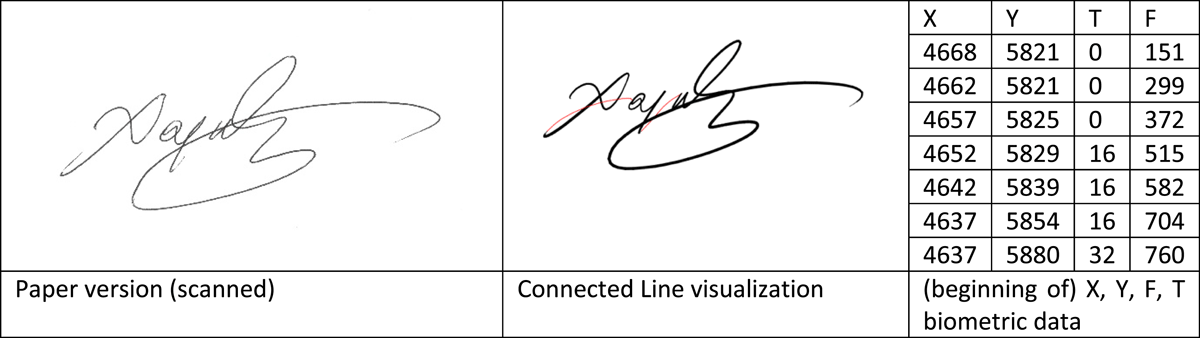
Figure 1
Different versions and visualizations of the same signature.
The correspondence between the ‘written’ trace on the paper and the captured information may exhibit some difference, but this can be accounted for (1).
Use of forms
Paper forms
The process of collecting writing samples and the use of forms has been largely ununified. In the case of Cyprus Police, for years the investigator had the freedom of selecting the form format for sample collection. This situation created problems in the workflow as there was no uniformity in either the template of the forms nor the contents of the collected samples. To resolve the situation, the Handwriting Laboratory proceeded with the creation of a set of instructions for all police investigators, a standardized set of form templates to be used for the sample collection and subsequent training of the police investigators with respect to the procedure of sample collection as well as the contents that have to be collected on a case-by-case scenario. As a result of this effort seven forms were created: one with a short questionnaire with details of the writer, one with the declaration statement for the sample collection procedure and five with different conditions for the collection of handwriting and signatures (see files of Appendix 1).
Hybrid forms
In order to streamline the sample collection process from the investigators, the same paper forms (same contents) were used as the basis for the hybrid sample forms. As described in the following part, the Wacom PHU-111 Clipboard (7) device was selected; the treatment of the paper forms for use with the PHU-111 involved designation of the biometric data collection areas, and the provision of clear space for the deployment of the bar code. Therefore, the use of the same forms (content wise) was straightforward (see Appendix 2).
Equipment Selection
The options for a hybrid DCS solution are limited. The pioneer in the field is Wacom, introducing EMR technology digitizers that would allow the use of an inking stylus (8) as early as 2001 (e.g. the CTF-420 digitizer (9)). Wacom produced various inking styli depending on the accompanying digitizer, but most of them (though not all) can be used with all the digitizers that use the same driver. Table 1 shows the latest Wacom inking styli models and the compatibility with the most recent digitizers.
Table 1
List of interoperability of Wacom Inking Pens and digitizers.
| PRODUCT NAME | COMPATIBILITY WITH STU 430 | COMPATIBILITY WITH STU 530 | COMPATIBILITY WITH STU 540 | COMPATIBILITY WITH DTU1031X | COMPATIBILITY WITH DTU1141B | COMPATIBILITY WITH PHU-111 |
|---|---|---|---|---|---|---|
| Bamboo Slate Pen UP-3708-00B-2 | Yes | Yes | Yes | Yes | Yes | Yes |
| Bamboo Slate Finetip Pen UP-3708-01B-2 | Yes | Yes | Yes | Yes | Yes | Yes |
| Clipboard Pen UP-3709-00A-2 | Yes | Yes | Yes | Yes | Yes | Yes |
| Bamboo Spark UP-3703 | Yes | Yes | Yes | Yes | Yes | Yes |
| KP13300D Ball Point Pen Black | No | No | No | No | No | No |
| KP13200D Fine Tip Pen | No | No | No | No | No | No |
Furthermore, Wacom introduced the PHU-111 Clipboard, a fusion of digitizer and clipboard that physically holds the paper substrate in place during the collection of the biometric data.
Alternatively to Wacom technology, Namirial entered the field of hybrid sample collection devices by introducing a hybrid version of their XYZMO NT10011 10-inch digitizer. This version of their digitizer is configured to work with an EMR inking stylus and allows for the collection of hybrid samples like the combination of Wacom inking pens and compatible digitizers. It needs to be noted that, according to current information (10) at the moment this paper was written, the PHU-111 and the pen UP-3703 have been discontinued.
Glass surface digitizer
The concept of using a glass-surface digitizer with a compatible inking pen to collect hybrid samples is straightforward and requires the positioning of the selected paper substrate on the digitizer. This technique has been used successfully in the past (1). From the aspect of evidence administration, this method creates two separate products: the paper sample and the biometric data, whilst there is no digital version of the paper sample itself (i.e. not just the biometric data but all the visual information on the paper), which may very well include additional case parameters (e.g. name of writer, date etc.).
Wacom PHU-111 Clipboard
The PHU-111 exhibits two advantages versus any other option of using a paper substrate over a glass surface digitizer: a) the paper substrate is held in position by the clipboard and b) the software that runs the clipboard allows the designation of specific biometric data collection areas on the form used, whilst at the same time keeping all other written information on the paper as visual information only. This allows for the simultaneous creation of completely identical paper and digital versions of the same document.
The PHU-111 operates paired with a smart device (Android or iOS). For the Cyprus Police deployment, the android tablet Samsung Galaxy Tab S6 Lite (11) was selected. The use of the PHU-111 requires the construction of forms in PDF format. The PDF forms must be processed by the corresponding Wacom Clipboard software (12) to designate biometric data collection areas (see Figure 2); when this is done, a new PDF file is created with the same visual information as the original PDF form, with the addition of a serial number at the top of the page. The created PDF files have to be loaded to the paired smart device.
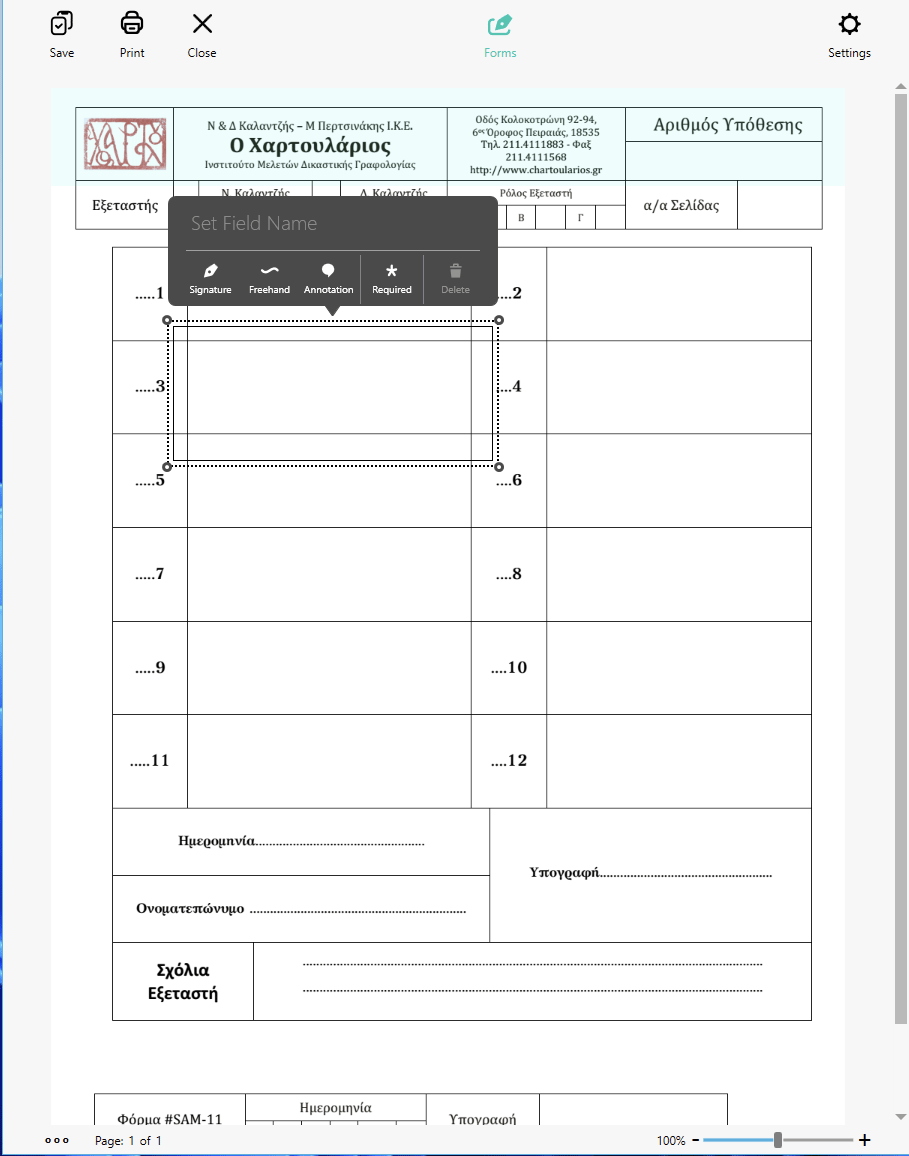
Figure 2
Designation of biometric data collection area on a PDF, using Wacom’s CLB create application.
The PHU-111 has a barcode scanner underneath the clipboard part; when the printed form is inserted in the PHU-111, the barcode is scanned, and the corresponding PDF file is recalled in the pared smart device. As information (either biometric data within the designated areas or visual only data executed outside of the designated areas) is written on the paper form on the PHU-111, the corresponding digital information is transferred to the smart device and populates the PDF form (see Figure 3).
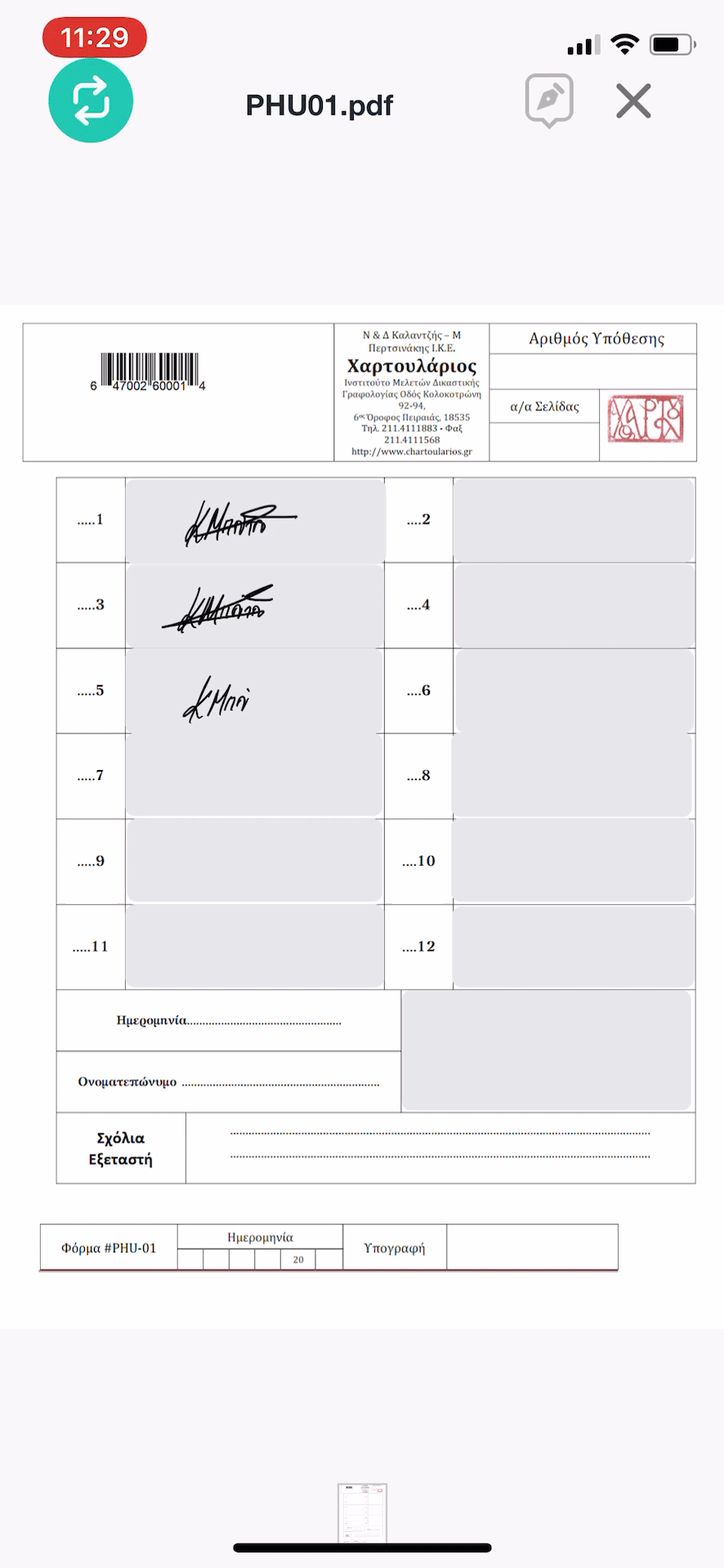
Figure 3
Paired smart device screen during sample collection with the PHU-111. The image of the DCS captured appears on screen in the corresponding area in real time.
Subsequently the PDF files containing the biometric data can be accessed by Wacom’s Signature Scope software and the biometric data can be extracted and analyzed.
From an administration point of view, the huge advantage of this method versus the glass surface digitizer method, is the simultaneous creation of a physical and a digital copy of the paper sample (apart from the captured biometric data).
The PHU-111 software will capture biometric data from the aforementioned designated areas, but at the same time it will capture and keep any other writing on the document as visual form (provided it is executed with a compatible inking pen.
An example is presented in Figure 4, where the physical and digital version of the same form are presented. The only biometric data captured in this example is that of the signatures executed inside the collection boxes; everything else (date, name etc.) is visually represented in the digital version of the form without biometric data.
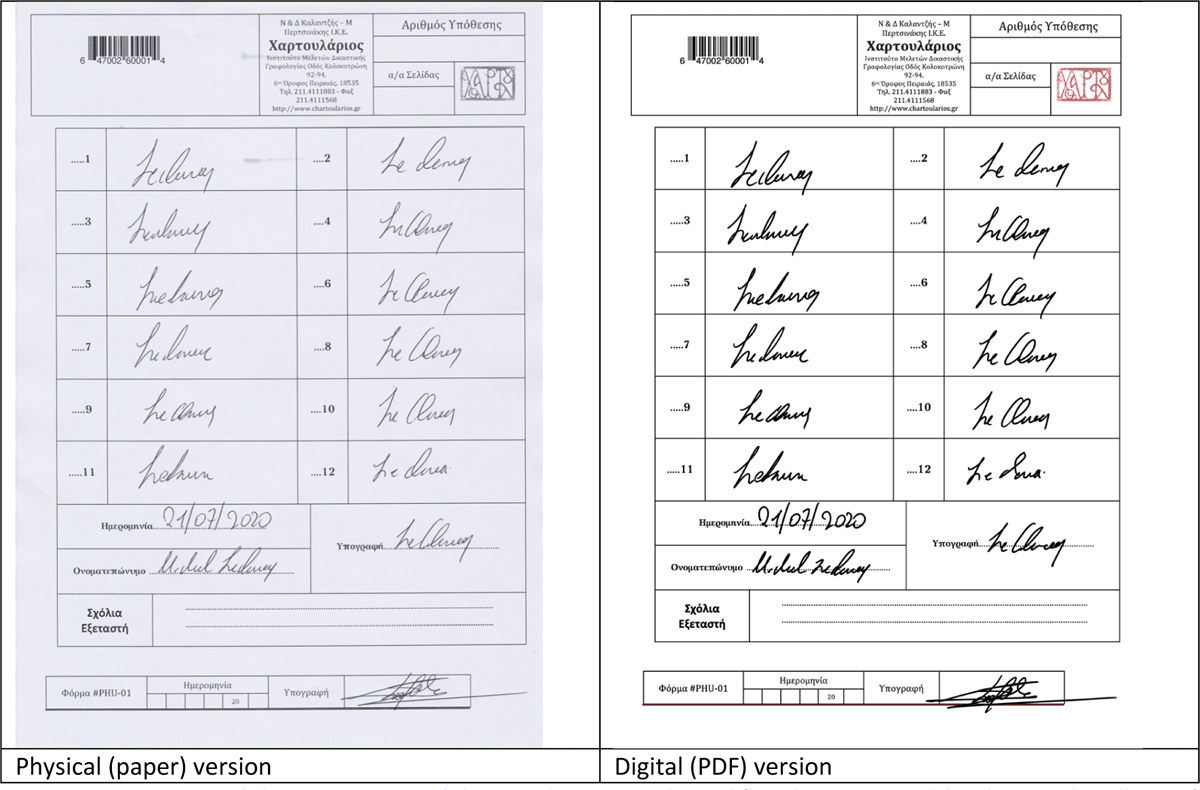
Figure 4
Juxtaposition of the two versions of the sample—one is physical (i.e. the paper used for the sample collection) and one is digital (in the form of a PDF that includes all the visual information but also includes encrypted the biometric data captured from the collection areas).
Paper and digital Version of documents
The outcome of several court cases in the legal system of Cyprus depends to a large extent on the way evidence is handled by investigators and forensic handwriting experts.
A definition of evidence is any item that can be used in judicial proceedings to confirm or disprove the commission of a crime. It is something that verifies or proves the occurrence of a crime, guilt, or innocence. In general, it is any object that constitutes proof in a trial and establishes the guilt or innocence of the accused.
One of the most fundamental types of evidence is documents in their physical form. Investigators handle these documents in digital form according to police guidelines. Great importance and care is given to the way they are handled. There are clear instructions from both the police leadership and the handwriting laboratory to officers on how they should treat documentary evidence, such as methods of collection, storage, packaging and more. Some cases have not had the desired outcome because of improper handling of documents (14, 15, 16).
From this aspect, the duality offered by the use of the PHU-111 (i.e. the digital version and the paper physical version being identical) allows easier management of the material and solves possible problems when it comes to GDPR concerns (13). Even from the point of report writing and court presentation, having an accurate digital version of the physical evidence (and having that physical evidence in the form of a full-sized page with printed case-relevant information as opposed to smaller formats such as A7-sized paperor Post it notes), can be beneficial and avoids a lot of managerial issues.
Deployment
Description of Cyprus situation
The Handwriting laboratory of Cyprus Police, which was formed in 1960 and is housed in Cyprus Police Headquarters in the capital of Cyprus, Nicosia, consists of four accredited educated FHEs; the incoming cases arise from the entire the country.
There are six district areas in Cyprus (Nicosia, Limassol, Larnaca, Paphos, Famagusta and Morfou), plus the Headquarters central Police. Each district has its own provisional criminal investigation department (CID) (see Figure 5). These departments are dealing directly with cases, suspects and persons of interest. When a complaint is submitted that involves the examination of handwriting, the local CID Officers will deal with the case requirements and conduct the sample-collection procedures, ultimately delivering the case documents to the trained FHEs in Nicosia Handwriting Laboratory at the headquarters (HQ).
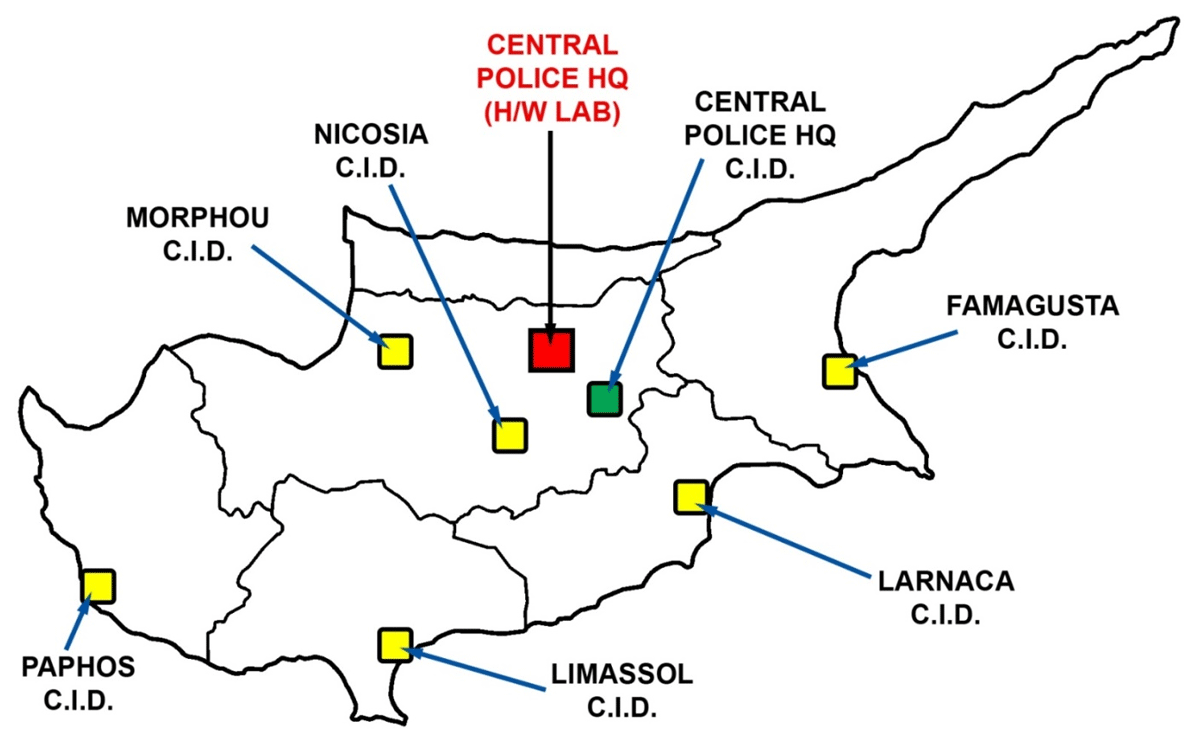
Figure 5
Cyprus map with designation of the different CID areas.
Paper evidence infrastructure
Once a (paper) document is submitted as evidence for a case, it is seized, recorded and stamped by the interrogator. The same procedure is followed for collected handwriting samples. All document evidence (questioned documents, reference material and handwriting samples) is submitted by hand to the HQ.
Hybrid evidence infrastructure
As mentioned previously, hybrid sample collection produces two types of evidence, the paper forms and their digital counterparts (in PDF form for the selected solution). The paper forms are submitted to the same treatment as the paper samples mentioned in the previous paragraph. Their digital counterparts are transferred to the HQ though a dedicated point-to-point internet line which connects the HQ with the various CIDs.
The workflow of sample circulations follows the following steps:
CID officer takes traditional samples and/or hybrid with PHU-111.
Documents (traditional samples and the paper version of the hybrid samples) are physically sent to HQ.
The digital counterparts of the hybrid samples are transmitted to HQ via secured landline network on established CID computer station.
For the hybrid samples, the paper and the digital versions are matched at HQ.
A more detailed presentation of the workflow is depicted in Figure 6.
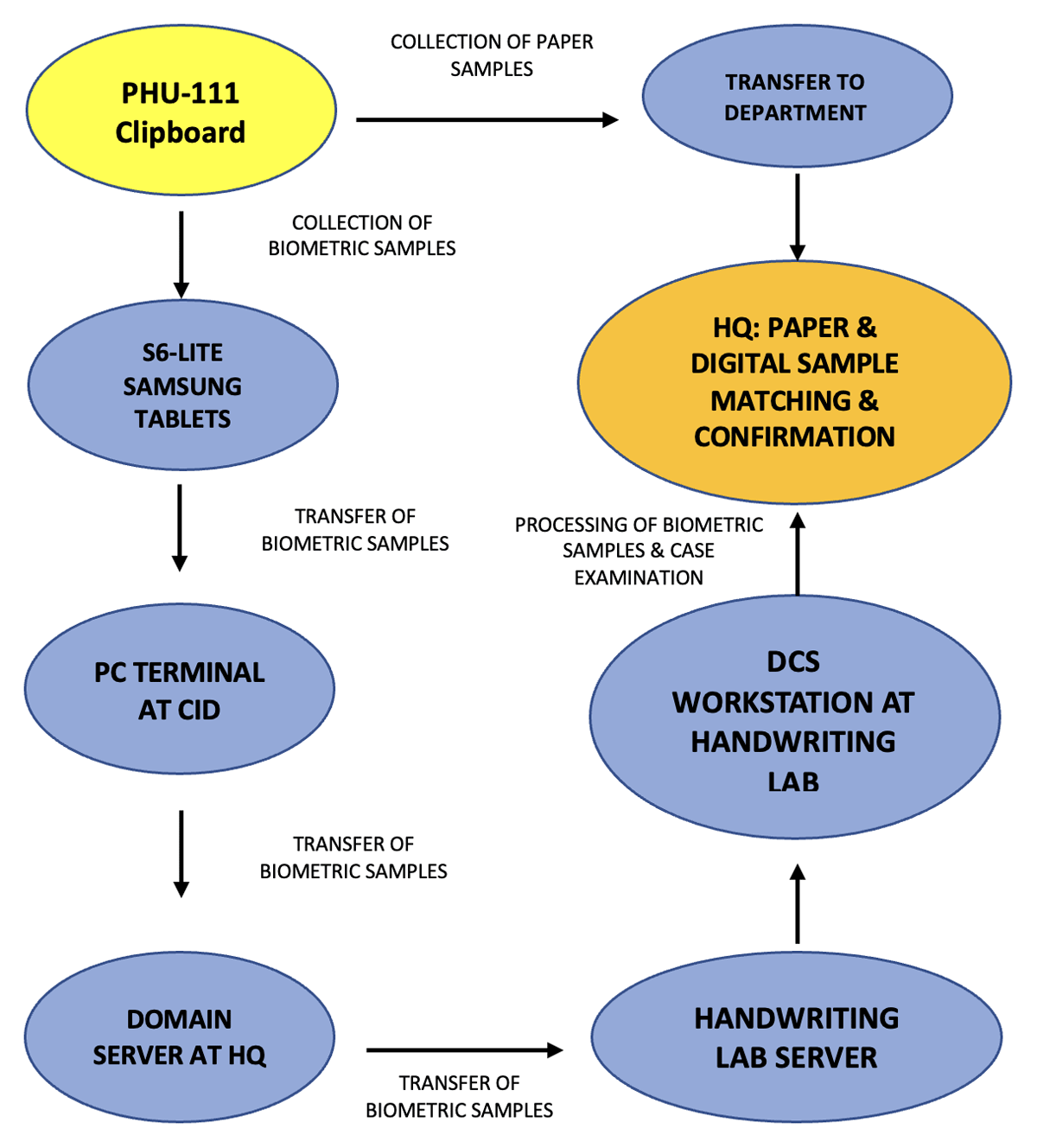
Figure 6
Paper and Biometric sample collection workflow.
Deployment
Obeying the Cyprus Police and the Cypriot legal framework, the samples are collected by police investigators who are not trained FHEs. To facilitate the deployment of this new system, the laboratory decided to create a training course and a proper sampling equipment kit for the police investigators.
Initially 141 police investigators were trained by the FHEs of the laboratory on the new sample collecting procedures involving paper samples. This was a necessary step to allow the harmonized collection of paper-only samples with the new system, but also this training provided the background knowledge for the selection of police investigators to be trained in the collection of hybrid samples.
The next step was the creation of the portable equipment kits, which consist of a bag with the Wacom Clipboard PHU-111, the accommodating Samsung S6-Lite tablet, printed instructions on all phases of the procedures, necessary paraphernalia (chargers, cables etc.) as shown on Figure 7.
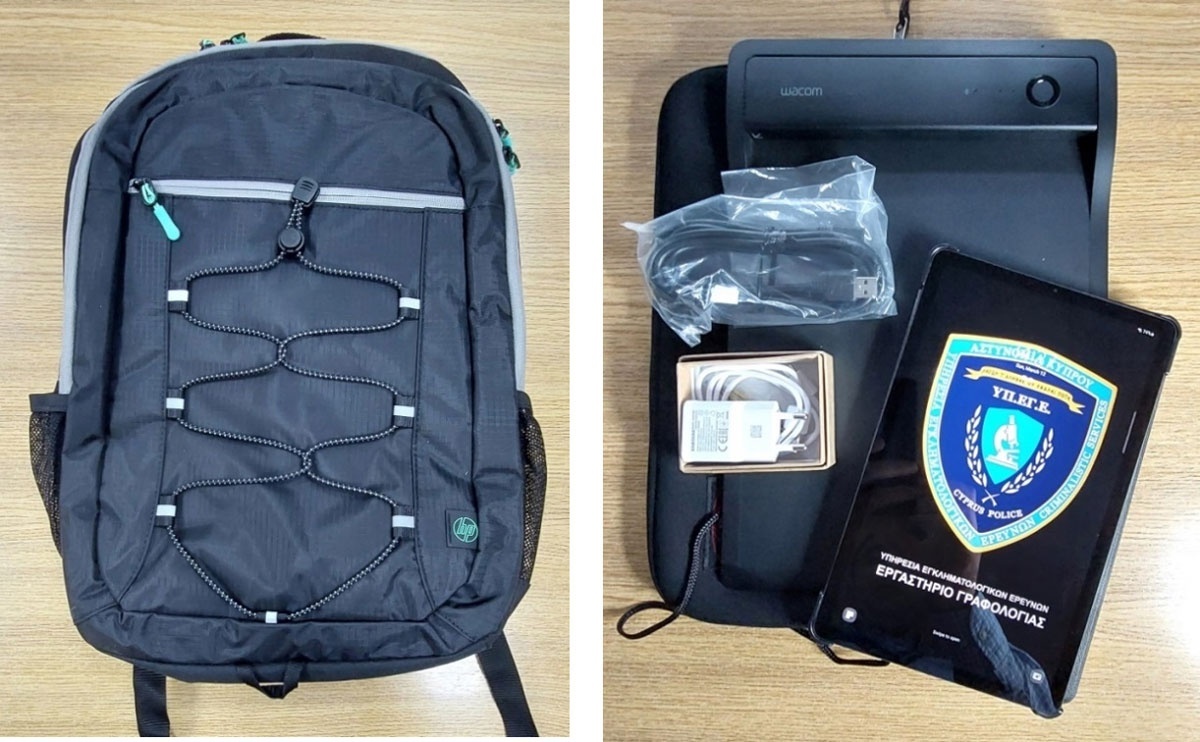
Figure 7
Portable equipment kit.
Then two groups of 23 police investigators in total were trained on the collection of hybrid samples and the use of the portable equipment kits, and were given the kits (two per CID district; one per shift). An additional surplus of portable equipment kits was created and kept in the Handwriting Laboratory for future reference and use (e.g. for substitution of a damaged kit or further deployment).
With respect to the infrastructure and the same (encrypted) circulation of the digital files, the following actions took place:
A server was installed in a remote location.
A dedicated computer was installed in each district CID (Total 7 terminals).
A connection between the remote server and CID computers was established.
Two dedicated, powerful station computers and a laptop solution (for mobility if needed) with the appropriate software were installed in the Handwriting Lab, which is used for examining cases.
A connection of each station computer and the remote server was established through a dedicated secure line.
Each district CID was supplied with its own credentials on the dedicated server to upload all the digital files of biometric signature samples taken for each case. Only the FHEs of the laboratory have access to these files.
After a test period of 12 months during which the procedure of sample collection, file circulation and processing was rehearsed, the process went live on January 12025. Since that date, trained police investigators have the option of (and have proceeded in) collecting hybrid samples for disputed pen-and-paper signature cases.
Discussion
DCS technology provides the FHEs with new aspects and characteristics of writing and signing execution. Apart from dealing with the issue of disputed DCS, the FHEs have the opportunity to take advantage of this technology for dealing with ‘traditional’ pen-and-paper cases, provided they can collect samples from writers.
Cyprus Police took advantage of this technology, created strategic deployment procedures adapted in country-specific legal and structural framework and commenced collecting and using such samples in ‘traditional’ casework.
FHEs already have use-cases from active court casework in which the additional information collected from the hybrid samples (and the information-rich visualizations that can subsequently be created) have assisted not only in the analysis phase but also in the presentation phase of the progress of casework (17).
The Cyprus Police example serves as a paradigm of thinking out of the box and taking advantage of this technology in innovating ways, facilitating already-established procedure in FHE practices. The hope is that more practitioners and laboratories around the world approach this new technology with such an attitude to allow innovation and full integration of its capabilities.
With respect to Cyprus Police strategy, the next steps involve training and deployment of pure DCS sample-collection kits and stations, integrating the disputed DCS casework example in the capabilities of the police network structure, and future expansion of the server infrastructure.
Additional File
The additional file for this article can be found as follows:
Competing Interests
The authors have no competing interests to declare.