
Introduction
The actual case considered in this paper includes a number of aspects of forensic document examination which the examiner must deal with when it is necessary to determine whether a contested document is as old as it purports to be or whether any changes (e.g., alterations and page substitutions) have occurred to the document since its initial production.
In this case, the document to be examined was a three-page Will, dated 13 August 1999 (the ‘1999 Will’). The 1999 Will consists of three green sheets of A4 paper (stapled and bounded together with a red ribbon and a brown–red sealing-wax seal) bearing the same watermark.1 All three pages of the document contain printed entries, and the first and second pages also bear three and four handwritten signatures, respectively. Based on the examination results obtained in this case, it is this author’s opinion that (as it will be discussed further in the paper) (1) all the seven signatures were most probably written with the blue ballpoint ink of the same formulation, and (2) the ink of the three signatures on the top page of the Will (page 1) had significantly faded resulting in changes to the composition of the ink’s dye components (a partial decomposition of certain dyes of the ink caused by the exposition of page 1 to light of strong intensity, such as direct sunlight through the window) which, in its turn, caused a notable change to the ink’s color (both tint and brightness) – the original bright blue color of the ink had turned into pale violet–gray (see Figure 6).
The fact that the dye compositions of the faded blue ink on page 1 and the ‘unexposed to light’ blue ink on page 2 did not match led the Plaintiff’s expert to come to the erroneous conclusions that page 1 was signed with one ink and page 2 was signed with a different ink, and thus that the 1999 Will was ‘prepared […] at multiple occasions’ (i.e., that pages 1 and 2 were not signed contemporaneously). Moreover, based on the result of a single ink aging test, the Plaintiff’s expert concluded that the signatures on page 1 of the 1999 Will were not written in 1999 but instead they were written after July 2017, that is within 2 years before their examination in July 2019. As will be shown further in this paper, the ink aging method (it is known in the scientific literature under the name ‘Solvent Loss Ratio Method’ or ‘SLRM’) that was used by the Plaintiff’s expert in this case is incapable of determining that a ballpoint ink has been applied to paper <2 years ago because the scope (limit) of applicability of the method is not 2 years, but <6 months (see Section II). Even if one were to assume, for the sake of argument, that page 1 of the 1999 Will was signed immediately prior to lodging the Will with the Probate Registry in September 2018, the ink on the document could not be ‘younger’ than 10 months old at the time the Plaintiff’s expert was examining the document in July 2019. It means that the Plaintiff’s expert used the SLRM beyond its <6-month scope of applicability, and thus the conclusion made by the Plaintiff’s expert that the ink on page 1 of the 1999 Will was <2 years old (but >10 months old) was a priori scientifically unsound and thus completely unreliable.
Prior to discussing the relevant aspects of the case (see Section III), this paper briefly summarizes the state of the art in two areas of forensic document examination that proved to be key areas for this case, namely, ink fading and ink aging, considered in Sections I and II, respectively.
I. Fading (Photodegradation) of Ink on Documents
The Scientific Working Group for Forensic Document Examination (SWGDOC) Standard for Test Methods for Forensic Writing Ink Comparison (1) defining that a ‘match between ink samples’ is ‘the inability to distinguish between ink samples at a given level of analysis’,2 also stresses that, ‘when inks give differing test results, the possibility of batch-to-batch variation within an ink formula [and] potential influences of interfering factors that can alter the composition of an ink sample must be considered (see Section 5).’3 ‘5. Interferences […] These effects can include discoloration or fading from aging, exposure to light or heat…’4
The fading of inks (photodegradation of dye components) on documents as a result of exposure to light is a well-known phenomenon reported and discussed in numerous scientific publications (see e.g., 2, 3, 4, 5, 6, 7, 8, 9, 10, 11, 12, 13, 14, 15, 16, 49, 51). As discussed below, when a ballpoint ink on paper is exposed to light, certain dye components of the ink may degrade (fade) to the degree that its detected composition is no longer consistent with the initial composition of the dye components of the (non-faded) ink. There are multiple publications showing that, as a rule, blue and black ballpoint inks fade (become more and more ‘pale’ losing both the intensity, i.e., brightness, and the hue of the initial color) when being exposed to light. The rate of fading is a function of the intensity at which the flux of photons (the ‘particles’ of light) are hitting/‘attacking’ the ink on paper, and therefore the rate of fading accelerates as the intensity of light increases. That is, for instance, an ink on paper located on a windowsill (or on a desk near a window) will fade much faster when being exposed to the direct sunlight (through the window) during sunny days in summer than when being exposed to light of lesser intensity ‘during foggy and rainy days when clouds masked the sun (10, pp. 89–107).’
Depending on the extent to which an ink has faded, the fading of the initial color (brightness and hue) of the ink may become notable to the naked eye, as it has been reported in multiple publications (see e.g., 10, 51). The reason why most blue and black ballpoint inks5 are prone to fading is because some of the colored components (organic dyes) of the inks are not lightfast. Ballpoint inks’ dyes that are not lightfast (not resistant to fading when exposed to light) are typically triarylmethane dyes of violet and blue colors. Therefore, when the ink on paper is exposed to light, these dyes degrade with the formation of several products of their decomposition. In particular, this degradation/fading process includes the sequential N-demethylation – a successive loss of methyl groups, which are substituted by hydrogen atoms.
For example, the demethylation products of Crystal Violet (CV) that are forming during the process of its photo-degradation include Methyl Violet (MV),6 tetramethylpararosaniline (TEMR), trimethylpararosaniline (TRMR), dimethylpararosaniline (DMR), monomethylparar–osaniline, and fuchsine. That is, during its photode–composition, the ‘parent’ dye CV decomposes into MV, which subsequently decomposes into TEMR and further into other, structurally similar compounds (TRMR, etc.), by successive loss of methyl groups.7
In the mid-1990s, Aginsky reported that the mechanisms of the degradation of the dye CV in ink on paper are completely different for ink stored in darkness compared with ink exposed to light: (a) when inks on paper are stored in darkness, the dye CV degrades with the formation of Michler’s ketone and N, N-dimethyl-4-aminophenol, and (b) when inks on paper are exposed to light, the CV undergoes successive demethylation with the formation of up to six photodegradation products – from MV to fuchsine (2, 3, 4, 5) (see Figure 1).
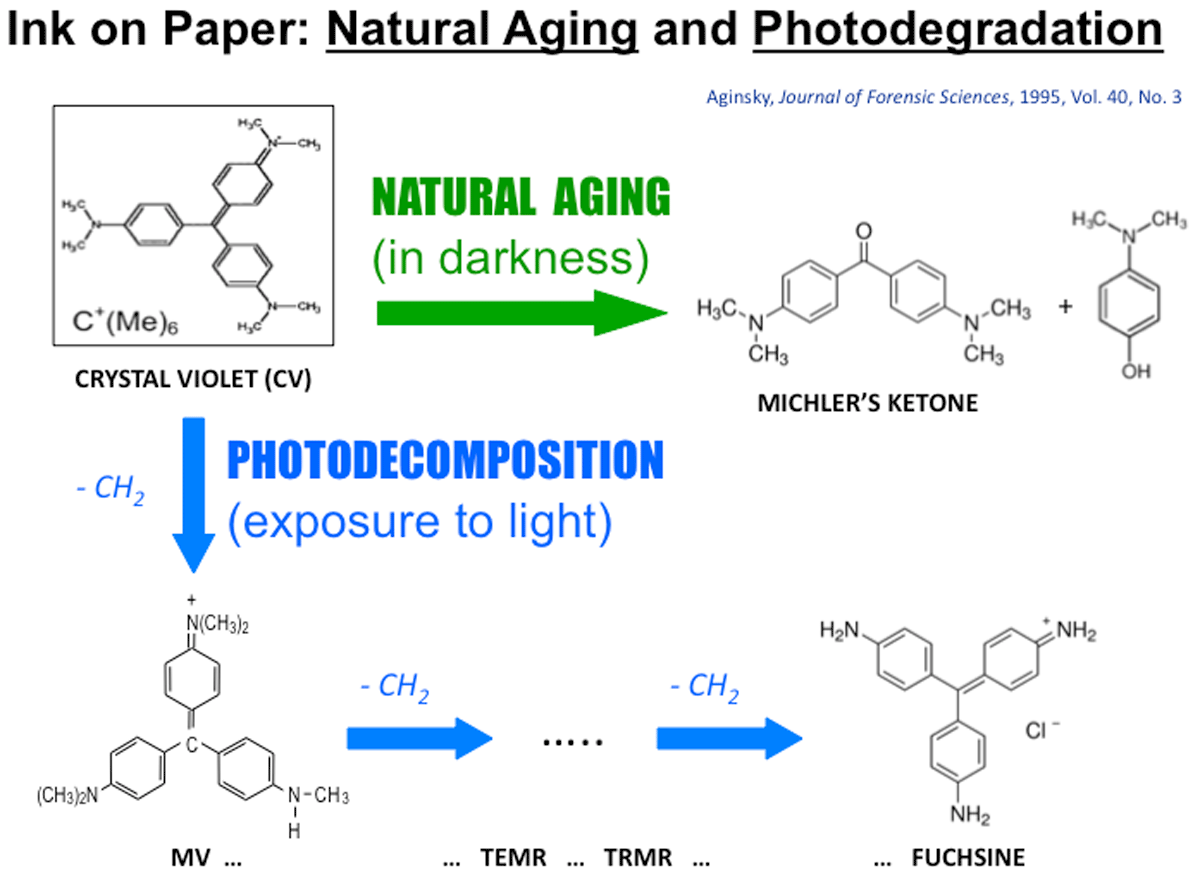
Figure 1
Two different mechanisms of the degradation of the dye CV (crystal violet) in inks on documents (2, 3, 4, 5, 47): (1) Natural Aging (when the document is kept in darkness) – the discoloration of CV due to the breakdown (oxidative cleavage in the presence of atmospheric oxygen) of CV into two compounds, Michler’s ketone and N,N-dimethyl-4-aminophenol;8 (2) Photodecomposition (when the document is exposed to light) – the decomposition of CV with the formation of up to six N-demethylation products – from Methyl Violet to fuchsine.
The dyes CV, MV, and their photodegradation products are ‘homologues, which are triphenylmethane dyes of a similar chemical structure and hence similar physical and chemical properties, whose chemical structures differ only by one methylene (CH2) group’ (17). All the seven ‘violet’ homologues (CV, MV, TEMR, TRMR, DMR, monomethylpararosaniline, and fuchsine), being very close ‘chemical relatives’, are very close in polarity. Therefore, when using thin-layer chromatography (TLC) and the solvent system that was developed in 1983 for TLC ‘separating dye components of writing inks’ (18, 19), they are separated on the TLC plate mainly based on the difference between their chemical structures by one methylene (CH2) group: CV, as the largest molecule (among the seven homologues), travels up the plate slower (lower Rf value) than the other six homologues, and fuchsine, as the smallest molecule, moves up the plate most rapidly (higher Rf value) than the other six homologues. That is, the chromatographic zones of the seven homologues are located on the TLC plate in the following sequence (upwards): CV (the color of the chromatographic zone is blue–violet), MV (violet), TEMR (reddish–violet), TRMR (red–violet), DMR (violet–red), monomethylpararosaniline (red), and fuchsine (deep red to magenta).9
As an example, Figure 2 [see also Figure 2 in ref. (17)] shows the results of the TLC separation of four homologues (upwards: CV, MV, TEMR, and TRMR) present in two black ballpoint inks, ‘Ink D’ (OfficeMax® black ballpoint ink) and ‘Ink E’ (Bic® black ballpoint ink).
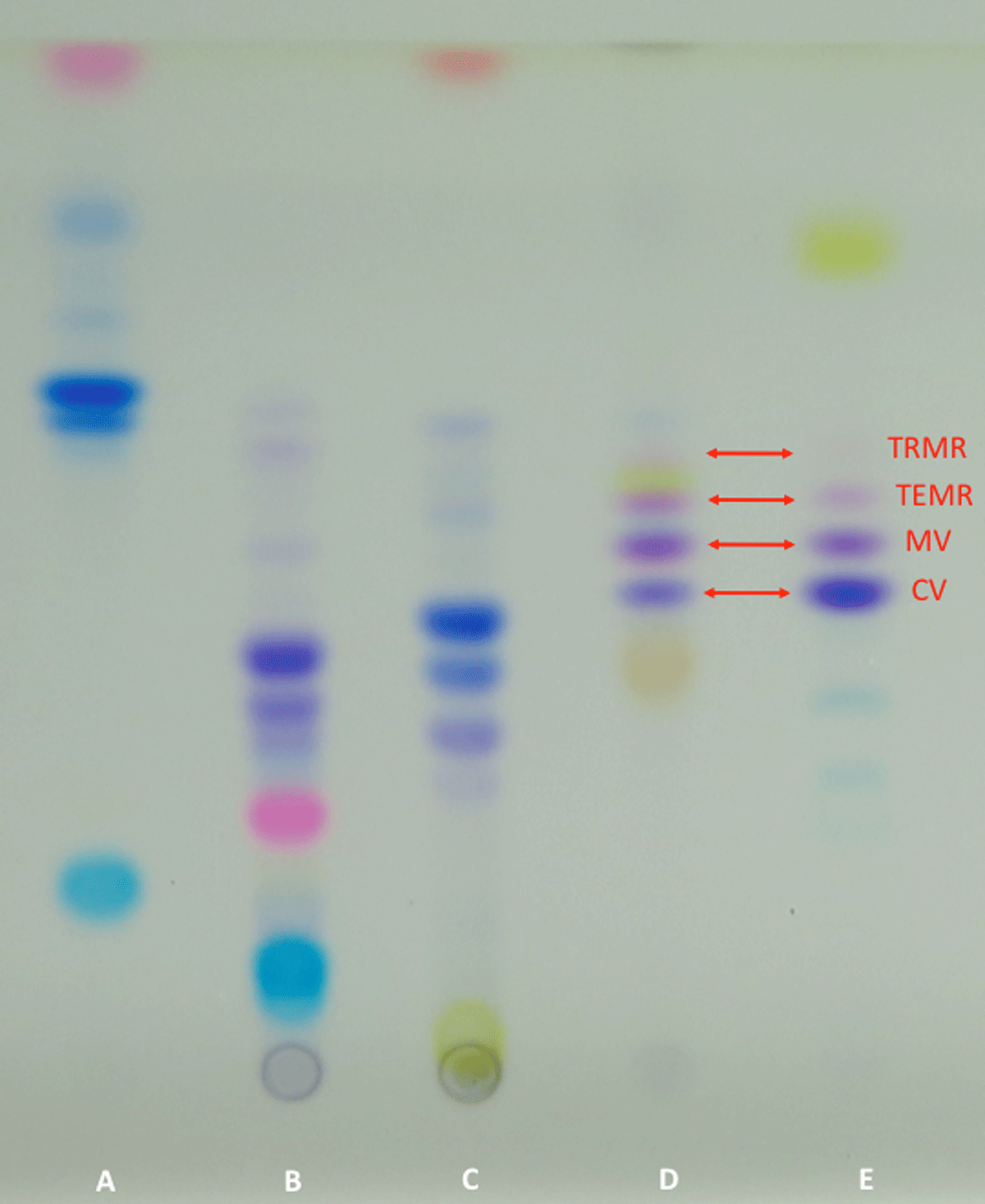
Figure 2
Five thin-layer chromatograms obtained for Inks A through E using the developing solvent ethyl acetate–isopropanol–water–acetic acid = 30:15:10:1 (photographed under daylight). The right two lanes are the chromatograms obtained for ink samples taken from the 12- and 18-year old entries written with Ink D (OfficeMax® black ballpoint ink) and Ink E (Bic® Soft Feel Jumbo black ballpoint ink, respectively).10 Both Ink D and Ink E contain the above four violet homologues (upwards: CV, MV, TEMR, and TRMR).11
Figure 3 illustrates another example showing a high efficiency and selectivity of TLC for separating the dye CV and its photodegradation products (for comparison, see Figures 2 and 8, 9, 10 in Section III).
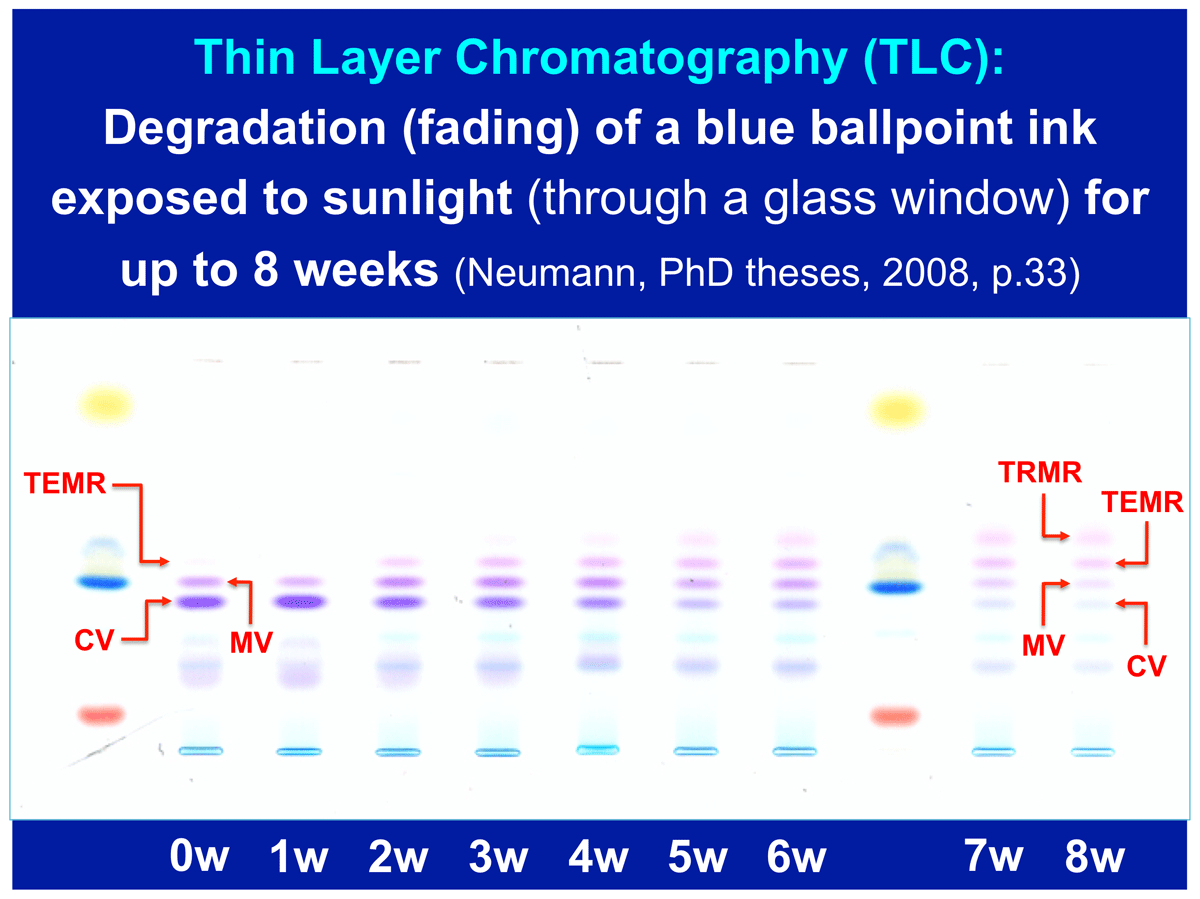
Figure 3
TLC analysis of ink samples taken from the same blue ballpoint ink on paper that had been exposed to sunlight through the window for up to 8 weeks [see ref. (12)].
Also, Figure 3 shows (1) that the exposure of the ink-on-paper to sunlight through the window has drastically changed the relative contents of the four triarylmethane dyes – CV, MV, TEMR and TRMR (the dyes CV and MV have almost vanished after the 8-week exposure to the sunlight, while the contents of TEMR and TRMR have significantly increased and exceeded the contents of CV and MV), and (2) that these changes can easily and reliably be detected by the visual comparison of the color intensities of the spots (chromatographic zones on the TLC plate)12 of the ink’s dye components – CV, MV, TEMR, and TRMR.
In the past two decades, scientists from various countries have published numerous experimental data supporting Aginsky’s findings, namely, that the above photodegradation products (usually TEMR and TRMR) form in significant amounts in inks (containing CV and MV) in cases when the inks on paper are exposed to light, and that these photodegradation products do not form in significant amounts when the inks are stored in darkness. Below are findings from some pertinent publications:
In 1995, Aginsky reported the results of the artificial aging (elevated temperature; no exposure to daylight) of a violet fountain pen ink of the writings made on white paper. The results showed that ‘only about 10% of the initial quantity of crystal violet [CV] could be decomposed for the period of 50 years of the natural aging of the violet ink placed on the paper for notes and kept in darkness at the room temperature’ (2). In addition, the above artificial aging results were confirmed by studying 32 entries (written on papers of various types), the ages of which varied from 24 to 70 years [‘32 entries written by the violet inks containing crystal violet (CV) or methyl violet (MV) during the period of time from 1923 to 1969’ (2, 47)].
In 2005, Weyermann reported the results of the testing of three blue ballpoint inks (that contained the dye CV as the major dye component), the ages of which varied from 4 to 14 years. The inks showed no significant degradation of the dye CV upon storage in the dark after 4 to 14 years. Based on the results of her research, Weyermann concluded that ‘unfortunately for the forensic scientists [that specialize in ink dating], dyes which are unstable in the presence of light do not degrade in the dark, or only very slowly so’ (10, p. 31).
In 2006, Weyermann et al. compared the results of the natural aging (the ink samples were ‘stored in darkness in a drawer’) and artificial aging (the ink on paper ‘was exposed to daylight by being attached to an outside window facing northwest’) of ‘two batches of [Bic blue] ballpoint ink’, and reported as follows: ‘No measurable change [in the composition of the ink’s triarylmetane dye components] was found for the ink strokes stored in the dark after one year, whereas a significant degradation was observed after already three days of exposure to daylight [and] a change of color is also visible to the naked eye; that is, the blue color turned to a green-turquoise shade’ (51).
In 2015, Williamson compared the results of the natural aging (the ink samples were ‘stored in a folder at room temperature for 22 months’) and photo-degradation of black ballpoint inks and reported that though ‘after 1 month exposure to daylight, strong signals of degradation products of Basic Violet 1 [Methyl Violet] were observed, no measurable change was found for the degradation products of Basic Violet 1 even after 22 months stored in the dark. These results were consistent with all other samples. These results are in agreement with the facts mentioned previously that the natural aging of ink entries is accelerated when the samples are exposed to daylight through a window, relative to samples not exposed to light’ (15).
In 2017, Amador, V. et al. examined the entries written with two black ballpoint inks on documents that were stored for 11 years and reported as follows: ‘Note that even after 11 years, the level of degradation experienced by the Basic Violet 3 (m/z 372) [BV3 = Crystal Violet] was very small’ (16).
In 2023, Óscar Díaz-Santana et al. examined entries written with an Inoxcrom® blue ballpoint ink on paper that were stored for up to 96 months in darkness and reported that the content of CV did not decrease during the 96-month period of aging in the dark,13 whereas the initially insignificant content of TRMR (‘0.21% with respect to the total pararosanilines’ – all violet triarylmethane dyes present in the ink), though slightly increased during the aging period (by 0.82%), but it still remained at a significantly lower level compared to the contents of CV (7.54%) and especially MV (85.11%) (49).
Thus, the results of multiple scientific studies have been reported showing, with experimental data, that the photodegradation products (TEMR, TRMR, etc.) of the dyes CV and MV accumulate in inks on paper when the inks are exposed to light of strong intensity and these degradation products do not appear in the inks in large quantities (not to mention that the contents of TEMR and especially TRMR in the ink would exceed the contents of CV and MV) if the inks are kept in darkness. Hence, it follows that even if a ballpoint ink on paper has been stored in darkness for many years (e.g., 20 years14), it is very unlikely that the ink could degrade so drastically as to the point where the contents of the ‘parent’ dyes CV and MV will become significantly less than the content of the CV/MV’s degradation product TRMR.15 It is important to stress that if such a drastic degradation of inks stored on paper in darkness were the case (such as the almost complete vanishing of the violet dyes CV and MV and the blue dye BB26 that occurred with the ink on page 1 of the 1999 Will – see lanes 1–3 in Figures 8, 10 that follow), then all the ‘ink libraries’ [see the SWGDOC Standard for Writing Ink Identification (50)] that include inks of hundreds different formulations written on paper and that have been maintained for scores of years by both government (e.g., the largest ink library maintained by the US Secret Service and IRS in the United States and the second largest ink library maintained by the Bundeskriminalamt in Germany) and by private laboratories in multiple countries would become useless after several years – simply because the degradation of the inks’ dyes (stored in darkness) would make the inks drastically different from their original compositions (formulations).
As an example, this author’s ink collection contains hundreds of entries written with black, blue and violet ballpoint inks over a period of time from 1973 to the 2020s (the ages of the inks on paper are from few days to approximately 52 years), and the results of the TLC examinations of all the inks of these known dated entries show that in each ink the contents of CV and MV are significantly larger than the content of TRMR (see e.g., Figure 4 and Table 1, as well as Figure 2).
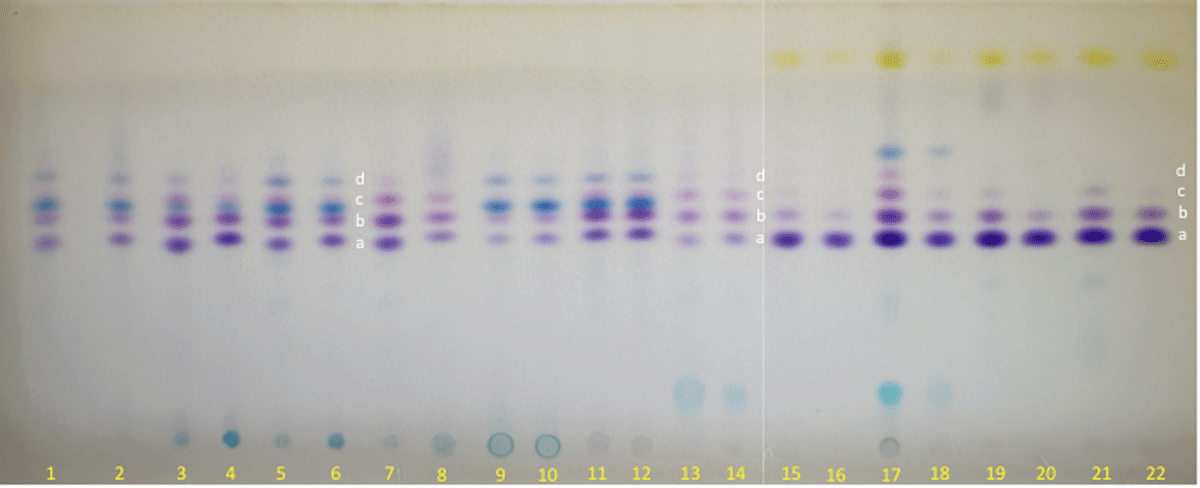
Figure 4
The TLC separation of the dye components of 11 pairs of blue and black ballpoint inks on paper of various compositions and ages (each pair includes ‘old’ and ‘fresh’ entries written with the same pen; see Table 1). The developing solvent was ethyl acetate–isopropanol–water–acetic acid = 30:15:10:1 (photographed under daylight). The ink’s four violet triarylmethane components separated by the TLC are as follows: (a) CV, (b) MV, (c) TEMR, and (d) TRMR.
Table 1
Blue and black ballpoint inks examined by TLC (see lanes 1–22 in Figure 4).
| LANE # | DESCRIPTION (PERTINENT INFORMATION ON CARTRIDGE, BARREL OF THE PEN, ETC.) | AGE OF INK ON PAPER |
|---|---|---|
| 1 | BIC blue ink (N-E-32) | 31 years |
| 2 | The same pen as in item 1 (see column ‘Lane #’) | 1 day |
| 3 | STAEDTLER blue ink (Stick 430 M DIN 16554 J1) | 31 years |
| 4 | The same pen as in item 3 | 1 day |
| 5 | SCHWAN-STABILINER blue ink (808 Medium Malaysia) | 31 years |
| 6 | The same pen as in item 5 | 1 day |
| 7 | GARANTIE-MINE blue ink (DIN 165544 ‘Senator’ West Germany) | 34 years |
| 8 | The same pen as in item 7 | 1 day |
| 9 | AT CROSS blue ink (refill, Fine, 09 00, USA) | 24 years |
| 10 | The same pen as in item 9 | 1 day |
| 11 | Blue ink (‘ROMANIA’ Italy) | 18 years |
| 12 | The same pen as in item 11 | 1 day |
| 13 | FORMULABS black ink (‘Black 923 cc, Lot 1192 3/79’) | 31 years |
| 14 | The same pen as in item 13 | 1 day |
| 15 | AT CROSS black ink (refill, 1 A36 Fine 711 Ireland) | 19 years |
| 16 | The same pen as in item 15 | 1 day |
| 17 | FISHER black ink (refill, pressurized, made in USA) | 17 years |
| 18 | The same pen as in item 17 | 1 day |
| 19 | TOMBOW black ink (refill, Fine, Japan 07.02) | 17 years |
| 20 | The same pen as in item 19 | 1 day |
| 21 | BIC black ink (four-color pen, Med. Pt., made in France) | 17 years |
| 22 | The same pen as in item 21 | 1 day |
As follows from Figure 4, TRMR (the CV/MV’s photodegradation product) did not form in significant amounts in any of the examined six blue and five black ballpoint inks on paper that had been stored (primarily in darkness) for a long time – from 17 to 34 years.
Based on the massive amount of experimental data on ink fading reported in multiple publications, including those mentioned above, this author makes the following conclusions:
If a ballpoint ink contains triarylmethane dye components, for example, CV, MV, TEMR and TRMR, the relative content of these labile dyes will inevitably be changing significantly as the ink on paper fades due to exposure to strong light (e.g., daylight through the window, which includes long-wave UV16) for a relatively long time (e.g., weeks and months).
Cases when the ink on paper contains larger concentrations of the CV and MV’s photodegradation products (TEMR, TRMR, etc.) than the concentrations of CV and MV – It is this author’s opinion that though it is generally not possible to determine, in each particular case, how long the ink was actually exposed to light (because such factors as ‘storage conditions [e.g., the intensity of light and duration of the exposure of the ink to light], ink composition [some ink’s components may quench the photo-degradation of certain dyes], and thickness of [ink lines in handwritten] entries’17 are typically not known to the examiner), the examiner, nevertheless, can make a scientifically sound and supported by numerous published data conclusion that a significant decomposition of the ink’s triarylmethane dyes (such as CV and MV) and the formation of the considerable amounts of their photodegradation products (exceeding the amounts of CV and MV in the ink) were caused by a long exposure (weeks and months) of the ink on the document to a relatively strong light (e.g., direct sunlight through the window).
As TLC is known to be capable of efficiently separating ink dye components CV and MV and the products of their photodecomposition, including TEMR and TRMR (as shown in Figures 2, 4), this analytical method can reliably establish that certain colored components (e.g., CV, MV, or the like) of an ink have significantly decomposed as a result of the exposure of the ink on the document to strong light. Therefore, TLC can help the examiner establish that as a result of the exposure of the ink on paper to light the ink has faded so significantly that its changed composition would no longer be consistent either with its initial composition or with the compositions of the non-faded inks of similar formulations (see the TLC results discussed in Section III).
Summing it up, the totality of the massive experimental results (data) on the subject of ‘ink fading’ obtained by numerous scientists from multiple countries, including the data discussed in Section I above, along with this author’s experience and researches in this subject (see e.g., 2, 3, 4, 5, 17, 18, 46, 47), have formed a necessary and sufficient scientific basis for the ultimate conclusion made by this author in the court case considered in this paper regarding the fading of the ink on page 1 of the 1999 Will (see Section III).
II. Ink Age Determination Using Solvent Loss Ratio Method (SLRM): Scope of Applicability of SLRM Is <6 Months
In this case, the Plaintiff’s expert used an ink aging method known as the Solvent Loss Ratio Method (SLRM) to evaluate the approximate ‘age’ of the ink of the signatures located on page 1 of the 1999 Will. This method was first reported as Rate of decrease of volatile components R% in 1996 in the article entitled ‘Dating and Characterizing Writing, Stamp Pad and Jet Printer Inks by Gas Chromatography/Mass Spectrometry’ (20, 21, 22)18 and then further described in two papers in 2002 (23) and 2010 (24). The SLRM is the ink aging method that determines the rate, R%, at which the content of the ink’s semi-volatile component, such as phenoxyethanol (PE) or a similar high boiling solvent, decreases at the time when the ink is being examined. Having obtained the value of R% exceeding 25%, the Plaintiff’s expert concluded that the 1999 Will ‘was not prepared in 1999 as indicated, but [page 1 of the 1999 Will was prepared within 2 years preceding the date of its examination in July 2019, i.e. it was prepared after] July of 2017.’ The foundation for this conclusion was a combination of two claims made by Gaudreau and Brazeau of the Canada Border Services Agency (CBSA) in their conference paper presented in 2002, namely, (1) that the solvent loss ratio exceeding 25% (R% > 25%) indicates that the ink is <300 days old, and (2) that ballpoint inks might lose their volatile components (ink solvents) during up to 2 years after being applied to paper, which implies that the scope of applicability of the SLRM might be up to 2 years (23). These two claims are discussed below.
Claim 1: The solvent loss ratio exceeding 25% (R% > 25%) indicates that the ink is <300 days old (23)
In 2002, Gaudreau and Brazeau introduced the ‘25% threshold’ (R% = 25%) and claimed that the scope of applicability of the SLRM is 300 days (23). Several years later, however, they stopped using this 25% threshold (24). The reason for that was the result of the analysis of an extensive set of experimental data (286 R% values), which had been obtained by these two authors and their colleagues at the CBSA laboratory when examining a representative set of ballpoint inks using SLRM. The analysis of the experimental data obtained (286 R% values obtained by the CBSA laboratory) showed numerous false–positive results for the above 25% threshold: multiple inks not only older than 300 days, but sufficiently older than 2 years showed R% > 25% (24, 25, 26, 27) (see the 286 data points, ‘R% vs. Age of Ink,’ in Figure 5).
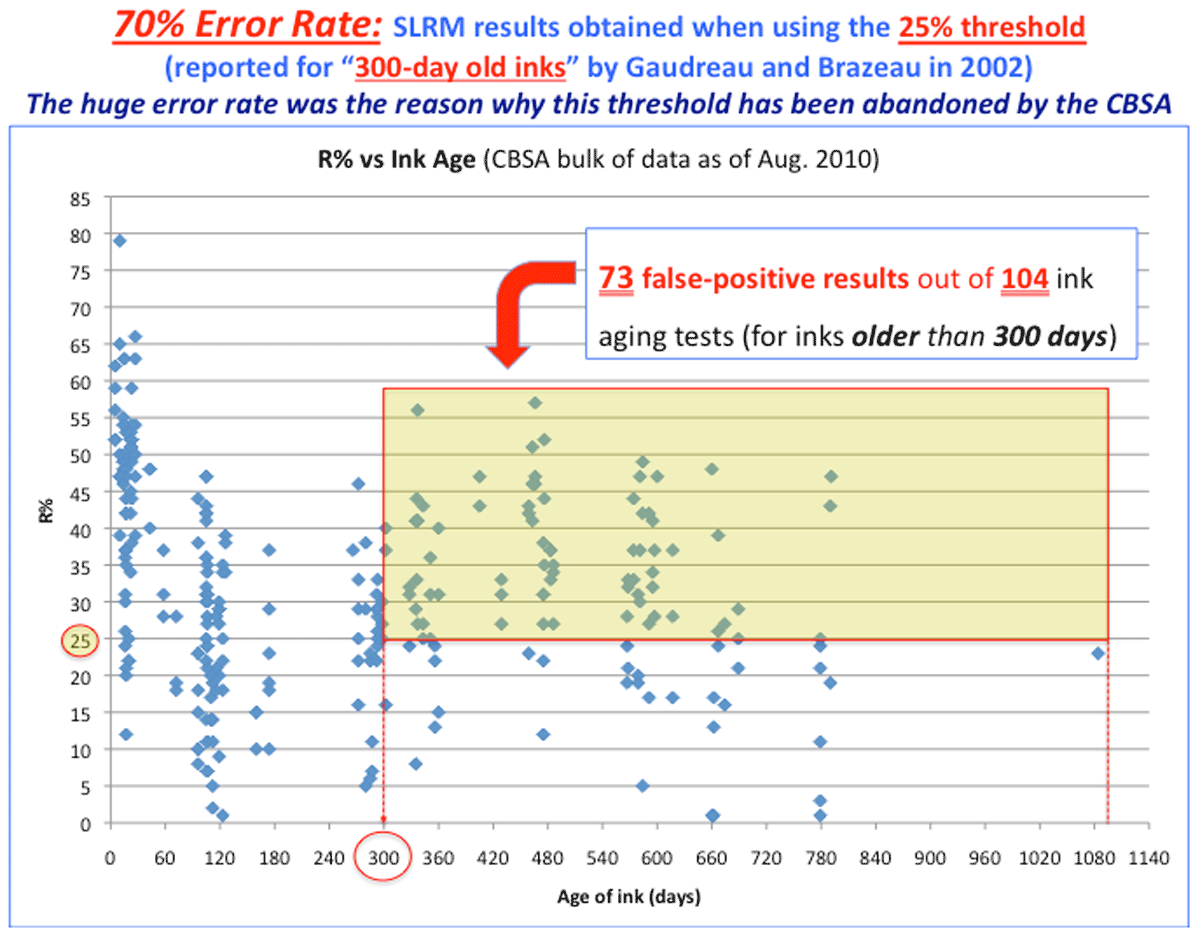
Figure 5
When using the R = 25% ‘threshold,’ the SLRM showed the error rate of 70% (73 false–positive results out of 104) for the inks older than 300 days, the error rate of 41% (9 false–positive results out of 22) for the inks older than 22 months, and the error rate of 30% (3 false–positive results out of 10) for the inks older than 2 years.
Therefore, since the 2010s, the CBSA laboratory has not used the above 25% threshold anymore,19 and since recently the CBSA laboratory has been relying on only one ‘threshold’ when using the SLRM – R = 50%: if the value of R% is statistically significantly larger than 50%, then it indicates that the age of the ink is <6 months (28). The fact that the CBSA laboratory uses the SLRM only for determining whether the age of ballpoint ink on paper is <6 months (28) is in agreement with multiple other publications that show, with experimental data, that the scope (limit) of applicability of the SLRM does not exceed 6 months [see ref. (29) and the publications referenced in Table 2].
Table 2
Peer-reviewed articles and published (in conference proceedings) papers that report experimental data obtained and discuss the scope of applicability of the ink aging methods which measure the gradual disappearance (‘solvent loss’) of the solvent 2-PE from ballpoint ink on paper (listed in chronological succession).
| YEAR | AUTHOR(S) (REFERENCE) | METHOD | THE SCOPE (LIMIT, RANGE) OF APPLICABILITY OF THE METHOD CONFIRMED BY PUBLISHED EXPERIMENTAL (NUMERICAL) DATA |
|---|---|---|---|
| 1993 | Aginsky (57) | Solvent loss with time (natural aging) | <2 months |
| 1996 | Aginsky (20) | SLRM | 3 months |
| 2002 | Gaudreau and Brazeau (23) | SLRM | 10 months* |
| 2005 | Wang et al. (66) | Solvent loss with time | 3 months |
| 2006 | Bügler et al. (34) | Thermal desorption and GC-MS (mass independent SLRM) | 3–4 months |
| 2007 | Brazeau and Gaudreau (67) | Solvent loss with time | < 6 months |
| 2007 | Weyermann et al. (68) | Solvent loss with time | ca. 2 weeks (the aging of blue Parker ballpoint ink was studied) |
| 2008 | Bügler et al. (36) | Mass independent SLRM: TD-GC/MS20 | Several months (300 different ballpoint inks were tested) |
| 2010 | Ezcurra et al. (69) | Solvent loss with time | <2 months (the aging of blue Bic ballpoint inks was studied) |
| 2011 | Weyermann et al. (53) | Outside proficiency testing using ‘blind’ ink samples are necessary to test the validity of current ink aging methods | This article reviews the state of the art in the area of ink aging analysis and stresses as follows:
|
| 2012 | Kirsch et al. (70) | Solvent loss with time | <3.5 months (161 different ballpoint inks were tested) |
| 2012 | Bügler (37) | Mass independent SLRM: TD-GC/MS | ca. 4 months (80 different ballpoint inks were tested) |
| 2012 | Koenig and Weyermann (71) | SLRM | <2 months (the study of the aging of fast, medium and slow aging inks) |
| 2014 | Aginsky (25) | SLRM | <3 months22 (14 different ballpoint inks were tested: Bic, Zebra, Pilot, Pentel, Avery, Lamy, Parker, etc.) |
| 2015 | Koenig et al. (72) | SLRM23 | <100 days (the study of the aging of fast, medium and slow aging inks) |
| 2018 | Koenig and Weyermann (32) | SLRM and TD-GC/MS | ‘few months’ 25 blue and black ballpoint inks24 of different brands (Bic, Papermate, Pilot, National Ink, Dokumental, Sanford, Formulabs, Waterman, Staedler, Lamy, Pelikan, Pentel, etc.) that represent fast, medium, and slow aging inks. |
Claim 2: Ballpoint inks might lose their volatile components (ink solvents) during up to 2 years after being applied to paper, which implies that the scope of applicability of the SLRM might be up to 2 years (23)
The only basis for this claim is the following theoretical contention stated by Gaudreau and Brazeau as follows: ‘The rate of evaporation [of ballpoint ink solvents, such as phenoxyethanol] stabilizes over a period of approximately six to eighteen months and is not significant much beyond two years after the ink has been applied to paper’ (23, p. 3).
This theoretical contention, however, has never been substantiated by any experimental data either in (23) or in any other scientific publication. On the contrary, multiple ink chemists in various countries have researched aging processes occurring in ballpoint ink on paper, specifically a process of the decrease in the level of PE during both the natural aging (at room temperatures) and artificial aging (when ink samples are heated, e.g., at 70°C), and they have published their results and pertinent experimental data clearly demonstrating that, at normal storage conditions (normal room temperature and humidity), the measurable decrease in the level of PE ceases within significantly <6 months after a placement of any ballpoint ink on paper [in total, hundreds of different ballpoint inks have been tested (25, 26, 27, 30, 31, 32, 33, 34, 35, 36, 37, 57, 66, 67, 68, 69, 70, 71, 72)]. These publications have been recently reviewed (25, 27, 32) and they are summarized in Table 2.
The comparison of the multiple ink aging techniques (including SLRM) considered in Table 2 shows some technical differences in certain aspects of the reported procedures (e.g., a monitoring of the evaporation of the solvent 2-PE either during the natural aging of the ink or using certain techniques, such as SLRM or TD-GC/MS, to induce the artificial aging of the ink that will mimic its natural aging; use of various sample preparation techniques – liquid extraction or thermodesorption of 2-PE from ink samples taken from written entries). Nevertheless, all the ink-aging techniques mentioned in Table 2 are methodologically very similar as they all:
Measure gradual disappearance of the solvent 2-PE from the inks aging on paper, and
Allow the analyst to reliably discriminate between ‘fresh’ (age less than a few months) and older ink writings.
Summing it up, based on the numerous (several hundreds) experimental data published by ink dating specialists in multiple countries (see Table 2), it is logical to conclude (1) that the scope (limit) of applicability of the SLRM is <6 months (approximately 3 to 4 months, according to the published results of the studies considered in Table 2), and (2) that the <6-month scope of applicability of the SLRM makes this ink aging method incapable of establishing whether the ink, which is known to be older than 6 months (as in the court case discussed in this paper), is younger than 2 years.
In this court case, as the author of the SLRM and knowing its capabilities and limitations, and based on the published results of many studies (see Table 2), the Defendant’s expert opined that the <6-month scope (limit) of applicability of the SLRM does not allow one to determine the ‘age’ of a handwritten entry in cases where it is known that the entry cannot be ‘younger’ than 6 months. The 1999 Will could not be younger than 6 months at the time when the Plaintiff’s expert examined this document in July of 2019. In fact, in July of 2019, the document could not be younger than 10 months, as it was lodged with the Probate Registry in September 2018. Therefore, in this case, the ink aging method (SLRM) used by the Plaintiff’s expert was incapable to provide any meaningful information that could be helpful to the court. To put it simply, in July 2019, an ink aging method that has the scope (limit) of applicability of less than 6 months should not have been used to try to determine whether the signatures located on page 1 of the 1999 Will were approximately 20 years old (Defendant’s proposition) or whether the signatures were much younger, but not younger than 10 months old (Plaintiff’s proposition).25 This time frame at issue (from ‘not <10 months’ to ‘20 years’) is simply beyond the scope (limit) of applicability of the SLRM.
Influence of light on the aging of ink: The prolonged exposure of page 1 of the 1999 Will to light of strong intensity has made the ink-aging results obtained in this case unreliable
It is this author’s conclusion, based on his experience, knowledge, and analysis of numerous published data on ink fading (many of which are discussed in this paper), that the high level of the photodegradation of the dyes CV and MV detected in the ink of the signatures located on the first (i.e., top) page of the 1999 Will (see Figures 8, 10 and the discussion of the TLC results in Section III that follows) could only be achieved if this page was exposed to a strong light for a relatively long period of time (e.g., several weeks of sunlight through a glass window). Therefore, this author testified in the court case discussed in this paper that the high content of the photodegradation (N-demethylation) products of the dyes CV and MV present in the ink of the signatures located on page 1 (the content of TEMR and especially TRMR in the ink significantly exceeded the content of CV and MV) provided very strong evidence [‘the “virtually certain” degree of confidence’ (60)] supporting the proposition that this page had been exposed to light of strong intensity for a relatively long time.
This author is not aware of any scientific publications that show that a writing ink stored in darkness for as long as around 20 years would fade (degrade) so drastically as to the point when the content of the parent dye CV (and MV) would become less than the contents of the CV’s degradation products TEMR and TRMR (as one can see from Figures 8, 10). At the same time, multiple researchers have published experimental data proving that the dyes CV, MV, and similar triarylmethane dyes, which are unstable in the presence of light, practically do not degrade in the dark (see e.g., 2, 3, 4, 10, 15, 16, 49).26 Moreover, using TLC and other analytical methods, various scientific studies have shown that the degradation by-products of an ink would be different if it was degraded by the passage of time as opposed to by exposure to intense light (see e.g., 2, 3, 4, 5, 47, 49).
Thus, after in this case it was determined that the ink of the signatures located on page 1 of the 1999 Will had been exposed to light of strong intensity for a relatively long time, the question arose whether the SLRM could still provide reliable results for such a faded (partially decomposed) ink.
This author is not aware of any scientific publications that would have shown, with experimental data, that a relatively long exposure of ballpoint ink on paper to light of strong intensity, such as sunlight, while causing a significant change in the composition of the ink’s triarylmethane dye components, nevertheless, does not have a significant effect on the results of the ink’s age determination using the ink aging methods, such as SLRM. On the contrary, there are multiple studies that show that heat at elevated temperatures (i.e., at temperatures that are higher than normal room temperatures) ‘induces [accelerated] drying and aging’ of ink on paper and, as a result, ‘induced aging takes an ink aging parameter [faster than at natural aging] to where it would be had it ceased aging naturally’ (21). Therefore, numerous scientific publications state that the ink aging results can be considered reliable only if the examined document(s) has been stored under ‘normal environmental conditions’ (i.e., at normal room temperatures – not higher than 30°C, humidity, and light conditions27). A prolong exposure to light of strong intensity (such as direct sunlight through the window that mainly consists of long-wave UV,28 visible, and ‘heat-producing’ infrared radiation), which typically will heat the surface of the document to temperatures significantly higher than normal room temperatures and therefore lead to the accelerated (i.e., artificial) aging of the ink on the document,29 is clearly inconsistent with the above ‘normal environmental conditions’. As a result of the accelerated (by elevated temperature) evaporation of the ink’s high boiling solvents, the ink will be aging (and the measured ink aging parameters, e.g., solvent loss ratio, R%, will be decreasing) faster than the same ink had it aged at normal environmental conditions. Thus, the combined detrimental effect of solar radiation on ink on paper is caused (1) by the absorption of the photon energy of the UV and visible radiation by the molecules of the ink’s dyes (that leads to the photodegradation of the dyes), and (2) by the ‘warming’ of the ink as a result of the absorption of the ‘heat-producing’ infrared radiation that leads to the accelerated aging of the ink on paper due to the accelerated evaporation of the ink’s solvents, including PE, and the accelerated polymerization of the ink’s resin. The latter will certainly skew (unpredictably affect) the ink age determination results obtained using any of the ink aging ‘methods to estimate the age of an ink [that] are the major ones based on the analysis of ink solvents’ (22), including the solvent loss ratio method (SLRM) used by the Plaintiff’s expert in the court case considered in this paper.
III. Case Examination: Whether Page 1 of the 1999 Will Has or Has Not Been Substituted Since (Many Years After) the Initial Production of the Document, That Is, Whether the Contested Three-Page 1999 Will Is Genuine with Respect To Its Date of Preparation
As mentioned above, one of the key issues in the probate matter was whether the three-page Will, dated 13 August 1999 (the ‘1999 Will’), was produced (printed) and signed on or around the date shown on the document (the Defendant’s proposition), or whether this three-page document or the first page of the document were produced and signed significantly later, for example, as late as September 2018 when the Will was lodged with the High Court (Hong Kong Special Administrative Region) Probate Registry (the Plaintiff’s proposition). However, as for the Plaintiff’s proposition, it should be noted that, based on the fact that the Plaintiff’s expert did not examine the ink on page 2 for dating purposes (see the first paragraph in Section II above), one can make a logical inference that, in this case, the Plaintiff actually contested the authenticity of the three-page 1999 Will only with respect to the date of the preparation (printing and signing) of its first page (the whole printed text of the Will is located on the first page). Therefore, it seems that the Plaintiff’s proposition in this court case was actually as follows: the first page of the 1999 Will was not produced (printed) and signed in 1999 contemporaneously with the other two pages of the document, but it was produced and signed significantly later – e.g., as late as September 2018.
The examination results obtained and conclusions made by this author (the Defendant’s expert) are summarized below.
A. Visual examination
1. The 1999 Will consists of three sheets of thick green A4 paper stapled and bounded together with a red ribbon and a brown–red sealing-wax seal. The paper of each page contains the same watermark.30
2. Each page of the 1999 Will bears printed entries produced with an office machine system (laser printer and photocopier) that uses dry toner-based electrophotographic technology and black toner.
3. The first and second pages of the 1999 Will bear three and four handwritten signatures, respectively, written with ballpoint ink. The three signatures on page 1 are of pale violet–gray color and the four signatures on page 2 are of bright blue color (see Figure 6).
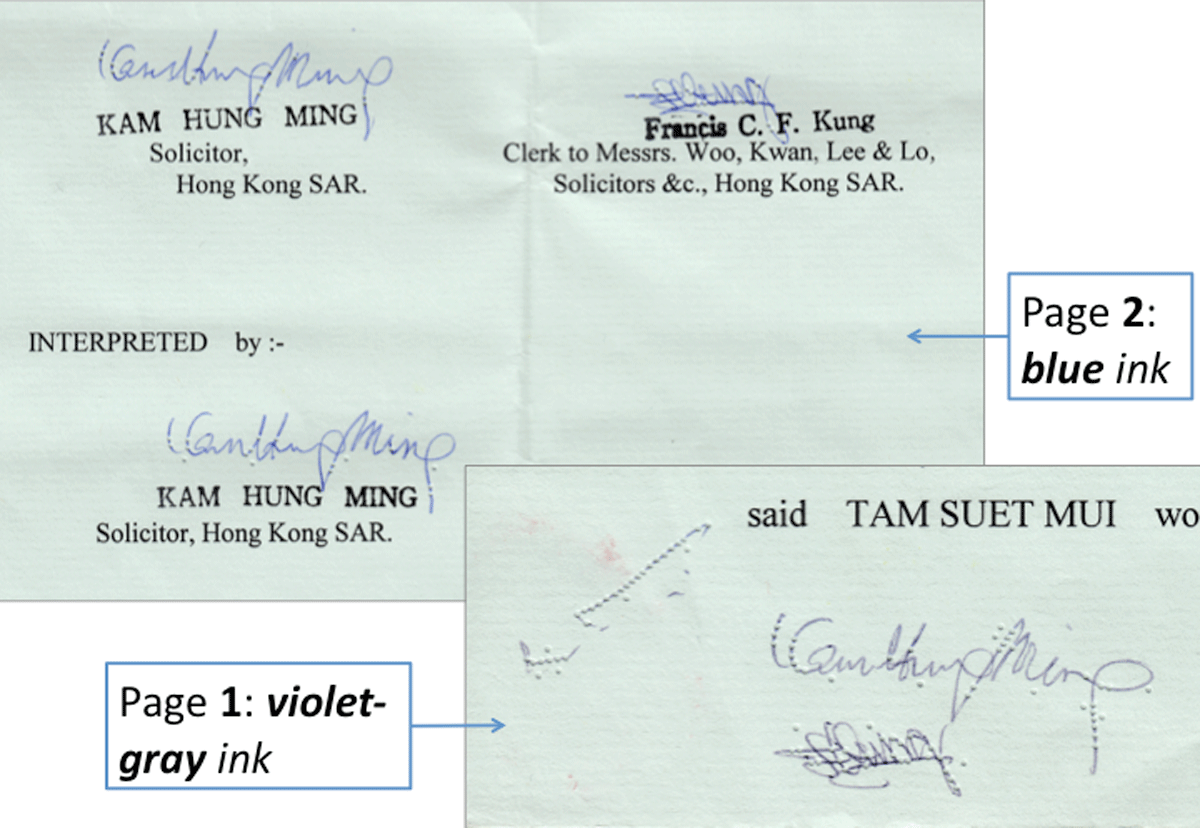
Figure 6
Fragments of pages 1 and 2 of the 1999 Will (numerous hole punches in the lines of the signatures indicate that the inks of the signatures have been subjected to a chemical analysis).
B. Indentation examination
4. In this case, an electrostatic detection device was not available at the on-site examination of the 1999 Will at the Probate Registry. However, when utilizing oblique light, the Defendant’s expert observed and photographed the inkless indentations (impressions) in page 2 of the 1999 Will corresponding to one of the three signatures written on page 1, and the impressions in page 3 of the 1999 Will corresponding to two of the four signatures written on page 2.
C. Ink comparison
5. As mentioned above, the first and second pages of the 1999 Will bear three and four handwritten signatures, respectively, written with ballpoint ink.
6. The ink of the four signatures on page 2 of the Will has a bright blue color. The ink of the three signatures on the top page of the Will (page 1) has a pale violet–gray color, which is not a typical color for ballpoint inks. As will be discussed further in this paper, the ink on page 1 has such an unusual color because the originally bright blue ink has significantly photo-decomposed that resulted in the changes to the composition of the ink’s violet and blue dye components (see the results of the TLC analyses of the ink’s dyes shown in Figures 8, 10) which, in its turn, caused a drastic change to the ink’s color (both tint and brightness): the original bright-blue color of the ink had turned into pale violet–gray (see Figure 6).
C-1. Gas chromatography-mass spectrometry (GC-MS)
7. In this examination, ink samples taken from the 1999 Will were analyzed by GC-MS as follows. For each signature tested, two ink samples (each sample was a microplug of ink on paper of ca. 0.5 mm in diameter) were placed into a small glass vial and extracted with about 2 μL of acetonitrile. The ink was extracted for 15 min. The extracts were analyzed using an Agilent 6850 gas chromatograph equipped with a split/splitless injection system and interfaced with an Agilent 5975C mass selective detector.31
8. The GC-MS chromatograms obtained for the ink samples taken from each of the seven signatures located on pages 1 and 2 of the 1999 Will showed a high level match: the ink of each signature contains the same six noncolored components (see e.g., Figure 7).32
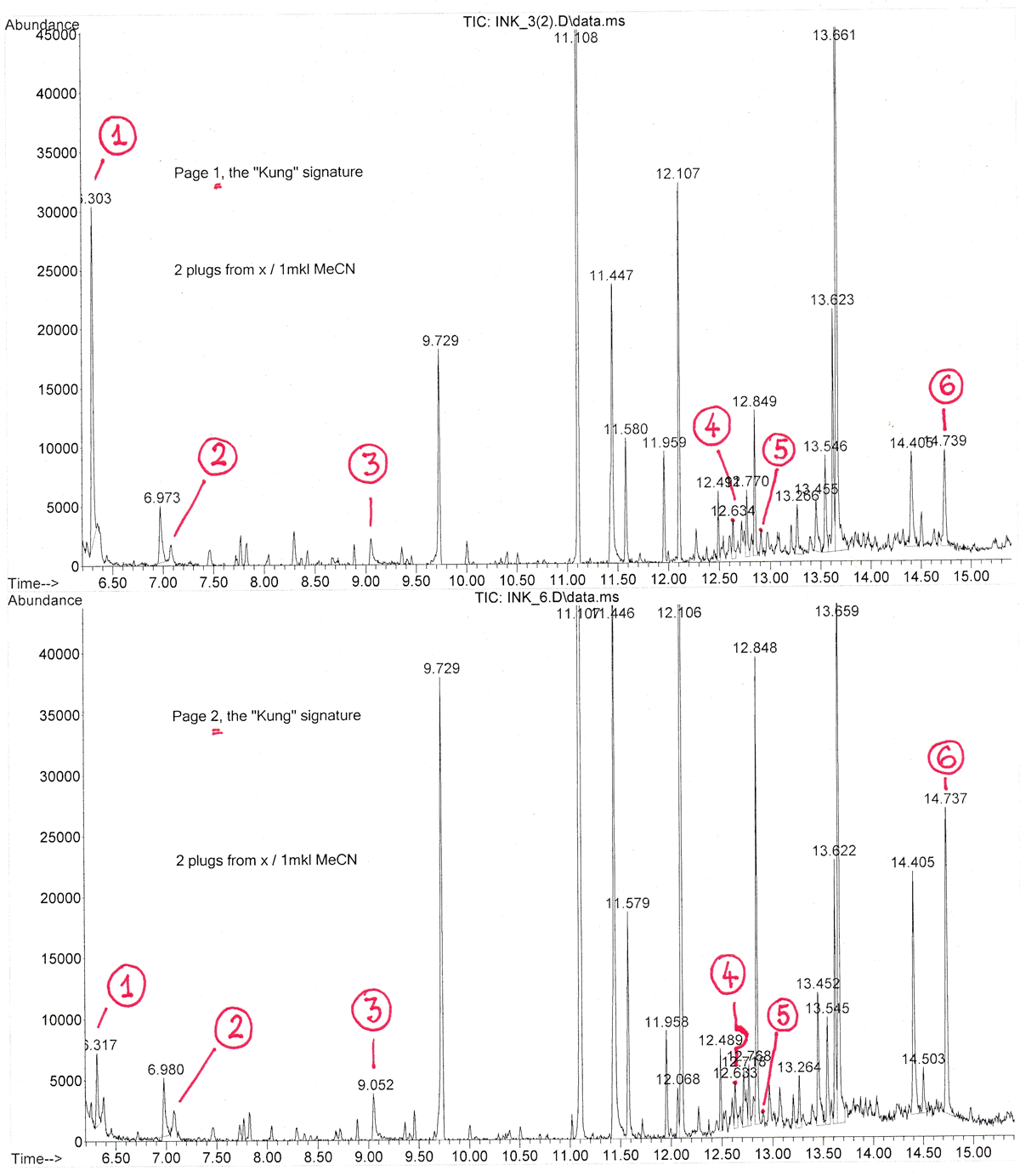
Figure 7
Comparison of the GC-MS chromatograms of ink samples taken from the signatures written in the name of ‘Kung’ on pages 1 (upper chromatogram) and 2 (lower chromatogram) of the 1999 Will. The six components of the ink, indicated by the red lines and circled numbers, are as follows: #1 – benzaldehyde; #2 – benzyl alcohol; #3 – phenoxyethanol; #4 – an unidentified micro component of the ink (five largest peaks in the component’s mass spectrum, m/z: 195 [base peak], 210, 180, 165, and 179); #5 – an unidentified micro component of the ink (five largest peaks in the component’s mass spectrum, m/z: 119 [base peak], 196, 105, 77, and 91); #6 – 1-(phenylmethoxy)-naphthalene.
Note: The other multiple peaks (other than those indicated by the red lines) appearing on the two GC-MS chromatograms are the peaks that represent the components of the paper. This was established as a result of the comparison of the GC-MS chromatograms obtained for the ink-on-paper samples and for the paper blank samples taken from the paper of the 1999 Will.
9. The combination of the above six noncolored ink components revealed by the GC-MS analysis provides a complex ‘chemical fingerprint’ of the ink. It is a very unlikely scenario at which four signatures on page 2 of the 1999 Will were written at one writing session using one pen (one ballpoint ink formulation), and the three signatures on page 1 were written at another writing session (e.g., years later) using another pen (a different ballpoint ink formulation), but, by some improbable coincidence, both inks happened to contain one and the same combination of the same six noncolored components.
C-2. Thin-layer chromatography (TLC)
10. In this examination, the TLC analysis of the ink samples was conducted as follows (the toner and paper blank samples were analyzed similarly). For each handwritten entry (signature) tested, three samples of ink (microplugs of ink on paper of ca. 0.5 mm in diameter) were placed into a small glass vial and extracted with about 2 μL of dimethylformamide. The ink was extracted for 20 min. The ink extract (visually colored) was applied using a capillary pipette on a high performance TLC silica gel 60-F254 (10 × 10 cm) pre-coated glass plate (Merck, Germany). The TLC plate was allowed to air dry (accelerated with a hair dryer) and was then placed in a vertical orientation into a developing tank. The tank was a glass enclosure with a removable lid and contained a few milliliters of a developing solution (mobile phase). The plate was developed sequentially using two mobile phases: (1) acetone–hexane = 1:4 and (2) ethyl acetate–isopropanol–water–acetic acid = 30:15:10:1. Resulting chromatograms obtained for each sample tested were observed and photographed under ultraviolet (254 and 365 nm) and daylight (see e.g., Figure 8).
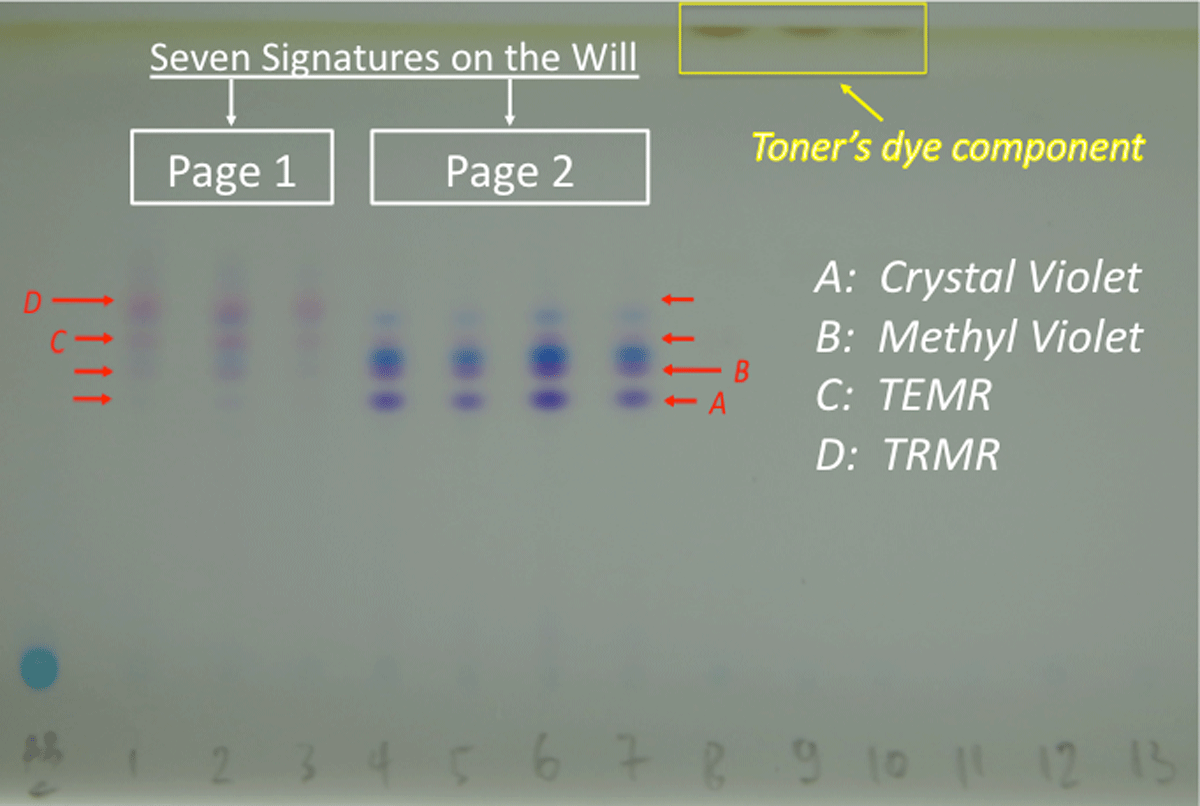
Figure 8
The effect of long-term exposure to light on certain dye components of the blue ballpoint ink on page 1 of the 1999 Will: two violet dye components ‘A’ and ‘B’ and both blue dye components of the ink have significantly decomposed (almost vanished). The thin-layer chromatograms (photographed under daylight) obtained for the following ink, toner, and paper samples taken from pages 1–3 of the 1999 Will: the ink samples taken from each of the three pale violet–gray signatures on page 1 (lanes 1–3); the ink samples taken from each of the four bright blue signatures on page 2 (lanes 4–7); the black toner samples taken from the printed entries on pages 1, 2, and 3 (lanes 8, 9, and 10, respectively); and the green paper blank samples taken from pages 1, 2, and 3 (lanes 11, 12, and 13, respectively).
11. Based on the color and the Rf (retention factor) values of the four chromatographic zones designated as A, B, C, and D in Figure 8, these chromatographic zones correspond to the abovementioned four violet and reddish-violet ink dye components – CV, MV, TEMR, and TRMR, respectively (see Figures 2, 4).
12. Figure 8 (lanes 1–3) shows that the ratio of CV and TEMR (designated as components ‘A’ and ‘C’ in Figure 8) is practically equal to zero (because only trace amounts of CV were visually detected on the TLC chromatograms obtained for the ink of the violet–gray signatures located on page 1 of the 1999 Will). Moreover, the major component of the ink’s colorant observed on the TLC chromatograms (lanes 1–3) was TRMR, designated as component ‘D’ in Figure 8. However, the massive set of experimental data reported in the numerous publications considered in Section I (see e.g., 6, 7, 8, 9, 10, 11, 12, 15, 16, 17, 49, 51), as well as Figures 2, 4, indicate that TRMR is a compound (like a ‘technological impurity’) that is not typically present at significant concentrations (in comparison with the concentrations of CV, MV, or TEMR) in blue, violet, and black ballpoint inks containing CV and MV. It is this author’s opinion that if significant amounts of TRMR were detected in a ballpoint ink on paper (exceeding not only the contents of CV and MV but even the content of TEMR), as in the court case discussed in this paper, then such an unusual (for a typical ballpoint ink formulation) composition of the ink’s violet triarylmethane dye components can only be scientifically explained as a result of the N-demethylation of CV, MV and TEMR caused by a long exposure of the ink to sunlight or another source of strong UV light.
13. One can see from lanes 4–7 in Figure 8 that the ink of each of the four signatures on page 2 of the 1999 Will contains the same five colored components: three violet dye components (designated as A, B, and C in Figure 8) and two blue dye components.
14. Based on the color and the Rf (retention factor) values of the two blue components (in Figure 8, one blue component is located between the chromatographic zones designated as B and C, and the other blue component is located between the chromatographic zones designated as C and D), these two components represent Victoria Blue [also known as ‘Basic Blue 26’ or ‘BB26’ (10, pp. 70–75)] – a blue triarylmethane dye that is frequently used, in combination with the dyes CV and MV, for manufacturing blue ballpoint inks by different companies in many countries (e.g., Bic, Schwan Stabilo, ICO/Hungary, Staedler, AT Cross, Faber Castel, Lamy, Mont-Blanc, Pelikan, Schneider, Sheaffer, Tombow, etc.)
15. Figures 9 and 10 below show that both blue components of the dye BB26 present in the ink of the four signatures on page 2 of the 1999 Will are also present, though in smaller quantities, in the faded ink of the three signatures located on page 1, that is, these two blue components are present in the ink of all seven signatures located on pages 1 and 2 of the 1999 Will (Note: in Figure 9, the positions of the blue dye components on the TLC chromatograms obtained for each signature are indicated by the left–right arrows).
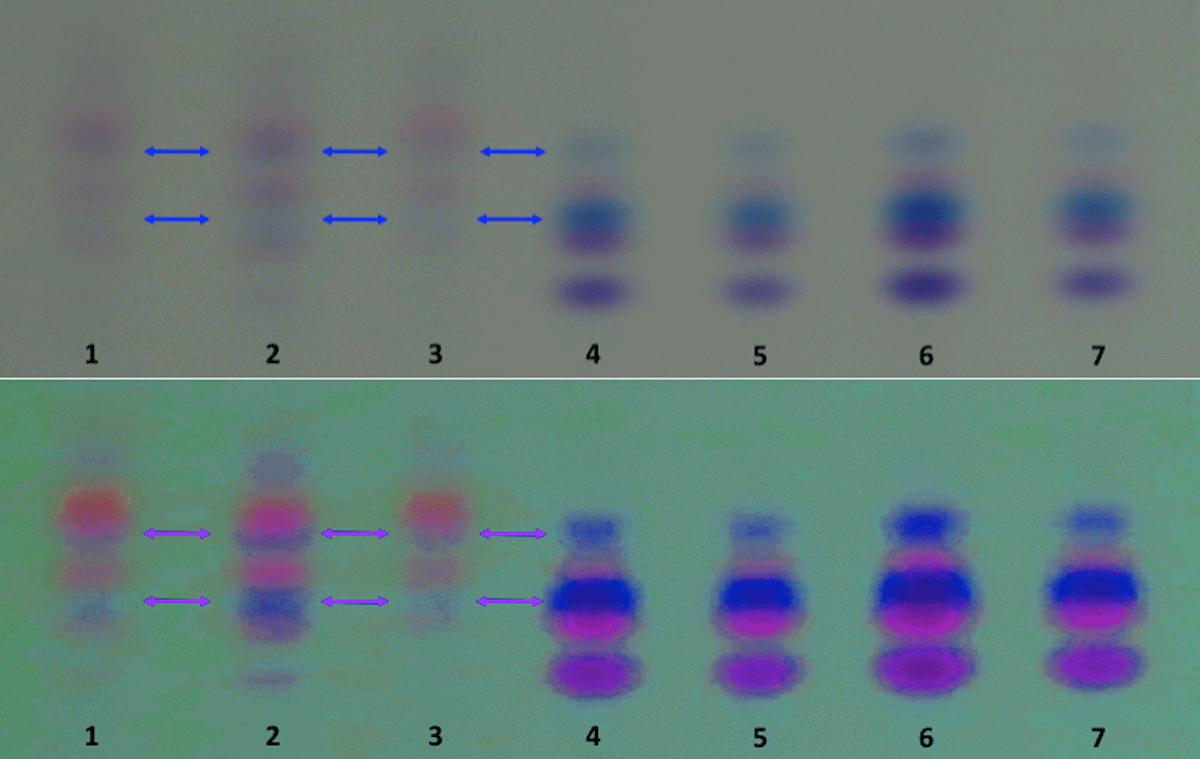
Figure 9
Both blue dye components of the ink on page 1 of the 1999 Will have significantly decomposed (almost vanished) after a long exposure of page 1 to light. Upper Image: a fragment of Figure 8 that shows the results of the TLC separation of the violet and blue dye components of the ink of each of the three signatures located on page 1 (see lanes 1–3) and each of the four signatures located on page 2 of the 1999 Will (see lanes 4–7). Lower Image: the upper image ‘observed’ through a ‘green filter’ that changes the color of the background of the TLC plate (from light-gray to light-green) and the colors of all chromatographic zones of the violet dye components (from dark-violet to bright-violet and from red–violet to bright red–orange) and the blue dye components (from greenish-blue to bright dark-blue). The ‘green filter’ was applied to the upper image using the ‘Adjust Hue/Saturation’ command in Photoshop. Specifically, the following Hue/Saturation parameters were used to obtain the lower image: Hue = +30 and Saturation = +80.
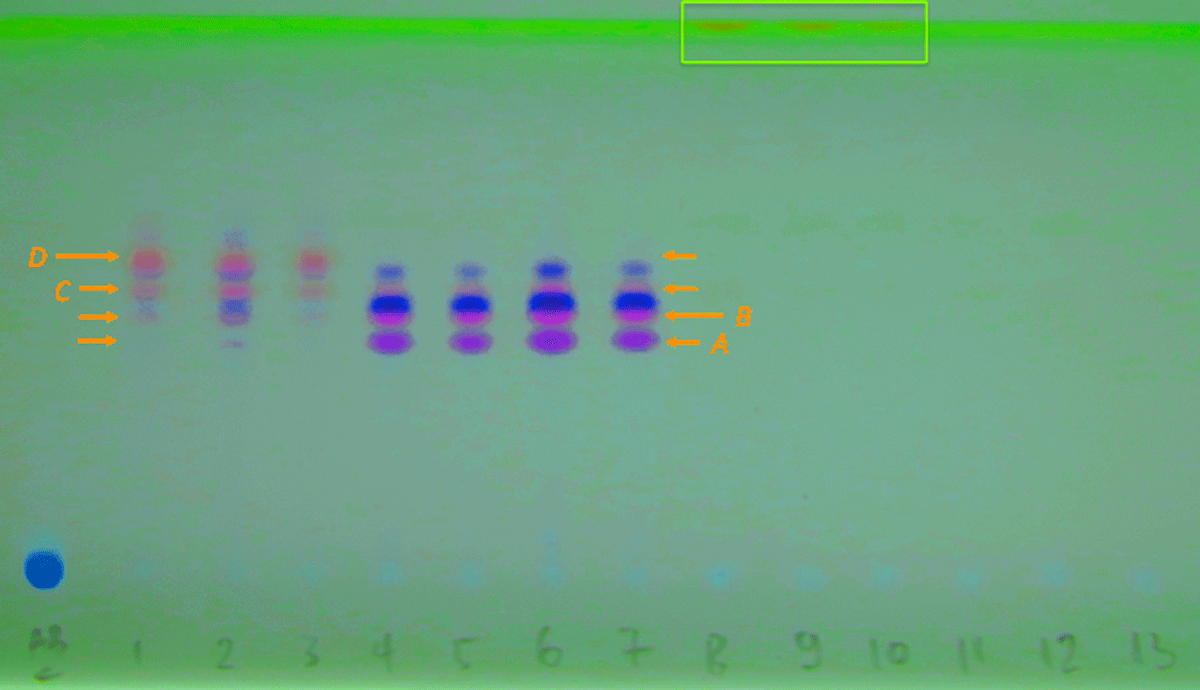
Figure 10
The image shown in Figure 8 modified using the ‘green filter’ (Hue = +30; Saturation = +80) described in Figure 9.
Note: The visual evaluation (‘semi-quantitative’ analysis33) of the resulting TLC chromatograms in Figures 9 and 10 (as well as in Figure 8) shows that the sizes and color intensities of the chromatographic zones (the spots with the same Rf value) of the violet and blue dye components somewhat vary both within lanes 1–3 (three signatures on page 1 of the 1999 Will) and within lanes 4–7 (four signatures on page 2 of the Will). Such variations are logical (typical) and explained by the fact that the ink samples (0.5-mm microplugs of ink on paper taken from each signature for the TLC analysis in this case) varied in the masses of the ink. It is a well-established fact that variations in the masses of ink in samples taken from handwritten entries are caused by at least two factors: (1) different writers (in this case, apparently three different people signed the 1999 Will) typically apply different pen pressures when writing/signing (the larger the pen pressure, the more ink is deposited on paper), and (2) even within one and the same signature, there are always significant variations in thickness and ink line morphology along the signature’s lines.
16. One can clearly see from Figures 9 and 10 that the quantity (‘concentration’) of both blue components of the triarylmethane dye BB26 in the faded ink of the three signatures on page 1 of the 1999 Will (see lanes 1–3 in Figures 9 and 10) is significantly less than the quantity of the same two blue components in the non-faded ink of the four signatures on page 2 of the Will (see lanes 4–7 in Figures 9 and 10).
17. Thus, Figures 8, 10 show a significant photodecomposition of all the five (two blue and three violet) dye components in the ink of the three signatures on page 1 of the 1999 Will.
18. It is a well-established fact that, similarly to the violet triarylmethane dyes, such as crystal violet (CV), the blue triarylmethane dyes, such as BB26 and the like, are not lightfast (see Section I above).
19. The significant photodecomposition of both blue and violet triarylmethane dye components of the ink of the three signatures on page 1 of the 1999 Will, as clearly seen from Figures 8, 10, evidences that the page 1 of the Will was exposed to light of strong intensity for a relatively long period of time (e.g., several weeks or months of sunlight through a glass window).34
20. Thus, the obvious drastic difference in the color between four bright blue signatures located on page 2 and three pale violet–gray signatures located on page 1 of the 1999 Will (see Figure 6), as well as the differences between the TLC chromatograms obtained for the ink of the bright blue signatures and the ink of the pale violet–gray signatures (see Figures 8, 10), is caused by the photodecomposition of the violet and blue dye components of the originally bright blue ballpoint ink of the three signatures located on page 1 of the 1999 Will due to a prolong exposure of page 1, including the signatures located on this page, to light, such as sunlight through the window.
D. The conclusions based on the results of the comparative (chemical and optical) examinations of the signatures
21. Notwithstanding that the ink of the signatures on the top (‘outer’) page of the 1999 Will (page 1) has significantly faded, while the ink of the signatures on the ‘inner’ page (page 2) has not (because in the three-page 1999 Will, the pages of which were stapled/bounded together, page 1 covered and thus protected page 2 from exposure to light),35 the combined results of the chemical (GC-MS and TLC) analyses of the ink of all seven signatures located on pages 1 and 2 of the 1999 Will allowed the Defendant’s expert to conclude that it is highly probable36) that all the seven signatures were written with the ink of the same formulation.37
22. Moreover, under the microscope, multiple strokes within the signatures written on pages 1 and 2 of the 1999 Will show similar (matching) morphological defects – complex patterns of elaborate striations.38 These results of the microscopic examination (coupled with the results of the chemical examinations) provide evidence that indicates that the signatures on pages 1 and 2 of the 1999 Will may have been written with the same ballpoint pen.39, 40
23. Recently, when this author presented the results obtained in the considered court case at the 82nd Annual Meeting of the American Society of Questioned Document Examiners in Atlanta, Georgia (61), some colleagues in discussions were making assumptions about a possible alternative (to the fading of the ink on page 1 of the 1999 Will) scenario according to which the difference between the ink on page 1 and the ink on page 2 of the 1999 Will might be because the ink used to sign page 1 and the ink used to sign page 2 of the Will could have had different compositions (different ink formulations or different manufacturing batches of the same ink formulation). For the following four reasons described below, it is this author’s opinion that the above scenario (alternative to the fading of the ink on page 1 of the 1999 Will) is highly improbable.
24. Reason 1: Based on this author’s 45-year experience in the field of ink analysis, it is very unlikely that two different ink formulations can contain the very same complex composition (chemical fingerprint) of multiple non-colored components (six components including two solvents) detected by GC-MS (see Figure 7). It is also important to stress that though the results of the TLC analysis show (see Figures 8, 10) that the inks on pages 1 and 2 of the 1999 Will have different quantitative composition of their dye components, the qualitative compositions of their dye components do not differ – the same three violet and two blue dye components.
25. Reason 2: It is very unlikely that a fresh or old ballpoint ink on paper would contain TRMR at a level exceeding (like in the considered case – see Figures 8, 10) the levels of CV and MV. During his long career, this author have used TLC for analyzing writing inks on paper in many hundred ink-analysis cases, analyzed hundreds of ink samples from his collection of blue, violet and black ballpoint inks produced since the 1960s, and never encountered at least a single fresh or old ink on paper in which the content of TRMR would be larger (not to mention significantly larger, like in this case) than the contents of CV and MV. Nor any of numerous publications regarding ink fading discussed in Section I would mention about at least one ink formulation in which TRMR > CV and TRMR > MV.
26. Reason 3: This author is not aware of any other publications (in additions to those discussed in Section I) that would report experimental data showing that at least one (‘unique’) blue, violet or black ballpoint ink formulation (or a manufacturing batch) has ever existed that had such an unusual chemical composition, namely, the composition of the ink’s dye components in which TRMR is the major dye component (as it can be seen for the dye composition of the ink on page 1 of the 1999 Will in lanes 1–3 in Figures 8, 10).
27. Reason 4: Even, if one were to assume that such an unusual (pale violet–gray) ink could have ever been produced (and the ink manufacturer’s product quality control department did not recline such a manufacturing batch as defective), then it is even more unusual that (A) the three individuals who had signed pages 1 and 2 of the 1999 Will using bright blue ink would later substitute page 1 with a new page 1 and decide to sign this new page 1 using the pale violet–gray ink so obviously different in color from the bright blue ink on page 2, and (B) by a rare coincidence, this new pale violet–gray ink happened to have not only the same qualitative composition of their dye components – three violet and two blue dye components (see Figures 8, 10) but also the very same complex composition (chemical fingerprint) of the non-colored components (six components including two solvents – see Figure 7).
28. Summing it up, it is this author’s opinion that the probability of alternative (to the fading of the ink on page 1 of the 1999 Will) scenario according to which the difference between the ink on page 1 and the ink on page 2 of the Will might be because the ink used to sign page 1 and the ink used to sign page 2 of the Will could have had different compositions (different ink formulations or different manufacturing batches of the same formulation) is so close to zero that this ‘alternative scenario’ can hardly be considered as a scientifically valid scenario explaining the unusual chemical composition of the ink on page 1 of the 1999 Will. This ink has a so peculiar composition of the ink’s dye components, in which TRMR proved to be the major dye component, that it seems that the only scientifically sound and supported by published data explanation of such a peculiar composition of the ink’s dye components (see lanes 1–3 in Figures 8, 10) is that the ink has significantly photo-decomposed – so significantly that its composition of the dye components does not any longer match a composition of the dye components of either any of the many hundred ballpoint inks analyzed by this author in his career or any of the numerous ballpoint inks the results of the analyses of which (using TLC and other analytical methods) have been reported in scientific literature (see Section I).
E. Ink aging test
29. The GC-MS analysis revealed the presence of the solvent 2-PE (designated as component ‘3’ in Figure 7) at similar low levels (<1 ng per 1-cm ink line) in the ink samples taken from each of the seven signatures located on pages 1 and 2 of the 1999 Will.41
30. The level of the solvent PE <1 ng per 1-cm ink line is insufficient for obtaining reliable ink aging data when using either the SLRM or the Sequential Solvent Extraction Technique (SET) (20, 24, 39, 40). This made it impossible to use the ink aging methodology for determining when the signatures were written on the 1999 Will.
31. As for the Plaintiff’s expert conclusion that the 1999 Will ‘was not prepared in 1999 as indicated, but [page 1 of the 1999 Will was prepared after] July of 2017,’ the Defendant’s expert opined that the less than 6-months scope (limit) of applicability of the SLRM (see Section II) a priori does not allow one to evaluate the approximate ‘age’ of ink if it is known that the age of the ink cannot be <6 months. In this case, the age of the ink of the signatures on the 1999 Will could not be <10 months (as the Will was lodged with the Probate Registry in September 2018 and examined by the Plaintiff’s expert in July 2019), and therefore, the ink aging method (SLRM) used by the Plaintiff’s expert was absolutely incapable to provide any meaningful information that could be helpful to the court (see Section II).
F. Ink availability test
32. The results of the TLC analysis show that the blue ballpoint ink used to write all the seven signatures on the first two pages of the 1999 Will ‘matches’ (50) multiple different blue ballpoint ink formulations manufactured by different companies in many countries (e.g., Bic, Schwan Stabilo, ICO/Hungary, Staedler, and other brands from Italy, Korea, etc.) Some of them, including the Bic blue ballpoint ink, were commercially available in the mid/late-1990s, and they remain available at the present time.
G. Toner comparison
33. No significant differences were found between any of the pages of the 1999 Will when assessing and comparing page format (alignment and spacing), ‘trash’ marks, print quality, and toner morphology (at magnifications 40 × and 140 ×) from page to page.
34. Using high power microscope magnifications (ca. 682.5 ×) it was established that (A) the average particle size of the toner of the printed entries was consistent through all the three pages of the 1999 Will (between 8 and 10 μ), and (B) the toner of the printed entries on the 1999 Will corresponded to the conventional 8- to 10-μ toner that was widely used in commercially available printers and copiers in the late 1990s, and it was not widely used in printers/copiers in the 2010s (48).42 These results support the Defendant’s proposition and they do not support the Plaintiff’s proposition43 as it is unlikely that the 8- to 10-μ toner could still be widely available and used for printing documents during the 2010s (48).
35. The results of the microscopic, TLC (see lanes 8–10 in Figures 8 and 10), and GC-MS (see Figure 11) examinations showed a high level of agreement between the samples of the black toner taken from the printed entries on pages 1 through 3 of the 1999 Will.
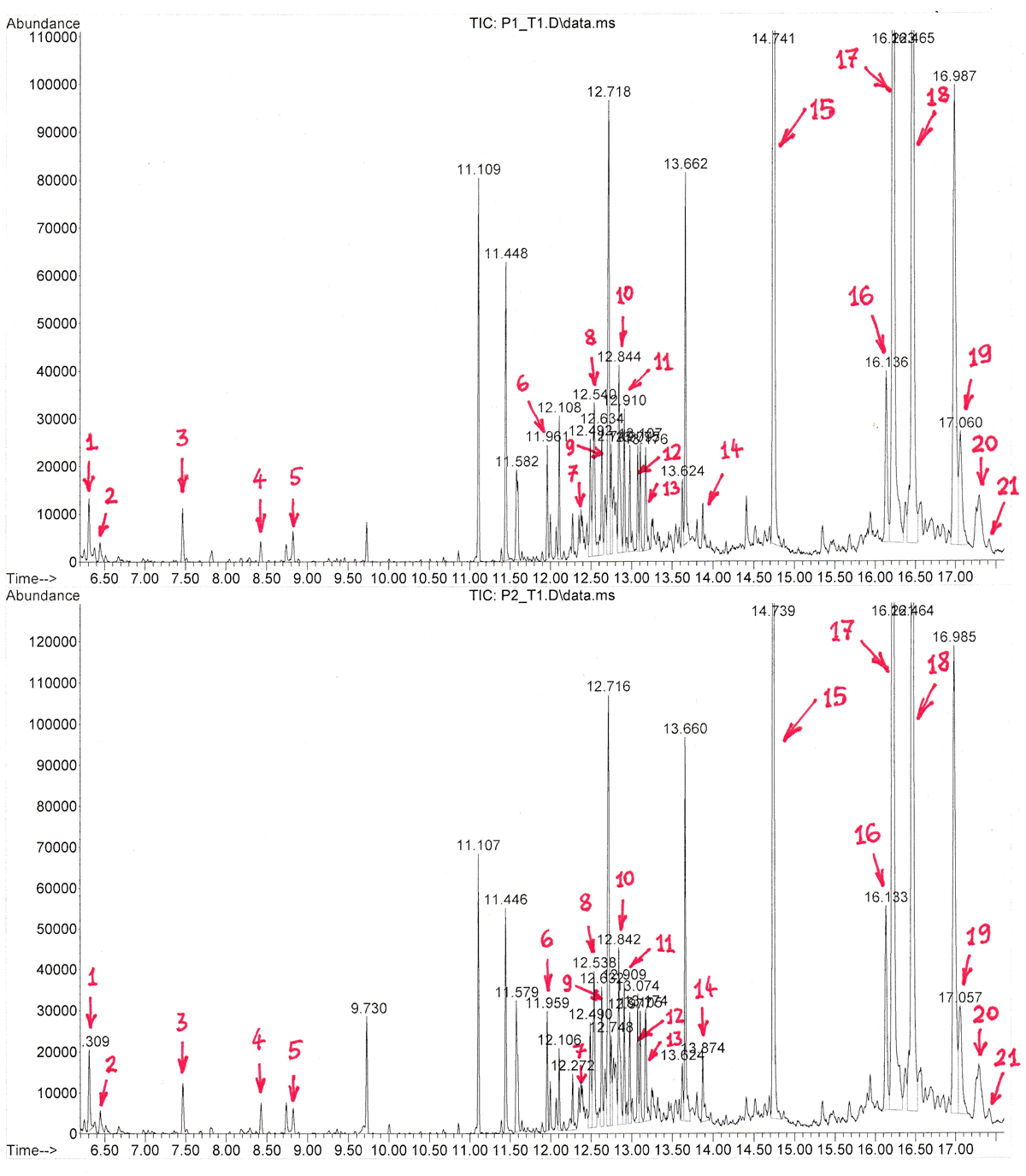
Figure 11
Comparison of the GC-MS chromatograms of toner-on-paper samples taken from entries printed on pages 1 (upper chromatogram) and 2 (lower chromatogram) of the 1999 Will. The 21 components of the toner are indicated by the red arrows. The other multiple peaks (other than those indicated by the red arrows) appearing on the two GC-MS chromatograms are the peaks that represent the components of the paper.
36. The 22 toner components detected by TLC (one violet–brown dye, see lanes 8–10 in Figures 8 and 10) and GC-MS (21 components, see Figure 11) create a very complex combination consisting of 22 components (chemical fingerprint) that is very unlikely to be coincidentally reproduced by other toner manufacturers. This provides evidence to conclude [at ‘the “virtually certain” degree of confidence’ (60)] that all the three pages of the 1999 Will were printed using toner of the same formulation.
H. Paper comparison
37. The paper of all three pages of the 1999 Will contains the same watermark and shows matching physical characteristics, such as color (green), thickness, UV fluorescence, surface texture, and opacity.
38. The results of the chemical (TLC and GC-MS) analyses of the paper of the 1999 Will showed that the paper of all the three pages contains the same number of chemical compounds detected by the GC-MS (over two dozen components – see Figures 7 and 11) and TLC (one green pigment and a one-component optical brightener).
39. The exposed to light paper of page 1 of the 1999 Will did not take on a more subdued appearance because the paper is of high quality and contains a lightfast green pigment:
Though low quality white paper (especially when it contains lignin) may darken (lose some brightness) or even turn yellowish after being exposed to sunlight for a relatively long time, a higher quality white paper may not take on such a subdued appearance after the exposure to sunlight. The fact that the paper of all the three pages of the 1999 Will contains a watermark evidences that the paper of the document is not of low quality, and therefore, it should be relatively lightfast.
The paper of the 1999 Will contains a green colorant. The chemical (TLC) examination of the paper has shown that this colorant is a pigment that is not soluble in organic solvents. As pigments are typically lightfast (very resistant to fading), it is not surprising that the green pages 1 through 3 of the 1999 Will look similar when one visually assesses the intensity of the green color of the pages.
The optical brightener [fluorescent brightening agent] present in the paper to impart brightness is sufficiently more stable to light than the triarylmethane dyes (CV, MV, and BB26) that are present in the ink of the signatures located on the 1999 Will.44
Conclusion
The analysis of the examination results discussed in this paper revealed no evidence that would support the Plaintiff’s expert’s conclusion that the 1999 Will ‘was not prepared in 1999 as indicated, but at multiple occasions more recently, [namely after] July of 2017.’ The Defendant’s expert gave evidence in court as follows:
The totality of the examination results obtained provided evidence that (1) does not support the Plaintiff’s proposition that this 3-page document or the first page of the document were produced and signed not in 1999 but at a much later point in time, [namely after] July of 2017, and (2) supports the Defendant’s proposition that all the pages of the 1999 Will were produced and signed contemporaneously with each other and probably in 1999, as dated, not at a much later point in time – after July of 2017.
The judge accepted the conclusions made by the Defendant’s expert and ruled as follows: ‘On the issue of the genuineness of the 1999 Will, I rule in favour of the defendant’ (45).
Notes
[2] The Defendant’s expert was advised that it had been stipulated by both sides in this court case that the paper with this watermark was commercially available in Hong Kong in 1999.
[3] See ref. (1), section 3.2.6.
[4] See ref. (1), section ‘9.2 Differentiation’.
[5] See ref. (1), section ‘5. Interferences’.
[7] CV and MV are triarylmethane dyes of violet color that are used for manufacturing most black, blue and violet ballpoint inks, as well as some fountain pen, rollerball and gel pen inks.
[8] Andrasko has published experimental data showing that the blue triarylmethane dye BB26 (‘Victoria Blue’) has ‘poor lightfastness [and that, being exposed to light, this blue dye] decomposes in a manner similar to that of [the violet dye] CV’ (8) [see also experimental data regarding the fading of the dye BB26 published by Weyermann (10, p. 107)].
[9] This mechanism of the natural (in darkness) aging of ink on paper has been recently confirmed with experimental results published by Óscar Díaz-Santana et al. (49).
[10] Each of the seven separated components was chemically extracted from the silica gel of the TLC plate, and its chemical formula was identified using mass spectrometry. The same procedure was used to identify the main product of the natural aging (in darkness) of the dye CV – 4,4′-bis-(dimethylaminophenyl)-ketone (Michler’s Ketone) (2, 3, 4). Also, it is interesting to note that when the reversed phase TLC was used to analyze the above seven homologues, they were separated on the TLC plate in the reverse sequence, that is, fuchsine traveled up the plate slower (lower Rf value) than the other six homologues, and CV moved up the plate most rapidly (higher Rf value) than the other six homologues (46).
[11] The entries written with Ink D and Ink E, along with other ‘standard’ ink samples present in this author’s ‘ink library’ [an ‘organized collection of reference samples of inks’ (50) maintained by this author since 1983], have been stored in darkness, except the relatively short periods of time when it was necessary either to take micro plugs of ink-on-paper (for their chemical analysis) from these and/or other ‘standard’ ink samples located on the same page or to compare the ‘standard’ and questioned inks using various ‘light, ultraviolet (UV), and infrared (IR) examinations’ recommended by the SWGDOC Standard for Writing Ink Identification (50).
[12] Note that though both inks, D and E, had been aging on paper for a long time (12 and 18 years, respectively) before they were examined by the TLC, they, as shown in Figure 2, contained only trace amounts of TRMR.
[13] Similar to instrumental planar chromatography (TLC coupled with scanning densitometry) that has been used for the ‘quantitative’ comparative analyses of inks (18), visual assessment of TLC chromatograms is also a widely accepted ‘semi-quantitative’ analysis technique (5, 41, 42, 43).
[14] Similar results were obtained for all four ballpoint inks analyzed – ‘two blue inks and two black inks, Inoxcrom and Sigma brands’ (49).
[15] In the court case discussed in this paper, 20 years was the difference in time between the date appearing on the 1999 Will and the date of its examination by the Plaintiff’s expert in 2019.
[16] In the considered court case, the content of TRMR in the ink of all three signatures appearing on page 1 of the 1999 Will is significantly larger than the contents of both CV and MV (see lanes 1–3 in Figures 8, 10).
[17] It is a well-establish scientific fact that part of UV from sunlight penetrates standard glass. As an example, in 2006, Tuchinda et al. reviewed the factors affecting glass UV protective properties, such as glass type, color, interleaves and coating, and they found that clear glass allows up to 90% of visible light and up to 72% of UV (mainly, long-wave UV, 315–400 nm) to pass through, depending on its thickness (52). And, as follows from experimental results reported by multiple scientists, including Weyermann (10) and Neumann (12), this long-wave UV light is certainly strong enough to cause a significant photo-degradation of inks’ colored components (triarylmethane dyes) that are not lightfast.
[18] See ref. (10, p. 7).
[19] In 2017, Cantu referred to this ink-aging method as ‘the solvent loss ratio method (SLRM) of Aginsky’ and mentioned it, along with ‘the sequential solvent extraction technique (SET) of Aginsky’, as two of the ‘four methods to estimate the age of an ink [that] are the major ones based on the analysis of ink solvents’ (22).
[20] To this author’s knowledge, (A) the 25% threshold [proposed in 2002 as the threshold for determining whether the age of ink on paper is <300 days (23)] has never been used by the CBSA laboratory in casework for determining whether the age of ink on paper is <2 years, and (B) no research article in a peer-reviewed journal has ever been published that would show, with experimental data, that solvent loss ratios exceeding 25% (R% > 25%) indicate that the inks are <2 years old.
[21] Cantu referred to this ink-aging method as ‘the sequential thermal desorption (TD) method [TD-GC/MS] of Bügler et al.’ (22).
[22] It should be noted that, as of present, no experimental data or results of outside proficiency testing have yet been published that would show that the ink aging parameter R% measured by the SLRM correlates with the age of a ballpoint ink on paper after the ink reaches the above age of ‘3–4 months’.
[23] The conclusion made in this study regarding the scope of applicability of SLRM is as follows: ‘SLRM is capable of monitoring/measuring only a relatively fast and thus short (not longer than six months) age-dependent process in ink on paper – the process of the ‘evaporation’ of phenoxyethanol (or other high boiling volatile components of ink) from ink strokes’ (25).
[24] The authors used the SLRM in accordance with published recommendations (24) (e.g., they used deuterated phenoxyethanol as the internal standard and also, in order to minimize sampling error, for each ink aging test using SLRM, they were taking twenty (20) pairs of ‘micro plugs’ of ink on paper) and acknowledged that they consulted with and ‘wish to thank Dr. Valery Aginsky and Luc Brazeau’ (72).
[25] The authors mentioned that these 25 blue and black ballpoint inks were selectively ‘chosen as representative of the different ageing behaviours’ and they were provided by Landeskriminalamt (LKA) in Munich ‘from their large collection of inks and ballpoint pens … in the frame of the International Collaboration on Ink Dating (InCID)’ of the European Network of Forensic Science Institutes (32).
[29] As mentioned in Section I, up to 72% of UV (mainly, long-wave UV, 315–400 nm) from sunlight penetrates standard glass (52), and, as follows from the experimental results reported by multiple scientists, including Weyermann (10) and Neumann (12), this long-wave UV causes a significant photo-degradation of inks’ triarylmethane dye components (CV, MV, etc.).
[30] As everyone knows, the Sun’s radiation strikes the Earth’s surface, thus warming it. Most heat in sunlight is in the infrared part of the electromagnetic spectrum. When sunlight strikes a surface, it transfers energy in the form of heat. Surfaces like asphalt, concrete, soil, or any other materials, including paper, absorb this energy, causing their temperatures to rise. For example, as a result of the study of how damaging for any car’s interior materials (dashboard, seats, etc.) are the sun’s rays penetrating through the car’s windows, it has been reported that during testing conducted at the State Farm® Vehicle Research Facility ‘interior surfaces exposed to direct sunlight [through the window] had recorded temperatures in excess of 195 degrees Fahrenheit [over 90°C]’ (54). It is logical to assume from the above that if, say, a handwritten document was placed on a windowsill or on an office desk near a window with solar radiation, then the sun’s rays that enter through the window glass could heat the paper of the document and the ink of the handwritten entries to temperatures significantly higher than the average temperature in the room. For example, this author’s experiments (using an infrared thermometer, in sunny days in April through May and September through October of 2024 in Michigan, USA) with sheets of paper of white and green colors placed on a table of light-brown color immediately next to a window on the south side of the house and exposed to direct sunlight through the window showed that, despite the fact that the air conditioner was maintaining the temperature of 22°C in the room, the surface of the paper became at least 10°C, for the white paper, and 14°C, for the green paper, hotter (probably mostly due to a lack of convective cooling of the paper) than the surface temperature of other sheets of the white and green paper (around 22°C) not exposed to the sunlight.
[31] The Defendant’s expert was advised that it had been stipulated by both sides in this court case that the paper with this watermark was commercially available in Hong Kong in and prior to 1999. Therefore, it was not necessary in this case to examine the paper of the 1999 Will with the aim to determine whether this paper was or was not available in 1999.
[32] The toner and paper blank samples were taken and analyzed by GC-MS similarly (38).
[33] The absence of any significant qualitative and/or quantitative differences between the compositions of the non-colored components (six components, including two high boiling solvents) of the faded ink on page 1 and the non-faded ink on page 2 of the Will (see Figure 7) is what this author has typically seen in his researches when using GC-MS for comparing faded and non-faded entries written with the same ink (pen), and it is also supported by the published results and conclusions of several scientific researches. For example, based on the experimental results, it has been found that, after a ballpoint ink on paper has ceased aging, no heating the ink at a moderately elevated temperature [not higher than 80°C (56)] can significantly affect the qualitative and quantitative chemical composition of the ink, including the ink’s high boiling solvents, such as 2-phenoxyethanol, benzyl alcohol, and the like, as well as other non-colored semi-volatile components (4, 5, 56, 57). That is, if a ballpoint ink entry was written on a document, say, 2 months ago, and the ink is still in the active stage of aging (its high boiling solvents are evaporating and its resin is hardening), then the above moderately elevated temperature will certainly accelerate the ink’s solvents’ evaporation (the ink’s ‘drying’) and therefore the ink’s rate of aging (4, 20, 21, 22, 23, 24, 25, 26, 30, 31, 32, 34, 35, 36, 37, 39, 56, 62, 63). But as soon as the ink on the document has completely aged out (the ink’s resin has hardened), small amounts of the ink’s high boiling solvents remain trapped inside the ‘matrix’ of the ink’s hardened resin ‘for a practically infinite period of time’ (57) [see also ref. (34)], even if the document continues to be stored under hotter than normal environmental conditions [at temperatures at least not higher than 80°C (56)], or if the document is heated by the sun’s ‘heat-producing’ infrared radiation.
[35] This conclusion is consistent with the results obtained by Neumann (12) and shown in Figure 3. For example, Figure 3 shows that the violet dye CV has almost vanished from the blue ballpoint ink after this ink (on paper) was exposed to sunlight through the window for 8 weeks.
[36] This author is not aware of any scientific publication that would report that UV light could penetrate a sheet of standard copy paper to a significant degree. Paper contains cellulose, optical whiteners, pigments, and other organic and inorganic compounds that both absorb and scatter UV radiation. For example, ‘optical whiteners function by absorbing ultraviolet radiation and re-emitting blue light’ (64). When multiple pages stacked one on top of the others, like the three pages of the 1999 Will (‘three sheets of thick green A4 paper stapled and bounded together with a red ribbon and a brown-red sealing-wax seal,’ see paragraph 1 and Figure 6), are exposed to sunlight, then it is obvious that the first (i.e., top) page absorbs most of the UV radiation. While some very thin paper might allow a small amount of UV to pass through, thicker paper, like book paper or copy paper, should block most UV light. As the paper of the 1999 Will is ‘thick’ and contains a ‘green’ pigment (see paragraph 1 above), then it is this author’s opinion that it is unlikely that the first (top) page of the Will exposed to sunlight through the window would pass a significant portion of the incident long-wave UV light (penetrated through the window) that could be sufficient to cause any noticeable fading of the ink on the second page of the Will. It is interesting to note that, similarly to cellulose paper, cotton shirt also effectively absorbs the sunlight and practically does not allow it to reach human skin. That is why one cannot get tan when wearing long-sleeve cotton shirts.
[37] According to the ‘SWGDOC Terminology for Expressing Conclusions of Forensic Document Examiners’ (60), the term ‘highly probable’ describes an opinion when there is very strong evidence [‘the “virtually certain” degree of confidence’ (60)] to support the conclusion. Optionally, using the Bayesian approach and a degree of confidence similar to that expressed by the term highly probable in section 4.1 of the above SWGDOC Standard, this conclusion could be reformulated as follows: the combined results of this examination provide (1) very strong support for the proposition that all the seven signatures were written with the ink of the same formulation, and (2) virtually no support for the proposition that the three signatures on page 1 of the Will were written with the ink of one formulation and the four signatures on page 2 of the Will were written with the ink of a different formulation.
[38] For expressing conclusions in this court case, this author used the terminology recommended in the SWGDOC Standard ‘SWGDOC Terminology for Expressing Conclusions of Forensic Document Examiners’ (60) and in other pertinent peer-reviewed publications [see e.g., ref. (58)].
[40] The procedure used to examine and compare the morphological defects of the ink strokes of the signatures on pages 1 and 2 of the 1999 Will is discussed in (58). When evaluating the experimental data obtained, this article reads as follows: ‘though a typical malfunctioning of a ballpoint pen resulting in the presence of striations and/or gaps in ink strokes is a class characteristic, a more serious pen malfunction, depending on the degree to which a particular defect occurs, might lead to written lines showing peculiar features (performance characteristics), which, in combination, may well become an individual characteristic of the pen’ (58).
[41] It is well known in the field of forensic document examination that if the entries being compared show peculiar written line characteristics that are caused by a defect(s) of a writing instrument, such a writing instrument can be identified (individualized) as the one that was used to produce the entries compared. Thus, Lindblom et al. referring to multiple scientific publications that describe the studies of burr striations in ink strokes in order to identify ballpoint pens, concludes that, ‘Very fine burr striations may occur at times in a pattern distinctive enough to individualize the pen’ (59). Also, the SWGDOC ‘Standard for Test Methods for Forensic Writing Ink Comparison’ recognizes that a forensic document examiner can conduct an ‘examination of the ink line to individualize the writing instrument that produced it based on its performance characteristics’ (1).
[42] It is important to stress that the fact that the solvent 2-PE was detected in the ink on page 1 of the 1999 Will tells nothing to the examiner about whether the ink is ‘fresh’ or old. Thus, as early as in 1993, based on the experimental results obtained, Aginsky found that ‘high boiling vehicles [phenoxyethanol, benzyl alcohol, and other high boiling solvents] cannot be completely removed from ballpoint inks by their heating (without damage of the paper on which the inks have been placed)’ (57). Based on these results, he described the following mechanism of the evaporation of high boiling solvents from ballpoint inks aging on paper:
The process of such evaporation is carried out from the surface of ink line placed on paper. To reach the ink line surface a vehicle [solvent] must diffuse from the inner layers of the line. However, resins and other viscous ballpoint ink ingredients limit a diffusion process (to some extent, of course). In addition, as soon as the reaction of cross-linking or polymerization of these ingredients has started, those diffusion processes are getting more and more slow, and at a certain stage of ink aging they stop completely. [As a result, the formed hardened ‘matrix’ will be] ‘keeping’ the remained micro drops of the ink volatile components [solvents] inside the aging ink line for a practically infinite period of time (or until extracting by a solvent or heating [at extremely high temperatures] ‘frees’ them). So when using a strong solvent capable to dissolve hardened ink resins ([e.g.] chloroform), those vehicle remainders can be easily detected [by GC-MS] even in very old ballpoint ink writings ([as it was shown with experimental data] for 12- and 15-year-old entries written by Soyuz blue-violet ballpoint inks of the same formula)’ (57).
These findings have been independently verified by Bügler, Buchner, and Dallmayer who, having analyzed multiple ballpoint inks (230 ballpoint inks from the collection of more than 4500 samples of inks maintained by the Forensic Sciences Institute of the Bavarian State Bureau of Investigation), determined that, ‘more than 95% of the initial amount of PE [phenoxyethanol] in ballpoint inks is lost during first 3 days after writing. Thereafter, the amount of PE decreases slightly and steadily and stays constant within the accuracy of the analytical method within a few weeks. This remaining amount of the ink solvent PE is trapped in the matrix ink resin/paper and can be detected in significant quantities even in samples as old as 50 years’ (55).
[43] During the printing process, toner particles are partially melted by the heat of the fuser, binding them to one another and onto the paper. The average particle size of the toner used to produce a printed (copied) document can be determined under the high power microscope using a proper magnification. A partially melted toner particle fused into paper will always look under the microscope somewhat larger in size (diameter) than it was prior to fusing to the paper. However, based on this author’s experience (48, 65), such increase is not too significant (<10%). For example, 5-μ CPT toner particles will not look like 8-μ ones as a result of their fusing onto a document during the printing process.
[45] ‘The most important characteristics of a fluorescent brightening agent include: … It must be sufficiently stable to light so that it may remain effective for a reasonable time [and] … It should not yield coloured decomposition products on long exposure to light and moisture’ (44).
Competing Interests
The author has no competing interests to declare.