

Figure 1
Example of blank collection sheet— unconstrained signature (constraint A). Gridded sheet style WL37 0G2pA6S, 148mm by 105mm.

Figure 2
Example of the line with a length of 4.7cm (constraint B).

Figure 3
Example of the fully enclosed box sized 6cm by 1.2 cm (constraint C) modelled after the signature sections of forms such as the Record of Medical and Personal expenses from Manitoba Public Insurance.

Figure 4
Example of 4.8cm by 0.96 cm (constraint D) consistent with the signature sections of forms such as the Notice of Objection (GST/HST) from the Canada Revenue Agency.
Figure 5
Example of the line found within a single spaced text with a length of 6.4 cm and a height of 0.4cm (constraint E) consistent with the T1 Income Tax and Benefit Returns from Canada Revenue Agency.
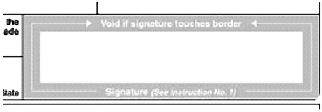
Figure 6
Example of the Passport Box (constraint F) found in the Adult General Passport Application (Passport Canada).

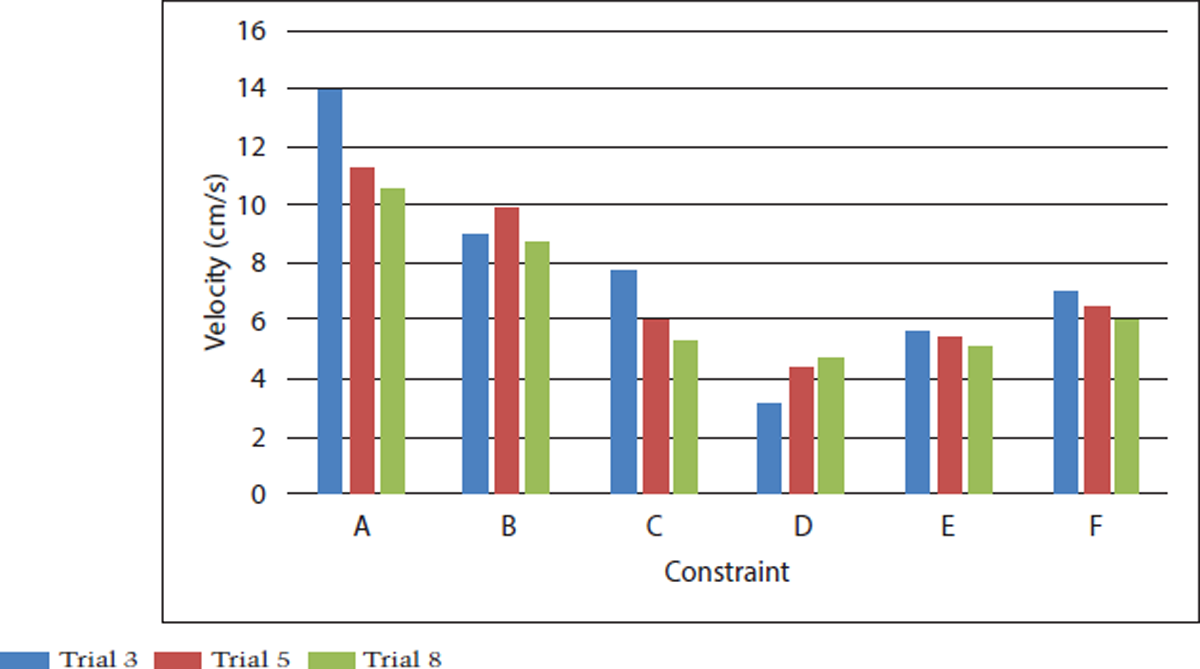
Figure 8
Example of Velocity variation within an individual’s signature for trials 3, 5 and 8 for all six constraints.
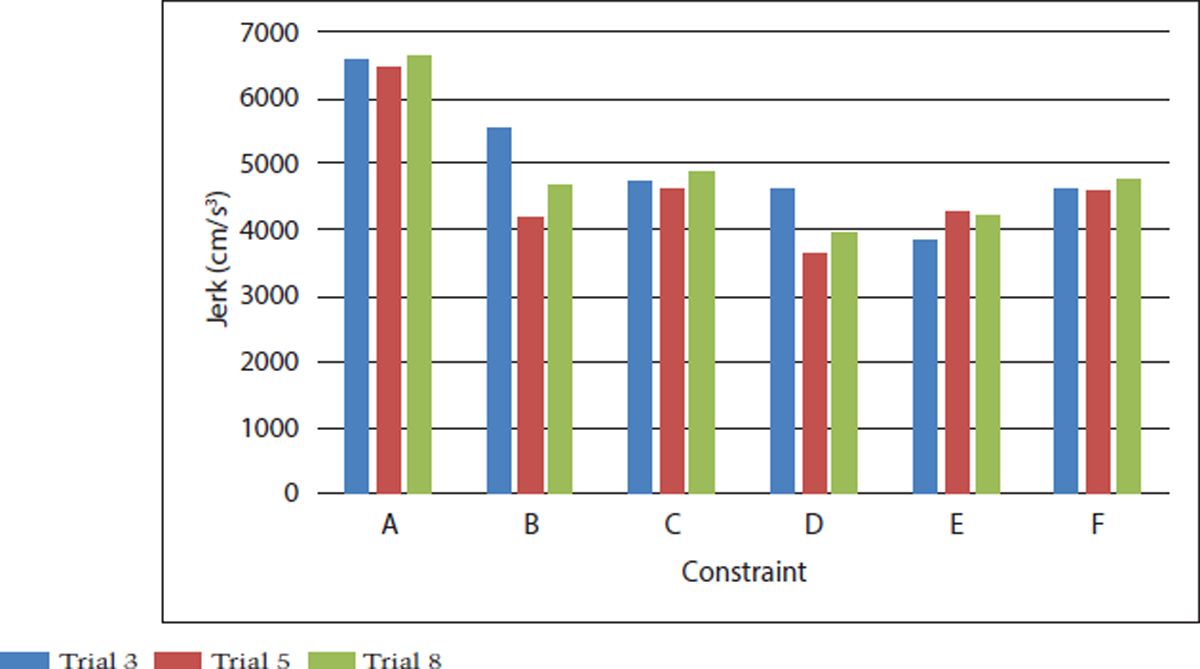
Figure 9
Example of Jerk variation within an individual’s signature for trials 3, 5 and 8 for all six constraints.
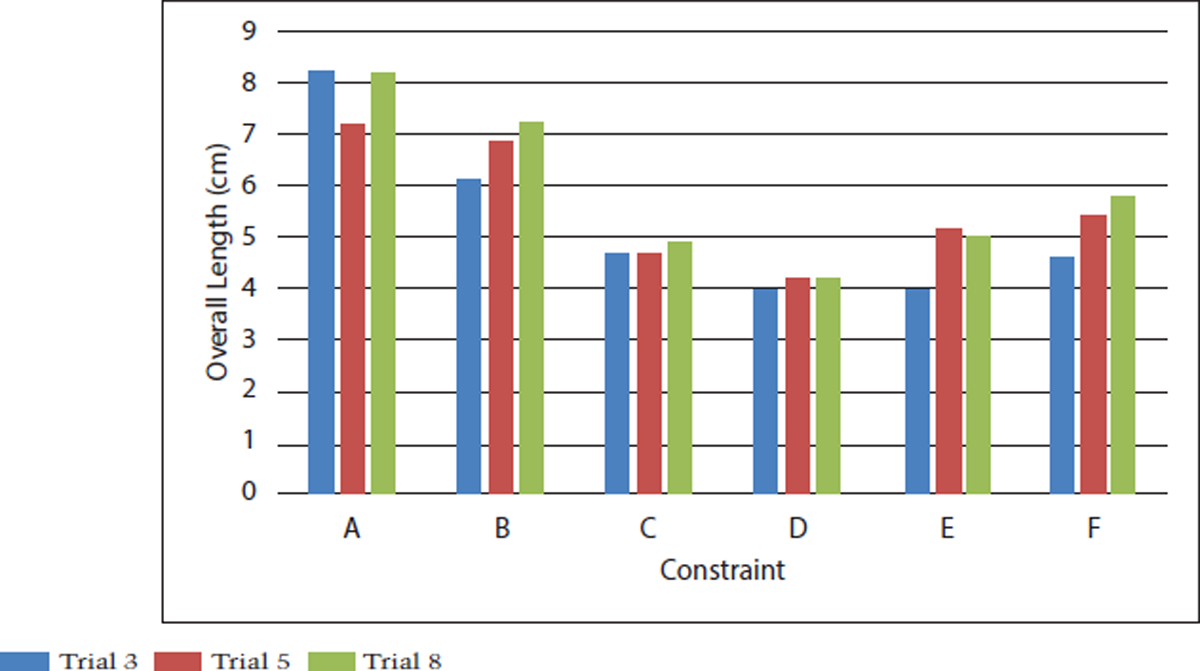
Figure 10
Overall length variation within an individual’s signature for trials 3, 5 and 8 for all six constraints.

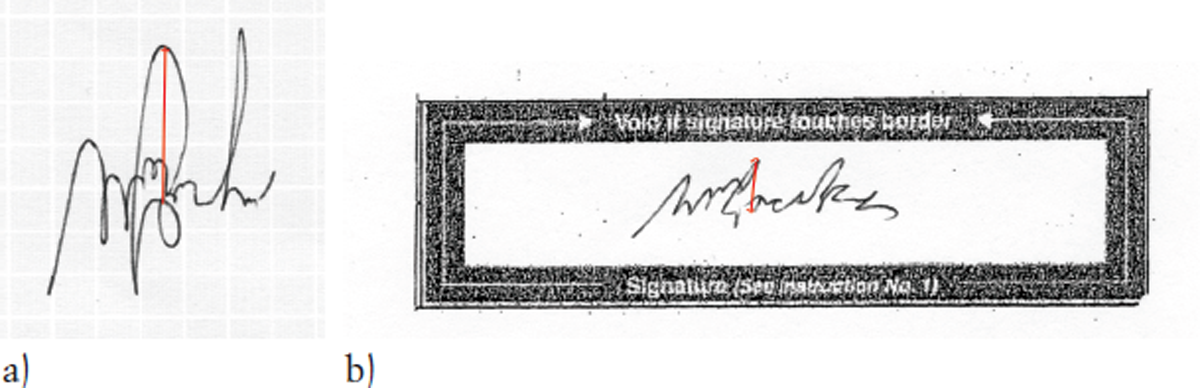
Figure 11
Example of unconstrained signature (a) and passport box constraint signature (b). A decrease in ascender height between free and constrained signatures is seen.
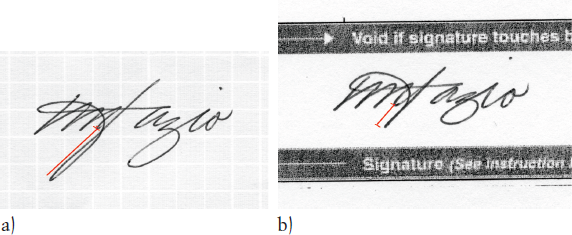
Figure 12
Example of unconstrained signature (a) and passport box constraint signature (b). A decrease in descender length is indicated by the red line.

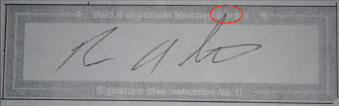
Figure 13
Example of a void passport box signature. The red circle indicates the area which touched the border.
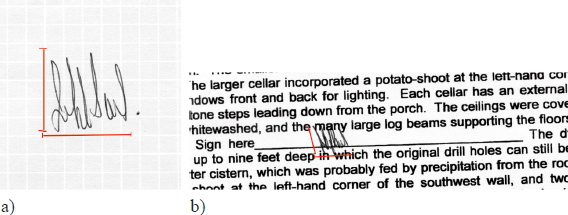
Figure 14
Example of overall size decrease, unconstrained signature (a) and constrained within text signature (b).
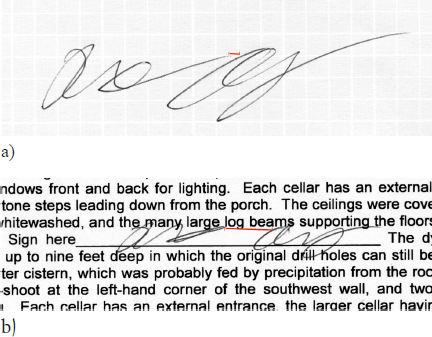
Figure 15
(a) Represents the unconstrained signature and (b) represents the constrained within-text signature. An increase in space between the first and last name segments is denoted by the red line.
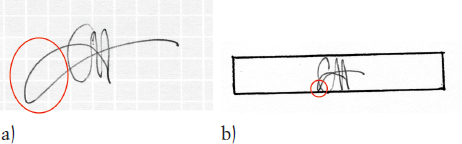
Figure 16
(a) represents the unconstrained signature (Constraint A) and b) represents the 4.8 cm x 0.96 cm box (Constraint D). There was a noted attempt to keep the loop feature of the signature within the constraint, causing visual alterations to the signature.
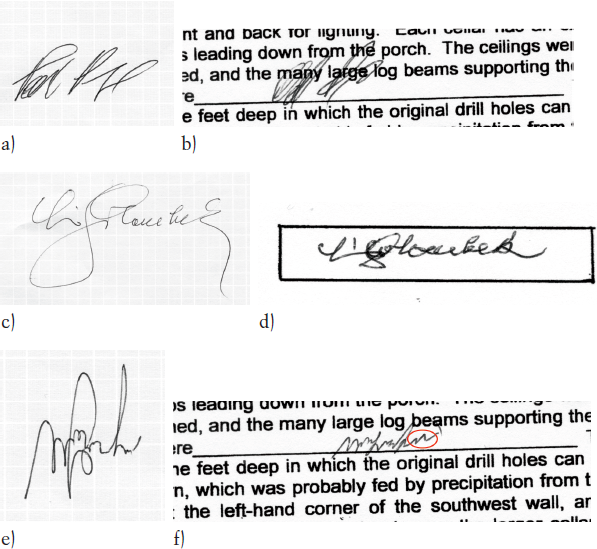
Figure 17
Examples of unconstrained signatures a), c) and e) from three different individuals and constrained signatures b), d) and f) from the same three individuals respectively. Examples of the addition of artefacts can be seen between samples e) and f). The constrained signature f) has several added peaks compared to that of the unconstrained sample e).
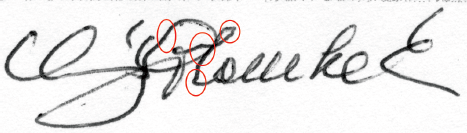
Figure 18
Example of diminished fluency produced within a constrained passport signature.