
Introduction
When a signature is required, it is extremely rare that it is provided on a blank page where the individual has free reign of space. Normally it is required on a line, in a box or within text. Forms that require signatures are ever-changing and the introduction of these requirements have increased the number of cases in which document examiners must analyze constrained signatures. The overall effect that these constraints have on a signature is unknown. Research concerning constraint and how it affects signatures has not been well-studied. In a study conducted by Morton (1980), the effects of crowding a signature were analyzed. It was determined that the lateral and vertical restrictions imposed on the signature resulted in minimal variation from that of a normally spaced signature and the fluency of the signature was hardly affected. Whether this degree of change was sufficient for a document examiner to produce erroneous conclusions was not addressed. Other publications surrounding this topic are anecdotal and conclude that a comparison between a constrained and unconstrained signature only complicates the document examination process (Doud 1981, Ruenes 1968, Lacy 1961). Although it is known that a person’s signature naturally varies each time it is executed, it is not known if constraint extends this variability beyond the writer’s natural variation (Evett et al. 1985).
To analyze the changes occurring when a signature is constrained, the variation in pen pressure, velocity and jerk can be analyzed. Velocity is the first time derivative of position as a function of time. It has magnitude (typically cm/s in handwriting applications) and positive or negative direction. A quantity having magnitude and direction is a vector quantity, measures that are only magnitude are called scalar quantities. Speed is a scalar quantity and is often erroneously used in place of velocity. In equation form velocity is:
Alternatively the time derivatives may be expressed in abbreviated form:
Jerk is the third time derivative of position as a function of time. As follows:
To date, the majority of dynamic information is estimated qualitatively through the analysis of static signatures (Mohammed et al. 2009). A pilot study by Ostrum et al. (2005) showed that the tablet as a handwriting measurement system can be used to test various theoretical aspects relating to both the handwriting movement itself and the examination of that handwriting by document examiners. Through the comparison of signatures produced by the same individual, it was found that variation in speed, deviations in the written stroke and pressure could be identified with the use of tablet technology (Ostrum et al. 2005). Using a digitizing tablet and software to capture dynamic writing characteristics removed the subjectivity inherent when document examiners assessed these features from a static record (Ostrum et al., 2005).
On a more frequent basis, forensic document examiners are now examining signatures where constraint plays an influential role in the writer’s ability to produce a natural signature. An indepth understanding of the variation that may occur naturally is required. The ways in which an individual manipulates their signature to fit within these specific confines will affect their signatures on a variety of levels, with a domino effect of variations as a direct result, and for the purpose of examination, need to be further studied. The purpose of this study is to determine the degree of change found within a constrained signature versus unconstrained signatures. With the use of overall visual analysis of the static signature and a more in-depth analysis of the dynamic features such as speed, pressure and jerk, the present study examined differences between constraint conditions and natural unconstrained signatures. To provide a more accurate measurement of these variables, this study employed theuse of tablet technology. While only genuine signatures will be analyzed in this study, the broader goal is to generate reliable data that can aid document examiners in simulation analysis.
Materials and Method
Preparation of Constraints and Subject Information
Six constraints were chosen that represented common signature constraints encountered by forensic document examiners. These samples in order of least to most constraining included: 1) a gridded sheet style WL37 0G2pA6S, 148mm by 105mm (WHITELINES); 2) a line with a length of 4.7 cm; 3) two fully enclosed boxes sized 6 cm by 1.2 cm modelled after the signature sections of forms such as the Record of Medical and Personal expenses from Manitoba Public Insurance; 4) 4.8 cm by 0.96 cm box consistent with the signature sections of forms such as the Notice of Objection (GST/HST) from the Canada Revenue Agency; 5) a line found within a single spaced text with a length of 6.4 cm and a height of 0.4 cm consistent with the T1 Income Tax and Benefit Returns from Canada Revenue Agency; and 6) the Canadian Passport box found in the Adult General Passport Application (Passport Canada) See Figures 1 through 6.
Each sample was given an identifier letter, A through F. The constraints, B to F, were then photocopied and cut to fit the dimensions of the Wacom Tablet detection pad (21.7 cm by 14 cm) ensuring the signature area was in the center of the pad to maximize both comfort and sensitivity. A participant questionnaire (Appendix 1) and information sheet was distributed to gather information pertaining to personal qualities that would affect the individual’s signature such as their native signing language, handedness and age. All subjects signed ethics board-approved informed consent prior to commencing the research.

Figure 1
Example of blank collection sheet— unconstrained signature (constraint A). Gridded sheet style WL37 0G2pA6S, 148mm by 105mm.

Figure 2
Example of the line with a length of 4.7cm (constraint B).

Figure 3
Example of the fully enclosed box sized 6cm by 1.2 cm (constraint C) modelled after the signature sections of forms such as the Record of Medical and Personal expenses from Manitoba Public Insurance.

Figure 4
Example of 4.8cm by 0.96 cm (constraint D) consistent with the signature sections of forms such as the Notice of Objection (GST/HST) from the Canada Revenue Agency.
Figure 5
Example of the line found within a single spaced text with a length of 6.4 cm and a height of 0.4cm (constraint E) consistent with the T1 Income Tax and Benefit Returns from Canada Revenue Agency.
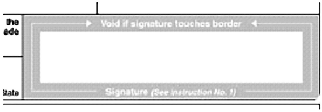
Figure 6
Example of the Passport Box (constraint F) found in the Adult General Passport Application (Passport Canada).
Software/Hardware Setup
A Wacom Tablet intuos3 PTZ – 630 and Ink Pen ZP – 130 – 00A were used for kinematic data collection. The platform and program used to store and analyze the signature kinematics was an acer (ASPIRE one, netbook) laptop computer and Neuroscript’s MovAlyzeR version 6.1.0.0 software.
The Wacom tablet was synced to the program allowing for real time analysis of the signature by MovAlyzeR.
Experimental Setup
The properties of the experiment were determined beginning with the trial duration. The trial duration was kept constant for all subjects under the age of 70 where the variables were as follows; 10 second signing period, 30 seconds for signature recording and 5 seconds between trials. For any subjects over the age of 70 the trial duration was slightly modified as follows: 30 seconds for signing, 40 seconds for recording and 30 seconds between trials. Participants under the age of 70 felt the original parameters provided ample time to comfortably complete their signature and set upfor the next sample. However, with the individuals over age 70, consisting of 5 participants age, 79, 80, 81 and 83 the 10 second signing period was not long enough to complete the full signature. This was determined by a trial run in which the participant was unable to complete the full signature within the original parameters. When the length of time to sign and between signatures was adjusted the participant was able to comfortably complete the sample.
Sampling
A total of 45 participants were selected from a pool of volunteers, of which 40 were able to complete the study. The participants ranged in age from 16 to 83 and were of varying race, gender, and occupation. The subjects were split into three age groups starting with age range 16–20 (14 participants), age range 21–49 (13 participants) and range 50+ (13 participants). During the sampling process the subject was placed in an environment conducive to customary signature positions and allowed to orient themselves in a way that was comfortable to them. Once settled, on the first meeting, the subject was briefed on the purpose and confidentiality agreement of the study. For each additional trial, totalling 10 trials, the subjects were asked if they were clear on the requirements, and then instructed to position the tablet at any angle desirable to them. Once the subject was ready to sign, the first constraint was placed on the tablet pad. To reduce variation between sampling, and allow for stability, the samples were taped using masking tape to the top left and right corners of the tablet pad. This was made constant for each sample and subject. The subject was instructed to sign the given constraint and remove their hand from the tablet once complete. The constraint was then removed and the next constraint sample placed on the tablet. This process was repeated for each of the six constraints in the trial. A minimum of two hours was allotted between trial sets to reduce the possibility of the subject becoming accustomed to the signing process. The subject was allowed to resume normal daily activities for the two hour intermission. When time permitted, the subject was contacted on different days for each trial set. A total of 60 signatures were collected from each participant that fully completed the study for a total of 2,400 signatures.
Analysis of Dynamic Results
In MovAlyzer, an individual’s signature is separated into segments based on change in direction as well as start and end point. The data collected by MovAlyzeR was recorded based on the kinematic values collected in each segment of the signature. The overall signature kinematics were determined by averaging all of the values obtained from each segment of the signature. The data for each signature was exported to Excel and the average pen pressure, average absolute velocity and average absolute jerk were calculated. Ten replicates of each constraint were then grouped together by constraint. All ten of these values were averaged to provide a final value for each constraint.
Analysis of Static Results
The ascenders and descenders were measured using the y(cm) vs Time(s) graph in MovAlyzer. A base line was determined representing the plane on which the signature lay. From this line the highest and lowest points were measured. The free hand signature (constraint A) and the passport box (constraint F), complexity measurements1 (Sita et al. 2003) were taken from trial 1,3,5,7,9 or 2,4,6,8,10 alternating between subjects. The five samples were either from trials 1,3,4,6,9 or trials 2,4,6,8,10. The complexities were then averaged to find a final value for each constraint. The length of each signature was measured by hand using a 30 cm ruler. These values were averaged for all ten trials.
Statistics
To determine if a statistical difference existed between the constrained and unconstrained signatures, 18 repeated measures analysis of variance (ANOVAs) were run. A repeated measures ANOVA was used specifically because it takes into account the collection of several trials over a particular time period. Trials 3, 5 and 8 were chosen to test for the significance of pen pressure, jerk, overall length, ascender length and descender length. The 3 trials were chosen at random, 3 of the 10 trials were chosen as this would provide statistically significant results that were representative of the full data group collected. For velocity an additional trial was added, trial 6, in order to improve the statistical reliability of the findings. A statistical program, Statistical Analysis Software (SAS) version 9.2 was used to perform the statistical analyses. The data gathered for pen pressure, velocity, jerk, overall length, ascenders and descenders for each person was compiled to test the variation in each feature over the whole population. Each feature was examined separately in SAS. If a significant difference was determined from the Repeated Measures ANOVA, a Tukey Test was used to ascertain between which samples there was variation. To analyze the complexity measurements an s x r Chi Squared test was used to examine the statistical significance of the ranked results. The s x r table allows the analyst to vary how many variables are used, For this experiment; the s represents the complexity group rankings (group 1 through 3) and the r represents the two constraints analyzed (constraints A and F). This test was performed on the combined rankings of all participants. All statistical analysis was run three times, once for each of the three chosen trials for each feature analyzed.
Results
Participant Overview
Participant questionnaires were examined to determine the population dynamics of the participant pool used in this study. The overall population dynamics were based on the participant’s sex, age, education, location where the English Language was first learned, first language, natural signing language, handedness and how often the participant signs.
The sample group consisted of 45% males and 55% females. 32% of the sample group was age 16-20, 35% age 21-50 and 32% age 51+. When surveyed about highest education level, 57.5% finished high school, 25% held a university degree and 17.5% were classified as other. 100% of the population learned English in Canada and naturally signed in English, while 75% had English as a first language. The remaining 25% consists of Albanian, Cantonese, Czechoslovakian and Italian. 82.5% of the population was right handed and 17.5% left. When asked how often the participants have to use their signature 42.5% said less often and 57.5% said often.
Dynamic Data
From the dynamic data collected, pen pressure, velocity and jerk, all demonstrated varying results with respect to their statistical significance. Table 2, 2 displays the overall results gathered for the repeated measures of the ANOVA and Tukey tests performed on the data collected for each variable.

Pressure
The analysis of pen pressure determined no significant variation between constraints and as such no statistical test was performed.
Velocity and Jerk
Analysis of the velocity and jerk data showed a declining trend with increasing constraint. Both dynamic variables were found to change significantly with constraint. The results show that there is variation in velocity and jerk between constraint A and the constrained signatures (B-F). The trend in velocity noted a constant decrease through the unconstrained signature, the 4.7 cm line, 6.0 cm x 1.2 cm box and the 4.8 cm x 0.96 cm box. The within-text and passport box showed a slight increase not only specific to the individual seen in Figure 8, but as a trend for the overall population. The jerk data showed a more general decreasing trend with increased constraint (Figure 9). Jerk was noted to decrease constantly until the within-text constraint where jerk then began to increase. Although there is a noticeable increase with the last two constraints, it must be acknowledged that the increase is minimal, and the jerk value is still not comparable to that of the unconstrained signature. The individual represented in Figure 6 below shows the decreasing trend with increasing constraint, and a very drastic initial drop between the unconstrained and 4.7 cm line constraint.
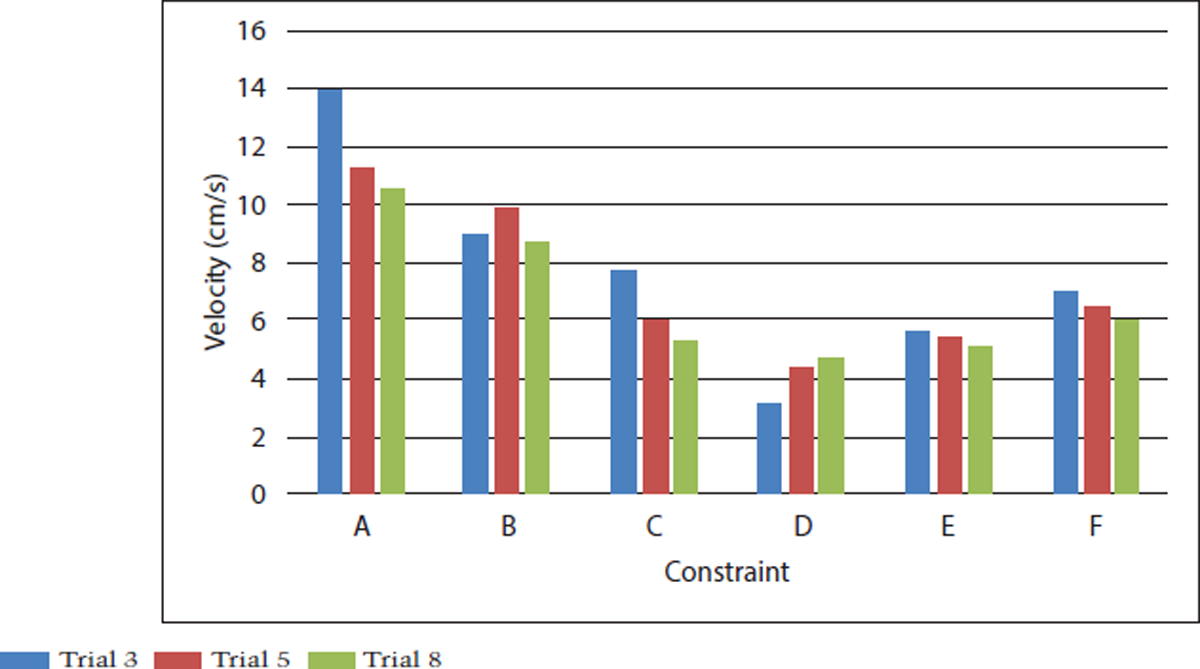
Figure 8
Example of Velocity variation within an individual’s signature for trials 3, 5 and 8 for all six constraints.
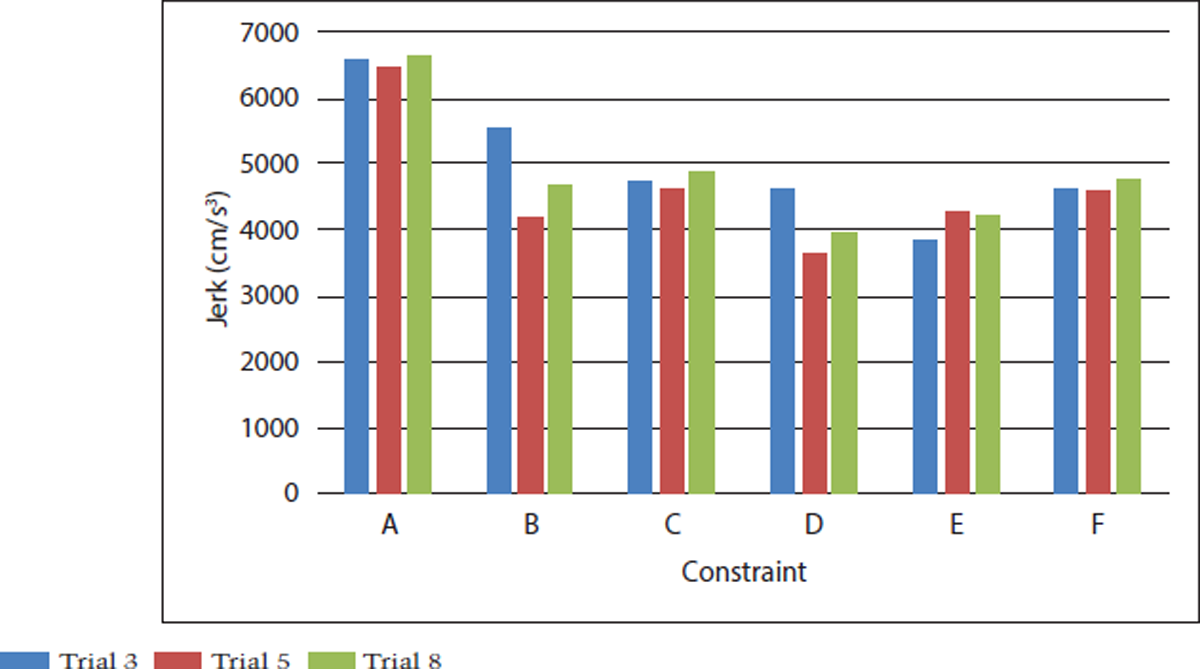
Figure 9
Example of Jerk variation within an individual’s signature for trials 3, 5 and 8 for all six constraints.
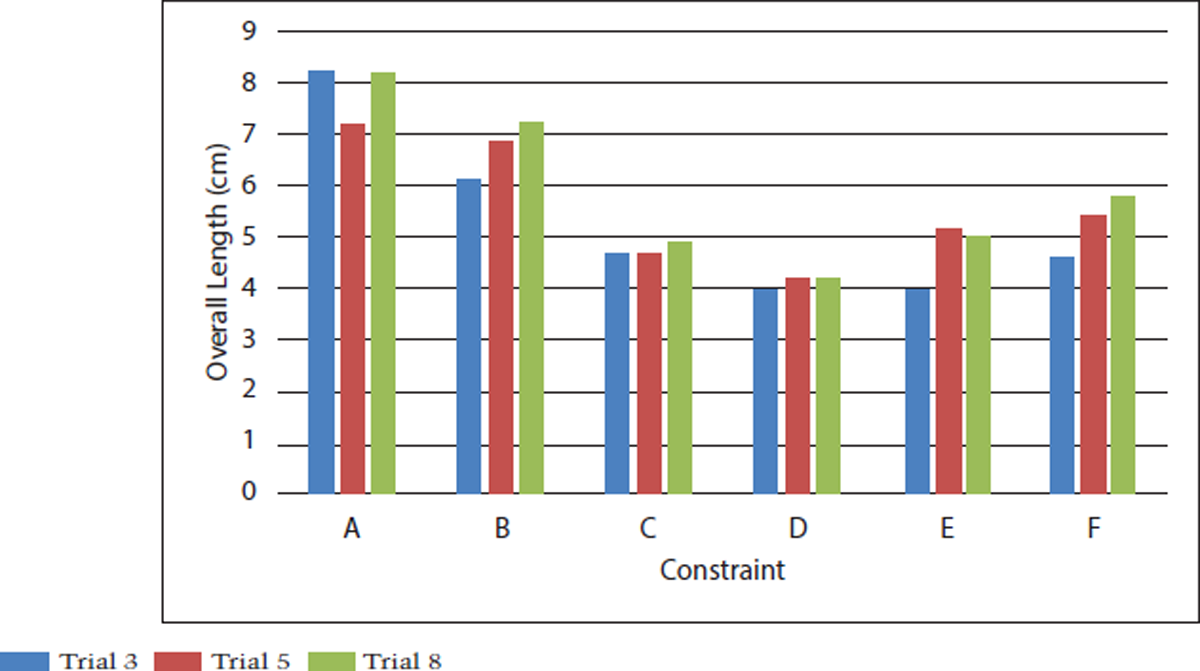
Figure 10
Overall length variation within an individual’s signature for trials 3, 5 and 8 for all six constraints.
Static Data
The static data measured overall length, ascender length as well as descender length. The latter all showed significant variation between constraints. Table 3 shows the overall results gathered for the repeated measures ANOVA and Tukey Tests.

The static data, upon analysis, showed a decrease in overall length, ascender length and descender length as constraint increased. The static variables were found to change significantly with constraint, meaning that these features were different between constraints. Most importantly, it was determined in each case that these features differed between constraint A and all constrained signatures (B-F).
Overall Length
Overall length showed an initial constant decrease from the unconstrained, 4.7 cm line, 6.0 cm x 1.2 cm box and the 4.8 cm x 0.96 cm box. A slight increase is seen in the within-text and passport box signatures (Figure 10).
Ascender Length
Ascender length decreased as constraint increased, affecting mainly signatures with features that span a higher distance above the remainder of the signature (Figure 11a,b).
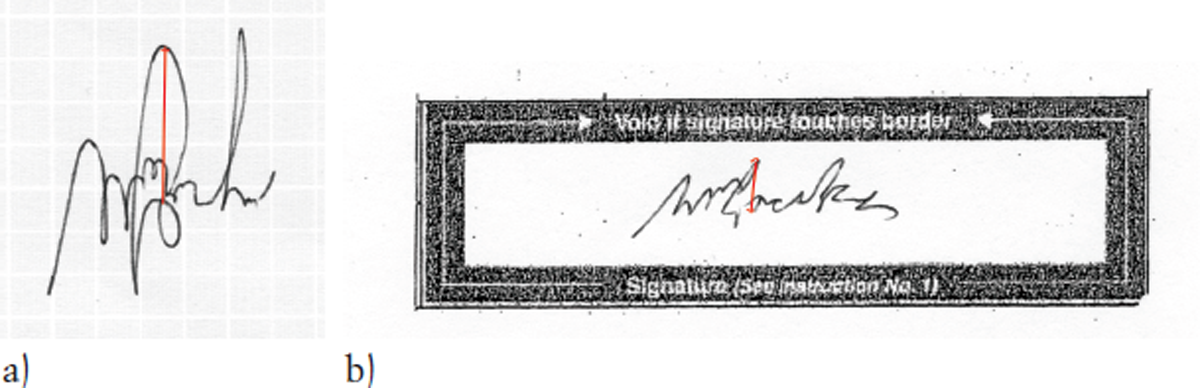
Figure 11
Example of unconstrained signature (a) and passport box constraint signature (b). A decrease in ascender height between free and constrained signatures is seen.
3.3.3 Descender Length
The descender length decreased with increasing constraint. This affected individuals with below baseline features in their signatures (Figure 12a,b).
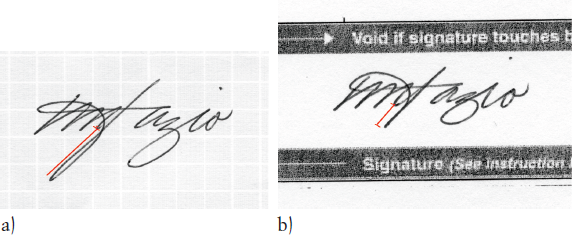
Figure 12
Example of unconstrained signature (a) and passport box constraint signature (b). A decrease in descender length is indicated by the red line.
Complexity
The complexity of all subjects is recorded in Table 4. Individuals were categorized into three groups based on complexity scores calculated for both the unconstrained and constrained passport box. While analyzing the signatures for complexity it was determined that 25 of 40 participants had text-based signatures, 9 of 40 were mixed and 6 of 40 were stylized.


Figure 13
Example of a void passport box signature. The red circle indicates the area which touched the border.
A Chi—squared test (s x r dimensions) performed on the complexity results determined an insignificant difference between the complexities of the unconstrained (Constraint A) and constraint passport box signature (Constraint F). These findings showed that no change in complexity was observed with increased constraint.
Unique Variations
During this study, if an individual’s signature touched the borders of the Passport Box sample (Figure 13), the signature was discarded and a new sample was completed.
Observed was an overall reduction in size. The decrease in overall size was found to occur most in the 4.8 cm x 0.96 cm box and the within-text samples. Figure 14 (a and b) is an example of an individual’s signature that experienced an overall size reduction both in height and length, while the signature seems to remain proportional.
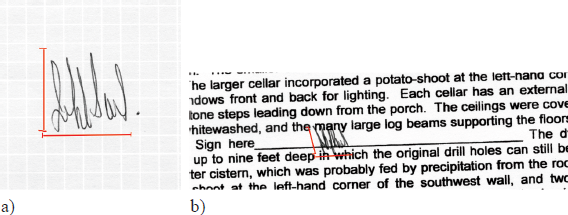
Figure 14
Example of overall size decrease, unconstrained signature (a) and constrained within text signature (b).
Another unique variation that was observed was the lateral expansion or contraction of the signature between each constraint. When comparing the unconstrained signature to each of the constraints, the spacing between the first and last name increased with the more space provided (Figure 15 a, b).
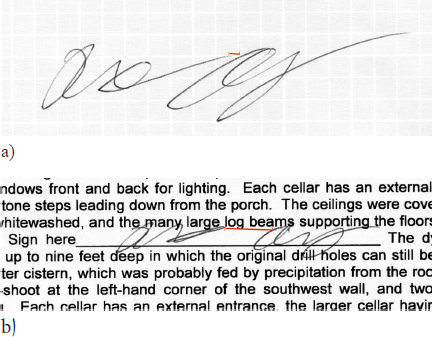
Figure 15
(a) Represents the unconstrained signature and (b) represents the constrained within-text signature. An increase in space between the first and last name segments is denoted by the red line.
During sample collection, participants were not given specific instructions to stay within the constraint boundaries, the passport box constraint being the exception. Several individuals went to the extreme of altering their signature’s features in order to remain within the boundaries (Figure 16a, b), while others did not make as much of an effort to do so.
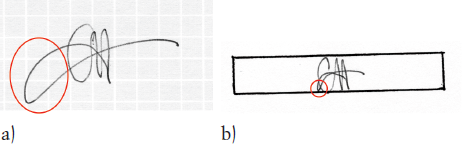
Figure 16
(a) represents the unconstrained signature (Constraint A) and b) represents the 4.8 cm x 0.96 cm box (Constraint D). There was a noted attempt to keep the loop feature of the signature within the constraint, causing visual alterations to the signature.
During this study, there were several cases where a constrained signature (Figure 17 b,d,f) differed extremely from the corresponding unconstrained signature (Figure 17 a,c,e)
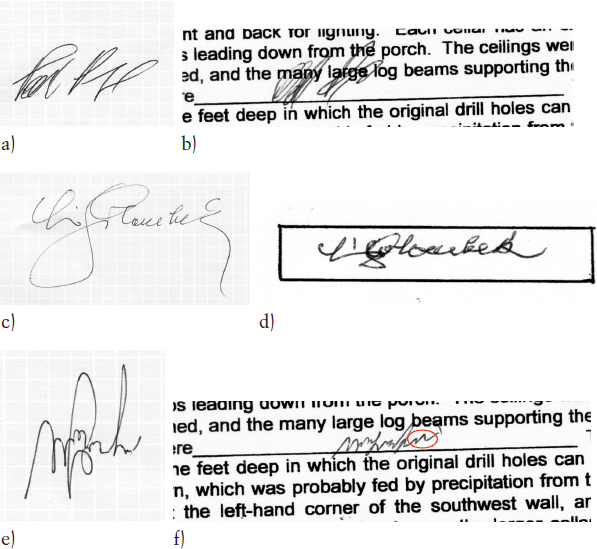
Figure 17
Examples of unconstrained signatures a), c) and e) from three different individuals and constrained signatures b), d) and f) from the same three individuals respectively. Examples of the addition of artefacts can be seen between samples e) and f). The constrained signature f) has several added peaks compared to that of the unconstrained sample e).
With increased constraint the presence of tremors and hesitations, unnatural to the signature, were noted (Figure 17 e and f). These anomalies, representative of lack of fluency, were predominately noted in the within-text and passport box samples. Another form of anomaly found was the addition of extra artefacts seen mainly in the within-text samples (Figure 17f).
Discussion
Dynamic Feature Variation
4.1.1 Pen Pressure
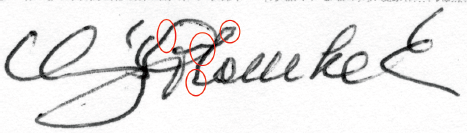
Figure 18
Example of diminished fluency produced within a constrained passport signature.
When analyzing the dynamic feature of pen pressure, it was determined that no significant variation existed between constraints, meaning that there was no increase or decrease identified between samples. In a study performed by Mohammed et al. (2010), the comparison of pen pressure between simulated and genuine signatures found an increase in pen pressure for the simulated signatures compared to pen pressure of the genuine signatures. This was confirmed in an earlier study by Van Galen et al. (1996). Pen pressure is an integral part of an individual’s writing and is currently being utilized as a biometric security measure (Estabrooks 2000; Hook, et al. 2003).However, in order for this to work as a method of identification, pen pressure must be constant within an individual’s writing. Hook et al. (2003) determined that pressure signals within an individual’s handwriting sample contain important information as to the structure of the text, as well as behavioural characteristics. With the unique combination of userspecific traits, the pressure signal of any handwritten symbol or text becomes encoded and constant. Although this study did not take into account constraint, it did demonstrate that pressure within an individual’s signature and overall handwriting exhibited consistency. However, this present study focused on the comparison of known genuine signatures under varying constraints. While there was no significant difference in pen pressure between the unconstrained genuine signature and the constrained genuine signatures, this provides valuable knowledge to document examiners. Research has shown that pen pressure patterns of a well-developed signature are extremely difficult, if not impossible, to mimic when simulating another’s signature, especially when aiming to duplicate specific formations and methods of execution (Estabrooks 2000). This is a critical finding in that pen pressure can be used as a discriminating feature between known and questioned signatures. The lack of variation in pen pressure found in this study demonstrates the concreteness of pen pressure in an individual’s writing. Document examiners can attribute any variation in pen pressure to a possible simulation. Results produced in this study reveal that pen pressure, even when constrained, will remain constant in a genuine signature.
4.1.2 Velocity
An individual’s signature establishes a constant velocity through repetition. Within this study, velocity of a genuine signature was found to decrease as constraint increased. The velocity of a constrained signature was lowest in the 4.8 cm x 0.96 cm box. This constraint represents the signature sections on both the Notice of Objection (GST/HST) form produced by the Canada Revenue Agency and the Government of Canada Security Clearance form. This sample was not considered the most constraining (in that the individual was allowed to sign outside the confines), however, it was the most limiting in terms of height and length. If the individual felt the need to remain fully within the constraint, which most did, this constraint would cause additional strain on the individual. A decrease in velocity between the unconstrained and constrained signatures has meaningful implications for forensic document examiners. Research has shown that simulated writing, because of its unnatural feel, increases the demands on the body’s processing system which is reflected in the change in speed of the signature’s execution (Mohammed et al. 2009). It was found by Mohammed et al. (2009) that genuine signatures were written more quickly than those of simulated signatures. Decreased velocity is currently an identifying factor of simulated signatures. With the understanding that a decrease in velocity can also be attributed to the presence of constraint, it becomes an issue in the examination process. In case work that involves constrained signatures, a decrease in velocity may no longer be a distinguishing feature of simulated signatures and should be examined with caution by document examiners.
4.1.3 Jerk
A common feature analyzed by document examiners, is the fluency of a signature. The fluency of a signature can be compromised by factors such as a writer’s state of health and the authenticity of a signature, where decreased health and simulation both reduce fluency. Normally, if the fluency of a signature is questioned, a document examiner can query the state of the individual’s health at the time the document was signed. If the individual was not ill, then the lack of fluency may be the result of simulation. Jerk is a dynamic representation of disfluency, where an increase in jerk reflects an increase in disfluency of a signature. The results of this study show that the unconstrained signature had a higher jerk value than that of any of the constraints. Although the decrease in jerk was not as constant as what was seen with velocity, the 4.8 cm x 0.96 cm box continued to produce the lowest values. A study performed by Mohammed et al. (2009) noted that simulated signatures had a much higher jerk reading than that of genuine signatures, allowing jerk to be used as a discriminating feature for simulation. Notwithstanding the fact that the findings in this case show contradictory results to that of Mohammed et al. (2009), it does educate document examiners on the possibility of a reduction in disfluency when constraint is present. The findings in the current study do not contradict that of previous work in that increased jerk is still correlated with simulated signatures only. However, a relationship between decreased jerk and constraint has been determined. A possible explanation for the decrease in jerk may be related to the heightened awareness required by an individual when constraint is increased. Since the individual has an established signature, the individual’s attention to detail, in execution, may increase fluency. When applying these findings to case work, examiners may attribute constraint as a contributing factor in decreased jerk and its relationship to fluctuations in other variables being examined.
1.1 Static Feature Variation
The static features analyzed were overall length, ascender length, and descender length. The analysis of these features showed a reduction with increased constraint. The effects did vary depending on the style of the signature. For example, those signatures that did not contain below baseline characters were not affected in descender length as readily as individuals who have letters such as “j” “y” or “p” in their signature. The same was noted with ascender length reduction. Individuals who began their signature with larger capitals letters, or whom contained letters such as “t” “h” or “k” were more affected. The effects of constraint on the static features of a signature influenced the appearance of the signature. Although this finding does show change, it is minimal in that the signature was still recognizable and would likely not lead a document examiner to an incorrect conclusion. That being said, the constraint does alter the static features of a signature, which may impose additional stress on other features within the signature. For example, with reduced ascender and descender space, an individual may lose fluency resulting in poor line quality of their signature. This is a feature common to simulated signatures. These observations were also noted in a previous study by Simsons et al. (2011). The overall effect of constraint on the length of the signature, ascenders and descenders, do not readily affect the signature analysis process due to the fact that the core of the signature was still recognizable. However, the effects these findings have on other factors such as fluency are what documents examiners should acknowledge.
1.1.1 Complexity
The complexity of a signature is the assessment of how difficult the handwriting would be to simulate (Sita et al. 2003). This is a form of analysis that allows document examiners to critique the signature on a level that is not purely a subjective comparison (Sita et al. 2002). In this thesis study, the majority of signatures fell within the high complexity group, text-based samples. In a study performed by Simsons et al. (2011), a reduction in complexity occurred within the passport box mainly due to the absence of details present in the unconstrained signature. However in the current study, there was no significant change in complexity between the unconstrained signature and the passport box signature. Even though limited research has been performed in this area, a lack of variation may be attributed to the styles of signatures found within this study. Signatures that favour a more text-based style are easier to maintain consistency and do not contain as many intricate details as a stylized signature may. The majority of signatures that exhibited signs of complexity reduction were considered mixed or stylized signatures. To further explain these results, research using an equal amount of text-based, mixed and stylized signatures should be conducted to determine if constraint will affect one style of signature more than another.
1.2 Experimental Observations
Throughout the study, a common theme among participants was their reaction to the constraints. On several occasions, individuals would admit to being stressed or “constrained” when faced with some of the more difficult samples. Many individ uals would repeatedly state they were extremely nervous prior to the sampling process and would express their anxiety as to which sample was next in sequence. Individuals also made comments such as, “This one (passport box) is so stressful, why do I have to do it,” and, “There is no point in me signing this one (passport box) because, when I do, it doesn’t even represent my actual signature; it does not look like my signature at all.” In addition, participants admitted to consciously planning their movements to ensure they would remain within the constraint. Knowing that individuals are cognisant of their signature, adjustments to accommodate a constrained signature is evidence to document examiners that constraint does induce a form of mental stress on an individual which arguably then affects their signature. The stress involved with constraint may produce a similar effect on a signature as would an illness. In a study performed by Mohammed et al. (2010), the variation in features such as size, velocity and pressure were observed in individuals with a variety of illnesses and/or state of mind, such as Parkinson’s Disease, aging and cannabis use. It was found that each illness or altering influence had varying effects on the features examined. In particular, Parkinson’s disease decreased the overall size of the signature and velocity. A constraint exerts stress on an individual’s ability to execute their signature, which arguably may be similar in nature to the individual having an illness. Document examiners need to take into account these effects and acknowledge that although the individual may not be ill, comparable features could be present and not necessarily associated solely with simulation.
1.3 Unique Findings
Canadian government forensic document examiners are often sent the T1 Personal Income Tax Returns form as representative known specimens since they are easily accessible by the Canadian Revenue Agency and, are regarded as reliable sources. In this study this form is represented by the within-text constraint. Of interest, was the extreme visual variation noted on several occasions mainly in the within-text sample, as seen in Figure 13. Decreased line quality, additional artefacts and extreme variation in letter shape and flow were noted with regularity in the within-text sample. These signatures differed to such a degree that experienced document examiners may find the determination of authenticity to be complicated. Since the within-text sample is representative of a form commonly used as a known sample, the findings in this study pose a concern to the examination process. This sample showed the most variation in visual appearance, meaning it is a poor representation of the known signature and should not be used as a comparison sample unless it is being compared to a questioned sample from the same form. Document examiners need to be exceptionally careful when using this form in an examination. Not only do the variations pose a problem, the lack of replicates within a reasonable time frame also effects contemporaneity. If a known signature is not obtained within the same relative time frame as when the questioned sample was written, there may be variation that would mislead an examiner. The T1 Personal Income Tax Returns form is submitted once per annum; this large time gap between samples reduces reliability. Based on the findings regarding the within-text constraint, document examiners must be cautious with the use of this form as a known sample. To help reduce the effects of constraint on the examination process, this form should be used as a known sample only in cases where the questioned sample is found within the same style constraint.
1.4 Overall Findings within Constraints and the Effects
Constraint has been shown to affect signatures both on a dynamic and static level. With varying results between constraints, it can be concluded that the 4.8 cm x 0.96 cm box had the greatest affect on the signatures. It is imperative that forensic document examiners take into consideration the types of comparisons they are performing on constrained signatures, based on these findings. It is recommended that when examining constrained signatures in case work, known samples used for comparison should be constrained in the same manner as the samples in question. Following this process will eliminate some variation that may be identified if an unconstrained known sample is compared to a constrained questioned sample. In addition, document examiners should also acknowledge where there is overlap in distinguishing features. A characteristic such as reduced velocity, seen in simulated and disguised signatures, should be analyzed with extreme caution when comparing constrained questioned signatures to those of unconstrained known signatures.
Conclusion
The effect of constraint on a signature has remained an unanswered questioned for forensic document examiners. This study has demonstrated that varying forms of constraint do affect an individual’s signature in several ways. The variation in dynamic data (velocity and jerk) may lead forensic document examiners to erroneous conclusions during the analysis process. At the same time, the variation in static features (overall length, ascender and descender length) may not affect the analysis process as drastically. It is important that forensic document examiners are aware of the variations imposed by constraint. When document examiners are analyzing a case where constraint is present, it is recommended that some known specimens reflect the same stress on the signature. Known samples produced under the same constraint, or in a relatively similar fashion, would be ideal. If a situation arises where similarly constrained specimens are unavailable, then extreme caution should be used during the examination process in conjunction with variations noted in this study. In addition to the effects this may have on document examiners, these findings may also enlighten designers of documents and aid them in producing documents which allow for the execution of a more natural signature by individuals using these forms.
Although this study has provided the field of forensic document examination with promising results, there are still several avenues of research to explore. Further research identifying reasons for lack of variation in pen pressure would be beneficial. As well, determining the effects of an individual’s health, such as stroke, blindness, dyslexia, and other forms of illness, in combination with constraint would be of interest to the field. Within this study it was noted that several participants were suffering from physical illness including blindness, and osteoarthritis, as well as undergoing surgery during the period under which this project was being conducted. Although the effects of these physical illnesses were not taken into consideration in this study, they should be considered in future research to determine if the results found could be attributed to the possible effects of illness. The identification of the dynamic variations experienced with constraint is of great importance, and a method for quantitatively measuring these variations from a static signature should be developed. It would also be of benefit to review and contrast the length of time variation between the completion of the unconstrained and the constrained signatures. Finally, the effects of constraint on text-based, mixed and stylized signatures should be compared to determine if a certain style is more or less affected by constraint. If a specific style of signature is found to be less affected by constraint, a document examiner may be able to attribute the variation in features to simulation rather than constraint. On the other hand, if a style is greatly affected by constraint, a document examiner may be less likely to conclude that the variation is due to simulation alone.
Appendices
Appendix I
Participant Questionnaire
Project Title: The Effect of Constraining Signatures, Part II
Student Researcher: Kristen Fazio
To be completed by the study participant:
Please mark the appropriate box with either an ✗ or a ✓
Sex: Male ◻
Female ◻
Age: 16 – 20* ◻* if the participant is between 16–18 yrs of age, the accompanying consent form must be completed
21 – 50 ◻
51 + ◻
Highest level of education: High school ◻
University ◻
Other ◻
If other, please specify:________
Where did you learn English?____________
What is your first language?____________
In what language do you usually sign?______________
Handedness: Right ◻
left ◻
In your daily life, do you tend to sign your name:
Many times a week? ◻
Less often? ◻
I understand that I can request results of this project by email when it is completed, from Ms. Kimberly Nugent (kimberly.nugent@uoit.ca)
Notes
[1] The complexity model most commonly used measures the number of turning points (TP), intersections and retraces (INTRT) within a signature and inputs them into three separate equations to determine the complexity
The complexity equations use in this study are:
High Complexity = (0.3407762 x TP) + (0.2397084 x INTRT) – 9.418039
Medium Complexity = (0.1685134 x TP) + (0.0871350 x INTRT) – 2.915064
Low Complexity = (0.0986248 x TP) + (0.0263783 x INTRT) – 1.508095