
Introduction
Appliance sales online to EU consumers are high and growing. While E-commerce brings clear benefits – wider product choice and more competitive pricing – it also introduces notable risks.
For products that consume energy, failure to meet energy performance regulations carries real consequences, both for the environment and for fair competition. The EU’s ecodesign requirements, working in tandem with mandatory energy labelling, collectively save hundreds of terawatt-hours of energy across the bloc each year (VHK 2024). But regulations only deliver results when they are followed. E-commerce has given rise to new sales models and actors that existing Monitoring, Verification and Enforcement (MVE) frameworks – including those covering ecodesign and energy labelling – struggle to address.
This paper examines how the EU’s online compliance provisions compare to those in other jurisdictions, all members of the IEA 4E Technology Collaboration Programme (TCP).
The paper starts with a background section including a short description of EU energy appliance regulations, an indication of the growth in online sales of these goods and outlining sales models. This is followed by a description of the methodology, the challenges of checking compliance of online sales, and a description of general regulations of online sales designed to address these. The MVE of online appliance sales in the EU are compared with those in other 4E jurisdictions. The paper ends with a summary and recommendations on how to strengthen EU MVE of online sales of energy-using appliances.
Background – online sales and compliance
EU Ecodesign and energy label regulations
Ecodesign and energy labelling are the EU examples of what are often referred to as Energy Efficiency Standards and Labelling (EES&L) programmes. EES&L programmes use one or both of the following complementary tools as the basis to improve the energy efficiency performance of appliances and equipment:
Minimum energy performance standards (MEPS), which prohibit the least efficient products. In the EU these are known as Ecodesign regulations and are currently set under a framework directive of 2009 (EC 2009). Future regulations will be under the Ecodesign for Sustainable Products Regulation (EC 2024).
Energy labels, which enable consumers to make more informed choices at the point of purchase by showing the comparative performance of all appliances (known as rating labels) or by identifying the best-in-class products (endorsement labels). The EU energy label is a mandatory efficiency rating label. The regulation which sets the framework of energy labels was published in 2017 (EC 2017).
The EU commission an annual review of the impact of ecodesign and energy labelling. The most recently published (VHK 2024) found that energy savings were 7.3% (2023) to 10.2% (2030) of total EU27 primary energy consumption in 2022 (1,259 mtoe; 14,642 TWh). These, then, are impactful policies if they are complied with.
The importance of online sales of energy using products to consumers
It is thought that online sales of energy using products to consumers are significant and/or growing. Data on the proportion of sales made online of domestic appliances for some 4E jurisdictions is published by NielsenIQ (2025). They state that the penetration of online sales in China for small domestic appliances reached 95% in January to June 2025 (an increase from 90% in January to June 2020) and 55% for medium domestic appliances (up from 50% over the same period). The equivalent figures for Western Europe are 45% (was 41% in 2020) for small domestic appliances and 27% (was 31%) for medium.
These data are incomplete but support the view that online sales to EU consumers of energy using products are significant and generally increasing.
Models of sales of products to consumers, in general and for E-commerce in particular
The fundamentals of selling consumer products are the same for in store purchases and E-commerce; a sale is realised when an offer for a product is accepted. (The sale also includes payment by the customer and the delivery of the product to the customer; these aspects are not relevant to MEPS and energy labels so are not considered here.)
The businesses involved in a sale will include:
The manufacturer: produces the product.
The retailer: offers the product to the consumer; this can be done online (online retailer, or hybrid if the retailer also has physical shops). The retailer can offer products from one manufacturer only (manufacturer=retailer) or from different manufacturers. The first situation also occurs if the retailer has products produced by others (OEMs) under its own name.
They may also include:
The marketplace: provides space to retailers to offer products: this can be done online (online marketplace) or physically (for example the store in store concept).
E-commerce introduces new roles and routes to market. Figure 1 shows conventional sales and E-commerce routes to illustrate the differences. An important feature of E-commerce is that it facilitates cross-border trade – in principle, and in practice, all of the actors in the supply chain may be in a different jurisdiction to the customer.
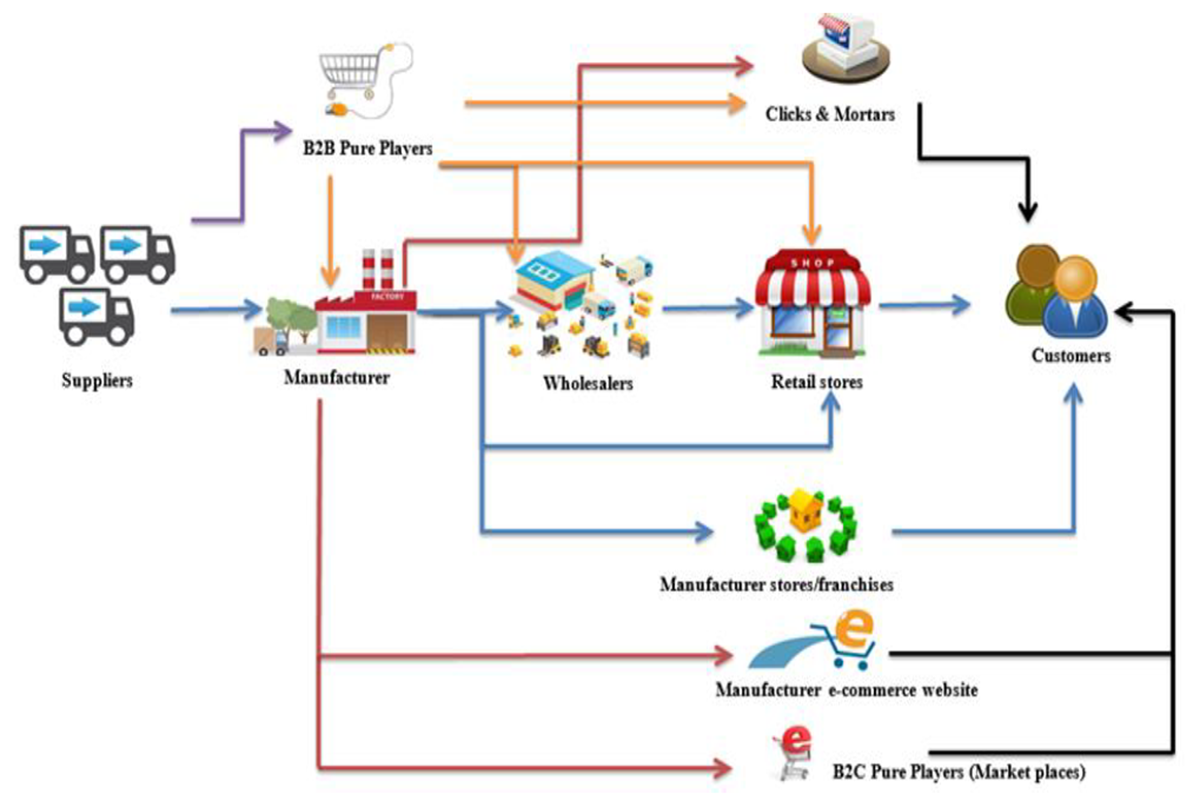
Figure 1
Supply chain integrating E-commerce players, Zair, Sefiani, & Fourka (2018).
Literature on compliance regimes for E-commerce
Sutinen and Kuperan (1999) developed a socio-economic theory of regulatory compliance. Based on evidence they found that there are a variety of reasons for actors to comply with regulation and all of them should be considered when designing a policy and associated MVE regime to achieve high compliance. These are broader than the simple economic drive to avoid paying penalties and include moral obligation and social values.
E-commerce presents a few new challenges for MVE regimes (as discussed below). Of these the one which has attracted most attention has been the role and responsibilities of online platforms (OPs) (Bertolini et al 2021) (Spier and Van Loo 2025), although these papers do not address environmental requirements such as MEPS. Literature on cross-border E-commerce is sparse: Liu et al (2022) reviewed the literature on this topic in China but did not identify regulatory compliance as a theme.
Overall, the literature appears to offer little guidance on the MVE of E-commerce which is relevant to Ecodesign and energy labels.
Methodology
This paper examines regulations in several member countries of the IEA TCP on Energy Efficient End-Use Equipment (4E): Australia, Austria, Canada, China, Denmark, the European Union (EU), France, Japan, Korea, the Netherlands, New Zealand, Sweden, Switzerland, the United Kingdom (UK) and the United States (US). (Note Austria, Denmark, France and the Netherlands were considered as members of the EU, not separately). It is only concerned with sales of products, not services, and with sales of products to consumers, not businesses.
An online search engine, Google was used to find information on regulations of E-commerce. An initial search generally found a web site in English, providing an overview for would-be retailers which listed the relevant regulations so that they could comply. This was followed by a search for the text of or official guidance on specific laws and news or government sites with reviews or proposed revisions of these. Wherever practicable original sources were used (that is the text of the regulations), although in some cases formal guidance was utilised. Summaries of the aspects of the regulation relevant to online sales of goods to consumers were written and 4E members were asked to review the material on their own countries for accuracy and completeness. This evidence was synthesised and summarised to draw out key points and allow comparisons.
The approach for gathering and collating information jurisdictional MEPS and energy labels was similar: a Google search which led either directly or indirectly to legal text, followed by 4E members’ review.
The search for material on online MVE practice used Google. We searched more broadly for any compliance activity and then examined this for references to online checks. In addition to these searches the website of the organisation responsible for MEPS and energy labels was searched for reference to MVE activity. As before 4E members reviewed the results.
Challenges of MVE for MEPS and energy labels for online sales
E-commerce introduces significant enforcement challenges compared to traditional retail.
The flexibility of E-commerce has enabled the number of supply routes to multiply, with millions of products sold by thousands of retailers. By itself this change in scale presents a barrier to effective MVE. E-commerce also facilitates cross-border sales, where suppliers may be unaware of and/or outside the jurisdiction of local regulations. For example, an eBay report on SMEs based in member countries of the Asia-Pacific Economic Cooperation forum (2018) showed that the average commercial seller on eBay exported to 36 countries. In addition, the low overheads of E-commerce means that in some sectors there are rapid market changes, with businesses starting and stopping overnight.
E-commerce can involve complex supply chains and new actors. Some actors have parallels with conventional retail, for example online marketplaces can operate similarly to department stores, providing an online (as against physical) space and other facilities for multiple retailers to operate. Others are distinct, such as fulfilment service providers (FSPs) who offer warehousing, and/or packaging, and/or addressing and/or dispatching, without having ownership of the products. Different sales models can operate alongside each other on the same website. That, combined with the new roles, can create ambiguity over responsibility for meeting regulatory requirements.
A further challenge can be that the investigative and enforcement powers that Authorities have for conventional supply chains and retailers do not apply to E-commerce actors.
General regulation of online sales of products to consumers in the EU and other 4E countries
The review found that most 4E jurisdictions had acted to address at least some of these challenges, either by amending existing regulations on the sales of products to consumers or adopting new regulations specific to online sales. The latter often also addressed other consumer issues such as pricing, transparency, online reviews and protecting consumer privacy – these are not covered here.
This section outlines general EU regulations, then those in other 4E countries before comparing them and making recommendations for improvements in the EU. (Ecodesign and energy label regulations are covered in the next section.)
EU regulation
The relevant articles from the three main EU regulations addressing E-commerce MVE challenges are summarised below:
Consumer Rights Directive (EC 2011)
The trader is required to provide the consumer with a description of the product, their contact details and a reminder of the existence of a legal guarantee of conformity for goods.
Market Surveillance Regulation (EC 2017)
Defines an ‘economic operator’ (EO) as ‘any … natural or legal person who is subject to obligations in relation to the manufacture of products, making them available on the market or putting them into service’ and requires there to be an EO based in the Union who takes on these responsibilities. This may include FSPs in the absence of another party.
The regulation requires EOs to check and keep the required documentation, cooperate with Authorities and inform the Authorities if they have reason to suppose that a product presents a risk. Online service providers are also required to cooperate with the Authorities.
Products which are targeted at consumers based in the Union via online or other remote means are considered as being offered for sale in the Union.
Authorities can act if products are not safe or if they do not meet regulatory requirements. They have broad investigative and enforcement powers, including withdrawing non-conforming products from the market. Also, products which do not conform or which do not have the required documentation can be stopped from entering the Union.
Digital Services Act (EC 2022)
The Act requires online marketplaces to obtain information on a trader before allowing them to trade on their site, including: name, identification, contact details, and self certification that they will comply with EU law. Further, online marketplaces should check this information; if they find it is inaccurate or incomplete they should ask the trader to remedy this and suspend their trading until it is corrected. They should also make reasonable efforts to randomly check whether the products offered have been identified as illegal.
Online marketplaces should design their websites so that it is easy for traders to provide labelling and marking in compliance with rules of applicable Union law.
Authorities have investigative powers and can place binding commitments on actors, impose fines and restrict access to the digital service. Also, any person based in the Union can complain to the Authorities about the provider of a service, regardless of where the provider of a service is located, and this should be investigated by the Authorities.
Regulation in other 4E jurisdictions
Most jurisdictions have similar definitions of E-commerce actors and place an obligation on actors to provide contact information. Relevant regulations found in 4E members’ jurisdictions were compared with each other in the 4E study. For brevity only the regulations which are similar in ambition to or go beyond those in the EU are discussed here, the others are listed in the Appendix.
E-commerce Law of the People’s Republic of China (PRC) (PRC2019)
This requires that only products which are safe and protect the environment are sold. The law applies to FSPs as well as platforms (online marketplaces). Platforms must collect and verify information on actors selling via their platform and provide this information to the Authorities when required. When a platform allows an unlawful product to be sold (“fails to take necessary measures, though it knows or should have known”) they have joint liability for this with the seller.
China Measures for the Supervision and Administration of Online Transactions (PRC 2021)
There is some overlap with the E-commerce law. Additional points include, that social networking and live streaming sites that allow online sales are in scope and are required to protect consumers and the environment and obtain information on sellers. Platforms shall establish an inspection and monitoring system for checking sellers and if they find that they are breaking the law they shall eject them from their site, making that information public within one day. Where a platform does not verify a seller, it will be liable for any wrongdoing by the seller. Platforms shall provide technical support to sellers in meeting their information obligations. Authorities have wide powers to investigate and punish illegal online transaction activities
UK Digital Markets, Competition and Consumers Act 2024 (UK Competition and Market Authority 2025)
The regulation sets requirements on traders and their actions, both of which are defined broadly and include providing information about a product on a website and online marketplaces. Stating or otherwise creating the impression that a product can be legally sold when it cannot, is banned. An invitation to purchase (advertisement, web page etc) must include any information which the trader is required under any other legislative provision to give to a consumer. Traders should not give consumers objectively false information. Any factual claims made by a trader about a product should be supported by evidence.
Comparison of EU E-commerce regulations with those in other jurisdictions
Being able to identify and make contact with an actor who is selling a product is an essential first step in MVE of E-commerce and most 4E jurisdictions have regulated to require this. The EU and China also require an online marketplace to check a seller’s information before allowing an actor to trade and stop them trading if they find it is inaccurate. The Chinese regulation goes further by making the marketplace liable for any wrongdoing by a seller if they do not verify them. These additional obligations require online marketplace to practice due diligence and make them part of the MVE regime, thus reducing the resources needed by the Authorities. The Chinese approach of making the marketplace accountable unless they can show that they verified the seller provides an incentive for marketplaces to check sellers and so is likely to be more effective.
Social media and streaming sites are increasingly adding online marketplaces, potentially providing a loophole to regulation, which the Chinese regulations close by explicitly including them.
The EU, Chinese and UK regulations require the product sold to be safe, not pose damage to the environment and/or meet other regulatory requirements. These references to environmental protection or other regulations should enable the Authorities with responsibility for E-commerce to act on energy efficiency product regulations, rather than referring non-compliances to separate organisations, increasing effectiveness.
The UK regulations ban traders from giving false information and require claims to be supported by evidence. Again, this could give Authorities the right to demand technical documentation to support claims of compliance with regulations (Ecodesign) and meeting the declared energy performance (for example on an energy label) without referring the non-compliance to the organisations responsible for enforcing these regulations.
The EU requires online marketplaces to randomly check that there is no publicly available information that identifies a product as illegal. In principle this means that marketplaces take on some of the monitoring and verification role, but it is hard to see how this condition could be enforced. On the other hand, the Chinese regulation, by making the marketplace jointly liable with the seller if an unlawful product is sold, provides an incentive for them to check compliance, and is likely to be more effective.
Where there is a requirement to routinely display certain types of information, such as an energy label or Product Information Sheet (PIS), the web site design can facilitate this or make it difficult. Both the EU and Chinese regulations recognise this and place an obligation on the marketplace to accommodate these requirements.
The EU and Chinese regulations include requirements on FSPs so that if the sellers are not based in their jurisdiction there is still an actor on the supply chain who can be held responsible for products and their documentation.
The suitability of EU E-commerce regulations for MVE of energy efficiency products
In principle, the EU regulations place responsibilities on online marketplaces and FSPs. These are actors who are based in the EU, so within their jurisdiction, and are often large corporations, so they have the resources to be compliant and can benefit from economies of scale.
However an evaluation of Article 4 (which relates to the responsibilities of FSPs) of the Market Surveillance Regulation (MSR) (DG GROW 2025) found that “it has been partially effective in improving product safety and compliance, protecting EU consumers, and reducing costs for Market Surveillance Authorities (MSAs), but that it faces challenges in identifying responsible economic operators, particularly for online sales from third countries selling products directly to consumers inside the EU (mainly through providers of online marketplaces). In this context, effectiveness is currently still hampered by unawareness of importers and FSPs of their responsibilities … the practical enforcement of Article 4 against manufacturers outside of the EU remains limited and therefore has not yet led to better compliance in E-commerce.”
From our study there are two areas, flagged above, where the obligations on online marketplaces and FSPs could be made more effective by following the example of China. If regulation made marketplaces responsible for the actions of sellers when they have not checked their information and jointly responsible with the seller for illegal sales this should improve compliance.
In theory, the Digital Services Act (DSA) means that websites have to be designed to make energy labels and PISs easy to display. In practice this may not be effective; the issue is most likely to be identified by the MSAs responsible for energy labels; when they find products for sale on web pages sellers sometimes report that the hosting website does not facilitate energy label display. These MSAs do not have enforcement powers under the DSA, they belong to National Digital Services Coordinators (NDSCs). Energy label MSAs have reported difficulties in engaging with NDSCs on this issue (Vandewynckel 2026). Delegating this authority to the most relevant MSA in each Member State would remove this difficulty.
The MSR makes it possible for Authorities whose remit is outside that of specific regulations, such as ecodesign and energy labels, to act on non-compliant documents and regulations. This could make MVE more seamless and effective, but it is not known if this power has been used.
One feature of most inspection and enforcement powers in the EU is that they are held at Member State level rather than centrally. This means that they can be fragmented and this can present a further barrier to effective MVE.
Having considered the regulatory regime for online sales of general product to consumers the next section considers the specific case of regulation of energy using appliances.
Online MV&E in Ecodesign and energy label regulations
EU regulation
Current Minimum Energy Performance Standards (Ecodesign regulations)
MEPS to date have been introduced as regulations for specific product groups set under the Ecodesign Framework Directive (EC 2009). Many energy using products sold to consumers are regulated. The regulations require manufacturers or their authorised representatives or importers to affix a CE marking and issue an EC declaration of conformity, whereby the manufacturer (or equivalent) ensures and declares that the product complies with all relevant provisions of the applicable implementing measure. This must take place before a product is ‘placed on the market’. This is a term used in multiple EU regulations and is defined as “making a product available for the first time on the Community market with a view to its distribution or use within the EU, whether for reward or free of charge and irrespective of the selling technique”. Thus, the regulations apply to online sales.
All current product Ecodesign regulations are under this framework.
New regulations
The Ecodesign for Sustainable Products Regulation (ESPR) (EC 2024) replaces the Ecodesign Directive, with a broader scope, covering products that are not energy related. New MEPS will be under this revised framework, although none have been adopted yet. Two articles of this regulation are concerned with online sales:
Fulfilment service providers are required to ensure that the conditions when providing a service do not jeopardise a product’s compliance.
Online marketplaces are required to:
Observe the DSA in respect of providing a single point of contact for MSAs and ensuring there is enough information on traders on their platform for them to be traced.
Cooperate with MSAs to facilitate elimination or mitigation of non-compliance of a product that is or was offered for sale online through their services.
Also, Member States are to give MSAs the power to order a provider of an online marketplace to act against non-compliant products, including by removing them.
Another additional feature of the ESPR will be that all products must have a Digital Product Passport (DPPs). The EC will set up a digital registry for DPPs, one of which purposes will be to improve the efficiency and effectiveness of market surveillance checks and customs controls.
Energy labels
Energy labels have been introduced as regulations for specific product groups under the Energy Labelling Framework Regulation (EC 2017). Energy labels are required for many energy using products sold to consumers but not all – all products with energy labels also have ecodesign requirements but some products covered by ecodesign regulations do not have energy labels.
For all products in scope, it is the responsibility of suppliers to:
Provide an accurate printed energy label.
Provide a PIS (product information sheet, also known as a product fiche): a table of information giving specified data on product characteristics and performance.
Register the product in a central database, the European Product Registry for Energy Labelling (EPREL), and upload information, including technical documentation.
The dealer must display an energy label, in a shop or on a website and make the PIS available to consumers at the point of sale. The size (relative to other information) and position of the energy label when displayed online are specified in the regulations.
Dealers and suppliers must refer to the energy efficiency class in visual advertisements and cooperate with MSAs. These actors are defined as follows:
Dealer means a retailer or other natural or legal person who offers for sale, hire, or hire purchase, or displays products to customers or installers during a commercial activity, whether or not in return for payment.
Supplier means a manufacturer established in the EU, the authorised representative of a manufacturer who is not established in the EU, or an importer, who places a product on the EU market.
Regulation in other 4E jurisdictions
MEPS
All 4E jurisdictions have MEPS for a wide range of products sold to consumers. For all but one of the jurisdictions these are at appliance model level and apply to E-commerce as well as conventional sales. The exception is Japan, where requirements are for fleet average sales rather than individual products, the Top Runner programme. This means that the regulations do not apply at the point of sale in general and therefore to online sales in particular. The MEPS place the responsibility for conformance on manufacturers or importers, and sometimes, in addition, the retailer. In five of the nine jurisdictions the products must be registered in a database before being put on sale. (In the EU this currently only applies to products with energy labels). In two jurisdictions, Australia and China, the Regulator must check and approve the registration before the entry becomes live in the database and the product can be sold. The data required in the databases is generally consistent with each other and with that in EPREL.
Energy labels
All the 4E jurisdictions require energy labels to be displayed on products sold in physical shops; in addition to the EU five others require energy labels to be displayed online: China, Japan, Switzerland, the UK and the US. In most jurisdictions the manufacturer or importer has to supply the energy label, the seller, variously defined, has to display it.
China, like the EU, sets requirements on the size and position of the energy label on the web page.
In China third-party trading platform operators (online marketplaces) are required to establish an energy efficiency labelling inspection and monitoring system for energy labelled products sold through their platform and take timely measures to stop any violations of the regulations.
Online MVE practice
Information on action taken by authorities to check and enforce compliance to MEPS and energy labels is difficult to find and generally lacks detail, for example how much relates to online sales is not always clear. It is likely that there has been more activity than presented here but it either has not been published and/or 4E members are not aware of it.
EU
In the EU, market surveillance is undertaken by the individual members states. No search was made for compliance checking by individual Member State MSAs acting alone.
Coordination and cooperation between market surveillance authorities is undertaken by EU Product Compliance Network (EUPCN).
EU funded market surveillance on MEPS and Energy labels. Since 2014 the European Commission has funded several Joint Actions and Concerted Actions on market surveillance of energy using products. All involve MSAs from several countries taking action in their own country but using common approaches and tools, sharing experience and developing good practice. They all cover several product groups. Actions generally include: inspection of online labels (since 2017); inspection of technical documentation and lab testing of performance. Headline results (% compliance rates and number and type of actions taken by Authorities) are reported.
Regional compliance activity. Nordsyn is a cooperation of Nordic countries on market surveillance and policy for MEPS and energy labelling. As well as joint actions by MSAs, it has funded the development and application of a webcrawler, NORDCRAWL (Bennich et al 2017), to check whether energy using products comply with MEPS and energy label requirements based on online sales information. As reported by Mogensen et al (2019) the webcrawler uses information gathered from the energy label to identify products which are non-compliant with ecodesign and energy label requirements. It has also been used to identify the retailers with highest and lowest percentages of models with missing energy labels for each product group.
EU Web crawler. It is reported (EC, undated): “The Commission has developed an IT market surveillance tool to support the inspectors from market surveillance authorities. The first component of the tool is a WebCrawler integrating AI-based functionalities, which scans web shops’ pages, to identify products sold online which do not comply with EU product legislation. The other component of the tool is a system that scans product documentation to identify potential formal non-compliances with EU legislation.” To our knowledge this has been used for compliance with safety regulations but not for Ecodesign or energy label market surveillance.
Other jurisdictions
An outline of the published activity in the EU and the other jurisdictions where activity was found is in Table 1. Note that published information in only three other IEA 4E jurisdictions was available.
Table 1
Online compliance checks and enforcement action published, by jurisdiction.
| JURISDICTION | ACTION |
|---|---|
| Australia | Annual checks of whether products sold are correctly registered in the database. Since 2019–2020 this has included online shops. The range of consumer products has increased, from 5 to 12 product groups and the number of consumer products checked has increased to about 10,000/year. The % compliance rate by product group is reported. |
| EU | A series of centrally funded Actions since 2015 have checked compliance and undertaken enforcement on selected product groups in several Member States. Since 2017 this has included checks of online labelling. Headline results (% compliance rates, action taken by authorities) are reported. |
| Switzerland | Annual shop inspections check MEPS and energy label compliance. At least since 2020 (oldest report available) these have included online shops – 10–13 a year. The annual overall compliance rate was reported to 2023. |
| US | The legal authority publishes case documents of enforcement actions due to failure to certify or incorrectly certify a product or to meet MEPS. It is not clear how many of these, if any, relate to online sales. |
Improving the effectiveness of MVE in E-commerce of EU energy efficient appliance regulations
The EU has a specific difficulty with E-commerce due to the use in multiple regulations of the concept of “placing goods on the market”, that is, it is defined as happening just once. As discussed by Ullrich (2019) E-commerce, which has different and more complicated supply chains, makes it more difficult to identify who is responsible for placing the product on the market. This affects sales of many types of products, not just those regulated under Ecodesign and is an ongoing concern for the EC and Member States. The EC has made efforts to address this by changes to the Market Surveillance Regulation. However, the review of the MSR (DG GROW 2025) found that practical enforcement against manufacturers outside of the EU remained limited.
Setting a requirement to register models of regulated products in a database should increase the effectiveness of compliance checking– the basic information should be easily accessible to the Authorities. Also, using the database it may be possible to use an algorithm or AI to automatically check: if information is complete; whether the energy performance meets the MEPS and if the information on the energy label is complete and consistent with other data.
The EU has a registration database, EPREL, but this is incomplete as only products with energy labels must be registered. Under the new framework regulation, ESPR, products will have a DPP and this information will be entered in a digital registry so this gap will be filled in the medium term. If the EU required the Regulator to check and approve the registration before the entry becomes live in the database and the product can be sold, as is the case in Australia and China, this should increase compliance.
Requiring energy labels to be displayed online, as in the EU and some other 4E jurisdictions, is important, not only because more consumers are buying energy using products online, but also because even when they buy in store many do their preliminary research online. For example, Euroconsumers (2025) reported that a survey of 2,500 consumers in ten European countries by consumer organisations found that over 90% of consumers relied heavily on online information for purchasing decisions.
However, currently online compliance with the correct display of energy labels and PIS varies by product group and Member State but is generally low. For example, as part of one of the Joint Actions, EEPLIANT3, (PROSAFE 2024) MSAs looked at 279 product pages for tumble dryers of 94 online retailers in nine countries. They found only 21% and 24% of labels and PIS respectively were fully correct and 34% of labels and 51% of PIS were missing altogether. Display of accurate energy labels clearly needs to be much higher than this to consistently affect consumer purchases.
Another benefit of online energy labels is that they enable compliance checking via web crawling, which can reduce the cost and increase the ease and speed of monitoring. While a web crawler has been used successfully regionally in the EU wider uptake would be beneficial.
Summary and recommendations
E-commerce can include more complex supply chains than conventional consumer sales and involve organisations who have no legal entity in the country they are selling into. These facets offer challenges to regulations that were designed for physical sales. The EU has developed new innovative rules to address gaps in existing regulation of E-commerce. They are intended to:
Increase the transparency of the supply chain, to consumers and authorities.
Make ‘new’ actors responsible for some aspects of compliance.
Address sales from outside their jurisdictions.
Give authorities the power to investigate and enforce rules on online sales.
Of the 4E member jurisdictions reviewed in this work only China has legislation which is more demanding of online actors. The Chinese regulations make the online marketplace liable for the wrongdoing of sellers on their site, providing an incentive for them to check sellers and products. If the EU were to adopt this approach this should increase compliance.
China’s regulations also have a wider scope – social network and streaming sites are explicitly covered by regulation. An increasing proportion of online sales are through these sites; Deloitte (2023) estimated that by 2025, the social commerce market would reach approximately two trillion US dollars and around 28% (or 13% excluding China) of all online retail sales. That being the case, it would be beneficial to close this loophole in the EU.
The question arises: why is China’s regulation stronger than that in the EU? We think that there are two reasons: first, the EU is an open market, in the sense that we regulate only when necessary. And in the case of E-commerce, it was some time before this necessity emerged, i.e. when E-commerce grew to being a significant portion of the market. Ironically, a major concern is the compliance of products sold by Chinese online marketplaces. Secondly, the regulatory process in the EU is generally slower than in China, because it is a democratic process.
The EU Digital Services Act requires online marketplaces to make it easy for sellers to provide the required labelling and marking, which is important for enabling energy label display online. However, infractions of this part of the regulation are more likely to be found by MSAs responsible for energy labelling than the National Digital Services Coordinators that are responsible for enforcing the DSA. There needs to be a simple and effective route for the ‘label MSAs’ to refer the NDSCs and for them to act on this or to delegate this power to the label MSAs.
Product registration databases can assist MVE by making information easily accessible to MSAs. At present the EU registration database, EPREL, is only required for products with energy labels, excluding products with requirements only under ecodesign such as computers. It seems likely that this gap will be filled in future by registration of DPPs under the ESPR, but this will take some years to take effect. It would be advantageous to include all products with regulated under the current ecodesign framework more quickly.
EPREL could be made a more effective part of MVE by requiring all registrations to be checked before a product can be offered for sale, as is the case in Australia and China. This would take more up front effort from MSAs but would improve compliance and reduce MVE effort overall. Further, it should be possible to make the checking more efficient by using algorithms or AI to do most of the checking, with inspectors checking only the exceptional cases that machine intelligence can’t process. It would require additional resources to develop a reliable AI with acceptable performance and low risk, but it should repay this investment quickly given the hundreds of thousands of models to be checked.
For products with energy labels, experience in the Nordic countries of the EU has demonstrated that web crawling can be an efficient and cost effective MVE tool, finding products with errors on energy labels and which don’t meet ecodesign requirements. These data can be used to identify manufacturers, importers, sellers and product groups with high levels of non-compliance so that they can be targeted with education and/or compliance actions. There could be significant improvements in online Ecodesign and energy label compliance from the widespread EU adoption of web crawling. A version of the EU webcrawler discussed above should be customised for this purpose and required to be used by all EU member states.
To sum up, the EU has taken steps to address the many challenges that E-commerce presents and, in most respects, compares well with that in other jurisdictions. However more needs to be done to increase compliance and ensure that the intended benefits of ecodesign and energy labels are achieved.
Additional File
The additional file for this article can be found as follows:
PowerPoint Slides
PowerPoint Slides relating to this article. URI: https://eceeeproceedings.org/articles/52/files/6a510465518cf.pptx
Appendices
Appendix: Listing of 4E jurisdiction’s regulations relevant to E-commerce
Note: this listing is of regulations not referenced elsewhere in the paper.
Australia:
Competition and Consumer Regulations 2010
Japan:
Act on Specified Commercial Transactions (Act No. 57 of 1976)
Act on the Protection of Consumers Who Use Digital Platforms for Shopping (Act No. 32 of 2021)
Korea:
Framework Act on Consumers, 2023
Act on Fair Labeling and Advertising, 2025
Act on the Consumer Protection in Electronic Commerce, 2025
New Zealand:
Fair Trading Act 1986 (version as at 2024)
Consumer Guarantees Act 1993 (reprint as at 29 October 2019)
Switzerland:
Federal Act on Unfair Competition (Unfair Competition Act, UCA) of 19 December 1986 (Status as of 1 January 2025)
United Kingdom:
Consumer Contracts (Information, Cancellation and Additional Charges) Regulations 2013
Product Regulation and Metrology Act 2025 CHAPTER 20
United States of America:
Integrity, Notification, and Fairness in Online Retail Marketplaces for Consumers Act – or the INFORM Consumers Act 2022
Acknowledgements
Thanks to the members of IEA 4E Executive Committee for their contributions to our understanding of the regimes in their jurisdictions. The views and findings in this paper do not necessarily represent the views or policies of the IEA Secretariat, the 4E TCP, or its individual member countries. The views in the paper are those of the authors and the authors are responsible for any errors.
We would also like to thank the anonymous reviewers and the eceee panel leaders for their feedback on this paper.
eceee paper ID
3-048-26