
Introduction
Energy efficiency (EE) is widely acknowledged in both academic literature and the European policy framework as a crucial component for achieving environmental and decarbonisation goals (IEA, 2025; Reuter et al., 2020; European Parliament & European Council, 2018). EE improvements benefit the entire energy system, and beyond, to social, economic, and environmental objectives, with potential effects on air quality, public health, energy poverty, and energy security (Mandel et al., 2022). In the residential and industrial sectors, the co-benefits of EE improvements can be between 0.5 and 3.5 times greater than the value of the energy savings achieved (Ürge-Vorsatz et al., 2014).
The International Energy Agency (IEA) has referred to EE as the “first fuel”, highlighting its vital role in the energy mix: without improvements in efficiency, overall energy consumption would rise (IEA, 2013). Despite its importance, EE remains less visible than other energy carriers (Broc et al., 2023). Since the oil crises of the 1970s, energy planning approaches and forecasting methods have evolved; demand is no longer treated as a fixed input extrapolated from past trends, but as a variable that can be influenced through interventions, such as in Integrated Resource Planning (Mandel et al., 2022).
The liberalisation of energy markets further transformed governance and planning, bringing an end to vertically integrated monopolies. The Energy Services Directive (2006) (European Parliament & European Council, 2006) and then the Energy Efficiency Directive (EED) of 2012, along with its 2023 recast, aimed to complement supply-side legislation on electricity and gas markets by requiring Member States of the European Union (EU) to adopt demand-side measures. Later, the Governance Regulation of the Energy Union introduced in 2018 the energy efficiency first (EE1st) principle, positioning EE as a cross-cutting priority within the Energy Union and recognising it as an energy resource that should be considered on equal footing with other energy carriers (European Parliament & European Council, 2018). EE1st thus promotes an integrated view of the energy system.
The main objective of this paper is to illustrate how the EE1st principle can be implemented in typical planning processes, policies and investment decisions. Four different pilot cases, done as part of the ENEFIRST Plus project,1 show how a pragmatic mix of methodological innovation, stakeholder engagement, and institutional alignment is needed. This paper addresses two main research questions:
Which main challenges arise when implementing the EE1st principle in different energy-related planning, policies, and major investments?
How can these challenges be addressed and overcome?
The research was carried out across four Member States (MSs), namely: Greece, Italy, Croatia, and Poland. The paper starts with explaining the background, reminding the definition of the EE1st principle, and presenting the delineation of the pilot cases. Thereafter, each pilot case is summarised with a targeted literature review, the methodology used, key results and discussion. The conclusion draws cross-cutting lessons learnt from the four pilot cases.
Background
Defining the EE1st principle
Article 2(18) of the Governance Regulation defines the EE1st principle as “taking utmost account in energy planning, and in policy and investment decisions, of alternative cost-efficient energy efficiency measures to make energy demand and energy supply more efficient, in particular by means of cost-effective end-use energy savings, demand response initiatives and more efficient conversion, transmission and distribution of energy, whilst still achieving the objectives of those decisions” (European Parliament & European Council, 2018).
The legal foundation of the EE1st principle has been reinforced in 2023 with Article 3 of the recast EED, which stipulates that the principle applies across all planning processes, policy measures, and major investment decisions related to the energy systems or that have an impact on energy consumption. Recital 18 of the EED recast further highlights that EE1st “implies adopting a holistic approach, which takes into account the overall efficiency of the integrated system, security of supply and cost effectiveness and promotes the most efficient solutions for climate neutrality across the whole value chain” (European Parliament & European Council, 2023).
This approach requires balancing demand- and supply-side options, prioritising investments that provide the greatest overall value to the energy system, while also accounting for societal perspectives. Accordingly, assessments should consider not only economic returns but also social and environmental benefits (Mandel et al., 2022). Moreover, a fair comparison between energy resources demands moving beyond short-term cost-per-unit assessments, adopting a long-term perspective consistent with broader energy and climate objectives (e.g., greenhouse gas reduction targets) and capturing a comprehensive range of impacts (Berger et al. 2025; IEA, 2025).
Selection of the pilot cases
Whereas the European framework was considered, to obtain more tangible and specific understanding and results, four pilot cases were chosen to better delve into the subject. Their topics were selected with the objective of covering various aspects related to the implementation of the EE1st principle in various sectors, illustrating also the specificities connected to each pilot. These topics were also selected based on their relevance in the partner countries:
The Greek pilot case was selected in relation to the preparation of Greece’s comprehensive assessment on heating and cooling, required by Article 25 EED.
In the case of the Italian pilot, Italy has the largest number of signatories for the Covenant of Mayors. Therefore, the connection to Sustainable Energy and Climate Action Plans (SECAPs) was immediately established, as these are the core operational documents for the Covenant of Mayors signatories, outlining actions to meet the 2030 climate and energy targets.
The Croatian pilot case was selected to explore the implications of EE1st for Cost-Benefit Analyses (CBA) of grid investments, as an existing CBA could be used as a baseline to discuss what could be assessed differently and how different the results would be.
In the case of the Polish pilot, Poland is facing an increasing congestion in its electricity grid due to, among other factors, the deployment of heat pumps and rooftop PVs. This has raised stakeholders’ interest in investigating barriers and drivers for rendering small end-users, notably households, part of the demand-side response.
Heating and cooling plans
Summary of the literature review and background analysis
Article 25 of the EED requires the implementation of the EE1st principle in heating and cooling plans. An effective way of doing this is through the utilisation of financial and economic CBAs. CBAs provide a straightforward, structured and transparent methodology for comparing scenarios and assessing alternatives related to energy infrastructure and building retrofits for EE improvements (Liu et al., 2018). It relies on clearly defined and adaptable parameters and can be easily applied by experts across different sectors and governance levels, making it a key instrument for implementing the EE1st principle. Article 25 and Annex X of the EED require comprehensive assessments on heating and cooling to include a CBA for assessing the cost-effectiveness of the main options available to meet future heating and cooling needs. CBA results are meant to guide the design or revision of policy measures, notably support schemes.
The EE1st principle emphasises the assessment of various EE policy measures while ensuring that social aspects are consistently integrated, rather than prioritising actions solely based on direct economic outcomes within a limited scope (Mandel and Berger, 2025). To achieve this, CBA serves as an appropriate methodological framework. The traditional CBA assesses the direct benefits of an energy intervention, on either the supply- or demand-side, by comparing these against the associated costs, typically using financial indicators such as revenues and expenditures (Oikonomou et al., 2023).
When the CBA determines whether an intervention is economically viable according to the investor’s viewpoint, it is referred to as ‘financial CBA’. In contrast, ’economic CBA’ extends this approach by incorporating social and environmental impacts alongside purely economic factors, usually also considering a longer-term perspective (Rogulj et al., 2023). The economic CBA reflects society’s (or public policy’s) viewpoint.
Considering both perspectives, financial and economic CBAs, provides a more comprehensive understanding of how energy investments may affect individual investors and society as a whole. This can guide the design or prioritisation of financial incentives. Investment options being already cost-effective in the financial CBA may not need incentives. Whereas options not yet cost-effective in the financial CBA but cost-effective in the economic CBA may need incentives (Oikonomou et al., 2023).
Methodology
In the case of the Greek pilot case, the focus was on the methodology used to compare options to meet future heating and cooling needs and to assess their relative cost-effectiveness. As previously mentioned, this approach aligns with the provisions of the EED as regards the conduction of the comprehensive assessment on heating and cooling. Emphasis was given on integrating the developed methodological approach into the foreseen procedure for the effective implementation of the comprehensive assessment as will be outlined within the expected guidelines by the EC.
The pilot case expanded the methodology used for the CBA, by considering a broader range of energy efficiency options, and including an economic analysis with a broader scope of impacts factored in. This pilot also included close cooperation with the Greek ministry and further stakeholder consultation to discuss the options to be assessed, together with key methodological choices.
Results and discussion
The main aim of the Greek pilot case was the formulation of heating and cooling strategies and the development of the respective investment plans at different administrative levels through the implementation of the EE1st principle. The Greek pilot case facilitated compliance with the provisions of Article 3 of the recast EED regarding the assessment of the different planning, policy, and major investment decisions for the promotion of energy-efficient heating and cooling technologies through the application of the EE1st principle.
Moreover, it provided useful insights and a robust methodological basis for the effective implementation of Article 25 of the EED to carry out the foreseen heating and cooling assessment and planning at national and local level in accordance with the EE1st principle.
Another objective of the Greek pilot case was to enhance the applied procedure within the framework of the National Energy and Climate Plan (NECP), ensuring that the most effective heating and cooling technologies will be promoted. The contribution of EE and RES interventions was compared with additional investments for natural gas or other conventional fuel infrastructure in terms of costs and benefits, to prevent potential stranded assets and other negative consequences when natural gas or other conventional fuel infrastructure cannot be justified by the CBA.
Lastly, the Greek pilot case facilitated the identification of demand-side resources that could partly or fully substitute natural gas or other conventional fuel infrastructures and compared these with other types of more energy efficient and beneficial planned infrastructures for the whole society.
The analysis was carried out at national level in order to assess twelve different EE options in typical buildings of the residential and tertiary sectors. The analysis led to three main conclusions:
All the examined EE options in residential buildings presented a benefit-cost ratio higher than one, except for efficient biomass and natural gas boilers. This demonstrates the positive impact on social welfare of most EE options.
The installation of aerothermal heat pumps limited to the coverage of heating demand led to the highest performance compared to other interventions in the building envelope and other alternative systems.
The potential combination of aerothermal heat pumps with interventions on the building envelope and PV systems led to slightly similar results demonstrating that its potential selection is fully justified from a social perspective.
Figure 1 illustrates the performance of different policy options in the residential sector, while Figure 2 illustrates the same for the tertiary sector. It should be noted that the conduction of a sensitivity analysis is imperative so as to explore how the potential variations in uncertain parameters (e.g., actual performance of heating systems and lifetime) might influence the CBA results.
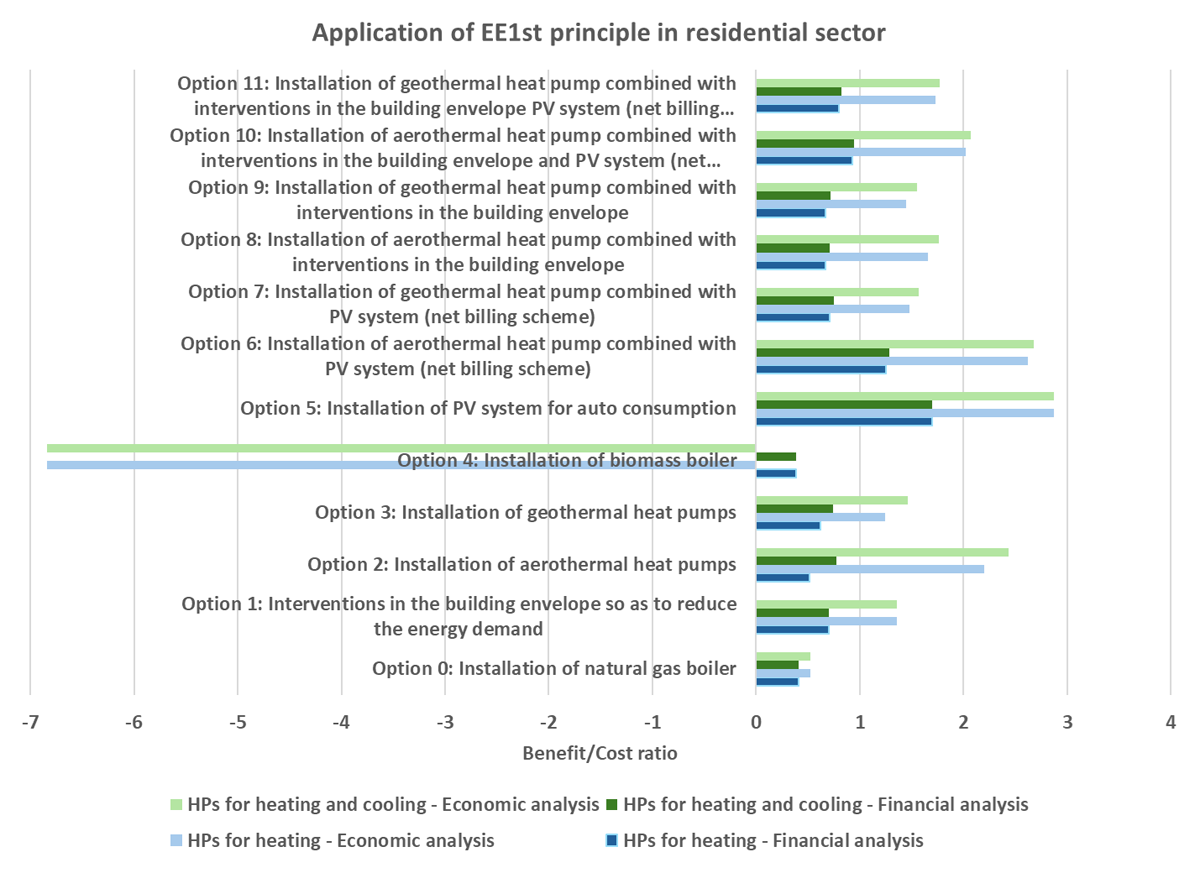
Figure 1
Graphical representation of the performance of different policy options in the residential sector considering the benefit/cost ratio (ENEFIRST Plus, 2025a).
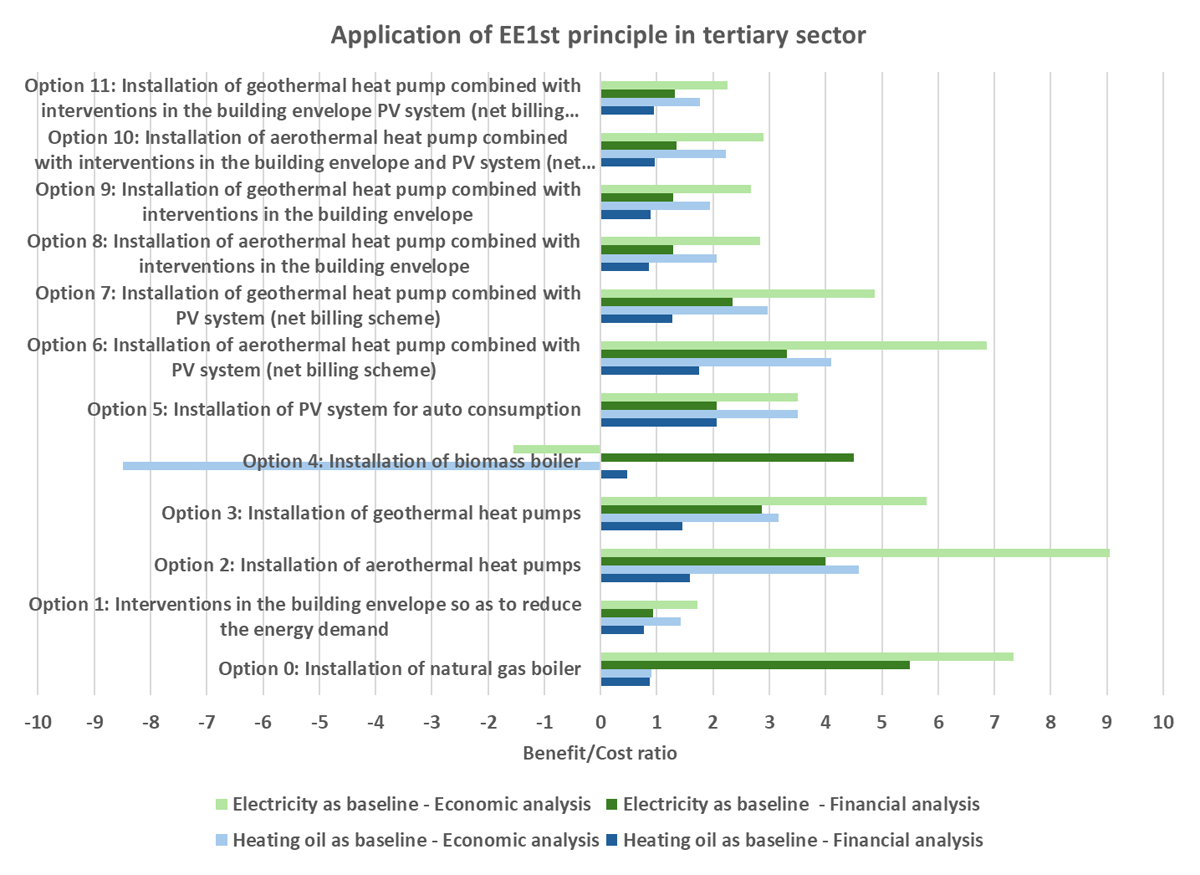
Figure 2
Graphical representation of the performance of different policy options in the tertiary sector considering the benefit/cost ratio (ENEFIRST Plus, 2025a).
The EE1st principle redefines the analytical framework for conducting CBA by broadening the scope of options assessed. Whereas a “classical” CBA would typically focus on comparing technologies to supply heat – such as boilers, heat pumps, or district heating expansions – EE1st also requires examining demand-side measures like insulation, energy-efficient building envelopes, and the integration of renewable self-consumption systems.
This wider scope ensures that reducing demand is properly assessed alongside improving supply, often revealing that EE measures can provide equal or greater benefits at lower cost and risk. For more details, see (Tourkolias & Mezartasoglou 2025). Moreover, an infographic was developed about the integration of EE1st in heating and cooling, considering the interactions between the different planning processes (e.g., comprehensive assessments and NECPs) (Peretto et al. 2025).
SECAPs – Sustainable Energy and Climate Plans
Summary of the literature review and background analysis
Recent data confirm that Italy remains one of the most active countries in the Covenant of Mayors framework. Around 4,900 local administrations have signed the Covenant of Mayors, accounting for 61.4% of Italian municipalities and 45% of the Covenant signatories in the EU (European Commission, 2026). Many of these administrations participated through joint or group signatories, highlighting a strong national commitment to SECAP-type planning. This planning aims to strengthen methodologies for climate risk assessment, emissions inventories and energy poverty evaluation. However, recent assessments highlight several persistent challenges:
uneven regional distribution of municipalities with fully developed adaptation commitments;
limited submission of monitoring reports compared with the number of plans;
capacity gaps in small municipalities, requiring regional or national support structures.
Overall, the Italian SECAP landscape is highly mature in terms of participation but still evolving in quality, monitoring, and the integration of new EU policy priorities, such as energy poverty and the operationalisation of the EE1st principle. The SECAP is a strategic policy tool rather than a technical project design, meaning that complementary technical and financial evaluation instruments are needed in later planning phases.
The Joint Research Centre (JRC) has issued new guidelines to enhance the quality of future SECAPs, citing the EE1st principle (Davide et al., 2025). The exchanges with stakeholders during the pilot case have stressed the need for additional guidance or support to integrate EE1st in the process and practices of SECAPs. Other lessons from the Italian pilot case illustrate the need for methodological improvements in data management. In fact, although large datasets are available, these are often heterogeneous and difficult to compare across municipalities; with social and behavioural dimensions remaining critical. Increasing awareness of EE among citizens, businesses, and public administrations is essential, as is the adoption of integrated approaches that combine technical measures with behavioural change policies.
Governance challenges continue to exist, as coordination between regional and municipal authorities is still fragmented. Limited resources and competing priorities frequently lead to conflicts in decision-making. Additional tensions may arise when EE measures intersect with the need to preserve historical and artistic heritage, or when uncertainty persists regarding long-term financial mechanisms. Strong stakeholder engagement and collaboration between public administrations, research institutions, and local actors, as demonstrated in the pilot case, enhances the integration of the EE1st principle.
Methodology
The Italian pilot case examined through a two-step methodology, the extent to which SECAPs are consistent with the EE1st principle and how the latter could be further integrated into these plans. The main aim of the Italian pilot case was indeed to verify SECAP compliance with the EE1st principle by establishing “whether”, and to “what extent”, the principle is embedded within them.
The procedure adopted for this assessment was designed to be transparent, communicable, and replicable. To operationalise the EE1st principle, an in-depth lexical and conceptual analysis of the main European regulatory framework was conducted, including the Governance Regulation of the Energy Union (European Parliament & European Council, 2018), the EC’s recommendation on EE1st (European Commission, 2021), the EED recast (European Parliament & European Council, 2023), and the EC’s recommendation on the interpretation of Article 3 of the EED (European Commission, 2024).
The first step was to review a selection of well-documented SECAPs to analyse the criteria for selecting and prioritising measures, the emphasis placed on EE, and the level of ambition of the targets. The second step entailed a more detailed analysis of a sample of measures (selected from the first step) using a multi-dimensional evaluation, an integrated approach (planning, investment decision, and market regulation), and a CBA methodology.
Results and discussion
This assessment led to the identification of five key semantic dimensions: energy, regulatory, social, awareness-raising, and financial. Each of these represents a core strategic domain through which the EE1st principle takes concrete shape within territorial policies. Specific indicators were identified for each dimension to quantify the magnitude of planned interventions:
the energy dimension assesses the benefits related to demand-side EE objectives;
the financial dimension examines the economic sustainability of proposed actions;
the social dimension focuses on combating energy poverty;
the awareness-raising dimension measures initiatives aimed at increasing citizen awareness on EE issues; and,
the regulatory dimension analyses strategies for removing regulatory barriers.
SECAP alignment with the EE1st principle was verified by detecting the presence of all dimensions and their distribution in accordance with the principle’s priorities established by the European framework. This multidimensional approach ensures a holistic assessment that simultaneously considered the technical, economic, social, and institutional aspects of local energy planning. It was found that more than half of the SECAP policy actions (53%) fall within the energy dimension, followed by the regulatory (35%) and awareness (12%) dimensions, while the social one remained marginal (ENEFIRST Plus, 2025b).
The methodology was validated by applying it to the former SECAP of the Metropolitan City of Naples (submitted in 2012). The analysis revealed substantial compliance with the EE1st principle, with all dimensions adequately represented and distributed according to the expected priorities. The only exception concerns the social dimension, which was absent because combating energy poverty did not constitute a mandatory requirement under the former regulatory framework (the energy poverty pillar has been introduced in the SECAP guidelines in 2022).
The proposed methodological framework represents a significant contribution to the systematic assessment of the integration of the EE1st principle within local energy policies. However, the tool requires further investigation and validation to consolidate its applicability across diverse territorial contexts, constituting a promising area for future research in the field of multi-level energy governance. The framework could provide a structured basis for comparing different generations of SECAPs over time, enabling policymakers to monitor how the integration of the EE1st principle evolves in response to regulatory updates, technological progress and shifting socio-economic conditions.
Grid investment projects
Summary of the literature review and background analysis
The implementation of the EE1st principle in grid investment planning represents one of the most structurally transformative applications of the recast EED. While Article 3 establishes EE1st as a general decision-making principle, Article 27 translates it into concrete obligations for transmission and distribution system operators (TSOs and DSOs).
Traditionally, grid investment projects have been justified through technical adequacy assessments and CBAs focused primarily on reliability, congestion management, and least-cost infrastructure expansion. Planning methodologies are generally based on projected load growth and generation patterns, with network reinforcement considered the default solution. In practice, alternatives such as EE improvements, distributed generation, storage, or demand-side flexibility are not systematically assessed, and National Regulatory Authorities (NRAs) do not always explicitly verify whether such options have been fairly considered. Conventional CBAs typically reflect the perspective of the system operator, emphasising capital expenditures (CAPEX), operational costs (OPEX), and technical indicators, while only partially accounting for wider societal impacts.
The EE1st principle broadens this analytical framework. It requires that grid investment decisions examine whether reducing or reshaping demand could defer, downsize, or eliminate infrastructure needs. Under the oversight of the NRAs, system operators have to systematically assess EE, demand response, storage, and other flexibility solutions before approving new grid investments. This entails extending CBAs beyond operator-centric metrics to include societal costs and benefits. This shifts grid planning from a predominantly infrastructure-driven approach towards a more integrated system perspective, ensuring that demand-side resources are evaluated on equal footing with supply-side expansion, while fully preserving security of supply as a primary objective.
Article 27 EED further calls on NRAs to review tariff structures, regulatory incentives, and CBA methodologies to ensure that these do not create disincentives for demand-side or non-wire alternatives. In this context, aligning regulatory frameworks with EE1st may require moving beyond CAPEX-based incentives and strengthening performance-based approaches.
The grid planning process, including national development plans and Ten-Year Network Development Plans (TYNDPs), is therefore central to operationalising EE1st. Scenario-based analyses and cross-sectoral integration are essential to ensure that supply- and demand-side options are compared on a consistent basis. At the same time, stakeholders have underlined that implementation should remain proportionate and avoid excessive administrative burden.
Academic and policy literature identify persistent barriers, including institutional mandates focused on infrastructure expansion, regulatory revenue models favouring capital investments, and methodological challenges in quantifying flexibility benefits. Addressing these barriers is crucial to embedding EE1st in standard grid planning practices.
Methodology
The main aim of the Croatian pilot case was to operationalise the EE1st principle within transmission system planning and, more specifically, within the CBA of transmission grid investment projects. Key stakeholders for this pilot case were the TSO and experts involved in the preparation of grid development plans and CBAs for grid investments projects, as well as the Energy Regulatory Agency.
The first step included ad-hoc meetings and focus groups to discuss current practices and assessment methodology, and what changes the EE1st principle may imply. This led to the delineation of a baseline situation from which further impacts to be improved could be identified. The approach was applied to an investment case previously assessed, to explore the differences that implementing EE1st in this type of assessment would be identified.
Results and discussion
The baseline analysis confirmed that Croatian transmission planning is formally aligned with national energy scenarios. Demand forecasts used in the national TYNDP are based on the NECP, where EE measures are already embedded in consumption projections. Efficiency in the grid itself is also considered, particularly through reduction of technical losses. However, demand-side flexibility, storage, and structured non-wire alternatives are not systematically evaluated as explicit substitutes for network reinforcement. Planning primarily addresses topological requirements, while operational flexibility is not yet fully integrated.
The examined CBA methodology is based on ACER recommendations (ACER, 2023) and ENTSO-E guidance for transmission projects (ENTSO-E, 2024). It adopts a societal perspective, including CAPEX, OPEX, reduction of network losses, avoided energy not served, redispatch cost reductions, enabled RES integration, increased cross-border capacity, and monetised CO2 reductions.
The pilot case concerned the revitalisation of an existing 220 kV high-voltage transmission line within the Croatian transmission system, selected as a representative example of a major transmission reinforcement project. The line is almost seven decades old and faces increasing operational and reliability challenges (for more details see (ENEFIRST Plus, 2025c). At the same time, rapid development of RES in the surrounding area requires additional connection capacity and improved system robustness, which makes the case particularly relevant from both decarbonisation and security-of-supply perspectives.
The results of the analysed investment options showed that only the least capital-intensive revitalisation alternative achieved a marginally positive net present value (NPV), slightly above the 4% discount rate and only after long-term operation, while more extensive reinforcement options produced negative NPVs.
Overall, the Croatian pilot highlights that the decisive stage for implementing the EE1st principle in transmission infrastructure is not the individual project-level CBA, but the upstream planning process. If demand scenarios embedded in national and network development plans do not explicitly incorporate EE, demand response, storage, and flexibility, then project-level CBAs operate within a constrained framework where reinforcement needs are already predetermined. In such circumstances, the scope of alternatives is limited to comparing technical solutions for grid reinforcement rather than questioning the underlying necessity of reinforcement itself.
Therefore, while targeted improvements in CBA methodology – such as structured screening of non-wire alternatives – are useful, the more critical leverage point lies in integrated scenario development and planning. By embedding EE1st consistently into demand forecasting and system planning, transmission investments can be right sized from the outset. Once planning demonstrates that reinforcement is indeed required, the CBA can then appropriately compare alternative technical solutions (e.g., different conductor technologies or reinforcement configurations) to identify the most socio-economically justified option. In this sense, planning is the primary vehicle for operationalising EE1st, while CBA serves as a refinement tool within the boundaries set by that planning framework.
Role of consumers in the electricity system
Summary of the literature review and background analysis
The integration of small end-users and prosumers into Demand-Side Response (DSR) programs is a fundamental pillar for the operationalisation of the EE1st principle within the Polish electricity system. Theoretically, the transition from centralised, supply-driven systems to decentralised, consumer-active markets requires addressing a complex hierarchy of socio-economic, technical, and systemic barriers. Within this framework, demand-side flexibility is categorised into implicit flexibility, where consumers react to market signals such as dynamic tariffs and explicit flexibility, which involves direct participation through incentive-based programs often managed by intermediaries.
Conceptual models of consumer engagement highlight that behavioural inertia and the prioritisation of domestic comfort often act as primary deterrents to participation. These are further compounded by economic uncertainty regarding the transparency of profit-sharing and the risk of financial penalties for non-compliance. Furthermore, the literature emphasises that systemic trust and data security are critical prerequisites for the adoption of smart home energy management systems (HEMS) and automated control technologies (Skoczkowski et al. 2024).
In this context, the role of the professional aggregator is redefined from a transitional intermediary to a permanent and essential market actor. Aggregators are theoretically necessary to shield small end-users from market volatility, manage performance risks, and bundle small-scale flexibility into commercially viable volumes. To facilitate this transition, an evolutionary model for DSR cooperation suggests a phased progression, as developed from the findings of the pilot case (Gilewski & Pilzak 2025).
Methodology
The Polish study utilised a mixed-methods approach, implemented across several distinct stages, to achieve a comprehensive and validated understanding of the DSR framework in Poland. This comprised performing a quantitative household survey, qualitative stakeholder interviews, stakeholder workshops for validation and solution development, and lastly the formulation of a cooperation model and recommendations. For more details, see (ENEFIRST Plus, 2025d).
Results and discussion
The empirical findings of the Polish pilot case demonstrate a profound and pervasive awareness gap regarding DSR among small end-users. Statistical analysis of the household survey indicates that 64% of respondents have never encountered the DSR concept, while only a small minority of 20% possess a comprehensive understanding. Paradoxically, prosumer status does not inherently correlate with higher levels of knowledge, as only 19% of prosumers reported a good understanding of DSR, a figure nearly identical to that of non-prosumers. Furthermore, the results indicate that awareness is notably lowest among high-consumption households – those exceeding 5 MWh per year – who paradoxically represent the most significant potential for system flexibility. Conversely, households with lower energy consumption (below 2 MWh/year) reported proportionally higher levels of understanding, suggesting that general energy consciousness and consciousness of consumption are more accurate predictors of DSR familiarity than technological criteria.
The quantitative evaluation of barriers identified a clear and multifaceted hierarchy of deterrents that drive reluctance among small end-users. Behavioural inertia, specifically the prioritisation of domestic comfort and the fear of lifestyle disruptions, emerged as the primary obstacle. Additionally, respondents expressed concern over anticipated high adaptation costs for equipment and the perceived non-transparency of profit-sharing rules between participants and operators. Systemic mistrust also serves as a critical hurdle, characterised by concerns over the unauthorised use of data, fear of invigilation or malware, and a lack of confidence in the intentions of program operators.
Regarding participation preferences, Polish households show a clear mandate for simplicity and tangible rewards over more complex settlement structures. A decisive 66% of respondents favour direct, incentive-based financial rewards, such as monetary payments for specific “saving sessions”. In contrast, complex dynamic tariff models are preferred by only 18% of the population, indicating that straightforward, risk-free structures are the most viable pathway for initial market engagement. Interestingly, while both groups prefer incentives, prosumers show a slightly different distribution of interest than non-prosumers, and households already utilizing multi-zone tariffs appear more generally open to DSR participation.
Survey results from market participants – including DSOs, retailers, and aggregators – highlight a triad of systemic barriers stalling the development of the residential flexibility market. DSOs emphasise that the accelerated and standardised rollout of Advanced Metering Infrastructure (AMI) is a fundamental technical prerequisite for mass-scale flexibility. While some DSOs have initiated pilot flexibility purchases, retailers currently show a preference for vertical integration over collaboration with independent aggregators. Aggregators identify existing legal regulations, which are currently unsuited to new business models, as the most critical obstacle to scaling services for smaller consumers.
A key result was the consensus that the professional aggregator must act as a permanent market “shield” to manage performance risks and remove the cognitive burden from individual consumers. Ultimately, stakeholders agreed that mass adoption will be driven by automated “fit-and-forget” service packages that optimize consumption through technology like smart heat pumps and Electric Vehicle (EV) chargers without requiring active user intervention.
The pilot concluded with the co-creation of an Enhanced Evolutionary Model for DSR Cooperation, envisioning a three-phase transition toward integrated local markets. The foundational phase focuses on building mass awareness through simple, voluntary, and risk-free incentive programs. Subsequent phases envision market liberalisation and the deep integration of automation technologies, such as electric vehicle chargers and heat pumps, culminating in integrated energy markets where prosumers can actively trade energy and flexibility services. In line with the stakeholders’ views, this theoretical pathway assumes that mass adoption will be driven not by turning every citizen into an energy expert, but by providing seamless “fit-and-forget” technology. For more details, see (Gilewski & Pilzak 2025).
Conclusions
Investigating how the EE1st principle can be implemented in various planning contexts, and what it implies, has shown the importance and challenges to connect the dots of the energy system and the stakeholders that make it run or make use of it.
The Croatian and Greek cases emphasise the essential role of the NECPs in providing a common reference for more sector-specific planning processes to align with. NECPs may then either drive or restrict the way demand-side resources are considered in these other processes, for example for heating and cooling plans, or network investment plans.
The four cases indeed show that the umbrella planning process is critical for an effective implementation of EE1st, as it frames how the evolution of the energy demand, and thereby demand-side resources, are considered. This is also the reference for stakeholders of the energy system to infer the interactions between the different parts of the energy system, and how their decisions should align with the overall trajectory.
This can be seen as an iterative process, where the more specific assessments or planning processes can provide new data and perspectives to be used in the next update of the NECP. The way this feedback and coordination loop is implemented may depend on the national context, the timing of each planning exercise, and how they are interacting in practice.
The implementation of EE1st may start with revising assessment methodologies, for example to broaden the scope of options and impacts considered, and to make the viewpoints adopted more explicit. Data availability remains a prerequisite and is improving. Assessments and discussions can anyway start with data currently available, overcoming data gaps with data available at EU level, from other countries or the literature.
Assessment results are context-specific and should be considered with caution (e.g., due to data limitations, methodological choices). Assessments are not meant to replace decision-making, but to inform it. Sensitivity analyses are valuable to better understand the results and how they should be analysed. By broadening the scope considered, EE1st enriches the decision-making process. It contributes to think beyond the immediate Key Performance Indicators (KPIs), keeping in mind the implications on the whole energy system and that energy is a means to multiple ends. In other words, decisions on energy-related investments have impacts on other policy objectives.
Implementing EE1st then goes beyond methodological and data issues. It requires discussions and cooperation among the various stakeholders involved in the planning processes (cf. Croatian, Greek and Italian cases), or in the design of regulatory frameworks and incentives (cf. Polish case). The broader scope of assessment implies to discuss its methodology and results with a broader range of stakeholders, thereby contributing to go beyond siloed approaches, as found in all cases.
In addition to the multi-stakeholder cooperation, implementing EE1st also aligns with the objective of multilevel governance. The Italian case highlights the need for coordination between the national, regional and local levels, and the importance of using common, or at least coherent, guidelines and datasets. National energy agencies may play a major role in structuring the technical support to the various levels of energy planning, and in facilitating exchanges among them.
At first sight, it can seem complex to adopt a holistic view of the energy system to align and integrate energy supply and energy demand in the most beneficial way to the society. This complexity is not new to stakeholders such as electricity system operators that have anyway to handle the transformation of the power sector. Likewise, energy agencies or institutes in charge of national heating and cooling assessments are also used to anticipate factors of changes in the heating and cooling demand, as well as in the technologies available and their costs. At local level, municipalities can benefit from technical assistance developed by national or regional agencies.
This may however be difficult to involve all stakeholders, particularly small end-users, as analysed in the Polish case about demand-response. Intermediaries may then play a key role in handling complexity, as aggregators for demand-response. To overcome pervasive awareness gaps and behavioural inertia, mass adoption will rely in this case on providing simple, risk-free financial incentives alongside seamless ‘fit-and-forget’ automated technologies, rather than expecting all citizens to become active energy market experts.
Likewise, policies play a major role in guiding or constraining individual decisions. Integrating the EE1st principle in the policy design contributes to align decisions of individual investors with an overall trajectory that matches individual priorities as well as umbrella policy objectives. The added value of EE1st lies here, first, in assessments that provide a broader picture, and second, in discussing these results with a broader range of stakeholders. This is therefore not adding another layer of red tape. This is about promoting evidence-based and transparent policymaking for sound and legitimate policies.
Additional File
The additional file for this article can be found as follows:
PowerPoint Slides
PowerPoint Slides relating to this article. URI: https://eceeeproceedings.org/articles/17/files/6a5106b0e76eb.pptx
Note
[1] https://ee1st.eu/.
Acknowledgements
The authors thank all the national stakeholders who took part in the pilot cases, and the European experts who provided feedback on the findings.
eceee Paper ID
2-086-26