
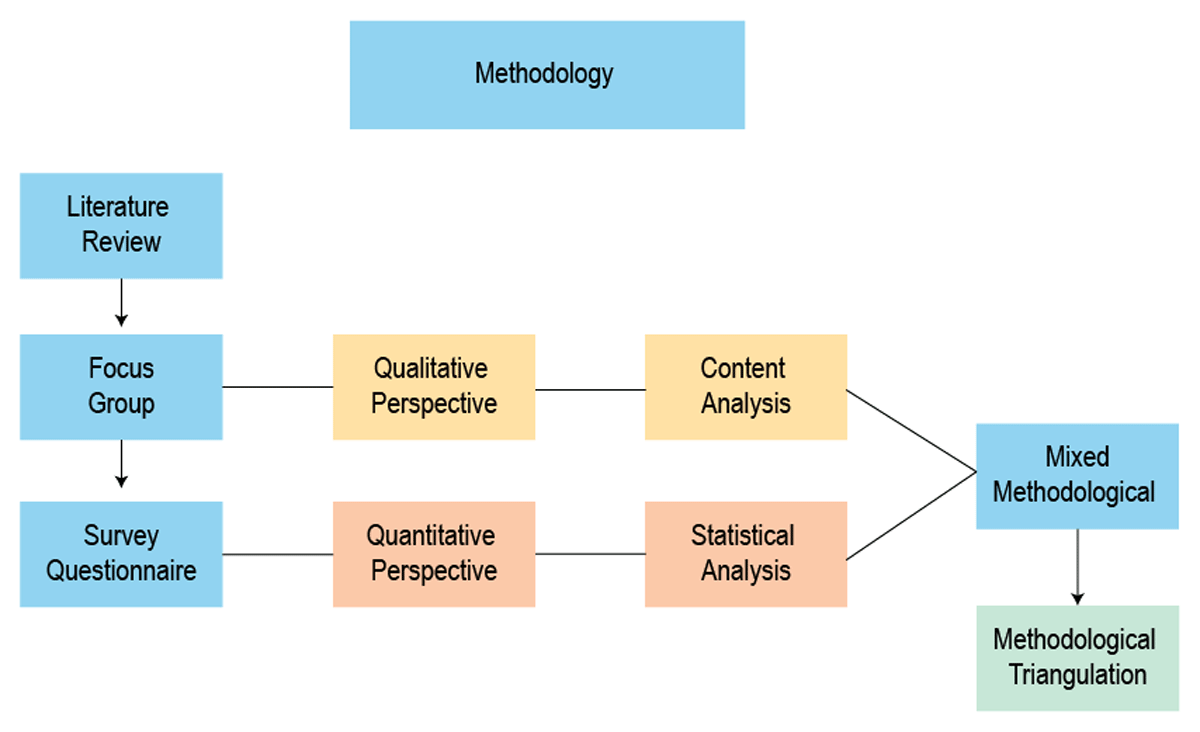
Figure 1
Sequential exploratory mixed-methods research design. (Original figure created by first author).
Table 1
Professional role importance rankings by group.
| ROLE | OVERALL M (SD) | PROFESSOR M (SD) | TUTOR M (SD) | t | p | d |
|---|---|---|---|---|---|---|
| Pedagogical | 4.68 (0.51) | 4.79 (0.41) | 4.47 (0.61) | 2.31 | 0.025* | 0.66 |
| Social | 4.67 (0.58) | 4.55 (0.60) | 4.89 (0.46) | –2.18 | 0.034* | 0.61 |
| Evaluator | 4.67 (0.58) | 4.71 (0.46) | 4.58 (0.77) | 0.81 | 0.422 | — |
| Adviser | 4.65 (0.55) | 4.55 (0.60) | 4.84 (0.38) | –1.92 | 0.061 | — |
| Manager | 4.18 (0.89) | 4.16 (0.95) | 4.21 (0.79) | –0.21 | 0.835 | — |
| Technologist | 4.19 (0.83) | 3.97 (0.89) | 4.63 (0.50) | –3.01 | 0.004** | 0.84 |
| Personal | 4.51 (0.91) | 4.37 (1.03) | 4.79 (0.54) | –1.68 | 0.100 | — |
| Researcher | 4.18 (1.00) | 4.05 (1.11) | 4.42 (0.69) | –1.32 | 0.193 | — |
[i] Note. Five-point Likert scale (1 = not important, 5 = extremely important). N = 57 (38 professors, 19 tutors). Effect sizes (Cohen’s d) calculated for statistically significant differences only. d = 0.66 and d = 0.61 represent medium effects; d = 0.84 represents a large effect (Cohen 1988). Effect sizes should be interpreted cautiously given the small tutor subsample (n = 19), which may produce less stable estimates. *p < 0.05. **p < 0.01.
Table 2
Ten most important distance education competencies.
| RANK | COMPETENCY | DOMAIN | OVERALL M (SD) |
|---|---|---|---|
| 1 | Assess student work according to established criteria | Evaluator | 4.82 (0.38) |
| 2 | Demonstrate availability to clarify doubts | Adviser | 4.82 (0.43) |
| 3 | Adopt an ethical posture | Personal | 4.82 (0.43) |
| 4 | Provide timely feedback on activities | Evaluator | 4.81 (0.40) |
| 5 | Provide feedback to student interactions and communications | Social | 4.77 (0.46) |
| 6 | Be empathetic in online communication | Personal | 4.77 (0.42) |
| 7 | Maintain a cordial learning environment | Social | 4.74 (0.44) |
| 8 | Suggest measures to improve student performance | Adviser | 4.72 (0.45) |
| 9 | Act as a learning facilitator | Social | 4.70 (0.65) |
| 10 | Promote student motivation | Adviser | 4.70 (0.50) |
[i] Note. All competencies rated above 4.70 on five-point scale.
Table 3
Most important competencies by professional group.
| RANK | COMPETENCY | ROLE | MEAN | SD |
|---|---|---|---|---|
| Professors | ||||
| 1 | Assess student work according to established criteria | Evaluator | 4.78 | 0.41 |
| 2 | Adopt an ethical posture | Personal | 4.79 | 0.41 |
| 3 | Conception and design of course/module at general and component levels | Pedagogical* | 4.76 | 0.49 |
| 4 | Conceive and develop learning activities | Pedagogical* | 4.75 | 0.49 |
| 5 | Define assessment strategies and activities | Pedagogical* | 4.75 | 0.43 |
| 6 | Demonstrate availability to clarify doubts | Adviser | 4.74 | 0.50 |
| 7 | Provide timely feedback on activities | Evaluator | 4.71 | 0.46 |
| 8 | Select appropriate resources for learning | Technological | 4.71 | 0.57 |
| 9 | Provide feedback to student interactions and communications | Social | 4.68 | 0.53 |
| 10 | Be empathetic in online communication | Personal | 4.68 | 0.47 |
| Tutors | ||||
| 1 | Demonstrate availability to clarify doubts | Adviser | 5.00 | 0.00 |
| 2 | Provide timely feedback on activities | Evaluator | 5.00 | 0.00 |
| 3 | Act as a learning facilitator | Social | 5.00 | 0.00 |
| 4 | Resolve conflicts amicably | Social | 5.00 | 0.00 |
| 5 | Maintain a cordial learning environment | Social | 5.00 | 0.00 |
| 6 | Be empathetic in online communication | Personal | 4.95 | 0.23 |
| 7 | Provide feedback to student interactions and communications | Social | 4.95 | 0.23 |
| 8 | Refrain from undesirable behaviours (i.e., contribute to a friendly environment, respect online etiquette rules) | Social | 4.95 | 0.23 |
| 9 | Demonstrate sensitivity during online communication processes | Personal | 4.89 | 0.32 |
| 10 | Create a climate favourable to positive emotions online | Personal | 4.89 | 0.32 |
[i] Note. *Denotes instructional design role. Table organised by participant group for comparison purposes.