
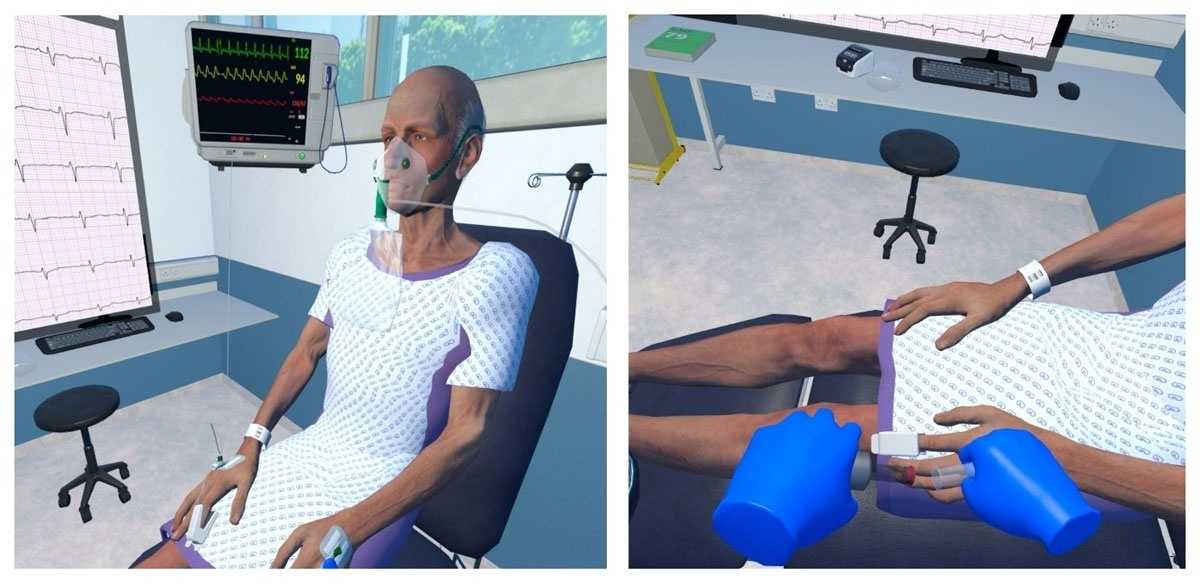
Figure 1
Views from within Headset version of the simulation, showing interaction with patient and instruments through virtual hands linked to controllers.
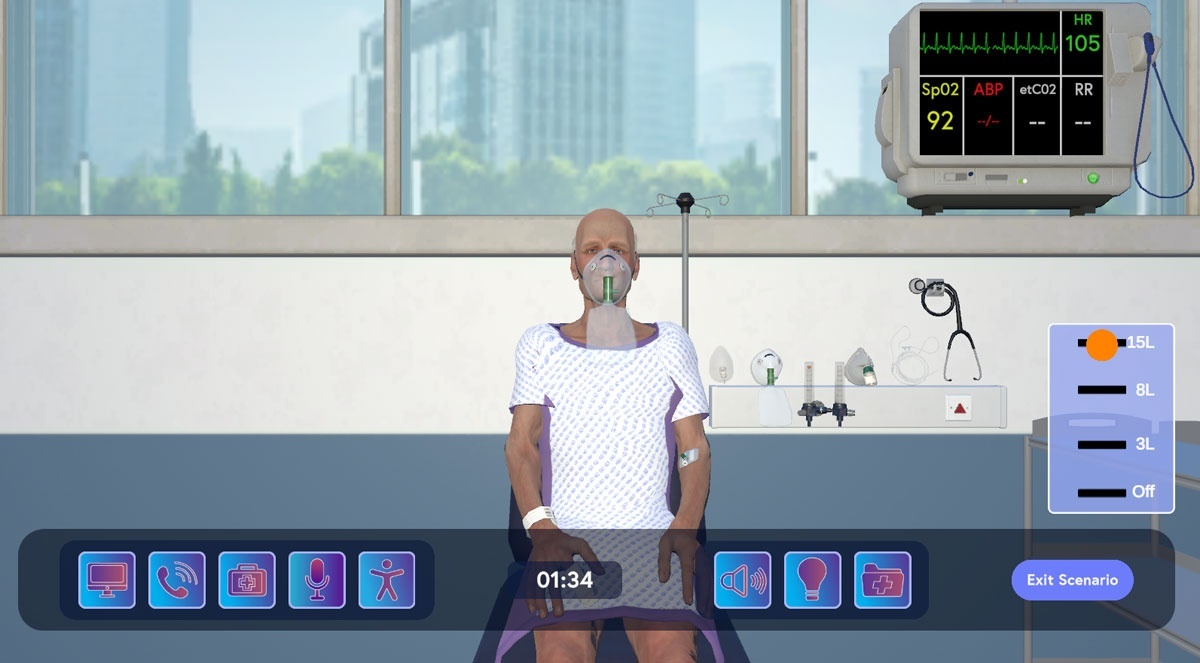
Figure 2
Onscreen version of the simulation, showing interface controls for interaction with virtual patient and instruments.
Table 1
Median ITEM scores by ITEM domain and trial.
| ITEM DOMAIN | 1. NURSING HEADSET TRIAL | 2. NURSING ONSCREEN INITIAL TRIAL | 3. SOCIAL WORK HEADSET TRIAL | 4. NURSING ONSCREEN MAIN TRIAL | JACOBS ET AL. 2023a (HEADSET) | |||||
|---|---|---|---|---|---|---|---|---|---|---|
| MEDIAN | IQR | MEDIAN | IQR | MEDIAN | IQR | MEDIAN | IQR | MEDIAN | IQR | |
| Immersion (max. 50) | 42 | 36–45 | 44.5 | 40–47 | 42 | 37–47 | 43.5 | 37–47 | 43 | 41–45 |
| Motivation (max. 50) | 41 | 39–44 | 43 | 42–45 | 37 | 36–44 | 42 | 37–45 | 45 | 44–47 |
| Cognitive Load (max. 100) | 63.3 | 50–73 | 71.67 | 55–78 | 50 | 48–58 | 63.3 | 57–70 | 56.7 | 53–64 |
| System Usability (max. 100) | 60 | 58–66 | 61 | 57–64 | 62 | 59–63 | 62 | 60–66 | 72.5 | 63–88 |
| Debrief (max. 25) | 25 | 21–25 | 22 | 21–23 | 19 | 18–20 | 23 | 20–24 | 20.5 | 19–22 |
Table 2
Summary of agreed themes and sub-themes from the thematic analysis.
| THEME | SUB-THEMES | EXAMPLE |
|---|---|---|
| Motivations to use VR in learning | Evidencing ability | ‘… great way for us to show that we are able to take the necessary tests and follow the orders… our tutors do not really see the practice part of the qualification and if this was used they would be able to be involved more.’ (Study1) |
| Filling gaps in ODL | ‘With our university being online, we do not have many situations where we can have a simulated situation and treat a patient without the situation being something real life.’ (Study4) | |
| Building confidence | ‘… builds confidence and knowledge of performing nursing interventions.’ (Study4) | |
| New experiences | ‘… gives you experiences that you may not come across in real life, can select experiences to develop skills.’ (Study3) | |
| Learning from mistakes | ‘… really good way into practicing my skills and allowing chances to make mistakes and improve.’ (Study4) | |
| Procedural knowledge | ‘Getting to know the stages that are required when dealing with a sick patient.’ (Study4) | |
| Theory into practice | ‘After studying the theory behind common health conditions, wounds, etc, it would be good to have simulations, similar to this, based on each case.’ (Study4) | |
| Immersive experience | Agency | ‘It allowed me to interact and make decisions using my previous knowledge of sepsis and from training while in placement.’ (Study2) |
| Presence | ‘The whole thing surprised me… it felt like you were actually there’ (Study1) | |
| Pressure to respond | ‘It was stressful! Like trying to work out, oh my God, I’m pressing it wrong, I’m doing it wrong.’ (Study1) | |
| Expected actions not possible | ‘I couldn’t figure out how to wash my hands or put on PPE.’ (Study2) | |
| Limited realism | ‘I found the clicking of speech boxes limiting. Free conversation would be much better for social work students.’ (Study3) | |
| Communicating with patient and other characters | ‘… when you have an actual patient, obviously, they’re not just sitting there quietly… you actually got constant communication with them … You can ask questions (in the simulation) but you can’t be constant. Like, is this okay? Is it hurting?’ (Study1) | |
| Cognitive load and usability | Novelty | ‘It was confusing at times, because I had never done anything like it before.’ (Study1) |
| Benefits of repeated practice | ‘… you’re learning to use the technology first. And that kind of distracted you a bit.’ (Study1) | |
| Overwhelming or overstimulating | ‘… overstimulating with too much noise, and panic set in a bit, feeling that I had to rush to help the patient.’ (Study4) | |
| Usability | ‘I didn’t find it easy to navigate the icons to solve the problem.’ (Study4) | |
| Accessibility | ‘… when there was audible instructions I found it difficult to take in the information due to my hearing impairment.’ (Study3) | |
| Teaching and learning context | Feedback | ‘I wasn’t sure if I was going to be told that the patient had stabilized and I had done everything I could. I noticed his oxygen saturation improved and after fluids his heart rate did too.’ (Study2) |
| Communicating with tutors and peers | ‘Maybe virtual classrooms like this where a lecturer takes you through the experience might be better for people like myself. Where I can virtually interact with real people.’ (Study4) | |
| Other potential scenarios | ‘… would be really good for running through different scenarios that might be encountered – for instance I have never seen a full asthma attack.’ (Study1) | |
| Study environment | ‘they were talking so much in the (online) tutorial I found it hard to hear the simulation.’ (Study4) | |
| (mis)alignment with studies | ‘I felt the nursing task was outside of my professional experience, and that was a bit disorienting.’ (Study3) | |
| Gaps in knowledge | ‘The procedures are OK, I’m happy with those. It’s reading blood… I don’t read blood results.’ (Study1) | |
| Applying prior experience | ‘I felt like I went in with a background of knowledge so I knew sort of the steps roughly to take. So I think that that did really help.’ (Study1) | |
| Guidance | ‘I think the hints could have been more helpful. It told you what to do but at times I was stuck.’ (Study4) |