
1. Introduction
The use of simulations is well established in healthcare education with virtual reality (VR) increasingly seen as a significant part of this (Abich et al., 2021; NMC, 2024). VR simulations have potential benefits for online and distance learning (ODL) students in health and social care (HSC) but they require distinct designs and practices to ensure access and positive learning experiences. This paper reports on a mixed methods research study comprising of four trials using the same VR simulation in two different modes (on-screen and VR headset) and with ODL nursing and social work students. Through this we explore perceptions and experiences of ODL HSC students around VR, including benefits, challenges, desirable features, and issues for learning design.
ODL is a well-established route for learning in HSC, both for pre-registration programmes and in continuing professional development (Hack, 2015). The significance of such programmes commonly lies in the opportunity offered to learners, often already employed in the sector, to advance their careers, and to scale up workforces by increasing access to flexible learning. Such programmes have evolved to incorporate distance learning methodologies combining highly structured, selfdirected online study with computermediated support from teachers and peers, alongside in-person placements in practice settings. While such programmes have a successful track record in training practitioners, they also present challenges. Students on a preregistration distancelearning nursing programme, for example, could struggle to make the transition into the student nurse role and, because of reliance on constrained placements, sometimes have difficulties developing essential clinical skills (Draper et al., 2014). Simulation-based training in healthcare can be transformative but is known to place distinct stresses and requirements on students and staff in research conducted with in-person teaching (Jowsey et al., 2020a). Meanwhile there is little understanding of how these benefits and issues translate or should be managed at a distance.
Traditional simulations with actors playing roles or use of physical mannequins, specific devices or locations can be less suited to ODL, where learners should be able to study at a time and location that suits them. Their study spaces, technology and support also differ from a campus or practice environment, with study commonly occurring at their home, workplace, or while travelling. Many ODL HSC qualifications will include placements or other means of gaining first-hand experience but these are limited. Simulation offers further opportunities for experiential learning. Teaching approaches in ODL also differ, often focusing on flexible pace and courses designed in advance of study.
There is a lack of understanding of these issues or the appropriate models for embedding VR simulations into ODL. VR can be defined as a ‘three-dimensional computer-generated simulated environment, which attempts to replicate real world or imaginary environments and interactions’ (Abbas et al., 2023). While some see such specialist hardware as essential to VR, similar activities can also be delivered through standard computer-based environments and displays – hereafter termed ‘onscreen’ VR in this paper, in contrast to ‘headset’ VR.
In this research, academics in nursing, social work, health and social care, and educational technology collaborated with a company producing VR simulations for healthcare to trial different ways of using a VR simulation focused on sepsis identification and management in ODL. Differences included the use of either VR headset and onscreen versions of the simulation, and with students from either nursing and social work qualifications. Wraparound activities were devised to introduce students to the topic and to prompt reflection through debrief sessions.
The research questions explored are:
What do ODL healthcare students perceive as benefits and challenges of VR simulations for their studies?
Does the modality (headset or onscreen) impact on the experience of learning through a VR simulation?
What features or support would enhance the experience of learning through VR simulations for ODL healthcare students?
To address these, we use an embedded mixed methods approach, combining a previously developed survey instrument: the Immersive Technology Evaluation Measure (ITEM) (Jacobs et al. 2023a, Jacobs et al. 2023b) with additional qualitative survey questions and analysis of debrief discussions. Using the same methods across each of the four trials, we identify patterns and contrasting experiences reported by students.
2. Literature Review
This section summarises key concepts, findings and, gaps from the existing research across ODL, simulation and VR in healthcare education.
2.1. Online and distance healthcare education
Research suggests positive potential for online learning in healthcare but limited understanding of effective provision. In a systematic review Pei and Wu (2019) conclude that online learning appears at least as effective for undergraduate medical teaching as classroom teaching but note that the large potential for variation in pedagogy and platforms used in online learning could have substantial impacts on the effectiveness of learning. Kumar and Todd (2022) find modest evidence that online learning interventions can have a positive impact in undergraduate teaching across allied health professions but again highlight large variation in forms of online learning alongside methodological limitations in research.
Arian et al. (2025) provide a comprehensive list of opportunities and challenges for online learning from a review of nursing literature, with relevant opportunities including accessibility to a larger audience, greater use of multimedia and interactivity, use of VR to simulate job conditions, and bridging the gap between theory and practice. Relevant challenges include technical access and low computer literacies, incompatibility of content with reality of roles, uncertainty in achieving emotional and psychomotor development, financial costs of hardware and software, and limited cultural acceptance without change in traditional attitudes towards learning. In social work, Vicary et al. (2018), highlight a further challenge for ODL – the belief that face-to-face contact is required for interpersonal skills development, but also highlight the potential for digital simulation and storytelling in this space, alongside the opportunities ODL flexibility and scale brings to creating a more diverse workforce.
Most of the recent research in this space focuses on emergency online teaching during the COVID-19 pandemic, rather than teaching that is fully planned and expertly designed to be delivered online. While findings must be understood in this context, they do highlight relevant challenges and opportunities for ODL. Giltenane & Dowling (2024) synthesized evidence from qualitative studies of nursing students’ experiences of online learning. They found concerns from students that online simulation could be insufficient for their skills development, but positive views towards the potential of online group work to develop collaboration skills essential in the workplace, and recognition that innovative forms of active learning such as simulation or gamification produced a learning experience superior to in-person lectures.
Research therefore suggests challenges to effective healthcare ODL that simulation could be appropriate to use to address, but substantial gaps in whether and how this can be achieved.
2.2. Virtual reality simulations for healthcare education
Simulation is a technique through which guided scenarios evoke significant aspects of real situations and experiences (Gaba, 2007). VR simulations are computer-generated three-dimensional spaces which enable learners to engage and interact in ways similar to reality (Akhtar et al., 2015; Kardong-Edgren et al., 2019; Plotzky et al., 2021). VR design usually strives for an immersive experience (Cho & Kim, 2024) in which the user feels enveloped by the virtual environment with a sense of presence and agency (Makransky & Petersen, 2021). Immersion is required to create a convincing and deeply engaging experience (Simpson et al., 2023).
Specialised hardware, such as headsets and controllers, can enable real-time interactive immersion in 3-D environments and are designed to enhance presence and agency. Some authors define VR simulation by its use of such hardware (Cynthia Hammond et al., n.d.), arguing that screen-based simulations are unable to provide this degree of immersion. However, understandings of what is required to create a sense of immersion useful to learning is still developing.
Forms of simulation, such as the use of actors playing the part of patients in various scenarios (Wilson & Rockstraw, 2012), have long been part of education for HSC practitioners. Simulation widens opportunities to engage in rare and high-risk healthcare scenarios while reducing the risks of harm to a patient, service user, or student. Real-life learning experiences can be challenging to arrange, complex, sensitive to student engagement, and logistically demanding (McDonald et al., 2021). Simulation can be crucial for students to develop both soft and clinical skills, often alongside placements in HSC practice settings, which are more limited and demanding. When learners practice skills in simulation they can safely make a mistake and learn from it, developing their confidence and competence. As a result, simulation-based learning fosters public trust in being treated by students (Dodds et al., 2018).
Simulations can facilitate the repetition and incremental learning necessary for effective learning of skills and procedures. Simulation enables students to observe, reflect and learn from the environment. Students can also learn together by observing and interacting with peers. Tutors can supervise and coach students in simulated environments (Ismail & Brown, 2026). Simulations can be matched to students’ needs and skills to provide effective learning, and if used to assess skills, could ensure consistency and parity across students (Aul et al., 2021). It can be feasible to repeat activities or to explore alternative outcomes to develop and test understanding before entering a real-life situation (Haider, 2024).
The use of simulation is well established in social work education, but less so where this is taught through ODL. As in nursing, simulation supports students to learn practice-related skills in a safe, low-risk environment (Baker & Jenney, 2022; Huttar & Brintzenhofeszoc, 2019; Ruíz-Ortega et al., 2023). Skills such as interviewing, assessment, diagnosis, intervention, communication, and decision-making in social work are targeted for the development of virtual and computer-based simulations. Mostly, micro skills have been the focus rather than macro skills such as advocacy (Baker & Jenney, 2022; Huttar & Brintzenhofeszoc, 2019; Lanzieri et al., 2021; Ruíz-Ortega et al., 2023), and while research suggests good potential for simulations to enhance interprofessional education across HSC roles, studies of this in social work are limited (Squires et al., 2025).
Simulations are also utilised to prepare social work students for practice-based learning and to clarify roles, responsibilities, and expectations, particularly during home visits and complex risk assessments and management (Best et al., 2024; Jefferies et al., 2023). Virtual and computer-based simulations have also been developed for social work practitioners to improve their emotional engagement, empathy, ethical reflections, and interprofessional working (Chen & Lin, 2025; Haider, 2024; Helle et al., 2023; Lanzieri et al., 2021; Simpson et al., 2023). VR simulations can also build confidence in prospective students to pursue social work (Best et al., 2024). VR simulations integrated into social work courses generally include pre-briefing, guided observation, and structured debriefing, often in small group settings, to link experiences to theory and competencies (Averbeck et al., 2024; Helle et al., 2023; Lanzieri et al., 2021; Matto et al., 2023).
2.3. Learning theories and healthcare simulation
Several theories are linked to simulation-based learning in HSC. Applications of theory have focused on the construction of understanding, knowledge, and skills through experience, stressing embedding the experience in its broader sociocultural context, and associated meanings. For example, drawing from Kolb’s theory of experiential learning, Kim et al. (2023) note that simulation-based learning benefits from reflection on experiences and supports the development of complex skills through scaffolding.
The transfer of learning from simulation to practice, and the generalisability of this learning, is a key concern for the development of professional skills. Models of transfer traditionally focus on how realistic and similar training contexts are to professional practice, suggesting that a simulation should share a closeness to real work. Others recognise the potential to abstract and make connections (Perkins & Saloman, 1992). Bransford and Schwartz (1999) argue to look beyond application of something learnt in one setting to another, to recognise ‘preparation for future learning’ – for example, that the student learns through the simulation to recognise important information and contextual differences for successful adaptation of what they have learnt to a new setting. Here, this type of learning may be facilitated through wraparound learning activities such as structured debriefing.
Beyond its core function in skill development, simulation can also contribute to students’ professional identity formation (Squire et al., 2025). Drawing on Lave and Wenger’s (1991) work on legitimate peripheral participation, Tien et al. (2019) argue that simulation enables educators to support professional socialisation by affording opportunities to assume levels of responsibility which would be inaccessible to students in practice. As such, simulation can enable students to think and act in the role of a practitioner rather than being limited to more peripheral observational or perfunctory contributions (Tien et al., 2019). As Jowsey et al. (2020b) argues, the inherent performativity associated with simulation – taking a role within professional boundaries, making decisions and acting on them – supports professional identity construction. In essence, simulations offer students the opportunity to demonstrate to themselves and others that they understand their role and can perform competently within it.
Makransky and Petersen’s (2021) theoretical framework for immersive learning, CAMIL, focused on headset VR and purports that ideally simulations afford a sense of ‘being there’ (presence) and control over actions in the environment (agency). Immersion is enhanced through headsets and other specialist equipment compared to onscreen VR as users experience a stronger sense of presence by being visually separated from their real environment and having the capacity to directly act using their body (Cummings & Bailenson, 2016). Presence and agency can also influence a range of factors related to learning, including cognitive load, intrinsic motivation, self-efficacy, and self-regulation. Working with experts and stakeholders, Jacobs et al. (2023a) devised a theoretical framework and instrument specific to healthcare education, the Immersive Technology Evaluation Measure (ITEM). This framework acknowledges similar factors as CAMIL, such as cognitive load and motivation, while highlighting elements significant to healthcare simulation, such as reflective debrief activities and the patient journey.
Intrinsic motivation, a desire to engage in an activity for personal satisfaction, plays a role in learning and appears to be linked with a sense of immersion (Jacobs & Rigby, 2022). VR simulations create situational interest, harness learners’ existing interest in the subject matter, and influence affective and motivational states, potentially enhancing engagement and mood (Thomann et al., 2024).
Saab et al. (2023) observes that while VR headset nursing simulations are viewed positively users can find navigating the environment or completing tasks difficult. As Jacobs et al. (2023b) notes usability issues associated with VR hardware and interfaces can impact on immersion and learning. Cognitive load theory (Sweller, 1988) suggests that the amount of information learners can handle is limited and that overload could hinder their learning and reduce transfer. Understanding of cognitive load can inform design by ensuring that unnecessary mental effort associated with the interface (extraneous cognitive load) is minimised and the effort needed to understand the material (intrinsic load) is optimised so that the learning experience becomes positive and achieves learning outcomes (Van Merriãnboer & Sweller, 2010).
As summarised in section 2.1, challenges to ODL in healthcare include perceptions that it does not facilitate the interpersonal, emotional, or psychomotor skills development achieved in face-to-face teaching. Evaluating immersive learning within ODL could counter this perception, while exploring experiences of immersion and experiential learning could enhance our understanding of how to integrate this effectively. Further key challenges for ODL are limited access and skills in technology. This underpins the need to explore the extent to which immersion is reliant on specialist hardware such as headsets, and the cognitive load created by the technical approach.
2.4. Research findings and gaps
While there is a substantial literature on VR in education, variations in technology, pedagogy, and context raise nuances and gaps. Research indicates that VR simulations are particularly effective in training procedural, technical and psychomotor skills (Abich et al., 2021; Car et al., 2022; Plotzky et al., 2021). Padilha et al. (2019) found that clinical virtual simulation significantly improved knowledge retention and initial clinical reasoning over two months.
Research on learner satisfaction and confidence with VR simulation is generally positive (Mai et al., 2024; Pellas et al., 2020; Phillips et al., 2023). Studies show that VR simulation can improve the confidence, competence, and self-efficacy of healthcare students (Haider, 2024) and practitioners (Simpson et al., 2023). For example, virtual simulations can enhance learners’ communication skills, ability to respond to unpredictable events, reasoning and decision-making skills (Washburn et al., 2021). Aul et al. (2021) found that students’ confidence improved with repeated use of simulations in consecutive years. Similarly, Williams et al. (2020) found that VR simulations can enhance students’ understanding of interprofessional competencies. VR simulations, including emergency response training, boost learners’ confidence and motivation in particular high-stakes scenarios (Mai et al., 2024; Simpson et al., 2023).
There are mixed findings on differences between headset and onscreen VR. Azher et al. (2023) found comparable levels of usability, performance, mental load and emotional responses between these modes of interaction in a nursing simulation activity, while in a school science setting, Martarelli et al. (2024) found that a headset rather than onscreen experience had more positive effects on learning. Outcomes can also vary by setting and level of study. In a systematic review of research with headsets and other forms of VR using specialist hardware, Coban et al., (2022) found a larger effect on learning in high schools than in higher education. Effect sizes also varied by field of study, with relatively small positive effects in medical education. They suggest that changes in technology and further improvement in usability, immersion, and other design factors will likely impact on the benefits of VR simulation.
Systematic reviews of VR simulations for social work education suggest that students found VR an interesting, useful, and to an extent, realistic tool for practising social work skills safely. High immersion and realism make VR a distinctive pedagogical tool to train in ethically difficult or high-risk scenarios that are hard to practice safely in the real social work field (Baker & Jenney, 2022; Lanzieri et al., 2021; Matto et al., 2023; Ruíz-Ortega et al., 2023; Simpson et al., 2023). The flexibility to support individualised learning, repeated practice, and immediate feedback supports active and experiential learning, but VR simulation is consistently framed in social work literature as a supplement, not a replacement, of practice learning, live role-plays and other relational experiences (Baker & Jenney, 2022; Best et al., 2024; Huttar & Brintzenhofeszoc, 2019; Ruíz-Ortega et al., 2023; Simpson et al., 2023).
Considering barriers to the uptake of VR simulations, there is evidence that students worry that VR may feel less ‘human’ than live interaction, particularly with poor design (Ruíz-Ortega et al., 2023; Simpson et al., 2023). The cost of headsets, development of VR simulations, usability issues, and institutional tech deficits, have limited widespread adoption (Averbeck et al., 2024; Huttar & Brintzenhofeszoc, 2019; Ruíz-Ortega et al., 2023; Simpson et al., 2023).
VR has gained some interest in relation to online learning in healthcare, where it is recognised that there are specific barriers and potential benefits when compared to other teaching modalities (Hack, 2015). Abadia et al.’s (2024) scoping review of Immersive VR suggests that it could address issues specific to online learning, such as access to work-based activities and engagement between students and educators. While suggesting headset VR should enhance benefits they note barriers including cost of hardware and need for more training.
3. Methodology
The study used a convergent parallel mixed methods approach. A pragmatic philosophy underpinned the approach as we intended the work to provide insights to inform teaching strategies and the further development of the VR platform and scenarios. Qualitative data from debrief sessions and open comment survey questions enable a rich understanding of student experiences with VR. Within the same survey, a Likert-type scale instrument, ITEM, was used to support comparative quantitative analysis of key recognised domains of VR simulation. ITEM was developed through consultation with stakeholders by Jacobs et al. (2023b) and was applied by them in a previous evaluation of the platform used here (Jacobs et al., 2023a).
Four trials were conducted, each using the same simulation and VR platform, but with different modality (headset or onscreen) and different cohorts (three studies with students registered on a pre-registration nursing programme and one with undergraduate social work students). A small gift voucher was provided to all participants who took part in the trials as compensation for the time involved. This research was assessed and approved by the Human Research Ethics Committee of The Open University UK.
3.1. The platform and simulation
The Goggleminds platform provides access to healthcare VR simulations either through VR headsets or a web browser referred to here as ‘onscreen’. The onscreen VR was compatible with common web browsers and operating systems, but currently not with tablets or mobile devices.
The platform enables users to interact with virtual patients, instruments and environments (see Figures 1 and 2). In the headset version, students use controllers to directly pick up and apply these instruments with virtual hands (Figure 1, right). The onscreen version provides a menu-driven interface to achieve the same actions. In both versions, users can access information and contact colleagues (for example to request samples, medication, or handover to a doctor) via virtual screens and telephone. They can ask the patient questions using menu-driven options, to which the patient will respond with audible speech.
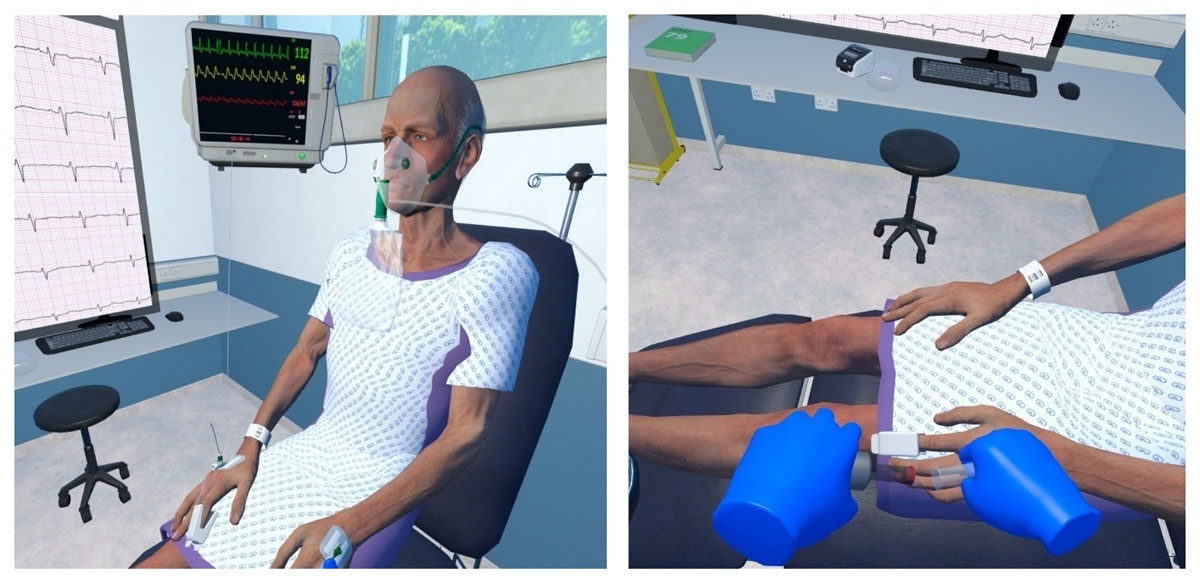
Figure 1
Views from within Headset version of the simulation, showing interaction with patient and instruments through virtual hands linked to controllers.
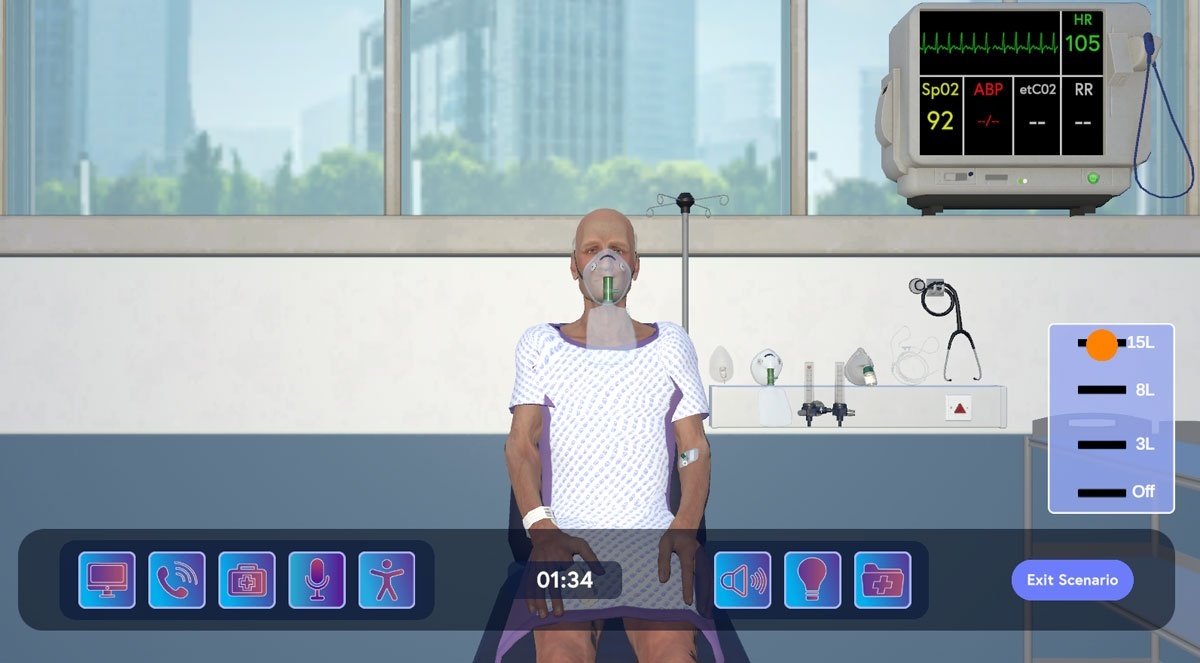
Figure 2
Onscreen version of the simulation, showing interface controls for interaction with virtual patient and instruments.
The sepsis simulation used in these trials focuses on a patient Claude, who has been admitted to hospital with a range of symptoms indicating potential sepsis. The student attends to Claude in a virtual ward. Information about the ‘Sepsis Six’ (Daniels et al., 2011) is provided through a poster on the wall of the room, and students are expected to complete these actions to be successful in the simulation.
The headset-based trials used Meta Quest 3 hardware. SideQuest software allowed the team running the sessions to observe what participants were doing in the simulation by mirroring the view they had from the headset. Researchers took notes on behaviour and provided support with any technical issues that arose for the participants during the activity.
3.2. Data collection
Participants reviewed information about the project and provided consent prior to engaging in the simulation activity. After the simulation activity was completed, a debrief activity using the same set of prompts was conducted and recorded. An online survey was then provided to participants to complete.
The debrief was designed to support guided reflection and capture richer feedback on experiences and perceptions of the value of VR. Debriefs were ran as individual interviews or joint focus groups, depending on the availability of participants. The debrief structure is provided in Appendix A. Debriefs were audio recorded with participant consent. Recordings were automatically transcribed and checked for accuracy prior to analysis.
The survey structure is described in Appendix B and included the ITEM scales (Jacobs et al., 2023a) and open comment questions.
Participants were registered students studying on Nursing or Social Work programmes with the university. Survey responses were provided anonymously and demographic information, including gender and age, were not requested.
3.3. Study 1: Nursing students headset trial
To facilitate use of VR headsets, participants were asked to visit the university headquarters. A sample of 208 students registered on Nursing programmes and living within two hours of the study location were identified and contacted via an email advertisement. Of these, 7 participants took part.
Prior to the trial participants were sent learning materials on sepsis and also had time to read them when they arrived. They were then provided with the VR headset and controllers and supported to use these. The simulation activity then began and participants had as much time as necessary to complete the task. Afterwards they took part in debrief sessions and completed the survey. 1–2 participants took part simultaneously.
3.4. Study 2: Nursing students initial onscreen trial
An initial onscreen trial involved students from any location, guided via email instructions to log in and take part in the simulation followed by an online debrief call. A further sample of 208 students registered on Nursing programmes were contacted through an email advertisement, not including any of those contacted for Study 1. Of those contacted, eight initially expressed an interest and completed an online consent form.
Participants received the same sepsis learning materials as in Study 1 and email support for the simulation. They were asked to complete the simulation at a time that suited them within one week and to choose an online debrief session from three possible times. Only four completed the simulation activity and post survey and debrief.
3.5. Study 3: Social work students headset trial
A further trial using headsets was conducted with students registered on a Social Work qualification and took place as part of an optional in-person tutorial session. Participants were therefore co-located with the researchers and were supported in the same way as in Study 1. Ten students participated in the simulation activity followed by a shared group debrief session and completion of the survey.
As the sepsis learning materials used in Study 1 and 2 were not aimed at Social Work students these were not used but an introduction to the topic and simulation were given in the tutorial.
3.6. Study 4: Nursing students onscreen main trial
As only a small number of participants completed Study 2, an alternative support model for the onscreen simulation was devised. This was integrated with an online ‘Sepsis Masterclass’ tutorial session, offered to year two students on an undergraduate Nursing degree programme. All students who had signed up to the masterclass were sent an invitation to participate in the simulation trial. Students who completed the consent form were sent instructions in advance to access the platform. A total of 75 attended the session, of which 56 completed the onscreen simulation activity and post survey.
The session began with a presentation and discussion of sepsis. Participants then received a tutorial on the simulation and were given 30 minutes to work through the simulation using their own browser, with support on-hand for queries. A debrief discussion was then held and participants asked to complete the survey.
3.7. Data analysis
Raw data from the ITEM scale questions were weighted according to the approach described by Jacobs et al. (2023a). This enabled comparison with that study. The Cognitive Load (NASA-TLX) responses were multiplied by 3.33 to give a maximum of 100. System Usability Scale responses were multiplied by two, again to give a maximum of 100. Independent samples t-tests were performed for comparison of ITEM responses between the studies, alongside analysis of descriptive statistics.
Thematic analysis was performed on the survey open comment responses and the data from the debrief sessions. Three researchers shared the work of analysing this data. The data was analysed using an approach based on the thematic analysis steps described by Braun and Clarke (2006). Each of the three researchers, working independently with a subset of the debrief and survey data, identified a preliminary list of codes through reviewing the data. Then comparing the codes they had identified, the team agreed a single codebook with themes and sub-themes reflecting key areas of interest and resolving the overlaps and repetition found in their individual coding. Having reached consensus, the data was then recoded according to this codebook.
4. Results
4.1. Quantitative analysis
As a simple measure of how positive students were about the VR simulation, participants were asked whether they ‘would like to learn in this way again’. In trials 1, 2, and 3, 100% of participants said they would. In trial 4, 53 of 56 participants said they would (95%).
The ITEM instrument provided survey data that could be compared quantitatively across the trials, and with its use to evaluate a further instance of use of the same platform, reported in Jacobs et al. (2023a). Table 1 shows that, across these trials, median ITEM scores are similar in most cases, and statistical tests do not show significant differences between studies on most ITEM domains. The only exceptions are that Cognitive Load scores in the Social Work Study 3 (median = 50) are lower when compared to the other studies. Comparing to the Nursing onscreen main trial (median = 63.3), this difference is significant t(59) = 3.385, p < 0.001. The debrief scores are also significantly lower for the Social Work trial t(62) = 3.279 p = 0.002.
Table 1
Median ITEM scores by ITEM domain and trial.
| ITEM DOMAIN | 1. NURSING HEADSET TRIAL | 2. NURSING ONSCREEN INITIAL TRIAL | 3. SOCIAL WORK HEADSET TRIAL | 4. NURSING ONSCREEN MAIN TRIAL | JACOBS ET AL. 2023a (HEADSET) | |||||
|---|---|---|---|---|---|---|---|---|---|---|
| MEDIAN | IQR | MEDIAN | IQR | MEDIAN | IQR | MEDIAN | IQR | MEDIAN | IQR | |
| Immersion (max. 50) | 42 | 36–45 | 44.5 | 40–47 | 42 | 37–47 | 43.5 | 37–47 | 43 | 41–45 |
| Motivation (max. 50) | 41 | 39–44 | 43 | 42–45 | 37 | 36–44 | 42 | 37–45 | 45 | 44–47 |
| Cognitive Load (max. 100) | 63.3 | 50–73 | 71.67 | 55–78 | 50 | 48–58 | 63.3 | 57–70 | 56.7 | 53–64 |
| System Usability (max. 100) | 60 | 58–66 | 61 | 57–64 | 62 | 59–63 | 62 | 60–66 | 72.5 | 63–88 |
| Debrief (max. 25) | 25 | 21–25 | 22 | 21–23 | 19 | 18–20 | 23 | 20–24 | 20.5 | 19–22 |
Comparing all participants in the online onscreen modality (n = 60, trials 2 and 4) with those who used a headset (n = 17, trials 1 and 3), only the Cognitive Load domain shows a significant difference (t(70) = 2.721, p = 0.008), with a medium to large effect size but considerable uncertainty (Cohen’s d = 0.755, 95% CI [0.194, 1.310). For all other domains, differences are not significant and effect sizes are small-medium (Cohen’s d of –0.055 to 0.428). Results therefore suggest a parity of reported immersion between onscreen and headset VR, but the analysis has low precision with confidence intervals of 1.09 to 1.12 units across the five domains. Further trials with larger sample sizes are needed to confirm these findings and effect sizes.
The finding around cognitive load may be explained by a range of factors including the distinct population of students involved in the social work headset study. As they were pursuing studies less well matched the task of diagnosing and treating a patient with sepsis in a virtual hospital environment, they may have felt less pressure to complete the task properly and therefore less cognitive load. Some of the social work participants also had experience with a previous VR simulation activity. Cognitive Load is perceived to be highest in Study 2, where nursing students used the simulation independently with only email-based support. However, the sample size of 4 limits conclusions drawn from this.
Comparison with Jacobs et al.’s (2023a) results show similar scores in most domains except in the median score for System Usability. In the present study, usability was consistently more than 10 points regardless of whether they used the headset or onscreen modality (60–62 here compared to 72.5 in Jacobs et al., 2023a). Given that the same platform was used in both studies, this may reflect the tasks and guidance given in the trials, or difference between participant populations.
The overall picture from the quantitative data shows a positive view of the potential for the simulation in ODL, and general similarity in ITEM scores across trials and modalities. As there is no significant difference between the Nursing online and in person studies (both of which offer the closest comparison of task and population), this data suggests that the headset and onscreen modalities perform similarly well in delivering a sense of immersion, motivation, and support for learning.
4.2. Qualitative analysis
The results of the thematic analysis process described in the methodology are explained here. Table 2 below summarises the overall themes and sub themes. themes and subthemes.
Table 2
Summary of agreed themes and sub-themes from the thematic analysis.
| THEME | SUB-THEMES | EXAMPLE |
|---|---|---|
| Motivations to use VR in learning | Evidencing ability | ‘… great way for us to show that we are able to take the necessary tests and follow the orders… our tutors do not really see the practice part of the qualification and if this was used they would be able to be involved more.’ (Study1) |
| Filling gaps in ODL | ‘With our university being online, we do not have many situations where we can have a simulated situation and treat a patient without the situation being something real life.’ (Study4) | |
| Building confidence | ‘… builds confidence and knowledge of performing nursing interventions.’ (Study4) | |
| New experiences | ‘… gives you experiences that you may not come across in real life, can select experiences to develop skills.’ (Study3) | |
| Learning from mistakes | ‘… really good way into practicing my skills and allowing chances to make mistakes and improve.’ (Study4) | |
| Procedural knowledge | ‘Getting to know the stages that are required when dealing with a sick patient.’ (Study4) | |
| Theory into practice | ‘After studying the theory behind common health conditions, wounds, etc, it would be good to have simulations, similar to this, based on each case.’ (Study4) | |
| Immersive experience | Agency | ‘It allowed me to interact and make decisions using my previous knowledge of sepsis and from training while in placement.’ (Study2) |
| Presence | ‘The whole thing surprised me… it felt like you were actually there’ (Study1) | |
| Pressure to respond | ‘It was stressful! Like trying to work out, oh my God, I’m pressing it wrong, I’m doing it wrong.’ (Study1) | |
| Expected actions not possible | ‘I couldn’t figure out how to wash my hands or put on PPE.’ (Study2) | |
| Limited realism | ‘I found the clicking of speech boxes limiting. Free conversation would be much better for social work students.’ (Study3) | |
| Communicating with patient and other characters | ‘… when you have an actual patient, obviously, they’re not just sitting there quietly… you actually got constant communication with them … You can ask questions (in the simulation) but you can’t be constant. Like, is this okay? Is it hurting?’ (Study1) | |
| Cognitive load and usability | Novelty | ‘It was confusing at times, because I had never done anything like it before.’ (Study1) |
| Benefits of repeated practice | ‘… you’re learning to use the technology first. And that kind of distracted you a bit.’ (Study1) | |
| Overwhelming or overstimulating | ‘… overstimulating with too much noise, and panic set in a bit, feeling that I had to rush to help the patient.’ (Study4) | |
| Usability | ‘I didn’t find it easy to navigate the icons to solve the problem.’ (Study4) | |
| Accessibility | ‘… when there was audible instructions I found it difficult to take in the information due to my hearing impairment.’ (Study3) | |
| Teaching and learning context | Feedback | ‘I wasn’t sure if I was going to be told that the patient had stabilized and I had done everything I could. I noticed his oxygen saturation improved and after fluids his heart rate did too.’ (Study2) |
| Communicating with tutors and peers | ‘Maybe virtual classrooms like this where a lecturer takes you through the experience might be better for people like myself. Where I can virtually interact with real people.’ (Study4) | |
| Other potential scenarios | ‘… would be really good for running through different scenarios that might be encountered – for instance I have never seen a full asthma attack.’ (Study1) | |
| Study environment | ‘they were talking so much in the (online) tutorial I found it hard to hear the simulation.’ (Study4) | |
| (mis)alignment with studies | ‘I felt the nursing task was outside of my professional experience, and that was a bit disorienting.’ (Study3) | |
| Gaps in knowledge | ‘The procedures are OK, I’m happy with those. It’s reading blood… I don’t read blood results.’ (Study1) | |
| Applying prior experience | ‘I felt like I went in with a background of knowledge so I knew sort of the steps roughly to take. So I think that that did really help.’ (Study1) | |
| Guidance | ‘I think the hints could have been more helpful. It told you what to do but at times I was stuck.’ (Study4) |
4.2.1. Motivations to use VR in learning
Participants were motivated by a desire for experiential, hands-on learning. They felt that VR could effectively bridge the gap between their online studies and their practice-based placements in real work contexts. They appreciated the opportunity to engage with new experiences, rarely encountered in practice, and to build their confidence and understanding of sepsis protocols:
I haven’t actually gone through the entire thing of what you do for a patient who you suspect has got sepsis… So when I was going through that, I can sort of now imagine. It just takes me to the room and it’s just helped me to imagine what I need to do. (Study1)
Nursing students clearly recognised that the situation presented a valuable test of procedural knowledge. Successfully meeting this challenge affirmed their knowledge and built confidence. The experience also provided an opportunity for independent clinical decision making and as one participant explained, to ‘feel themselves in the role’ (Study4) of a nurse.
While the simulation could also expose knowledge gaps, participants appreciated the risk-free opportunity to learn from mistakes and reflect on areas for improvement:
I thought I done rubbish, to be honest with you, I was thinking, oh my god, I should have done this. I wouldn’t have done this in person… I would have, like, obviously, started with the lower oxygen and then went higher. (Study1)
Participants saw the potential for VR to enable them to evidence their abilities to their tutors, however some were less sure about use in summative skill assessment:
I’m not sure I would be happy to be examined or tested via VR… real world practicalities would be taken away… I won’t be treating VR patients in real life. The unpredictability of real patient experiences is as important a part of the learning as the treatment itself. (Study4)
In line with the quantitative findings, social work students were slightly less certain about motivations but still saw a lot of potential if the right scenarios were available to them, linking this theme to the ‘Teaching Context’ discussed below.
4.2.2. Immersive experience
Participants commented on the realism of the simulation, noting both the visual and auditory detail and the responsiveness to their actions. The quantitative data highlights that the participants’ sense of immersion did not differ between the onscreen and headset trials. Headset users did, however, describe the experience in qualitatively different terms referring to an embodied sense of presence. As headset users felt able to move freely, turn their head and perform actions with their hands, they experienced a sense of physical engagement. They also reported a diminished awareness of elapsed time within the simulation. Nevertheless, both onscreen and headset users consistently reported that experience felt authentic, with an onscreen participant saying it was ‘really, really realistic’ (Study4).
Analysis of participants’ descriptions of immersion identified that participants perceived the simulation as realistic overall, highlighting auditory elements such as the beeping of the heart rate monitor or the sounds of an oxygen pump. Nursing students, who were more familiar with the procedural elements of clinical work, referred to the authenticity of required procedures, such as taking blood or inserting a cannula. Participants were acutely aware when the simulation did not enable all expected actions: Some standard procedures were easier to perform or not available, such as flushing before cannulating, and the range of patient responses were limited.
Patient responses to procedures performed, such as signs of pain or urine colour changing in response to hydration, were also noted where limited. Richer communication with the patient and interaction with other staff members was identified as an area for enhancement, highlighting the importance of the social dimension of these experiences: ‘I was expecting some other characters to maybe enter the room… maybe expecting a doctor to come in …and tell you what to do’ (Study1).
They also thought that the lack of other people and interruptions was unnatural. Practice environments are usually busy with noise and activity.
However, this did not seem to have a negative impact on the participants’ sense of immersion. This could be because the simulation posed participants with a problem which needed to be solved and was emotionally engaging. They needed to ‘think on your feet’ to identify and meet the patients’ needs. This positive sense of being under pressure absorbed them in the task and was described as stressful and enjoyable.
4.2.3. Cognitive load and usability
Usability and cognitive load related to two dimensions of need – navigating the simulation and making appropriate clinical responses to a patient with sepsis. Both nursing and social work participants reported initial challenges in using the simulation itself, largely due to its novelty. While some of the specific issues were different, both headset and onscreen participants reported an initial sense of disorientation and a need to learn to interact with the simulation before addressing patient need: ‘How to do certain things, clicking at the buttons, that was the more difficult part. How to give this, how to fit it on properly, making sure I don’t bump into things’ (Study1).
Importantly for activity design, participants wanted to counter this novelty with more opportunities to practice: ‘The help navigation video was great but I would still welcome the first simulation without time and feedback – no pressure about what happened to the patient.’ (Study4)
For some participants, cognitive load related to their sense of being overwhelmed or ‘over stimulated’ by the sensory input in the simulation. This combined with the dual focus on understanding the simulation mechanics and responding to the patient was reported as challenging. Social work students, having less experience with clinical procedures, felt that a more passive or observational experience would be appropriate.
The other dimension of cognitive load related to limitations of participant knowledge about sepsis itself. This was particularly mentioned by nursing participants. As participants worked through the scenario, some became aware of things they did not know and found this an uncomfortable experience. Social workers, did not note this experience possibly because they were less invested in the need to have an in-depth knowledge of sepsis. While the limitations of knowledge might relate to the participants’ stage of learning as a trainee nurse, other factors included whether their prior experiences matched the particular requirements of their setting. For example, some participants did not recognise the equipment in the simulation or had not been allowed to catheterise male patients in their placement workplaces.
4.2.4. Teaching and learning context
The modes of delivery varied between trials, and onscreen participants in studies 2 and 4 took part in their usual study environment (e.g. at home or work). With ODL more of the management of technology and environment is in the hands of the learner, and barriers are not always evident or easily resolved by those teaching or supporting them. Given this, comments on the provision of guidance, and technology-related issues, were prevalent.
Some nursing students experienced discomfort when acting beyond their current scope of practice or knowledge, and there were social work and nurses with specialisms who suggested a misalignment of this specific simulation to areas where they perceived VR could aid their studies. As their intended role primarily involves close attention to communication and context, simulations should focus on that to be most useful. While it was noted that the topic itself did hold relevance to all participants, there was a perception that simulations needed to be more adaptive to the learning requirements of different groups: ‘I normally deal with mental health, (and) yes, sepsis is something we have to think about when we’re doing routine monitoring anyway. But normally we wouldn’t be in that situation where we’re ordering chest X-rays and things like that.’ (Study4)
The sub-theme of realism described earlier was strongly related to this communication element. Both social work and nursing participants wanted interactive communication with the patient and peers. In contrast to the examples of misalignment described above, they were highly motivated when they found that they could apply their prior knowledge in the simulation.
Noting that sepsis was relevant to all HSC students, but differing roles would be played around it, nursing participants listed further topics which could be practiced through simulation, including responding to patients with asthma, seizures, cardiac arrest or a mental health crisis. A challenge and opportunity noted by a social work participant was that ‘social workers operate in such a diverse range of environments’ (Study3), and so simulations may not reflect the practice settings important to them but could be valuable if they managed to adapt and represent this diversity.
Participants also noted the essential importance of feedback during the simulation to guide action, and where this might be lacking when compared to reality, for example:
His saturation (is) improving… But I was kind of thinking well, do I need to get more fluids into him? But actually there’s no kind of indication as whether you do or not…I mean, like, you can’t see the bag filling up, so you don’t really know. (Study1)
Feedback was also raised as particularly important around ending the simulation activity. For example: ‘[I] felt a bit lost as to when I was “done”. Also, it would have been good to find out what happened to Claude next. E.g. did he go to ICU, was his source of infection found…’ (Study2).
5. Discussion
The findings add weight that VR simulations could raise particular benefits and issues for healthcare ODL, yet this issue has received little attention in prior research. Here, we discuss the research questions in turn:
5.1. What do ODL healthcare students perceive as benefits and challenges of VR simulations for their studies?
ODL students saw strong potential in using VR to develop and demonstrate their skills with tutors. Echoing research in other settings, participants reported that learning through simulated practice was a positive and motivating experience (Makransky et al., 2021). The hands-on nature of the experience tested and validated their knowledge and skills (Shin, Park, & Kim, 2015), and these novel practical experiences motivated engagement (Makransky et al., 2021). VR therefore has specific potential to address the perceived challenges of limited face-to-face contact in ODL (Vicary et al., 2018) by providing a bridge a space between theoretical learning and real-life placements.
While engagement with simulation is often framed around mastery of skills and knowledge, responsibility for patient care and decision making can also have implications for professional identity formation (Jowsey et al., 2020b). Nursing participants reported that the independent role they were given in the simulation, rather than the supervised student role they take in placement settings, was a significant benefit. They could ‘feel themselves in the role’. Thus, VR has the potential to foster professional identity formation. This was dependent on the relevance of the activity to the participants’ role and consequently, was less resonant for social work participants.
While there is a nascent literature related to professional identity development and simulation (Jowsey et. al., 2020b; Tien et al., 2019), there is very little which considers the contribution virtual simulation could make to this aspect. The field would benefit from further exploration in this area. Moreover, the development of professional identity may also be supported further through debriefing which takes in reflection on scope of practice and participant’s views of themselves as a practitioner-in-development (Tien et al., 2019). Developing tools and practices that support effective and flexible debrief activities for ODL is a further opportunity and challenge highlighted here.
Learners could however feel initially overwhelmed by having to learn to both control their actions and resolve the simulation task, and there were distinct challenges to introducing the platform and providing support at a distance. Qualitative data suggested that some experiences included a high cognitive load, potentially hindering learning with feelings of being overwhelmed or stressed. ODL places high requirements on the technical skills and literacies of students (Arian et al., 2025) and use of VR extends this. Particular attention is therefore needed to the ways VR is introduced to ODL students, and it would ideally be used in a sustained way to gain benefit once the learner is comfortable with it.
5.2. Does the modality (headset or onscreen) impact on the experience of learning through a VR simulation?
Comparing ITEM scores across trials was somewhat surprising, demonstrating that onscreen VR produced similar immersion scores and participants felt that they were ‘really there’. Although headset users described the experience in qualitatively different terms, the ratings for immersion were not significantly higher. While most literature assumes or provides some evidence that headset users experience heightened immersion (Buttussi & Chittaro, 2018; Jacobs & Maidwell-Smith, 2022; Jacobs & Rigby, 2022), it is notable that the focus on technological differences could disregard the impact of different pedagogical approaches (Plotzky et al., 2023) or tasks (Buttussi & Chittaro, 2018). Given that the task and pedagogical factors are identical in the current study, the similar levels of immersion between the two modes suggest that some equality of experience is available to students regardless of how they access the simulation.
This suggests that immersion depends less on the technology than it does on the users’ depth of engagement with the task. Michailidis, Balaguer-Ballester, & He (2018) note that when video game players concentrate on a task with a well-defined goal, enact skills that successfully meet task demands, and receive immediate and unambiguous feedback on performance, they experience flow states with a loss of self-awareness and time perception. Task design appears significant in evoking this state akin to immersion.
The relatively unfamiliar technology of a VR headset did not appear to create a higher cognitive load than the on-screen simulation, but with these sessions being held in person at a campus, participants could be observed and support was more easily at hand. There were instances where the distance between educators supporting the activity and the onscreen participants led to confusion about how to proceed, or usability issues only reported after the session. The support offered around the activity may be more impactful than the modality.
The most notable difference was between nursing students and social work students with the latter experiencing a significantly lower cognitive load. But social work students were less likely to identify with the detailed clinical elements of the task, and were somewhat less motivated, which as Junker et al. (2025) notes, may influence the participants’ willingness to engage in the cognitive processing required. Social work participants may have only participated superficially with the task rather than engaging in cognitively demanding tasks of remembering what they knew about sepsis and integrating this with actions in the simulation.
Purchasing headsets at scale for ODL students would be a significant investment and therefore should be an evidence-based decision, and despite growth in mainstream availability, it is unclear if or when the technology will proliferate widely enough to make it an expectation of taking a course. There are also likely to remain accessibility issues for some students when using VR (Wild et al., 2024). It is therefore encouraging that a similarly immersive learning experience is available to students without a headset.
5.3. What features or support would enhance the experience of learning through VR simulations for ODL healthcare students?
Participants desired more opportunities for communication within simulations, and evidence of the efficacy of multiuser VR simulation is promising (Zackoff et al., 2024). This would meet several needs. First, practice settings often incorporate teamwork and the capacity to share tasks would support the development of these skills. Second, when the simulation reveals gaps in learner knowledge, peers might be able to advise or share problem solving. Third, the facility for educators to observe practice and guide students could support formative assessment and learning. Greater instructor presence in and around the simulation could help to support learning and reduce cognitive load by offering guidance (Lapierre et al., 2022).
However, as ODL learning aims for flexibility and scale there are challenges to providing other students or tutors at any time learners want to complete the activity. In our future work we are investigating alternatives, such as artificially intelligent agents, to provide some of this support in tandem with educator oversight and engagement with peers.
Opportunities for repeated practice are often proposed as a solution as well (Lapierre et al., 2022) and similarly, participants’ suggested the option to familiarise themselves with the simulation by caring for a stable patient or in the social worker’s case, observing care instead. ODL students possess varying levels of technical skill and use a wide range of devices. Practice runs would enable them to identify any technical issues before setting out to resolve the scenario. In these trials however, few students took up the opportunity for practice despite suggestions to do this. This may be due to a lack of time, limited confidence, or desire to engage at the same time as others. If learners do not find the technology easy to use, they may be less willing to engage with simulations in the future (Padilha et al., 2018). However, there may be more value in repetitive practice of the problem scenario so that students have the chance to correct errors or try different options, though automaticity may be an undesirable outcome (Lapierre et al., 2022).
Both nurses and social workers thought that VR simulation offered potential learning value across a range of scenarios they had learnt about or would experience in their intended professional roles. Some participants did comment on those parts of the experience that did not match their expectations or local context, and while a degree of fidelity with practice reality will be necessary, there is a danger that the pursuit of a high degree of verisimilitude might distract from the design of effective scenarios for learning. Hamstra et al. (2014) notes that the designers of simulations can become preoccupied with surface realism which can overshadow the need to carefully design the learning task, and an engaging and challenging problem-solving task can project fidelity on to the simulation scenario.
This suggests that designers and educators should promote the personal relevance of simulations to the individual in order that the activity is motivating and engaging. However, the recognition of differences between the simulation and real practice could also show that participants were actively reflecting on the transfer of learning, which could enhance the outcomes (Bransford & Schwartz, 1999). ODL educators should therefore consider both the extent to which the simulation aligns with real practice but also how to encourage active engagement with the differences that are perceived, accommodating diverse ODL student populations and the variability of professional contexts.
5.4. Limitations and further research
This study presents several limitations some of which reflect the inherent challenges associated with ODL and VR headset trials. Three of four studies involved fewer than ten users, limiting the statistical power and generalisability of the findings. In Study 1, the requirement for students to travel to a central location to use a headset contributed to the small sample size. Comparing the limited number that completed Study 2 with the more successful Study 4 suggests that without an organised event to support them, students may be less motivated to engage and face barriers that result in non-completion.
A second limitation is that, although the core features of the VR simulation remained consistent across trials, the surrounding conditions varied. Learning materials and tuition were provided in different ways and debriefs were also held individually or collectively depending on whether multiple participants were available. As such, the study does not constitute a true experiment with controlled conditions.
Additionally, all participants were self-selected, likely comprising individuals who were more motivated or comfortable with new technology. If such simulations are mandatory, then motivation may be more variable.
Sending headsets to students and supporting them to use these was considered beyond of the scope of this study but would enable insights into the guidance needed and the potential barriers faced, for example space limitations in home or work environments that may impact on the ability to effectively use headset VR.
6. Conclusion
Simulation offers health and social care training programmes the opportunity to widen access to practice environments. While campus-based institutions may turn to virtual simulation due to the cost and space restraints associated with simulation suites (Padilha et al., 2018), ODL institutions, often at larger scale, will see different challenges and opportunities for VR. This study suggests that ODL healthcare students perceive VR simulation to fulfil their needs as a scalable way to access standardised and repeatable practice learning situations, demonstrating skills to their tutors, and providing a valuable avenue to develop their professional identity. Furthermore, we find that headset and onscreen VR can provide similarly motivational and immersive experiences, suggesting that integration can be flexible and does not require specialised hardware. Technical and pedagogical wraparound support is however important to the experience and has distinct requirements in ODL. While further research is needed to confirm and deepen understanding, this suggests that VR is well suited to ODL healthcare study.
Appendices
Appendix A: Debrief Structure
General impressions
What do you think of the simulation?
What did you feel worked well?
What did you find difficult?
What surprised you?
Learning
Can you tell me the main things you learnt from the simulation?
Did anything happen or that you needed to do that you were unsure or confused about?
What do you now realise you need to learn more about?
Emotions
How did the experience feel for you?
What do you think made you feel like that?
How did those feelings affect what you did?
How did these feelings change over time?
Developments and improvements
What would have improved the experience for you?
Appendix B: Survey Structure
Immersive Technology Experience Measure
Immersion scale (8 likert-type questions, plus an immersion rating from 1–10)
Motivation scale (10 likert-type questions)
Cognitive load (6 likert-type questions, based on NASA-TLX)
Usability (10 likert-type questions, based on System Usability Scale)
Debrief scale (5 likert-type questions)
Feedback on the experience (open comment unless otherwise stated)
How would you describe your experience with the simulation?
Do you think you’d like to learn this way again? (yes/no)
What if any do you think were the benefits to you of taking part in this activity?
Do you have any suggestions for ways to enhance the interaction with the virtual patient? If so, please explain these
Do you have any suggestions for ways to improve the simulation or the platform? If so, please explain these
Do you feel that simulations such as these should be used further in your qualification? If so, how should they be used?
Any other comments
Data Accessibility Statement
Data from the feedback survey described in this paper is available from: https://ordo.open.ac.uk/articles/dataset/Virtual_Reality_Sepsis_Simulation_Trial_Feedback_survey_responses_/31655806/1.