
Introduction
There has been long-standing interest in incorporating flexibility into higher education (Hrastinski 2019; Loon 2021). At its core, the concept of flexible learning is about giving learners the opportunity to customize their education and training, and thus their learning process, to best suit their own needs and specific life contexts by combining options within the learning environment (Barnett 2014; Wade 1994). In addition to time flexibility in part-time formats, the ability to offer flexible learning through blended, online, or hybrid study programs has continued to improve with technological advances (Barua & Lockee 2024). Teachers and students experienced these advances during the global shift to distance learning during the COVID-19 pandemic. Although this unplanned, rapid adaptation, known as ‘emergency remote teaching,’ differs from a systematic, well-planned approach designed for online delivery (Hodges et al. 2020), many students valued the opportunity to shape the learning process in terms of when, where, and how they learn. As more students balance academic, personal, and professional commitments, the demand for flexible learning modalities is increasing (Lockee & Clark-Stallkamp 2022; Pelletier et al. 2024; Ratten 2023; Valtonen et al. 2021). As a result, higher education institutions need to consider how to design learning experiences that vary in format but are equivalent in quality and learning outcomes (Pelletier et al. 2023).
In the post-pandemic era, blended learning is seen as a particularly promising modality to increase flexible learning, as it combines face-to-face and online learning (Fisher et al. 2021; Guppy et al. 2022; Imran et al. 2023; Kim 2020; Truss & Anderson 2023). However, the transition from traditional classroom teaching to blended learning poses many challenges for educational institutions; for example, Bozkurt (2022) asks, when we blend, do we only blend modalities (onsite and online), or pedagogies, or technologies, or a combination of all of these? Deciding the level at which the changes need to be made (at the university level, the program level, or the level of individual courses) is also required. Implementing blended learning at the program and course levels can, given the virtually unlimited design possibilities and applicability in so many different contexts (Buhl-Wiggers et al. 2023; Cheung & Wang 2019), be a complex challenge. Applied research should address these questions with scientifically grounded answers.
Previous research has focused on the effectiveness and efficiency of flexible learning in the modality of blended learning, and meta-analyses (Bernard et al. 2014; Means et al. 2014; Müller & Mildenberger 2021; Vo et al. 2017) provide a good picture of the state of research. In addition, there have been numerous studies of the perceptions and effectiveness of blended and online learning in the context of emergency distance learning during the pandemic (Masalimova et al. 2022; Tonbuloğlu & Tonbuloğlu 2023). However, pandemic studies have limitations for post-pandemic implementation (Kerres & Buchner 2022). Moreover, most studies to date have focused on the course level, so there remains a notable lack of research at the program level (Müller & Mildenberger 2021).
Future research should extend beyond effectiveness and educational design to examine the critical role of flexibility in blended learning environments, as highlighted by Bozkurt (2022). In particular, Beer et al. (2023) underscore the need for studies focused on students’ perceptions of flexibility and its influence on their learning success, progress, and satisfaction.
There is also a lack of research on the perspectives of academics, and further research here would shed light on their role in and views on the implementation of flexible learning in a blended learning modality (Graham 2019; Mozelius & Hettiarachchi 2017; Truss & Anderson 2023). Further, because one of the claimed benefits of flexible learning is improved work-life balance (OECD 2023; Veletsianos & Houlden 2019), the perspectives of employers should also be analyzed in more detail. Consequently, there is a need for a study of these three perspectives together in a multi-stakeholder approach, followed by reflection and collective discussion.
This article addresses these research needs and questions in the context of a systematic flexible learning initiative at a higher education institution.
Research Overview
In this section, we clarify the concepts of flexible learning and blended learning, which are central to this study, and present key findings, particularly in relation to stakeholder views. We also present models for effective implementation of teaching innovations and blended learning.
Flexible Learning and Blended Learning
Flexible learning is a broad term with a long history and various interpretations (Barua & Lockee 2024; Boer & Collis 2005; Li & Wong 2018). Flexible learning programs should meet learners’ unique needs and enable them to take responsibility for their learning process (Wade 1994). Therefore, the learning environment should allow students to decide for themselves what, when, how, and where to learn (Higher Education Academy 2015).
Pedagogically, there are several dimensions of flexible learning. According to the widely cited article by Chen (2003), flexible learning requires flexibility in at least one of the following dimensions of learning: time, place, pace, learning style, content, assessment, and learning pathway. Li and Wong (2018) analyzed previous publications and arrived at similar components of flexible learning: time, content, entry requirement, delivery, instructional approach, assessment, resource and support, and orientation and goal.
Nowadays, implementation of flexible learning is primarily through the use of technologies (Tucker & Morris 2012). However, the dimensions identified above show that flexible learning is much more than just the use of technologies and the delivery of tertiary education online (Beer et al. 2023; Li & Wong 2018). Nevertheless, the technologies serve as important enablers for use in designing flexible learning environments in a blended or online format. Accordingly, flexible learning is often associated with and used in connection with blended or online learning (Andrade & Alden-Rivers 2019; Anthony et al. 2020; Smith & Hill 2019).
Blended learning combines face-to-face and online learning (Graham & Halverson 2023). The term encompasses all technology-enhanced learning except pure online and pure face-to-face teaching. With most institutions using online learning management systems, blended learning is becoming the norm, or ‘new normal’ (Dziuban et al. 2018). An overview of the findings of meta-analyses to date on the learning effectiveness of blended learning shows at least equivalent or slightly positive effects in general (Bernard et al. 2019; Müller & Mildenberger 2021). However, the authors point out that the effect sizes in the individual studies are heterogeneous; effectiveness therefore largely depends on the context and the quality of the implementation (see also Dziuban et al. 2020; Nortvig et al. 2018). Ashraf et al. (2022), for example, pointed out that most blended learning courses are not as effective as they could be because they do not have a strong pedagogical framework.
Stakeholder Perceptions
As noted above, blended learning is a modality that can be used to make learning more flexible. In analyzing the state of research on the stakeholder perceptions of students, lecturers, and employers, we therefore include studies that have been implemented in a blended learning design with the aim of promoting flexible learning.
Student perceptions
Meta-analyses show that blended learning promotes student satisfaction (Ashraf et al. 2022) and that students generally prefer it over traditional courses (Spanjers et al. 2015).
Owston et al. (2013) found that high achievers view blended learning more positively than low achievers, a finding supported by Botts et al. (2018). Regarding the form of blended learning, Owston and York (2018) analyzed the ratio of online to face-to-face teaching and concluded that students expressed more positive experiences when the online component of the teaching was higher than 36%. There is also evidence that upper-division students and graduates are more aware of the benefits of occasional face-to-face events, which give them the opportunity to interact directly with lecturers and network with their peers on campus (Owston et al. 2019).
A more detailed analysis of student perceptions indicates that the flexibility of the blended learning modality is the most valued attribute (Ali 2023; Banihashem et al. 2023; Graham 2019; Groen et al. 2020; Vanslambrouck et al. 2018). Convenience, reduced travel time, and face-to-face interaction are also appealing features of blended learning (Owston et al. 2019). Reduced social cohesion is seen as a negative aspect (Nortvig et al. 2018). Problems with organizing learning in groups are also mentioned (Pei et al. 2024; Vanslambrouck et al. 2019). In addition, students are aware that blended learning is demanding in terms of self-regulation and involves challenges in using learning technology (Rasheed et al. 2020). Broadbent (2017) explores the importance of using self-regulated learning strategies in more detail, concluding that time management and learning strategies, such as elaboration, are particularly important in blended learning. Elaboration involves integrating and connecting incoming information into one’s existing knowledge base and goes beyond simple repetition in a rehearsal strategy.
Lecturer perceptions
Faculty members in higher education institutions are often ambivalent in their perceptions of blended learning (Truss & Anderson 2023). On the one hand, lecturers recognize various benefits of blended learning for students; they see the possibility of increased flexibility (and thus improved compatibility) between studies and other commitments, and they are aware of the need to foster students’ self-regulation skills as part of the digital transformation of society (Jackman 2018). On the other hand, the faculty also have negative responses to the introduction of blended learning. In addition to the new technical requirements, the pedagogical demands of the new learning format and the changed role in the teaching process are particularly challenging for lecturers (Ashraf et al. 2021; Senali et al. 2022). There are also complaints about the increased workload, especially in developing the online learning environment (Graham 2019; Müller & Wulf 2021).
Many studies on the implementation of blended learning also address what teachers perceive as a lack of learner engagement in online asynchronous learning (Ashraf et al. 2021; Lawter & Garnjost 2023; Li et al. 2014; Senali et al. 2022), which in turn leads to high demands on the design of blended learning (Halverson & Graham 2019; Heilporn & Lakhal 2021; Heilporn et al. 2021).
Employer perceptions
Most studies on blended learning focus on the course level, and there are few that examine employer perceptions of flexible learning in a blended learning degree program. These studies have generally focused on the value of the degree depending on the modality. Purely online courses tend to have a negative impact on candidate ratings, while this is not true for blended learning; overall, blended learning degrees are considered equivalent to pure face-to-face courses (Bobek et al. 2022; Braun et al. 2020). Grossman and Johnson (2017) compared the importance of modality with other study characteristics and concluded that the reputation of an educational institution is more important than the modality. In addition, employers who have experience with online/blended learning courses also rate them more positively.
Implementing flexible learning in a blended learning format
From the arguments derived from current research as set out above, we conclude that implementing a new flexible learning study program in a blended learning format offers benefits from the student perspective but is demanding and time-consuming for lecturers, potentially provoking resistance (Bruggeman et al. 2021; Huang et al. 2021). Incentives for lecturers to switch to blending are not always easy to identify (Mozelius & Hettiarachchi 2017). Therefore, plausible reasons for why these changes need to be provided, and incentives to motivate lecturers must be created (Bruggeman et al. 2021; Huang et al. 2021). In addition, teachers need to be supported in the technical and educational development and implementation of blended learning (Jokinen & Mikkonen 2013; McCarthy & Palmer 2023). Thus, making an entire degree program more flexible involves far-reaching structural changes in the entire organization, and these must be accompanied by appropriate measures (Müller & Wulf 2021). Some authors have developed models addressing the key challenges of implementing blended learning and describe implementation measures at different levels (McCarthy & Palmer 2023; Porter & Graham 2016; Porter et al. 2014).
One particularly practical model for identifying implementation issues and planning the change process is the Knoster educational change matrix (Knoster et al. 2000). The five elements of the matrix (see Figure 1) are necessary conditions for successful change. If only one element is missing, various negative consequences, such as confusion or frustration, may result, and these can prevent a successful change process. Knoster’s change matrix served as an orientation framework for the implementation of FLEX, the flexible learning study program. The model was also used to develop an implementation survey for lecturers and to test the effectiveness of the measures (see also Methodology).
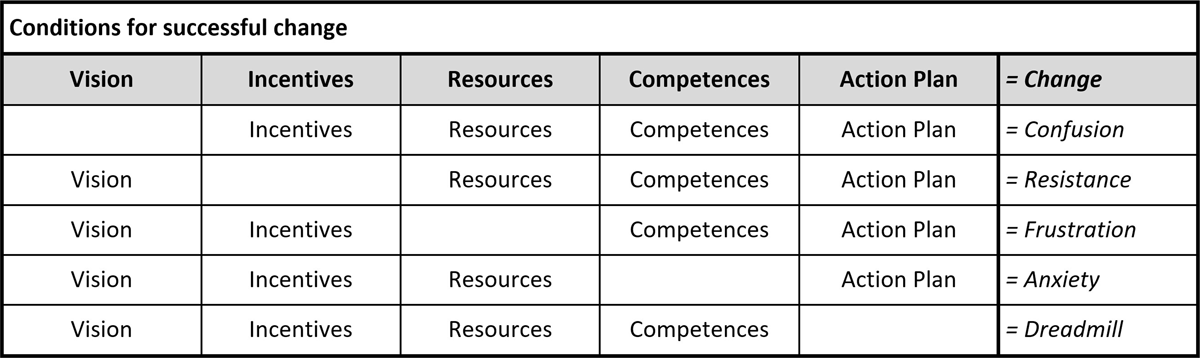
Figure 1
Dimensions of the Knoster educational change matrix.
Research Aim
Most publications on perceptions of flexible learning programs in a blended learning modality focus on students; only a few have investigated how other stakeholders, such as lecturers and employers, perceive flexibility. However, as outlined above, it is important to examine the different perceptions together in a multi-stakeholder approach and to compare and contrast the perspectives, as any change necessarily affects all perspectives. The literature also exhibits a focus on the course level, with a distinct lack of research at the program level. This is particularly significant because it is usually the implementation at the program level that enables flexible learning. Furthermore, very few studies have systematically analyzed the implementation of blended learning programs over several years. Such studies would be able to provide higher education policymakers with information on how blended learning modalities can be systematically implemented at both the course and program levels to enable flexible learning for students.
To address this, we analyzed the perceptions of a flexible study program on the part of students, lecturers, and employers in a blended learning design. The specific research question is:
What are the perceptions of the main stakeholders (students, lecturers, and employers) regarding the flexible learning study structure and the blended learning design?
Methodology
Research Context
The Zurich University of Applied Sciences launched a new flexible learning study program in a flexible study format (FLEX) in 2015 as part of a comprehensive e-learning strategy (Müller et al. 2018). The Bachelor of Business Administration is a successful, well-established program offered in both full-time (FT) and part-time (PT) formats. The FLEX format is the third study format for this program. All bachelor programs have two levels: the ‘Assessment’ level (60 ECTS credits; two semesters for FT students, three semesters for PT and FLEX students) and the ‘Main Study’ level (120 ECTS credits; four semesters for FT students, five semesters for PT and FLEX students). For the PT and FLEX formats, a part-time job or family commitment of no more than 60% is recommended. Classes have 30–60 students. FLEX enrollment was substantially lower than enrollment in FT and PT but increased to 23% in 2023 (see Figure 2).
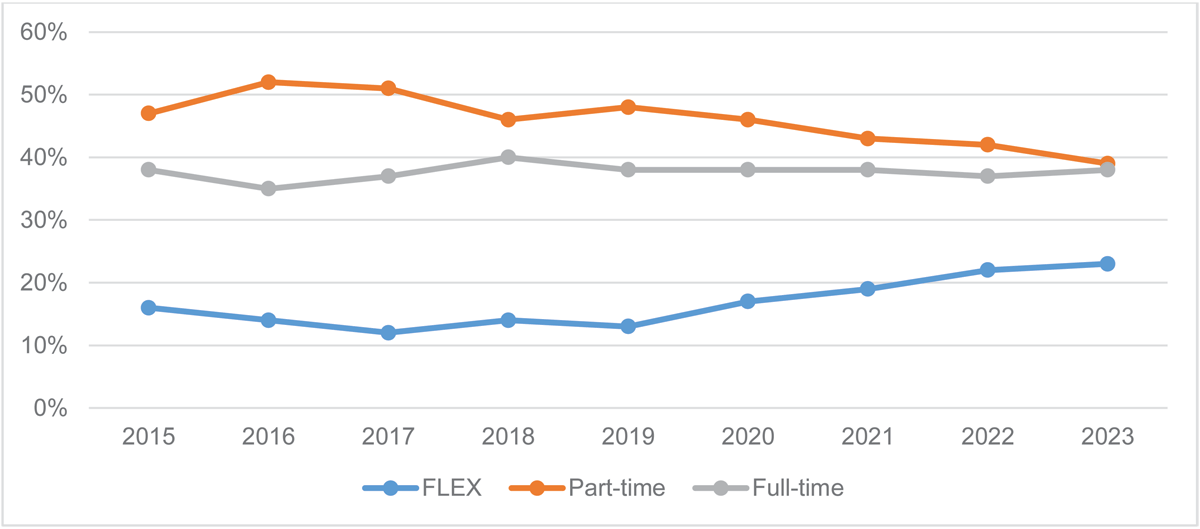
Figure 2
Proportion of students enrolled in formats full-time, part-time, and FLEX.
The concept for the new blended learning format was developed in 2014 and tested in a pilot course. After the successful evaluation of the pilot course (Müller et al. 2018), 44 courses were transformed for the Bachelor of Business Administration (2015–2020). The first FLEX cohort graduated in 2019. The COVID-19 pandemic in 2020 led to a full transition to distance learning, so the FLEX program evaluation focuses on the pre-pandemic period.
The FLEX format aimed to help students balance work and personal commitments with flexible study. Face-to-face sessions were reduced by 51% compared to the PT program and replaced by virtual self-study phases (Müller et al. 2023). FLEX students attended campus for two days every three weeks, with asynchronous self-study in between. This guaranteed compatibility with a remote residential location.
Following our explanations in the Research Overview, the FLEX design is classified as blended learning (Allen et al. 2007) and offers greater flexibility in time, delivery, instructional approach, resources, and support (Li & Wong 2018), but the content, entry requirements, orientation or goal, and performance assessment remain the same as traditional courses.
The effectiveness of the FLEX study program was analyzed in a separate study (Müller et al. 2023). Overall, the analysis of effectiveness found that the overall learning effectiveness of the FLEX flexible learning program with a 51% reduction in classroom teaching time was equivalent to that of the conventional program. In addition, the learning effectiveness of the individual FLEX courses was found to be moderated by the quality of implementation of the educational design factors.
Research Design
We adopted a mixed-method research approach with an explanatory design to investigate the research question (Creswell & Clark 2017). The mixed-methods approach provided a thorough understanding of the stakeholder perceptions of the FLEX study program. We collected both quantitative and qualitative data from online surveys and interviews.
Participants
Students
The participants of the study were all students of the FLEX study program (N = 278; 35% female students, 65% male students). An entrance survey analysis shows that most students chose FLEX for time (57%) or location (38%) flexibility due to private (10%) or professional (39%) commitments. Most students came from the greater area surrounding the university, with more external students in FLEX than PT. FLEX students reported commuting by public (73%) or private transport (23%); few were staying in hotels/hostels or with friends (4%) or had a second home (1%). All FLEX students were employed, with an average employment rate of 74% (FLEX). Their employers generally allowed FLEX students flexibility in working hours (43%) or reduced hours during the semester (36%); few allowed study time during work hours (7%). For 15% of the FLEX students, employers provided no specific arrangements.
Lecturers
The participants in the study were all lecturers in the FLEX study format (N = 58; 8 female lecturers, 50 male lecturers). All lecturers in the FLEX study format had previously taught the module in both conventional and FLEX formats, ensuring subject expertise and extensive teaching experience. Assessment-level modules usually have several classes with different lecturers, which made selection of those interested in FLEX possible. Main study modules are generally taught by only one lecturer, which limited selection options. All interviewed lecturers were full-time employees.
Employers
One female and three male employer representatives were interviewed to explore the perceptions of FLEX students’ direct supervisors. All had experience with the PT students, and some with the FT students, allowing a comparison of study formats and their impact on work. All four employer representatives (A, G, K, and L) worked for large banks in Switzerland, managing medium-sized teams and directly supervising students. Only supervisors from the banking sector could be approached for interviews because at the time of the interviews, only students in the banking & finance specialization had completed their studies.
Data collection
Student perceptions (N = 287) of the FLEX learning format were collected using an online survey. At the end of each semester, the FLEX students completed a questionnaire on usability, motivation (Wilson et al. 1997), learning outcome (Rindermann & Amelang 1994), and satisfaction with the FLEX study format (Ryan 1982) using a 5-point Likert scale and two open-ended questions (‘What do you like about the FLEX study program? What do you like less?’).
Using the Knoster model, we developed a 20-item implementation instrument for lecturers with a 4-point Likert scale (see Appendix, Table A) and two open questions (‘What has been particularly successful/what should be improved in the implementation of FLEX?’). Lecturer perceptions (N = 35) were collected using an online survey at the end of the first and second implementations of their modules.
Qualitative data included the responses to the open survey questions, guided interviews, and focus group discussions with students, lecturers, and employers. Interviews with employers were semi-structured. All interviews and discussions were fully transcribed. The characteristics of the qualitative analysis are presented in Table 1.
Table 1
Characteristics of qualitative data collection and analysis.
| STAKEHOLDERS | SOURCES | SEGMENTS (AGREEMENT/DISAGREEMENT) | AGREEMENT RATE | KAPPA |
|---|---|---|---|---|
| Students (N = 278) |
| 1,444 (1,226/218) | 84.90% | 0.84 |
| Lecturers (N = 35) |
| 540 (356/184) | 65.93% | 0.63 |
| Employers (N = 4) |
| 423 (326/97) | 77.07% | 0.75 |
| Total | 2,407 (1,908/499) | 79.26% | 0.78 |
Data analysis
We analyzed the quantitative data with descriptive and inferential statistics (t-test). Qualitative data were categorized using Mayring’s (2015) content analysis principles. An initial category system (see Appendix, Table B) was created based on the FLEX program’s strategic orientation and analyzed using MAXQDA software. Two coders independently coded the data, with intercoder agreement checks in two iterations to identify weaknesses (Kuckartz & Rädiker 2019). The final coding guide was developed after resolving inconsistencies (see Appendix, Table B). Intercoder agreement was checked at the segment level, resulting in a kappa value of 0.78. The code frequencies were then analyzed, and key aspects were summarized, discussed, and supported with the exemplary statements (ES) in Appendix, Table C. Because the format category contains overall assessments of the FLEX format, the comments on this category are described first, and then the categories are listed according to the number of mentions. Closely related categories are grouped together, and individual statements with correspondingly low relevance are omitted.
Results
The results are first presented for each stakeholder separately, after which, in the discussion section, the results of the various stakeholders are linked to the discussion of the two central aspects of the research question, the flexible learning study structure and the blended learning design.
Perceptions of Students
FLEX students rated the usability, motivation, learning outcomes, and satisfaction aspects of the FLEX format positively, with a mean score of 4 and above (see Table 2). However, at the module level, there is considerable variation between years and formats, and all values at the assessment level are higher than those of the main study level.
Table 2
Results of the student evaluations of the FLEX format.
| TOTAL | ASSESSMENT LEVEL | MAIN STUDY LEVEL | t-TEST | |||||||
|---|---|---|---|---|---|---|---|---|---|---|
| N | MEAN | STD | N | MEAN | STD | N | MEAN | STD | ||
| Usability: The learning environment is technically easy to use. | 287 | 4.40 | 0.64 | 221 | 4.41 | 0.66 | 66 | 4.38 | 0.57 | t(285) = 0.37, p = .71 |
| Motivation: I found the studies motivating. | 287 | 4.00 | 0.82 | 221 | 4.05 | 0.78 | 66 | 3.80 | 0.91 | t(285) = 2.22, p = .03 |
| Learning Outcomes: I learn a lot in my studies. | 287 | 4.07 | 0.86 | 221 | 4.11 | 0.85 | 66 | 3.92 | 0.99 | t(285) = 1.49, p = .14 |
| Satisfaction: I like the study program. | 291 | 4.14 | 0.86 | 225 | 4.26 | 0.78 | 66 | 3.73 | 0.99 | t(289) = 4.54, p < .01 |
The most frequent codes for students’ qualitative sources are time flexibility (20%), self-study (20%), and spatial flexibility (16%) (see Appendix, Table B).
In the category format (n = 77), several students expressed satisfaction with the mix of attendance and self-study phases (ES 1). However, some suggested more attendance time, such as one day per week for challenging subjects such as maths or micro (ES 2–3). Criticisms included lessons outside announced FLEX slots and inconsistent attendance days (ES 4–5).
The most frequently assigned codes, time flexibility (n = 139) and place flexibility (n = 115), are considered together with the code job compatibility (n = 24). The reason for this is that there is a lot of overlap between the statements. Students often stated that they appreciate that a large part of the course content can be studied independently of time and place. In general, the option to organize their time on their own is perceived as very positive (ES 6–9). The time flexibility also allows good coordination with the students’ jobs, and they can study when they can concentrate well and are not restricted by their job activities. The students also appreciated the fact that the format saved them travel time to and from the university (ES 10).
Self-study (n = 138) was the second most common code. Students appreciate the clear structure and lecturer support in forums (ES 11–12). However, they would appreciate more and better learning videos (ES 13–15). Students also desire consistent design across Moodle modules, clearer learning paths, and task reminders (ES 16–18). Students value self-directed learning for its autonomy and efficiency (ES 19–22). It allows them to prioritize learning and reduce dependence on peers. However, some struggle to track progress and meet expectations (ES 23), requiring more discipline when studying (ES 24).
Many students expressed a negative view of the groupwork aspect (ES 25–26). Group work was not appreciated because of the time and coordination required, and it was not considered appropriate for the FLEX format, which these students perceived as an individualized format. Group work is often done using a division of labor, by which each student works on one part and the parts are put together when finished.
Regarding face-to-face sessions, the fact that they are mainly used for discussion and reflection was seen as positive (ES 27). Most students preferred non-compulsory attendance, though some felt it should be mandatory for interaction (ES 28). Some criticized the lack of cohesion (ES 29) and low interaction within classes (ES 30).
Some students experienced a lack of support from lecturers who were not convinced of the FLEX format (ES 31). Others wanted lecturers to avoid focusing too much on unprepared students during sessions (ES 32–33).
Perceptions of Lecturers
Quantitative evaluation results (see Figure 3 and Appendix, Table A) are positive for all implementation conditions. The lecturers (n = 31) generally agreed with and were clear on the goals (vision), there were sufficient intrinsic and extrinsic incentives to engage in the project (incentives), the lecturers had sufficient resources (resources), they assessed their competences for coping with the requirements of a FLEX module as good (competences), and the project organization was assessed positively by the majority (action plan). Overall, the level of satisfaction of the lecturers was high (satisfaction). Figure 3 shows that lecturers of main study modules (n = 15, grey boxplot) were more critical of implementation factors than those at the assessment level (n = 19, orange boxplot). This may be due to the larger, pooled assessment-level modules allowing volunteer selection for FLEX, unlike the main study modules in which all lecturers were required to teach FLEX.
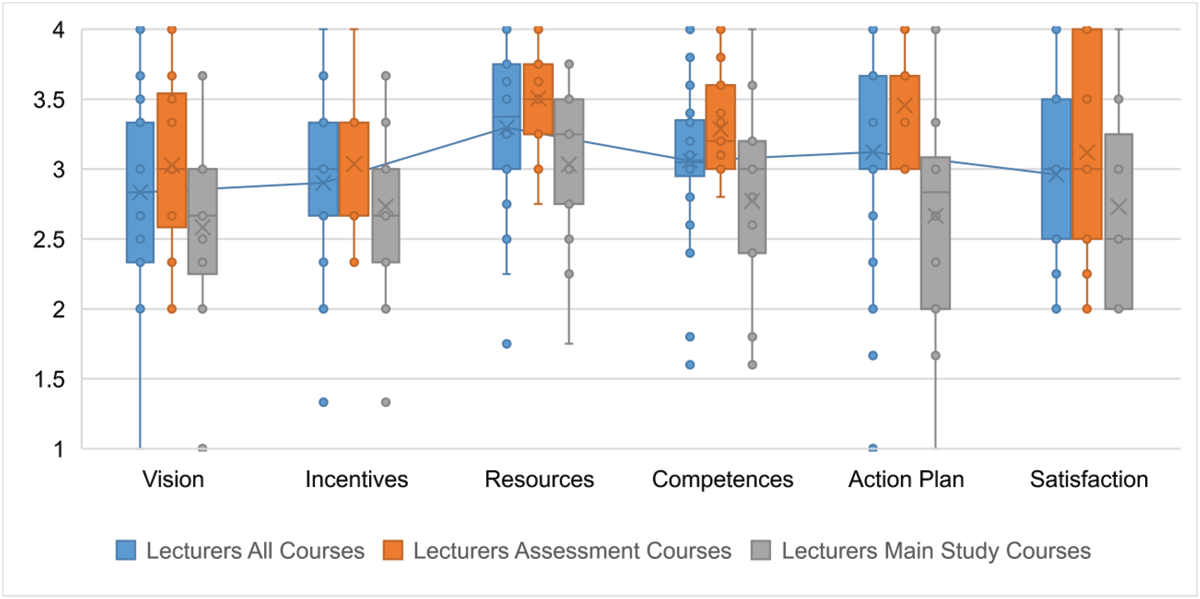
Figure 3
Lecturers’ perceptions of the educational change matrix dimension.
Table B in the Appendix shows that the most frequent codes for teachers’ qualitative resources are for the categories engagement (24%), in-class learning time (13%), self-study time (13%), and format (11%).
The lecturers’ general assessments of the FLEX blended learning format are coded in the category format (n = 30). Overall, the lecturers agreed that the new FLEX study format with a blended learning design was the right approach (ES 34–35), although some also questioned why a complete conversion to a distance learning course in online format was not adopted (ES 36). The results show that lecturers of communicative subjects (foreign languages and communication) are more critical of the FLEX format than lecturers of other subjects (ES 37). Their argument is that communicative skills are difficult to develop with less face-to-face time (ES 38).
Lecturers of other subjects also criticized the reduced social interaction between learners and lecturers, although this was contrasted with the potential of flexible learning (ES 39). Others appreciated this new teaching format because of the small classes and the high level of interaction (ES 40).
Many statements in the evaluations, and particularly in the focus interviews for the category format, had criticisms of the aspects of work-life balance and student priorities (ES 41–43). As a result of this attitude, students were criticized for a lack of preparation in the self-study phase, insufficient attendance, and focused ‘learning to the test’ just before the exams (category commitment, n = 65, ES 44–45).
The comments in the categories of compatibility (n = 3) and burden on students (n = 4) indicate similar attitudes. Lecturers commented on students’ workloads from their commitments in their jobs and private lives, leaving little time for online self-study (ES 47).
Compared to students in other formats, lecturers also reported a lower level of student identification with their academic studies and the university institution (social category, n = 12, ES 48).
With regard to the category study quality (n = 12), lecturers suggested considering exam performance and drop-out rates but noted that the learning behaviors criticized did not necessarily lead to poorer outcomes, because FLEX students proved to be able to regulate their learning well (category self-regulated learning, n = 1, ES 49).
Due to the varying engagement of the students in the self-study phase, the design of the attendance phases was challenging and demanding for the lecturers (category presence teaching, n = 35, category self-study, n = 37, ES 50). Some lecturers added compulsory activities such as assignments or tests to increase engagement (ES 51), while others preferred to leave it up to students as to whether and how to use their learning offerings (category assessment, n = 17, ES 52).
Several lecturers pointed out that the understanding of the FLEX program has not been made sufficiently clear (category teaching culture, n = 9) and recommend that issues of teaching culture, that is, the roles and expectations of learners and lecturers, should be clarified and communicated clearly at the beginning of the program (category FLEX other, n = 24, ES 53–54). In addition, the lack of presence also affected the lecturers’ self-esteem to some degree: it was sometimes interpreted as a lack of appreciation for their teaching work (category teachers, n = 4, ES 55).
Few comments were made about infrastructure (n = 2) and tools (n = 13), although technical and didactical support for FLEX was positive. No statements were explicitly coded for temporal flexibility, spatial flexibility, and learning preference, but these were considered within the format category.
Perceptions of Employers
Table B in the Appendix shows the frequencies of codes for employers’ qualitative sources. The most frequent codes are job compatibility (43%), self-regulated learning (13%), and learner workload (10%). In the format category (n = 9), employers noted challenges with changing attendance days each term, preferring consistent days throughout the program (ES 56). Fixed attendance days every three weeks were seen as positive for scheduling and providing students with fixed objectives (ES 57).
As noted, the code ‘job compatibility’ was the most frequently mentioned code (62 mentions), with 47 positive or neutral and 15 negative. The FLEX format, therefore, seems to be perceived as quite compatible with the job from the employer’s point of view. Employers preferred FLEX because it kept employees in the office more often (ES 58). However, they noted that it requires high self-discipline and is not suitable for all students (category self-regulated learning, n = 18, ES 59). Employers appreciated distinct formats for different needs (category learning preference, n = 4, ES 60) and estimated higher employment rates for FLEX than part-time (ES 61).
Employers do not see any differences in career impact when comparing FLEX graduates and part-time graduates (category study quality, n = 5, ES 63). However, they noted less social exchange and networking in FLEX students compared to students in traditional formats (category social aspects, n = 4, ES 64). Also, phases without a fixed ‘FLEX timetable’ are seen negatively (ES 65).
Employers perceive that the FLEX format leads to less pressure on students at the beginning of the semester, which is seen as positive. However, toward the end of the semester, the pressure on FLEX students increases more than on students in other study formats. Irrespective of this, employers notice a drop in performance among employees (students) before and during the examination phase. However, this statement does not distinguish between FLEX and other formats. The drop in performance is perceived as ‘normal’ and does not represent an unexpected problem for employers (category workload student, n = 14, ES 66).
Employers appreciated the greater time flexibility of FLEX students (category temporal flexibility, n = 10), because this enabled working hours to be flexible and made balancing workloads easier (ES 67).
Employers viewed spatial flexibility (n = 4) positively for students due to reduced travel, though not as an advantage for themselves (ES 68). Also, they appreciated that lessons did not take place in the evening, allowing employees (students) to participate in customer events (ES 69).
Irrespective of the study format chosen, employers believe that the time and effort spent studying should be primarily at the expense of leisure time and not at the expense of the job (category Compatibility leisure and health, n = 4, ES 70). Apart from a few exceptions, students are not permitted to study during working hours even if conditions allow, such as when the workload is low (ES 71).
Discussion
The results of perceptions of the stakeholder groups with regard to the two aspects of the research question—flexible learning study structure and blended learning design—are integrated and discussed below. The analysis shows (see also Appendix, Table B) that students and employers strongly emphasize the flexible learning study program structure, while the statements of the lecturers focus more on the blended learning course design.
Flexible Learning Study Structure
Students, lecturers, and employers all have a generally positive attitude towards the implementation of the flexible learning study program in a blended learning modality. This aligns with other studies on the implementation of blended learning (Mestan 2019). However, lecturers from highly interactive disciplines like languages and communication and those who could not opt out of teaching in the FLEX modality have more reservations. Some lecturers feel that there are fewer opportunities for interaction and academic discourse due to the reduced level of face-to-face teaching. As a result of some lecturers’ reservations about the FLEX format, students noted that they sometimes felt like ‘second-class students’. Not surprisingly, the detailed evaluation of the learning effectiveness of individual modules also reveals a correlation between lecturers’ attitudes towards FLEX and the learning effectiveness of the modules (see also Müller et al. 2023).
The significance of flexibility is also reflected in the fact that the main motivation for students to enroll in the FLEX format was, indeed, the flexibility of the format. Students and employers value time flexibility particularly highly. It allows students to combine their studies with other time-consuming commitments, such as a high level of employment and family care responsibilities. As in other studies (Vanslambrouck et al. 2018), various students also mentioned that they would not be able to pursue their studies at all without the FLEX format, and this echoes the findings of other studies that have also highlighted the importance of time flexibility for students (Groen et al. 2020). From an employer’s perspective, the increased flexibility in students’ schedules is also advantageous, as it allows them to better accommodate workplace demands. A structured and predictable timetable of student availability across the duration of a degree program is particularly important for employers, as it facilitates planning and coordination in the workplace. Although employers allow students a high degree of temporal flexibility over the course of the week or year, they offer little time to study during working hours.
Spatial flexibility is perceived as subordinate to time flexibility and is scarcely mentioned at all by any of the stakeholder groups. This is also reflected in the geographical catchment area of students, which does not differ much from that of the conventional teaching format (i.e., few students live further away from the university).
In the FLEX program, face-to-face time was reduced by 51% compared to the conventional program and replaced by an asynchronous online learning environment. The reduction corresponds to many other similar implementations of blended learning (Müller & Mildenberger 2021) and exceeds the 36% minimum identified by Owston and York (2018) for a positive perception by students. Students and lecturers assess the 51% reduction in attendance time differently. Some students would prefer even more time flexibility in their learning process; these students would like to be provided with as many learning resources as possible without time restrictions or formal conditions and be free to decide when and what they learn. They interpret flexible learning as the individual flexibility to organize the learning process according to their own preferences to optimize their exam preparation. Others would like to see more face-to-face sessions and are aware that flexibility also comes at a cost. For example, the student respondents mentioned the difficulty of working with peers and organizing group work; this was also reported by Vanslambrouck et al. (2018). Other studies have also shown that learners are aware of certain trade-offs with flexible learning and do not want maximum flexibility in all dimensions (Li 2014; Tucker & Morris 2012). Cognitive psychologists have also pointed to the negative effects of too much flexibility (Corbalan, Kester & van Merriënboer 2009). As experience with very open learning environments such as discovery learning shows (Kirschner, Sweller & Clark 2006), less experienced learners, in particular, are not always aware of what is best for their learning process and are therefore prone to making suboptimal decisions. Many options in highly flexible learning environments can exacerbate this effect. In addition, having many options means that decisions have to be made constantly, which requires cognitive resources and can lead to high cognitive load due to the individual’s personal freedom in the learning process (Sweller 1994).
All stakeholders emphasized that the FLEX format demands strong self-regulation skills. Students’ difficulties with self-directed learning and time management highlight this and are in keeping with the findings of other studies (Barnard et al. 2009; Owston et al. 2013; Van Laer & Elen 2017). All stakeholder groups indicated that FLEX is not recommended for all students and that it may be worth offering different study modalities to allow students to choose the study format that best suits their individual needs and requirements. This echoes the finding of the FLEX pilot study (Müller et al. 2018) that students’ needs and choices are very diverse, reflecting the diversity of their life contexts and study skills. As not all learners have the necessary personal skills to effectively plan, organize, and reflect on the learning process in flexible learning, institutions should, where possible, offer modalities with different levels of flexibility, or lecturers should use appropriate support structures to individually assist students with more structural needs.
A cultural aspect mentioned by all three stakeholder groups is the reduced social cohesion in FLEX classes. This is in keeping with other studies about connectedness and social belonging in online and blended learning (Arslan 2021; Hehir et al. 2021). Students know each other less well and participate less in student social events, potentially building smaller professional networks during their studies as a result. Lecturers also perceive that FLEX students, unlike students with a higher attendance rate, tend to have a more business-oriented life due to their high level of employment and have fewer connections with the higher education institution and their peers.
Blended Learning Design
Detailed analysis of student evaluations shows that satisfaction with the design of the blended learning environment was comparable to the conventional face-to-face learning environment but was also characterized by a certain heterogeneity due to the freedom in the educational course design. Modules with appropriate structure, guidance, and learning tasks for activation, interaction, and assessment had better student evaluations and higher learning effectiveness (see also Müller et al. 2023). In addition, the analysis showed that students particularly value learning with learning videos, which is in line with student perceptions in other blended learning implementation projects (Groen et al. 2020).
Lecturers noted that the biggest challenge was student motivation and engagement. A main criticism was the lack of commitment in the asynchronous self-study phase and the resulting inadequate preparation for the attendance phases. Lecturers also note a considerable rate of absenteeism during attendance periods. Some committed students also cited a lack of preparation for these phases, aligning with other studies on blended learning implementation (Ashraf et al. 2021; Lawter & Garnjost 2023; Li et al. 2014; Senali et al. 2022).
The lecturers’ adaptation strategies vary. Some prefer more controlling, mandatory learning activities in their modules, such as compulsory assignments or tests, while others see their module more as a learning opportunity and leave it to students to decide how to use it. Finding the right balance of structure, guidance, accountability, and support without overly restricting the desired flexibility has proven to be the biggest challenge in designing blended learning in a flexible learning program. This is in line with previous studies, such as Vanslambrouck et al. (2018), which emphasize that institutions should keep in mind that they need a clear vision of how to guide students in this flexibility without taking too much control.
Practical implications
At the higher education institution analyzed, an e-learning strategy was developed and adopted in 2014 in a complex process involving various stakeholders over several coordination cycles. A key element was the introduction of the FLEX bachelor’s degree format alongside the existing full-time and part-time formats. In this format, face-to-face classroom time was reduced by 51% and replaced with an online learning environment in a blended learning format. The implementation of FLEX was analyzed over a period of more than four years in 133 courses across various disciplines, using a mixed-methods approach. In general, the project provides evidence that making education more flexible by offering blended learning with reduced classroom time can improve access to education without compromising learning effectiveness. In addition, this study showed that stakeholder satisfaction is relatively high and that they perceive a flexible learning program as valuable. The analysis of stakeholders’ perceptions has refined the understanding of the FLEX format. A clearer distinction is now made between the flexible study structure, addressing student and employer needs, and the blended learning format, which can be demanding and sometimes unsatisfactory for lecturers.
The findings should encourage higher education institutions to offer more flexible study programs in the future. At the same time, this project highlights the importance of high-quality implementation of blended learning. Quality of implementation moderates the effectiveness of the courses and stakeholder satisfaction. Implementation quality depends on several factors at both the program and course levels. Key findings at the program and course levels are listed below, although successful change usually requires interaction between levels and actors.
Program Level
The FLEX format was systematically developed, involving various stakeholders and considering various measures for successful change, to gain lecturer commitment. Early involvement was crucial for several reasons: a) to reward efforts in developing the courses, b) to make structural decisions and provide the infrastructure, and c) to support them in understanding and implementing blended learning according to the change matrix. McCarthy and Palmer (2023) point out that the final application of blended learning is an individual endeavor and relies heavily on lecturers’ implementation. Institutions should enable teachers to create effective blended learning environments by providing both support and flexibility. The process of implementation and change was facilitated by allowing interested lecturers to volunteer for initial modules, leading to high willingness and commitment. Positive experiences from these early adopters were used in the course of the project when self-selection was no longer possible and teachers who were less open to innovation were integrated. This is in keeping with other universities’ experience (Groen et al. 2020).
When starting the project, some lecturers were concerned that the increased use of online learning would lead to a reduction in staff, for example, due to lecturers being replaced by learning videos and other digital learning resources. An important argument against fears of staff cuts was that the hourly factor in the blended learning format FLEX was the same as in the traditional formats PT and FT. While face-to-face time is reduced by half in blended learning courses, the lecturers’ working time is freed up to prepare and support the online phase. In addition, the development of digital self-learning courses involves a considerable initial investment. Experience with the FLEX implementation shows, for example, that an additional workload of over one hundred hours can be expected for a three-ECTS course. These development hours were available to lecturers in addition to their teaching hours and were intended to provide an incentive to commit to the FLEX format. Additional hours were also allocated for reflection and optimization of the module after the first implementation. Thus, in contrast to other implementation projects (e.g., Groen et al. 2020; Mestan 2019), time resources were not a barrier, as the additional work for developing the blended learning courses was compensated.
Flexible learning has extended teachers’ roles to include producing electronic resources, designing online environments, and supporting asynchronous learning. To avoid negative effects like confusion or resistance, teachers need preparation and support through training, coaching, and workshops. In FLEX implementation, the scripting workshop proved particularly useful in developing blended learning environments.
The study also highlighted the necessity to clarify the self-conception and teaching culture of the degree program. In particular, the level of flexibility must be defined through consultation with the relevant stakeholders, most notably the staff and students. Furthermore, students and teachers may have differing ideas of flexible learning and differing conceptions of their roles. This makes clarifying expectations on teaching assignments, student presence, and lecturer response times crucial to achieving a common understanding without overly restricting autonomy. Restriction of autonomy can lead to resistance among lecturers when introducing blended learning (Huang et al. 2021; Truss & Anderson 2023).
Course Level
At the course level, the design and implementation of blended learning is of central importance. It is essential to provide students with an appropriate course structure, guidance, activating learning tasks, stimulating interaction and teacher presence, and timely feedback on the learning process and outcomes. In blended learning with substantial asynchronous self-learning, particular attention needs to be paid to student engagement during self-learning and its integration with classroom phases. Our study shows that student engagement is critical due to the multiple demands of a flexible study program, and therefore, this engagement needs to be explicitly encouraged and required. Recommendations in this regard can be derived from research on promoting student engagement in blended learning, particularly in a flipped classroom design (Bond & Bergdahl 2022; Heilporn & Lakhal 2021; Heilporn et al. 2022; Manwaring et al. 2017). Among the measures that promote emotional, cognitive, and behavioral engagement, those that promote activation through a variety of learning tasks and social interaction, like collaborative reading of instructional texts or videos with annotation tools, are particularly important.
The online phase was long the focus of blended learning design because it was largely unfamiliar to teachers. To promote student engagement in asynchronous learning, more attention should be paid to linking the online and face-to-face phases. An appropriate design of the face-to-face phase is also crucial (Buhl-Wiggers et al. 2023). However, lecturers’ extensive classroom teaching experience may lead them to adhere to traditional educational designs rather than adapt to the requirements of blended learning. Last but not least, assessment is a guiding principle for learners; students focus their learning efforts strongly on the assessed learning activities and products (Biggs 1996). It is, therefore, important to provide incentives to engage in asynchronous learning, which may require adjustments to the assessment system at the course, program, and even university levels.
Limitations and future research
The findings of this study should be considered in the context of its limitations. First, due to the small sample size, particularly in stakeholder employers, our study could not provide a more nuanced understanding of stakeholder perceptions. Therefore, the perceptions of employers and other stakeholder groups, such as strategic management (e.g., university management, politicians), should be analyzed in more detail.
Second, the sample was drawn from a single study program. While this allowed us to examine changes within a single context over several years, it limits the generalizability of our findings to other programs, disciplines, and institutions. However, prior to the introduction of the FLEX program, the institution was already well-positioned in terms of digital learning; for example, all lecturers had a good level of ICT skills and experience with learning management systems (Müller et al. 2016). This suggests that the initial situation is comparable to many other universities today.
Nevertheless, it would be valuable to scientifically investigate systematic implementations of blended learning at the degree program or university levels in various disciplines and to obtain broader scientific findings on implementation and practice. In particular, the connection between student characteristics and the perception, choice, and academic success of study formats with different degrees of flexibility should be investigated. With these findings, higher education institutions would have scientifically validated guidelines for the choice of the appropriate form of flexibility and study modality.
Data Accessibility Statement
The datasets are available from the corresponding author on reasonable request.
Additional File
The additional file for this article can be found as follows:
Appendices. Tables A to C. URI: https://eurodljournal.com/articles/155/files/685a7834a5019.pdf
Abbreviations
COVID-19: Coronavirus disease 2019
FLEX: Flexible study format
FT: Full-time study format
LMS: Learning Management System
PT: Part-time study format
Acknowledgements
We thank the students, the lecturers, and the employers who participated in this study.
Competing Interests
The authors have no competing interests to declare.