
Table 1
Corpus Overview.
| SOURCE/GENRE | BOOKS | REVIEWERS | REVIEWS | TOKENS (MIO.) |
|---|---|---|---|---|
| charts | 291 | 7860 | 39163 | 10.31 |
| newly reviewed books | 5321 | 28211 | 220074 | 61.48 |
| book lists | 3278 | 14664 | 133805 | 36.37 |
| historical novel | 860 | 6331 | 25720 | 7.23 |
| literature | 990 | 8393 | 36504 | 9.75 |
| fantasy | 1054 | 10046 | 43956 | 12.84 |
| romance novel | 1202 | 10464 | 56392 | 15.75 |
| crime and thriller | 1510 | 10076 | 56368 | 13.95 |
| erotic literature | 427 | 4777 | 12070 | 3.36 |
| young adult | 856 | 14409 | 59082 | 17.72 |
| entertainment | 774 | 7646 | 24595 | 6.34 |
| science fiction | 367 | 3083 | 5580 | 1.7 |
| other genres | 29 | 1227 | 1720 | .4 |
| all | 8069 | 30434 | 321987 | 89.05 |
[i] ‘Charts’, ‘newly reviewed books’, and ‘book lists’ refer to the three sources used to construct the corpus; the other rows show how the corpus is distributed across the genre labels assigned by LovelyBooks. The values for ‘all’ are smaller than the sum of ‘charts’ + ‘new reviews’ + ‘book lists’, since there is some overlap among the works covered by these sources. ‘Other genres’ includes, for example, children’s books, comics, and cookbooks.
Table 2
Frequency of fictionality words.
| WORD CLASS | EXAMPLES | BOOKS | REVIEWERS | REVIEWS | WORDS |
|---|---|---|---|---|---|
| fikti/ficti | fiktiv, Fiktion, fan fiction | 2446 | 4337 | 10751 | 12814 |
| fikti | fiktiv, Fiktion, fiktional | 2164 | 3511 | 8678 | 10120 |
| ficti | fan fiction, science fiction | 643 | 1425 | 2180 | 2694 |
| fiktiv_ADJ | fiktiv, teilfiktiv, halbfiktiv | 1673 | 2405 | 5242 | 5886 |
| fiktion_NOUN | Fiktion, Genrefiktion | 1063 | 1720 | 2995 | 3274 |
| science_fiction_NOUN | Science-Fiction, Sci-Fiction | 298 | 578 | 817 | 1022 |
| fiction_NOUN | Fiction, Fiction-Bücher | 310 | 467 | 627 | 692 |
| fiktion_ADJ | fiktional, quasi-fiktional | 329 | 354 | 456 | 501 |
| fiction_X11 | 231 | 356 | 437 | 477 | |
| fan_fiction_NOUN | Fanfiction, Wattpad-Fanfiction | 123 | 279 | 354 | 434 |
| rest | Fiktionalisierung, fictiv | 163 | 189 | 230 | 253 |
| autofiktion_ADJ | autofiktional | 60 | 103 | 141 | 152 |
| fiktiv_NOUN | Fiktivität, (das) Fiktive | 103 | 102 | 120 | 123 |
[i] Example: There are 5886 words from the class fiktiv_ADJ (‘fiktiv’, ‘teilfiktiv’, ‘halbfiktiv’, etc.) in the corpus. These 5886 words appear across 5242 reviews, are used by 2405 different reviewers, and occur in reviews of 1673 different books.
Table 3
Annotation Categories.
| ANNOTATION CATEGORY | EXPLICATION: THE ANNOTATED WORD QUALIFIES … | EXAMPLE |
|---|---|---|
| object | objects and places within the world represented by a literary text | ‘Die fiktive griechische Insel trägt den Namen Aura.’ |
| character | characters or groups of characters within the world represented by a literary text | ‘Zwei der zentralsten Charaktere des Buches sind fiktionale Figuren.’ |
| event/state | events or states within the world represented by a literary text | ‘Allgemein waren für meinen Geschmack die Geschehnisse zu fiktiv.’ |
| world | the world represented by a literary text | ‘Ich kann aus der Realität in eine fiktionale Welt flüchten.’ |
| world (other) | elements within the world represented by a literary text not covered by the previous categories | ‘In einer fiktiven Vergangenheit erzählt uns Oberons ehemaliger Hofnarr eine seltsame Geschichte.’ |
| element | unspecified ‘elements’, ‘aspects’, or ‘parts’ of a literary text | ‘Trotzdem handelt es sich um einen Roman, der viele fiktionale Elemente beinhaltet.’ |
| story | the ‘story’ or ‘plot’ of a literary text | ‘Die Geschichte ist zwar fiktiv, könnte allerdings genauso passiert sein.’ |
| representation | a representation or narration, or the act of representing or narrating | ‘Bei diesem Rechtsmedizin-Thriller handelt es sich um die fiktionale Erzählung eines echten Kriminalfalls.’ |
| work | a literary text, novel, work, book, etc. | ‘Aber hey es ist ein fiktives Buch, es soll mich unterhalten und spannend sein.’ |
| other | cases not covered by the previous categories, e.g., references to real authors | ‘Eine andere autofiktionale Essayistin, die ich sehr mag […]’ |
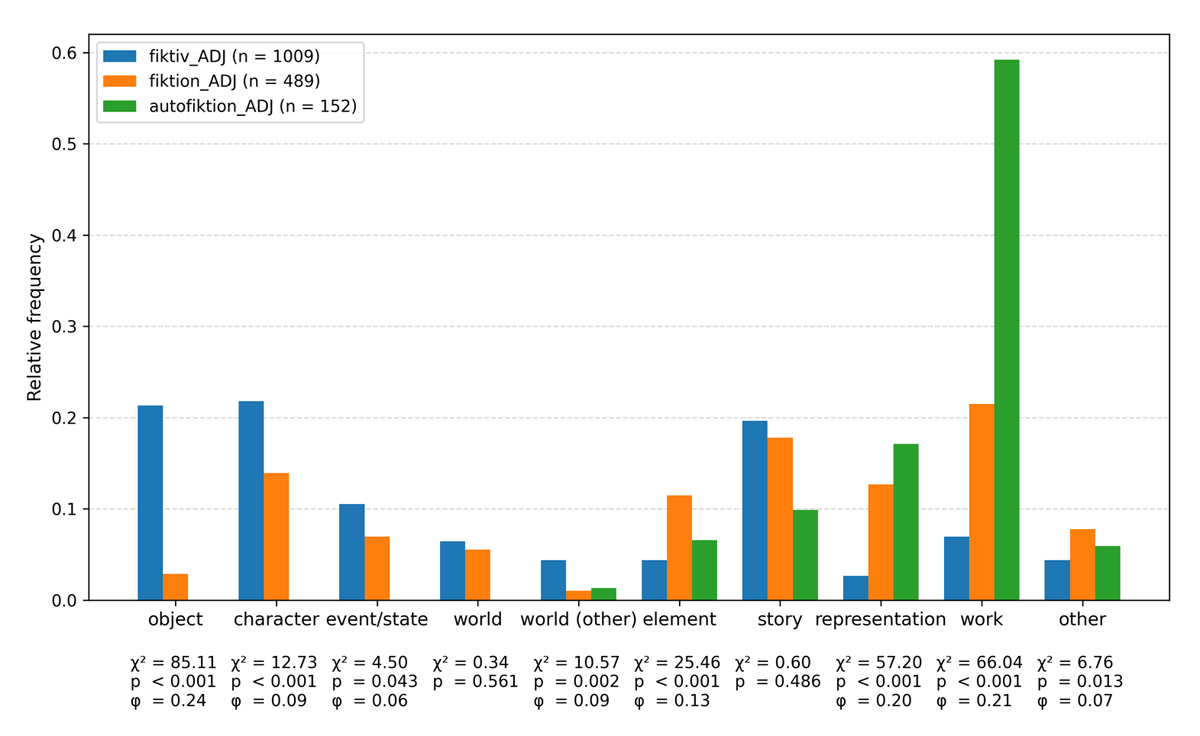
Figure 1
Results Annotation Task 1 (Phenomena).
Example: Among the 1009 annotated instances of fiktiv_ADJ, 21% were assigned to the ‘object’ category; among the 489 annotated instances of fiktion_ADJ, this proportion was 3%, and among the 152 instances of autofiktion_ADJ, 0%.14 The difference between fiktiv_ADJ and fiktion_ADJ is statistically significant (χ²(1) = 85.11, p < 0.01, φ = 0.24). All significance tests refer solely to the relationship between fiktiv_ADJ and fiktion_ADJ. All p-values were adjusted using the Benjamini–Hochberg procedure.
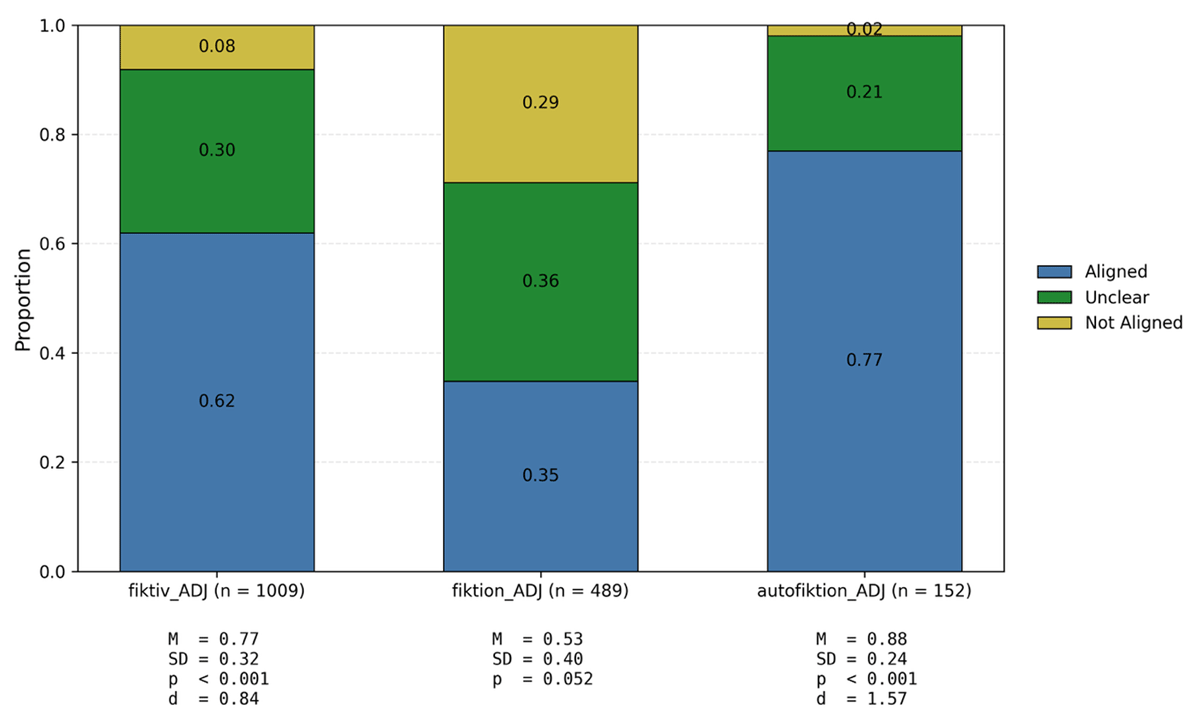
Figure 2
Results Annotation Task 2 (Alignment).
Example: Of the 1009 annotated instances of fiktiv_ADJ, 62% were aligned with literary studies, 8% were not aligned, and 30% were classified as neither. The bootstrap test revealed that the mean (M = 0.77) is significantly above 0.5 (p < 0.001, d = 0.84).