
1 Introduction
One of the key aspects of people’s discourse on literature concerns the terminology they use. The range of terminological resources available in a given communicative context can play a crucial role for which phenomena are foregrounded, which distinctions are emphasized, and which ideas are articulated. Fittingly, then, literary scholars devote considerable effort to explicating, refining, and teaching the terms of their discipline, as reflected in reference works such as The Routledge Dictionary of Literary Terms (Childs & Fowler 2006), The Penguin Dictionary of Literary Terms and Literary Theory (Cuddon 2014), or The Oxford Dictionary of Literary Terms (Baldick 2015). However, terminology is not only relevant for literary scholars or other people who engage with literature professionally, but also for lay readers. When discussing literature, everyday readers frequently use non-trivial terms such as style, suspense, fiction, or literature, whether precisely or imprecisely, reflectively or unreflectively. Employing such terms is part of what can be called lay literary theory, which means, roughly, the engagement of literary laypeople with literary-theoretical terms and propositions (for details, see Köppe & Winko 2013: 1–2; Rühling 2020: 217–222). The aim of this contribution is to shed further light on the terminological resources of readers in non-professional contexts by examining a particularly significant example in German. The article focuses on a terminological distinction that is typically not made, or at least not made in the same way, in English (Harweg 2004: 299; Enderwitz 2012; König 2020: 92): the distinction between fiktiv and fiktional.
German-language scholars generally use the adjective fiktional to characterize representational media or utterances, while they use the adjective fiktiv to qualify phenomena that are represented by such media or utterances and/or that do not exist in the real world. According to this distinction, the novel The Lord of the Rings is fiktional —it is a work intended and received as fiction—but it is not fiktiv, since it is a cultural artifact that exists in reality, outside the world represented by a fictional work. On the other hand, the character Frodo Baggins is fiktiv—he belongs to the world represented by a fictional work and does not exist in reality—but Frodo is not fiktional, since he is not himself a representational medium. While there are certainly differences in nuance when it comes to explicating the terms in question (see Section 2), the basic distinction is largely uncontroversial in German-language research and is widely presented in companions or introductory works (e.g., Rühling 2011: 29; Martínez & Scheffel 2013: 15–16; Köppe & Kindt 2014: 81–82; Missinne et al. 2020: 5–7). Furthermore, the fiktiv/fiktional distinction is sometimes considered a central tenet of fictionality theory. German-language scholars have argued that ‘the interconnection of fictiveness [Fiktivität] and fictionality [Fiktionalität] remains an inescapable fact for any theory of literary fiction’ (Zipfel 2001: 167), or even that ‘the distinction between fictiveness [Fiktivität] and fictionality [Fiktionalität] constitutes […] the very core of any theory of literary fiction’ (Kablitz 2008: 18; Kablitz 2013: 169–170).1
The terms fiktiv and fiktional are not confined to scholarly usage, but also play a role in non-academic and non-professional discourses on literature. This is evident, for example, from numerous instances where users on digital social reading platforms such as LovelyBooks (the German counterpart to Goodreads) employ these terms (see Section 4). However, whereas literary scholars usually draw a clear distinction between fiktiv and fiktional, everyday readers often conflate the two—or at least this seems a reasonable suspicion. The scholar Lutz Rühling, for example, refers to fiktiv and fiktional as ‘colloquially often synonymously used expressions’ (Rühling 2011: 29). Similar assumptions are voiced within non-academic contexts themselves. For instance, a BookTok video from 2023, which sets out to clarify the distinction between fiktiv and fiktional, opens with the observation that ‘an unbelievable number of people make this mistake [of conflating fiktiv and fiktional]’ (isi_peazy 2023).2 Indeed, it is easy to find examples on platforms such as LovelyBooks where users describe characters and objects within fictional works as fiktional and the works themselves as fiktiv even though, from the perspective of literary studies, the correct usage would be exactly the opposite.3
While the examples mentioned so far may offer an initial guess as to how everyday readers use fiktiv and fiktional, they remain largely anecdotal. The aim of this contribution is to provide a more systematic perspective on the usage of these terms. On a broader level, the study will thereby contribute to our understanding of the degree of terminological differentiation readers apply in their engagement with literature, the extent to which academic conventions resonate in non-scholarly contexts, and what kind of terms need or need not be explicated when addressing the non-scholarly public. To fulfill these aims, I will analyze a large corpus of reviews from LovelyBooks and test three closely related pairs of hypotheses:
H0dist: LovelyBooks users do not distinguish between fiktiv and fiktional. (H1dist: they do.)
H0align-fiktiv: LovelyBooks users do not predominantly use fiktiv in alignment with how the term is usually understood in literary studies. (H1align-fiktiv: they do.)
H0align-fiktional: LovelyBooks users do not predominantly use fiktional in alignment with how the term is usually understood in literary studies. (H1align-fiktional: they do.)
It is helpful to separate these sets of hypotheses, as users might distinguish between fiktiv and fiktional, but in a way that does not align with literary studies (i.e., H1dist does not imply H1align-fiktiv or H1align-fiktional). Note that the aim of testing the hypotheses is not to scold or praise LovelyBooks users for (not) following an allegedly ‘correct’ usage, but rather to elucidate their terminological practices from a descriptive, rather than a normative, perspective.
Section 2 provides an overview of related work, while Section 3 introduces the LovelyBooks corpus on which this study is based. Section 4 explores how frequently the terms fiktiv and fiktional appear in the corpus, alongside related terms such as Fiktion, Science Fiction, and Fanfiction. The core of this contribution, Section 5, presents an annotation study designed to test the hypotheses outlined above. Section 6 provides a brief qualitative analysis of cases where reviewers use fiktiv and fiktional in ways considered ‘incorrect’ from the perspective of literary studies, as well as of the functions these terms can serve.
2 Related Work
Until now, no research has been conducted on how people use the terms fiktiv and fiktional in non-academic or non-professional contexts. However, several related areas of study exist.
Fictionality Theory: In philosophy, literary studies, and other disciplines, the concept of fictionality has been the subject of an extensive and long-lasting debate (for overviews, see Klauk & Köppe 2014; Gjerlevsen 2016; Zetterberg-Nielsen & Zetterberg-Nielsen 2019; Gammelgaard et al. 2022). One of the challenges in this debate lies in the variability of terms across research areas and languages (Hempfer 2004 [1990]). In English-language scholarship, the terms fiction, fictional, and fictionality seem to be used as broad, overarching categories that cover all phenomena in question (König 2020: 92; Rajewsky 2020: 33–34). By contrast, German-language scholarship tends to distinguish between fiktiv and fiktional, at least since the 1990s (Rajewsky 2020: 34–35). From today’s perspective, a particularly influential contribution was made by Zipfel (2001: 19), who defines fiktiv as referring to ‘the non-reality of what is represented’ and fiktional as referring to ‘texts in which something fictive [Fiktives] is represented.’ Similarly, Kablitz (2013: 166) speaks of ‘the fictive [dem Fiktiven] as a property of what is represented and the fictional [dem Fiktionalen] as a property of representation’. As a final example, Rühling (2011: 29) states that the “predicate ‘fictional’ [fiktional] refers exclusively to a particular mode of representation, namely that the represented object does not exist. By contrast, the predicate ‘fictive’ [fiktiv] refers solely to a—provisionally so called—specific mode of existence of objects (in the formal sense), namely that these objects do not exist.”4 While all of these explications point in a similar direction, controversies arise when the focus shifts to more specific issues (see also Hempfer 2018: 40–43). For instance, scholars have debated whether real-world entities that appear within the world represented by a fictional text (e.g., Napoleon Bonaparte in Tolstoy’s War and Peace) should be considered fiktiv (Rühling 2011: 29–30; Köppe & Kindt 2014: 82–83), or whether every fictional work has a fiktiv narrator (Köppe & Stühring 2011; Patron 2021). Still, such debates do not alter the fact that the basic fiktiv/fiktional distinction enjoys a considerable degree of consensus in German-language research. This is evidenced not only by its broad dissemination in companions and introductory works (see the introduction), but also by the explicit acknowledgement of its widespread acceptance. For example, Rajewsky and Enderwitz (2016: 1) argue that the fiktiv/fiktional distinction has ‘to a large extent been established’ in German-speaking contexts and that there is ‘consensus’ on it. Similarly, Zipfel (2016: 19) claims that the distinction has become ‘established’ in German-language research.5
Readers and Fictionality: Some research has been conducted on how everyday readers engage with fiction, understood here not as (narrative) literature in general, but as texts produced in accordance with the institution of fictionality (see Pettersson 2016 for an overview that emphasizes this distinction). One line of inquiry examines fictionality competence, that is, the ability to engage with fictional communication, which typically develops during childhood (Groeben & Dutt 2011). Findings in this area indicate a link between fictionality competence and broader literary competence (König 2020). Another strand of research investigates whether reading fictional versus non-fictional texts (or texts framed as such) yields differences in reading experience, cognitive processing, or evaluative judgments. These studies often confirm that such differences exist (e.g., Leavitt, Ryazanov & Christenfeld 2014; Ghasseminejad 2024), though some contributions highlight qualifications (Pettersson 2016; Chlebuch et al. 2020). Overall, the body of work outlined in this paragraph emphasizes the general significance of fictionality in reception processes.
Readers and Terminology: Some studies specifically focus on readers’ use of literature-related terminology, thereby examining (parts of) lay literary theory. Dera (2024) analyzes Dutch school students’ conceptions of the term literature and concludes that their understanding is generally limited. Gittel and Haider (2025) investigate the usage of the German term Erzähler (‘narrator’) in journals of the 19th and 20th century, that is, not necessarily by laypeople, but in most cases by individuals who are not literary scholars. They find a tendency to distinguish between narrators and authors, which is still ongoing today. Other studies shift the focus to terms and categories not typically used in literary studies but more specific to other domains, such as categorization practices on Archive of Our Own (Price 2019) or so-called Book Tropes (Kröncke 2025). Overall, the results reported thus far appear to be ambivalent. On the one hand, there are contexts in which readers employ literature-related terms with notable nuance (as in some uses of Book Tropes). On the other hand, where comparisons with academic usage are possible, lay terminology is not as elaborated as in scholarly contexts (as with literature) or, at the very least, requires considerable time to catch up with the latest theoretical developments (as with Erzähler).
Digital Social Reading: Since the present study draws on reviews from LovelyBooks, another related field of inquiry is research on digital social reading. Digital social reading documents are increasingly recognized as a valuable source for reader-oriented research, offering unprecedented access to large volumes of reception discourse (cf. Lauer 2020; Rebora et al. 2021; Walsh 2023; Pianzola 2025). A substantial number of studies in this area analyze online reviews, with many investigating their evaluative dimension, for instance, by identifying which aspects of literary texts readers focus on and/or rate positively or negatively (e.g., Milota 2014; Boot 2023; Rebora & Vezzani 2024). Some of this evaluation-focused research has already examined German-language reviews, including those on Amazon (e.g., Mehling et al. 2018), as well as on LovelyBooks (e.g., Rebora, Messerli & Hermann 2022; Heumann 2025). In contrast, the present contribution belongs to another group of studies that do not center on the evaluative content of reviews, but instead use them to investigate other reception phenomena. In the case of studies on LovelyBooks, such phenomena can include the ways in which readers relate literature to real life (Borkowski 2021) or, as in the present contribution, their terminological practices.
3 Corpus
The corpus used in this study consists of reviews from LovelyBooks, the leading German-language online platform for book reviews. It seems reasonable to assume that the majority of LovelyBooks users are non-professionals in their engagement with literature, that is, they are not professional literary scholars, critics, etc., though exceptions certainly exist. It should also be noted that the LovelyBooks user base is not representative of German-language readers of literature in general, and even less so of the German-speaking population as a whole. This is why the hypotheses stated in the introduction refer not to ‘readers’ or ‘people’, but to ‘LovelyBooks users’. Finally, the LovelyBooks corpus may introduce biases related to the specific text type, as it is at least conceivable that users employ the terms fiktiv and fiktional differently in online reviews than in other types of texts.
The corpus comprises over 300,000 reviews and was assembled from three sources:
charts: all reviews for books listed in LovelyBooks’ weekly ‘Top 20 Charts’ between June 2024 and June 2025. These charts are curated by LovelyBooks and are intended to reflect ‘community popularity’, that is, books that are ‘of greatest interest, most read, and most reviewed’ in the respective week (LovelyBooks 2025). This source captures reviews of titles that are particularly trending among users.
newly reviewed books: all reviews for books that received new reviews in the summer of 2025. These books were identified by browsing the LovelyBooks pages dedicated to major genres6 and collecting titles listed in the ‘new reviews’ sections. While not every newly reviewed book could be included, the top X new reviews across all major genres were sampled multiple times. Importantly, not only the newly written reviews but all existing reviews for the selected books were included. This source captures reviews for books that users chose to review beyond the top charts.
book lists: all reviews for books featured on selected ‘book lists’ curated by LovelyBooks, specifically, the Beste Neuerscheinungen (Best New Releases) and the Lesenswert (Worth Reading) lists covering all major genres from 2022 to 2025. This source captures reviews of books highlighted and recommended by the LovelyBooks editorial team.
In all cases, only full reviews were considered; very short reviews (‘Kurzmeinungen’) were excluded. Data collection was conducted in the summer of 2025.7
Overall, the corpus consists of a large and diverse set of reviews (see Table 1). Although there is a focus on relatively recent books and reviews, this focus is not absolute: users can, of course, also review older books, and older reviews are included as well.8
Table 1
Corpus Overview.
| SOURCE/GENRE | BOOKS | REVIEWERS | REVIEWS | TOKENS (MIO.) |
|---|---|---|---|---|
| charts | 291 | 7860 | 39163 | 10.31 |
| newly reviewed books | 5321 | 28211 | 220074 | 61.48 |
| book lists | 3278 | 14664 | 133805 | 36.37 |
| historical novel | 860 | 6331 | 25720 | 7.23 |
| literature | 990 | 8393 | 36504 | 9.75 |
| fantasy | 1054 | 10046 | 43956 | 12.84 |
| romance novel | 1202 | 10464 | 56392 | 15.75 |
| crime and thriller | 1510 | 10076 | 56368 | 13.95 |
| erotic literature | 427 | 4777 | 12070 | 3.36 |
| young adult | 856 | 14409 | 59082 | 17.72 |
| entertainment | 774 | 7646 | 24595 | 6.34 |
| science fiction | 367 | 3083 | 5580 | 1.7 |
| other genres | 29 | 1227 | 1720 | .4 |
| all | 8069 | 30434 | 321987 | 89.05 |
[i] ‘Charts’, ‘newly reviewed books’, and ‘book lists’ refer to the three sources used to construct the corpus; the other rows show how the corpus is distributed across the genre labels assigned by LovelyBooks. The values for ‘all’ are smaller than the sum of ‘charts’ + ‘new reviews’ + ‘book lists’, since there is some overlap among the works covered by these sources. ‘Other genres’ includes, for example, children’s books, comics, and cookbooks.
From this point onward, the analysis will focus on the overall corpus, with distinctions by source type and/or genre made only occasionally, as such differences are not the primary concern of this paper.9
4 Occurrences of Fictionality Words
A first necessary step is to examine how frequently fictionality words occur in the corpus. ‘Fictionality words’ are operationally defined here as words containing the string fikti or ficti, with obvious false positives excluded.10 As a wide range of word forms appears—not only fiktiv and fiktional, but also, for example, halbfiktiv, autofiktional, fiktionalisiert, Fiktion, Fiktivität, Science Fiction, Fan Fiction, and others—it is necessary to group the findings systematically. To this end, the following workflow is applied:
Search the reviews for words containing the strings fikti or ficti (case-insensitive) to capture both German and English spellings, manually excluding any obvious false positives (though none occurred in the corpus analyzed here).
Lemmatize all matches using the Python package spaCy.
Manually sort the resulting lemmas into groups based on morphological and semantic criteria. The groups are: fiktiv (e.g., ‘fiktiv’, ‘halbfiktiv’, ‘Fiktivität’), fiktion (e.g., ‘fiktional’, ‘Fiktion’, ‘Fiktionalität’), as well as, for further differentiation, fiktionalisier (e.g., ‘fiktionalisieren’, ‘Fiktionalisierung’), autofiktion (e.g., ‘autofiktional’, ‘Autofiktion’), autofiktiv (e.g., ‘autofiktiv’, ‘Autofiktivität’), science_fiktion (e.g., ‘Science-Fiktion’), fan_fiktion (e.g., ‘Fanfiktion’), and fikti_other (miscellaneous cases, e.g., URLs containing ‘fiktiv’). Parallel groups were created for spellings with ‘c’: fictive, fiction, science_fiction, fan_fiction, and ficti_other (no instances of fictionalize, autofictive or autofiction appeared). Each match was assigned to exactly one group.
Conduct a POS analysis (using spaCy) for all matches, enabling further differentiation within each group from step 3. This allows the identification of classes such as fiktiv_ADJ (e.g., ‘fiktiv’, ‘halbfiktiv’), fiktiv_NOUN (e.g., ‘Fiktivität’, ‘Fiktivheit’), fiktion_ADJ (e.g., ‘fiktional’, ‘semifiktional’), and so forth. The primary classes of interest for this study are fiktiv_ADJ and fiktion_ADJ.
Table 2 presents the number of hits for all matches (fikti/ficti), separately for the German spelling (fikti) and the English spelling (ficti), and finally for all classes that have at least 100 hits. Classes with fewer than 100 hits are grouped together in a ‘rest’ category.
Table 2
Frequency of fictionality words.
| WORD CLASS | EXAMPLES | BOOKS | REVIEWERS | REVIEWS | WORDS |
|---|---|---|---|---|---|
| fikti/ficti | fiktiv, Fiktion, fan fiction | 2446 | 4337 | 10751 | 12814 |
| fikti | fiktiv, Fiktion, fiktional | 2164 | 3511 | 8678 | 10120 |
| ficti | fan fiction, science fiction | 643 | 1425 | 2180 | 2694 |
| fiktiv_ADJ | fiktiv, teilfiktiv, halbfiktiv | 1673 | 2405 | 5242 | 5886 |
| fiktion_NOUN | Fiktion, Genrefiktion | 1063 | 1720 | 2995 | 3274 |
| science_fiction_NOUN | Science-Fiction, Sci-Fiction | 298 | 578 | 817 | 1022 |
| fiction_NOUN | Fiction, Fiction-Bücher | 310 | 467 | 627 | 692 |
| fiktion_ADJ | fiktional, quasi-fiktional | 329 | 354 | 456 | 501 |
| fiction_X11 | 231 | 356 | 437 | 477 | |
| fan_fiction_NOUN | Fanfiction, Wattpad-Fanfiction | 123 | 279 | 354 | 434 |
| rest | Fiktionalisierung, fictiv | 163 | 189 | 230 | 253 |
| autofiktion_ADJ | autofiktional | 60 | 103 | 141 | 152 |
| fiktiv_NOUN | Fiktivität, (das) Fiktive | 103 | 102 | 120 | 123 |
[i] Example: There are 5886 words from the class fiktiv_ADJ (‘fiktiv’, ‘teilfiktiv’, ‘halbfiktiv’, etc.) in the corpus. These 5886 words appear across 5242 reviews, are used by 2405 different reviewers, and occur in reviews of 1673 different books.
Fictionality words occur in 10,751 of the 321,987 reviews in the corpus (3.3%). To provide a rough point of reference, they are far less frequent than words such as ‘suspense’ (Spannung, spannend, gespannt, etc.; 52% of reviews) or ‘narration’ (Erzähler, erzählen, Erzählung, etc.; 28%), but broadly as frequent as ‘literature’ (Literatur, literarisch, etc.; 3.4%) or ‘complex’ (komplex, Komplexität, etc.; 3.5%), and even more frequent than ‘interpretation’ (interpretieren, Interpretation, etc.; 0.8%) or ‘vividness’ (anschaulich, Anschaulichkeit, etc.; 1.4%). In terms of reviewers, 4,337 of the 30,434 reviewers in the corpus (14.3%) use fictionality words at least once, and 3,474 of the 10,302 reviewers who have written five or more reviews do so (33.7%). Overall, it seems fair to say that fictionality words are not among the most frequently used terms for discussing literature on LovelyBooks, but neither are they so rare as to occur only in the most exceptional cases.
Among all fictionality words, those with the German spelling (using a ‘k’) are much more frequent than those with the English spelling (using a ‘c’). The latter mostly appear as nouns, including genre terms like science fiction and fan fiction, which tend to keep their English spelling even in German-speaking contexts.
When looking at the individual classes, fiktiv_ADJ is by far the most frequent. The other class central to this study, fiktion_ADJ, occurs much less often, which constitutes a first important distinction between the two. Another noteworthy case is autofiktion_ADJ. In German literary studies, the term autofiktional is used to characterize texts ‘in which a character who is clearly identifiable as the author (through the same name or a distinctive variation of it, through life dates, or through the mention of previous works) appears in a narrative that is explicitly marked as fictional (through paratextual genre designation or fiction-specific narrative techniques)’ (Zipfel 2009: 31). The fact that this highly specialized term appears more than one-fourth as often as fiktion_ADJ is striking and points to the particular frequency of autofiktion_ADJ or, conversely, to the rarity of fiktion_ADJ. A possible explanatory factor is the particular popularity of Autofiktion in contemporary German-language literature (Baßler 2022: 267–327; Solloch 2024).
When the results are broken down by genre, certain patterns emerge that align with expectations from the perspective of literary studies. For instance, fictionality words occur particularly often in reviews of historical novels (515 fictionality words per 1 million tokens, compared to 144 for the corpus as a whole), while the class science_fiction_NOUN is, unsurprisingly, especially frequent in reviews of science fiction (334 instances per 1 million tokens, compared to 11 in the overall corpus). The genres with the lowest density of fictionality words are young adult literature (72 per 1 million tokens), fantasy (66) (perhaps because the fiktiv and fiktional status of the phenomena is so obvious that it need not be stated), and romance (41). Further details on genre distribution can be found in the Jupyter Notebook accompanying this publication (see the ‘Data and Methods Accessibility’ Section at the end of the article).
Exploratory analyses reveal no strong correlations between the occurrence of a fictionality word in a review and the number of stars assigned to a work (on LovelyBooks: 1 to 5), the number of times the review was marked as ‘helpful’, or the number of comments it received (in all cases, |r| < 0.05). This holds true after controlling for the confounder of review length, since longer reviews naturally offer more opportunities to include fictionality words and also tend, for example, to attract more comments. Similarly, reviewers who use fictionality words do not differ substantially from those who do not in terms of star ratings, helpfulness votes, comments, or average review length, once controlling for the total number of words they have written across all their reviews in the corpus (in all cases, |r| < 0.1). Again, more detailed results can be found in the accompanying Jupyter Notebook.
5 Annotation Study
To investigate whether fiktiv and fiktional are used in distinct ways (Hdist) and whether their usage aligns with how these terms are conceptualized in literary studies (Halign-fiktiv, Halign-fiktional), two manual annotation tasks were conducted. The first task, designed to provide data for testing Hdist, consists in annotating which types of phenomena (characters, literary works, etc.) LovelyBooks users qualify as fiktiv or fiktional. While focusing on the qualified phenomena cannot capture all potential differences in usage, the annotation results should still serve as a major indicator. At least from the perspective of literary studies, one would expect a clear contrast between the two terms in this regard. For example, fiktiv should be applied more often to represented objects or characters, while fiktional should be applied more often to literary works.
The second task consists in annotating whether fiktiv or fiktional are used in alignment with literary studies, thereby providing the data needed to test Halign-fiktiv and Halign-fiktional. At first, the second task may seem redundant because one could assume that alignment can easily be inferred from task 1. For instance, one might think that whenever fiktional is used to refer to a literary work, this is correct from the perspective of literary studies, and whenever fiktiv is used for such a work, this is incorrect. However, while such generalizations hold in most cases, there are exceptions. For example, a literary work mentioned only within another fictional work and not existing in the real world can indeed be called fiktiv. Conversely, some works are literary but not fiktional.
Section 5.1 describes the sample selected from the corpus for annotation. Section 5.2 outlines the annotation categories. Section 5.3 presents the inter-annotator agreement. Section 5.4 discusses the methods used for hypothesis testing. Finally, Section 5.5 reports the results.
5.1 Sample
For manual annotation, all 501 instances of fiktion_ADJ in the corpus and a random sample of 1,000 instances from fiktiv_ADJ were selected. To ensure diversity, the fiktiv_ADJ sample includes no more than three instances per reviewed book and no more than two instances per reviewer. While annotating additional fiktiv_ADJ instances would certainly be beneficial, the chosen sample size is already sufficient for the planned analyses. Moreover, the main limiting factor for all statistical analyses is the number of fiktion_ADJ instances, which cannot be offset by adding more fiktiv_ADJ annotations.12
In addition to fiktiv_ADJ and fiktion_ADJ, all 152 instances of autofiktion_ADJ are included in the annotation sample. While cases of autofiktion_ADJ are not essential for testing the hypotheses outlined in the introduction, they represent an interesting group in their own right: highly specialized, yet surprisingly frequent compared to fiktion_ADJ.
By focusing on the classes fiktiv_ADJ, fiktion_ADJ, and autofiktion_ADJ, the annotation is restricted to adjectives and deliberately excludes nouns (‘Fiktivität,’ ‘Fiktion,’ etc.). This decision aligns with the formulation of the hypotheses and is further motivated by the first annotation task, which requires identifying the type of phenomena qualified by the annotated words. Adjectives almost always qualify concrete phenomena (e.g., ‘fiktive Figur’, ‘fiktionales Werk’), whereas nouns like Fiktion do so far less frequently (e.g., ‘Dass es sich um Fiktion handelt, finde ich gut’).
5.2 Categories
Table 3 summarizes the annotation categories for the first annotation task, which consists in specifying the types of phenomena each annotated word qualifies. The categories were developed through a combination of a top-down, theory-driven approach (Which types of phenomena should be relevant from a literary-theoretical perspective?) and a bottom-up, data-driven approach (Which categories best capture the most frequent uses of fiktiv and fiktional in the LovelyBooks corpus?).
Table 3
Annotation Categories.
| ANNOTATION CATEGORY | EXPLICATION: THE ANNOTATED WORD QUALIFIES … | EXAMPLE |
|---|---|---|
| object | objects and places within the world represented by a literary text | ‘Die fiktive griechische Insel trägt den Namen Aura.’ |
| character | characters or groups of characters within the world represented by a literary text | ‘Zwei der zentralsten Charaktere des Buches sind fiktionale Figuren.’ |
| event/state | events or states within the world represented by a literary text | ‘Allgemein waren für meinen Geschmack die Geschehnisse zu fiktiv.’ |
| world | the world represented by a literary text | ‘Ich kann aus der Realität in eine fiktionale Welt flüchten.’ |
| world (other) | elements within the world represented by a literary text not covered by the previous categories | ‘In einer fiktiven Vergangenheit erzählt uns Oberons ehemaliger Hofnarr eine seltsame Geschichte.’ |
| element | unspecified ‘elements’, ‘aspects’, or ‘parts’ of a literary text | ‘Trotzdem handelt es sich um einen Roman, der viele fiktionale Elemente beinhaltet.’ |
| story | the ‘story’ or ‘plot’ of a literary text | ‘Die Geschichte ist zwar fiktiv, könnte allerdings genauso passiert sein.’ |
| representation | a representation or narration, or the act of representing or narrating | ‘Bei diesem Rechtsmedizin-Thriller handelt es sich um die fiktionale Erzählung eines echten Kriminalfalls.’ |
| work | a literary text, novel, work, book, etc. | ‘Aber hey es ist ein fiktives Buch, es soll mich unterhalten und spannend sein.’ |
| other | cases not covered by the previous categories, e.g., references to real authors | ‘Eine andere autofiktionale Essayistin, die ich sehr mag […]’ |
Each annotated word is assigned at least one of the categories listed in Table 3. It is also possible to assign multiple categories, for example, when expressions like ‘fiktive Figuren und Orte’ occur, where the word fiktiv refers simultaneously to characters (Figuren) and objects (Orte).
The second annotation task is to classify whether the annotated fictionality words are used in alignment with their standard understanding in literary studies.13 For each word, exactly one of the following options has to be chosen:
(1) The term is used clearly correctly according to literary studies (e.g., ‘die fiktive Figur’, ‘der fiktionale Roman The Lord of the Rings’).
(0) The term is used clearly incorrectly according to literary studies (e.g., ‘die fiktionale Figur’, ‘der fiktive Roman The Lord of the Rings’).
(0.5) Neither (1) nor (0) applies. This is the case, for instance, when the annotated expression can be interpreted in multiple ways, or when there is disagreement within mainstream scholarship about whether the usage should be considered correct.
The 0.5 option is applied relatively broadly to ensure that the 1 and 0 options represent sufficiently clear cases. 0.5 is annotated, for example, in most cases where users describe the story (Geschichte) of a work as fiktiv or fiktional, since several interpretations are possible. The term may be meant to refer to the events and actions within the represented world, which are usually fiktiv but not fiktional, or to the linguistic representation of these events, which is usually fiktional but not fiktiv. The Reallexikon der deutschen Literaturwissenschaft, a key reference work in German literary studies, acknowledges the multiple meanings of ‘story’ or ‘plot’ (Martínez 2007). Accordingly, German-language scholarship sometimes labels stories (Geschichten) as fiktiv (e.g., Martínez & Scheffel 2013; Zipfel 2016: 19) and sometimes as fiktional (e.g., Köppe 2014; Reicher 2014). Another example for the 0.5 option are cases where users describe real-world phenomena (e.g., London or Napoleon Bonaparte) that appear within the world of a fictional literary text as fiktiv. In literary studies, opinions differ on how such cases should be understood and whether they should in fact be called fiktiv (for a brief overview, see Rühling 2011: 29–30; Köppe & Kindt 2014: 82–83).
5.3 Inter-annotator agreement
The sample was manually annotated by the author of this paper, and all further analyses will rely exclusively on these annotations. To at least tentatively quantify the intersubjectivity of the annotation process, a small part of the sample (40 fiktiv_ADJ, 40 fiktion_ADJ, and 20 autofiktion_ADJ cases) was independently annotated by a colleague. On this subsample, inter-annotator agreement was calculated (cf. Artstein & Poesio 2008; Artstein 2017).
Krippendorff’s alpha was chosen as the metric, as it can accommodate multiple labels per annotated word in the first task and account for the ordinal nature of the annotation data in the second task (Krippendorff 1970; Reiter & Konle 2022). The resulting values—0.84 for the first task and 0.91 for the second—indicate a high level of agreement and support the intersubjectivity of the annotation process.
5.4 Methods for hypothesis testing
Hdist is tested by examining whether the distribution of annotation categories from the first task (object, character, etc.) differs between instances of fiktiv_ADJ and fiktion_ADJ. Each category is tested separately using chi-squared tests (for the comparison of fiktiv_ADJ and fiktion_ADJ, all cells in all contingency tables have values ≥ 5), with the Benjamini–Hochberg correction applied to control for multiple hypothesis testing. Effect sizes are measured using the Phi coefficient. In addition, a PERMANOVA (Anderson 2001) is used to test whether the overall annotation profiles differ between fiktiv_ADJ and fiktion_ADJ. This permutation-based, non-parametric test does not assume normally distributed variables and can handle cases in which individual words belong to multiple annotation categories simultaneously.
For Halign-fiktiv and Halign-fiktional, it is tested whether the mean of the alignment annotations for fiktiv_ADJ and fiktion_ADJ exceeds 0.5. Mean values above this threshold indicate that the terms are used more often in line with scholarly conventions than not. The 0.5 threshold is, of course, rather minimal, as it still allows substantial deviations from ‘correct’ usage. Given that annotation values are restricted to 0, 0.5, and 1 and are not normally distributed, significance is assessed via a bootstrap test. Effect sizes are quantified using Cohen’s d.
In accordance with standard practice, results are considered significant at p < 0.05.
5.5 Results
Figure 1 presents the proportions of instances assigned to the categories of the first annotation task, differentiated by fiktiv_ADJ, fiktion_ADJ, and autofiktion_ADJ, along with chi-squared tests comparing fiktiv_ADJ and fiktion_ADJ.
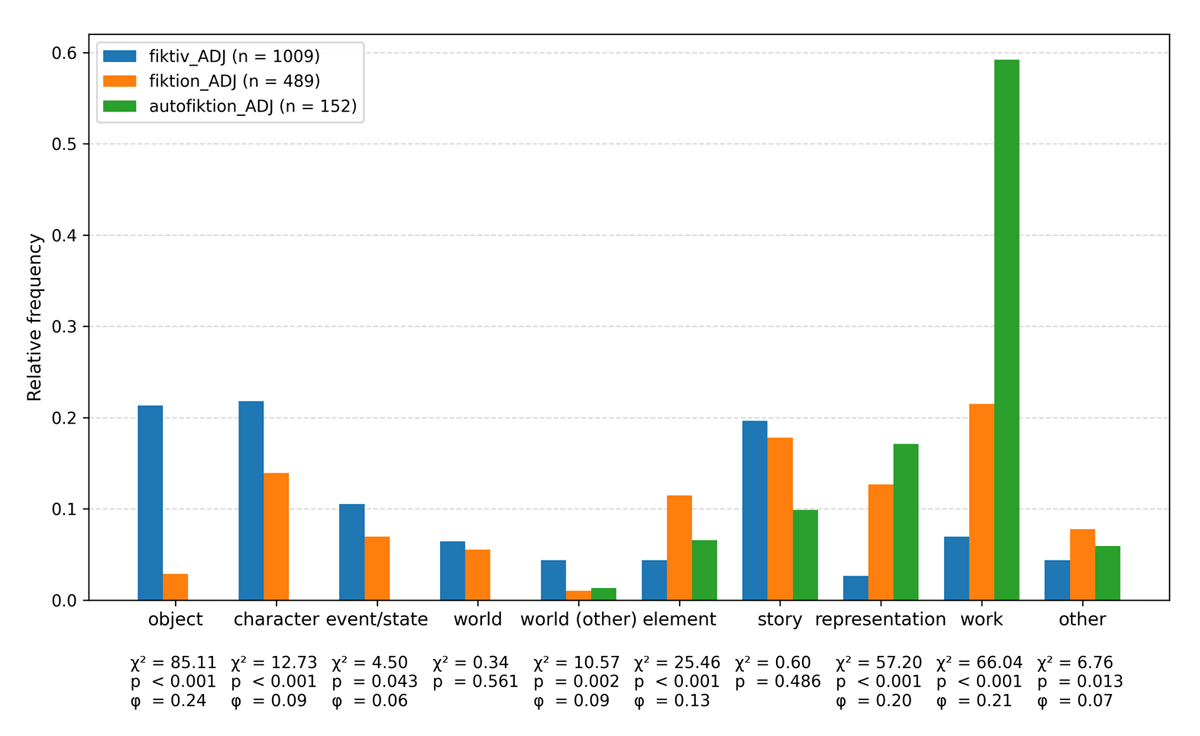
Figure 1
Results Annotation Task 1 (Phenomena).
Example: Among the 1009 annotated instances of fiktiv_ADJ, 21% were assigned to the ‘object’ category; among the 489 annotated instances of fiktion_ADJ, this proportion was 3%, and among the 152 instances of autofiktion_ADJ, 0%.14 The difference between fiktiv_ADJ and fiktion_ADJ is statistically significant (χ²(1) = 85.11, p < 0.01, φ = 0.24). All significance tests refer solely to the relationship between fiktiv_ADJ and fiktion_ADJ. All p-values were adjusted using the Benjamini–Hochberg procedure.
The PERMANOVA testing whether the overall annotation profiles differ between fiktiv_ADJ and fiktion_ADJ revealed a significant difference (pseudo-F = 30.67, p < 0.001), based on 10,000 permutations and using Jaccard distance.
The results indicate that LovelyBooks users do, in fact, use the terms fiktiv and fiktional differently, at least with regard to the kinds of phenomena these adjectives are used to describe. This distinction is evident both in the overall distribution and in several individual categories. Among others, the proportion of fiktiv_ADJ instances used to describe objects or characters is higher than the corresponding proportion among fiktion_ADJ instances, whereas the proportion of fiktion_ADJ instances used to describe representations or works is higher than the corresponding proportion among fiktiv_ADJ instances. The findings are at odds with H0dist and support H1dist. Nevertheless, some important qualifications remain. Both fiktiv and fiktional are at least occasionally used to describe (almost) every category, only with differing frequencies. Moreover, for some individual categories (world, story), no significant differences were found. Finally, it should be kept in mind that fiktiv_ADJ occurs more than ten times as often as fiktion_ADJ in the corpus (see Section 4). Therefore, when considering absolute rather than relative frequencies, every category, including ‘representation’ and ‘work’, is almost certainly described as fiktiv more often than as fiktional.
The autofiktion_ADJ group generally moves further in the direction already signaled by the shift from fiktiv_ADJ to fiktion_ADJ. For example, for the category ‘character’, fiktion_ADJ is used less often than fiktiv_ADJ, but autofiktion_ADJ is used even less often, namely not at all. Similarly, a larger share of fiktion_ADJ instances than of fiktiv_ADJ instances is associated with the category ‘work’, but the share of autofiktion_ADJ instances is higher still. Accordingly, a PERMANOVA reveals a significant difference between autofiktion_ADJ and fiktiv_ADJ (pseudo-F = 66.76, p < 0.001, 10,000 permutations, Jaccard distance), but also between autofiktion_ADJ and fiktion_ADJ (pseudo-F = 26.19, p < 0.001, 10,000 permutations, Jaccard distance).
Figure 2 presents the results of the second annotation task. For each word class, it reports the proportions of instances that align or misalign with the usual conceptualization of the term in literary studies, as well as the results of a bootstrap test (10,000 iterations) assessing whether the mean annotation value exceeds 0.5.
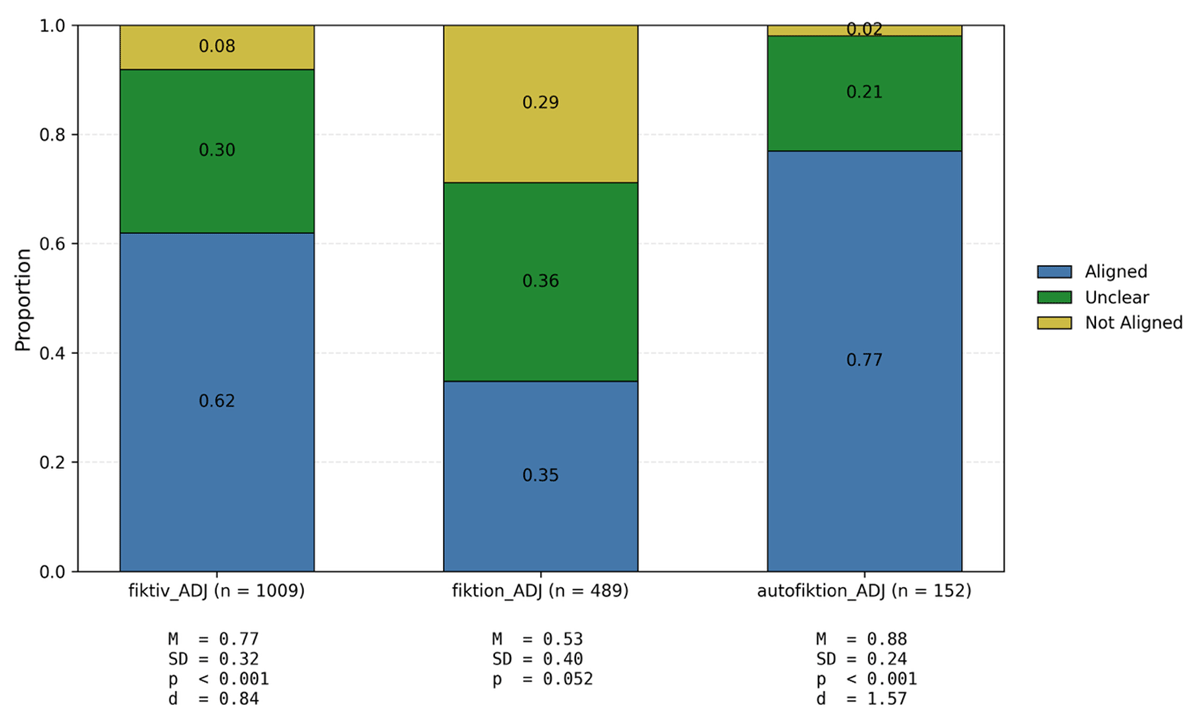
Figure 2
Results Annotation Task 2 (Alignment).
Example: Of the 1009 annotated instances of fiktiv_ADJ, 62% were aligned with literary studies, 8% were not aligned, and 30% were classified as neither. The bootstrap test revealed that the mean (M = 0.77) is significantly above 0.5 (p < 0.001, d = 0.84).
The results show that fiktiv is used significantly more often in ways that align with literary studies than not, thereby contradicting H0align-fiktiv and supporting H1align-fiktiv. This finding mirrors the patterns already observed in the first annotation task: fiktiv_ADJ tends to be applied more frequently to objects or characters than to representations or works, which corresponds to the standard understanding of the term in literary studies. At the same time, a considerable number of misaligned cases remain. Most of these occur when fiktiv_ADJ is used to describe real-world literary texts, representations, or representational acts (see the accompanying Jupyter Notebook). Moreover, if the categories rather than the terms are taken as the starting point, it is very likely that phenomena from the ‘representation’ and ‘work’ categories are classified ‘incorrectly’ more often than ‘correctly’ from the perspective of literary studies, given that these categories are labeled fiktiv more often than fiktional in absolute terms (see above).
Instances of fiktion_ADJ are used slightly more often in alignment than in misalignment with literary studies, but the difference is minimal and not statistically significant at p < 0.05. Accordingly, the results do not allow to reject H0align-fiktional. Even though fiktion_ADJ is used more often than fiktiv_ADJ for representations and works, and less often for objects and characters (see Figure 1)—as one would expect from the perspective of literary studies—this shift in the ‘right direction’ remains limited. In fact, there are still roughly as many cases where fiktion_ADJ is applied to elements of the represented world as to representational acts or media, which accounts for most of the divergences from literary studies (see Figure 1 and the accompanying Jupyter Notebook). A possible explanation for the high rate of misalignment builds on the observation that reviewers employ fiktional at less than one tenth the frequency of fiktiv. This disparity may reflect a relatively low degree of familiarity with fiktional, which in turn could account for why reviewers use it less consistently in line with literary studies.
The autofiktion_ADJ cases are used significantly more often in alignment with literary studies than in misalignment. The proportion of aligned instances is even higher than for fiktiv_ADJ. Fittingly, Figure 1 has shown that autofiktion_ADJ is used particularly often to describe the phenomena one would expect from a literary-studies perspective, namely representations or works rather than characters or objects. One possible explanation is that the highly specialized term autofiktional is predominantly used by especially knowledgeable LovelyBooks users.
Exploratory analyses reveal no strong correlation between whether a review contains only aligned or misaligned instances of fictionality words and any of the following variables: star rating, number of times the review was marked as ‘helpful’, number of comments, review length in words, or the total number of reviews written by the reviewer in the corpus (in all cases, |r| < 0.1).
6 Qualitative Analysis
This section adds a brief qualitative analysis with two aims: first, to examine in more detail those instances in which reviewers on LovelyBooks employ the terms fiktional or fiktiv ‘incorrectly’ from the perspective of literary studies; and second, to provide an outlook on the functions that these terms can serve for LovelyBooks users.
Regarding the ‘incorrect’ uses of fiktiv and fiktional, my main point is that users do not seem to apply some alternative, internally consistent theoretical distinction between the two terms (for example, systematically using fiktiv for German-language titles and fiktional for English-language ones). Rather, it appears that reviewers extend the meaning of one term so far that it also covers what is usually associated with the other term in literary studies and/or treat fiktiv and fiktional as interchangeable. This observation is nonobvious, since it has been shown that non-professional readers can indeed apply nuanced terminological distinctions in certain contexts (see Section 2). As an example, consider this statement:
I experienced the book as a very well-researched and excellently portrayed historical novel, in which the fictive [fiktiv] and historical protagonists harmonize beautifully and which is written in a very fluid style. Of course, the book is fictive [fiktiv], but if you close your eyes, you could almost believe in the treasure of the Nibelungs. (birgitd 2023 on Die Mission des Goldwäschers from Ralf H. Dorweiler)
In the example above, the word fiktiv is used twice: the first instance is aligned with the usual understanding in literary studies, as it qualifies ‘protagonists’ who belong to the world represented by the fictional work and do not exist in the real world. The second instance, however, is not aligned, as fiktiv is used to qualify the reviewed book Die Mission des Goldwäschers, which exists in reality and is, from the perspective of literary studies, not fiktiv (but rather fiktional). In this instance, the term fiktiv appears to take on a broader meaning, encompassing not only what literary scholars would classify as fiktiv, but also what the latter would describe as fiktional. Here is a second example:
At the center of the novel is the friendship between the famous English writer William Somerset Maugham and a fictional [fiktional] British expat couple, the Hamlyns: Robert, a lawyer, and Lesley, who was born in Penang. […] We learn a great deal about “Willie” Maugham from his own perspective: his childhood, his work as a doctor in the First World War where he met his often rather exuberant lover Gerald, and his marriage to Syrie. Into this narrative, his acquaintance with the fictive [fiktiv] Robert Hamlyn is interwoven. (Scarletta 2025 on The House of Doors from Tan Twan Eng)
Here, the case is similar but slightly different: the review refers to entities that are same, or at least ‘overlapping’ (the Hamlyns and the character Robert Hamlyn), and labels them first as fiktional and then as fiktiv. From the perspective of literary studies, only the second usage is correct: Robert Hamlyn is part of the world of a fictional literary work and not real (he is fiktiv), but he is not himself a representational medium (and therefore not fiktional). All in all, it seems likely that the reviewer is using the terms fiktiv and fiktional interchangeably. He or she does not apply the terminological distinction as it is understood in literary studies, nor is there any reasonable indication of an alternative distinction at play.
There are many possible explanations for why reviewers sometimes use the terms fiktiv and fiktional interchangeably or in overlapping ways. For instance, they may have never—or only rarely—been exposed to the terminological distinction in schools, universities, or other literature-related contexts; they may find the distinction too difficult to apply consistently; and/or they may see little practical use in distinguishing between fiktiv and fiktional. The latter explanation relates to the functions the terms in question serve for LovelyBooks users, and these functions will now be explored in more detail.
In a very broad sense, the terms fiktiv or fiktional are usually employed to signal that the phenomena in question exhibit a certain characteristic, namely that they are (or represent) something ‘not real’. This general function can be linked to a number of more specific subfunctions, which clarify why it is important for users to highlight the non-reality of the represented phenomena. A particularly common subfunction in the annotated sample was to emphasize the presence of a given quality by noting that it applies ‘even though’ the represented phenomena do not exist in the real world. This often takes the form of sentences such as: ‘Even though something is fiktiv/fiktional, it still has quality X.’ One of the examples cited above already points in this direction: the last sentence of the first quoted review can be read as suggesting that, even though the work is fiktiv, the represented content (in this case, ‘the treasure of the Nibelungs’) is ‘almost believable’. Thereby, the reviewer underscores that the believability is not self-evident and is noteworthy.
In the corpus reviews, a variety of phenomena can be highlighted as the ‘quality X’ that applies even though something is fiktiv and/or fiktional. One common example is relatability to reality. For instance: ‘Even though it is emphasized that it is a fictional [fiktionale] story, some scenes/prejudices can indeed be transferred to reality, and many unpleasant questions are raised that really make one stop and think.’ (heavyfun 2023 on Iron Widow. Rache im Herzen by Xiran Jay Zhao). Similarly: ‘In this context, I really liked the central focus on the queer community, because even though it is a fictive [fiktive] witch story, one can relate it to reality.’ (XLapislazuliX 2023 on Her Majesty’s Royal Coven by Juno Dawson). Another frequent variant of the ‘quality X’ are certain emotional responses elicited by the work or its represented phenomena. For example: ‘Although the island Möwesand is purely fictive [fiktiv], I felt very comfortable there.’ (Wiebke13 2023 on Süße Wünsche by Marie Schönbeck). Or: ‘For all newcomers, Elwenfels may be a fictive [fiktiver] place—but after the first book you feel so attached to the wonderful village community that you are there in mind and heart, and thus Elwenfels becomes absolutely real.’ (Wildpony 2023 on Traubentod by Britta Habekost).
The use of phrases such as ‘even though’ or ‘but’ indicates that reviewers perceive a contrast between the fiktiv or fiktional status of the phenomenon they discuss and the qualities it exhibits, such as being relatable to reality or eliciting emotional responses. Reviewers may either believe themselves that such a contrast exists, think that others do, or at least treat it as a reasonable assumption. Yet, while alluding to the contrast, the users precisely emphasize that it does not hold for the work under discussion. The terms fiktiv and/or fiktional serve to articulate this somewhat complex idea and make the highlighted qualities appear even more noteworthy.
Crucially, the function just described, as well as the more general function of alluding to something ‘not real’, can be fulfilled by both fiktiv and fiktional on LovelyBooks. What matters for this function appears to be less a distinction within the realm of fictionality (i.e., between fiktive and fiktionale phenomena) than the broader distinction between the realm of fictionality as a whole (encompassing both what is fiktiv and fiktional) and everything outside it. For this broader contrast, either term can be employed. This may help explain why, in a significant number of cases, the terms seem to be used interchangeably or in overlapping ways. From the perspective of LovelyBooks users, both terms often have a similar functional potential, making the finer distinction between fiktiv and fiktional less important.
7 Conclusion
The goal of this contribution was to shed more light on the terminological resources readers use when discussing literature, focusing on the German terms fiktiv and fiktional. Specifically, the paper set out to test whether users on LovelyBooks employ these terms in distinct ways (Hdist), and whether they use them in line with their common understanding in literary studies (Halign-fiktiv/Halign-fiktional).
Fictionality words such as fiktiv or fiktional appear in roughly 3% of the corpus reviews. Thus, they are certainly not among the most frequent words, but also not among the extremely rare words. Among all fictionality-related terms, fiktiv is much more common than fiktional. An annotation study showed that LovelyBooks users indeed differentiate between fiktiv and fiktional when it comes to the phenomena to which they apply these terms, thus supporting H1dist. Among others, fiktiv is used more often than fiktional for objects and characters represented by literary works, while fiktional is used more often than fiktiv to qualify representational acts or media. Regarding the alignment with literary studies, reviewers mostly use fiktiv in a way that is consistent with how literary scholars understand the term, thus supporting H1align-fiktiv. The picture for fiktional is more complex. On the one hand, the usage of fiktional shifts, from the perspective of literary studies, in the ‘right direction’ compared to fiktiv, being employed more frequently than fiktiv for representations and literary works, and less frequently for objects and characters within such works. On the other hand, this shift remains so limited that fiktional is still not used significantly more often in alignment than in misalignment with the standard literary studies understanding, meaning that H0align-fiktional cannot be rejected. The analysis also included the highly specialized term autofiktional and showed that this term was used distinctly from both fiktiv and fiktional and aligned with scholarly usage even more frequently than fiktiv. A qualitative exploration suggests that usages diverging from the standard literary-studies understanding of fiktiv and fiktional do not reflect an alternative, systematic distinction. Rather, they indicate a tendency to blur the boundaries between the two terms. This may be, at least in part, because differentiating between fiktiv and fiktional is not essential for some of the functions these terms serve on LovelyBooks.
On a broader level, the analysis paints an ambivalent picture of the terminological resources readers employ when discussing literature. On the one hand, not every reader, for sure, follows a strict system of clear-cut terminological distinctions or employs terms in the way they are understood in literary studies. On the other hand, it would be misleading to conclude that readers use terms completely haphazardly or that their terminological practices are entirely unrelated to scholarly usage. Rather, the results indicate that the situation falls somewhere in between. Nuanced terminological distinctions can be made, and terminology from literary studies can, perhaps mediated through institutions such as schools or literary criticism, resonate in non-scholarly contexts. However, this is not always and absolutely the case, but to varying degrees, depending on the term and reviewer. In any case, the results underscore that literary scholars should take care to explain the meaning of terms such as fiktiv and fiktional when addressing a general audience.
Significant limitations remain, alongside opportunities for future research. First, the present study necessarily focused on LovelyBooks users who actually employ the terms fiktiv or fiktional. However, these users are likely not representative of all LovelyBooks users (even though, as noted above, their reviews do not systematically differ in star count, comment count, etc.), and even less so of readers more generally. It would therefore be valuable to extend the analysis to other populations, potentially drawing on different methods and data sources. This could also include a more systematic examination of how literary scholars themselves use the terms fiktiv and fiktional, in order to test whether their terminological practices consistently align with fictionality theory or sometimes follow their own conventions. Next, it could be valuable to include additional terms that users might employ when referring to fictionality, such as invented, made-up, or imaginary. Even more fundamentally, while this study followed a semasiological approach—starting with specific terms and then examining their usage and meaning—one could adopt an onomasiological perspective instead, beginning with specific contents or concepts, such as fictionality, and asking which terms people use for them in which circumstances. Finally, it would be helpful to extend the research to non-German contexts as well.
Data Accessibility Statement
Code and data are available at https://github.com/MertenKroencke/fiktiv_fiktional and https://doi.org/10.5281/zenodo.17876824. The full text of the LovelyBooks reviews is not publicly accessible via these links but can be obtained upon request for research purposes at https://doi.org/10.5281/zenodo.17877135.
All reviews used in this study were publicly accessible on LovelyBooks without registration. No personal data (e.g., email addresses of users) were collected. There is no indication that the study conflicts with the platform’s terms of use.
Notes
[3] In German: ‘Die Verknüpfung von Fiktivität und Fiktionalität ist m. E. ein nicht hintergehbares Faktum für jegliche Theorie der literarischen Fiktion’ (Zipfel 2001: 167); ‘Mir scheint die Unterscheidung zwischen Fiktivität und Fiktionalität nachgerade das Kernstück aller Theorie literarischer Fiktion auszumachen’ (Kablitz 2008: 18).
[4] The user isi_peazy has, according to her website, studied literary studies and now works as a professional journalist. She attributes these ‘mistakes’ not only to ‘first-year students in literary studies’, but also to ‘established literary critics’, as well as to ‘newspapers and books’ (isi_peazy 2023; https://www.isabellacaldart.de/).
[5] Examples: ‘Even though the protagonist Kim Jiyoung is just a fictional [fiktional] character from South Korea, her problems are nonetheless shocking realities’ (Lily911 2021); ‘What Atwood does is to bring these elements together, to condense them literarily, and to transport examples from different countries and religions into the fictional [fiktionale] Gilead, a successor state to the USA.’ (Anonymous 2023); ‘Even though the book is fictive [fiktiv], the protagonists’ decisions seem realistic and understandable.’ (FlupCarl 2020); ‘I absolutely devoured the novel, and even though it’s completely fictive [fiktiv], it still feels very authentic.’ (KerstinMC 2024).
[6] In German: ‘Fiktiv […] bezieht sich auf die Nicht-Wirklichkeit des Dargestellten. […] So werden im folgenden Texte, in denen Fiktives dargestellt wird, als fiktional bezeichnet’ (Zipfel 2001: 19); ‘Mir scheint es deshalb kapital, zwischen dem Fiktiven als einer Eigenschaft des Dargestellten und dem Fiktionalen als einer Eigenschaft der Darstellung zu unterscheiden’ (Kablitz 2013: 166); “Das Prädikat ‘fiktional’ bezeichnet im folgenden ausschließlich eine bestimmte Darstellungsweise, derart daß das Dargestellte nicht existiert. Das Prädikat ‘fiktiv’ hingegen bezeichnet im folgenden ausschließlich eine, wie sich vorläufig sagen läßt, bestimmte Existenzweise von Gegenständen (im formalen Sinne), derart daß diese Gegenstände nicht existieren” (Rühling 2011: 29).
[7] Kablitz (2008: 15; similarly Kablitz 2013: 165) argues that fictionality theory pays ‘insufficient consideration’ to the distinction between fiktiv and fiktional, even in German scholarship. Yet, since the distinction is well established there, Bareis (2016: 46) finds this criticism ‘incomprehensible’.
[8] For example, see https://www.lovelybooks.de/buecher/fantasy/. LovelyBooks assigns its own genre labels to each work, and these labels are also used here. For corpus construction, genre pages and book lists (see next corpus source) were collected for the following genres: crime & thriller, fantasy, literature, romance, young adult, historical novel, entertainment, science fiction, and erotic literature.
[9] It appears that LovelyBooks does not offer a direct way to access all reviews, including their unique URLs, for a given book just by inspecting the HTML of the book page on first load (e.g., https://www.lovelybooks.de/autor/J.-R.-R.-Tolkien/Der-Herr-der-Ringe-143872740-w/). Instead, users need to repeatedly click ‘Weitere Beiträge laden’ to load all reviews for the book, then open the share menu for each review and select ‘URL kopieren’ to retrieve its unique URL (e.g., https://www.lovelybooks.de/autor/J.-R.-R.-Tolkien/Der-Herr-der-Ringe-143872740-w/rezension/17584557280/). By visiting these review URLs, one can then access the full review content as well as additional data such as the date, star rating, comments, and more.
[10] It would certainly be worthwhile to also include the LOBO Corpus, compiled by Rebora, Messerli, and Hermann (2022), which contains 1.3 million LovelyBooks reviews. However, as this corpus does not currently appear to be publicly available, and given that the present corpus is already sufficient for testing the hypotheses outlined in the introduction, it was not used here.
[11] It is plausible—and, as the next section will show, in fact the case—that the frequency of fictionality words varies across genres. For example, such words occur more frequently in reviews of historical novels than in those of romance novels (see Section 4). However, frequency differences alone do not necessarily imply that genre also influences how these words are used, that is, whether fiktiv and fiktional are employed in distinct ways or in ways that align with literary studies, which is the central focus of this paper.
[12] Of course, there are also words that do not contain the strings fikti or ficti yet are still used to refer to the phenomenon of fiction, such as erfunden (invented) or ausgedacht (made-up). However, these terms are deliberately excluded, since the present study follows a semasiological approach and focuses specifically on fiktiv and fiktional.
[13] The class fiction_X is used for terms that were assigned to the fiction group (e.g., ‘fiction’, ‘fictional’, ‘Fiction-Reihe’, ‘Fiction-Thriller’) and received the POS tag X (other) from spaCy. This occurred mostly for terms like ‘Science Fiction’, ‘Japanese Fiction’, or ‘Historical Fiction’ (i.e., terms without a hyphen), probably because they were not recognized as German words. Consequently, in most cases, fiction_X effectively corresponds to fiction_NOUN.
[15] Alignment is judged primarily by whether the terms are used to qualify elements represented within a fictional literary work or the representations and representational media themselves. The annotation is not concerned with whether readers’ explicit or implicit concept of fictionality on a more general, foundational level is plausible from the perspective of literary studies.
[16] The number of annotated instances shown in Figure 1 (1009 fiktiv_ADJ + 489 fiktion_ADJ + 152 autofiktion_ADJ = 1650) differs slightly from what was reported in Section 5.1, where it was said that 1000 instances of fiktiv_ADJ, 501 instances of fiktion_ADJ, and 152 instances of autofiktion_ADJ (total = 1653) were annotated. These differences occurred for two reasons. First, a few additional fiktiv_ADJ words appeared within the same sentences as the originally selected words and were also annotated. Second, a small number of words were ultimately not annotated, mostly because they occurred within quotations. Furthermore, some words were assigned multiple annotation categories. As a result, the 1650 instances received a total of 1681 category assignments, which explains why, in some cases, the sum of percentages per word class slightly exceeds 100%.
Acknowledgements
I would like to thank Jana Eckardt for her careful annotation work and her invaluable support throughout this project.
Competing Interests
The author has no competing interests to declare.