
1. Introduction
For many adolescents, fiction reading is a leisure activity (Medienpädagogischer Forschungsverbund Südwest 2024), but for German high school students, it is also taking place in the school context, where the reading material is chosen for them, the process of engagement is guided by teachers’ instructions, and the focus of analysis is also set by them. The collective rereading of selected passages that commonly takes place in the literary classroom introduces students to a literary text in a way that differs significantly from solitary reading: Parts of the text are presented out of their original context, at times out of order, and possibly integrated into a new interpretive or topical context by the teacher. We assume that these two distinct reading situations—reading in private vs. reading for and discussing in school—affect several reading outcomes. In the present study, we aim to clarify the effect of these reading situations on (1) students’ confidence, extent, and understanding when interpreting a novella, and (2) their understanding and interpretation of the fictional characters. More specifically, we will research (3) the effects of rereading, a commonly used teaching method in the literary classroom. To investigate this, we conducted a questionnaire study with 56 students who, to varying degrees, engaged with Stefan Zweig’s Schachnovelle (1942), which included inviting them to take part in a controlled rereading experiment in the LitLab.
With this rereading experiment, we examine different aspects of how classroom discussion and rereading influence what students take away from a literary text: On the text-interpretation-level, we survey whether talking about a literary work together helps students to feel more confident in their interpretations and how classroom discussions shape their sense of the text’s central message. Additionally, we analyse the range of themes mentioned by students, and how classroom interaction impacts the variety of these topics. On the character-level, we ask whether working with the text in class leads to more text-based and coherent descriptions of characters, and whether it strengthens students’ sense of character conceptualisation and understanding.
Building on previous research on how adolescents read and interpret literary texts, the present study aims to investigate the effect of a teaching strategy frequently used in the literary classroom: rereading teacher-selected passages, possibly in light of a specific aspect such as character development. One very modest effect expected of rereading is the recollection of the text, as students might not have a text world or character model readily available when the reading was done a while ago. A second reading has been hypothesised to “prevent superficial processing of text” (Greving and Richter 2019) and has been shown to increase understanding and help readers to notice details (cf. Xue et al. 2020). The focus of empirical studies on rereading has mostly been on expository texts and vocabulary learning (cf. Rawson and Kintsch 2005; Greving and Richter 2019). The few studies on literary rereadings looked at Shakespeare’s poetry (Xue et al. 2020) and Borges’ short story “Emma Zunz” (Dixon et al. 1993; Kuijpers and Hakemulder 2018). Thus, as is often the case in experimental literary studies, longer forms of literature have not yet been investigated. In all of these latter studies, complete rereadings of the texts were carried out by participants. In the educational context of literature lessons, however, complete rereadings are uncommon as an educational practice for novellas or other more extensive forms of narratives.
At the same time, research on literary pedagogy has approached similar questions from a different angle, focusing less on rereading itself and more on how classroom communication shapes textual understanding. Scholes (1985) argues that pupils, like all readers, are not passive recipients of meaning but active participants in its construction. Consequently, dialogue (Applebee et al. 2003) and discourse (Nystrand et al. 1997) are seen as essential components of literary education. Traditional approaches that emphasise correct answers—a practice criticised by Durkin (1978)—have been supplemented by methods such as retelling, which serves as a tool for assessing comprehension (Fisher and Frey 2014). Effective classroom discussions rely on ‘authentic’ (Nystrand 2006) and contingent questions (Boyd and Rubin 2006) that encourage pupils to engage with texts on their own terms (Giovanelli and Mason 2015). Some pedagogical research suggests a link between this and increased student confidence (Boyd 2016). At the same time, teachers must provide structured guidance (Pearson and Gallagher 1983) that balances textual analysis with personal response (Soter et al. 2008). When this balance is achieved, engagement with literary characters can support young readers’ personal development (Pike et al. 2021).
While classroom discussions foreground collaborative meaning-making, rereading particular passages shifts attention to the cognitive processes that enable students to infer characters’ perspectives, a process closely linked to Theory of Mind and empathy. Theory of Mind allows individuals to represent others’ beliefs, desires, and intentions, including the understanding that these may differ from reality (Premack and Woodruff 1978; Perner 1991; Wimmer and Perner 1983; Zunshine 2003). This capacity underlies perspective-taking, an important skill in literary interpretation that allows readers to infer characters’ motives and anticipate possible outcomes (Ho et al. 2022; Gery et al. 2009; Mason & Just 2009). Empathy, particularly its cognitive dimension, overlaps with Theory of Mind by facilitating understanding of characters’ mental states, while affective empathy involves the emotional resonance with these characters (Davis 1983; Decety and Jackson 2004; Shamay-Tsoory et al. 2009). Empirical research links reading fictional narratives to improved Theory of Mind, and enhanced cognitive and affective empathy towards characters and real people like them (Bal and Veltkamp 2013; Dodell-Feder & Tamir 2018; Djikic et al. 2013; Keen 2006; 2007; Kidd and Castano 2013; Mar 2011; Mar et al. 2009), even though results are not always conclusive (for a failure to replicate Kidd and Castano’s results see Camerer et al. 2018, Panero et al. 2016 and Samur et al. 2018; Wimmer et al. 2021), especially with respect to the exposure necessary for effects to occur (Quinlan et al 2023, Mar 2018, Eekhof and Mar 2024).
Rereading can be expected to deepen students’ understanding of character traits, as they become more attuned to patterns of behaviour, speech, and motivation that may not be evident on first encounter. Previous research shows that readers’ perceptions of characters are guided not only by textual cues but also by their existing frameworks and expectations, which intuitively shape evaluations of character traits (Auracher and Hirose 2017). Rereadings might be able to challenge such “fast”, intuitive thinking. This challenge might also extend to processes of identification and empathy that are influenced by narratological features such as internal focalisation and other text-level aspects such as evaluative language which shape how readers infer characters’ mental states and motivations (van Krieken et al. 2017). Additionally, rereading may aid comprehension monitoring—the ability to update information on many different levels of a storyworld such as tracking characters’ goals, emotions, and beliefs—which supports deeper understanding of narrative coherence and character development (Wassenburg et al. 2015).
Building on the framework provided by previous research, this paper first presents the experimental stimuli and setup, followed by an overview of participants and assessment measures. We then report on the students’ interpretation of the text (section 4.1) and their felt understanding of its two main characters (section 4.2), and if and how rereading influenced students’ perceptions of the latter (section 4.3), before discussing the implications of these findings, potential limitations, and recommendations for classroom practice.
2. Stimuli
In modern literary history, the novella is considered a prime example of impact-oriented literary production (Weitin 2016). Its clear, structured, and often conventional narrative arcs—as well as its typically reduced number of characters and emphasis on a central conflict, which lend themselves well to experimental design (Weitin 2015; 2017)—help explain the genre’s strong presence in both school and university curricula. For the present study, we have chosen excerpts from Stefan Zweig’s novella Schachnovelle, a text regularly included in the core curriculum of German secondary schools. Zweig’s novella, with its psychological tension and sociohistorical implications, is not only a canonical text but also has a pedagogical dimension: According to the official curricular guidelines (Hessisches Kultusministerium 2022, 40), reading works by Stefan Zweig and other representatives of Exilliteratur is meant to encourage students to reflect on their own place in the world and to understand historical belief systems and moral reasoning. The inclusion of this novella in the school curriculum can also be justified from a developmental psychology perspective: Pupils in the middle phase of adolescence (12–19 years) transition into adulthood, taking on differentiated social positions and roles that shape them and enable them to forge their own path in life. Young people acquire the cognitive prerequisites for dealing with the complexity and relative standpoints that surround them in their living environment (Auracher and Hirose 2017). Its inclusion can thus be considered to be part of a broader effort, in line with the official guidelines for teachers, to aid students in the literature classroom in not only learning about literary history and interpretation, but also improving personal skills such as empathy.
Yet, the Schachnovelle complicates the expectations typically associated with the genre. Although novellas are often thought to convey clear interpretive trajectories, Zweig’s work is marked by a deliberate ambiguity. This raised a central question for our study: Does the teaching of literature serve to reduce such ambiguity in the eyes of pupils, or does it instead draw attention to it?
To explore this, we focused on the novella’s central conflict, a chess match between two radically opposed figures: the slow, methodical world champion Czentovic and the intellectual Dr. B., an Austrian lawyer traumatised by solitary confinement under the Gestapo. These two characters are not only presented as psychological opposites but are also constructed through different narrative techniques. Only Dr. B. is granted the opportunity to narrate parts of his story in the first person, while Czentovic’s life and sudden fame are conveyed through second-hand accounts. Czentovic, the “son of an anaemic South Slavic Danube skipper”1 (“Sohn eines blutarmen südslawischen Donauschiffers”, SN 72), is described as “dull” (“das […] dumpfe […] Kind”, SN, 32), his type likened to termites (“termitenhaft”, SN, 17), and his chess playing to an “automat” (“dieser unmenschliche Schachautomat”, SN, 32). The narrator expresses overt disdain for him, leaving little room for the character to speak in his own voice. When selecting text excerpts as stimuli for the experiment, we had little choice regarding passages in which Czentovic actually says anything.
To investigate whether a teaching method focusing readers’ attention on either the protagonist or the antagonist would shape their impressions of the characters or influence their interpretation of the text’s message, we designed two sets of stimuli. Participants were randomly assigned to one of two groups: the protagonist group (Dr. B.) or the antagonist group (Czentovic). In selecting the text extracts, we ensured that the excerpts captured key aspects of the novella’s style and structure, presenting them in near-chronological order. Some of the excerpts were adapted to clarify reference chains of personal pronouns. The final excerpt in both conditions highlighted the novella’s central symbol—chess—as its thematic focal point.
The antagonist series began with his name, Czentovic, and included extracts about his low provenance from a rural southern European area, his limited cognitive and verbal abilities, and the large narrative distance that results from his stereotypical characterisation. Stimulus 4, for example, describes Mirko Czentovic as simple-minded and utterly lacking in independence:
Mirko kept staring at the characters that had been explained to him a hundred times, and they still appeared strange to him; even for the simplest subjects, his slow-working mind lacked any power of retention. When he had to do arithmetic, he still needed to count on his fingers at the age of fourteen, and reading a book or a newspaper remained a special effort for the half-grown boy. Yet Mirko could by no means be called unwilling or defiant. He obediently did whatever he was told—fetching water, splitting wood, working in the fields, tidying up the kitchen—and carried out every assigned task reliably, though with irritating slowness. What annoyed the good pastor most about the obstinate boy, however, was his total indifference. He did nothing without explicit instruction, never asked questions, did not play with other boys, and sought no occupation on his own unless it was expressly assigned; once Mirko had completed the household chores, he would sit stubbornly in the room with that empty look one sees in sheep grazing in a field, showing not the slightest interest in the events around him. (SN 7-8)
The protagonist series opened with the name of the protagonist, Dr. B., highlighting his academic identity. The following excerpts framed him, in line with the narrator’s perspective, as the complete opposite of the antagonist. His traumatic experiences in Gestapo custody make both him and the reader more aware of his privileged origin from a well-established, wealthy family. His intellectual capacity and articulate language not only help him survive but also mirror the voice of the narrator, who is clearly sympathetic with him, as can be seen in Stimulus 7:
Before I approached him, I took the opportunity to observe him. His sharply defined head rested on the cushion in a posture of slight fatigue; what struck me most was the peculiar pallor of his comparatively young face, framed at the temples by dazzlingly white hair. I had, for some reason I could not explain, the impression that this man must have aged suddenly. As soon as I stepped toward him, he rose politely and introduced himself with a name that I immediately recognised as belonging to a highly respected old Austrian family. I remembered that a bearer of this name had been among Schubert’s closest friends, and that one of the imperial physicians of the old Emperor had also come from this family. (SN 44-45)
After participants had completed the initial part of their respective stimulus series—each structured around a single character—they all read a shared sequence of text extracts. These included descriptions of the characters’ contrasting habits and the emotionally charged final chess match. The last stimulus contained the novella’s general reflections on chess, which, in line with the genre convention, can be interpreted as guiding the reader towards an understanding of one of the text’s central messages:
From my own experience, I knew well the mysterious attraction of the “royal game,” the only one among all the games ever devised by humankind that sovereignly escapes the tyranny of chance and grants its laurels of victory solely to the intellect—or rather, to a particular form of mental gift. Yet is it not already an insulting limitation to call chess a game? Is it not also a science, an art, suspended between these categories like Mohammed’s coffin between heaven and earth—a unique union of all opposites: ancient and yet eternally new, mechanical in its design and yet brought to life only by imagination, confined within a geometrically rigid space and yet boundless in its combinations, ever evolving and yet sterile, a form of thinking that leads nowhere, a mathematics that calculates nothing, an art without works, an architecture without substance, and nevertheless, demonstrably, more enduring in its being and existence than all books and works—the only game that belongs to all peoples and all times, and of which no one knows which god brought it down to earth to kill boredom, sharpen the senses, and stretch the soul. (SN 19-20)
With a partly between-, partly within-subjects design, we aimed to investigate how the mental models of protagonist and antagonist—shaped by the narrator’s strong bias—influence the perception of the characters and the understanding of the story’s broader meaning. In particular, we were interested in how reading and rereading the novella under different conditions might result in different interpretations, depending on the lens through which the rereading is structured and contextualised.
In collaboration with three secondary school teachers in Darmstadt, we recruited pupils from their classes for a study conducted at the LitLab of the Technical University of Darmstadt in April 2023. Only one class had studied Zweig’s Schachnovelle in school before the experiment, while the others had read the novella privately and knew it would not be part of their German classes. This allowed us to compare different rereading contexts in a controlled setting.3
3. Methods
3.1. Participants
We recruited 56 students from three classes of a German high school. With the help of the teachers,4 parents were informed of the study beforehand, and students received consent forms before the experiment. As compensation for their time at the laboratory, participants received 20 Euros.
Most students were aged between 17 and 19 (N = 46), the others were aged 16 or below (N = 10). Forty-three had German as their mother tongue (6 of those were bilingual speakers), 13 had different mother tongues (1 of them bilingual). Of our sample, 33 participants identified as female, 20 as male, and three did not indicate a gender identity.
The Schachnovelle was taught in one of the three classes. Students in the other two classes had been encouraged to read the novel in their own time, but knew it would not be a topic in any of their classes at school. Thus, participants varied on the dimension of having read the novel Schachnovelle (complete; partly; not at all) and having discussed it in German class (in class; private).
None of the students who discussed it in class stated that they had not read the text at all, leaving us with five levels of reading engagement based on the combinations of these two variables: complete in class, partly in class, complete private, partly private, and no text knowledge. Their distribution within our sample is shown below (see Figure 1).
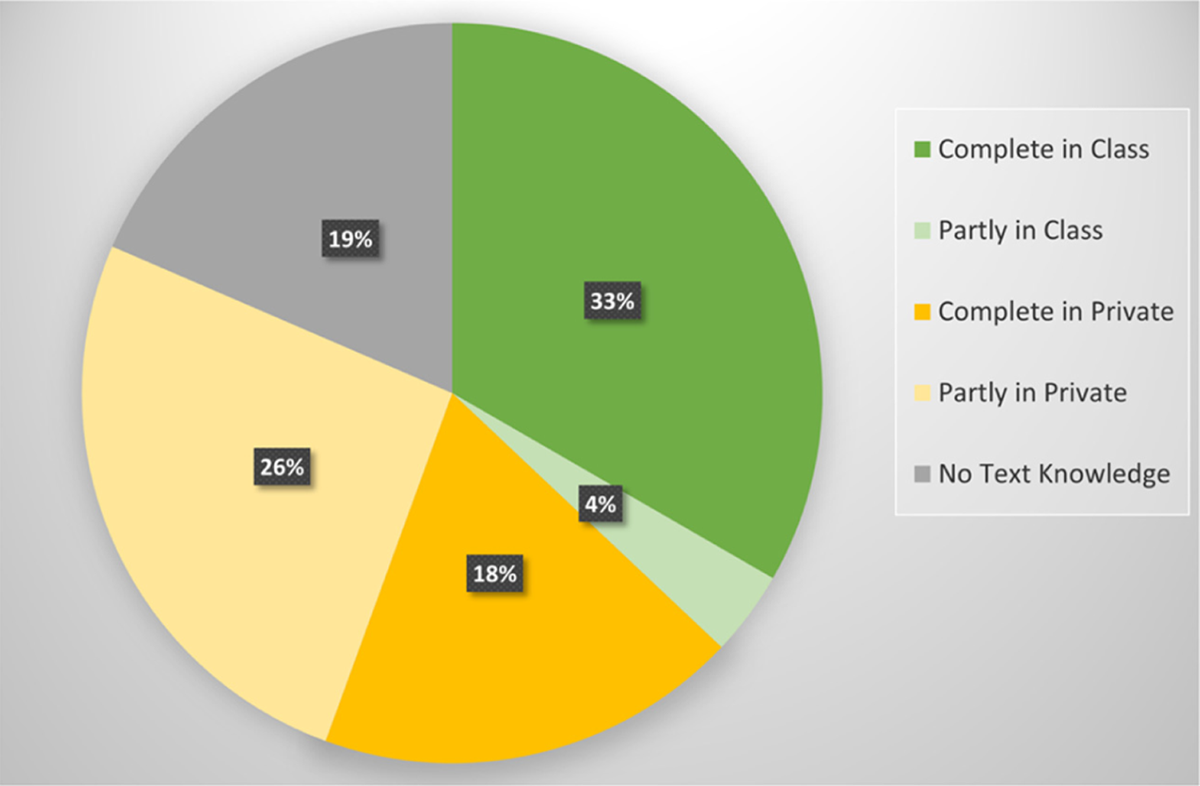
Figure 1
Proportions of Students per Text Engagement Group.
In the following analyses, we excluded the Group ‘Partly in Class’ due to its small number of participants and instead focused on the four text engagement groups ‘Complete in Class’ (N = 18), ‘Complete Private’ (N = 12), ‘Partly Private’ (N = 14), and ‘No Text Knowledge’ (N = 10).
In order to keep the classroom situation as natural as possible, none of the researchers observed the lessons dedicated to the Schachnovelle in the school context, but we had access to the worksheets used5 and were informed by the teacher that students engaged with these worksheets during the time at school and that the results were then presented and discussed with the whole class. The lessons focused on psychoanalysis—students read excerpts of Freud’s 1910 Five Lectures on Psycho-Analysis—and identification with Dr. B.’s trauma—students were asked to write an interior monologue from Dr. B’s perspective, describing his first day in solitary confinement—as well as the historical context—students were given information on life in the Austro-Hungarian monarchy. We cannot, however, guarantee that all students engaged with all worksheets in the time dedicated to them. So, while our knowledge of the specific teaching methods (for example, whether results of the discussion were organized and backed up by the teacher on the blackboard) and the exact engagement of each student is limited, we have an overview of the routes of engagement that were offered and the topics that were covered in the classroom discussion (see also 4. Results).
3.2. Experimental Setup and Measures of Assessment
Participants were invited to the experimental room one by one to (re)read 10 passages of the novella, either with a focus on the protagonist or the antagonist as described above, on a computer screen in their own time.6 Post-reading, questionnaires assessed overall liking of the extracts read, (partial) knowledge of the original text, and sociodemographic variables, as well as measures for the dependent variables. The latter will be explicated in more detail below.
To grasp participants’ access to a holistic interpretation, they were prompted to briefly spell out the message of the novel in a free-text response format: “If you had to spell out the text’s message: What is the message of the Schachnovelle? Please only write one short sentence.” A bottom-up coding system was developed for thematic analysis of their responses (see Table 1): Two coders established the thematic categories for scoring—historical classification; human psyche; trauma; chess; worldly wisdom; no message; theme not message—and coded the entire data set. Subsequently, a third coder applied the developed coding system to the entire data set. The interrater reliability between the first two coders and the third coder was strong (κ = 0.85), and discrepancies were resolved after discussion.
Table 1
Coding Instructions for Thematic Categories in Students’ Interpretations of the Textual Message.
| THEMATIC CATEGORIES | CODING INSTRUCTION |
|---|---|
| Historical classification | Select this option if the message provides a historical classification or a call to remember certain historical events. |
| Human psyche | Select this option if the message refers to human psychological mechanisms in general or to people’s internal processes. Exception: Trauma (this has its own category). |
| Trauma | Select this option if the message (explicitly/implicitly) refers to psychological disorders or trauma or addresses the psychological processing of negative life events. |
| Chess | Select this option if the message refers to the game of chess or chess players. |
| Worldly Wisdom | Select this option if the message is in the form of only slightly modified, very general platitudes. |
| No message | Select this option if the participant states that they cannot give a message or leaves the field blank. |
| Theme not message | Select this option if the statement is not a message, but at most names the topic or theme of the text. |
To assess the perceived literary ambiguity of the text’s message, participants were asked to rate the question “Do you believe that the book Schachnovelle, of which you just read extracts, has a clear message?”, using a 5-point Likert scale.
To determine whether focused rereadings create a clearer or different understanding of individual characters, participants were asked whether their impression of both the protagonist, Dr. B., and the antagonist, Czentovic, had changed. For each character, they were given four options to choose from:
I have the same impression of him as after reading the book on my own.
I have the same impression, but it is now clearer.
Today, I have a different impression of the character.
I have read the extracts for the first time today.
If the third option was chosen, participants were asked to elaborate on what exactly had changed in their impression.
To assess whether rereading and class discussion foster more accurate, text-based character models, we developed a character trait matrix based on textual analysis. We stipulated that there are certain characteristics that fit one character, but not the other. The protagonist Dr. B is portrayed in the novella as ‘aufrichtig’ (sincere), ‘bescheiden’ (modest), ‘feinfühlig’ (sensitive), ‘nervös’ (nervous) and ‘unruhig’ (uneasy), whereas his antagonist Czentovic is shown to be ‘eitel’ (vain), ‘hochmütig’ (arrogant), ‘habgierig’ (greedy), ‘selbstbewusst’ (self-confident) and ‘unhöflich’ (rude). For all these characteristics, participants were asked to indicate whether it was a fitting description of Czentovic and if it was a fitting description for Dr. B., hence allowing that a character trait could be seen as fitting to one, both, or neither of the characters.
We further sought to investigate the influence of the reading situation on cognitive and emotional aspects of the Theory of Mind when it comes to the felt understanding of characters: Could readers, after class discussion and rereading, better understand characters’ emotions and actions? With regard to both the protagonist and the antagonist, participants were asked to “Imagine that the character was a real person.” and asked to rate whether they “could describe how this person would behave in life situations that you know yourself” and whether they “felt able to describe what feelings this person would have in life situations that you know yourself” on a 5-point Likert scale (anchored “yes absolutely” and “no, not at all”).
4. Results
4.1. (Felt) Understanding of a Text’s Message
To explore the influence of complete reading and class discussion on the understood text message, we compared the thematic analyses by text engagement groups and participants’ ratings on the question of perceived certainty of a clear message. In the following, we will start by first considering pupils’ confidence and capability of producing a holistic interpretation, before turning to a quantifying approach with regard to the message topics. All figures reported below are rounded.
Pupil’s Confidence and Capability of Producing a Holistic Interpretation when faced with Literary Ambiguity
The generation of a holistic text interpretation can be considered a challenging task for students, particularly in the context of literary classics, which might be perceived as being significantly dissimilar to the texts most students engage with during their leisure time. Nevertheless, it is intuitive to assume that greater text engagement would lead to an increase in the willingness and capability to produce a brief interpretation of the overall text message. And this is indeed what the data shows: Taken together, no answers, as well as answers which only indicate a supposed theme of the text (e.g. part. FAMO26: ‘Jealousy is a potential meaning’), and those that name unspecific worldly wisdoms which require no direct experience of the text to be formulated or understood (e.g. part. JEHA07: ‘Practice makes perfect’) are least frequent in the highest text engagement group, ‘Complete in Class’: Here they make up only 11% of answers. The same answer types are second least frequent in the second highest engagement group, ‘Complete in Private’, but here they already make up 58% of answers. This stark increase is mainly due to a greater number of topical answers, hinting at the important role of German lessons for elaboration and specification of interpretations (see Figure 2). In accordance with our predictions, the proportion of no or unspecific responses is highest in the groups ‘Partly in Private’ and ‘No Text Knowledge’ (79% and 80% of answers, respectively). As we have not enquired further at what point in the novella those who indicated to ‘have read it partly’ have stopped reading, it is possible that experiences of these two groups are indeed very similar.
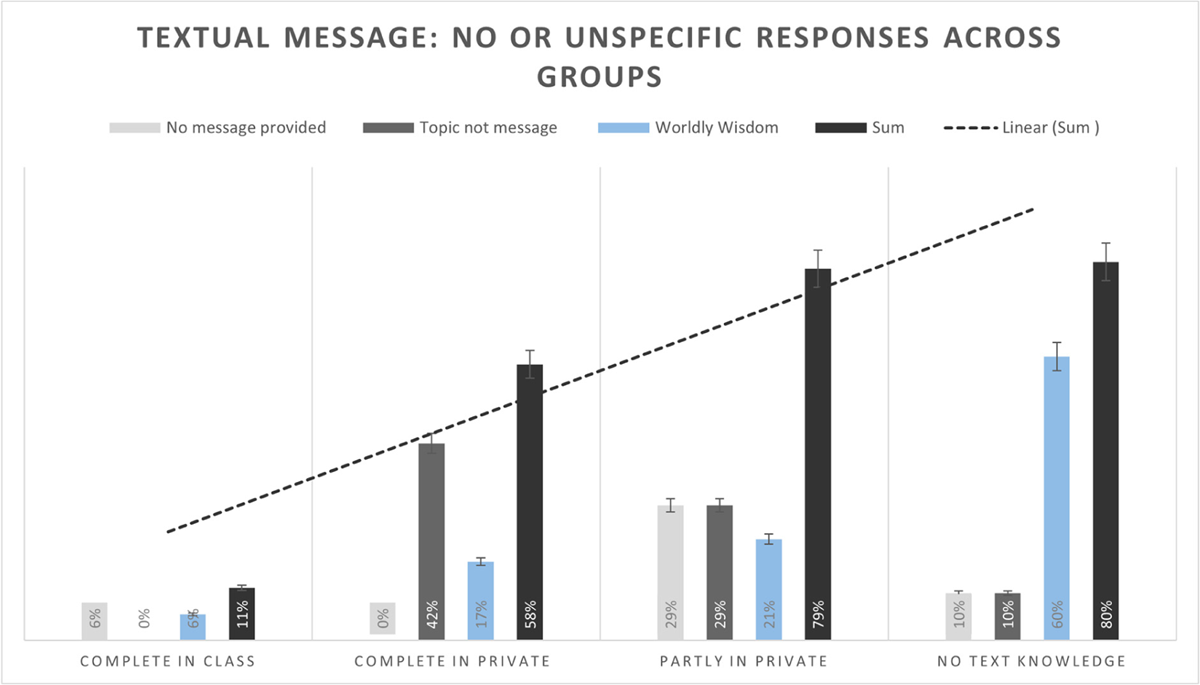
Figure 2
No or Unspecific Responses to the Question of Textual Message Across Text Engagement Groups.
While a clear and expected trend emerges, it is worth noting an unexpected finding: Those who did not pick up the novel were not the least likely to name some message of what they had just read in ten short extracts—instead, participants from the group ‘Partly in Private’ were (see Figure 2). This suggests that the latter group, possibly due to having a clearer grasp of what a full reading would have amounted to exactly and thus being aware of having only partial information, felt less comfortable naming a message.
While the vagueness of responses decreased with greater text engagement, and abstention from naming a message was lower for complete readings, the perceived clarity of the message did not show a complementary pattern (see Figure 3). In line with expectations, mean uncertainty was highest for the ‘No Text Knowledge’ group, as they had only ten short excerpts to base their interpretation on. However, contrary to expectation, those who had read only part of the text before the experiment did not show greater message uncertainty than those who had read the full text (both with and without class discussion). This could indicate that the novella’s ending does not greatly contribute to elucidating the matter of an overall message. And indeed, Stefan Zweig’s Schachnovelle differs from the definition of the genre by not providing a clear message epitomised by a symbol. The chess game referenced in the title does not serve as a straightforward emblem of meaning (see last stimulus quote in section 2.). It can also be hypothesised that the uncertainty in the two groups may have different causes. While readers who read it privately may simply not know whether their own interpretation would be reasonable because they do not discuss it, class discussions may have highlighted the existence of different ways of interpreting the novel and thus reduced the feeling that there is one clear message of the text.
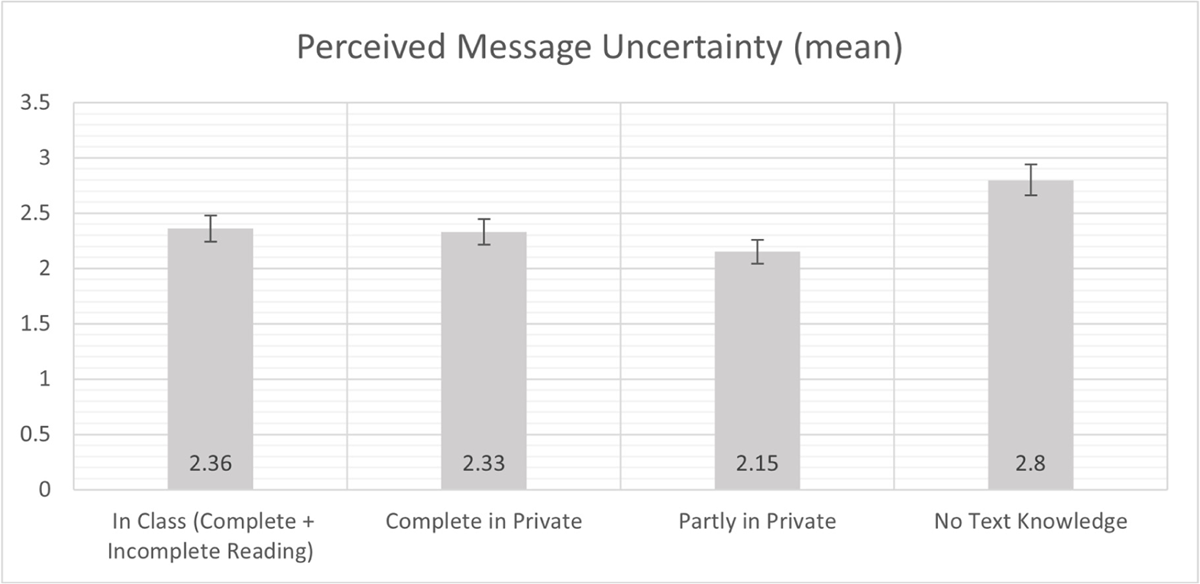
Figure 3
Perceived Message Uncertainty Across Text Engagement Groups.
All in all, it can be concluded that complete readings, and more notably, class discussion will enhance pupils’ confidence in articulating an overall interpretation of the text in terms of its core message. More than complete readings in private alone, the literary classroom reduces uncomplex, unspecific types of responses (see Figure 2), indicating that taking part in the literary classroom enhances students’ capability of producing an interpretation that is both holistic and specific to the literary work. At the same time, the literary classroom does not markedly increase the perceived clarity of the text when comparing students’ evaluation of this matter between complete readings in private and in school (see first two columns in Figure 3), suggesting that literary ambiguity was highlighted in or by classroom discussions. In fact, this is consistent with another aim of the German core curriculum, which stipulates that students must be capable of identifying “ambiguity as a constitutive feature of literary texts” (Hessisches Kultusministerium 2022, 16).
Topics of Provided Textual Messages
We assumed that the focus set by the teacher will be reflected in participants’ responses regarding the message of the texts. In our case, the teacher of the class that discussed the novella provided the students with material on the historical context (namely the Austro-Hungarian monarchy and the connection of Dr. B.’s family to the system), the human psyche (namely an excerpt from secondary literature on repression by Sigmund Freud), and more specifically the effects that imprisonment by the Gestapo could have on an individual.7 Based on these focus areas of the literary classroom, we hypothesised that participants of the engagement group ‘Complete in Class’ would come up with more messages from the respective coding categories ‘Historical Classification’, ‘Human Psyche’, and ‘Trauma’ compared to all other groups, and would show less subject variability in their stated messages compared to the group ‘Complete in Private’.
Comparing different levels of reading engagement reveals distinct patterns in the types of messages selected (see Figure 4). Participants in the ‘Complete in Class’ group chose messages from five subject areas, with the majority focusing on the teaching themes: Messages that fit into the categories of ‘Trauma’ and ‘Human Psyche’ were chosen by 33% of participants, respectively, and ‘Historical Classification’ by 11%. ‘Chess’ was the main focus of the perceived message in 11% of cases, and ‘Worldly Wisdoms’ were put forward by only 6% of participants in this group.
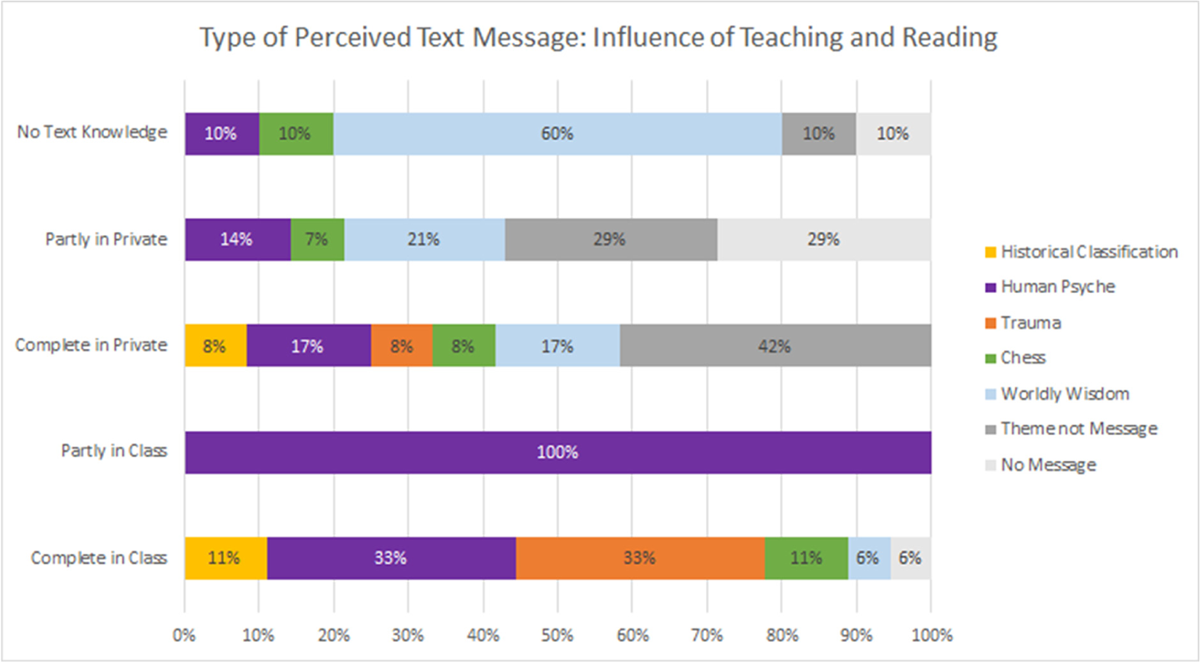
Figure 4
Type of Perceived Textual Message Across Text Engagement Groups.
In private reading without subsequent class discussion, the entirety of the reading has no significant effect on the frequency of occurrence of message topics ‘Human Psyche’ (incomplete: 14%; complete: 17%), Worldly Wisdoms (21% vs. 17%) and ‘Chess’ (7% vs. 8%). But only after complete private readings, ‘Historical Classification’ (0% vs. 8%) and references to ‘Trauma’ (0% vs. 8%) also become a main topic within the overall messages. Additionally, only complete private readings enabled all students to identify some kind of message or theme.
Thus, after classroom discussion, interpretations centred more strongly on the main focus topics of the worksheets: these accounted for 77% of all responses in the ‘Complete in Class’ group, compared to 33% in the ‘Complete in Private’ group. However, this does not indicate a narrowing of interpretive range; classroom discussion reinforced shared themes without silencing alternative perspectives in students’ interpretations. Overall, complete readings of the text broadened the range of identified messages, while classroom discussion amplified interpretive threads related to the discourse within the classroom without reducing diversity of interpretation.
4.2. (Felt) Understanding of Literary Characters
To explore the influence of complete reading and class discussion on the understanding of literary characters, we studied students’ character models of both the antagonist and the protagonist to see how close the students’ models are to text-based character models. We also measured how well they felt able to understand real people similar to the two characters encountered in Schachnovelle, both regarding their emotions and their actions.
Students’ Precision of Character Models
To assess the accuracy of participants’ character models, we calculated the proportion of correct responses (fitting or not fitting) for each selected adjective for both the protagonist, Dr. B., and the antagonist, Czentovic. We anticipated that participants with further text engagement in class would have the most nuanced understanding of the characteristics that are typical of or which distinguish certain characters, possibly especially so with respect to Dr. B., given that the worksheets (see section 3.1.) focused on this character.
Regarding the antagonist, the data substantiates this assumption: The majority of participants in the ‘Complete in Class’ group demonstrated accurate responses to every single item, with an average score of 86.1% correctly answered survey items (see Figure 5). In contrast, the ‘Complete in Private’ readers, while on average still correct on nine out of ten character items, only reached an average score of 67.1% correct responses (see Figure 6), indicating a greater variety of character models in this group, with less emphasis on text-based elements. The control group of readers who read only the ten short extracts of the novella had an average score of 44.4%, thus scoring below chance, with the majority only being right on three items (see Figure 7).
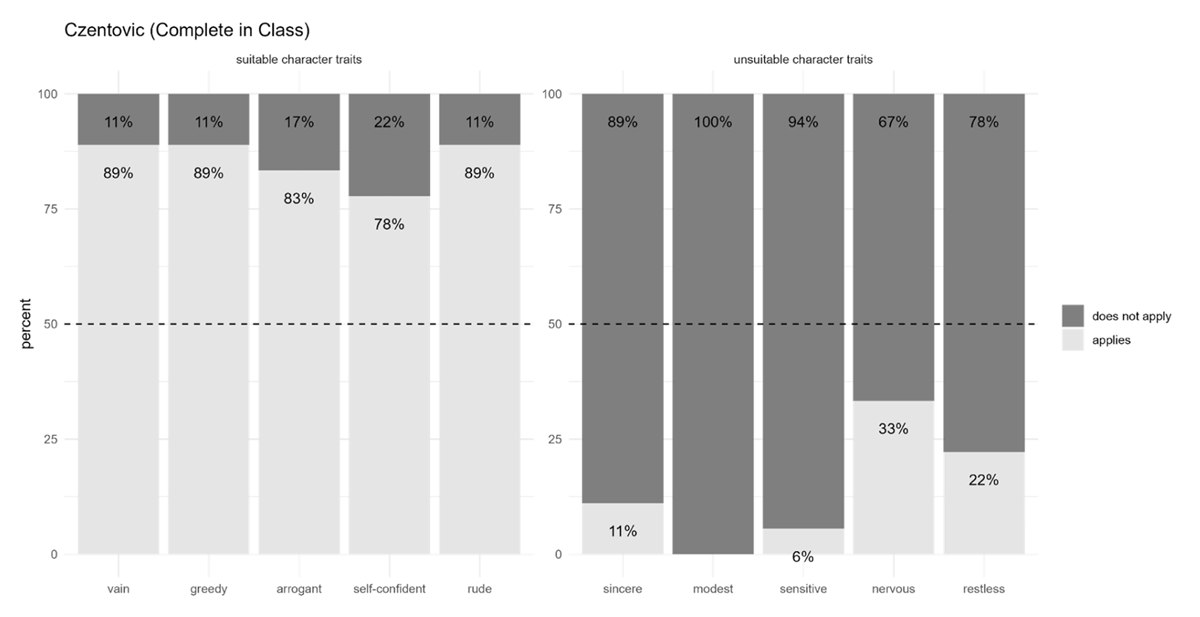
Figure 5
Results for the antagonist’s character traits of participants who read the whole text and discussed it in class. Correct answers in light grey on the left and dark grey on the right.
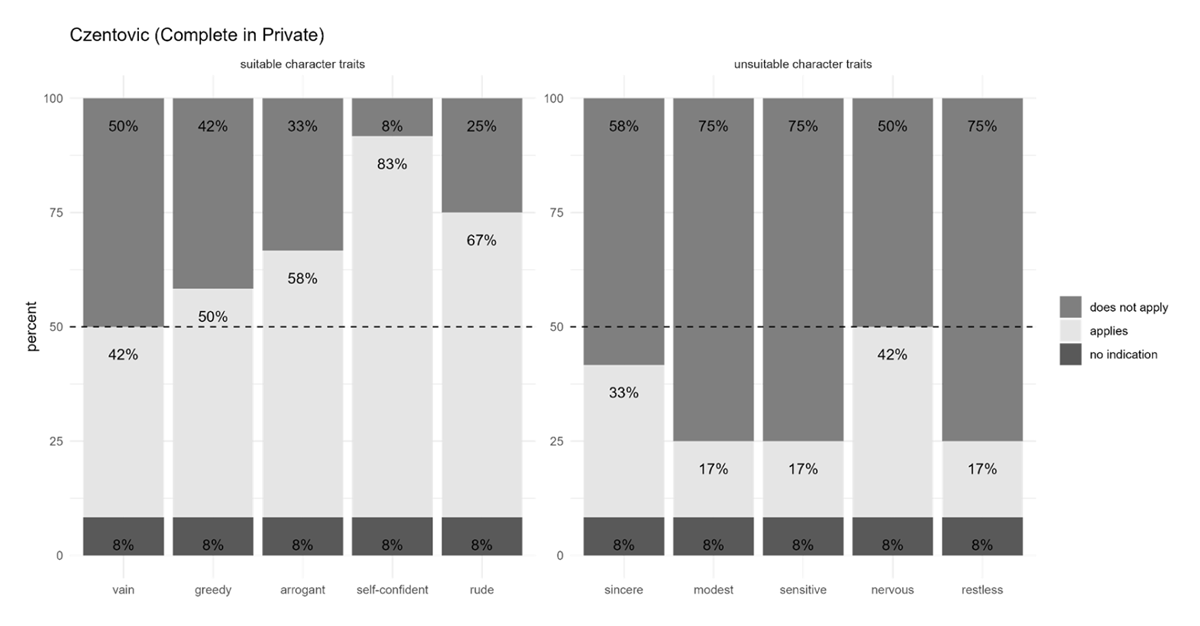
Figure 6
Results for the antagonist’s character traits of participants who read the whole text in private. Correct answers in light grey on the left and dark grey on the right.
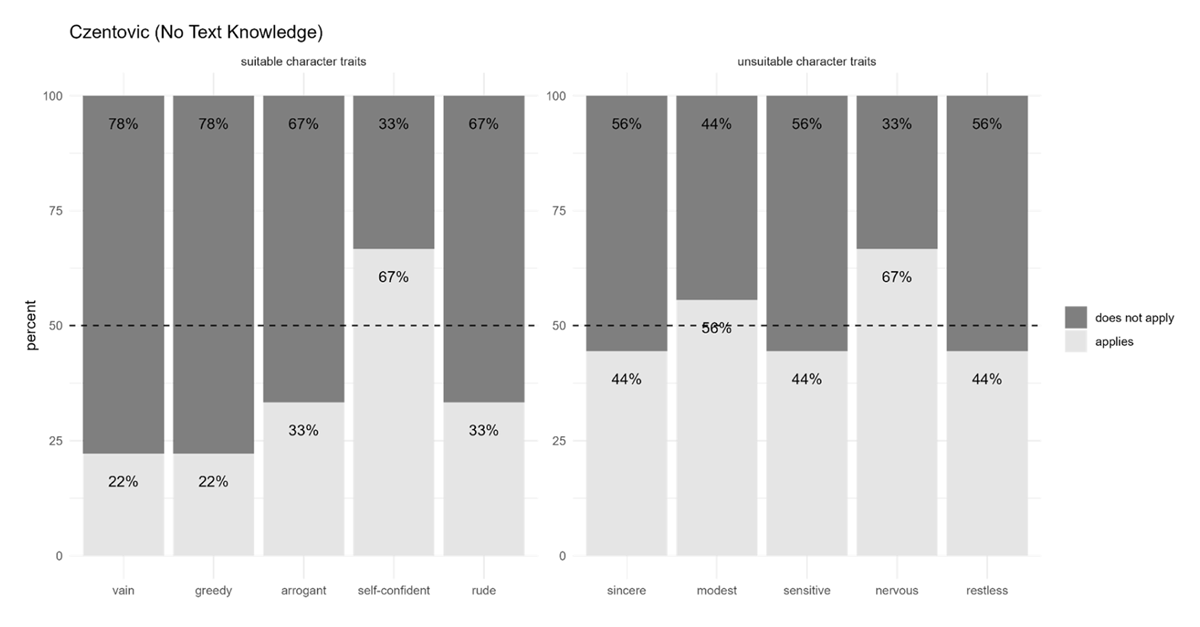
Figure 7
Results for the antagonist’s character traits of participants with no prior text knowledge. Correct answers in light grey on the left and dark grey on the right.
With regard to the protagonist, the data again indicates an influence of the literary classroom, as the ‘Complete in Class’ group exhibited considerably higher scores than the ‘Complete in Private’ group. As with regard to the antagonist, the former were, on average, correct on all items (see Figure 8), whereas this was only the case for eight of the ten items for the latter (see Figure 9). This was reflected in an overall mean of 84.6% vs. 61.4% correct answers. Again, the control group, who had to base their character models on the extracts only, was on average correct in only 37.3% of cases (see Figure 10). It is noteworthy that the proportion of correct answers differs markedly for the item ‘sensitive’ between the two higher engagement groups: the ‘Complete in Class’ group demonstrated a 73% accuracy rate, whereas the ’Complete in Private’ group exhibited a mere 14% accuracy rate on this item.
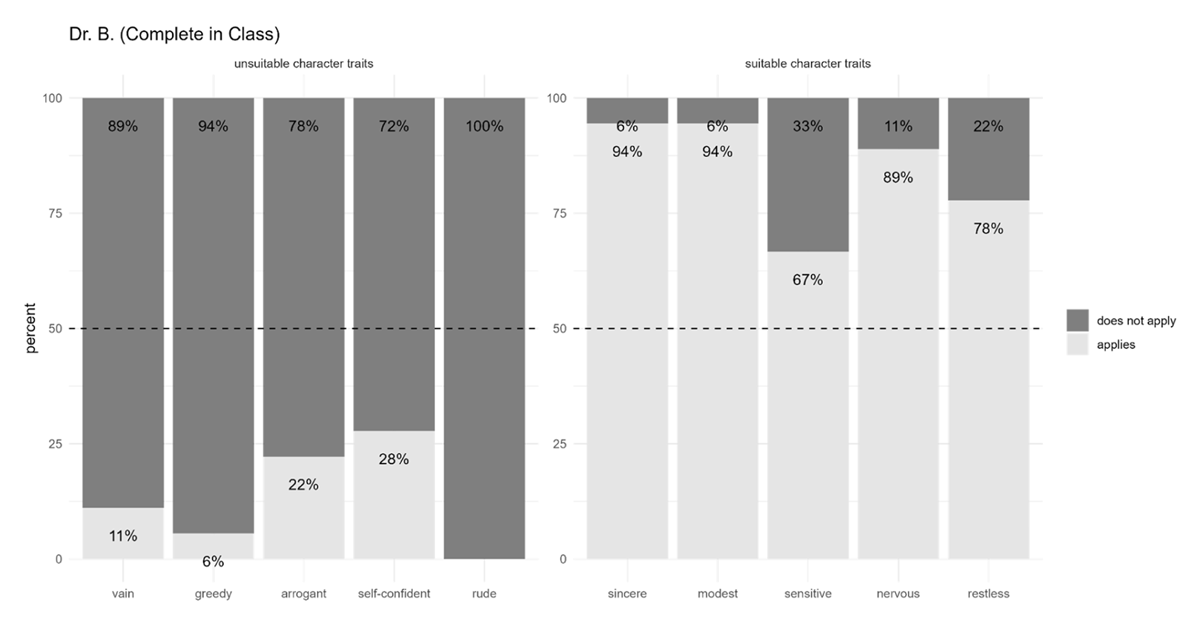
Figure 8
Results for the protagonist’s character traits of participants who read the whole text and discussed it in class. Correct answers in dark grey on the left and light grey on the right.
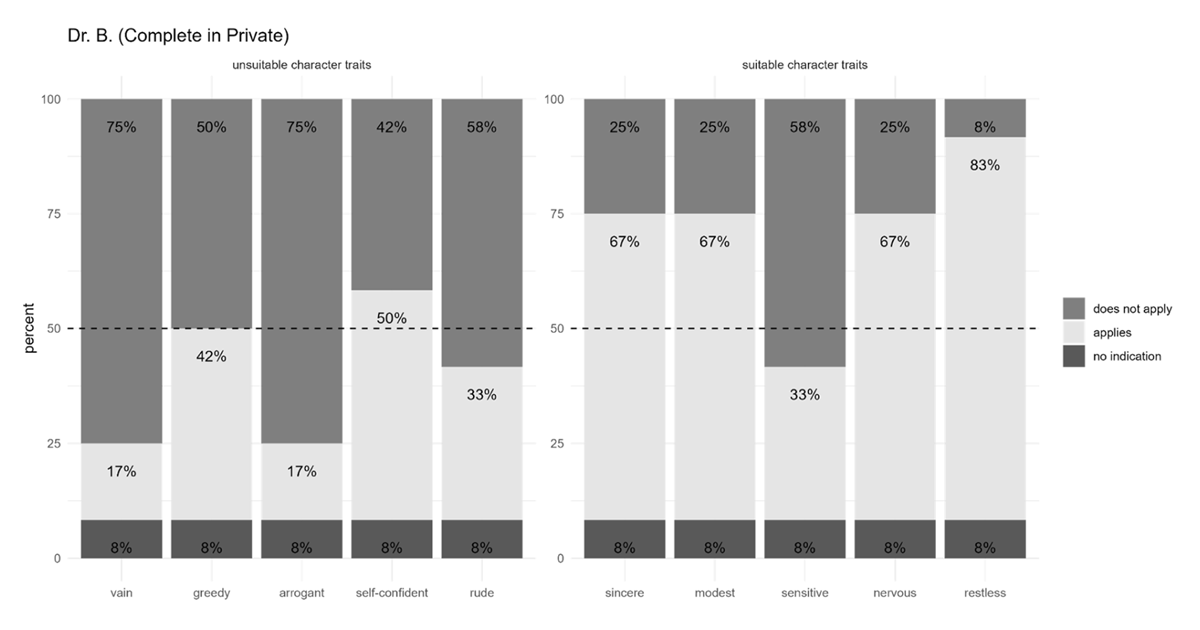
Figure 9
Results for the protagonist’s character traits of participants who read the whole text privately. Correct answers in dark grey on the left and light grey on the right.
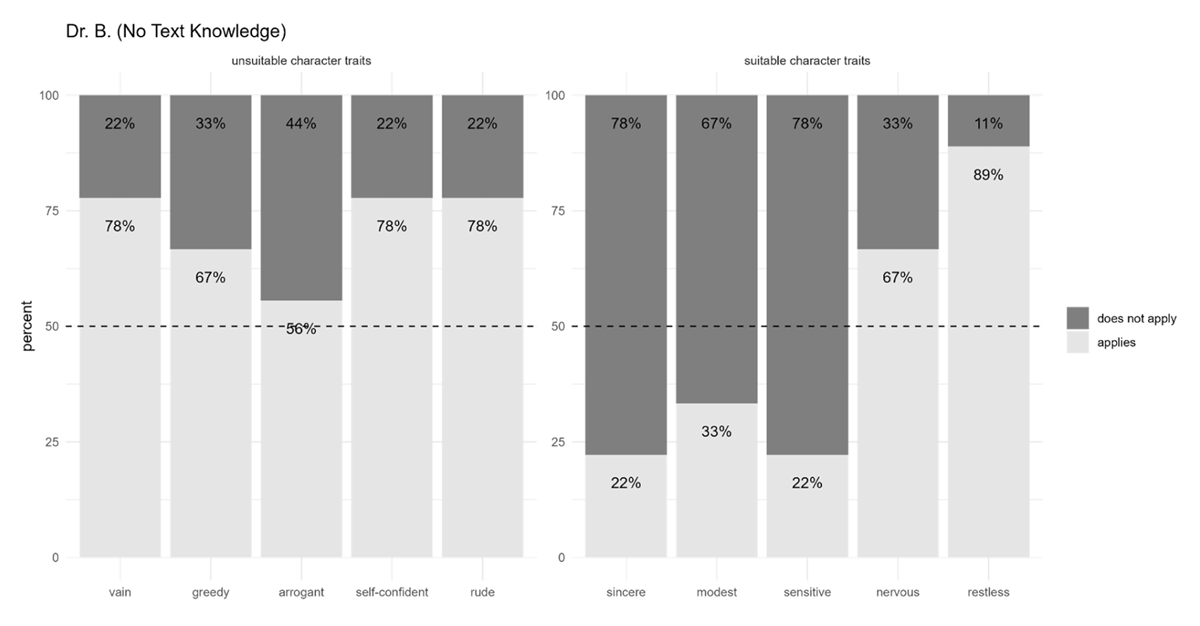
Figure 10
Results for the protagonist’s character traits of participants with no prior text knowledge. Correct answers in dark grey on the left and light grey on the right.
These results indicate that the literary classroom fosters the development of more accurate character models. It also seems that the dichotomy of the positively valenced character Dr. B. and the very negatively portrayed Czentovic is more pronounced in ‘Complete in Class’ readers who are, for example, all sure that Dr. B. is not rude and sincere, while Czentovic is not modest and, by a great majority, also seen as vain, greedy, and arrogant. Directing students’ attention to the trauma experienced by Dr. B. through the worksheets may have directly impacted their clearly superior performance on the item ‘sensitive’, seeing this as very fitting for Dr. B., while at the same time performing slightly worse on (the equally fitting items) ‘nervous’ and ‘restless’, which some of them might have interpreted, following class discussion, as derived from the trauma and hence not as characteristics in their own right. Overall, the teaching method appears to have had a beneficial impact on creating text-based character models of both the antagonist and the protagonist.
Students’ Understanding of Characters’ Emotions and Actions
The students were asked to envision both the protagonist and the antagonist as tangible individuals whose emotional responses and actions they would need to predict in situations familiar to them. Subsequently, they were asked the degree of confidence in their ability to do so (for details, see Figure 11). The control group, comprising participants without prior text knowledge who only read ten short extracts, exhibited the greatest (or equally greatest) uncertainty both in regard to emotions and behaviour for both characters.
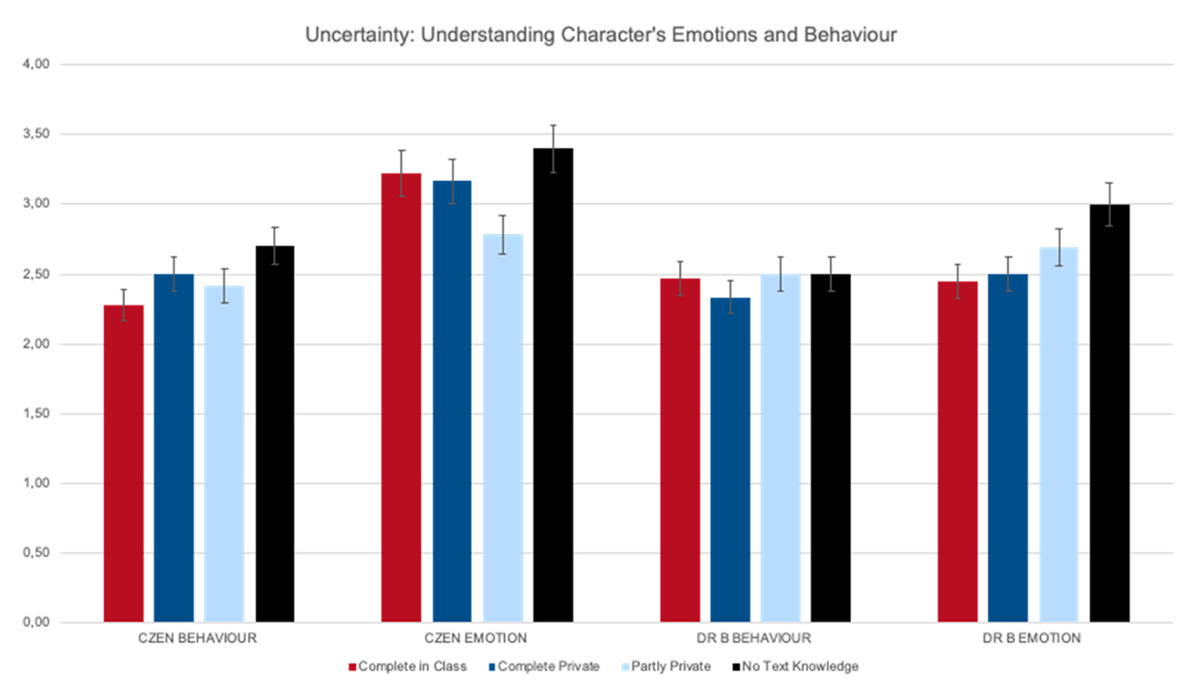
Figure 11
Differences in Text Engagement Groups: Feeling certain or uncertain regarding protagonist’s and antagonist’s emotions and behaviour. High bars indicate greater uncertainty of how someone like that character would act or feel.
Our findings indicate that, across groups, the antagonist Czentovic’s emotions are the most challenging to comprehend and predict (M = 3.14), while the protagonist Dr. B.’s emotions are less opaque (M = 2.66). In general, making predictions regarding behaviour appears to be easier for the participants, and a less pronounced difference between protagonist (M = 2.45) and antagonist (M = 2.47) is found. This pattern may be indicative of the narrative perspective of the Schachnovelle, in which the behaviour of both characters is described by an intradiegetic narrator, but with a clear focus on the protagonist when it comes to thoughts and feelings. This textual situation provides readers with a similar amount of insight into all depicted characters’ behaviours, but affords less information regarding the antagonist’s feelings, which could explain these results.
Most importantly in regard to our aim to understand differences between private readings and school-set readings, the data suggests no substantial difference in understanding emotions and actions between these groups (on average, no difference greater than 0.22 points on the rating scale). We can thus conclude that this specific literary classroom experience did not make the characters appear more lucid for our students.
4.3. Rereading: Investigating the impact of a specific educational practice
The present study sought to explore the effects that a focused rereading practice, focusing on specific extracts with either the protagonist or the antagonist (see section 2), might have on students’ accuracy of character models, their self-observed changes in character perception, and felt understanding of characters’ emotions and behaviours.
Does Rereading Create more accurate Character Models?
When using a rereading paradigm, one pedagogical aim could be to install a more accurate and text-based character model in students. If this effect could indeed be observed, we would expect that regarding the antagonist Czentovic, Group A, who focused on him in the rereading, should be better at picking out the correct character traits compared to Group B.
When examining the impact of rereading on students’ ability to accurately attribute character traits to the story’s protagonist, the findings revealed that pupils who had read the extracts focusing on the protagonist Dr. B. demonstrated better character accuracy following rereading, in comparison to those who had read the extracts focusing on Czentovic.
The improvement in protagonist trait attribution was most pronounced among private readers: students focusing on Dr. B. reached 70% accuracy (see Figure A1 in the Appendix), compared to 55.7% for those not focusing on the protagonist in the rereading (see Figure A2 in the Appendix). For in-class readers, those with a focus on Dr. B. in the rereading also performed better, but the gap was smaller (89% vs. 82%, see Figures A3 and A4 in the Appendix). The greater gain in private readers likely reflects that this was their first educational task on the text, whereas in-class readers already had a more developed understanding, and consequently, less room for improvement.
By contrast, focusing on Czentovic did not generally enhance trait identification (see Figures A5–A8 in the Appendix). With the exception of the group that had previously encountered the text in a school setting and in relation to the five applicable characteristics, there was a decline in accuracy after rereading sections focusing on Czentovic in comparison to those focusing on the protagonist. Contrary to our expectations, participants in the ‘Complete in Class’ group who focused on Dr. B. during rereading improved in assessing Czentovic, correctly identifying him as ‘arrogant’ and ‘rude’ while dismissing ‘sensitive’ or ‘restless’. Similarly, in the ‘Complete in Private’ group, a focus on the protagonist also improved accuracy for the antagonist, with participants more often correctly attributing traits such as ‘greedy’, ‘self-confident’, and ‘rude’, and less often perceiving him as ‘modest’ or ‘nervous’, consistent with the novella’s portrayal.
Consequently, a focus on the protagonist, as achieved through a rereading intervention of extracts dealing with this character, indeed increased the accuracy of character traits for the protagonist in the case of the Schachnovelle. However, in order to comprehend the antagonist’s character (traits), it is more beneficial to observe him in comparison to the protagonist, and also to undertake a rereading with a focus on the protagonist. A re-examination of textual extracts with a focus on the protagonist and the juxtaposition of characters in the final match appears to have facilitated a more profound comprehension of the antagonist-protagonist structure than a focus on the antagonist and the same confrontation yielded.
This mixed result in rereading fostering character understanding—with a positive effect on character accuracy observed after rereading sections centred on the protagonist, but not on the antagonist—warrants further research on different kinds of literary texts with varied character structures and on the effect of specific passages chosen for rereading.
Does Rereading Change the Way Characters are Perceived?
We stipulated that reading selected passages highlighting character features of one specific character should help to create a solidified understanding of this character, either by deepening a reader’s perception of that character, confirming the impression of a first reading, or by changing one’s perception of that character if new aspects are highlighted that were overlooked in a first reading.
For most of these participants, the reading impression remains consistent (see Figure 12: Group A-Dr. B.: 67%; Group A-Czentovic: 43%; Group B-Dr. B.: 74%; Group B-Czentovic: 75%). However, it is noticeable that the group who read excerpts with a focus on the minor character not receiving the narrator’s sympathy, Czentovic, sees the greatest alteration in impression: taken together, a changed or deepened impression form the majority here (deepened: 38%; changed: 19%). Those who read extracts focused on the main character Dr. B. also changed or deepened their impression of the minor character, albeit to a much smaller degree (deepened: 15%, changed: 10%).
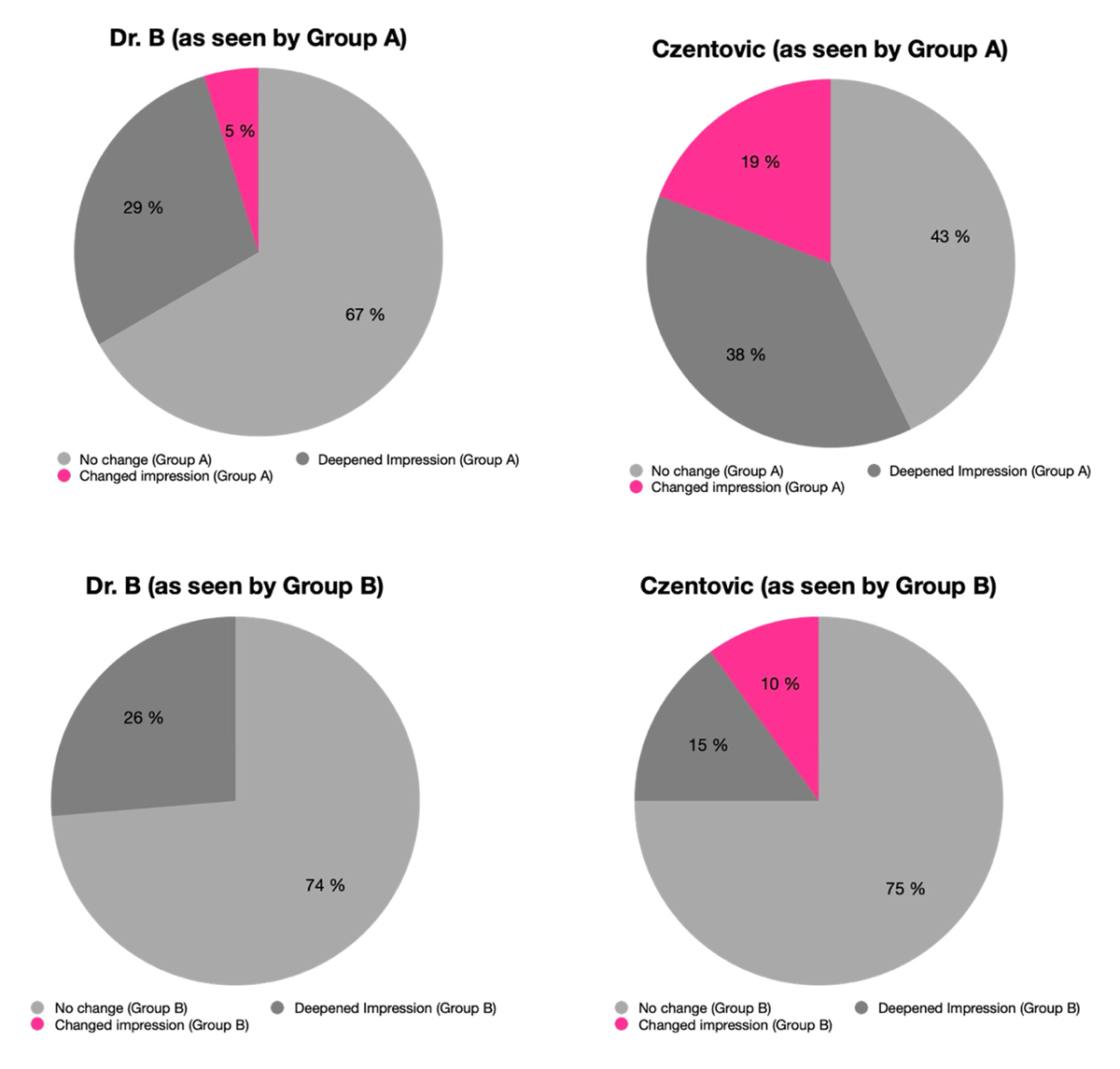
Figure 12
Changes in character perception per character (antagonist/protagonist) and Intervention Group (Group A-focus on Czentovic/Group B- focus on Dr. B.) after rereading.
On the contrary, a changed perception of the (main) character Dr. B. is very rare (Group A: 5%) or even non-existent for the group with excerpts focused on him (Group B: 0%). In both groups, a deepened impression occurs for around a quarter of participants (Group A: 29%, Group B: 26%, no significant group difference).
In this dataset, we observe that rereading leads more frequently to the impression of an altered perception regarding the (minor) character compared to the perception of a main character, who is favourably portrayed by the story’s narrator. This effect occurs in both groups, but is especially pronounced in the group guided with the minor character (A: 57%; B: 25%). This result suggests that there is no clear link between the introspective experience of rereading and the accuracy of character models. Qualitative research could build on participants’ reflections to explore these effects further and see whether this is also the case for rereading other texts. It is worth noting, however, that rereading ten short excerpts does not lead most readers to feel they have gained a deeper or significantly changed understanding of the story’s characters, possibly in line with humans’ reluctance to change their opinions about characters once they have made up their mind (Auracher and Hirose 2017).
Does Rereading increase the felt Understanding of Characters’ Emotions and Behaviour?
The data analysis indicates that a comparative reading of groups A and B with a specific focus does not result in discernible enhancements in the transparency of the respective characters, whether in terms of emotional expression or their behavioural patterns (see Figure 13). It appears that a distinctive quality of the Schachnovelle is the difficulty readers encounter in comprehending Czentovic’s emotional state—and, possibly unsurprisingly, this persists also after a rereading of ten brief extracts. These findings suggest that rereading short extracts may not be a particularly effective means of fostering ‘Einfühlung’ in characters, either in terms of emotional understanding or cognitive insight. Nonetheless, this does not rule out the potential of alternative pedagogical approaches to achieve this aim, nor this being an effect specific to this text.
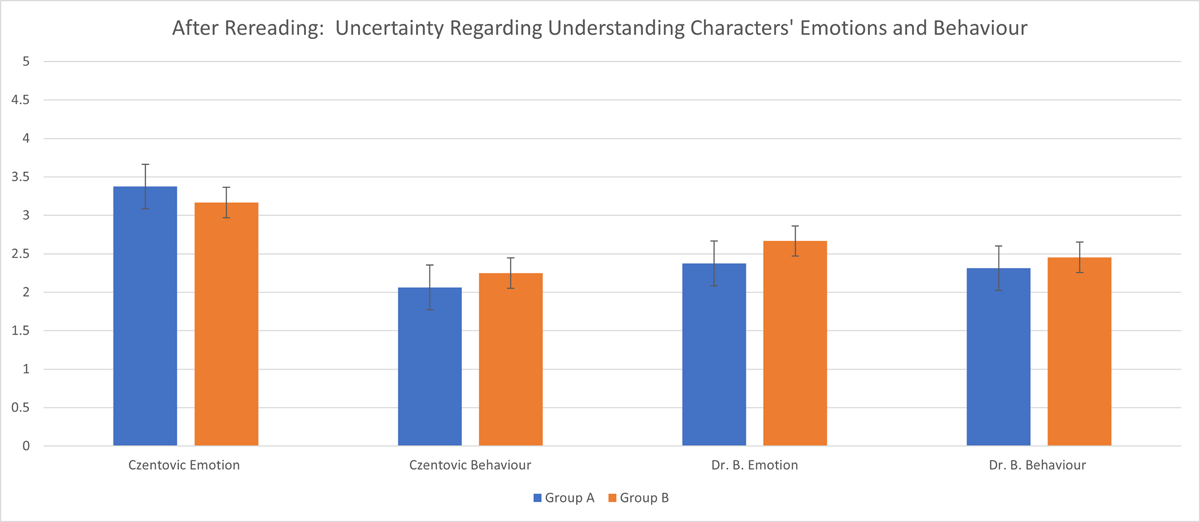
Figure 13
Uncertainty with regard to Czentovic’s and Dr. B.’s Emotions and Behaviour. Greater values indicate greater uncertainty.
5. Discussion
As might be anticipated, complete readings decrease the number of messages indicating shallow processing of the text. But it is the literary classroom that exerts an even more pronounced effect in this regard: Those who have read the Schachnovelle in its entirety and covered it in class almost universally mention a specific message, are less likely to mention generic themes and exhibit a lower occurrence of messages related to generic life lessons than participants who read the story on their own. This suggests a deeper processing level of the novella through the context of the literary classroom.
We found that both the completeness of reading the here-studied novella Schachnovelle and the literary classroom did not significantly decrease the perceived ambiguity of the message in students. As hinted above, a possible explanation could be that for informed readers, more knowledge does not necessarily mean more definitiveness. On the one hand, those who know the entire text have everything they need to name a message at their disposal. But they might also find more reason to think of deviant meanings and hence experience what literature is about: ambiguity. This is also in line with the conviction that the ‘guided practice’ of teaching literature (Pearson and Gallagher 1983) should enable pupils to make their own ‘authentic’ experience with the literary text (Nystrand et al. 1997; Nystrand 2006; Giovanelli and Mason 2015). As a result, and despite this heightened awareness of ambiguity, participation in the literary classroom made it more likely that students would feel and be able to arrive at an overall interpretation of the text and to identify a specific core message of that literary work.
A comparison of the mentioned message topics shows that the same topics are mentioned both after complete private reading and after complete readings accompanied by classroom instruction. There is, however, a notable shift in frequencies in the latter group toward the themes that were covered in class. This indicates that it is the completeness of readings that diversifies interpretations (and not, as an alternative explanation might posit, the classroom discussion of various interpretations), whereas the discussion in class intensifies what readers understood in their private reading. The discourse within the classroom strengthens topics related to the teacher’s focus without silencing other interpretation strands. For future studies, it would be beneficial to directly compare instructional approaches where the literary classroom is focused on different aspects of the same novella and students are provided with varying teaching materials.
Another crucial objective identified for the literary classroom is the ‘Einfühlung’ in literary characters. When examining students’ understanding of characters’ emotions and actions, no significant differences were observed between those who had read the novel in private only and those who had also studied it in class, neither regarding the protagonist nor the antagonist. Thus, prior classroom discussion did not appear to make the characters’ emotional worlds more transparent to students, suggesting that empathic engagement with literary figures may depend more on the text’s internal structure than on external mediation. There is, however, a significant influence of the chosen methods within the literary classroom on the accuracy of the image of literary characters. When comparing correct assignments of fitting and non-fitting character attributes, readers who have covered Schachnovelle in school by far outperform those who have read the novella completely in private, both when it comes to the protagonist and the antagonist.
Additionally, the objective of this study was to analyse the impact of a rereading intervention focused on one of the two main characters in the novella. While the intervention did not produce strong effects, it did yield some noticeable outcomes. Rereading selected passages—particularly those related to the protagonist—led to a slight increase in the accuracy with which students identified character traits. There is also a small but notable increase in the number of students who reported either a deepening or a change in their impression of the antagonist character. This indicates that targeted rereadings (particularly when coupled with an appropriate assignment, as would be typical in a literary classroom setting) may be an effective pedagogical approach for facilitating students’ identification of elements in texts that may not be immediately apparent or emphasised in the original literary material, which they might otherwise have overlooked during a first, independent reading. It seems that rereadings alone are not enough to foster empathy for characters, and that they need to be accompanied by other teaching strategies if this is the goal.
6. Conclusion
This study set out to investigate the effects of literary classroom instruction and rereading strategies on students’ interpretation of Stefan Zweig’s Schachnovelle. The findings show that students who read and discussed the novella in class were significantly more confident in articulating its message, produced more text-specific responses, and demonstrated a more text-grounded understanding of character traits than those who engaged with the text privately. While complete readings alone already led to richer interpretations, the structured environment of classroom instruction promoted even greater interpretive depth. However, neither complete reading nor classroom discussion substantially reduced students’ sense of ambiguity regarding the novella’s message, suggesting that increased familiarity with the text may, in fact, highlight its interpretive openness rather than resolve it. This insight aligns with the pedagogical aim of literature teaching to maintain, rather than dissolve, the ambiguity of literary works.
Our investigation also highlighted the role of rereading as a targeted educational tool. Although rereading ten selected extracts did not lead to measurable increases in students’ empathic understanding or Theory of Mind capacities with respect to the characters, it did affect how readers perceived and described them. Our findings point to two potential benefits of rereading in the literary classroom: a focus on the protagonist, as set with extracts about Dr. B of Zweig’s Schachnovelle, can increase the accuracy of character traits for the protagonist. In the case of this novella, the main character is rendered with such great narrative sympathy and psychological depth that a focus on him also improves the comprehension of the antagonist’s character traits. A re-examination of textual extracts with a focus on the protagonist and the juxtaposition of characters in the final match appears to have facilitated a more profound comprehension of the antagonist-protagonist structure than a focus on the antagonist and the same confrontation yielded.
At the same time, rereading passages focused on the antagonist character could lead to a change or deepening in participants’ impression of him, demonstrating the potential of rereading to draw attention to aspects of the narrative that may otherwise remain marginal. Schachnovelle’s Czentovic is a subaltern character who hardly speaks at all. While rereading alone does not necessarily yield more empathetic character models, it does create space for students to revisit and refine their perceptions, perhaps especially so in the case of more opaque or negatively portrayed figures.
It would be advantageous for future studies to expand the sample size beyond the current limited sample of three classes from a single German high school. Moreover, it is important to consider that some of our findings may be highly specific to the novella under study, particularly in relation to its protagonist/antagonist structure. Furthermore, it would be beneficial to extend the scope of collaboration with teachers in order to gain a more nuanced understanding of the pedagogical approaches currently employed in literary classrooms and to explore a broader range of interventions beyond rereadings, such as creative writing, role play, or comparative reading across texts. Future work may then address specific aspects (for example, young readers’ confidence in interpretation, the creation of text-based character models, or felt understanding of characters) in relation to various teaching methods. At the same time, the present study suggests that rereading is a promising measure within empirical literary studies—one that can be meaningfully integrated into school-based research. Future work could benefit from varying the textual material and comparing different didactic focuses to determine how best to balance interpretive freedom with structured guidance in literature education.
Additional File
The additional file for this article can be found as follows:
Notes
[2] SN = Zweig, Stefan (1991). Schachnovelle. 10. Auflage. Fischer-Bibliothek. Frankfurt am Main: S. Fischer.
[3] To ensure that students had actually read the text, they were anonymously asked to indicate how well they knew it (see also section 3.2 Participants).
[4] We would like to thank the teachers Stefanie Walther, Antonia Hensmann, and Peter Wengel from the Justus Liebig Schule Darmstadt for their support throughout the project.
[5] Radvan, Florian, Stefan Rogal, and Stefan Zweig, eds. 2013. Stefan Zweig, Schachnovelle: Kopiervorlagen für die Sekundarstufe II. Kopiervorlagen – Literathek. Cornelsen.
[6] The analysed data is part of a broader research study that comprised of eye-tracking, fEMG, and EDA measurements, as well as queries on judgment pre- and post-reading. We will not elaborate on these aspects in this report. It should be noted, however, that movement was restricted under these conditions (fixed chin rest for eye tracking; being wired up to record facial movements and skin conductance responses on the hands). Nevertheless, we tried to ensure a comfortable reading experience by allowing participants ample time to acclimate to the setup (at least 15 minutes prior to being seated in the experiment booth) and making sure they were sitting as comfortably as possible before starting the experiment.
[7] For the worksheets used, please see Radvan, Rogal, und Zweig (2013).
Ethics and Consent
Ethical approval by the ethics committee of the TU Darmstadt was obtained on 30.09.2022.
Data Accessibility Statement
The supporting data of this study is available from the third author upon request.
Author Contributions
Author 1: Investigation, Supervision, Software, Data Curation, Methodology, Formal Analysis, Visualisation, Writing – Original Draft Preparation, Writing – Review & Editing.
Author 2: Formal Analysis, Visualisation, Writing – Review & Editing.
Author 3: Conceptualisation, Investigation, Supervision, Methodology, Writing – Original Draft Preparation, Writing – Review & Editing.