
Table 1
Overview of the six hypotheses tested in the study.
| HYPOTHESIS | DESCRIPTION |
|---|---|
| H1 | Textual foregrounding increases readers’ state empathy and empathic distress toward morally ambivalent characters. |
| H2 | Textual foregrounding increases readers’ aesthetic appreciation of the text. |
| H3 | The relationship between textual foregrounding and empathy is mediated by perceived foregrounding and/or aesthetic appreciation. |
| H4 | The effect of textual foregrounding on state empathy and empathic distress is moderated by the readers’ trait empathy. |
| H5 | Textual foregrounding affects empathic distress (even though direction and magnitude may be unclear due to ambiguous character roles). |
| H6 | The Kindly Ones evokes more empathic distress than Lolita. |
Table 2
Examples of foregrounding manipulation in Lolita and The Kindly Ones, in English and in the Italian version provided in the surveys.
| NOVEL | ORIGINAL TEXT | MANIPULATED TEXT, WITH FOREGROUNDING REDUCED |
|---|---|---|
| Lolita | And there were times when I knew how you felt, and it was hell to know it, my little one. [E c’erano momenti in cui sapevo come ti sentivi, e saperlo era l’inferno, piccola mia.] | There were times when I knew how you felt and it was horrible to realize it. [C’erano dei momenti in cui riconoscevo il modo in cui ti sentivi e rendermene conto era orribile.] |
| Lolita | and the next moment the tenderness and the azure—all would be shattered. [un attimo dopo la tenerezza e l’azzurro – tutto andava in pezzi.] | and after that the sense of tenderness and bliss were over [subito dopo il senso di tenerezza e di benessere si esaurivano.] |
| The Kindly Ones | she stared at me with her large surprised incredulous eyes, the eyes of a wounded bird [mi fissava con i suoi grandi occhi sorpresi, increduli, occhi da uccello ferito] | she looked at me with an expression of surprise and incredulity in her eyes [mi guardava con un’espressione di sorpresa e incredulità] |
| The Kindly Ones | I kept shooting at her and her head exploded like a fruit [continuavo a spararle e la sua testa si era spaccata come un frutto] | I kept shooting at her to the point that her head burst open [continuavo a spararle tanto che la sua testa si spaccò] |
Table 3
Dimensions and items of the IRI test employed in the present study, including measures of internal consistency (r = reverse scored items).
| DIMENSION | ITEMS |
|---|---|
| Empathic Concern (Cronbach’s ɑ = .77) | 2. I often have tender, concerned feelings for people less fortunate than me. |
| 4. Sometimes I don’t feel very sorry for other people when they are having problems. (r) | |
| 9. When I see someone being taken advantage of, I feel kind of protective towards them. | |
| 14. Other people’s misfortunes do not usually disturb me a great deal. (r) | |
| 18. When I see someone being treated unfairly, I sometimes don’t feel very much pity for them. (r) | |
| 20. I am often quite touched by things that I see happen. | |
| 22. I would describe myself as a pretty soft-hearted person. | |
| Perspective Taking (Cronbach’s ɑ = .84) | 3. I sometimes find it difficult to see things from the “other guy’s” point of view. (r) |
| 8. I try to look at everybody’s side of a disagreement before I make a decision. | |
| 11. I sometimes try to understand my friends better by imagining how things look from their perspective. | |
| 15. If I’m sure I’m right about something, I don’t waste much time listening to other people’s arguments. (r) | |
| 21. I believed that there are two sides to every question and try to look at them both. | |
| 25. When I’m upset at someone, I usually try to “put myself in his shoes” for a while. | |
| 28. Before criticizing somebody, I try to imagine how I would feel if I were in their place |
Table 4
Dimensions and items of the State Empathy during Message Processing Scale and the empathic distress construct employed in this study, including measures of internal consistency.
| DIMENSION | ITEMS |
|---|---|
| Affective Empathy(Cronbach’s ɑ = .84) | 1. The character’s emotions are genuine. 2. I experienced the same emotions as the character when reading this excerpt. 3. I was in a similar emotional state as the character when reading this excerpt. 4. I can feel the character’s emotions. |
| Associative Empathy(Cronbach’s ɑ = .86) | 5. I can see the character’s point of view. 6. I recognize the character’s situation. 7. I can understand what the character was going through in the text. 8. The character’s reactions to the situation are understandable. |
| Cognitive Empathy(Cronbach’s ɑ = .86) | 9. When reading the excerpt, I was fully absorbed. 10. I can relate to what the character was going through in the text. 11. I can identify with the situation described in the text. 12. I can identify with the character in the text. |
| Empathic Distress(Cronbach’s ɑ = .90) | 1. The story made me feel miserable. 2. The story made me feel sad. 3. During reading I felt increasingly unnerved. 4. The story aroused unpleasant sensations in me. |
Table 5
Adapted dimensions and items relating to aesthetic feelings, as employed in the present study, including measures of internal consistency.
| DIMENSION | ITEMS |
|---|---|
| Aesthetic Attractiveness(Cronbach’s ɑ = .85) | 1. I found the style of the text captivating. 2. I found the style of the text interesting. |
| Perceived Foregrounding(Cronbach’s ɑ = .90) | 1. I found the style of the text striking. 2. I found the style of the text original. |
Table 6
Mean values reported for the state empathy dimensions by condition, with measures of difference and effect sizes.
| DIMENSION | ORIGINAL (N = 28) | MANIPULATED (N = 31) | DIFFERENCE AND EFFECT SIZES | |||
|---|---|---|---|---|---|---|
| M(SD) | M(SD) | t | df | p | r | |
| Affective Empathy | 4.95(.62) | 4.12(.85) | 4.34 | 54.67 | <.001* | .50 |
| Cognitive Empathy | 5.19(.66) | 4.22(.84) | 4.95 | 55.77 | <.001* | .55 |
| Associative Empathy | 4.27(.72) | 3.32(.81) | 4.77 | 56.99 | <.001* | .54 |
| Empathic Distress | 4.60(.93) | 4.17(1.19) | 1.53 | 55.87 | <.129 | .20 |
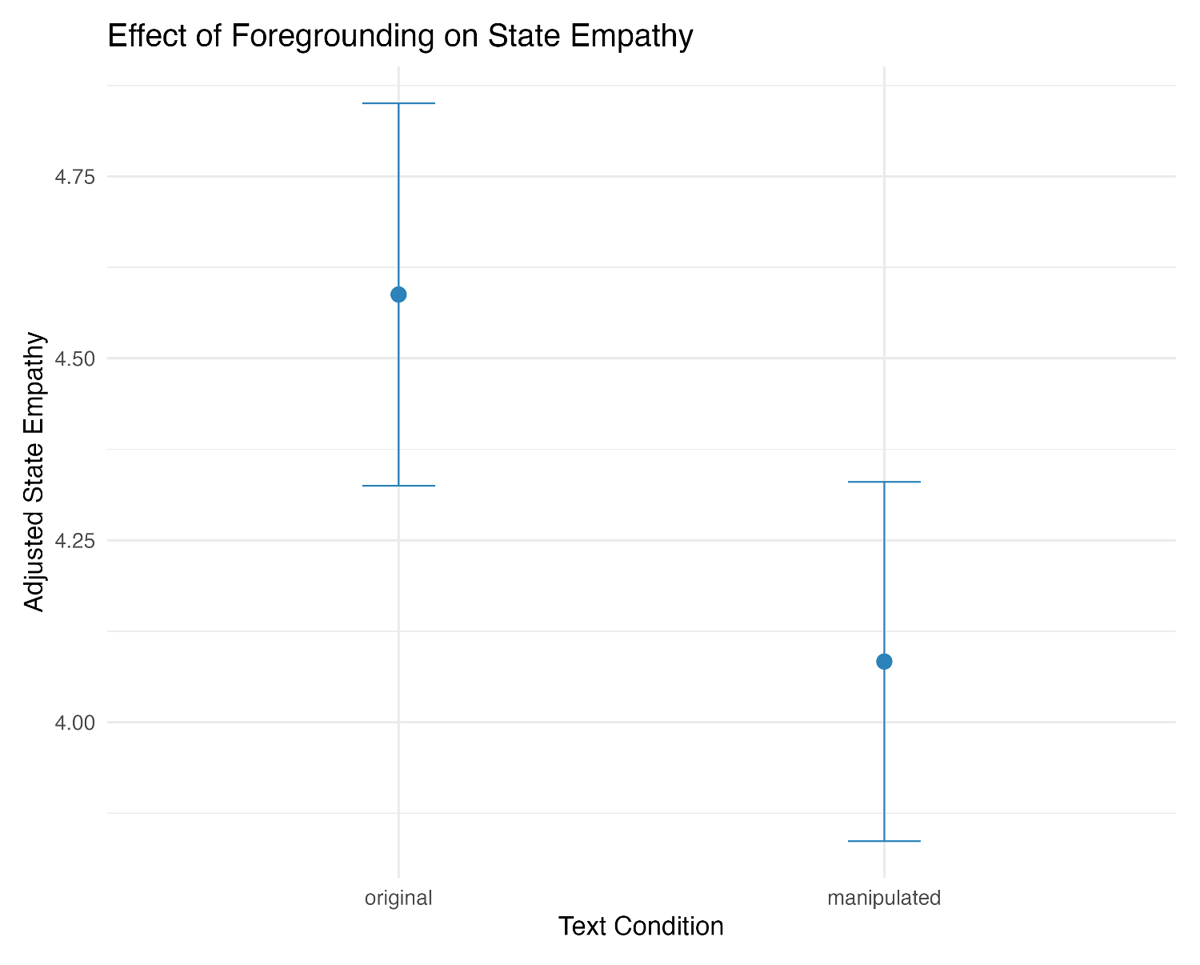
Figure 1
Effects of Foregrounding on State Empathy. Estimated marginal means of state empathy scores by text condition (original vs. manipulated), controlling for Trait Empathy, Aesthetic Attractiveness, and Perceived Foregrounding. Error bars represent 95% confidence intervals.
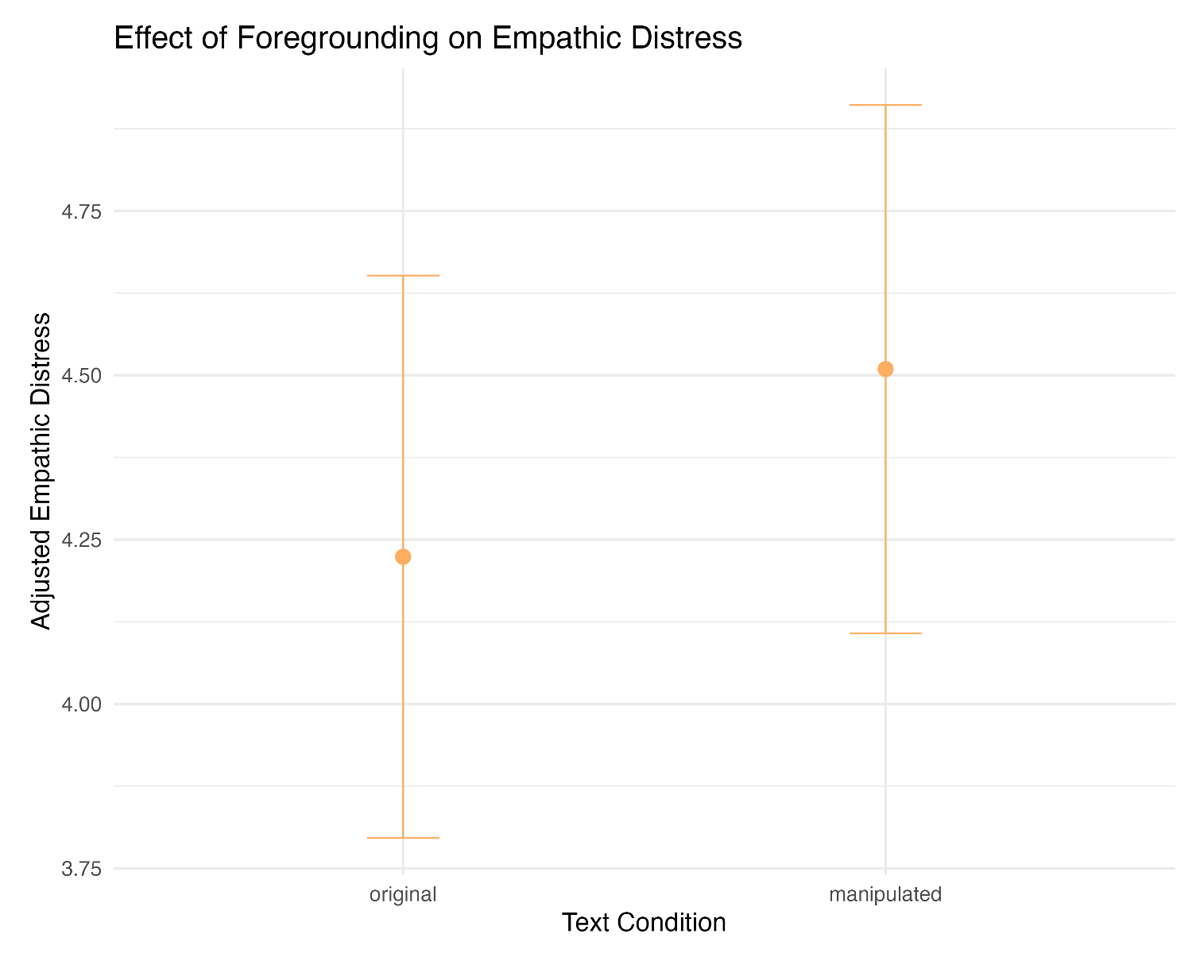
Figure 2
Effects of Foregrounding on Empathic Distress. Estimated marginal means of empathic distress scores by text condition (original vs. manipulated), controlling for Trait Empathy, Aesthetic Attractiveness, and Perceived Foregrounding. Error bars represent 95% confidence intervals.

Figure 3
Mediation model of the effect of textual foregrounding on State Empathy through Aesthetic Appreciation. Values are standardized coefficients (β) with 95% confidence intervals. Both indirect (a·b) and direct (cʹ) effects were significant, consistent with partial mediation.

Figure 4
Mediation model of the effect of textual foregrounding on Empathic Distress through Aesthetic Appreciation. Values are standardized coefficients (β) with 95% confidence intervals. The indirect effect (a·b) was significant, while the direct effect (cʹ) was not, consistent with full mediation.
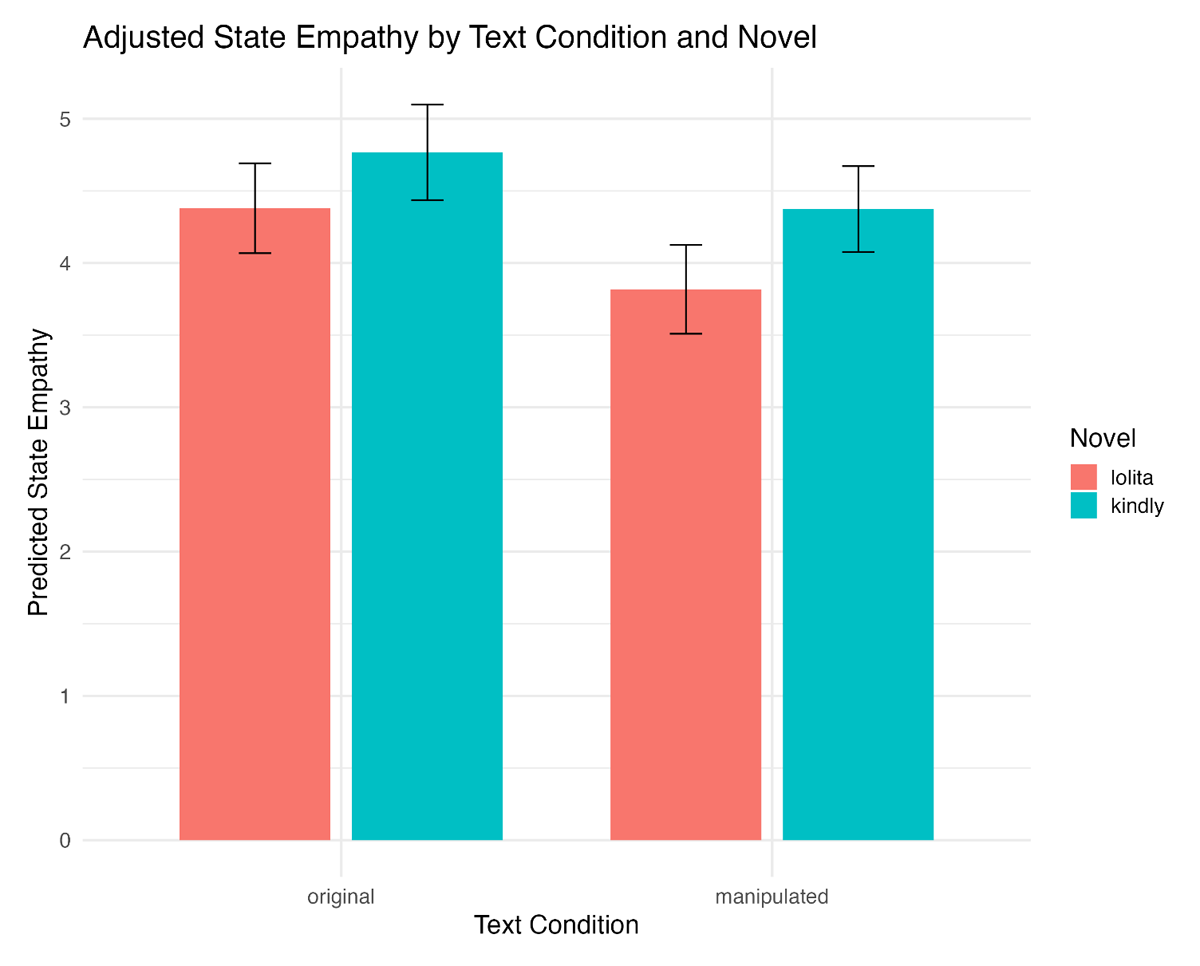
Figure 5
State Empathy by Text and Condition.
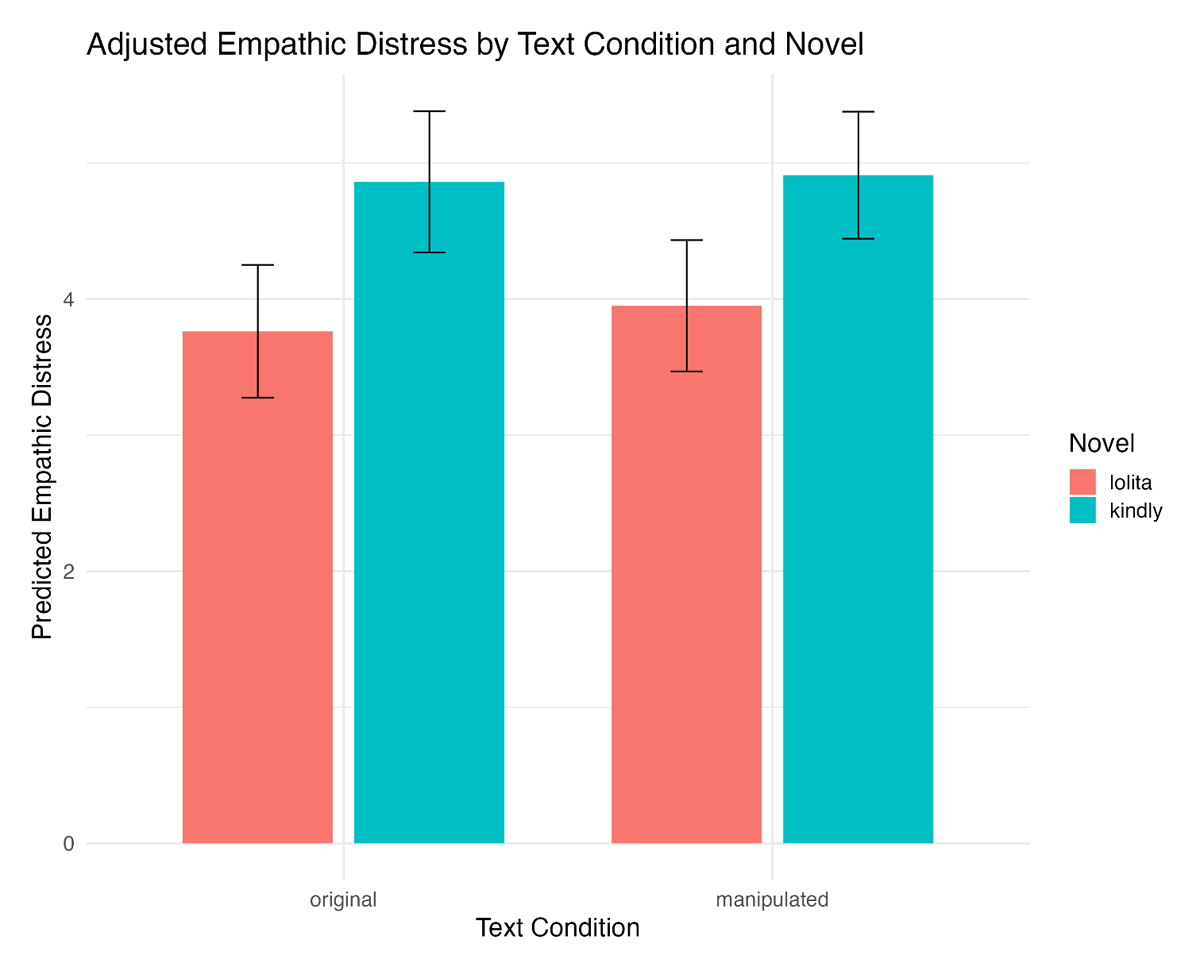
Figure 6
Empathic Distress by Text and Condition.