
1. Introduction
As readers, we often find ourselves attracted to the intricate worlds of fiction, navigating the emotional landscapes of characters whose experiences and feelings seem to mirror our own. After all, emotional engagement with fictional characters is key to what draws us to literature, leading us to reflect on the depths of our affective and interpersonal abilities. The relation between reading and enhanced empathic and prosocial abilities has been extensively explored during the past two decades (Burke et al. 2016; Coplan 2004; Hakemulder 2000; Kidd & Castano 2013; Koopman 2017; Mar et al. 2006; Mar et al. 2009), although with ‘an inconsistent pattern of findings’ (Wimmer et al. 2021: 2). Simultaneously, studies in literature and aesthetics have been focusing on narrative empathy—an affective and cognitive response to characters in fictional stories, which is characterized by vicariously experiencing the mental and emotional state of characters from their viewpoint—as first theorized by Keen (2007). According to Fernandez-Quintanilla (2020: 125), narrative empathy involves ‘a character-oriented (emotional) response and perspective taking,’ by which the reader ‘forms a mental representation of the character’s situation and mental state(s) while maintaining a self-other distinction’, that helps them ‘re-enact, simulate, or imaginatively experience in a first-person way what they perceive is the character’s mental state and mental activity,’ so that their response ‘is congruent with the reader’s perception and understanding of what the character’s experience must be like.’
Just as real-world empathy, narrative empathy is not a unitary construct; rather, it encompasses a range of psychological processes that are related but function differently—e.g., being aware of another’s internal state, feeling what another feels, perspective-taking, imagining oneself in another’s place, experiencing distress in response to another’s suffering, among others (see Batson 2009; Maibom, 2020: 5–22). However, narrative empathy differs from empathy experienced in real-world interpersonal contexts,1 because it is profoundly shaped by textual and stylistic factors, including how the story is told and what aesthetic strategies it employs. In this regard, some of the ways language influences narrative empathy are still underexplored, as Fernandez-Quintanilla and Stradling (2023: 104) point out. Therefore, research should identify and examine the (textual) conditions—i.e., the narrative and/or stylistic features—under which readers feel emotionally connected to fictional agents and may be able to experience empathy (Hakemulder 2020; Koopman & Hakemulder 2015; Koopman 2016).
Furthermore, if literature is markedly able to foster powerful connections with fictional individuals, positively encouraging the development of interpersonal abilities, questions may arise in the case of characters or narrators whose experiences, feelings, and moral values differ considerably from our own. In this regard, an innovative strand of empirical research addresses the ways fictionality affects empathic responses toward negative and morally ambivalent characters (de Jonge et al. 2022). This, in fact, represents a fresh approach to the study of narrative empathy, which is instead traditionally associated with shared emotions, positive attitudes, fellow feeling, and prosocial benefits. However, what is still left to understand is the role of textual factors in the arousal of the peculiar empathic engagement with negative characters and situations, which has been popularized in aesthetics as ‘negative empathy’ (Ercolino 2018; Bonasera 2024; see Section 2.1).
In order to fill this gap, the experimental study presented here addresses the potential of stylistic features—namely, foregrounding—to affect and to orientate the readers’ emotional and empathic reactions toward negative, unreliable and/or immoral characters/narrators. Since research on negative empathy has been mostly theoretical so far, with few empirical exceptions (de Jonge et al. 2022; Salgaro et al. 2021), this study is meant to shed light on this phenomenon from an empirical, reader-oriented perspective, connecting the extensive body of research on foregrounding to the speculations about negative empathy recently put forth in aesthetics. Section 2 provides a concise overview of the theory of negative empathy and of the studies that have substantiated the influence of foregrounding on readerly engagement. Sections 3 and 4 present a reader-response experiment that centers on the manipulation of foregrounding in literary texts believed to elicit negative empathy. Finally, in Section 5, the results of this study pave the way for a discussion on the potential of stylistic features to affect readers’ emotional, empathic, and aesthetic responses.
2. Theoretical Background and Present Study
2.1 Negative empathy
Despite some disagreements (see Maibom 2020: 85–88), empathy is widely associated with morally positive behavior (Batson 2014; Eisenberg & Miller 1987), which is often studied through the empathy-altruism hypothesis (see Batson 2009; Batson et al. 2014; Keen 2007: 16–26), notably considering literature as a ‘moral laboratory’ (Hakemulder 2000). As a counterpoint, examining empathy for overtly immoral or morally ambivalent characters—i.e., negative empathy—may offer a more nuanced perspective as it intersects with current debates in psychology, aesthetics, and philosophy.
Research in social psychology and neuropsychology has examined the separability of positive and negative empathy by defining the latter as ‘empathy for the negative emotions of others’ (Andreychik & Migliaccio 2015: 2; Morelli, Lieberman & Zaki 2015: 57), which is ‘associated with a motivation to help others to avoid negative outcomes and emotions’ (Andreychik & Lewis 2017: 146), in contrast to positive empathy, which involves understanding and sharing another person’s positive emotions. Neuropsychological studies show that witnessing others’ suffering can activate brain regions associated with personal distress, highlighting the neural basis of this phenomenon (Decety & Ickes 2009; Eisenberg & Eggum 2009). Nevertheless, studies in aesthetics have recently elaborated this concept further when it specifically relates to works of art. After reappraising a long-neglected formulation first put forth by early 20th-century psychologist and aesthetician Theodor Lipps,2 negative empathy was defined as ‘an aesthetic experience involving a cathartic identification with characters, figures […] that are characterized in a disturbingly negative and seductive way’ (Ercolino & Fusillo 2022: 70–71; my translation), capable of evoking moral reflection.3 This ambivalent form of narrative empathy originates from the uneasy identification with antiheroes, who are portrayed as simultaneously evil and seductive throughout disturbing and uncomfortable narratives. Unlike standard empathy, which is often associated with prosocial concern, this ambivalent emotional alignment allows us readers—within the ‘safe’ space of fiction (Bonasera 2023: 165; Bonasera 2024)—to vicariously experience both the suffering and the problematic motivations of morally troubling characters, regardless of the discrepancy between our value system and theirs. This includes appreciating the character’s full emotional spectrum—even the pleasure they may derive from immoral acts—as, within aesthetic works, the idea of negative empathy does not refer to the valence (positive vs. negative) of their emotions, but rather to the tension inherent in the reader’s empathic engagement with them. For instance, a reader may feel pleased when an immoral character achieves their villainous goal, yet simultaneously aware that such pleasure is ethically problematic. This ambivalence between emotional proximity and ethical detachment, and the moral reflection that this prompts, is what constitutes negative empathy.
Having been theoretically revived only recently, empirical work on negative empathy remains limited. De Jonge et al. (2022) showed that fictionality indirectly affects empathy for immoral characters via moral disengagement. Moreover, since these characters are precisely crafted to elicit such an ambiguous experience, studies should investigate the textual foundation that makes the experience possible. For instance, Bourget (2023) highlighted that specific stylistic devices, such as free indirect discourse, blur narrative boundaries, thus inviting empathy for negative characters. Furthermore, with the help of computational tools such as sentiment analysis, Bonasera (2023) showed that the semantic representation of conflicting emotions may contribute to the peculiar shaping of negative empathy narratives. Yet, lexical features alone are insufficient to explain the triangular relation between literature, (im)morality, and readers’ empathy. A more comprehensive account must include stylistic aspects specifically distinctive to literary fiction and study the actual reader responses to these narratives. While no validated scale for negative empathy currently exists, it may be operationalized indirectly through standard measures of state empathy which, when directed toward morally ambivalent characters, may reflect negative empathy, particularly when paired with post-reading comments indicating discomfort, ethical reflection, or emotional ambivalence.
2.2 Foregrounding and readerly empathy
Foregrounding—‘that which makes literature “literature”’ (Hakemulder 2020: 92)—seems the most suitable area for this investigation, at the very least for the importance that it has progressively acquired in (empirical) literary studies. The object of a long research tradition in stylistics since the Russian Formalists, foregrounding encompasses the textual qualities that stand out from ordinary language to create a defamiliarizing effect (Mukarovsky 1976; Shklovsky 1965; Van Peer et al. 2021). Simpson (2004: 50) defines foregrounding as ‘a form of textual patterning’ which has specific literary-aesthetic purposes and which ‘typically involves a stylistic distortion of some sort, either through an aspect of the text which deviates from a linguistic norm or, alternatively, where an aspect of the text is brought to the fore.’ Distortions such as rhetorical devices acting on the level of discourse—e.g., novel metaphors, original parallelisms, ellipses, repetitions, etc.—bypass the readers’ automatic processing of the text and instead alert them to the striking formal features of the text. This may enhance reflection and lead to deeper insights, which may also echo across the readers’ feelings and emotions (Fialho 2007, 2019; Hakemulder 2000, 2004; Kidd & Castano 2013; Miall & Kuiken 1994, 1999; Van Peer 1986; Van Peer et al. 2021, among others). In fact, the de-automatization enabled by foregrounding is also supposed to impact narrative empathy, since it makes the narrative experience more vivid and immersive, by allowing readers more time to contemplate the perspectives of the characters (Bálint et al. 2016). Studies confirm that depth of foregrounding processing correlates with greater empathy (Scapin et al. 2023), though findings are mixed: Van Peer, Hakemulder and Zyngier (2007) observed minimal effects on readers’ emotions, while Kuzmičová et al. (2017) even found more empathy for less literary versions of texts. These discrepancies highlight the need for further investigation into how stylistic features affect empathic engagement. Empirical research typically manipulates foregrounding at word and sentence levels, to assess its impact on the reading experience (see Van Peer et al. 2021: 157–159). However, since effects depend on whether readers perceive and process literary language, both textual and subjective measures must be considered.
2.3 Present study
This study aims at exploring how textual foregrounding influences readers’ emotional and empathic engagement with narratives featuring unreliable and immoral narrators. Following common practices in the studies on the topic (Bálint et al. 2016; Hakemulder 2020; Van Peer et al. 2021), it distinguishes between textual foregrounding—the inherent presence of stylistic features, such as semantic deviation, unusual syntax, or sound patterns that depart from linguistic norms—and perceived foregrounding—the extent to which readers subjectively notice these stylistic elements. Participants to this study read either original excerpts from novels considered capable of triggering negative empathy or manipulated versions of the same excerpts with reduced semantic, phonetic and grammatical foregrounding.
The main hypothesis anticipates that a higher degree of textual foregrounding leads to increased empathic connection, understanding, and vicarious emotional experiences related to the characters, and it was formulated as follows: Textual foregrounding increases readers’ state empathy and empathic distress toward morally ambivalent characters.
Furthermore, since the impact of textual style may extend beyond direct emotional responses, it might enhance the aesthetic experience of a text. Therefore, the study was also grounded on the following hypothesis: Textual foregrounding increases readers’ aesthetic appreciation of the text.
However, the mere presence of textual foregrounding does not guarantee adequate reader perception or processing. Therefore, perceived foregrounding was measured with a self-report scale, to check manipulation success as well. In addition, though not a dependent variable in this study, the processing of foregrounding was inferred via its effects on state empathy and aesthetic appreciation, in line with prior empirical literary studies (Scapin et al. 2023), and especially by analyzing the post-reading comments. That is, if original foregrounded excerpts resulted in higher perceived foregrounding and stronger emotional or aesthetic responses, it would indicate that the reader processed foregrounding in a meaningful way. This leads one to consider the potential mediating roles of these perceptual and evaluative responses: The relationship between textual foregrounding and empathy is mediated by perceived foregrounding and/or aesthetic appreciation.
Individual differences among readers may also play a role in their emotional responses to literature. Specifically, a reader’s pre-existing disposition for empathy could modulate how they react to foregrounded texts. Therefore, the following hypothesis was put forth: The effect of textual foregrounding on state empathy and empathic distress is moderated by the readers’ trait empathy.
In considering the complex nature of empathic distress (see Section 3.4.2), especially when engaging with morally ambiguous characters/narrators, the direction and magnitude of the response to stylistic manipulation can be less straightforward than other empathic dimensions. It may be directed either at the perpetrator, at their victims, or at the disturbing situation. This led to anticipate that: Textual foregrounding affects empathic distress (even though direction and magnitude may be unclear due to ambiguous character roles).
Finally, because the two source novels differ markedly in thematic tone and narrative content, a comparative hypothesis was included to examine potential content-specific effects beyond stylistic features—particularly in the elicitation of empathic distress. As discussed in Section 3.1, The Kindly Ones graphically depicts historical atrocities and physical violence, whereas Lolita conveys its immorality more subtly due to the narrator’s seductive tone. Accordingly: The Kindly Ones evokes more empathic distress than Lolita. For ease of reference, the six hypotheses are summarized in Table 1:
Table 1
Overview of the six hypotheses tested in the study.
| HYPOTHESIS | DESCRIPTION |
|---|---|
| H1 | Textual foregrounding increases readers’ state empathy and empathic distress toward morally ambivalent characters. |
| H2 | Textual foregrounding increases readers’ aesthetic appreciation of the text. |
| H3 | The relationship between textual foregrounding and empathy is mediated by perceived foregrounding and/or aesthetic appreciation. |
| H4 | The effect of textual foregrounding on state empathy and empathic distress is moderated by the readers’ trait empathy. |
| H5 | Textual foregrounding affects empathic distress (even though direction and magnitude may be unclear due to ambiguous character roles). |
| H6 | The Kindly Ones evokes more empathic distress than Lolita. |
The investigation consisted in a between-subjects study, targeting two distinct groups of respondents: the two groups received the same survey, varying only in the level of foregrounding of the selected novel excerpts (as detailed in Section 3.2). If supported, these hypotheses would collectively show how stylistic features can intensify emotional engagement, even toward morally problematic characters/narrators. This engagement, precisely because it challenges the reader’s ethical stance, represents a core instance of negative empathy as defined within this study. A detailed description of the materials, procedures, and measures involved in this investigation is provided in Section 3.
3. Methods
3.1 Materials
The excerpts were selected from two novels often associated with negative empathy in studies on the topic (de Jonge et al. 2022; Ercolino 2018; Ercolino & Fusillo 2022), namely Lolita by Vladimir Nabokov, originally published in 1955, and The Kindly Ones by Jonathan Littell, originally published in French as Les Bienveillantes in 2006. Both novels feature immoral, unrepentant, unreliable narrators, although the nature and context of their immorality differ significantly: Lolita is a fictional autobiography of Humbert Humbert, a pedophile whose obsession with the eponymous stepdaughter turns him into a murderer. The Kindly Ones is the fictional memoir of former SS officer and Holocaust perpetrator Max Aue, reflecting on the atrocities he committed during the war, hardly ever regretting them. Given these distinct contexts, there might be intensity differences in the emotional responses evoked. Specifically, The Kindly Ones is more overtly horrific and historically anchored, potentially prompting stronger distress responses, whereas Lolita may elicit more conflicted engagement due to its seductive narrative voice. To limit bias, excerpts were presented as decontextualized: Lolita was framed as a ‘love story,’ and The Kindly Ones as a ‘war story,’ thus allowing readers to infer character traits independently (see Section 5.6).
Excerpts were selected based on a sentiment analysis,4 identifying sections with highly polarized or abruptly shifting emotional valence (Bonasera 2023). The detected fluctuations from extreme high to extreme low sentiment levels, as well as the sudden shifts located in the emotional content of the texts may affect the readers’ emotional reactions, leading them to experience tension between emotional closeness and detachment—which is the core of negative empathy. Hence, passages rich in emotional ambiguity and complexity were prioritized. Two emotionally charged paragraphs for each novel were chosen from the published Italian translations, since the target respondents were all Italian native speakers. While Lolita and The Kindly Ones are known works, the textual excerpts were carefully selected to minimize recognizability: all identifying names and contextual framing were removed, and the passages were presented as standalone, decontextualized narratives, in order to isolate stylistic and affective responses.
Excerpts from Lolita featured Humbert’s reflections on his abuse of his stepdaughter. In the first one—which represents the most negative point (lowest valence) in the novel’s sentiment arc, if only on a lexical basis (Bonasera 2023)—Humbert retrospectively acknowledges the girl’s distress post-assault: ‘there she was sprawling and sobbing, and pinching my caressing hand, and I was laughing happily, and the atrocious, unbelievable, unbearable, and, I suspect, eternal horror that I know now was still but a dot of blackness in the blue of my bliss’ (Nabokov 1991: 169). In the second excerpt—which showcases a high incidence of positive emotions and more emotional diversity, confirmed by a moderately high coefficient of normalized emotional entropy5 (0.69, on a scale from 0 to 1)—Humbert reflects on his obsessive adoration for the girl, while expressing his remorse for having deprived her of her childhood and losing her, thus allowing for a drastic emotional shift: ‘I loved you. I was a pentapod monster, but I loved you. I was despicable and brutal, and turpid, and everything, mais je t’aimais, je t’aimais! And there were times when I knew how you felt, and it was hell to know it, my little one’ (Nabokov 1991: 285).
The excerpts from The Kindly Ones show the narrator’s traumatic recollections of sexual deviance and war crimes. The first one blends incestuous hallucinations with memories of executions and is characterized by a single extended period whose frantic rhythm reflects the escalation of the protagonist’s thoughts and memories, sparking a sense of claustrophobia in the readers: ‘I began howling, bellowing and bashing my head against the floor, I was past all restraint, I bashed my head and sobbed, not out of horror, because this female form that would never remain my sister had pissed on me, it wasn’t that, but when I saw it […], I saw the hanged women in Kharkov who as they suffocated emptied themselves over the passersby’ (Littell 2010: 912). The second excerpt recalls the atrocious mass execution carried out by Nazi Germany’s forces against thousands of Jewish civilians at the Babi Yar ravine (Ukraine) during World War II. With regards to the emotional content, this text displays an abrupt sentiment shift and a high degree of ambiguity and emotional complexity (normalized emotional entropy: 0.85). After witnessing the massacre, the protagonist is instructed to finish off the wounded, but his attention is caught by the sight of a beautiful woman, barely alive among the dead, who ‘stared at me with her large surprised incredulous eyes, the eyes of a wounded bird, and that look stuck into me, split open my stomach and let a flood of sawdust pour out’, says Aue (Littell 2010: 128). For a moment, he dwells upon the chance of comforting her (‘I wanted with all my heart to bend over and brush the dirt and sweat off her forehead, caress her cheek and tell her that it was going to be all right, that everything would be fine’, Littell 2010: 128), only to end up brutally executing her in the throes of his uncontrollable rage: ‘but instead I convulsively shot a bullet into her head […] I kept shooting at her and her head exploded like a fruit, then my arm detached itself from me and went off all by itself down the ravine, shooting left and right, I ran after it […] it mocked me and shot at the wounded all by itself, without me’ (Littell 2010: 129).
Although the excerpts were decontextualized, the implicit presence of potentially disturbing themes—e.g., pedophilia, sexual abuse, murder, incest, antisemitism—required a trigger warning to be included in the informed consent and participants were informed of their right to withdraw from the experiment at any point.
3.2 Procedure
The study used a between-subjects design with the level of foregrounding as independent variable. One group of respondents read original texts, containing a high level of semantic, phonetic and grammatical foregrounding, while the other group received excerpts where foregrounding had been reduced. This process involved reducing phonetic and syntactical repetitions, paraphrasing complex sentences, simplifying vocabulary, removing figurative language and replacing it with more common alternatives without cutting the content of the excerpts, with the goal of crafting a version that would be perceived as more ordinary. Although the manipulation significantly lowered perceived foregrounding (see Section 4.1), some participants still found the manipulated texts ‘original’ or ‘striking.’ This likely reflects the composition of the participant pool (see Section 3.3), who may have been relatively attuned to stylistic features and thus more sensitive to residual traces of literariness even in the simplified versions. This outcome also indicates that achieving a truly ‘non-literary’ version of complex literary texts is inherently challenging and that narrative complexity or thematic intensity may contribute to the persistent perception of literariness. Therefore, rather than a binary exploration of ‘literary vs. non-literary’ texts, this study should be understood as a nuanced examination of the effects of varying degrees of foregrounding on reader response (see Section 5.6).
The resulting versions are comparable in terms of length (original excerpts: 1368 words; manipulated: 1354 words). Table 2 provides examples of the manipulation process carried out to reduce foregrounding:
Table 2
Examples of foregrounding manipulation in Lolita and The Kindly Ones, in English and in the Italian version provided in the surveys.
| NOVEL | ORIGINAL TEXT | MANIPULATED TEXT, WITH FOREGROUNDING REDUCED |
|---|---|---|
| Lolita | And there were times when I knew how you felt, and it was hell to know it, my little one. [E c’erano momenti in cui sapevo come ti sentivi, e saperlo era l’inferno, piccola mia.] | There were times when I knew how you felt and it was horrible to realize it. [C’erano dei momenti in cui riconoscevo il modo in cui ti sentivi e rendermene conto era orribile.] |
| Lolita | and the next moment the tenderness and the azure—all would be shattered. [un attimo dopo la tenerezza e l’azzurro – tutto andava in pezzi.] | and after that the sense of tenderness and bliss were over [subito dopo il senso di tenerezza e di benessere si esaurivano.] |
| The Kindly Ones | she stared at me with her large surprised incredulous eyes, the eyes of a wounded bird [mi fissava con i suoi grandi occhi sorpresi, increduli, occhi da uccello ferito] | she looked at me with an expression of surprise and incredulity in her eyes [mi guardava con un’espressione di sorpresa e incredulità] |
| The Kindly Ones | I kept shooting at her and her head exploded like a fruit [continuavo a spararle e la sua testa si era spaccata come un frutto] | I kept shooting at her to the point that her head burst open [continuavo a spararle tanto che la sua testa si spaccò] |
Since foregrounding manipulation is an extremely delicate process—all the more so when performed on such intricate and sophisticated styles as in these novels— it was preliminarily discussed with two associate professors in Linguistics and Literary Studies and then pretested among eight people with a background in literature, none of whom detected unnatural phrasing in the manipulated texts.
Two parallel surveys—one per condition—were administered online via Qualtrics and randomly assigned to participants (see Section 3.4 for measures). Generally, they did not require more than 20 minutes for the compilation.
3.3 Participants
Fifty-nine undergraduate literature students (Mage = 19.93, SD = 1.40; 10 male, 49 female) participated voluntarily. All were Italian native speakers and were randomly assigned to read either the original (N = 28) or manipulated excerpts (N = 31).6 Gender distribution did not significantly differ across the two text conditions (manipulated: 28 female, 3 male; original: 21 female, 7 male), χ²(1) = 1.49, p = .22; Fisher’s exact p = .17. Thus, the sample was approximately balanced across conditions with respect to gender. Gender was explored post-hoc only to check generalizability (see Section 4.1.4). To assess the adequacy of the sample size, a post-hoc power analysis was conducted. Based on observed effect sizes (Cohen’s d ranging from 1.10 to 1.39), it indicated that the study was well-powered (>98%) for state empathy and aesthetic appreciation variables, but underpowered (32%, Cohen’s d = 0.40) for empathic distress. These results support the robustness of the main findings, while also highlighting limitations in interpreting non-significant results for empathic distress (see Section 4.1.2). Participants provided informed consent and were adequately briefed and debriefed. Personal data protection guidelines were met. The study was approved by the Research Ethics Review Committee of the University of Turin (reference number 0722800). The study was not pre-registered.
3.4 Measures
The two surveys were identical in structure, differing only in the version of the excerpts provided, with foregrounding as the independent variable. Trait Empathy (a subject variable) and various state-level responses—including State Empathy, Perceived Foregrounding and Aesthetic Attractiveness—served as dependent variables. Distinguishing between trait empathy—one’s empathic disposition—and state empathy—the specific reaction during reading—enabled a more precise modeling of the readerly empathic process, allowing to attribute observed variations in state empathy to the experimental manipulation rather than to pre-existing individual differences (Shen 2010: 505–506). As mentioned in Section 2.1, because no specific validated scale has been developed nor validated for negative empathy, this study employed established instruments (Koopman 2016; Shen 2010). While not explicitly designed for negative empathy, these tools tap into multiple facets of engagement with characters (e.g., shared affect, cognitive alignment, empathic distress). Shen’s State Empathy during Message Processing Scale allowed a multidimensional analysis of state empathy with the character—addressing affective, cognitive and associative dimensions—while Koopman’s measure of empathic distress assessed discomfort during reading. Post-reading open-ended responses supplemented these data, by providing a richer understanding of the specific emotional and cognitive responses captured by these quantitative measures. Each construct is detailed below.
3.4.1 Trait Empathy
Trait Empathy was measured using two 7-item subscales of the Interpersonal Reactivity Index (IRI; Davis 1980, 1983), namely Empathic Concern and Perspective Taking. The IRI is a multidimensional self-report tool that captures distinct but related aspects of dispositional empathy. Empathic Concern reflects ‘“other-oriented” feelings of sympathy for unfortunate others’, while Perspective Taking assesses ‘the tendency to spontaneously adopt the psychological point of view of others’ (Davis 1983: 113–114), thus providing a good sense of both affective and cognitive facets of someone’s disposition to empathize with others. The original items were used in a validated Italian translation (Albiero et al. 2006) and rated on a 7-point Likert scale (instead of the original 5-point), in order to fit with the other measures. Both subscales demonstrated good reliability (see Table 3). A preliminary check showed that Trait Empathy differed slightly between conditions, t(57) = –2.30, p = .025, d = 0.60, with participants in the original (foregrounded) condition reporting higher dispositional empathy (M = 5.37) than those in the manipulated condition (M = 4.90). Accordingly, Trait Empathy was retained as a covariate in subsequent analyses to control for this baseline difference.
Table 3
Dimensions and items of the IRI test employed in the present study, including measures of internal consistency (r = reverse scored items).
| DIMENSION | ITEMS |
|---|---|
| Empathic Concern (Cronbach’s ɑ = .77) | 2. I often have tender, concerned feelings for people less fortunate than me. |
| 4. Sometimes I don’t feel very sorry for other people when they are having problems. (r) | |
| 9. When I see someone being taken advantage of, I feel kind of protective towards them. | |
| 14. Other people’s misfortunes do not usually disturb me a great deal. (r) | |
| 18. When I see someone being treated unfairly, I sometimes don’t feel very much pity for them. (r) | |
| 20. I am often quite touched by things that I see happen. | |
| 22. I would describe myself as a pretty soft-hearted person. | |
| Perspective Taking (Cronbach’s ɑ = .84) | 3. I sometimes find it difficult to see things from the “other guy’s” point of view. (r) |
| 8. I try to look at everybody’s side of a disagreement before I make a decision. | |
| 11. I sometimes try to understand my friends better by imagining how things look from their perspective. | |
| 15. If I’m sure I’m right about something, I don’t waste much time listening to other people’s arguments. (r) | |
| 21. I believed that there are two sides to every question and try to look at them both. | |
| 25. When I’m upset at someone, I usually try to “put myself in his shoes” for a while. | |
| 28. Before criticizing somebody, I try to imagine how I would feel if I were in their place |
3.4.2 State Empathy and Empathic Distress
After reading each excerpt, participants completed a quantitative test to assess their empathic and aesthetic responses. All items in Table 4 were translated into Italian, since a validated version of these scales was not available. To obtain an Italian version of the scales, an Italian native speaker translated the original items. The Italian version was then back translated into English by a native English speaker to cross-check the quality of the translation. Responses were measured on a 7-point Likert scale.
Table 4
Dimensions and items of the State Empathy during Message Processing Scale and the empathic distress construct employed in this study, including measures of internal consistency.
| DIMENSION | ITEMS |
|---|---|
| Affective Empathy(Cronbach’s ɑ = .84) | 1. The character’s emotions are genuine. 2. I experienced the same emotions as the character when reading this excerpt. 3. I was in a similar emotional state as the character when reading this excerpt. 4. I can feel the character’s emotions. |
| Associative Empathy(Cronbach’s ɑ = .86) | 5. I can see the character’s point of view. 6. I recognize the character’s situation. 7. I can understand what the character was going through in the text. 8. The character’s reactions to the situation are understandable. |
| Cognitive Empathy(Cronbach’s ɑ = .86) | 9. When reading the excerpt, I was fully absorbed. 10. I can relate to what the character was going through in the text. 11. I can identify with the situation described in the text. 12. I can identify with the character in the text. |
| Empathic Distress(Cronbach’s ɑ = .90) | 1. The story made me feel miserable. 2. The story made me feel sad. 3. During reading I felt increasingly unnerved. 4. The story aroused unpleasant sensations in me. |
State Empathy was measured using Shen’s (2010) multidimensional scale devised to assess the ‘process through which the recipients comprehend, process, and are influenced’ by written messages, which occurs ‘when the perception of the character’s state automatically activates the recipient’s vicarious experience of their state, situation, and object’ (Shen 2010: 507). This measure captures three specific dimensions: Affective Empathy (i.e., ‘the activation and experience of affective reactions to others’ experiences and/or expressions of emotions’, including ‘the understanding and sharing of others’ feelings’, Shen 2010: 506), Cognitive Empathy (i.e., ‘recognizing, comprehending, and adopting another person’s point of view’, Shen 2010: 506), and Associative Empathy (i.e., ‘identification with the […] message’ leading to the recipients’ ‘vicarious experience of what the characters experience’ and facilitating ‘social bonding and relationship development’, Shen 2010: 507). Each subscale included four items and showed strong internal consistency (see Table 4).
Since the narratives portrayed ambivalent characters and unsettling circumstances, Empathic Distress was assessed using Koopman’s (2016) construct, informed by adjectives from De Wied et al. (1995) and grounded in Hoffman’s (2000) theory of empathic distress. According to this theory, empathic distress is an other-oriented feeling that implies metacognitive awareness, since ‘one not only feels distressed but knows this feeling is a response to something unfortunate happening to someone else’ (Hoffman 2000: 63). Excessive empathic distress can turn into ‘an intense feeling of personal distress, which may move the person out of the empathic mode entirely’ (Hoffman 2000: 198),7 leading to emotional withdrawal in order to avoid unbearable negative feelings. This parallels the mechanisms of emotional closeness and subsequent detachment theoretically proposed for negative empathy.8 In this study, the scale demonstrated excellent reliability (see Table 4). However, it is important to acknowledge an interpretive limitation due to the complexity of the narratives selected in this study: since some items on the scale might broadly reflect a reader’s overall discomfort during reading, we cannot definitively ascertain whether this distress is actually directed at the perpetrator’s internal state or whether it stems from a vicarious experience of the victims’ distress or of the situation as a whole. Thus, while the scale reliably captures discomfort, it cannot isolate its precise object. This ambiguity is addressed in Section 5.6.
3.4.3 Aesthetic Attractiveness and Perceived Foregrounding
To measure the aesthetic appreciation of textual features, readers were also asked to rate feelings toward the style of the texts—i.e., aesthetic feelings, which point at the formal qualities of the text and include appreciating the beauty and the originality of the style. Consequently, two constructs—Aesthetic Attractiveness and Perceived Foregrounding—were adapted from Koopman (2016), based on Andringa’s (1996) distinction between appreciation of a text’s beauty and perceived novelty. Aesthetic Attractiveness reflects ‘the extent to which the style is found beautiful, good and interesting’, while Perceived Foregrounding rates ‘how original, striking and surprising the style is’ (Koopman 2016: 88). The specific Perceived Foregrounding subscale served as a manipulation check, where significant higher ratings were expected for original excerpts. Both constructs were reduced in the number of items for two main reasons: to keep the survey concise in order to prevent frustration and boredom in participants and to avoid confusing redundancy in translation, as several adjectives included in the scales roughly translate as the same concept in Italian. Despite this reduction, internal consistency remained high for both constructs, as reported in Table 5.
Table 5
Adapted dimensions and items relating to aesthetic feelings, as employed in the present study, including measures of internal consistency.
| DIMENSION | ITEMS |
|---|---|
| Aesthetic Attractiveness(Cronbach’s ɑ = .85) | 1. I found the style of the text captivating. 2. I found the style of the text interesting. |
| Perceived Foregrounding(Cronbach’s ɑ = .90) | 1. I found the style of the text striking. 2. I found the style of the text original. |
3.4.4 Post-reading comments
To complement the quantitative measures, the final part of each excerpt section in the survey included an optional open-ended question asking participants to describe the feelings evoked during reading (‘Which feelings did this excerpt evoke in you while reading? Try to describe them in the most detailed way possible’). This allowed and encouraged participants to express emotional reactions in further detail, in case the quantitative survey did not fully capture the complexity of their feelings. However, the question was presented as optional to avoid respondent fatigue. Of the 59 participants, 31 (52.5%) responded to this question for all four excerpts, providing a total of 124 comments available for analysis.
4. Results
This section presents the findings structured around the hypotheses guiding this study (see Section 2.3). First, the success of the text manipulation in altering the perception of foregrounding is examined, then data related to the influence of foregrounding on state empathy and empathic distress is presented. ANCOVA was primarily employed to test the relationships among textual foregrounding levels (independent variable) and reader responses (dependent variables), with Trait Empathy included as a covariate. Aesthetic appreciation was explored as a potential mediator in this relationship, and mediation analyses were conducted to gain deeper insights into these pathways.
4.1 Quantitative responses: Empathy and aesthetic appreciation
4.1.1 Manipulation check: Perceived Foregrounding and Aesthetic Attractiveness
A t-test revealed significantly higher Perceived Foregrounding scores for readers of the original versions (M = 5.29, SD = 1.04) compared to the manipulated ones (M = 4.00, SD = .81), t(50.94) = 5.23, p < .001, r = .57. This means that the style of the original texts was perceived as particularly striking, thus providing confirmation that the manipulation process was successful. Similarly, Aesthetic Attractiveness was reported as significantly higher for the original texts (M = 5.58, SD = .83) than for the manipulated ones (M = 4.60, SD = .79), t(55.70) = 4.62, p < .001, r = .53, meaning that readers perceived the original texts as particularly fascinating and interesting (thus supporting H2: Textual foregrounding increases readers’ aesthetic appreciation of the text). Together, these results show that the manipulation of foregrounding altered both stylistic features and perceived aesthetic quality.
4.1.2 Effects of foregrounding on State Empathy and Empathic Distress
As reported in Table 6, the data confirms the main hypothesis that, for this specific population of readers and within the context of the chosen excerpts, textual foregrounding affects state empathy while reading (H1: Textual foregrounding increases readers’ state empathy and empathic distress toward morally ambivalent characters). Participants who read the original excerpts reported significantly higher scores across all state empathy dimensions (except for Empathic Distress), therefore they were better able to: a) feel emotionally connected to the narrator and experience higher affective reactions to his emotions (Affective Empathy); b) recognize, understand and adopt the narrator’s point of view (Cognitive Empathy); c) identify with the narrator’s experiences and emotions as they were happening to him (Associative Empathy). While they were able to feel unpleasant emotions in connection with the story and the character’s situation (Empathic Distress), a t-test on this construct revealed no statistically significant difference between the two groups. The results suggest that higher levels of textual foregrounding enhance empathic engagement, but have limited impact on distress, implying that factors other than stylistic features influence unpleasant feelings (thus failing to support H5: Textual foregrounding affects empathic distress—even though direction and magnitude may be unclear due to ambiguous character roles). Possible reasons for this incongruity are further discussed in Section 5.6.
Table 6
Mean values reported for the state empathy dimensions by condition, with measures of difference and effect sizes.
| DIMENSION | ORIGINAL (N = 28) | MANIPULATED (N = 31) | DIFFERENCE AND EFFECT SIZES | |||
|---|---|---|---|---|---|---|
| M(SD) | M(SD) | t | df | p | r | |
| Affective Empathy | 4.95(.62) | 4.12(.85) | 4.34 | 54.67 | <.001* | .50 |
| Cognitive Empathy | 5.19(.66) | 4.22(.84) | 4.95 | 55.77 | <.001* | .55 |
| Associative Empathy | 4.27(.72) | 3.32(.81) | 4.77 | 56.99 | <.001* | .54 |
| Empathic Distress | 4.60(.93) | 4.17(1.19) | 1.53 | 55.87 | <.129 | .20 |
An ANCOVA controlling for Trait Empathy, Aesthetic Attractiveness and Perceived Foregrounding showed a significant effect of textual manipulation on state empathy, F(1, 54) = 33.93, p < .001, R2 = .46. In this model (Figure 1), Aesthetic Attractiveness significantly predicted State Empathy, F(1, 54) = 6.75, p = .012, suggesting that readers who found the texts more aesthetically pleasing were more emotionally and cognitively engaged, while Perceived Foregrounding was marginally significant, F(1, 54) = 3.26, p = .076. Trait Empathy did not significantly predict state Empathy, F(1, 54) = 1.44, p = .236. Because Aesthetic Attractiveness and Perceived Foregrounding significantly differed across conditions, their inclusion as covariates may partly adjust for the manipulation itself. Results should therefore be interpreted as conservative estimates of the foregrounding effect. These results further support H1 (Textual foregrounding increases readers’ state empathy and empathic distress toward morally ambivalent characters) and H2 (Textual foregrounding increases readers’ aesthetic appreciation of the text), reinforcing the idea that literary style fosters greater emotional and cognitive engagement with morally complex characters, independent of individual disposition.
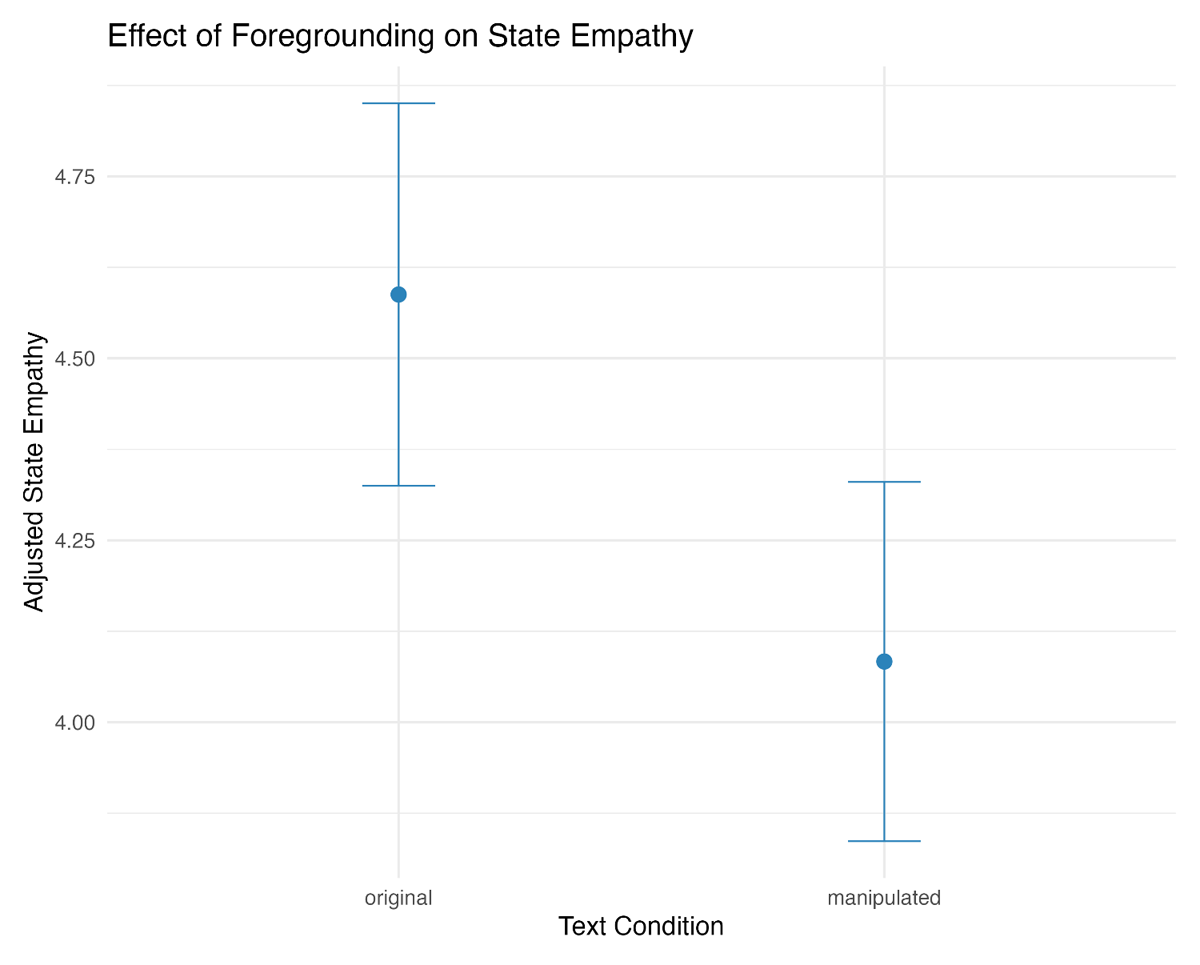
Figure 1
Effects of Foregrounding on State Empathy. Estimated marginal means of state empathy scores by text condition (original vs. manipulated), controlling for Trait Empathy, Aesthetic Attractiveness, and Perceived Foregrounding. Error bars represent 95% confidence intervals.
A second ANCOVA testing the effects of the same predictors on Empathic Distress found no significant effect of manipulation, F(1, 54) = 2.77, p = .102, R² = .24. However, Trait Empathy was a significant predictor, F(1, 54) = 6.65, p = .013, indicating that more dispositionally empathic readers experienced higher levels of vicarious discomfort. Aesthetic Attractiveness also significantly predicted Empathic Distress, F(1, 54) = 4.75, p = .034, whereas Perceived Foregrounding was a marginal predictor, F(1, 54) = 3.06, p = .086. Figure 2 displays the adjusted Empathic Distress scores for each condition. Contrary to the pattern observed for State Empathy, in this model distress was slightly higher in the manipulated condition than in the original, foregrounded texts. However, this difference was not statistically significant, and the confidence intervals overlap. This trend—though small and not robust—further suggests that either stylistic manipulation reduces feelings of discomfort or that empathic distress is actually a reader-dependent, dispositional response rather than a text-driven one. H5 (Textual foregrounding affects empathic distress—even though direction and magnitude may be unclear due to ambiguous character roles) is thus further unsupported by these data.
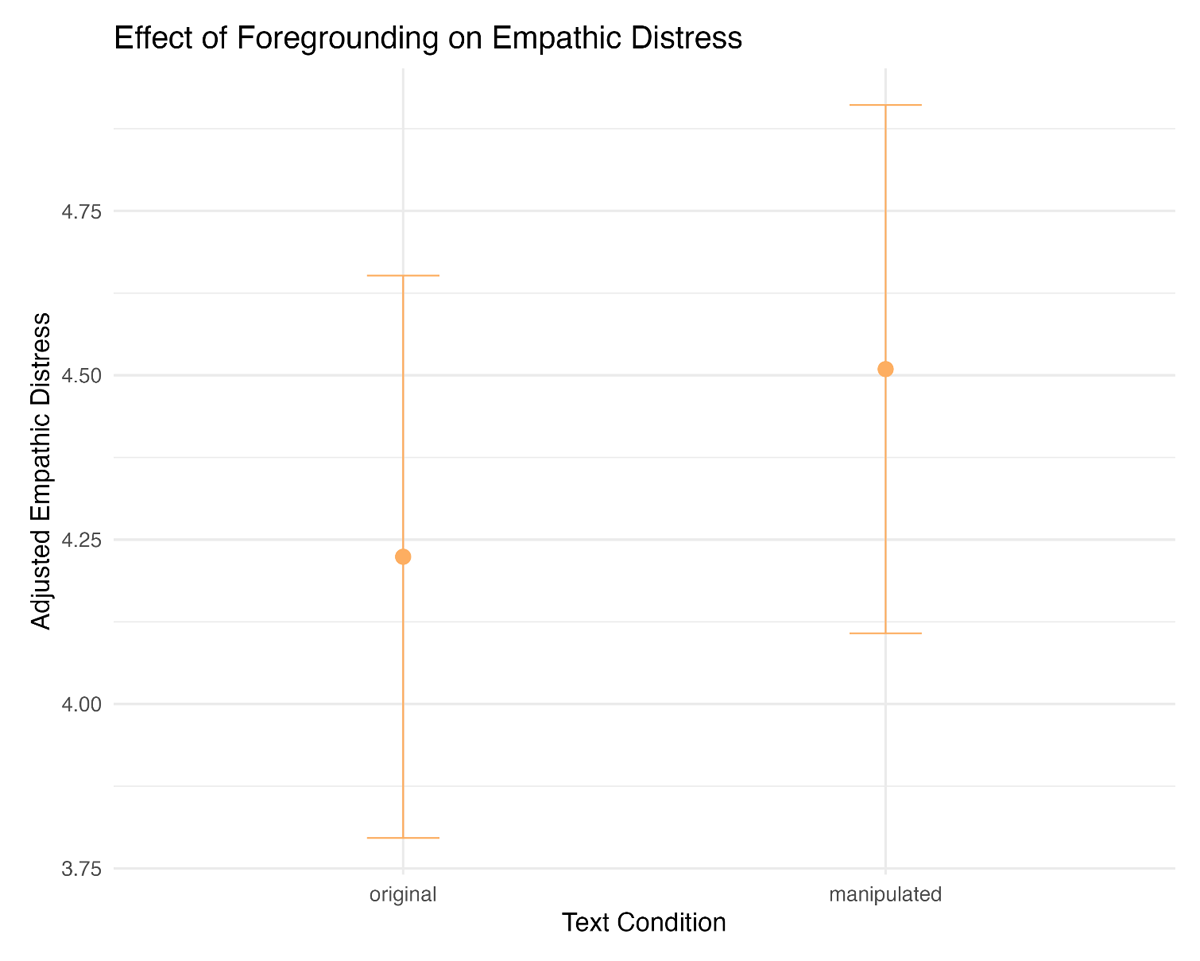
Figure 2
Effects of Foregrounding on Empathic Distress. Estimated marginal means of empathic distress scores by text condition (original vs. manipulated), controlling for Trait Empathy, Aesthetic Attractiveness, and Perceived Foregrounding. Error bars represent 95% confidence intervals.
These findings support the interpretation that readers are capable of empathic engagement with morally compromised narrators and that literary foregrounding enhances this connection. Even though the study could not employ a validated scale for negative empathy, it captured relevant empathic dimensions, such as emotional alignment and perspective taking. Given that empathy toward tortured characters increased while distress did not, this form of engagement likely reflects that an ambivalent alignment—what we may term ‘negative empathy’—was taking place, rather than conventional prosocial empathy or vicarious suffering.
4.1.3 Mediation analyses: The role of aesthetic appreciation
A mediation analysis (Figure 3) was then conducted to test whether aesthetic appreciation mediated the effect of stylistic manipulation on the empathic response. The analysis revealed a significant indirect effect (ACME = 0.26, 95% CI [0.08, 0.49], p = .004), as well as a significant direct effect (ADE = 0.65, p < .001), indicating partial mediation. Approximately 29% of the total effect of textual foregrounding on empathy was accounted for by increases in aesthetic appreciation. This supports the hypothesis that stylistic foregrounding enhances narrative empathy both directly and indirectly through readers’ aesthetic engagement with the text (H3: The relationship between textual foregrounding and empathy is mediated by perceived foregrounding and/or aesthetic appreciation).

Figure 3
Mediation model of the effect of textual foregrounding on State Empathy through Aesthetic Appreciation. Values are standardized coefficients (β) with 95% confidence intervals. Both indirect (a·b) and direct (cʹ) effects were significant, consistent with partial mediation.
A second mediation analysis using Empathic Distress as the outcome variable (Figure 4) showed a significant indirect effect (ACME = 0.39, 95% CI [0.05, 0.90], p = .012), whereas the direct effect of textual manipulation was not significant (ADE = 0.04, 95 % CI [–0.59, 0.64], p = .94). The total effect was small and non-significant (0.43, 95 % CI [–0.09, 1.00], p = .13). This pattern is consistent with full mediation, indicating that stylistic foregrounding influenced readers’ Empathic Distress only indirectly through enhanced Aesthetic Appreciation. However, given the breadth of the confidence intervals and the modest overall effect size, this finding should be interpreted with caution. Overall, the results suggest that aesthetic engagement can shape readers’ affective discomfort toward morally ambivalent narrators, although such distress appears less robustly modulated by stylistic features than empathic engagement itself.

Figure 4
Mediation model of the effect of textual foregrounding on Empathic Distress through Aesthetic Appreciation. Values are standardized coefficients (β) with 95% confidence intervals. The indirect effect (a·b) was significant, while the direct effect (cʹ) was not, consistent with full mediation.
Together, these results demonstrate that aesthetic appreciation plays a meaningful mediating role in shaping readers’ empathic responses to these morally ambivalent characters, influencing the effect of stylistic foregrounding and thus providing qualified support to H3 (The relationship between textual foregrounding and empathy is mediated by perceived foregrounding and/or aesthetic appreciation). The mediation pattern, however, differs across dimensions of empathy: while State Empathy is influenced by foregrounding both directly and indirectly (through aesthetic appreciation), Empathic Distress is affected only indirectly through aesthetic engagement, and the effect is comparatively weaker. These findings reinforce the distinction between engagement and distress, suggesting that stylistic foregrounding enhances emotional-cognitive immersion more reliably than it elicits discomfort or vicarious pain.
4.1.4 Interaction effects, text-specific findings, and gender differences
To explore whether individual differences in Trait Empathy moderated the effects of stylistic manipulation (H4: The effect of textual foregrounding on state empathy and empathic distress is moderated by the readers’ trait empathy), two moderation models were tested using interaction terms between empathic disposition and textual manipulation. Though the main effect of manipulation remained significant (B = 0.50, p = .015), for State Empathy the analysis showed no interaction between the two dimensions (B = 0.29, p = .159), indicating that the increase in empathy observed in readers of the original texts occurred consistently across participants, regardless of Trait Empathy, thus reinforcing the conclusion that textual foregrounding enhances empathic engagement independently of dispositional traits. For Empathic Distress, the interaction term was also non-significant (B = –0.27, p = .432), but Trait Empathy itself was a significant predictor (B = 0.56, p = .015), suggesting that Empathic Distress is more strongly driven by readers’ dispositional empathy than by the textual manipulation. In both models, the absence of interaction effects indicates that Trait Empathy did not modulate the influence of textual foregrounding and further confirms that while State Empathy can be shaped by stylistic features, Empathic Distress reflects a more stable, trait-dependent response, providing partial support to H4.
To explore whether Empathic Distress varied depending on the narrative content, a paired-samples t-test was conducted comparing participants’ Empathic Distress scores for The Kindly Ones and Lolita. The results revealed a statistically significant difference in Empathic Distress between the two texts, t(58) = 5.58, p < .001, with readers reporting higher scores for The Kindly Ones (M difference = 1.10, 95% CI [0.71, 1.49]). This suggests that The Kindly Ones elicited significantly greater vicarious discomfort than Lolita, likely due to differences in narrative content or emotional tone, thus supporting H6 (The Kindly Ones evokes more empathic distress than Lolita). These findings reinforce the view that Empathic Distress may also be more strongly shaped by thematic material than by stylistic features such as foregrounding.
In addition, separate ANCOVAs were conducted to assess whether the effect of textual foregrounding on State Empathy held across the two novels (Figure 5). For both texts, stylistic manipulation had a robust and statistically significant effect, with readers of the original, foregrounded texts reporting significantly higher levels of State Empathy than those who read manipulated versions—F(1,54) = 22.21, p < .001 for Lolita; F(1,54) = 16.53, p < .001 for The Kindly Ones. This suggests that narrative form—rather than just thematic content—can meaningfully shape readers’ empathic engagement.
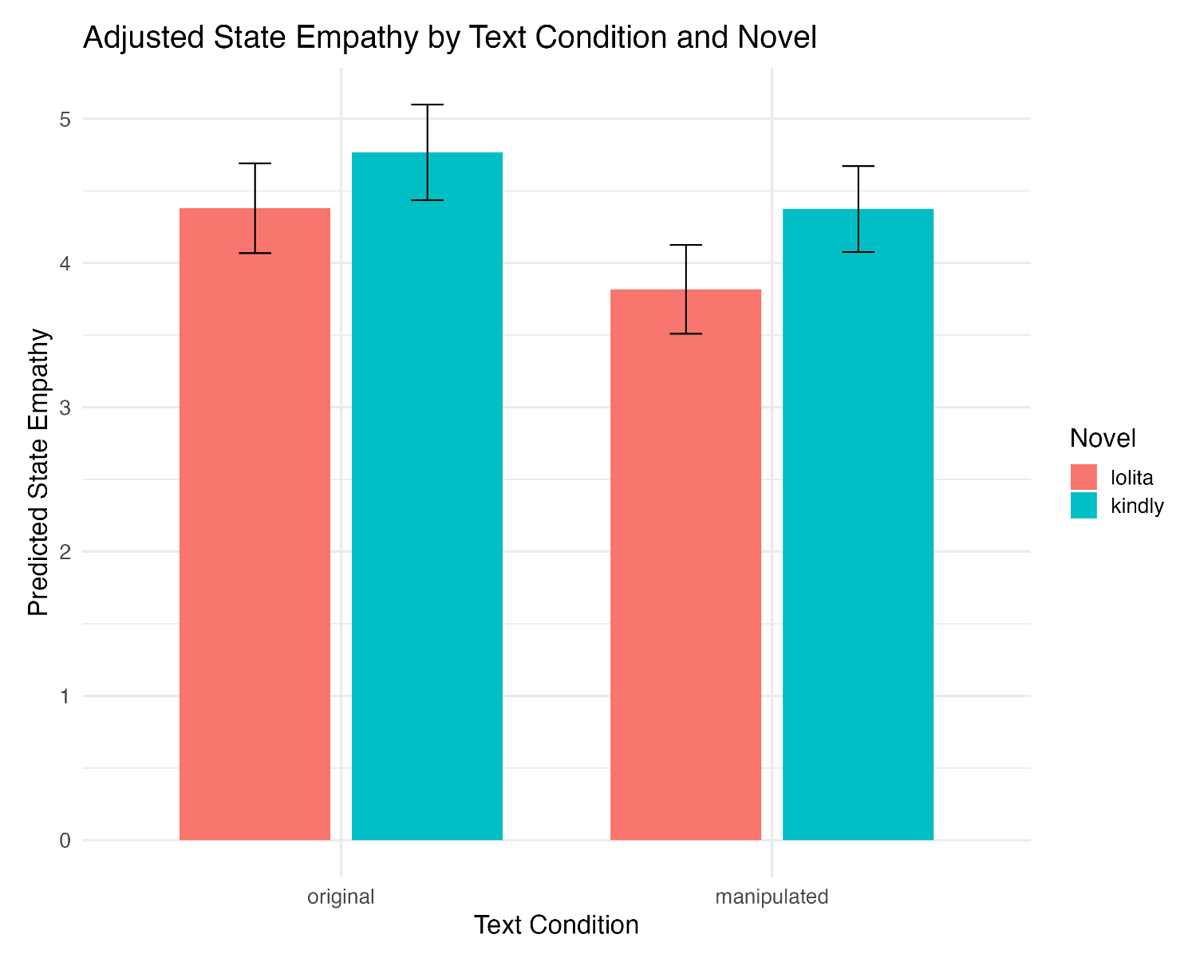
Figure 5
State Empathy by Text and Condition.
However, covariate patterns differed between texts. For Lolita, Aesthetic Attractiveness (p = .007) and Perceived Foregrounding (p = .020) were both significant predictors, and Trait Empathy showed a marginal effect (p = .074). This suggests that readers’ responses to Lolita were shaped primarily by the manipulation and by their sensitivity to style, with only a marginal contribution of dispositional empathy. In contrast, for The Kindly Ones, Aesthetic Attractiveness was the only significant covariate (p = .016), while Trait Empathy and Perceived Foregrounding had no significant effect. This may indicate that stylistic effects in The Kindly Ones operated more directly and less dependently on readers’ disposition or perception of style. Taken together, these results confirm that the empathic effect of foregrounding is replicable across texts, although the mechanisms of reader engagement may vary depending on narrative themes and other features.
For Empathic Distress, ANCOVA models again revealed no significant effect of foregrounding in either text (Lolita: F(1,54) = 0.92, p = .341; The Kindly Ones: F(1,54) = 2.63, p = .111). This confirms earlier findings that textual foregrounding has limited impact on distress-based responses (Figure 6).
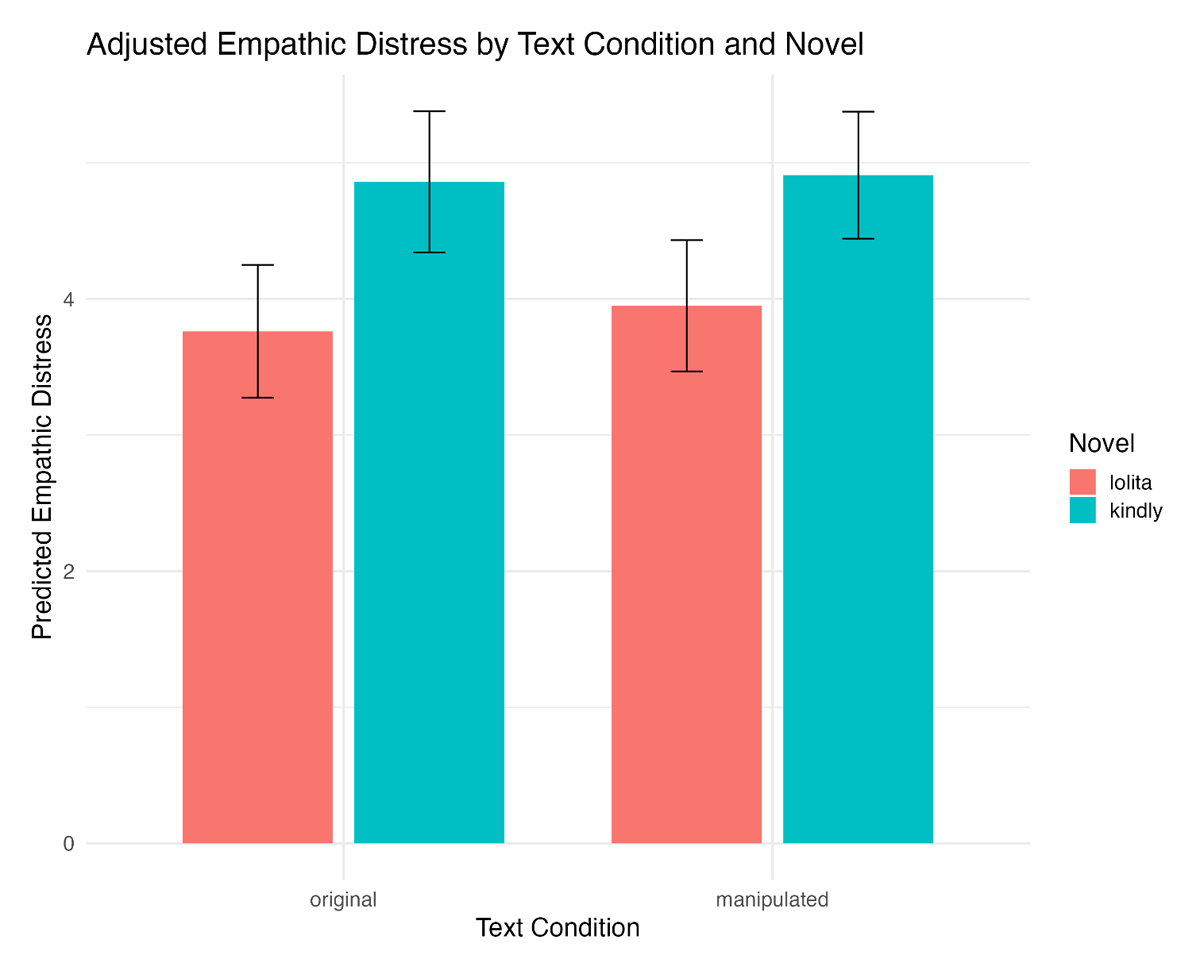
Figure 6
Empathic Distress by Text and Condition.
However, in The Kindly Ones, Trait Empathy significantly predicted Empathic Distress (p = .047), suggesting that readers with higher dispositional empathy experienced greater vicarious discomfort, regardless of the text’s style. In Lolita, Trait Empathy showed a marginal effect (p = .057), while Aesthetic Appreciation and Perceived Foregrounding were not significant. These patterns reinforce the interpretation that Empathic Distress is dispositional.
Finally, an exploratory ANCOVA including Gender as a factor found that it had no significant effect on State Empathy (F(1,53) = 0.20, p = .65), while textual manipulation remained highly significant (F(1,53) = 33.50, p < .001). This indicates that the effect of textual foregrounding on State Empathy was consistent across male and female participants. Aesthetic Attractiveness (p = .013) and Perceived Foregrounding (p = .073) were relevant covariates, whereas Trait Empathy was not (p = .242). These results suggest that stylistic and aesthetic features of the text, rather than reader gender, were the primary drivers of State Empathy in this experiment. In the corresponding model for Empathic Distress, neither Gender (p = .43) nor textual manipulation (p = .10) were significant, but both Trait Empathy (p = .013) and Aesthetic Attractiveness (p = .035) significantly predicted Empathic Distress.
To complement the quantitative results, the next section presents the results of the open-ended responses where readers were able to express their feelings in their own words. These offer additional insight into the experiential quality of empathy toward the narrators—particularly its moral and emotional ambivalence—that may not be fully captured through the survey instruments employed.
4.2 Insights from post-reading comments
Participants were invited to respond to an optional open-ended question about the specific feelings they experienced while reading. These responses offered additional insight into the affective and moral nuances of engagement with the texts. Among respondents who answered all open questions, 13 belonged to the original condition (46.4% completion rate) and 18 to the manipulated (58.1% completion rate). While the completion rate for these optional questions was higher in the manipulated group, the number of usable responses was distributed across both conditions, with 124 total comments available for analysis. Responses were analyzed through a mixed approach, combining established coding schemes that conceptually align with the current study (e.g., Koopman 2016) with themes emerging from the data itself. This allowed to capture a comprehensive understanding of readers’ engagement—including core empathic aspects and other relevant affective and evaluative reactions. Readers’ comments were thus categorized into five macrocategories: (a) feelings of closeness, including empathy, sympathy, understanding, and identification; (b) feelings of distress and discomfort; (c) aesthetic feelings, such as appreciation of the text’s style or language; (d) distance or detachment from the character and/or the narrative; and (e) moral judgment, including ethical evaluations or justification of the characters’ actions. The coding process revealed that several responses exhibited overlap across multiple categories. To ensure consistency and reliability, two independent coders analyzed the responses and assigned them to the appropriate category. In cases where disagreements arose, responses were discussed and re-evaluated until an agreement was reached. Intercoder reliability was high (Krippendorff’s ɑ = .98).
4.2.1 Closeness
Readers of the original, foregrounded excerpts reported more frequent empathic engagement than those who read the manipulated versions. Mentions of empathy or sympathy (freq. = 25) and empathic understanding (freq. = 16) were more common compared to the manipulated condition (freq. = 12 and freq. = 8, respectively). Several participants described feeling emotionally moved or connected to the narrators, despite their moral ambiguity. One participant noted, ‘I fully felt the character’s emotions, and it did my heart good to read it’9 (original, Lolita), while another commented on The Kindly Ones, ‘Reading aroused in me a sense of pity toward the character, who seems to surrender to a life he would like to be different.’ Another reader of the original texts mentioned being able to identify with the narrator of The Kindly Ones when he reflects on his past mistakes: ‘Even if not in such extreme situations, it’s something I do as well.’ As anticipated (see Section 3.4.2), several participants also mentioned feeling emotionally confused, as a result of empathizing with both perpetrators and victims. More on this ambiguity is discussed in Section 5.6.
4.2.2 Distress and ambivalent feelings
Although quantitative data showed no significant differences in empathic distress between groups, these responses revealed that readers of the manipulated excerpts reported more frequent experiences of unease (freq. = 24) than those in the original condition (freq. = 14). For instance, descriptions included ‘a sense of inexplicable discomfort toward the narrator’ (Lolita), and ‘feelings of bitterness and fear’ and ‘a strange sense of unease’ (The Kindly Ones). Although these responses may reflect empathic discomfort evoked by the character’s suffering, they could also indicate emotional dissonance or rejection rather than empathic alignment—potentially explaining the incongruous quantitative results (see Section 4.1.2). Notably, ambivalent emotions—such as simultaneous compassion and discomfort—were reported more often by readers of the original texts (freq. = 15) than among those who read the manipulated versions (freq. = 5). Participants repeatedly described conflicting affective states, such as ‘anger, but also discomfort and pity’ toward the protagonist. These mixed responses align with the concept of negative empathy as a profoundly ambivalent and emotionally layered form of reader engagement.
4.2.3 Aesthetic appreciation and engagement
Responses also revealed that readers of the original texts more often commented on the beauty or evocative power of the prose (freq. = 17) compared to those who read manipulated versions (freq. = 5). The evocative language of both novels was cited as a key factor enhancing immersion and emotional involvement. One participant noted how ‘the cruel descriptions and words are precisely what prompted empathy and immersion for me’ (The Kindly Ones). Another reflected on how a vivid metaphor—the narrator’s arm detaching and acting on its own as a symbol of losing control during the massacre—allowed them to ‘enter the mind of a soldier’ and engage with the narrative on a deeper level, even if they never experienced war firsthand. These comments provide further support for the aesthetic dimension of foregrounding theory, suggesting that defamiliarizing stylistic choices can heighten both aesthetic and emotional resonance.
4.2.4 Emotional distance
In contrast, participants who read the manipulated texts more often reported emotional detachment or lack of identification (total freq. = 18). Several described feeling ‘not very involved,’ ‘not understanding’ the protagonist, or maintaining ‘distance from the character.’ These comments suggest that stylistic simplification may reduce the readers’ ability to enter the characters’ perspective or to respond emotionally to their experiences—further echoing the observed scarce effects of foregrounding on state empathy in the manipulated condition. Similar comments were absent in the original condition.
4.2.5 Moral judgment and justification
Moral evaluation was a recurring theme across both conditions. Expressions of moral condemnation were evenly distributed, suggesting that style may be scarcely influential in shaping moral judgement. However, readers of the original texts more frequently offered mitigating interpretations of the characters’ actions, despite their perceived uneasiness (see Section 4.2.2). These included references to mental illness and ‘lack of impulse control’ (Lolita), and ‘orders from above’ and ‘trauma’ (The Kindly Ones). In several responses (freq. = 13), these justifications co-occurred with explicit comments on empathy or sympathy felt for the character. For example, one participant wrote, ‘I saw a glimmer of compassion in the character… and I felt the same compassion for both characters—two victims of circumstances greater than themselves.’ This suggests that literary style may facilitate complex empathic and ethical reflections, allowing readers to consider character motivations without necessarily condoning their actions.
4.2.6 Summary
The open-ended responses enrich the quantitative findings, by illustrating how higher levels of foregrounding enhance readers’ narrative empathy, aesthetic appreciation, and emotional ambivalence. These forms of engagement are often accompanied by complex moral reasoning. Conversely, the more neutral style of the manipulated texts elicited more frequent reports of emotional distance and distress. These findings reinforce the theoretical claim that negative empathy—a conflicted but emotionally invested form of alignment—is facilitated by literary style. They also demonstrate how style can shape not only what readers feel, but how they interpret and reflect upon ethically challenging narratives.
5. Discussion
This study investigated the intricate relationship between literary foregrounding and readers’ responses, focusing particularly on the empathic engagement with morally ambivalent characters/narrators. Using multiple analytical approaches, six hypotheses spanning emotional and aesthetic domains of literary experience were tested. The findings provide strong empirical support for the claim that stylistic features—specifically, foregrounding—enhance state empathy both directly and through aesthetic appreciation. Readers’ reflections immediately after reading further contextualized and enriched these results. While the findings are promising and offer insights into how literary style shapes reader engagement, some should be interpreted with appropriate caution, acknowledging the study’s inherent complexities and limitations.
5.1 Foregrounding facilitates state empathy but not empathic distress
Consistent with H1, readers exposed to the original, foregrounded texts reported significantly higher levels of Affective, Cognitive, and Associative Empathy (collectively, State Empathy) than those who read the stylistically manipulated versions. These effects remained robust after controlling for Trait Empathy, Aesthetic Attractiveness, and Perceived Foregrounding. This indicates that literary techniques play an important part in fostering emotional resonance—even in the case of disturbing stories and fictional characters whose values and actions diverge markedly from our own. However, contrary to H5, Empathic Distress did not differ significantly between conditions. In fact, Empathic Distress was marginally lower in the original texts, and it was primarily predicted by Trait Empathy. This suggests either that stylistic richness may attenuate rather than amplify negative affect, or that Empathic Distress is more closely tied to content and individual disposition than to textual form. Thus, while foregrounding facilitates engagement and alignment with complex narrators, it does not necessarily evoke personal discomfort or vicarious suffering. These findings were echoed in the open-ended responses. Readers of the original texts more frequently described feelings of closeness, empathy and identification, even in a morally ambiguous context. In contrast, readers of the manipulated versions more often reported distress, framing it as confusion, unease, or rejection. These data thus reinforce the interpretation that stylistic richness fosters empathic connection, while stylistic neutrality may elicit discomfort with less emotional engagement—clarifying why distress did not increase in the foregrounded condition.
5.2 Aesthetic appreciation as a mechanism of empathy
Aligned with H2, original texts were rated as significantly more aesthetically attractive than their manipulated counterparts, suggesting that stylistic foregrounding significantly enhanced the perceived literary quality. Mediation analyses further supported H3, revealing that Aesthetic Attractiveness significantly mediated the effect of foregrounding on State Empathy, accounting for nearly 30% of the total effect. These findings lend empirical support to theoretical claims that literary features contribute to emotional alignment with characters via an aesthetic pathway (Miall & Kuiken 2002). Post-reading comments underscored this mechanism. Participants explicitly noted that the vivid, often defamiliarizing stylistic elements of the original excerpts—such as evocative language and imagery (e.g., ‘the arm detached from the body’)—deepened their immersion and heightened their emotional involvement, even when the content was disturbing. In contrast, although aesthetic appreciation showed a significant indirect effect on Empathic Distress. Crucially, however, the direct effect was non-significant and the total effect of stylistic manipulation on distress was small and non-significant, suggesting a full but weak mediation. This points to a more complex, and potentially content-driven, mechanism for distress-related responses, where appreciation of style alone is insufficient to robustly evoke discomfort. All in all, these findings strengthen the idea that literary style is not a mere aesthetic device, but a central component of the affective experience of literature—capable of intriguing readers into ethically challenging perspectives.
5.3 Effects of trait empathy, gender, and moral judgments
Contrary to H4, Trait Empathy did not moderate the effect of foregrounding on either State Empathy or Empathic Distress, suggesting that stylistic foregrounding exerts a relatively uniform effect across individual differences. However, Trait Empathy was a direct predictor of Empathic Distress, reinforcing the idea that distress is a more dispositional response, whereas State Empathy is more sensitive to stylistic features. Similarly, Gender was unrelated to either outcome, suggesting that the impact of literary style on empathy is consistent across male and female readers—relatively increasing the generalizability of these results. Open-ended responses across both conditions included moral evaluations, but readers of the original texts more often offered nuanced or mitigating interpretations of the characters’ actions. This suggests that while stylistic foregrounding may not change moral evaluations outright, it appears to encourage deeper reflection and moral complexity, supporting the notion of negative empathy as a morally ambivalent experience.
5.4 Text-specific effects
Novel-specific analyses supporting H6 confirmed that The Kindly Ones elicited significantly more Empathic Distress than Lolita, even though both texts involved morally compromised narrators. This difference—observed through paired t-tests and content-specific ANCOVAs—implies once again that Empathic Distress may be more sensitive to narrative content, emotional tone, or thematic intensity than to stylistic form. In particular, The Kindly Ones generated stronger discomfort, particularly among highly empathic readers. Interestingly, the mechanisms of empathy differed slightly between texts. In Lolita, Perceived Foregrounding and Aesthetic Attractiveness contributed more strongly to engagement, while for The Kindly Ones engagement was more directly tied to stylistic manipulation. These patterns suggest that while foregrounding consistently affects empathy, the way readers respond to stylistic features may vary according to the narrative context.
5.5 Toward a model of negative empathy
Collectively, these findings offer strong empirical support for the concept of negative empathy—a morally ambivalent, aesthetically mediated form of engagement with disturbing fictional characters/narrators. The combination of increased State Empathy and a pattern of Empathic Distress that is only weakly and indirectly modulated by style, together with the mediating role of aesthetic appreciation, and the reports of emotional ambivalence in the open-ended comments all align with recent theoretical accounts of complex reader-character relationships in literary works like the ones under scrutiny. Unlike conventional accounts of empathy, negative empathy allows readers to emotionally connect with morally troubling characters without necessarily suffering on their behalf. Literary style appears to facilitate this via foregrounding, by drawing attention to language, fostering aesthetic appreciation, and opening space for ethical reflection. These findings align with theories that emphasize the importance of emotional ambiguity and stylistic form in the literary experience (Bálint et al. 2016; Hakemulder 2020; Keen 2007; Scapin et al. 2023).
5.6 Limitations and future directions
Several limitations should be acknowledged. First, although this study employed validated subscales for State Empathy and Empathic Distress, it did not include a dedicated measure of negative empathy, a construct that remains underdeveloped in empirical research. Future studies should aim to develop and validate instruments capable of capturing morally ambivalent empathic responses more precisely.
Second, while the stylistic manipulation was carefully designed, its effects could vary depending on genre, reader background, or linguistic and cultural context. Future work should attempt generalizing these findings across diverse populations and narrative forms. Moreover, because the manipulated texts retained traces of literariness, the stylistic contrast may have been smaller than intended; this limits how strongly we can attribute effects solely to foregrounding.
Third, although the excerpts were anonymized and decontextualized, it remains theoretically possible that some readers may have recognized the source texts—particularly Lolita—even without explicitly mentioning it. While this study prioritized capturing immediate emotional reactions, future experiments should include a familiarity check to assess recognition bias. A further limitation concerns the framing of Lolita as a ‘love story’: some readers may not have realized that the narrator describes sexual abuse, which could have attenuated moral awareness and distress.
Most importantly, the interpretation of Empathic Distress remains inherently ambiguous in this context. While the study was adequately powered to detect large effects for most variables, the findings for Empathic Distress should be interpreted with caution, as the design had limited statistical power (32%) to detect effects in this variable. Moreover, the source of this distress remains ambiguous: it was sometimes unclear whether it stemmed from identification with the narrator’s suffering, sympathy for the victims, or a generalized emotional discomfort with the depicted situation. This ambiguity, which was acknowledged earlier (Section 3.4.2), complicates conclusions about foregrounding’s impact on Empathic Distress specific to the perpetrator, and more broadly on distress as a component of negative empathy. Future work should consider refining measurement tools to explicitly differentiate the target of the readers’ Empathic Distress response.
Finally, the analysis of post-reading comments also revealed subtle affective dimensions not fully captured by the quantitative instruments, such as the interplay between aesthetic appreciation and moral reasoning. It should be noted that the response rate for these open-ended questions was higher in the manipulated condition (58.1%, N = 18) than the original condition (46.4%, N = 13), which means comparisons of the raw frequency of these observations should be interpreted with caution. The findings suggest that literary style can influence how readers interpret and morally evaluate ethically complex characters, but the precise pathways remain to be explored in further detail.
6. Conclusion
This study provides new insights into how stylistic foregrounding influences readers’ emotional and aesthetic engagement with morally ambiguous characters/narrators. The results suggest that foregrounding enhances state empathy, increases aesthetic appreciation, and fosters complex reflective responses— while only weakly and indirectly modulating empathic distress via aesthetic appreciation. These findings offer cautious empirical support for the theoretical notion of negative empathy as an aesthetically mediated and morally ambivalent form of engagement with disturbing fictional subjects. They also reaffirm the role of literary style not simply as a decorative element, but as a key mechanism through which readers feel, think, and reflect in ethically charged narrative works. While methodological challenges persist—particularly in measuring emotional and moral complexity—this study lays valuable groundwork for future empirical investigations into the relationships among style, empathy, morality, and narrative experience. Continued research in this area will refine our understanding of how literature enables readers to confront and reflect on human behavior in all its moral ambiguity, possibly illuminating the darkness of our fascination with evil characters.
Data Accessibility Statement
The data that support the findings of this study are available in OSF at https://osf.io/ad6s7/?view_only=aaba75db505b43048720401c81087daa.
Notes
[1] Although research has suggested a possible link between fiction reading and improved long-lasting empathic skills in real life (e.g., Kidd & Castano 2013), this study does not seek to generalize to real-world behavior, but rather to analyze how stylistic manipulation influences narrative empathy during reading and immediately after.
[2] It is worth noting that Lipps’s theory of Einfühlung, by which he described the feeling of being drawn into the work of art, lies at the roots of the modern interpretation of empathy in aesthetics. Moreover, he was the first to grasp empathy as possessing both positive and negative facets (see Ercolino 2018; Bonasera 2024).
[3] In the present study, I employ the term negative empathy following Ercolino and Fusillo’s (2022) aesthetic definition rather than its use in social psychology and neuropsychology to indicate empathy for others’ negative emotions.
[4] Although perfectible—in fact, a simple lexicon-based sentiment analysis notably fails to detect many stylistic and pragmatic factors, such as irony and ambiguity—this computational technique allows to locate and visualize the overall emotional content conveyed by single lexical items in a text, as well as the emotional shifts and fluctuations throughout a narrative (Bonasera 2023).
[5] In sentiment analysis, entropy is used to measure how emotionally varied a piece of text is. A higher entropy value means the text expresses a wider range of emotions (such as joy, sadness, anger, fear, etc.), rather than focusing on just one or two, reflecting its complexity and emotional richness.
[6] The demographic features of the respondent sample (gender, age, nationality, exposure to literary texts due to their academic specialization) may lead to question the study’s representativeness and potential for generalizability, as it may not fully capture the diversity of the general population. Therefore, while the results of this study provide valuable insights, they must be integrated with broader examinations (see Section 5.6).
[7] “Empathic distress” and “personal distress” are two psychological constructs that may appear similar to the aesthetic notion of negative empathy as conceived by Lipps, see Ercolino (2018: 246–247). See also Maibom (2020: 58–60) for a discussion on the complexity of discriminating the two concepts within the debate in psychology.
[8] As Ercolino acknowledges, ‘there seem to be a few similarities between empathic distress, personal distress, and negative empathy’ since ‘they are all associated with unpleasurable feelings experienced by the empathizer, they all bring somehow to intersubjective awareness, and they imply some form of detachment between the empathizing subject and the empathized subject or object’ (Ercolino 2018: 247).
Ethics and consent
This study was approved by the Research Ethics Review Committee of the University of Turin (reference number 0722800, 23/12/2024).
Acknowledgements
This study originates from a paper presented at the 2023 IGEL Conference in Monopoli (Italy). I thank the organizers and participants for their precious feedback. I am deeply grateful to the anonymous reviewers for their insightful comments on a first draft, which significantly improved the clarity and rigor of this article. I also thank Dr. Claudia Roberta Combei for her invaluable support with the study design and data analysis.
Competing interests
The author has no competing interests to declare.