
Table 1
Reasons given for lack of OER adoption in the Global North and South
| Variables | Global North studies | Global South studies |
|---|---|---|
| Lack of OER awareness | Reed, 2012; Rolfe, 2012 | Hatakka, 2009; Samzugi & Mwinyimbegu, 2013 |
| Lack of legal permission to create and share OER | Fitzgerald & Hashim, 2012 | Mtebe & Raisamo, 2014; Flor, 2013; Tynan & James, 2013 |
| Lack of relevant, high-quality OER to use | Clements & Pawlowski, 2012; Willems & Bossu, 2012 | Abeywardena, Dhanarajan & Chan, 2012 |
| Lack of personal interest or motivation | McGill, Falconer, Dempster, Littlejohn & Beetham, 2013; Pegler, 2012; Reed, 2012; Rolfe, 2012 | Cox, 2016; Gunness, 2012; He & Wei, 2009 |
| Lack of time | Allen & Seaman, 2014 | |
| Lack of institutional recognition for OER adoption | Jhangiani, Pitt, Hendricks, Key & Lalonde, 2016 | |
| Infrastructural challenges, such as low levels of internet penetration, broadband availability, and electricity stability | CERI/OECD, 2007; Ngimwa, 2010 | |
| Technical capacity | Lesko, 2013; Wolfenden, Buckler & Keraro, 2012 | |
| Social and pedagogical norms | Cox, 2012; Wolfenden, Buckler & Keraro, 2012 |
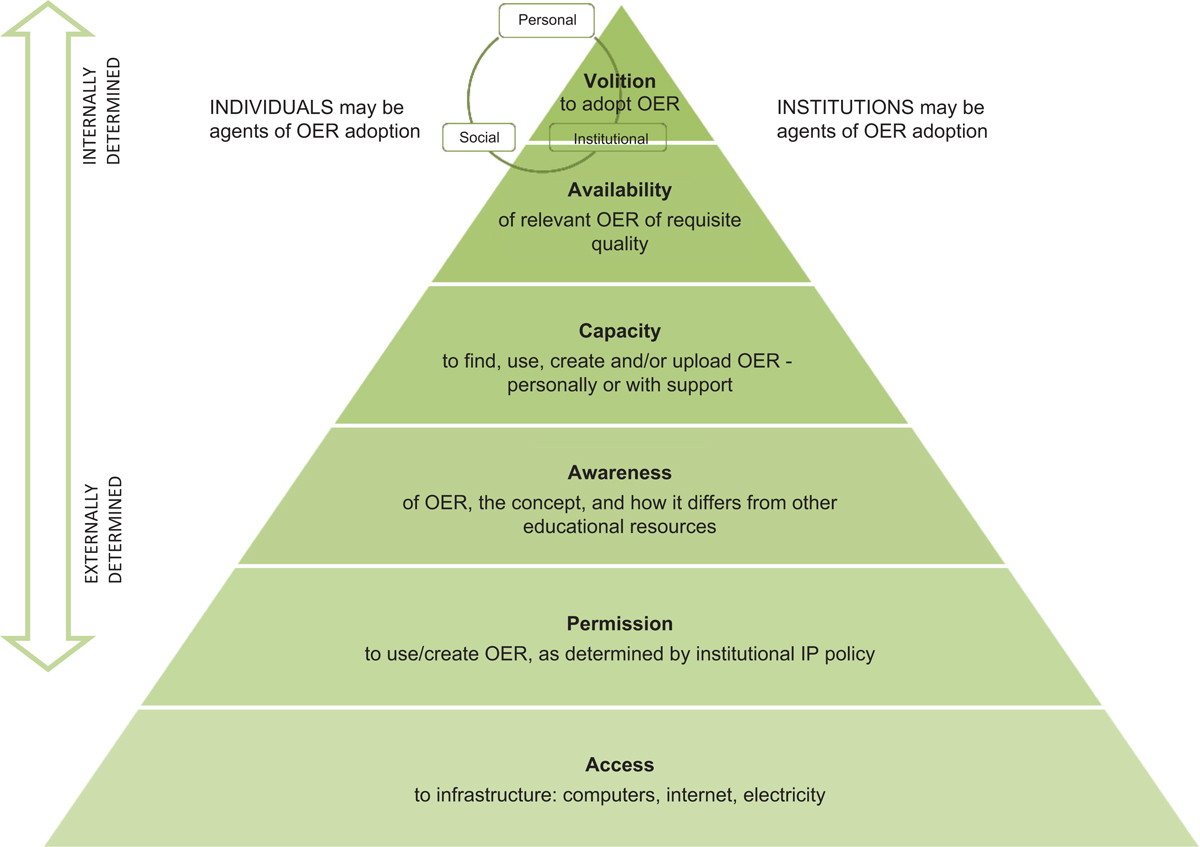
Figure 1
The OER adoption pyramid
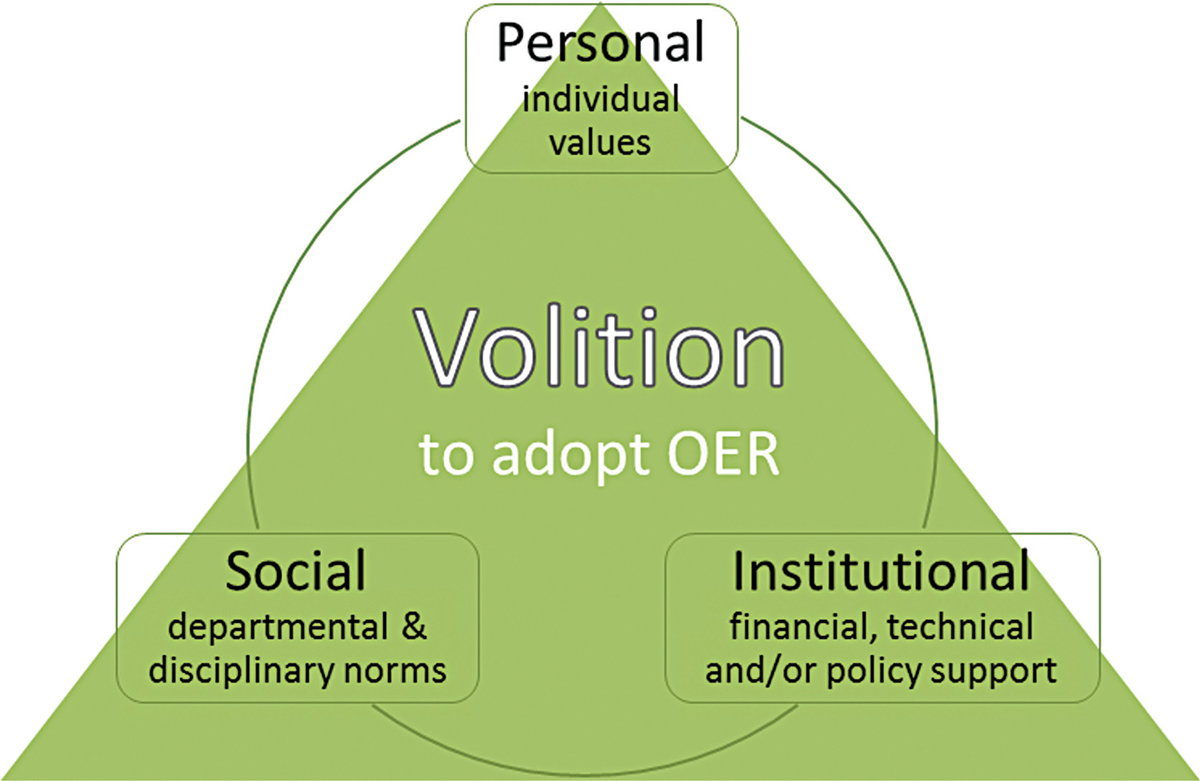
Figure 2
Variables shaping volition in the OER Adoption Pyramid
Table 2
Variables associated with six OER adoption factors (from bottom to top)
| OER Adoption Factors | Associated variables for OER users | Associated variables for OER creators |
|---|---|---|
| Volition |
|
|
| Availability | Perception of an OER’s:
| Perception of one’s own teaching materials’:
|
| Capacity |
|
|
| Awareness |
|
|
| Permission |
|
|
| Access |
|
|
Table 3
Questions to ask OER users and creators – whether lecturers or institutions – to assess OER readiness at an institution (starting from the bottom factor)
| Factors | Questions for potential OER users | Questions for potential OER creators |
|---|---|---|
| Volition | Do you have any desire to use OER? | Do you have any desire to create and share your teaching materials as OER? |
| Availability | Have you found OER online – of acceptable relevance, utility and quality – that you can use? | Do you hold copyright over teaching materials – of necessary relevance and quality – that you could license and share as OER? |
| Capacity | Do you know how and where to search for and identify OER? Do you know how the different CC licenses impact the ways in which you can use an OER? | Do you know how to license your teaching materials so that they can be shared as OER? Do you know where (on which platforms) you can upload your materials as OER? |
| Awareness | Do you have any knowledge of or experience with OER? Do you understand how Creative Commons (CC) licenses differentiate OER from traditionally copyrighted materials? | Do you have any knowledge of or experience with OER? Do you understand how Creative Commons (CC) licenses differentiate OER from traditionally copyrighted materials? |
| Permission | Do you have permission (from your curriculum committee, etc.) to use OER for teaching? Does the desired OER allow you use it in your specific context (e.g. no CC-ND licenses on items that will be sold as course material)? | Do you possess copyright over teaching materials that have been developed at your institution? |
| Access | Do you have (stable) electricity provision? Do you have (stable) internet connectivity? Do you have the necessary computer hardware for OER use? | Do you have (stable) electricity provision? Do you have (stable) internet connectivity? Do you have the necessary computer hardware for OER creation? |
Table 4
Level of OER readiness per factor – if lecturers are the agents of OER creation
| OER adoption factor | UCT | UFH | UNISA |
|---|---|---|---|
| Volition | |||
| Availability | |||
| Capacity | |||
| Awareness | |||
| Permission | |||
| Access |
| Key: Level of OER readiness | very low | low | medium | high | very high |
Table 5
OER Readiness Tables – with comparison based on different agents of analysis
| Factor | lecturers as OER users | lecturers as OER creators | institution as OER creators | ||||||
|---|---|---|---|---|---|---|---|---|---|
| UCT | UFH | UNISA | UCT | UFH | UNISA | UCT | UFH | UNISA | |
| Volition | |||||||||
| Availability | |||||||||
| Capacity | |||||||||
| Awareness | |||||||||
| Permission | |||||||||
| Access | |||||||||
| Key: Level of OER readiness | very low | low | medium | high | very high |
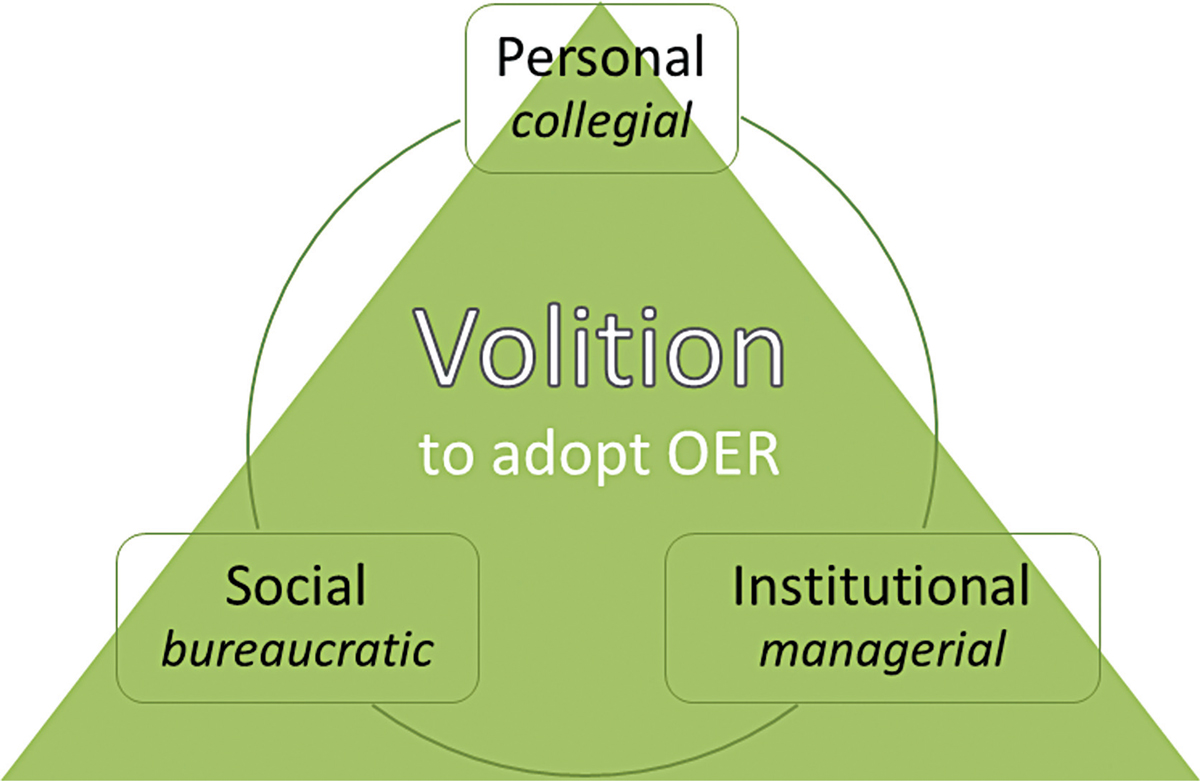
Figure 3
Relationship between volition variables and institutional culture type