
Introduction
Recent improvements in online learning have made the use of synchronous online settings more popular for the institutions. With their new tools, synchronous settings provide some transformations for online learning (Kuo, Walker, Belland, & Schroder, 2013). The advantages of using synchronous tools include real-time communication between the instructor and learners or among learners, immediate response from the instructor in a sense of a real classroom learning setting. It also allows learners to engage in learning with peers and the instructor at the same time. With the sense of online learning community, learners and instructors can build collaborative knowledge (Shea & Bidjerano, 2009) and meaningful learning through reflection and discourse (Gutiérrez-Santiuste, Rodríguez-Sabiote, & Gallego-Arrufat, 2015). In this sense, researchers reported that meaningful learning outcomes are provided by following the Community of Inquiry (CoI) framework in the online instructional process (Rourke & Kanuka, 2009). The framework is considered as an effective way to explain the interactions among people, content and system for successful teaching and learning (Garrison, Anderson, & Archer, 2001; 2010).
Garrison, Anderson and Archer (2010) pointed out that the CoI framework has become a leading model that can be used as a practical approach for exploring or evaluating the quality of the inquiry. It should be noted that research on CoI in higher education has generally examined the issue within asynchronous and blended instructional settings, only few studies investigated whether and how synchronous online environments may be understood within CoI framework.
Study Framework
Online learning settings include communication and personalization dimensions. According to Gregori, Torras, and Guasch (2012) researchers need to analyse a wide range of actions to define the interactions and instructors use the potential of interactions that supports meaningful learning (Kanuka & Garrison, 2004) and facilitates students satisfaction (Hosler & Arend, 2012; Maddrell, Morrison & Watson, 2011). CoI explains the online instructional process in three dimensions as teaching, social, and cognitive presences (Garrison et al., 2001). Following the model, online instructional processes may be described and analysed through the relationships among these three presences (Gregori et al., 2012). A summary of CoI framework is depicted in Figure 1.
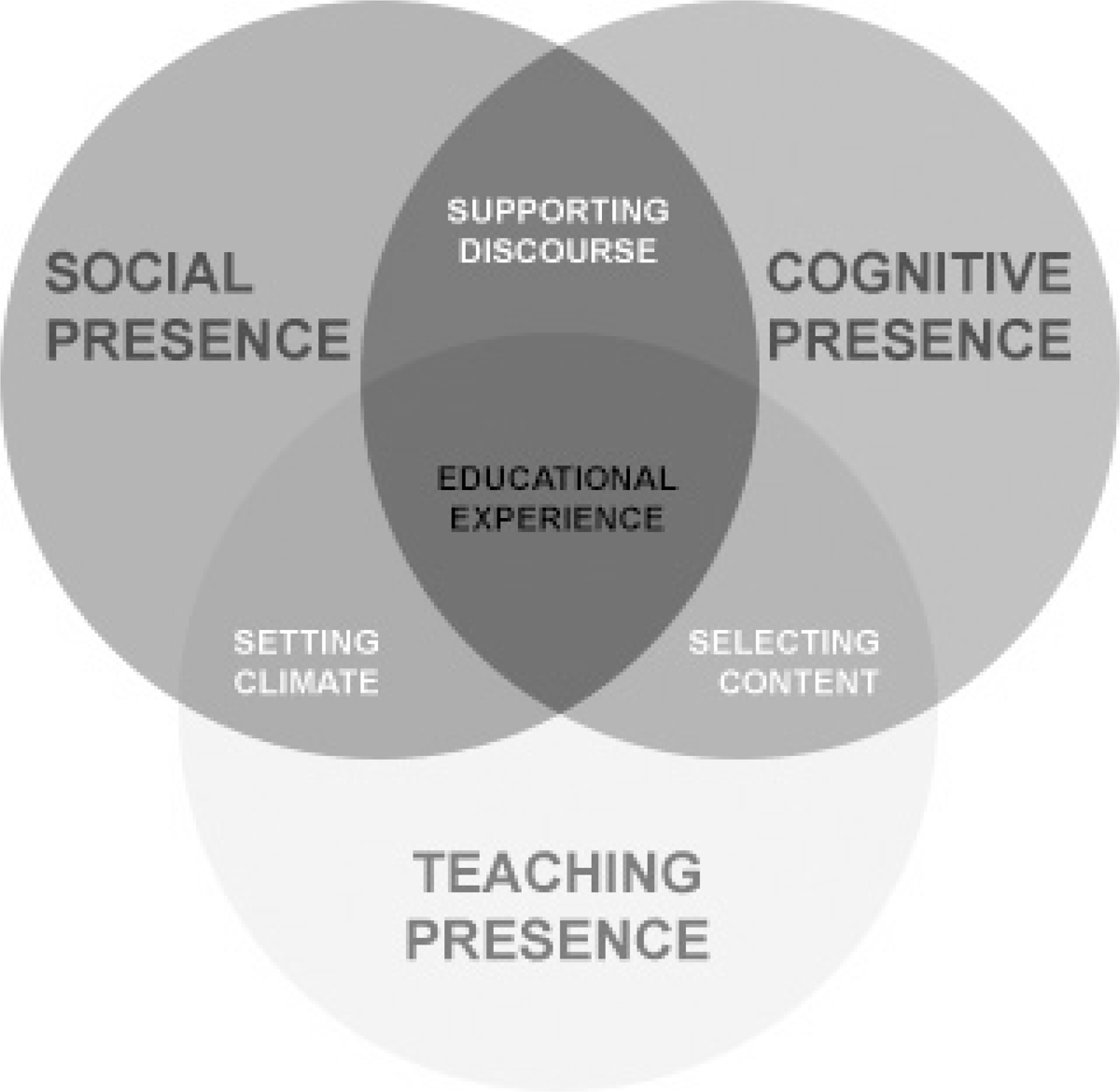
Figure 1
Community of inquiry framework (Garrison et al., 2001).
Successful online courses create a CoI where students interact with one another, the instructor and the learning materials to develop new knowledge and skills (Arbaugh, 2008; Boston et al., 2009; Garrison & Arbaugh, 2007). Researchers point out that when online courses have a strong CoI, students participate in discussions, perceive that they learn more, are more satisfied with the learning experience (Garrison & Cleveland-Innes, 2005; Richardson & Swan, 2003).
In the framework, cognitive presence is defined in relation to the meaning construction and higher levels of thinking (Kanuka & Garrison, 2004). It is discussed in four phases of critical inquiry: triggering event, exploration, integration and resolution (Garrison et al., 2001). Triggering event occurs when participants gain perceptions about the issues or problems identified for further inquiry (Arbaugh, Bangert, & Cleveland-Innes, 2010). In exploration phase, studying on the problems individually or collaboratively through critical reflection and discourse takes place. In the community, learners construct meaning from the reflections in the integration phase. Learners practically try out their ideas or conceptions in the resolution phase (Darabi, Arrastia, Nelson, Cornille & Liang, 2011). Social presence is defined as the feeling connected with others (Arbaugh et al., 2008). Effective communication, open communication and group cohesion is considered in the context of social presence. Social presence is critical for collaboration because it takes a role in achieving cognitive objectives by supporting critical thinking and facilitating knowledge exchange (Garrison, Anderson, & Archer, 2010). Teaching presence represents the instructor as an active member of the community who designs the learning environment and comprises of the teachers’ roles in facilitating learning tasks and presenting the topics. Overall, Shea, Li, Swan and Pickett (2005) posited that social interaction is a required element needed in online instructional process. At this point; an idea come into mind that; basic interactions (student-student, student-instructor and student-content) may be reshaped in online synchronous courses and the synchronous functions may provide a different way of senses of community of inquiry constructs.
Synchronous Online Learning
Due to the nature of the delivery methods and the affordances of the web conferencing system, the development of the community may be differentiated from those of asynchronous online learning settings. Synchronous settings allow instructor to provide a live lecture or presentation. Students attend to a virtual classroom which provides feelings similar to the real classroom. Students are allowed to share knowledge in the discussion boards, or send private messages to the peers. Real time communication between instructor and students is enhanced through features such as audio, video, whiteboard. Participant list, text chat room, video/audio meeting room, notes, and surveys are the frequently used in synchronous sessions. In addition; instructors have opportunity to carry out the activities through direct presentation, discussion or investigation strategies. Moreover, electronic whiteboards can be used to work collaboratively on the same activity.
Related Literature
A series of studies were carried out focusing on sense of community of inquiry and reported various levels of relationships between cognitive, social and teaching presences and learning outcomes (Garrison, Cleveland-Innes, & Fung, 2010; Kozan & Richardson, 2014; Pisutova-Gerber & Malovicova, 2009; Rockinson-Szapkiw, Wendt, Whighting, & Nisbet, 2016; Schellens & Valcke, 2006). For instance, Shea and Bidjerano (2009) reported that students’ cognitive presence could be predicted through perceived teaching and social presence. Similarly, using a standard multiple regression analysis, Archibald (2010) found that social presence makes a higher contribution to the explanation of cognitive presence than teaching presence. In another study, undergraduate students were surveyed and a moderate positive relationship among CoI constructs was reported in a blended setting (Maddrell et al., 2011). In another study, Daspit and D’Souza (2012) analysed the wiki environment through CoI and found that teaching presence and social presence were correlated to cognitive presence. Öztürk (2015) created a learning community on Facebook and addressed high correlation between learners’ perceived social, cognitive, and teaching presences. Other research also establishes a high correlation between social and cognitive presence (Shea & Bidjerano, 2009), as well as a dynamic relation between the three presences and a causal relation of social and teaching presence to the perception of cognitive presence (Garrison et al., 2010; Archibald, 2010). There is also some evidence that the sense of community is significantly associated with perceived learning (Rovai, 2002; Shea, 2006; Shea, Li & Pickett, 2006). In this regard, Shea and Bidjerano (2010) surveyed over 2000 college students and documented the relationships of CoI to describe learning outcomes in hybrid and fully online learning environments. The study of Maddrell et al. (2011) concluded that only cognitive presence correlates significantly and positively with achievement measures. On the other hand, in a recent study; instructors analysed cognitive presences with an automatic system and reported the relationships between learners’ cognitive presence and their social participation within asynchronous online discussion by classifying messages (Hind, Idsissi, & Bennani, 2018). Lee and Huang (2018) also reported that providing more interaction opportunities helped students develop higher social presence; however, there was no relationship between social presence and learning outcomes. In another study; a multiple linear regression analyses revealed moderate relationship between learners’ perceived teaching presence and cognitive presences (Huang, Law & Lee, 2018).
Need for the study
An effective online learning setting should facilitate easy communication and feedback. In this sense, the technology used to support online courses may affect to the interaction level between students and instructors (Rubin, Fernandes, & Avgerinou, 2013). In online courses, there are several aspects of the technology that are likely to affect teaching and learning process. Synchronous online settings present some advanced tools for interactions, however, learners do not have much time for real-time messaging, discussing, or collaborating (Stewart, Harlow, & DeBacco, 2011), and also searching for information, critical thinking, receiving feedback or socially interacting in a limited lesson period (Bonk & Zhang, 2006). Thus; student-instructor, student-student online dialogues, spontaneity, sense of community and being perceived by the others may take place different from asynchronous settings (Stodel, Thompson, & MacDonald, 2006). Accordingly, synchronous online learning settings have distinct pedagogical demands owing to the nature of interactivity.
Although there is a growing emphasis on determining interactions on asynchronous online learning, the studies composed of synchronous interactions are still scarce (Akyol & Garrison, 2011; Pisutova-Gerber & Malovicova, 2009; Rourke & Kanuka, 2009). Thus, further studies are still needed to answer whether CoI constructs reflecting the synchronous learning process via interactions among students, instructor and content will lead to deep and meaningful learning.
On the other hand; cognitive presence is recognized as a core concept in the CoI definition, and is considered as one of the key elements of effective online learning (Garrison et al., 2001). Some evidences are reported positive correlation between cognitive presences, sense of community and perceived learning, academic achievements (Shea & Bidjerano, 2010), however the learning setting in those studies are either asynchronous or blended. In this sense; Rubin et al. (2013) noted some inconsistencies in terms of the study contexts in which further research is warranted.
In order to formulate the academic achievements in synchronous online settings; the influences of teaching, social and cognitive presences were discussed through the affordances of web conferencing. Accordingly, this study attempts to determine the relationships between presences and the academic achievements web conferencing through the lens of CoI.
Aim of the Study
Following the CoI framework, one aim of this study is to gain an insight to the relationships between cognitive, teaching and social presences and the academic achievements in web conferencing. Many authors used the theoretical framework to assess cognitive presence indicators and descriptors, both in online and blended education (e.g. Akyol & Garrison, 2011; Kanuka & Garrison, 2004; Stein et al., 2007). In this study; specifically, cognitive presence was taken into consideration relevant to academic achievements in one research question.
In line with the overall purpose of the study, the following research questions were directed:
What is the relationship between the perceived teaching, cognitive and social presences in web conferencing?
What is the relationship between the perceived cognitive presences and the academic achievements in web conferencing?
Method
Participants and Setting
A quantitative correlational analysis is carried out in the study. The participants were 72 (39 male, 33 female) undergraduate sophomore students (between 18-24 age) enrolled in an instructional technology program at a public university in Turkey. The program trains teachers to teach IT courses in secondary schools. Participants had enough computer literacy to follow the online courses and to employ the tools used in web conferencing. The participants had little prior knowledge about programming. The study was conducted in an introductory programming classroom during 14 weeks, 4 lesson hours per week. During the implementation, course activities, tasks, strategies and assessments were all organized to facilitate both collaborative and individual learning. The synchronous meetings were provided between 90-120 min per week. Most of the learners continued on participating in the virtual class during the semester.
During the instructional process; Adobe Connect web conferencing system was used as a delivery tool. Adobe Connect as a web conferencing system provides audio-visual communication and interactions between students and instructors synchronously. The instructor used both pictorial and audial form of presentation and enriched documents such as PowerPoint, PDF files, pictures and videos during the presentations. During and after presentations, students are allowed to discuss on the subjects. The discussions were about presentations, shared pictures, links or videos followed in the lesson. In addition; students are allowed to exchange ideas, provide feedback for peers and receive feedback from the instructor and peers about their tasks via the system. Students were also allowed to share a variety of files; images, presentations, audio, video and their desktop including running applications. All lessons are recorded with the Adobe Connect recording system.
Data Collection and Analysis
Three data sources were used in this study: CoI Questionnaire, messages in video records and final test scores. The instruments are briefly described in Table1.
Table 1
Data Collection Tools
| Data Collection Tools | Used for |
|---|---|
| CoI Questionnaire | Identifying perceived CoI constructs and relations among them (teaching, social and cognitive presences) |
| Messages in Video Records | Determining and explaining relations between perceived cognitive presence and academic achievements |
| Final Test |
Community of Inquiry Questionnaire (CoIQ): The Turkish version of the CoI questionnaire was used to determine learners’ perceptions of each presence. Arbaugh et al. (2008) originally developed the instrument and Öztürk (2012) validated its Turkish version. The instrument consisted of 34 items in three dimensions (teaching presence: 13, social presence: 9, cognitive presence: 12) in a 5-point Likert type scale ranging from 1-Strongly Disagree to 5-Strongly Agree. In previous studies, it was used for similar purposes (Arbaugh et al., 2008; Shea & Bidjerano, 2009). The questionnaire was administered to the participants before the final exam in a classroom in approximately 40 min when the students came together for the final exam at the end of the semester. Descriptive analysis was conducted to analyze CoIQ responses. The results were presented including mean, frequency, percentage and standard deviations and interpreted in terms of teaching, social and cognitive presence measures.
Final test scores: Besides students’ self-report of presences, their final test scores as academic achievements in the form of grades were also used in the study. The author who was also the instructor developed an open-ended test to assess both conceptual and strategic programming knowledge. Another instructor also reviewed the test items for content validity to ensure measuring the related objectives. After the instructors concurred that the instrument was valid, the test was administered in the classroom at the end of the semester.
In order to analyse the final test scores; the researcher and another instructor first assigned the scores for the questions individually. Then they discussed about each item on the test. After a negotiation for refining the scores, the final scores were calculated. In order to explore the relationships between perceived CoI constructs and academic achievements, Pearson correlation coefficient was calculated.
Online discussion messages: Both text and audio messages in the video records of the lectures were used to explain the experiences reflecting the perceived presences. Watching the video records, the researcher transcript narrations of the participants and inserted them to the text messages.
Cognitive Presence Categories Template (CPCT) developed by Garrison et al. (2001) was used to analyse discussion messages to identify cognitive presences of students. Four phases of cognitive presence indicators are included in the template: triggering event, exploration, integration and resolution. The template was also used for similar cognitive presence analysis in other CoI studies (Öztürk & Deryakulu, 2011). Transcript analysis of the of discussions was conducted in order to explore students’ cognitive presences referring to the indicators in the template. The author and a research assistant applied the transcript analysis with a negotiated coding approach. After coding the transcripts individually, they discussed these together until they come to an exact agreement. The categories, indicators and units of analysis are worked out iteratively with regard to the events identified in the template.
Results
In the results section; findings about the relationships among the perceived presence measures were presented first, and then the relationships between the cognitive presences and academic achievements were discussed.
Measures of teaching, cognitive and social presences
The mean scores from students’ responses for CoIQ were evaluated in the ranges and descriptors as (1.00-1.79: not satisfactory, 1.80-2.59: merely satisfactory, 2.60-3.39: satisfactory, 3.40-4.19: highly satisfactory, 4.20-5.00: excellent). Carifio and Perla (2008) pointed out that while Likert type items may well be ordinal, Likert scales consisting of sums across many items will be interval. Hence, mean values may be used to transfer ordinal data into intervals so that parametric tests can be conducted. Similar ranges were used for some other Likert type instruments (Caparaz, Llorca, Mance & Red, 2013).
Teaching Presence
The descriptive results for perceived teaching presence are shown in Table2.
Table 2
Descriptive measures of teaching presence scores
| Categories | Items | M | SD |
|---|---|---|---|
| Design and organization | The instructor, | ||
| clearly communicated important course goals. | 3.44 | 1.29 | |
| clearly communicated important course topics. | 3.56 | 1.24 | |
| provided clear instructions on how to participate in course learning activities. | 3.51 | 1.07 | |
| clearly communicated important due dates/time frames for learning activities. | 3.89 | 1.05 | |
| Facilitation | was helpful in identifying areas of agreement and disagreement on course topics that helped me to learn. | 3.67 | 0.99 |
| was helpful in guiding the class towards understanding course topics in a way that helped me to clarify my thinking. | 3.9 | 0.99 | |
| helped me to keep course participants engaged and participating in productive dialogue. | 4.03 | 0.94 | |
| helped me keep the course participants on task in a way that helped them to learn. | 3.85 | 1 | |
| encouraged course participants to explore new concepts in this course. | 3.95 | 1 | |
| Instructor actions reinforced the development of a sense of community among course participants. | 4.03 | 0.96 | |
| Direct instruction | helped me to focus discussion on relevant issues in a way that helped me to learn. | 3.92 | 0.91 |
| provided feedback that helped me to understand my strengths and weaknesses relative to the course’ goals and objectives. | 3.36 | 0.92 | |
| provided feedback in a timely fashion. | 3.85 | 1.04 |
The overall mean value of the responses for the perceived teaching presence is highly satisfactory. Students’ highest average scores (4,03: highly satisfactory) for teaching presence were about two items of the facilitation category: “The instructor helped me to keep course participants engaged and participating in productive dialogue” and “Instructor actions reinforced the development of a sense of community among course participants.” Other items were assessed in highly satisfactory level.
Social Presence
The mean scores of perceived social presence are outlined in Table3.
Table 3
Descriptive measures of social presence scores
| Categories | Items | M | SD |
|---|---|---|---|
| Affective expression | Getting to know other course participants gave me a sense of belonging in the course. | 3.01 | 1.06 |
| I was able to form distinct impressions of some course participants. | 3.82 | 0.95 | |
| Online or web-based communication is an excellent medium for social interaction. | 2.93 | 0.95 | |
| Open communication | I felt comfortable conversing through the online medium. | 3.62 | 1 |
| I felt comfortable participating in course discussions. | 3.86 | 1.04 | |
| I felt comfortable interacting with other course participants. | 2.92 | 1 | |
| Group cohesion | I felt comfortable disagreeing with other course participants while still maintaining a sense of trust. | 3.78 | 0.91 |
| I felt that my point of view was acknowledged by other course participants. | 2.76 | 0.83 | |
| Online discussion helped me to develop a sense of collaboration. | 2.78 | 0.96 |
Students’ perceptions towards social presence sub-scale was assessed in satisfactory level (M=3.62). 47 of the participants assessed the item “I felt comfortable disagreeing with other course participants while still maintaining a sense of trust” in excellent level. The items related to the discussions, sense of collaboration, sense of belonging in the course were all assessed in satisfactory level.
Cognitive Presence
Students’ perceptions about the items related to cognitive presence are shown in Table 4.
Table 4
Descriptive measures of cognitive presence scores
| Categories | Items | M | SD |
|---|---|---|---|
| Triggering event | Problems posed increased my interest in course issues. | 3.27 | 1.04 |
| Course activities piqued my curiosity. | 3.18 | 0.89 | |
| I felt motivated to explore content related questions. | 3.19 | 0.98 | |
| Exploration | I utilized a variety of information sources to explore problems posed in this course. | 3.34 | 1.04 |
| Brainstorming and finding relevant information helped me to resolve content related questions. | 3.32 | 1.1 | |
| Online discussions were valuable in helping me appreciate different perspectives. | 3.45 | 0.94 | |
| Integration | Combining new information helped answer questions raised in course activities. | 3.26 | 1.01 |
| Learning activities helped me to construct explanations/solutions. | 3.08 | 1.08 | |
| Reflection on course content and discussions helped me understand fundamental concepts in this class. | 3.18 | 1.06 | |
| Resolution | I can describe ways to test and apply knowledge created in this course. | 3.19 | 1.01 |
The mean cognitive presence score was as satisfactory (M=3.24). The item “Transferring knowledge to the work or other activities” was assessed with lower scores than other items (2.97) and the items about utilizing a variety of information sources were assessed with highest score (3.34). In this sub-scale 40 students’ scores were between satisfactory and highly satisfactory level. The mean score for the item “I felt that my point of view was acknowledged by other course participants” (M=2.76), which was the lowest score of all items.
Overall, students’ responses to the CoIQ items about the CoI constructs were satisfactory. The results indicate that the learning environment provided by web conferencing was evaluated as highly satisfactory (M=3.76) with regard to teaching presence scores; satisfactory (M=3.28) for social presence scores and satisfactory (M=3.24) for cognitive presence scores.
Relationships between presences and academic achievements
Final exam scores were used to determine the relationships between academic achievements and presence scores.
In order to determine the correlations between the perceived presence scores from CoIQ and academic achievements, the Pearson correlation coefficient was calculated. The correlations were shown in Table 5.
Table 5
Relationships between presence measures and final exam scores
| Average Scores | Teaching Presence | Social Presence | Cognitive Presence | Final Exam |
|---|---|---|---|---|
| Teaching Presence | 1 | .200 | .056 | .053 |
| Social Presence | .200 | 1 | .578** | .180 |
| Cognitive Presence | .056 | .578** | 1 | .722** |
| Final Exam Scores | .053 | .180 | .722** | 1 |
Table 5 illustrates that correlation between cognitive presence mean scores and final exam scores is moderately positive (r = 0.722). In accordance with Cohen (1998), the r value (0.5-0.75) is considered as moderately positive. The teaching presence and social presence mean scores were not significantly correlated with final exam scores. Only cognitive presence mean scores were correlated moderate positive (r = 0.578) with average social presence scores.
Presence measures with regard to academic achievements
Using percentile ranking, students with the percentile rank of average final score over 73% were classified as high achievement group (HG); those with percentile rank of score (27% - 72%) were assigned as average (AG), and those with below 26% were considered as low achievement group (LG). Similar way is used in some other studies in order to define the groups regarding to their achievements (Bornmann, Schier, Marx & Daniel, 2011; Butzin, 2001). The comparison of descriptive results in terms of teaching, social and cognitive presence scores of three groups (LG, AG and HG) is illustrated in Figure 2.
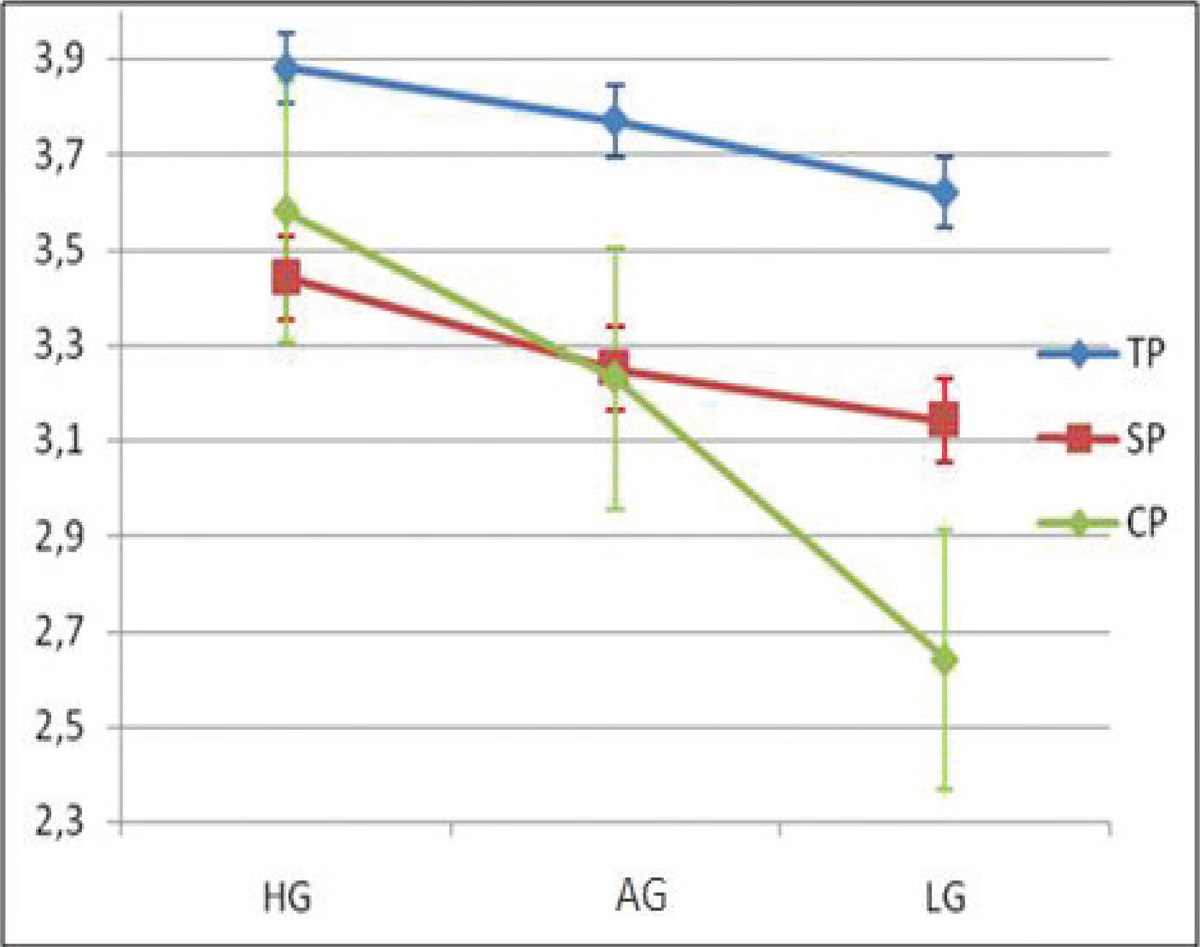
Figure 2
Mean scores of teaching, social and cognitive presences.
Figure 2 shows that HG has the highest and LG has the lowest average scores in the three presences and cognitive presence scores of LG are considerably lower than teaching presence and social presence scores.
Seeing that, three basic assumptions of ANOVA including normality, homogeneity of variances, and independence of the samples were verified; one-way ANOVA was conducted to compare teaching, social and cognitive presence scores with regard to the groups. The results were presented in Table 6.
Table 6
Comparison of presence measures between low, average and high achievement groups
| Source | Sum of Squares | df | Mean Square | F | p | |
|---|---|---|---|---|---|---|
| Teaching Presence | Between Groups | .688 | 2 | .344 | .641 | .530 |
| Within Groups | 37.597 | 70 | .537 | |||
| Total | 38.285 | 72 | ||||
| Social Presence | Between Groups | 1.015 | 2 | .507 | 1.292 | .281 |
| Within Groups | 27.486 | 70 | .393 | |||
| Total | 28.501 | 72 | ||||
| Cognitive Presence | Between Groups | 9.481 | 2 | 4.741 | 23.733 | .000 |
| Within Groups | 13.982 | 70 | .200 | |||
| Total | 23.463 | 72 |
The results indicate that there were no statistically significant differences between groups (HG, AG, LG) in teaching presence scores having values of (F(2,70) = .641, p = .530). Similarly, there were no statistically significant differences among the mean values in social presence scores of the groups (F(2,70) = 1.292, p = .281). However, in terms of cognitive presence, a significant difference existed among the scores of HG, AG, LG (F(2,70) = 23.733, p =.000), at the p<.05 level.
Cognitive presence and academic achievements
Since the significant difference existed only between cognitive presence scores of the groups LG, AG and HG (see Table 6), the analysis of relationships between perceived presence scores and academic achievements was directed on perceived cognitive presences. Thus, students’ discussions were analysed in order to explain their cognitive presence measures which emerged in web conferencing. Some example statements from these discussions were presented in Appendix 1. Students’ text and narrations as discussion messages were analysed through CPCT with inter-rater reliability of two raters having Cohen’s Kappa 0.87 after discussion to resolve discrepancies. The mean scores for message analysis were interpreted for HG, AG and LG and shown in Table 7.
Table 7
Cognitive presence scores from messages analysed through CPCT
| Groups | N | Mean | SD |
|---|---|---|---|
| HG | 12 | .7307 | .12759 |
| AG | 12 | .6682 | .11920 |
| LG | 12 | .5922 | .09729 |
| Total | 36 | .6637 | .12592 |
The mean cognitive presence scores gathered from discussions were (HG= .7307, AG=.6682 and LG=.5922). The results show that the mean values of AG are saliently higher than those of LG.
Discussion
Garrison (2000) emphasized that there should be an interaction between the cognitive, social and teaching presences. In this sense, some research studies reported significant relationships among cognitive, social and teaching presences (Shea & Bidjerano, 2012; Kozan & Richardson, 2014). In this study, focusing on presences, the relationships between cognitive presence and academic achievements were discussed in web conferencing. The results indicated that the scores gathered from the questionnaire about cognitive, social and teaching presence scores were close to each other. While there was no statistically significant difference between the groups (HG, AG, LG) in teaching presence scores and in social presence scores; students with higher final grades having perceived cognitive presence scores were statistically significantly higher than the students having average and lower final grades. Accordingly, the results were discussed by focusing on the relationships among the presences first, and then the relationships between the cognitive presence and the academic achievement scores.
Relationships among the presences in web conferencing
Cognitive presence refers to processes of planning, monitoring and adapting strategies for knowledge construction. In this study, instructor asked students to solve problems and promoted them to discuss about the problems to write optimal programming codes. In accord to the study of Gašević, Adesope, Joksimović & Kovanović (2015) reported that, the instructor’s feedback came front in the activities that played a positive role in terms of the relationship between teaching presence and cognitive presence. Similarly in this study, students’ responses indicate that the instructor could organize the course to encourage learners’ collaborative study. He also reinforced the development of a sense of both cognitive and social presences by keeping students engaged in productive dialogues. Regarding teaching presence, it was seen that the instructors’ role in the process facilitated learners’ knowledge construction. In this sense; learners’ perspectives indicated that they could understand the problems, use their previous knowledge, and get support from peers in practice sessions. This is consistent with the suggestion of Shea and Bidjerano (2012) that the instructor should provide opportunities to support and sustain critical discussions for quality online learning. In addition, the organizational role of the instructor has also become prominent in the students’ cognitive presences. Because, the students’ perspectives in the discussion messages indicate that, the learning environment via web conferencing was organised as they were able to share their ideas about problems, compare their programming code pieces, and criticize their own codes or peers’ codes. Similar to this finding, Kumar, Dawson, Black, Cavanaugh and Sessums (2011) pointed out that quality teaching presence requires instructors who not only should have excellent online pedagogical skills but also should have organizational skills, and experience with online courses.
Survey data also provided hints about social presence that web conferencing relatively fostered socialization. Students’ feelings were generally positive about conversing with each other through web conferencing. The items about social presence were generally assessed as higher than motivational factors. It was may be due to the off-task communication that has facilitated sense of community. The enhanced affordability of synchronous interaction between the instructor and students communication was provided with both in text and video format via webcams. Even this kind of interactions were taken place for a short time, it provided a social atmosphere to project themselves as real people into the community, and it supported the students to easily present their idea in a trustworthy way. That is to say, students interacted with peers or instructor as real people via asking, sharing and discussing actions synchronously.
In sum, the affordances of the web conferencing system played a facilitator role in developing students’ cognitive presences. Students’ responses reflected that using chat area for text messaging and audio options for talking provided both verbal cues and senses of belonging in the lesson. Although, students do not have much time to use the tools of web conferencing system in a limited lesson time, the tools acted as scaffolding elements for constructing knowledge. Because it brings extra effort, they should work on constructing programming knowledge and also deal with peers or the instructors’ discussions. Accordingly, the students generally concentrated on the task related issues and they could not consider other postings in the chat or discussion postings. The findings of the current study is in accord with the findings of Gutiérrez-Santiuste et al. (2015) suggesting that the communication tools used within web conferencing system positively influenced to the perceived cognitive presences. On the other hand, Akyol and Garrison (2011) addressed that the duration of the course sometimes cannot be sufficient for students to discuss on projects or exchange knowledge. In contrast, in this study, despite the limited time of web conferencing course periods, most of the students perceived the course activities helpful.
Relationships between cognitive presence and academic achievements in web conferencing
In this study, cognitive presence scores were found moderately correlated with final exam scores. The results indicated that, the students who had higher academic achievements also had high cognitive presence scores. This finding is important because the measurement of students’ learning is based on the objective measures of achievement, not to the perceived learning of the educational experience. Considering the quality of knowledge exchanging as an indicator of cognitive presence; the current study is in agreement with the idea that students with high cognitive presences are more active in exchanging knowledge in learning communities (Garrison, Anderson, and Archer; 2001). Similarly, Öztürk (2015) found that the academic achievements are in relation with the quality of discussions in online learning. Surprisingly, the results gathered from the resolution phase of the questionnaire were relatively lower than those of other phases. One reason for this result may be that the items in this phase were generally related to the transmission of the constructed knowledge to the practice.
In this study, alongside the quantitative data, the analyses of messages were also used to discuss the correlations of the cognitive presences and academic achievements. The analysis of messages showed that the students with high academic achievement provided more quality messages. The students’ perceptions were positive that online discussions in synchronous course were useful to understand fundamental concepts and develop new perspectives. This result is in agreement with results of the findings reported by other researchers who documented that online discussions are necessarily effective in supporting critical, creative, and complex thinking skills (Kanuka & Garrison, 2004). In this sense, it may be thought that quality messages about the programming codes, structures or concepts contributed to create a collaborative climate and positively influenced the cognitive presences. This is confirmed with the findings that the contribution of quality messages to the academic achievements was higher in high academic achievement students.
Some limitations of this research study were, however, that this study utilized a group of students’ perceptions and test scores to assess the relationships between presences and academic achievements. The data is gathered from a group of undergraduate students who took an online course in a programming language course. The sample size was not large and the instructional unit was specific. So, a larger sample size would increase the sensitivity of the analysis, and different topics of other courses may offer different results. Despite all, the results about the presences through the discussions with regard to the nature of web conferencing provide some hints for evaluating the students’ presences in the synchronous system.
Conclusion and Future Implications
In this study, the perceived teaching, social and cognitive presences were found satisfactory or highly satisfactory. We can say that; students’ perspectives indicate that the interactions and communications in the learning activities within web conferencing can provide a sense of community of inquiry. The study revealed that students with a strong sense of cognitive presence have a high level of academic achievement. It was also noted that the role of the instructor plays a crucial role in organising the synchronous setting that triggers both social and cognitive presence. In line with this; precautions should be taken in terms of providing instructors having enough technological and pedagogical knowledge for delivering synchronous online courses via web conferencing. Since the results may not be generalizable, future research can also be repeated by increasing the sample size and with different communication media of synchronous systems.
Consequently, the developments in web conferencing suggest to interest in how to expand the CoI framework for synchronous communication. Practically, instructors should pay attention to their roles in the synchronous courses. Furthermore, in order to provide quality cognitive presences, instructional designers should be aware of the affordances of synchronous settings in which the social and cognitive cues are somewhat transformed.
Appendices
Appendix 1. Sample Pieces from the Messages
T. “ Try to use controls for storing odd numbers?”
Sc. “I used one control but cannot hold all of them, something is missing.”
Sd. “Use it after before output when the loop is finished?”
T. “So, you can share that part of your program, is yours working?
Sa: “How did you use a function of approximation in your code?”
Sb: “I got the input then in a loop I used the function. When I calculated the results, I sent them to the main function.”
T: “Who could not use the arrays in the code?”
Sf . “Was it necessary, I did not use it but the program is running?”
Sg. “Of course, the problem begins with: “Use arrays in the code””