
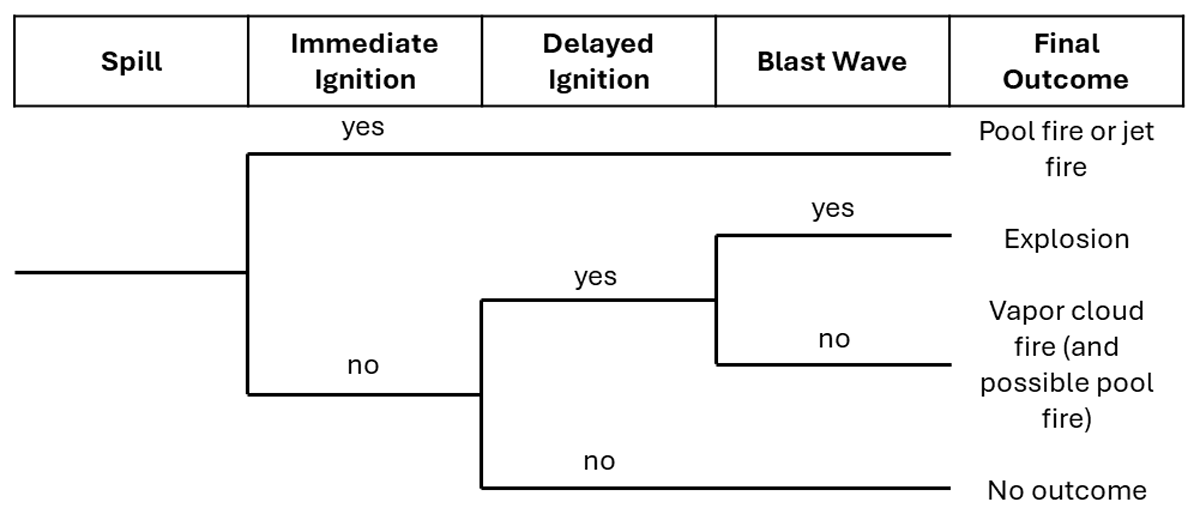
Figure 1
Example flammable material leak event tree. Adapted from Ronza, Vilchez and Casal (2007).
Table 1
The 13 possible hydrogen ignition sources and descriptions. Reproduced from BSI (2019) and Health & Safety Laboratory (2012).
| IGNITION SOURCE | DESCRIPTION |
|---|---|
| Hot surfaces | These can ignite hydrogen if they reach a temperature above the autoignition temperature of the gas. |
| Flames and hot gases (including hot particles) | Flames can ignite hydrogen directly, while hot gases and particles can be an ignition source if they are of sufficient temperature to heat hydrogen above its ignition point. |
| Mechanically generated sparks | Sparks generated through mechanical means, such as grinding or impact between metals, can ignite hydrogen. |
| Electrical apparatus | Electrical equipment can generate sparks or heat, which may ignite hydrogen under certain conditions. |
| Stray electric currents, cathodic corrosion protection | Unintended electric currents and those used for corrosion protection can, under certain conditions, lead to hydrogen ignition. |
| Static electricity | The build-up and discharge of static electricity can provide an ignition source for hydrogen. |
| Lightning | A direct lightning strike or related electrical discharge can ignite hydrogen. |
| Radio frequency (RF) electromagnetic waves | RF waves, typically from 104 Hz to 3 × 10¹¹ Hz, have been documented to cause ignition in certain conditions. |
| Electromagnetic waves | Broad range of electromagnetic waves, from 3 × 10¹¹ Hz to 3 × 10¹⁵ Hz, may potentially ignite hydrogen under specific circumstances. |
| Ionizing radiation | This type of radiation can ionize hydrogen molecules and potentially lead to ignition, especially in the presence of oxygen. |
| Ultrasonics | Ultrasonic waves can create heat or mechanical vibrations that might ignite hydrogen in specific setups. |
| Adiabatic compression and shock waves | Rapid compression of hydrogen can increase temperature and lead to ignition, as can shock waves under certain conditions, also known as ‘diffusion ignition’. |
| Exothermic reactions, including self-ignition of dusts | Chemical reactions that release heat can ignite hydrogen. This includes the self-ignition of dusts in the presence of hydrogen. |
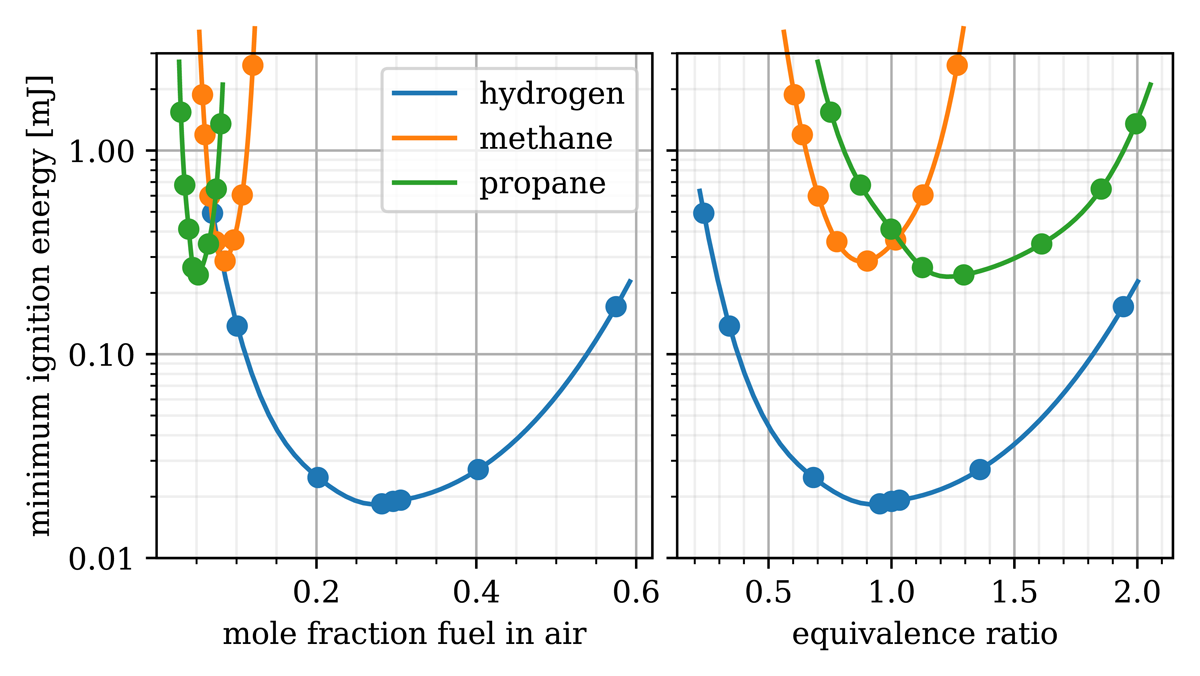
Figure 2
Minimum ignition energy of hydrogen as a function of concentration. Data from Lewis and von Elbe (1987).
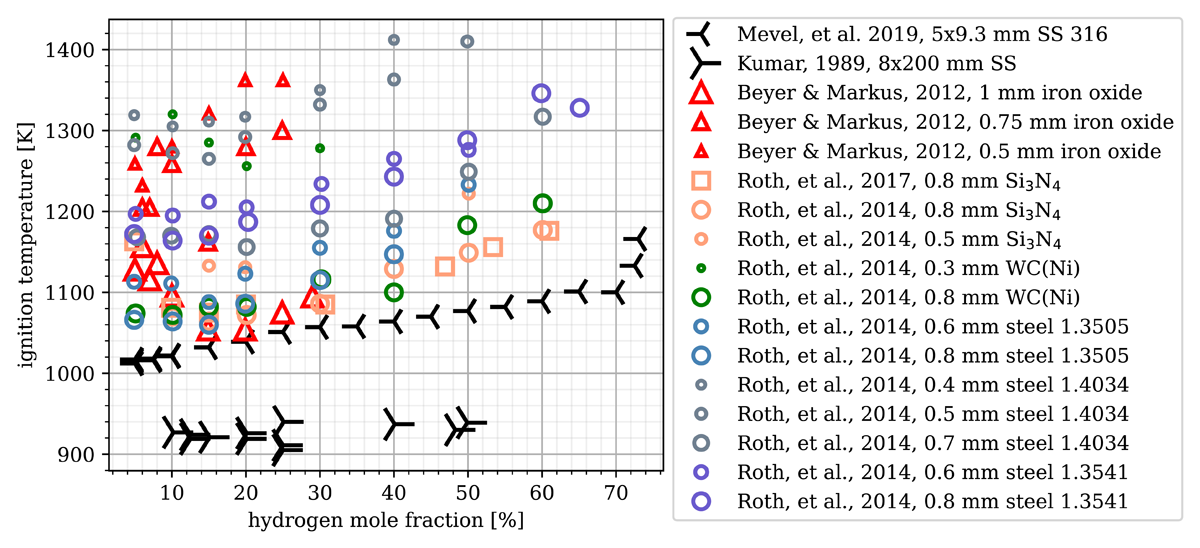
Figure 3
Hot surface ignition temperature as a function of mole fraction. Reproduced with data from Mével et al. (2019).
Table 2
Comparison of immediate ignition probability models and the parameters considered in each model (Mulcahy and Ehrhart, 2025).
| MODEL DESCRIPTION | TEMPERATURE (T) | AIT | PRESSURE | MIE | MIEadj (T) | ER | FLOW RATE | REFERENCE |
|---|---|---|---|---|---|---|---|---|
| Baseline | X | X | X | X | (Moosemiller, 2011) | |||
| Baseline and Temp Adj | X | X | X | X | X | (Center for Chemical Process Safety, 2014) | ||
| Baseline and ER Adj | X | X | X | X | X | (Hankinson, Mathurkar and Lowesmith, 2009) | ||
| Baseline and Temp Adj and ER Adj | X | X | X | X | X | X | (Mulcahy and Ehrhart, 2025) | |
| Tchouvelev | X | (Tchouvelev et al., 2006; Tchouvelev et al., 2007; Tchouvelev, 2008) | ||||||
| Dutch QRA Guidelines | X | (Uijt de Haag and Ale, 2005) |
Table 3
Comparison of delayed ignition probability models and the parameters considered in each model (Mulcahy and Ehrhart, 2025)
| MODEL | IGN. SOURCE STRENGTH | PROB. IGN. SOURCE PRESENT | AREA | TIME | SURFACE TEMP | MULTIPLE IGNITION SOURCES | FLOW RATE | REFERENCE |
|---|---|---|---|---|---|---|---|---|
| Rew et al. | X | X | X | X | X | (Rew, Spencer and Daycock, 2000) | ||
| CCPS | X | X | (Center for Chemical Process Safety, 2014) | |||||
| Simmons | X | (Simmons, 1974) | ||||||
| Pesce | X | X | X | X | X | (Pesce et al., 2012) | ||
| Tchouvelev | X | (Tchouvelev et al., 2006; Tchouvelev et al., 2007; Tchouvelev, 2008) | ||||||
| Dutch QRA Guidelines | X | X | X | X | X | (Uijt de Haag and Ale, 2005) |
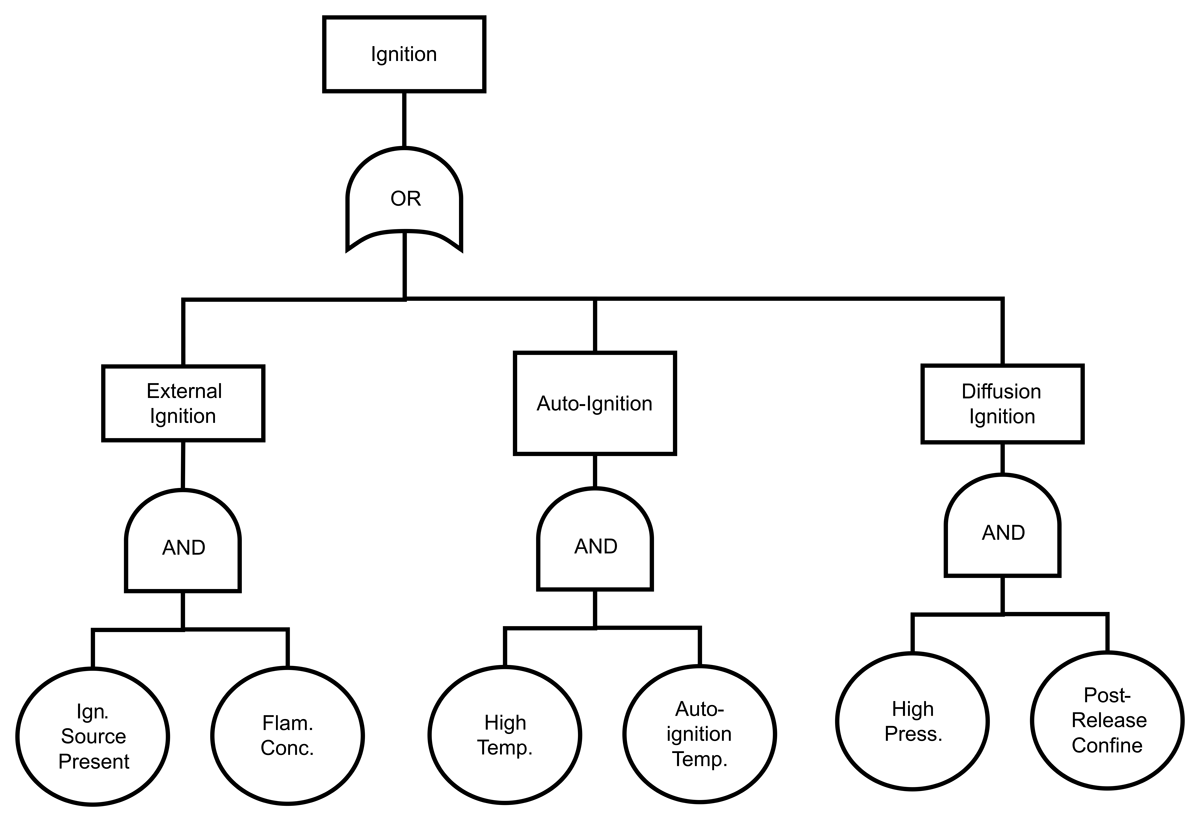
Figure 4
Example fault tree framework showing how multiple ignition mechanisms could be combined to estimate an overall ignition probability.
| Acronym/Abbreviation | Definition |
| AIT | Autoignition temperature |
| ER | Equivalence ratio |
| IA HySafe | International Association of Hydrogen Safety |
| JRC | Joint Research Centre |
| LFL | Lower flammability limit |
| MIE | Minimum ignition energy |
| RF | Radio frequency |
| SAFEN | Safe Energy Carriers |
| QRA | Quantitative risk analysis |