
Introduction
Hydrogen hazards are largely due to the flammability of the fuel. Mixtures from 4% to 75% by volume in air are flammable; they have a minimum ignition energy (MIE) of just 17 μJ, and an autoignition temperature of 585°C (Astbury and Hawksworth, 2007). The safety risks associated with systems and processes involving hazardous substances, including hydrogen, can be evaluated via quantitative risk assessment (QRA)—which is typically comprised of the following steps:
Hazard Analysis: Determine possible modes of failure and safeguards.
Consequence Analysis: Measure adverse effects from key identified hazards.
Frequency Analysis: Identify quantitative information on the frequency/probability of failures.
Risk Evaluation: Calculate risk to relevant human receptors, identify appropriate health-based benchmarks.
Risk Conclusions: Establish tolerable/acceptable individual and societal risk levels.
Several generic QRAs are available for hydrogen energy systems (e.g., (EPRI, 2025a; EPRI, 2025b; EPRI, 2025c; EPRI, 2025d; EPRI, 2024a; EPRI, 2024b; Al-Douri and Groth, 2024; Wismer et al., 2024; Yang et al., 2024)). However, several gaps/limitations limit the efficacy of current hydrogen QRAs. First, detailed information for real-world (large-scale) hydrogen systems is often proprietary and difficult to obtain. Also, component reliability information is not readily available. Finally, detailed ignition probability models do not currently exist for hydrogen; QRA is inherently limited in its usefulness in the absence of robust ignition probability data.
Hydrogen ignition probability values are key inputs at multiple stages of a given event tree associated with a hydrogen leak incident (e.g., Figure 1). Importantly, these probabilities are used to estimate the likelihood of different possible outcomes—for example, the relative likelihood of a jet fire, explosion, or no ignition. These outcomes have very different potential harms: thermal effects from a jet fire, overpressure effects from an explosion, or no direct harm if the hydrogen does not ignite. So, while estimating the overall probability of a leak is one challenge, determining the relative likelihood of these different outcomes can greatly affect any risk calculation output.
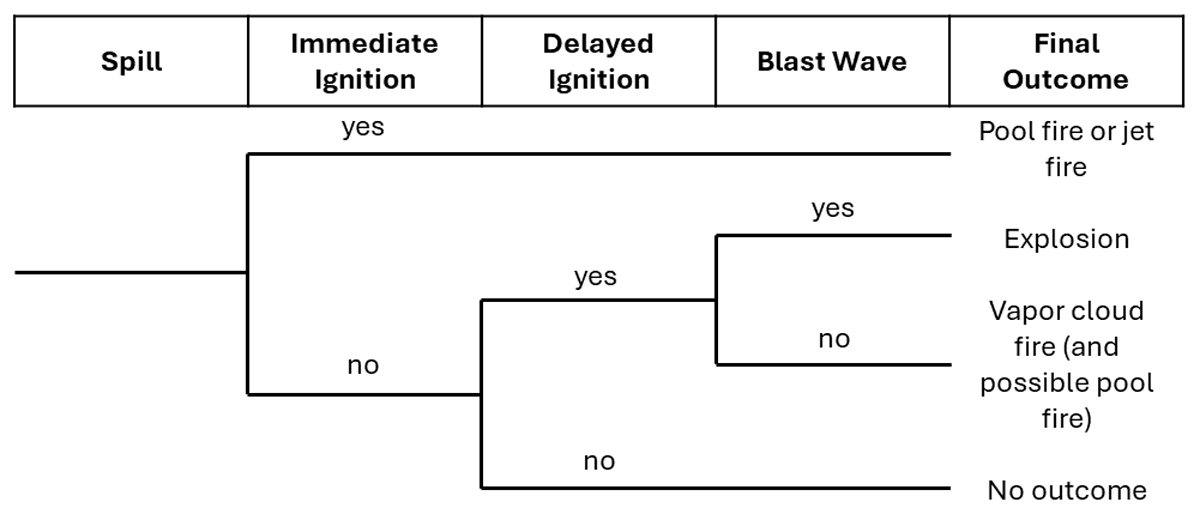
Figure 1
Example flammable material leak event tree. Adapted from Ronza, Vilchez and Casal (2007).
The phenomenon of ignition, and thus ignition probability, can be separated into immediate or delayed ignition (Changlong, Juncheng and Xiongjun, 2012; Ronza, Vilchez and Casal, 2007):
Immediate Ignition: Flammable materials are ignited immediately after leakage by autoignition or an ignition source.
May result in a jet flame (hydrogen and other flammable gases) or pool fire (liquids)
Delayed Ignition: The released flammable gas cloud is ignited by an ignition source physically distant from the release point after some time has passed since leak initiation.
May result in flash fires, sometimes accompanied by a flame front acceleration that ultimately results in an explosion
May ultimately burn back to the point of origin, resulting in a jet fire or pool fire
The temporal distinction between immediate and delayed ignition is not absolute and can vary based on the fuel properties, release scenario, and other factors. For example, a given delay time might lead to immediate ignition for a natural gas, while the same short delay may allow for partial mixing and result in delayed-ignition consequences for a similar hydrogen leak. An ignited hydrogen release may also have a higher propensity to transition from deflagration to detonation for a given delay compared to a hydrocarbon release, potentially leading to severe overpressure events. Some in the literature (Ronza, Vilchez and Casal, 2007) make the distinction between immediate and delayed ignition events as spatial, rather than temporal; that is, how far away from the release point the released fuel reaches before igniting, rather than a set timeframe.
There are many factors which may influence ignition probability, including the flow rate of a release, the properties of the fluid being released, and environmental/nearby conditions of the release (Changlong, Juncheng and Xiongjun, 2012; Ronza, Vilchez and Casal, 2007). Some generalized models of ignition probability have attempted to capture some or all of these parameters. However, the specific properties and behavior of hydrogen result in some different ignition behavior compared to other fuels; therefore, consideration of the likelihood of the specific ignition mechanisms for hydrogen is useful to consider these physical differences in a safety assessment.
Here, we present a comprehensive landscape review of the probability of hydrogen ignition. This includes a review of hydrogen ignition mechanisms, existing probabilistic models, and a suggestion of how these (or newly developed) models could be combined to estimate an overall probability of hydrogen ignition. This review focuses on the probability of the ignition of hydrogen releases; therefore, it does not include detailed reviews of the consequences of ignition (i.e., events and impacts occurring after ignition), the probability of failure/leak of hydrogen (e.g., leak frequencies), or the ignition of substances other than hydrogen. While all of these factors are important for safety assessments, they are outside the scope of the current review.
Mechanisms
For a flammable gas (e.g., hydrogen), the right mixture of fuel and oxidizer, along with some source of energy, can cause the initiation of the chemical chain reaction known as ignition. In an International Association for Hydrogen Safety (IA HySafe) and Joint Research Centre (JRC) workshop, possible hydrogen ignition sources were grouped into 13 distinct categories (BSI, 2019; Health & Safety Laboratory, 2012), listed in Table 1. In theory, these sources could ignite any flammable fuel, but stoichiometric hydrogen has a very low ignition energy, so the probability of some of these mechanisms may be non-negligible for hydrogen (whereas they may be negligible for other gaseous fuels). Even in the absence of an obvious ignition source (e.g., open flames, sparking equipment), whether a feature of the hydrogen system or surroundings could manifest as an ignition source is a probabilistic issue amenable to study via QRA methodologies. For instance, some of the entries in Table 1 (e.g., electrical discharge, compression, and shock waves) are not always obvious sources that could have some chance of igniting a hydrogen system—despite precautions taken—and it would be valuable to provide some methodology to estimate these probabilities.
Table 1
The 13 possible hydrogen ignition sources and descriptions. Reproduced from BSI (2019) and Health & Safety Laboratory (2012).
| IGNITION SOURCE | DESCRIPTION |
|---|---|
| Hot surfaces | These can ignite hydrogen if they reach a temperature above the autoignition temperature of the gas. |
| Flames and hot gases (including hot particles) | Flames can ignite hydrogen directly, while hot gases and particles can be an ignition source if they are of sufficient temperature to heat hydrogen above its ignition point. |
| Mechanically generated sparks | Sparks generated through mechanical means, such as grinding or impact between metals, can ignite hydrogen. |
| Electrical apparatus | Electrical equipment can generate sparks or heat, which may ignite hydrogen under certain conditions. |
| Stray electric currents, cathodic corrosion protection | Unintended electric currents and those used for corrosion protection can, under certain conditions, lead to hydrogen ignition. |
| Static electricity | The build-up and discharge of static electricity can provide an ignition source for hydrogen. |
| Lightning | A direct lightning strike or related electrical discharge can ignite hydrogen. |
| Radio frequency (RF) electromagnetic waves | RF waves, typically from 104 Hz to 3 × 10¹¹ Hz, have been documented to cause ignition in certain conditions. |
| Electromagnetic waves | Broad range of electromagnetic waves, from 3 × 10¹¹ Hz to 3 × 10¹⁵ Hz, may potentially ignite hydrogen under specific circumstances. |
| Ionizing radiation | This type of radiation can ionize hydrogen molecules and potentially lead to ignition, especially in the presence of oxygen. |
| Ultrasonics | Ultrasonic waves can create heat or mechanical vibrations that might ignite hydrogen in specific setups. |
| Adiabatic compression and shock waves | Rapid compression of hydrogen can increase temperature and lead to ignition, as can shock waves under certain conditions, also known as ‘diffusion ignition’. |
| Exothermic reactions, including self-ignition of dusts | Chemical reactions that release heat can ignite hydrogen. This includes the self-ignition of dusts in the presence of hydrogen. |
Experiments on the ignition of hydrogen can be used to elucidate the mechanisms behind their functionality and define the dependent parameters needed for probabilistic models. For example, some ignition mechanisms are highly sensitive to the stoichiometry, flow rate, or pressure of the mixture while others are not. As noted in Table 1, there are many potential ignition sources, of which some mechanisms are well-studied, and some less so. Idealized experiments can give insight into the fundamental physics behind the different ignition mechanisms, while other experiments can mimic more practical scenarios of concern for safety. Wen, Hecht and Mevel (2025) provide a comprehensive review of combustion, including experiments on the ignition of hydrogen. Here, we present some considerations around hydrogen ignition that are important for probabilistic modeling coupled with QRA.
Stoichiometry of the mixture
Hydrogen in air has a wide flammability range from 4% to 75% by volume. Experiments to determine flammability limits use quiescent mixtures in closed containers and often involve observing flame propagation. As has been noted by Cheikhravat et al. (2012) and Vogelzang, Huijzer and Delnooz (2024), among others, very near the lower flammability limit (LFL), the flame propagation of hydrogen-air mixtures varies from only upward and sideways propagation close to the LFL (approximately 4–9%) to propagation in all directions at volume fractions above 8–9%. In other words, even if ignition occurs, consequences may be inherently mitigated in some cases due to inhibited flame propagation where the hydrogen concentration falls between the commonly-cited LFL of 4% and the more practical threshold of 8–10%.
Even in these idealized experiments, there is some uncertainty in exactly where these limits are. In most incidents, there are additional gradients and flows of fuel and air, resulting in even more uncertainty in whether a given mixture will fully ignite. For example, the average mole fraction of a jet release must be well above the LFL along the centerline, typically above 10%, to ignite a turbulent jet into a jet flame due to all of the turbulent fluctuations and concentration gradients in a jet release (Schefer et al., 2011) (Panda and Hecht, 2017).
From an ignition and risk modeling perspective, if not all the hydrogen is consumed upon ignition, a less hazardous event could result than if all of the fuel is burned upon ignition. Thus, an ignition model may need to consider not only the probability of ignition but also the stoichiometry of the mixture to determine which of the event branches to follow in Figure 1. Indeed, some ignition models include the equivalence ratio (ER) in their formulation, as discussed in the Models section. Alternatively, the ignition probability can be based on the probability of both the presence of an ignition source and the appropriate stoichiometry leading to the event of interest.
Ignition source characteristics
The characteristics of an ignition source, such as the strength or temperature, can affect ignition and combustion. The strength of an ignition source can drastically affect both whether a mixture will ignite as well as the consequences of an ignited incident, particularly the overpressure hazards. Although the autoignition temperature for hydrogen is known, experiments show significant variability in the practical ability of hot surfaces and particles to ignite hydrogen mixtures.
The MIE of hydrogen is known to be lower than most other fuels. The MIE is shown in Figure 2 as a function of the concentration of fuel in air. The MIE for hydrogen is below that of methane and propane, with a minimum of approximately 17 µJ for a mixture of around the stoichiometric mole fraction of 30% hydrogen in air. Noting that the figure has a logarithmic scale on the vertical axis, the MIE increases significantly away from the stoichiometric mixture, increasing by nearly two orders of magnitude for a mole fraction near the LFL. This means that for a given ignition source with a fixed energy, different mixtures of hydrogen and air may or may not ignite.
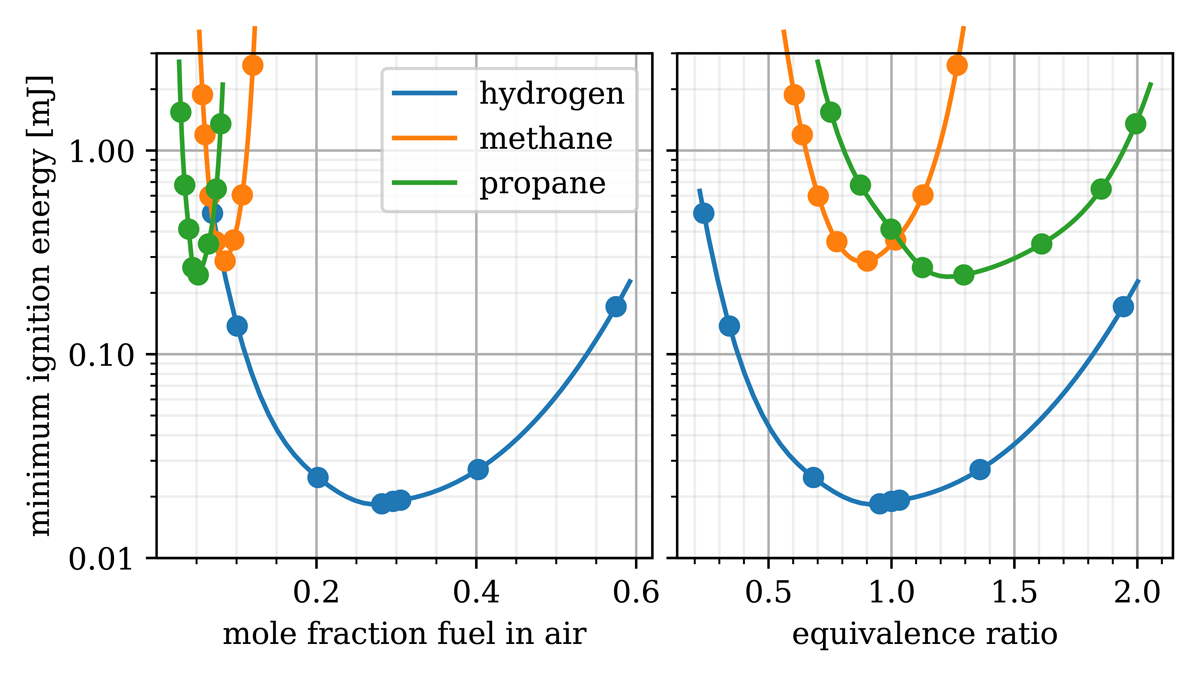
Figure 2
Minimum ignition energy of hydrogen as a function of concentration. Data from Lewis and von Elbe (1987).
The ignition energy of a particular mixture can affect the probability of ignition because it may be more likely for a flammable concentration to encounter a weak ignition source. Even in areas in which ignition sources are controlled/restricted, weak ignition sources can arise from friction, static electricity, or other sources (Beeson and Witte, 2023; Wen et al., 2022). Thus, the ignition energy for hydrogen may be an important consideration for determining the probability of encountering an ignition source that could ignite a given mixture.
The ignition strength can also affect the probability and outcome of a hydrogen combustion event. It is important to distinguish between the energy variations in common spark sources (millijoules) versus high-energy sources (joules or kilojoules). While small variations in spark energy may not drastically alter the deflagration regime, larger increases in ignition energy can fundamentally change the combustion mode. Groethe et al. (2007) demonstrate that a 40 J capacitive discharge resulted in subsonic flame propagation (i.e., a deflagration) and maximum overpressure values of approximately 18 kPa, while a 5.2 × 10⁴ J high-explosive charge igniting the same 30% mixture of hydrogen in air caused the flame to move at supersonic speed (i.e., a detonation) with a maximum overpressure about five times greater, at approximately 90 kPa. Several of the delayed ignition models discussed in the Models section explicitly consider ignition strength due to this effect. Other works exploring the effects of ignition/initiation strength (and other factors including mixture composition, system geometry/size, wall properties, etc.) on fuel combustion outcomes include those of Sanchez (2023) and Lee (1984). However, it remains unclear, due to the stochastic nature of ignition, exactly what minimum energy is required for the initiation of detonation, and pinpointing this exact value is beyond the scope of the present review.
The reported autoignition temperature of hydrogen has some variability but is approximately 550°C. Of more practical interest is hot surface and hot particle ignition of gas flows. Figure 3 shows hot surface ignition data from several literature sources compiled by Mével et al. (2019). There is significant variability in the hot surface temperatures required to ignite the flows, ranging from just above the typically reported autoignition temperature—around 650°C—all the way up to approximately 1100°C. Inspection of each specific particle size and composition does generally show a trend of increasing hot surface temperature as the mole fraction of hydrogen in air increases. The ignition temperature also generally increases as the particle size decreases. Interestingly, Proust and Daubech (2019) show an insensitivity of the temperature for hot surface ignition on the composition, flow speed, or initial temperature of a hydrogen flow. Roth et al. (2014) studied the ability of particles to ignite mixtures of hydrogen. Like the hot surface ignition experiments, a slight increase in temperature was required for richer hydrogen mixtures. Smaller particles, which carry less energy, also required higher temperatures to ignite the mixtures.
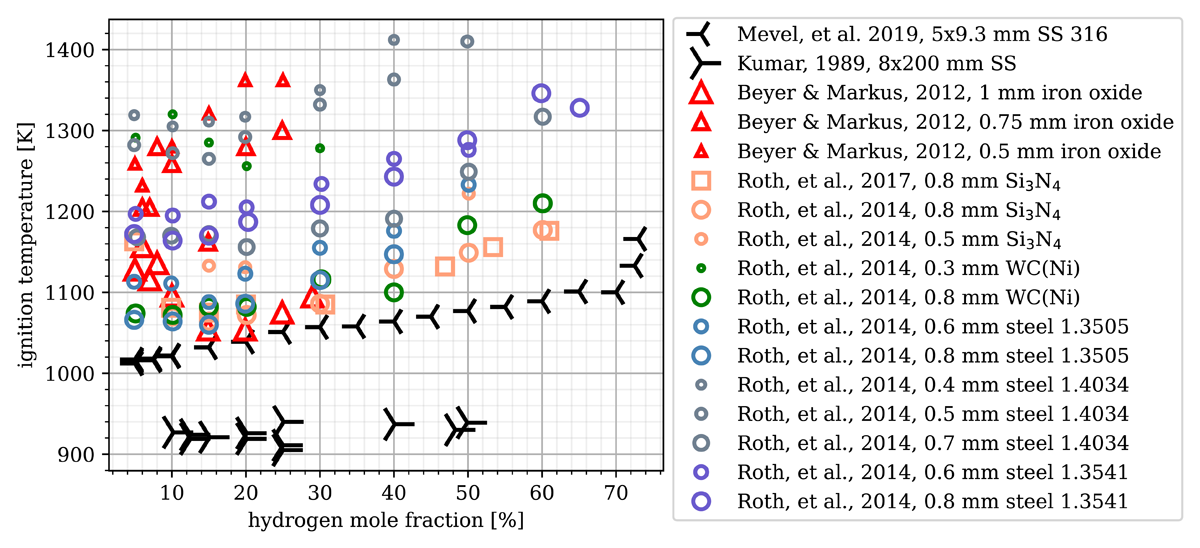
Figure 3
Hot surface ignition temperature as a function of mole fraction. Reproduced with data from Mével et al. (2019).
Ignition probability models may need to consider the characteristics of ignition sources to determine whether a given configuration will ignite as well as the consequences of the combustion upon ignition.
Unexplained and self-ignition
Hydrogen has been known to ignite without an obvious ignition source, which led to a review of postulated ignition mechanisms by Astbury and Hawksworth (2007), in which the authors describe several possible mechanisms that could lead to ignition. Mechanisms include Joule-Thomson heating, electrostatic discharge, sudden adiabatic compression, hot surface ignition, and diffusion ignition, where shock-waves compressively heat the mixture. They concluded that none of these mechanisms on their own could be responsible for the seemingly spontaneous ignition events reported in the literature, but that some combination of these mechanisms could lead to the ignition of hydrogen without an obvious source. Of the mechanisms mentioned by the authors, the phenomenon of diffusion ignition has been most comprehensively studied and can on its own lead to the self-ignition of hydrogen under the right circumstances.
Diffusion ignition alone can cause a hydrogen release to ignite into a jet flame but requires a sudden release of hydrogen (such as that through a burst disk) along with a specific downstream geometry. Downstream, the geometry needs to:
Cause shock reflections and interactions, increasing the volume of the mixture that is heated and eventually ignites
Keep the shock-heated mixture around for at least the ignition delay time
Have a large enough volume that the flame kernel that forms can ignite the released hydrogen into a diffusion flame (often along the periphery of the tubing)
It has also been shown that higher pressures and shorter diaphragm rupture times increase the propensity for diffusion ignition.
As noted by Astbury and Hawksworth (2007), diffusion ignition alone cannot be responsible for all the ignitions of hydrogen that have been reported in the literature without an obvious ignition source. While there must be an ignition source that is setting off the chemical chain reaction leading to combustion, in many cases, the source remains elusive. Investigations into self-induced electrical discharges from entrained dust (or ice, in the case of cryogenic hydrogen) have shown that while it is possible to ignite with a large amount of dust, the quantity of particles needed are unlikely to be present for most scenarios (Merilo et al., 2012), or that ignition was not observed and that sufficient charge build-up is unlikely (Hall et al., 2021).
It is acknowledged that unexplained ignition sources are not unique to hydrogen; hydrocarbon incidents also frequently involve inconclusive ignition sources (Acton, Acton and Robinson, 2016). However, the specific physics of hydrogen, particularly its exceptionally low MIE compared to methane or propane, suggests that mechanisms which are negligible for hydrocarbons may be critical drivers for hydrogen ignition. Ignition probability modeling of hydrogen releases may need to consider the non-negligible probability that a release will ignite without a well-defined ignition mechanism.
Models
A very large body of work exists exploring the phenomenon of flammable substance ignition. However, this section focuses on published ignition probability models that have been deemed to be particularly noteworthy by the authors of this article. An effort was made to cover the breadth of existing models, not necessarily every existing variation.
As discussed above, ignition probability models can be categorized as describing the probability of either delayed or immediate ignition. Some models are not explicitly described using these terms but can often be categorized based on how the model accounts for time and/or accumulation. Some models also exist that propose ignition probabilities without distinguishing between delayed and immediate ignition (e.g., Ronza, Vilchez and Casal, 2007). However, these models may be less useful for risk assessment because the potential consequences associated with delayed and immediate ignition differ. This section focuses on models that distinguish between delayed and immediate ignition.
Immediate ignition
There are currently two types of immediate ignition probability models. The first type of model (Moosemiller, 2011) considers autoignition as a function of temperature, and the autoignition temperature (AIT) of hydrogen and ignition, due to static discharge, as a function of pressure of the MIE. There are then alternative models which modify this baseline model. The proposed alternative models adjust the MIE input to the static discharge portion of the immediate ignition probability model to account for temperature (Center for Chemical Process Safety, 2014), the ER (Hankinson, Mathurkar and Lowesmith, 2009), or both the temperature and the ER (Mulcahy and Ehrhart, 2025).
The second type of immediate ignition probability model considers only the mass flow rate and provides a different immediate ignition probability for ranges of mass flow rates. This type of model is used in the HyRAM+ software. The HyRAM+ values were originally reported in materials by Tchouvelev et al. (Tchouvelev et al., 2006; Tchouvelev et al., 2007; Tchouvelev, 2008). These values were modified using expert judgment from immediate ignition probability values that existed for methane and propane to account for differences in molecular weight and the increased flammable range for hydrogen. The Dutch QRA Guidelines (the ‘Purple Book’) (Uijt de Haag and Ale, 2005) do not explicitly address hydrogen. However, the guidelines provide direct ignition frequencies based on flow rates depending on a category of the reactivity level for the flammable substance; based on their definitions, hydrogen would be in their high reactivity category.
Table 2 summarizes parameters considered by different immediate ignition probability models. Models that consider the same parameters, such as the Tchouvelev and Dutch QRA Guidelines, do not assign the same immediate ignition probabilities.
Table 2
Comparison of immediate ignition probability models and the parameters considered in each model (Mulcahy and Ehrhart, 2025).
| MODEL DESCRIPTION | TEMPERATURE (T) | AIT | PRESSURE | MIE | MIEadj (T) | ER | FLOW RATE | REFERENCE |
|---|---|---|---|---|---|---|---|---|
| Baseline | X | X | X | X | (Moosemiller, 2011) | |||
| Baseline and Temp Adj | X | X | X | X | X | (Center for Chemical Process Safety, 2014) | ||
| Baseline and ER Adj | X | X | X | X | X | (Hankinson, Mathurkar and Lowesmith, 2009) | ||
| Baseline and Temp Adj and ER Adj | X | X | X | X | X | X | (Mulcahy and Ehrhart, 2025) | |
| Tchouvelev | X | (Tchouvelev et al., 2006; Tchouvelev et al., 2007; Tchouvelev, 2008) | ||||||
| Dutch QRA Guidelines | X | (Uijt de Haag and Ale, 2005) |
Delayed ignition
There are more unique models for delayed hydrogen ignition than for immediate hydrogen ignition; however, these models are also more varied. For comparison, we present two of these models. The first model (Simmons, 1974) considers only the cloud area and is not specific to hydrogen.
In this equation, A is the cloud area in meters squared and erf denotes the error function.
At the opposite end of complexity, there is the Rew et al. model (Rew, Spencer and Daycock, 2000), in which the probability of delayed ignition is modeled as:
Where ρ is the probability of ignition from a source given that it is active, a is the proportion of time the source is active, μ is the density of ignition sources per square meter, A is the cloud area in meters squared, λ is the rate of activation of the ignition source, and t is the time in minutes for which the probability of delayed ignition is being calculated.
Table 3 summarizes some of the prominent parameters in multiple delayed ignition probability models. As with the immediate ignition case, there is an ignition probability model from Tchouvelev that assigns ignition probabilities as a discrete function of flow rate.
Table 3
Comparison of delayed ignition probability models and the parameters considered in each model (Mulcahy and Ehrhart, 2025)
| MODEL | IGN. SOURCE STRENGTH | PROB. IGN. SOURCE PRESENT | AREA | TIME | SURFACE TEMP | MULTIPLE IGNITION SOURCES | FLOW RATE | REFERENCE |
|---|---|---|---|---|---|---|---|---|
| Rew et al. | X | X | X | X | X | (Rew, Spencer and Daycock, 2000) | ||
| CCPS | X | X | (Center for Chemical Process Safety, 2014) | |||||
| Simmons | X | (Simmons, 1974) | ||||||
| Pesce | X | X | X | X | X | (Pesce et al., 2012) | ||
| Tchouvelev | X | (Tchouvelev et al., 2006; Tchouvelev et al., 2007; Tchouvelev, 2008) | ||||||
| Dutch QRA Guidelines | X | X | X | X | X | (Uijt de Haag and Ale, 2005) |
Model discussion and outlook
The mechanisms explicitly included in the immediate ignition probability models are autoignition and static discharge, and temperature and pressure are significant parameters for modeling these mechanisms. Adjustments to the MIE based on AIT or ER produce significantly different ignition probabilities however, so additional research is needed to justify these modifications or refine them. Flow-rate based immediate ignition probability models are simpler, discrete alternatives. However, neither of the flow-rate based models that we summarized have an experimental hydrogen-specific basis, so their validity compared to the mechanistic models is unclear.
There is significant variation among the delayed ignition probability models to the extent that different models may predict probabilities near 0 for the same conditions that result in probabilities near 1 with other models. Cloud area, strength and quantity of ignition sources, probability that an ignition source is present, time, and/or flow rate may be important factors across these models.
There are multiple opportunities for development in this space. There is an opportunity to experimentally investigate current hydrogen ignition probability values and the effects of real-world conditions on those probabilities to better refine the field of developed models. While some models may consider overall ignition, there are currently no published models that explicitly attempt to estimate the probability of ignition due to unexplained or self-ignition.
Some work has also been done using modeling and simulation to predict ignition probabilities (Meland, 2024) for comparison to existing predictions from mechanistic data-based models used in the Safe Energy Carriers (SAFEN) project (Fossan et al., 2024). The SAFEN project also seeks to include mechanisms for liquid hydrogen released into or onto water in their model development. A fault tree framework could also be explored, which would allow for quantification of uncertainties from all contributing factors.
A recent study by Allason, Halford and Johnson (2025) considered real-world unintended ignition of hydrogen releases at a research test facility. The calculated ignition probabilities had high uncertainties, but generally aligned with some of the previously published ignition probability models. However, even in this case, most of the data came from accumulated or pipeline releases, and so may be less relevant for other types of leaks. Similar data assessments are needed for different leak scenarios; in addition, a similar analysis for hydrocarbon releases would be of interest to compare this type of data to more well-established hydrocarbon ignition probabilities.
Fault tree framework
A fault tree can be a useful way to organize a logical framework to determine the probability of an event occurring (AIChE CCPS, 2008). Fault trees can be constructed with ‘AND’/‘OR’ logic and probability calculations to estimate the overall probability of the event. This framework can be applied to the problem of hydrogen ignition by building a logical combination of different ignition mechanisms; by quantifying the individual probability of individual mechanisms, the overall probability of ignition can be estimated. An example initial fault tree framework for hydrogen ignition probability is shown in Figure 4.
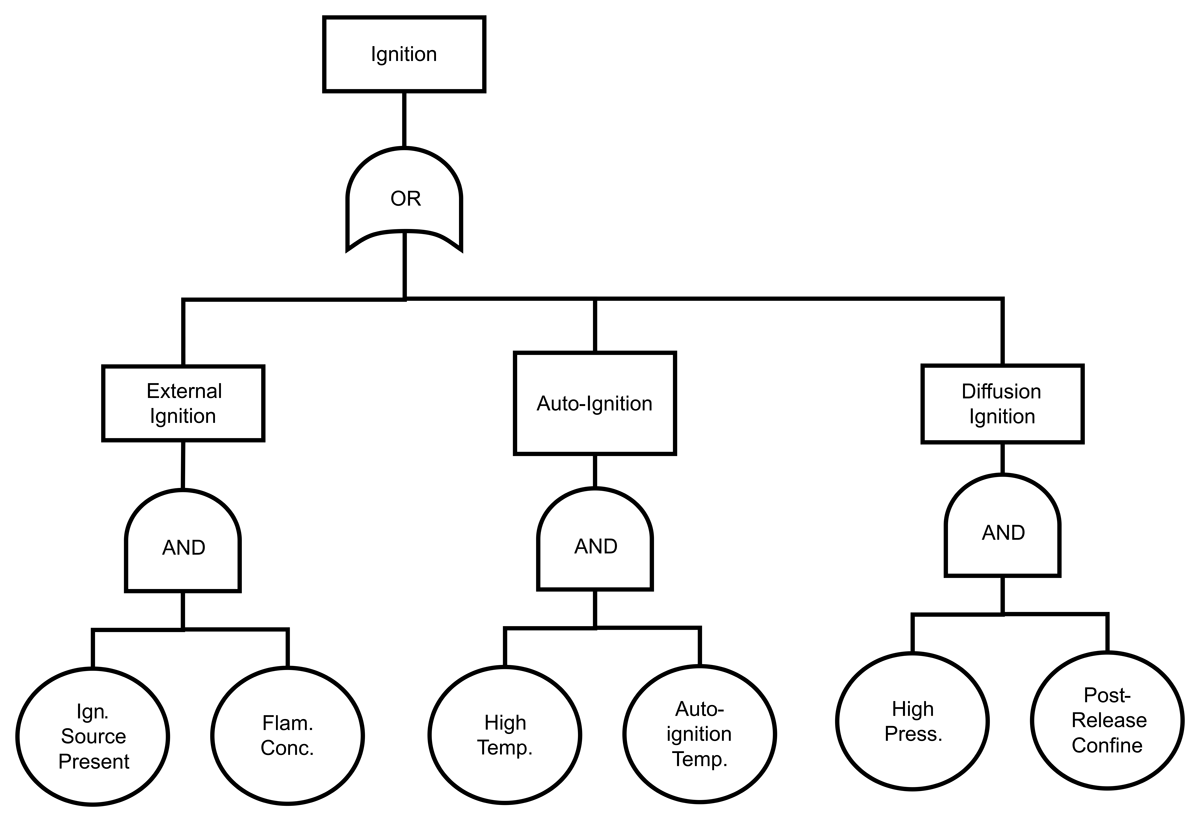
Figure 4
Example fault tree framework showing how multiple ignition mechanisms could be combined to estimate an overall ignition probability.
This simple example framework highlights several possibilities that are useful for determining the probability of hydrogen ignition. First, the framework is extensible: additional ignition mechanisms can be added or removed as appropriate or as new information is gained. Because the different ignition mechanisms are combined using the top-level OR-gate, it is straightforward to add additional mechanisms. Additionally, the framework is flexible, in that interactions between mechanisms can be directly included; if two ignition mechanisms are dependent on the same input, for example, this is easy to implement in the fault tree logic. Finally, the fault tree logic is explicit; the ‘inputs’ to each ignition mechanism and how the ignition mechanisms interact is laid out visually in the diagram and explicitly in the mathematical implementation. This makes it possible to base the ignition model on the underlying physics and easy to trace the sensitivity of a single input (or even a whole ignition mechanism) on the overall ignition probability. The explicit implementation also makes it much easier to modify and make changes in the future.
However, such a framework also comes with downsides. The framework can quickly become highly complex, with many different inputs and implementation details to keep track of. Each input value is an assumption that may or may not have a strong theoretical or empirical basis. For example, it is easy to conceptualize whether or not an ignition source is present, but coming up with a quantifiable value for this input can be difficult. Each combination of inputs (AND/OR gates) is also an assumption; the choice of how these ignition mechanisms interact can drastically affect the final calculated value of ignition probability. Finally, such a framework may end up over-weighting well-known or highly quantifiable ignition mechanisms. Well-studied ignition mechanisms may end up driving the final result due to higher uncertainty in other ignition mechanisms.
While quantifying various types of inputs to ignition probabilities can be difficult, the fault tree framework also lends itself well to uncertainty quantification. If each input to the fault tree is defined as a probability distribution rather than a single numerical value, then these probability distributions can be sampled over many different trials to determine a probability distribution of the final overall ignition probability. By propagating these uncertainties through the fault tree logic, the uncertainty of the final result can also be estimated. This extends the flexibility of the fault tree not only to different mechanisms and different inputs, but also to different levels of uncertainty. Some ignition mechanisms may be well understood and have tighter distributions, while other mechanisms can be much more variable. This can even be analysis-specific; for example, estimating the probability of an ignition source being present may be much easier to estimate within a small well-defined enclosure rather than a larger outdoor facility. Furthermore, such uncertainty quantification through sampling can also allow for identification of the main sources of uncertainty and show how reducing uncertainty in a given input could reduce the uncertainty in the overall ignition probability. Finally, by quantifying the uncertainty in the ignition probability given the current state of knowledge, this uncertainty can be directly used in a QRA, which can further propagate this (and other sources of) uncertainty through to the final risk values.
To move beyond a conceptual framework, the fault tree must be populated with probabilities derived from experimental data (e.g., (Mathurkar, 2009)), incident databases (Wen et al., 2022; Hydrogen Tools, n.d.), and/or expert elicitation (e.g., (Center for Chemical Process Safety, 2014; Tchouvelev et al., 2007)). However, incorporation of static probabilities into the fault tree runs the risk of propagating substantial error throughout the calculation due to the stochastic nature of ignition, the countless interdependent factors which influence leak and ignition probabilities as well as outcomes, and the wide variations in quality and reliability of published probability values amenable to incorporation into the fault tree. While challenging, recent work has demonstrated the possibility of using Bayesian networks to integrate sparse data into a logical framework for calculating situational ignition probabilities (Tamburini et al., 2025). Any ignition probability framework (e.g., fault tree, Bayesian network) must balance a sufficient level of complexity to provide a useful prediction to a risk assessment while not being so complex as to prevent usability and over-parameterizing the model based on limited validation data.
Conclusions
Key findings
The probability of a hydrogen release igniting depends on a number of factors, including the characteristics of the release itself and nearby environmental factors. The pressure and size of the release can affect the concentration variability of the leak, which in turn can affect the probability of a gas mixture capable of sustained flame propagation encountering a sufficiently strong ignition source. The pressure and flow characteristics of the leak can also affect the probability of the leak to self-ignite.
Ignition probability models are often differentiated between immediate and delayed ignition. This is done so that the different consequences of immediate versus delayed ignitions can be properly accounted for in the risk assessment, but also because different ignition mechanisms can affect the probability of immediate or delayed ignition.
Current immediate ignition probability models consider autoignition and static discharge, and temperature and pressure are important parameters for modeling these mechanisms. However, different models can predict different ignition probabilities for the same set of conditions. Other immediate ignition probability models consider the flow rate of the leak. However, neither of these types of models have an experimental hydrogen-specific basis, so their validation for real-world behavior is unclear.
There is significant variation among the delayed ignition probability models to the extent that different models may predict probabilities near 0 for the same conditions that result in probabilities near 1 with other models (Mulcahy and Ehrhart, 2025). For models that include them, cloud area, the strength and quantity of ignition sources, probability that an ignition source is present, time, and/or flow rate may all be important factors.
Knowledge gaps
Diffusion ignition alone cannot be responsible for all of the hydrogen ignitions that have been reported in the literature without an obvious ignition source. While there must be an ignition source leading to combustion, in many cases, the exact nature of this ignition source remains unknown.
Some ignition mechanisms have established probability models, such as the autoignition temperature or a flammable cloud encountering an ignition source. Other mechanisms, such as diffusion ignition for hydrogen mixtures, have no explicit ignition probability model. Translating the physical understanding of ignition behavior to an expression of probability can be challenging, but necessary to fully incorporate these ignition mechanisms into a QRA. Such a model should capture relevant physical characteristics of the release environment, so that the probability of different releases with different pressure or flow characteristics can be captured.
Some ignition probability models consider the possibility for a flammable cloud to encounter an ignition source. Unfortunately, these models can sometimes make simplifying assumptions that fail to fully capture the behavior of a hydrogen release, such as considering the movement of a distinct flammable cloud rather than a continuous jet-release. Conversely, other models may require highly specific and detailed fluid dynamics modeling of the geometry of a particular release scenario, making it difficult to extend those models to more generic releases. Developing or modifying simplified ignition probability models that consider hydrogen behavior in a generic way, while allowing for the possibility of more detailed modeling for a specific system design or release scenario, would be useful for a variety of QRAs.
The probability of ignition due to different ignition mechanisms would be useful for a variety of reasons. If different ignition probability models could be compared directly, insights into which of these mechanisms would drive the overall ignition probability for a specific system design or leak scenario would be useful. Different prevention or mitigation strategies may apply to different ignition mechanisms, and so by understanding which ignition mechanisms dominate the overall ignition behavior and risk outcomes, the relative usefulness of different strategies could be determined.
Currently available ignition probability models do not estimate or quantify uncertainty in probability estimates. The fact that different published probability models for both immediate and delayed ignition probability can give widely different predictions for the same scenarios highlights the uncertainty in the current state of knowledge. A more explicit treatment of uncertainty in ignition probability estimates would allow for a more nuanced understanding of ignition behavior, and for treatment of this uncertainty to be propagated through to the resulting risk values.
Next steps
Development of a common framework to estimate overall ignition probability from various ignition mechanisms would be useful in addressing many of the gaps identified above. The fault tree framework proposed here would be beneficial due to the ability to explicitly handle different ignition mechanisms and the uncertainty for each. Such a framework can be easily expanded to include additional mechanisms beyond the ones discussed in this work.
Leveraging understanding of the physical behavior of diffusion ignition and jet-releases can enable the development of ignition probability models. Such models can be combined with other ignition probability models to estimate the overall probability of ignition in a QRA.
Validation of probability models for individual ignition mechanisms and for the overall probability of ignition is critical to ensure that these numerical models reflect real-world behavior. Both laboratory experiments that consider the probabilistic nature of ignition and analysis of real-world operating data (if available) could be used to validate such models.
Abbreviations
| Acronym/Abbreviation | Definition |
| AIT | Autoignition temperature |
| ER | Equivalence ratio |
| IA HySafe | International Association of Hydrogen Safety |
| JRC | Joint Research Centre |
| LFL | Lower flammability limit |
| MIE | Minimum ignition energy |
| RF | Radio frequency |
| SAFEN | Safe Energy Carriers |
| QRA | Quantitative risk analysis |
Acknowledgements
The authors wish to thank Chris LaFleur, Melissa Louie, and Kristin Hertz at Sandia National Laboratories for their technical reviews of this work.
Competing Interests
The authors have no competing interests to declare.
Author Contributions
E.S.H. authored several sections of the manuscript and reviewed all other contributions in the final document. D.M.B. authored several sections of the manuscript and reviewed all other contributions in the final document. B.D.E. co-lead the team, authored several sections of the manuscript, and reviewed all other contributions in the final document. A.G. initiated preparation of the manuscript, contributed to its development and refinement, and coordinated with co-authors during revisions.