
In the modern knowledge workplace, boundaries between digital and physical domains are increasingly blurred. Digital communication tools, while potentially liberating, often undermine autonomy. Much knowledge work follows what Newport (2021) calls the “hyperactive hive mind workflow” (p. xi), a mode centered on ongoing, unscheduled conversation via email and instant messaging.
This paper aims to demonstrate the potential to apply cybernetic principles to address the challenges workers face in this environment, such as goal interference and attention management, by using the “buddylist” app, a mobile application we have developed based on the ideas explored in this paper as a case study. We draw upon the work of cyberneticians Ross Ashby and Stafford Beer to analyze the problem of goal interference in contemporary workplaces. We argue that Ashby’s concepts of homeostasis and requisite variety, along with Beer’s Viable System Model, can provide a powerful framework for understanding the dynamics of the hyperactive hive mind workflow, enabling the development of new tools and workflows that center worker agency. This analysis explores how “buddylist,” drawing on principles from cybernetics, attention research, and goal-setting theory, functions as a variety absorption mechanism, helping to regulate information flow, reduce goal interference, and promote alignment between individual and organizational goals. Our research demonstrates how cybernetic principles can be practically harnessed to address novel challenges in contemporary society. Our goal is not to empirically prove the efficacy of the buddylist case (this would be outside the scope of the current piece) but rather to demonstrate the ways in which cybernetics has continued relevance in informing design thinking—in other words, how cybernetics can be used as a tool to elucidate novel solutions to contemporary problems.
Our analysis proceeds in three parts. First, we analyze the empirical reality of contemporary knowledge work, drawing on field studies, and use the framework of the “perception-action cycle,” interpreted through a cybernetic lens inspired by Ranulph Glanville, to understand how humans set and achieve goals and how the hyperactive hive mind workflow disrupts this cycle. Second, we argue that cybernetic principles can elucidate both challenges and solutions, drawing from Ashby’s law of requisite variety and homeostasis and Beer’s work on applying these principles to organizations via the Viable Systems Model (VSM). Finally, we discuss how buddylist demonstrates how cybernetic principles can inform the design of practical interventions that support both individual and organizational goals while preserving worker agency.
Problem
Today, knowledge workers face unprecedented challenges in managing attention. Knowledge workers with smartphones tend to check their messages frequently. Field studies demonstrate the scope of this challenge: in one study, workers were interrupted every 15 minutes by email and every 18 minutes via instant message. The draw of these interruptions proved immense: 41% of workers responded to email nearly instantly (under 2 seconds) while 71% responded to an instant message instantly (Iqbal & Horvitz, 2007). This creates an environment particularly susceptible to goal interference, which occurs when external stimuli or internal thoughts impede the ability to accomplish specific intended objectives. This interference manifests as either distractions or interruptions, depending on how individuals choose to manage the interference.
From a cybernetic perspective, goal interference emerges as a natural product of complex systems—any sufficiently complex system inevitably produces noise. What distinguishes the hyperactive hive mind workflow is its tendency to short-circuit human perception-action cycles, leading to almost Pavlovian responses to digital notifications. Through the lens of Ashby’s homeostats—self-regulating systems that maintain stable states in response to perturbations—this workflow reveals a fundamental breakdown in variety absorption. As Glanville’s (2009) corollary to Ashby’s law of requisite variety states, “the variety of the controller and the controlled must, for effective control to take place, be the same” (p. 70). In hyperactive hive mind workflows, this parity breaks down: the variety of incoming communication far exceeds the variety of human attentional capacity available to regulate it. Homeostatic maintenance becomes impossible when unstructured messages arrive faster than humans can process them. Cybernetics can help elucidate sociotechnical solutions to this problem, but first it is necessary to understand goal-directed behavior in humans.
Understanding Goal-Directed Behavior
The Perception-Action Cycle and Goals
To understand how humans can set and achieve high-level goals and why humans are susceptible to goal interference, Gazzaley and Rosen (2016) introduce the perception-action cycle—a feedback loop through which the brain receives and processes sensory inputs, makes decisions, and generates actions based on those inputs and internal goals (see Figure 1 for a visualization of the perception-action cycle).

Figure 1
The Perception-Action Cycle, visualized.
In the modern digital workplace, dominated by the hyperactive hive mind workflow, this cycle is frequently disrupted by digital interruptions, leading to goal interference.
A cybernetic lens clarifies this cycle. Glanville reframes Aristotle’s phronesis (“knowledge for,” practical wisdom) and sophia (“knowledge of,” theoretical wisdom) as mutually reinforcing, circular modes: acting to understand and understanding to act.
To use an example from Neese’s perspective, a software engineer may start their day by reviewing an assigned task and notice a new bug report in their project management system (perception, concrete experience). This prompts the developer to examine the bug and consider possible causes and solutions (processing), causing them to prepare plans for fixing the bug (decision making) and implementation of the fix (action). During the implementation of the fix, the engineer will reflect on the bug, gaining more in-depth insights into the software’s architecture and weaknesses (sophia). This analysis will then inform their future actions and decision-making (phronesis), as shown in Table 1.
Table 1
Mapping a software developer’s typical workflow to the Perception-Action Cycle and Glanville’s framework of Acting to Understand and Understanding to Act.
| WORKFLOW | PERCEPTION-ACTION CYCLE | GLANVILLE |
|---|---|---|
| Developer receives a bug report | Perception | Phronesis |
| Developer analyzes the bug | Processing | Sophia |
| Developer formulates a plan to fix the bug | Decision-making | Phronesis informing and informed by Sophia |
| Developer fixes the bug, enhancing theoretical knowledge | Action | Phronesis informing Sophia |
| Developer reflects on the bug, informing practical future actions | Feedback | Sophia informing phronesis |
This forms the basis of the engineer’s workflow, allowing them to continuously learn about the systems they are building and helping them improve those systems while also allowing them to strengthen their own skills. In practice, the engineers oscillate between concrete problem-solving and reflective abstraction, each informing the other over time (Glanville, 2014). However, in the context of the hyperactive hive mind workflow, maintaining this cycle is quite challenging. Notifications, context switching, and impromptu messages disrupt each phase of this cycle, fragmenting both immediate work and deeper learning processes.
These disruptions affect both the immediate perception-action cycle and the broader learning process represented by the interplay between phronesis and sophia. Constant interruptions can prevent the developer from sufficiently reflecting on their experiences, thus limiting the depth of understanding they might gain from each situation. The good news is that cybernetics, particularly the work of Ashby and Beer, also has much to say about how to approach solving this problem.
Cybernetics and Goals
Why Ashby and Beer?
Ashby’s and Beer’s cybernetic frameworks offer valuable tools for understanding how digital workplace tools create misalignments between human cognitive architecture and technological design, providing foundations for designing better systems.
Ashby’s Conception of Goals and Regulation
A defining characteristic of Ashby’s understanding of goals is his systems theory approach. He notes that the challenge of defining goals becomes “even greater if the system that is to have the goal is not even one machine but a mixture of machines and men, with the goal involving only the whole, not the parts” (Ashby, 1981, p. 115)—such as when a knowledge worker and their digital tools function as an integrated system. He solves this problem by shifting from felt wants to observable behavior: “stop asking, ‘Does this system feel a want?’ and instead ask, ‘How does it behave?’” (p. 116). For practical purposes, he replaces “the idea of a felt need with the idea of a focus in a stable dynamic system” (p. 117).
Ashby observes that “almost all state-determined systems tend to preferred regions” (p. 117). Thus, “’making a system that seeks a goal’ trivially easy: one forms a state-determined dynamic system at random… one is then almost certain to have a system that… will show that it is actively goal seeking for some preferred state” (p. 118). The challenge isn’t creating goal-seeking behavior—that emerges naturally. Rather, “it should be noticed at this point that getting a machine to have some goal is no problem at all”; the difficulty lies in making that goal meaningful to the designer (p. 118).
This latter point proves critical to understanding the current crisis in knowledge work. In the hyperactive hive mind workflow, digital technologies tend towards short-circuiting the human perception-action cycle. However, it is only when viewed from the systems level—in which the human mind is viewed in sociotechnical context with other workers and machines, and further, often embedded in a human organization with its own motives and goals—that the effects of this interference become perceptible. It is not that individuals are goal-less; rather, the hyperactive hive mind workflow tends towards constructing its own goals, regardless of whether those goals are meaningful or useful to the individual or the organization.
Goals and Beer’s Viable Systems Model
Beer built upon Ashby’s work but took a more organizational perspective on goals. Beer saw organizational goals as emerging from the interactions between people rather than being simply imposed top-down. His viable system model (VSM) focused on viable enterprises—organizations of sufficient complexity to behave as living, adaptive systems, from manufacturing firms to government institutions. His VSM treated these organizations as recursive systems where goals at different levels had to remain aligned for the survival (viability) of the organization. While Ashby emphasized goals as constraints enabling control, Beer saw the goals of organizations as emerging properties directing the actions of individuals in the system.
Beer viewed goals as integral to the viability of a system, which he defined as the system’s ability to maintain a separate existence and adapt to shifting environments. Beer emphasized the dynamic, recursive nature of systems, where each subsystem has its own goals that contribute to the overall goal of the larger system. And he was critical of the ways computers were being deployed in organizations. Even in the 1970s, he noticed that computer-mediated decision-making and information processing devices were often used to sever informal linkages that had arisen organically within organizations.
Beer observed that since these channels were not formally recognized on organizational charts, they were not automated during computerization processes. Simultaneously, the human facilitators of these channels might be prohibited from operating outside their roles or have their positions eliminated entirely, further hindering information flow through these informal pathways. Beer (1981) notes, “in the limiting case where the departmental outstation is fully automated, there is no possible way in which the social link can be maintained. Computers do not just happen to develop the trick of shouting to each other across the void, as human beings always do” (p. 108). As Andrew Pickering (2010) notes, “a technological transformation which appeared progressive on the surface might thus be regressive as seen from the perspective of the VSM (p. 254).
This organizational diminishment of variety-handling capacity illuminates both macro and micro dimensions of the modern knowledge work crisis. At the organizational level, Beer’s and Ashby’s frameworks reveal how the standardization of communication channels, while appearing to increase efficiency, reduces the system’s capacity for effective self-regulation. When mapped to the individual level, this principle results in knowledge workers’ diminished ability to maintain attentional homeostasis. Their cognitive variety-absorption mechanisms become overwhelmed by the constant stream of communication. Rather than solving this variety deficit, the reemergence of informal channels through email and instant messaging has ironically exacerbated it by creating what might be termed a “variety overflow”—an excess of incoming information without corresponding mechanisms for effective filtering.
Individual workers, lacking the rich variety-handling capabilities that once existed in physical office spaces, find themselves caught in a self-reinforcing cycle where the tools meant to facilitate communication instead contribute to the hyperactive hive mind workflow’s perpetual state of goal interference. This analysis suggests that any effective solution must address both organizational and individual needs for variety management—a challenge that requires rethinking not just communication tools but the fundamental mechanisms by which knowledge workers maintain cognitive homeostasis in the digital workplace.
A Cybernetic Approach to Digital Presence: buddylist
The synthesis of Ashby’s understanding of homeostasis and Beer’s introduction of organizational cybernetics provides a theoretical basis for addressing goal interference in knowledge work environments. How might these cybernetic insights be operationalized to address the concrete challenges faced by knowledge workers? A particularly relevant aspect of this problem lies in the domain of presence and attention management. Specifically, how do workers signal their availability for collaboration and negotiate their need for focus? Unpacking these questions offers an entry point for applying cybernetic principles to workplace design.
Historical Context and Presence Management
In an office, even in an open floor-plan office, workers have multiple mechanisms for signaling their “presence”—a term referring not to physical presence but openness to receiving outside, bottom-up disruptions from co-workers. Closing doors, wearing headphones, or posting signs represent traditional variety absorption mechanisms (Sander, 2023). These physical signals function as homeostatic regulators, helping maintain cognitive equilibrium in complex sociotechnical environments.
While contemporary workplace tools (such as Slack) offer status messages, workers must navigate fragmented systems with varying presence management capabilities, and previous context-driven solutions have shown mixed results (Fogarty et al., 2004).
Introducing buddylist
To address these challenges in practice, Neese built a working prototype of the buddylist1 application for iOS devices in February–September 2024, with a particular focus on demonstrating the viability of a novel approach to presence managed informed by cybernetics. The prototype was built to test out some of these ideas and shared among a small community of colleagues for review; it has yet to be distributed to a public audience or commercialized.
The buddylist system proposes an explicit system that enables workers to communicate their “digital intentions” via status messages like those found in early instant messaging software. In contrast to the fragmented nature of modern status management, buddylist integrates with various digital workplace communication tools to show integrated presence indicators with minimal requirements from the worker. As shown in Figure 2, it does this by controlling notification frequency, limiting bottom-up disruptions, sharing focus levels with colleagues to set response time expectations, and creating unified presence signals across multiple platforms.
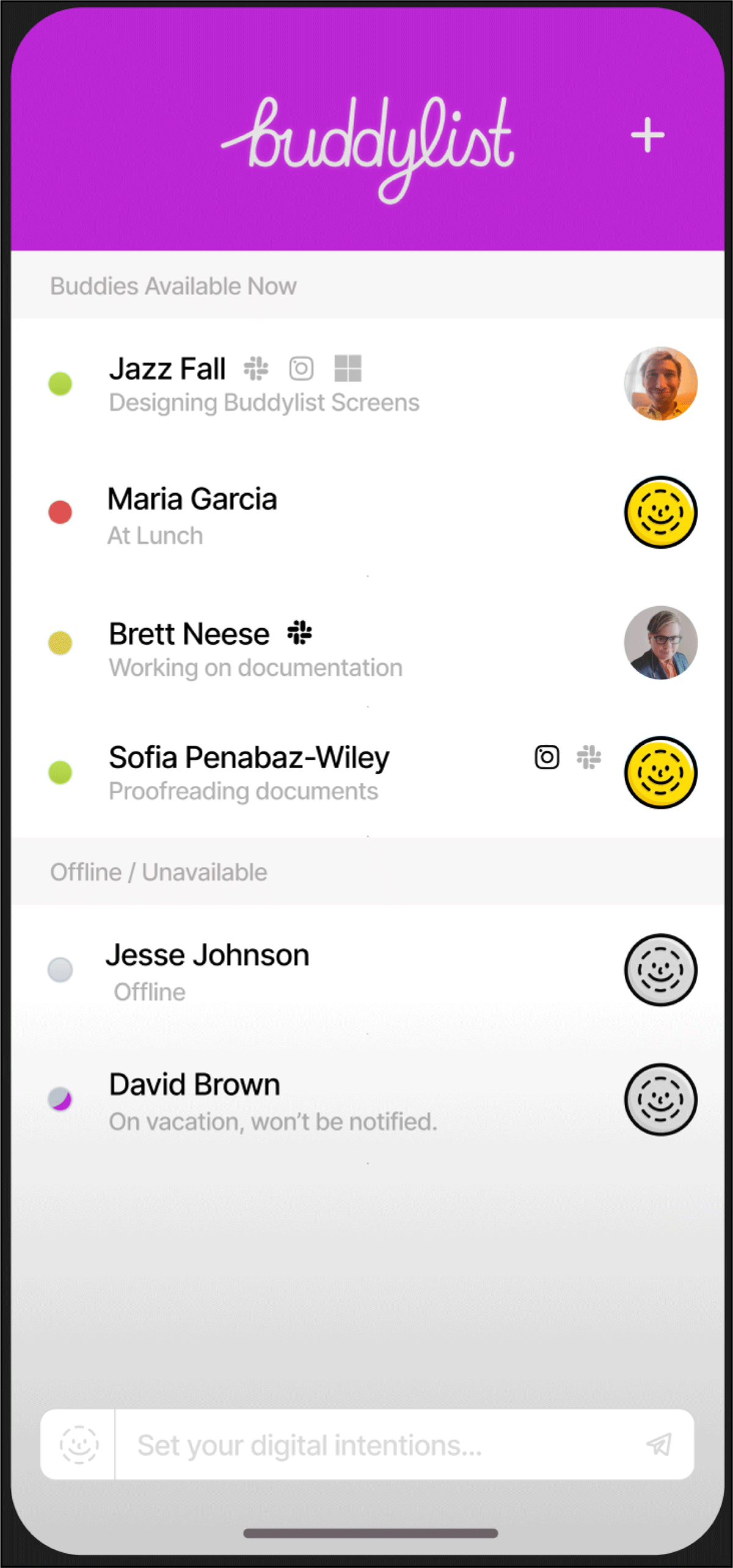
Figure 2
Screenshot of the buddylist prototype, showing users, their connections to messaging applications, and their current “digital intentions.”
The buddylist application connects to various social and work platforms via their public application programming interfaces (“APIs”) which allows them to publish short status messages that are then propagated across these platforms. Users can quickly see which of their connections on buddylist are currently available, busy, or have notifications disabled. buddylist also interacts with the notification systems in these platforms. For example, Slack, a popular application for business communication, provides a dnd.setSnooze API that allows buddylist to programmatically enable or disable a user’s Slack notifications (Slack, n.d.).
Users on buddylist can quickly connect with their friends and colleagues who are available through “deep links” to the recipient’s preferred messaging platform. These links directly launch the users into the conversation with their colleagues, bypassing the often-lengthy list of chat messages users are usually greeted with upon opening a traditional messaging application.
Finally, buddylist can be configured to hook directly into user’s “Focus Mode” system (Figure 3) on iOS, iPadOS, and macOS using the “Focus Filters” mechanism (Apple, n.d.) This allows buddylist to automatically update based on the user’s specified context. Many knowledge workers in the contemporary workforce, particularly software engineers, receive notifications from human as well as non-human actors, such as monitoring and alerting systems, business analysis tools, and even AI agents. By hooking into the core notification systems available on iOS, buddylist can serve as an aid to dealing with these notifications as appropriate. For example, it is not uncommon for software engineers to be on-call or required to be available to be paged to respond to incidents (much as a doctor). In these scenarios, it’s critical that alerts are not filtered. Integration with Focus Modes on iOS provides one mechanism to handle such situations. We can even imagine a direct integration between buddylist and various paging systems, such as PagerDuty, with a status of being “On-Call” or “Off Duty.”
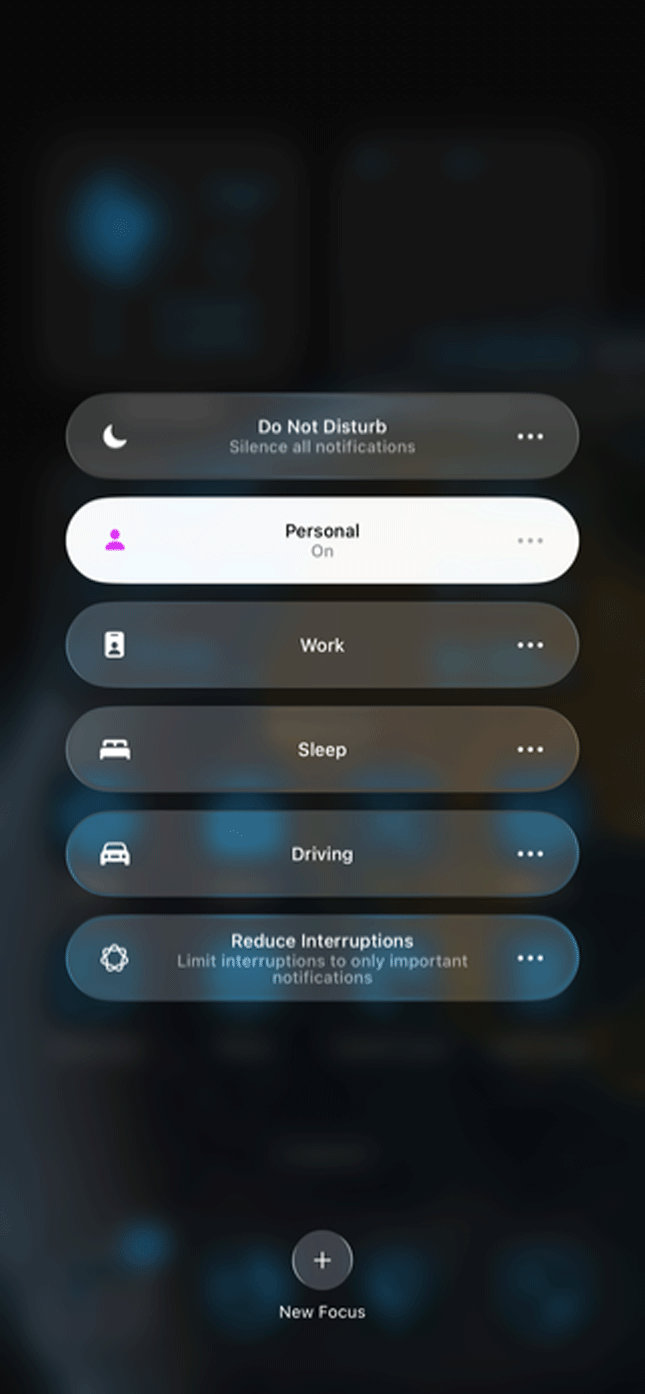
Figure 3
Screenshot of the Focus Modes selector on an iPhone 16 running iOS 26. These statuses can automatically propagate to buddylist.
This approach affords a more controlled engagement with digital communication tools while freeing cognitive resources for both senders and recipients. Much like Beer’s VSM, it creates pathways for signals about one’s presence to recursively travel up and down the “Brain of the Firm”—the communication channels through which the organization coordinates itself. The system enables worker autonomy while facilitating collaboration when appropriate. While Beer criticized computerization and the disruption of communication channels, we argue that the spatial loss due to computerization, the time lag of email, and the overcompensation with instant messaging is addressed with buddylist, which returns worker autonomy of space and time to the individual, thus aiding in a retrieval of these critical human linkages.
Empirical Observations and Theoretical Implications
While further empirical research is necessary to make rigorous scientific claims, initial user reactions to prototypes of buddylist suggest both productivity and well-being improvements through what might be termed a “dual recursive effect.” The system allows knowledge workers to both set intentions about their own use of digital communication tools and ensures colleagues are aware of those intentions. By sharing their focus states, workers leverage social pressure to both maintain their stated intentions and help colleagues regulate their communication patterns. In other words, buddylist takes advantage of two distinct forces:
First, at the individual level, it enables commitment to single-task focus and limits self-interruption through explicit intention setting. The act of declaring one’s intended focus state appears to strengthen goal-directed behavior through metacognitive engagement with attention management. Gollwitzer (1993) calls these “implementation intentions,” and they specify when, where, and how a goal-directed behavior will be executed. In other words, implementation intentions provide the how in service of the goal intention. These “simple mental acts” are “able to mimic a central effect of habits… [which is] rather amazing in view of the fact that habits commonly are the result of time-consuming, laborious practice” (p. 167). We posit that the intentions users set in buddylist may produce similar effects as those found by Gollwitzer, although further empirical research is needed.
Second, it shifts social dynamics by reducing the anxiety associated with message monitoring and response timing. When workers clearly communicate their work and attentional status, social pressures that typically drive instantaneous responses are reversed, redirecting organizational behavior toward alignment with broader strategic goals, a reflection of Beer’s VSM principles.
Discussion
We can understand buddylist through multiple theoretical frameworks that bridge cybernetic principles with contemporary research in attention management and organizational psychology. At its core, the system functions as a variety absorption mechanism, helping regulate information flow and reduce goal interference through explicit communication of presence states. This homeostatic control mechanism aligns with Ashby’s concept of requisite variety while introducing practical tools for maintaining cognitive balance.
At an organizational level, the system’s design affords the creation of communication channels that echo Beer’s VSM, with free-form, text-based status messages increasing the ability for organizations to maintain overall coherence while workers focus on their tasks within the organization. Research by Shteynberg demonstrates that “mere awareness of shared intentionality with members of one’s social group intensifies one’s own individual goal pursuit” (Shteynberg & Galinsky, 2011, p. 1291), a phenomenon buddylist leverages to enable what Shteynberg terms “implicit coordination”—where individuals behave similarly based merely on shared awareness of group intentions. These theoretical mechanisms suggest that buddylist’s effectiveness is rooted in not just its technical functionality, but in its alignment with principles of human cognition and social organization.
The system’s ability to simultaneously promote individual and organizational goal alignment suggests several broader implications for understanding sociotechnical systems. Firstly, it demonstrates the continuing relevance of early cybernetic frameworks in addressing contemporary challenges. Ashby’s conception of goals and variety, along with Beer’s organizational insights, provide powerful analytical tools to illuminate present-day concerns.
Secondly, it reveals how attention management in digital environments requires understanding both individual cognitive processes and organizational dynamics. The hyperactive hive mind workflow emerges not simply from individual behavior patterns but from complex interactions between cognitive architecture, technological affordances, and organizational structures. For a technological intervention to be effective, it must therefore address multiple levels of system complexity simultaneously.
Third, buddylist’s implementation suggests that informal communication channels play crucial roles in the effectiveness of organizations. As Beer’s work anticipated, attempts to formalize or standardize communication without accounting for informal channels may reduce rather than enhance organizational effectiveness. The buddylist approach is to preserve and enhance these informal channels while providing structured support for attention management.
Conclusion
The wider implications of this discussion extend beyond specific technological implementations, pointing towards fundamental principles for designing digital work environments that merit careful consideration. Central to understanding these design principles is the importance of variety absorption mechanisms in managing digital communication. This intrinsically connects to the demonstrated value of explicit intention setting in maintaining goal-directed behavior, where implementation intentions act as cognitive scaffolding for sustaining focus. These individual mechanisms operate within complex social dynamics that either reinforce or undermine individual attention management practices, which highlights the need to consider both cognitive and social dimensions in workplace design. Most pragmatically, this points toward the necessity of developing integrated approaches to presence management across platforms, moving beyond siloed solutions to create coherent systems that support worker agency across the full spectrum of digital interactions. Altogether, this work calls for a more nuanced approach to digital workplace design that acknowledges both the cybernetic foundations of human-system interaction and the social-psychological realities of contemporary knowledge work.
As organizations continue their digital transformation journey, cybernetics can provide valuable guidance for developing systems that support rather than undermine human cognitive capabilities and organizational effectiveness. The buddylist example shows how these theoretical insights can enable practical interventions that preserve the essential variety-handling capabilities of both workers and organizations while supporting individual agency. As communication technologies continue restructuring workplace dynamics, interdisciplinary approaches—including the cybernetic framework of homeostasis, variety, and recursive organization—are increasingly critical to informing the development of interventions that support human flourishing in the complex sociotechnical environments of the contemporary workplace.
Notes
Acknowledgements
An early version of this paper was presented at the American Society for Cybernetics’ 60th anniversary conference in Washington D.C., June 15–19, 2024. The authors wish to thank all who attended for their consideration and input. The authors also wish to thank Ben Sweeting for reviewing that early draft in detail.
Competing Interests
Neese is writing about their work on the “buddylist” prototype, which they self-funded and developed through their firm Neon Labs, LLC. The prototype was a research project and has not been commercialized. Penabaz-Wiley has no competing interests to declare.
Author Contributions
Neese wrote the main body of the text. Penabaz-Wiley was Neese’s professional advisor, providing substantial guidance, editorial support, detailed notes and critical feedback to enable it to appeal to a wider academic and scientific audience.
Author Information
Brett Neese is a software engineer and cybernetic researcher.
Sofia Penabaz-Wiley works in ethnobiology, landscape and environment, and complex systems, lecturing with a focus on the sustainability of social-ecological systems.