
Table 1
A categorical table classifying conceptual ontologies into distinct types.
| LOCALISED | NON-LOCALISED | |
|---|---|---|
| OBJECTS | Representationalism | Fregean |
| PROCESSES | Abilitism | Calibrationism |
[i] Note. The table classifies types of conceptual ontology in terms of whether concepts are primarily treated in existing literature as processes or objects that are of a localised or non-localised character.
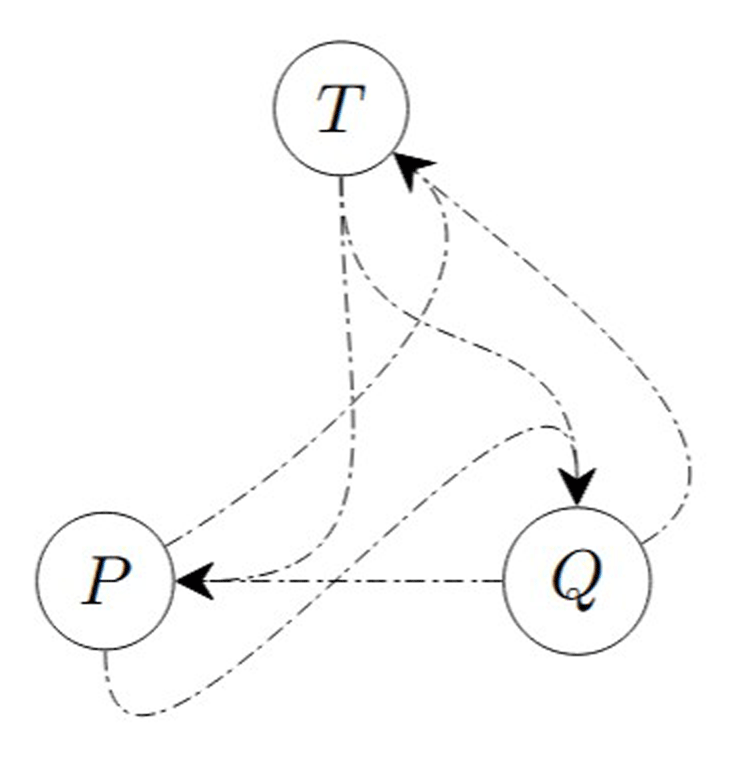
Figure 1
An example of a static snapshot of some complex of relations as illustrated via an entailment mesh.
Note. An illustration of a complex of topic relations in the form of an entailment mesh. The topic relations above are represented by nodes corresponding to letters from the Latin alphabet. The complex is said to be a coherent structure—following Rescher (1973)—by virtue of all relations within the complex mutually reciprocating each other. Assume we have some set of topic relations which belong to some index represented by i or j in this case. For such a structure to be considered coherent, any topic relation Ri that entails Rj must also be entailed by Rj. Modified by author from a diagram both sourced from and licensed by Nick Green (2006a) under the Creative Commons Attribution-Share Alike 3.0.
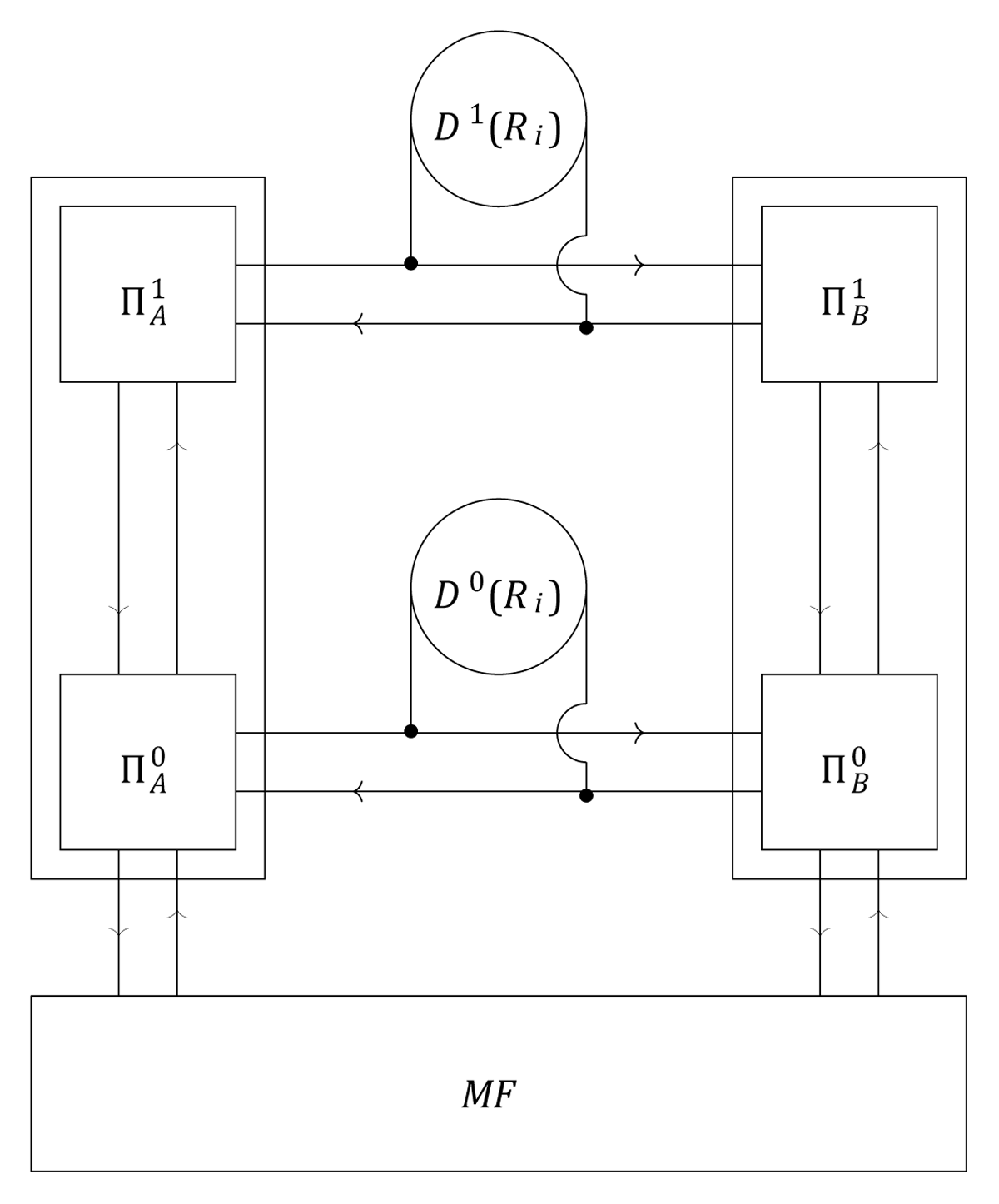
Figure 2
An example of a conversational architecture as illustrated via a conversational skeleton.
Note. An abstract visualisation of a conversation is illustrated as a conversational skeleton. The interaction is demarcated within the conversational language into “how” and “why” modalities, i.e. L = ⟨L0, L1⟩. Within the architecture, participants A and B provide and interpret topic relations Ri through the means of speech-acts, utterances, or descriptions D—as represented by circular nodes. These relations are “stored” in procedural repertoires Π—as represented by square nodes—which are enacted upon during a conversation. Finally, a modelling facility MF is a shared environment or laboratory that permits the codesign of models and artefacts for conceptualisation concerning a purpose, task, or goal. Diagram modified from Pask (1975) and licensed under the Creative Commons Attribution-Share Alike 3.0.
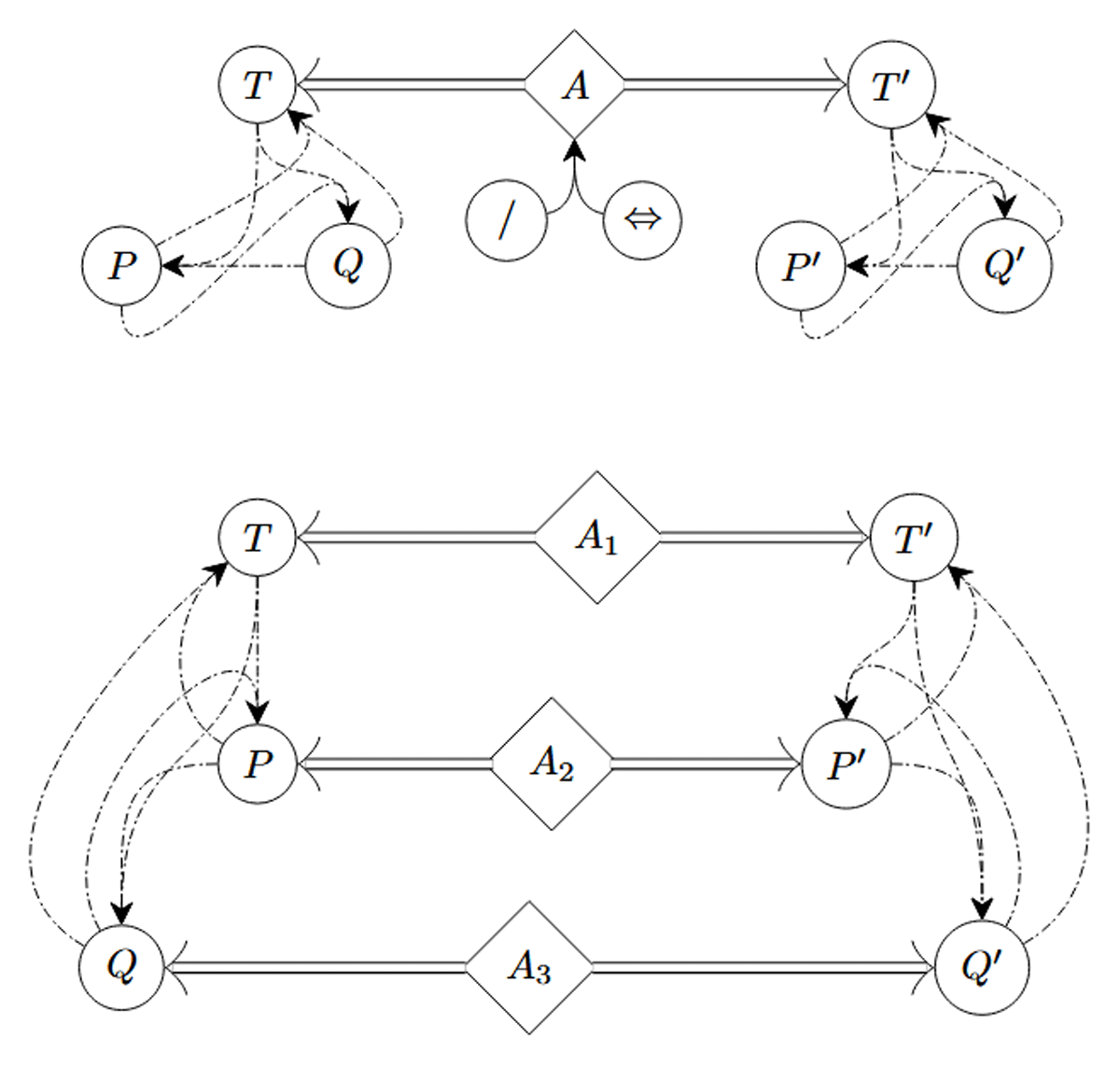
Figure 3
An example of an analogy derivation.
Note. Figure 3 depicts an analogy between two entailment meshes. The top illustration specifically represents an analogy between two topics where a semantic distinction / and an isomorphism ⇔ persists. Given the criteria of coherence, any analogy relation A that holds between two relations of two separate entailment meshes must hold for all topic relations between each mesh—as suggested by the bottom illustration. This permits logical correspondence to be underpinned by logical coherence within conversation theory. Modified by author from a diagram both sourced from and licensed by Nick Green (2006b) through the Creative Commons Attribution-Share Alike 3.0.