
The title of this article is taken from a quote by the cybernetician and experimental philosopher Gordon Pask, who developed conversation theory to study learning and knowledge acquisition in the context of human-computer interactions (and whose work has recently seen a resurgence of interest in the context of architecture and educational technology; see Roobaert & Claeys, 2022; Temizel, 2025; Tilak, 2025). In essence, the theory provides a formalised dialectical framework to describe how conversation modulates conceptualisation processes during peer-to-peer interactions; eventually leading to a synchronization of each conversational participant’s understanding regarding the shared significance of such-and-such a topic.
Pask (1975) believed “a ‘concept’ must be some kind of process” (p. 44), which simultaneously emerged and could be maintained through conversation. It was not an object, nor a product that could be “stored” inside an intentional actor: It was an ongoing process that was produced and reproduced through conversational interactions. This is a very specific ontological stance as to the character of a concept that he commits to, which notably contrasts other prevailing ontologies of conceptualisation—whose influence has been far more influential for research in artificial intelligence and machine learning (see Brooks, 1991; Dreyfus, 1992; McCarthy, 1996; Jordanous, 2020). I hold that these prevailing ontological commitments have significantly affected the nature and scope of such researchers’ inquiries, in ways that have limited their ability to emulate conceptualisation processes in machines.
For this reason, I suggest Pask’s work on epistemology is of special relevance to contemporary philosophical debates regarding the ontology of conceptualisation, such that it can provide reflexive considerations for those working in artificial intelligence and machine learning (AI/ML) regarding how their use of the term is underpinned by certain ontological commitments as to what a concept is. This affects both the parameters and assumptions regarding the design of the experiments enacted when attempting to emulate conceptualisation procedures in machines. How one interprets what a concept is, will inform how one designs and enacts research in such areas. This is evident when contrasting how Pask (1975) conceived of concepts when compared to his contemporary, rival, and friend Marvin Minsky (1974). The issue of conceptual ontology should not be treated as of superficial interest then: How people have defined what a concept is within AI/ML research has had a material impact on what has been researched and why.
In the case of contemporary research regarding the emulation of conceptualisation processes, I have suggested conversation theory may provide a better model for understanding how to enact joint-conceptualisation procedures during peer-to-peer interactions (see Manning, 2025). This is specifically because of the conceptual ontology encouraged by Pask, which I have argued is more suited to the co-emergence of shared understandings through conversational interactions when compared to adjacent theories. I begin by contrasting the differences and similarities of various conceptual ontologies. Afterwards, I examine the form of a concept in Pask’s account, which I label as calibrationist for the sake of convenience, before finally suggesting how concepts both emerge and are maintained within the architecture of conversational interactions—whilst reiterating some of the benefits this characterisation has when compared to others currently used in AI/ML.
Ontologies of Conceptualisation
What exactly is a concept? This has been a significant concern in contemporary philosophical literature and a source of disagreement in relation to the issues of (i) how the word concept is being used within pre-existing literatures, and (ii) what parameters govern the word’s usage within various epistemic frameworks. While I acknowledge some readers may be uneasy with my interest in conceptual ontology—perhaps under the assumption I am making a universalist claim as to the “true” essence of the concept—my intention is merely to describe the limited ways the term has been used in philosophical literature to show (i) that the Paskian usage of the term does not sufficiently fit such categories, and (ii) certain areas of research in AI/ML may have unintentionally limited the scope of their research into conceptualisation processes, due to the way it has been discussed in philosophical circles. Based on this view, incorporating the formal dialectical and conceptual framework developed by Pask may provide researchers in machine learning and other AI-related fields with new ways to research conceptualisation processes within multi-agent interactions. In this way, I seek to develop upon the idea that the historical research program of artificial intelligence has been founded on the assumption of representationalism (see Brooks, 1991; Dreyfus, 1992; McCarthy, 1996; Jordanous, 2020). I also suggest conversation theory can provide a sufficiently non-representational framework towards the mechanization of conceptualisation processes for intentional multi-agent systems. I now briefly examine the differing conceptual ontologies—which I have categorised in Table 1—in order to contrast them with Pask’s own ontology of the concept.
Table 1
A categorical table classifying conceptual ontologies into distinct types.
| LOCALISED | NON-LOCALISED | |
|---|---|---|
| OBJECTS | Representationalism | Fregean |
| PROCESSES | Abilitism | Calibrationism |
[i] Note. The table classifies types of conceptual ontology in terms of whether concepts are primarily treated in existing literature as processes or objects that are of a localised or non-localised character.
Firstly, there is the notion that a concept is a mental representation. By the representationalist paradigm of conceptual ontology, I have in mind the traditional idea that was commonly adopted within AI/ML whereby the term concept denotes a mental representation, i.e., a kind of token that is assigned mental contents. In the context of existing literature, this typically refers to a mind-dependent informational structure that comprises a token that’s assigned propositional contents or attitudes (Jackendoff, 1989; Margolis & Laurence, 2007). For example, take my notion “Weybridge is a town on the river Wey.” I conceive of the mental particular of “Weybridge” as a token relation that is substitutable for the expression “A town on the river Wey” whose contents may be treated as tokens themselves. These concepts can be combined in various ways to produce more complex mental representations, whose form may partially resemble the tree-like structures found in frame-based accounts of conceptualisation (Minsky, 1974; Fillmore, 1982; Hommen, 2018; Petersen, 2015). These frame-based approaches to the mechanization of conceptual processes have tended to conceive a concept as a kind of mental representation which—I have previously argued—has limited researchers’ ability to design models of conceptualisation to more accurately emulate human collaborative learning within the research domains of AI/ML (see Manning, 2025).
Secondly, concepts have been used to designate what have been called “abstract objects” which may be labelled the Fregean paradigm. This conceptual ontology derives from the work of Gottlob Frege (see Beaney, 1997). Frege viewed concepts as abstract objects that were not, strictly speaking, stored in an individual’s mind. While the Fregean paradigm of conceptual ontology intersects with the representationalist view that a concept is a kind of individuated predicate—specifically, a grammatical predicate—which is assigned a name (p. 182), it cannot be reduced to this. Suppose we have two conversational participants (let’s say A and B) who are discussing some topic. A believes Trees are flora and not fauna, and B also believes this. Here, flora and not fauna form the predicate—and therefore for Frege the meaning—of each participant’s belief. This predicate is an abstract object for Frege because (i) it can be individuated as a token or object of discussion and (ii) it is a non-localised phenomenon, such that it neither strictly “belongs” nor is “stored” in any participant but is embodied through them. Because it is non-localised, it cannot be reduced to a mental representation, as this must be localised and stored in the mind of a conversational participant. Frege was partially concerned with the issue of how two people could instantiate the same concept between themselves: specifically, when accounting for the uniqueness of their first-person subjective experience (Nagel, 1980; McGinn, 1989). The issue for Frege was that if concepts were mental representations that were localised to the mind, then how is it possible to communicate our conceptions to each other at all? Now it should be said that Margolis & Laurence (2007) find this reasoning problematic: They contend that while each person’s mental representation must be unique, they can be of the same type, i.e., two instances of “snow is white,” for example (p. 567). While I agree with their view, I do think Frege’s general point about the non-localisation of concepts is worthy of exploring: For when claiming concepts are “of the mind,” they tend to be viewed as being stored in individual minds.
Thirdly, there is also the notion that concepts are abilities. This paradigm of conceptual ontology is known as abilitism, which sees concepts as extending beyond the domain of cognitive processes within the mind to non-cognitive processes enacted through the body. In essence, it asserts that since mental functions have a symbiotic relationship with bodily functions, a concept must be a complex interplay of various intersecting processes within a person (Kenny, 2010; Giunchiglia & Fumagalli, 2016; Bulov, 2023). Concepts in this account are not treated as tokenesqe structures that one has, but capacities that one may exercise to achieve something. While such concepts may include such tokens, Bulov (2023, p. 7) suggests these tokens—i.e., concept carriers—exist as constituents of an ability rather than the ability itself.
Take the example of the concept of hammering a nail or that of swimming correctly: The correctness of each concept is not purely related to propositional contents in this account. It involves a process of cultivating specific techniques in practical interactions with the world. The account necessitates that there are a priori capacities to embody such concepts as well: Defects in sensory organs auxiliary to the mind, or the peripheral nervous system, might mean a person might not be able to instantiate the concepts of pain or colour within the abilitist paradigm. Someone with a rare degenerative neurological condition such as multiple system atrophy meanwhile might lose their concept of knowing how to swim because of the effects of the autonomic dysfunction that is bought about by the condition, which will have a significant impact on such an individual’s ability to both learn and maintain such an ability. Therefore, concepts must be conceived of as types of processes that are embodied by cognitive and non-cognitive architectures within this reading. While the abilitist paradigm does extend the use of the term concept to indicate the non-mental constituents of concepts, I argue authors in the area still tend to treat concepts as localised to some variation of the brain-body system in practice. While the account treats concepts in terms of processes, it does not concern itself with the kind of non-localisation of concepts that Frege was historically concerned with. Even if I disagree with Frege’s view that the term concept is reducible to the individuated object of a grammatical predicate, I do believe he was correct to highlight the non-localised character of the concept.
Finally, we have what I label the calibrationist reading, which treats concepts as cyclic processes that attempt to maintain and preserve some complex of relational contents between conversing participants. While the paradigm is emblematic of Pask’s work, I suggest that it has its origins in the works of the British and German idealist traditions (Joachim, 1884; Bradley, 1897, 1914/2011; Bosanquet, 1892; Lotze, 1884, 1887a, 1887b; Hegel, 1874, 1969, 1977). Unlike these traditions, however, which are purely interested in understanding the role of coherence in phenomenological terms, later theorists were either specifically interested in or discussed the possibility of the formalisation of epistemological structures whose systems were the result of the continuous construction of themselves (see Pask, 1975, Piaget, 1971; Rescher, 1973). In virtue of this, a concept is considered here as a unit of autopoiesis which constitutes the unity of cohering contents (Pask, 1981; Maturana & Varela, 1980).
In defining his usage of the term concept, Pask (1975) postulated that concepts are characterised within conversation theory as problem-solving procedures which (i) form a hypothesis, (ii) attempt to satisfy that hypothesis, and finally (iii) test to confirm or deny that hypothesis (p. 244). Such procedures are embedded within the architecture of conversational interactions for Pask; they do not exist outside of it. We form hypotheses—utilising working models—between ourselves and our conversational partners and continuously seek to test for their validity or falsity within a conversational interaction.
These procedures are used in conversation to converge towards or maintain a common understanding between conversationalists. This implies conversational participants have a priori asynchronous understandings of each other’s viewpoints initially, and work towards synchronising thought and action—to varying degrees—between themselves. To illustrate this point, Surendran (2023) provides the example of a student thinking that spiders are insects because they are creepy crawlies. During a lesson, the teacher attempts to help the student converge to the concept that spiders are arachnids, not insects. In doing so, the teacher seeks to identify within a conversational interaction the incompatible assumptions the student has regarding the nature of a spider when compared to the teacher’s own understanding of it. The teacher then corrects the student’s understanding to make the student’s understanding coherent with the teacher’s own.
Pask’s (1976) notion of a concept may also be characterised as a stable compilation of itself in the form of a procedure that brings about mutually reciprocating relations (p. 143). This is because to stabilise one relation, you in effect need to stabilise all others, as is exemplified in the philosophy of coherence advocated by Rescher (1973). This requires conversational interactions to stabilise conceptions during ongoing interactions between various participants with asymmetric viewpoints and notions.
The essence of a concept, for Pask, is to act as a process that maintains—within the architecture of a conversation—the compatibility of its relational contents with themselves when exposed to incompatibilities that might arise through conversational and non-conversational exposure. It is not a product of representation in the form of an individual relation nor its complex; instead, it produces such relations and their complexes as byproducts of its activity. An illustrative representation of a product of a concept in the form of a complex of relations is exemplified in Figure 1 in the form of an entailment mesh. This depicts what Rescher (1973) labels as the mutual reciprocity of relational contents. The complex is not the concept itself but rather an abstraction of its unity as an invariant representation of contentful relations. Once again, to reiterate, the concept in this reading is the process through which this unity is maintained.
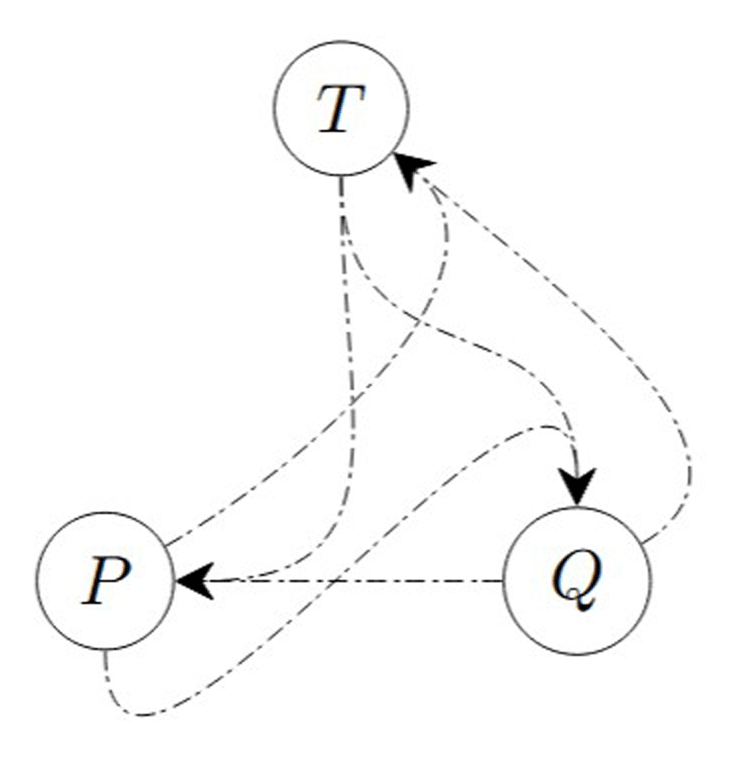
Figure 1
An example of a static snapshot of some complex of relations as illustrated via an entailment mesh.
Note. An illustration of a complex of topic relations in the form of an entailment mesh. The topic relations above are represented by nodes corresponding to letters from the Latin alphabet. The complex is said to be a coherent structure—following Rescher (1973)—by virtue of all relations within the complex mutually reciprocating each other. Assume we have some set of topic relations which belong to some index represented by i or j in this case. For such a structure to be considered coherent, any topic relation Ri that entails Rj must also be entailed by Rj. Modified by author from a diagram both sourced from and licensed by Nick Green (2006a) under the Creative Commons Attribution-Share Alike 3.0.
This describes Pask’s usage of the term concept and the ontic assumptions he imbued, guiding its use, which I have labelled the calibrationist paradigm. To this effect, Pask’s usage of the term concept—much like in Fregean ontology—treats a concept as a sufficiently non-local phenomenon by virtue of existing through conversation rather than being located within someone or something. Scott (2021) suggests that both Mead (1934) and Laing, Philipson, and Lee. (1966) had an impact on his and Pask’s thinking about conversation and conceptualisation, which gives credence to the view that Pask accepted the extended mind thesis as discussed in philosophy and cognitive science (Vygotsky, 1962; Clarke & Chalmers, 1998; Kirchhoff & Kiverstein, 2019). From this it may be argued that conversation theory accepts the view that the mind is (i) both extended to epistemic artifacts within an individual’s non-conversational environment, and (ii) extends to other intentional agents who interact conversationally with each other (Ongaro, Hardman & Deschenaux, 2024). This is exemplified within conversation theory via the conversational skeleton as seen in Figure 2.
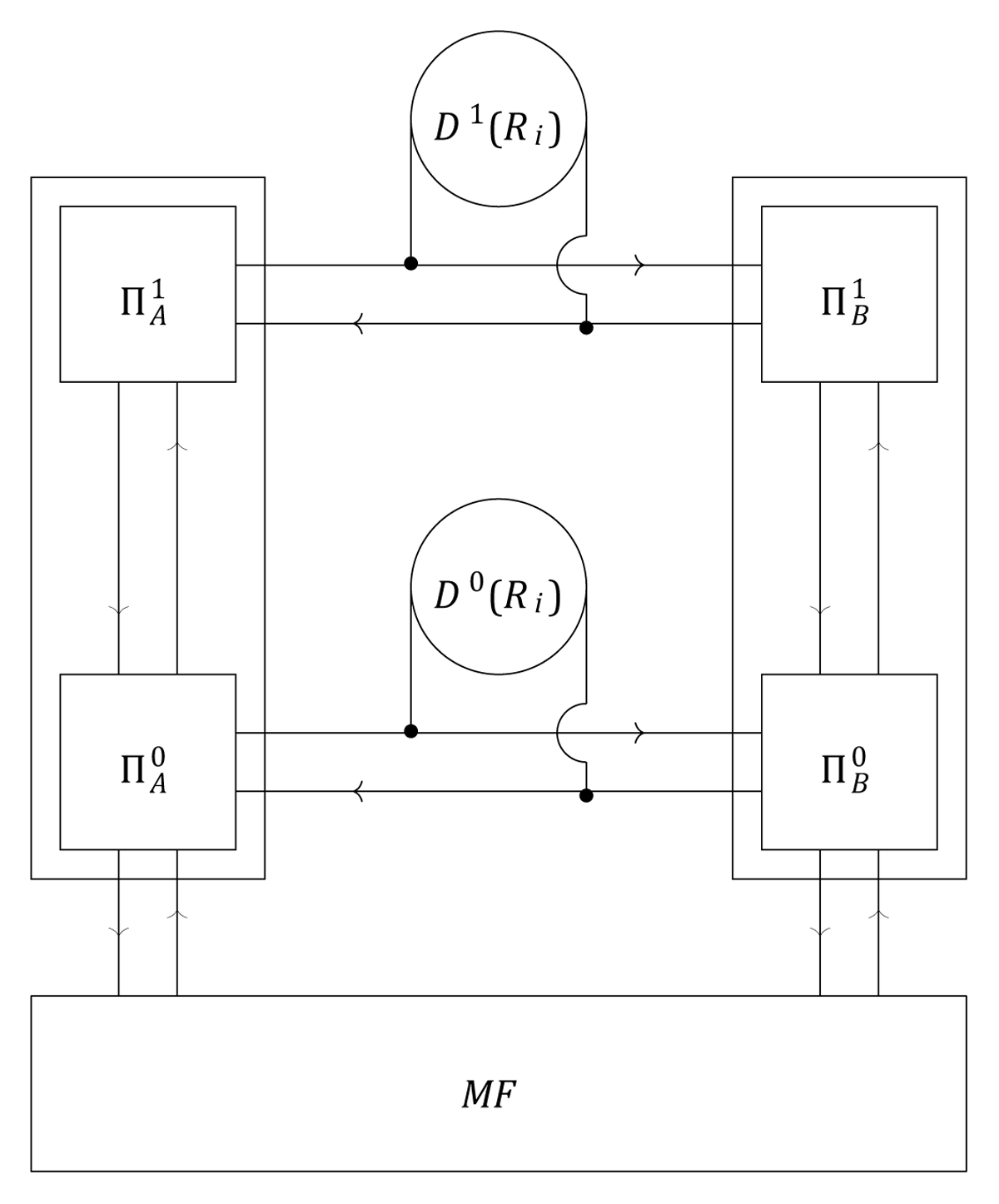
Figure 2
An example of a conversational architecture as illustrated via a conversational skeleton.
Note. An abstract visualisation of a conversation is illustrated as a conversational skeleton. The interaction is demarcated within the conversational language into “how” and “why” modalities, i.e. L = ⟨L0, L1⟩. Within the architecture, participants A and B provide and interpret topic relations Ri through the means of speech-acts, utterances, or descriptions D—as represented by circular nodes. These relations are “stored” in procedural repertoires Π—as represented by square nodes—which are enacted upon during a conversation. Finally, a modelling facility MF is a shared environment or laboratory that permits the codesign of models and artefacts for conceptualisation concerning a purpose, task, or goal. Diagram modified from Pask (1975) and licensed under the Creative Commons Attribution-Share Alike 3.0.
In any case, concepts within the calibrationist reading (as exemplified by Pask) both arise and are maintained as stable constructions through cultivating a consensus in conversation regarding a topic’s significance within a particular context. In this interaction, each conversational participant either expects the other to abide by certain normative constraints or to bring others into a specific universe of discourse or space of reasons (Brandom, 1994; Surendran, 2023). This implies either some a posteriori synchronicity in the form of a mutual understanding, or a need to converge a priori asynchronous understandings to yield it. The concept does not belong to any participant, however, but emerges within the interaction:
Again, in our culture, there is a strong pressure to say “belong to” one or other participant. As a rule, such remarks are inconsistent. The trouble is only exacerbated by quoting some version of “the whole is (obviously) more than the aggregation of its parts”. For example, “concepts arise in the interaction between participants” merely begs the question of what a participant is. This particular problem is highlighted by noting that if “conversation” and “concept making” are taken to be equisignificant, then many conversations go on in a single brain. For instance, most thinking is a conversation of that type. By the same token, if a human being is said to “learn on [their] own” surely [their] brain incorporates a student-like process that learns and a teacher-like process that (at the very least) directs the learner’s attention to a different facet of the subject matter. (Pask, 1975, p. 171)
Surendran (2023, p. 148) notes how this type of conceptual ontogenesis has also been taken by contemporary neo-pragmatist figures like Robert Brandom (2011), who sees concepts as arising through conversational interactions whereby we give and ask each other for reasons for our claims. This represents a rejection of certain aspects of representationalist and abilities-based ontologies, which tend to treat concepts as “belonging to” individuals, whenever as mental contents stored in the mind, or as capacities of the brain-body system.
What’s more, following Scott (2009), is that concepts within Pask’s account aren’t treated as hierarchical structures—but heterarchical ones instead. This contrasts various frame-based accounts of conceptualisation commonly adopted within AI/ML (see Minsky, 1974; Fillmore, 1982; Petersen, 2015; Hommen, 2018). While frame-based accounts of conceptualisation vary significantly, the feature they all share is that “human knowledge forms hierarchically interrelated clusters of information” (Hommen, 2018, p. 385). The conceptual ontogenesis advocated by Pask represents a radical departure from this view. But Minsky’s (1974) frame-based interpretation of conceptualisation and its representationalist underpinnings have come to significantly dominate contemporary AI/ML approaches to the mechanization of conceptualisation. This is most evident in contemporary—specifically, but not always neuro-symbolic—approaches to AI/ML (see Lake et al., 2015; Mao et al., 2019; Ding et al., 2023).
For example, Lake et al. (2015) have previously utilised probabilistic program induction to learn and generate visual concepts in the context of machine learning. Through their work, they were able to synthesize multiple instances of an input into a general type. This was achieved using stochastic programs that could generate concepts which would be used as exemplars to identify objects. While not necessarily analogous to the frame-theoretic models of Minsky (1974) nor Fillmore (1982), I suggest the characterisation of a concept found in Lake et al. (2015) is “frame-like” in the sense that (i) the data was manipulated hierarchically from a set of primitives and (ii) the byproduct of this synthesis was a rough token-type that could be used to identify visual objects. The use of the term concept here is both symbolic and representational in nature.
Again I must stress at this point that given this paper’s role in discussing conceptual ontology, I argue we can design systems to emulate conceptualisation processes using different underlying ontological commitments as to the nature of a concept: Therefore it is not necessary to be limited to one way of thinking about the issue, and implementing other ways of thinking could offer alternative utility for researchers in the area. In any case, in the calibrationist account I advocate here, I suggest instead that concepts are non-hierarchical processes that are sufficiently non-localised emergent properties that are equisignificant with conversation. This stands in contrast to the representationalist usage of the term. Concepts arise in the interaction of conversational participants and cannot be said to be localised to one or the other participant—at least, strictly speaking. Thus, as Scott (2009) postulates, concepts are a “heterarchical system of processes that are organisationally closed” (p. 54). Concepts are heterarchical precisely because there is a redundancy of conversational control: The role of teacher-like and student-like processes may switch between different conversational participants during an interaction.
If a system is legitimately said to teach, then it must be able to learn from its student who may reverse the roles to play at teacher. (Pask, 1972, p. 243)
The benefit of this approach is that it allows for a conceptual ontology which is relativistic—i.e., different people’s concepts are sufficiently asynchronous with each other—whilst also allowing normative parameters governing concept use to be established, i.e., agreeing or agreeing-to-disagree about how to use concepts in certain situations. Given its conversational and dialectical underpinnings, the approach may be of more utility within AI/ML for those wishing to emulate the emergence of shared understandings within conversational interactions.
While I’ve chosen Paskian conversation theory to exemplify the calibrationist reading, these tendencies can also be found more generally across literature from second-order cybernetics, the Soviet psychological school, neo-pragmatism, and German and British idealism. The educational psychologist Lev Vygotsky (1962), for example—whose thinking Derry (2013) argues was influenced by Hegel and Spinoza—is acknowledged by Pask (1976) alongside Piaget (1971) and others as having had substantial influence on the cybernetician’s own thinking about conceptualisation and conversation. I do not therefore claim this reading is reducible to Pask, but rather that he, through his background in cybernetics, was able to apply the non-representational accounts of prior thinkers when developing machines to emulate conceptual processes.
Nicholas Rescher’s (1973) work on formal coherence also played a significant role in validating Pask’s ontic thinking about concepts. Rescher’s work aimed to formalise aspects of British idealism (Joachim, 1884; Bradley, 1897, 1914/2011; Bosanquet, 1892), which was in turn heavily influenced by the German idealist tradition (Lotze, 1884, 1887a, 1887b; Hegel, 1874, 1969, 1977). Lotze (1887b), for example, holds that the existence of things “at every moment is the transitory result of reciprocal action between many elements, unceasing renewal of this action being required so that their apparently steady continuance may extend for even but a small space [of time]” (p. 579). He also writes that: “Each of their properties appears to be ultimately dependent upon conditions, and to change when conditions change; and all these conditions consist of variable reciprocal relations subsisting between many things—that is, of activities they exercise and are affected by” (p. 578). Bradley (1897) meanwhile suggested that: “you cannot ever get your product standing apart from its process” (p. 27), which was not only a view he derived from German thinkers such as Hegel (1977) but whose underlying principle emerged as a formal proof in second-order cybernetics later on (see von Foerster, 2007; Kauffman, 2005).
Meanwhile, some neo-pragmatist thinkers, such as Brandom (1994), provide contrary—but not necessarily contradictory—accounts of conceptualisation which are, in my view, calibrationist in nature, i.e., Brandom’s deontic scorekeeping model. Essentially, for Brandom, conversational participants such as you or I attribute to others a sense of being committed to a claim, attitude, or performance based on our individual models as to what it means to be committed to such-and-such. When one such participant attributes to others a sense of being committed to such-and-such, the observing participant entitles an observed participant to behave in certain ways per that commitment. However, if the observer perceives inconsistencies in what the observed person says or does, then the observing participant may engage in a process of clarification with their observed partner regarding their intentions and actions. This involves a process of giving and asking for reasons relating to a perceived inconsistency to (i) test the initial validity of our hypothesis and (ii) to see if the observing conversational participant was right to attribute to their observed conversational partner this sense of being committed in the first place.
Having explained to the reader (i) what I believe are the four variations of conceptual ontologies and (ii) why, in the context of AI/ML only the representationalist account of concepts is really considered, I now seek to elaborate more systematically what a concept is in the calibrationist reading via Pask’s formalisation of the notion. Not only does this provide a more rigorous account of Pask’s usage of the term concept, but it also provides a sketch as to how it could be implemented within the design and application of technologies within AI/ML. While full appreciation of this requires the reader to delve into Pask’s account of the protologic Lp—which provides a calculus of rules that conceptual procedures follow—this is not relevant for the purposes of the text and so I will avoid discussing it.
What is a Concept?
When I refer to a concept as a cyclic process pertaining to the maintaining of the coherence of a set of topics, I have in mind a specific formal conceptual framework for understanding what a concept is; this framework is taken from Pask’s (1975, 1976) conversation theory, which is a cybernetic approach to the formalisation of dialectical interactions between conversational participants. By this claim, I mean the theory is concerned with how two participants—say for example A and B—form, share, and modulate conceptualisation processes between each other in order to synchronize their otherwise asynchronous conceptual models of a topic. I argue Pask’s conception of language mirrors many contemporary philosophical paradigms. These conceptions of language tend to prioritise the intentional and pragmatic nature of language-use (Austin, 1975; Wittgenstein, 1953/2009; Grice, 1957; Rescher, 1966/2019; Searle, 1979). Specifically, Pask has a conception of language that is enacted during conversation to do things rather than simply represent things.
While Pask’s understanding of a conversational language was conceived with these considerations in mind, his primary concern was how conversational participants were able to achieve a mutual understanding between one another. This involves the convergence or calibration of beliefs and judgements, such that a degree of synchronization occurs between otherwise asynchronous actors. Because concepts may be described as cyclic processes in Pask’s account, it follows that for a concept to exist, it must be shown to sufficiently loop through—as articulated by Pangaro (2008)—conversational participants who are interacting with each other. If participants A and B are said to “have” a concept of the same topic, they need to produce and reproduce the contents and structure of the concept between themselves. This must be done in such a way that both participants’ notions of a topic become both purportedly and actually analogous to the other’s notion of that topic.
In the next subsection, I will examine the basic form a concept takes as a process within calibrationism. In doing this, I demonstrate parallels between Pask’s notion of a concept and Hegel’s notion of begriff to show how both accounts treat concepts as cyclic self-sustaining processes. I then further extend this analysis in the subsection afterwards, by demonstrating how conversation theory provides a conceptual ontology whereby concepts are ontically non-localised processes that emerge amid conversational interactions. In advocating this account, I suggest that concepts are not a priori localised to the mind nor body but are rather transpersonal processes that act through us and our interactions with the world.
What is a concepts form?
Pask (1975) sees concepts as relating to topic relations—i.e., relational contents that may be discussed in conversation—such that the concept of a topic relation is defined as a procedure which brings said relation about (p. 47). This definition functionally resembles what Hegel (1977) labels as begriff—i.e., concept, notion, or word. This is evidenced in the following extract:
If we give the name [concept] to the movement of knowing, and the name of object to knowing as a passive unity, or as the “I”, then we see that not only for us but for knowing itself, the object corresponds to [its concept]. (Hegel, 1977, para. 166)
While Miller translates Hegel’s (1977) use of the term begriff as “notion,” I argue that (i) the word is synonymous with “concept” in German and that (ii) Hegel himself treats begriff in terms of self-movements and circles in a way that is similar to Pask (see Hegel, 1977, para. 33). Therefore, there exists at least a partial overlap between Paskian and Hegelian conceptual ontologies, which will be useful to elaborate upon here, given my claim of certain resemblances between cybernetic and idealist conceptual ontologies (which I have termed calibrationist in order to sufficiently distinguish this notion of a concept from other conceptual paradigms as seen in Table 1). One such resemblance is where Hegel (1977) asserts that the essence of the object is its concept, such that by “object” we understand the concept itself as the constitutive force of the object (para. 53). While Hegel conceives the object as existing as such, it only exists as such in so far as it acts in the process of constituting itself.
Following the work of cyberneticians such as Heinz von Foerster (2007) and Louis Kauffman (2005), I suggest that objects in the calibrationist reading may be interpreted as having an ontological form of an eigenvalue that is produced and reproduced by some eigenfunction, i.e., its process. In other words, the object is a “token” or “product” x which is constituted by some function f. This idea may be represented in the following logical abbreviation:
Therefore, the object is both the input and output of the concept. This permits the object to become self-sustaining via being self-generating. It is possible to render—using Pask’s own notation scheme—a concept as a cyclic process whereby a concept of tokenised relational content produces and reproduces itself via relational feedback, such as seen in Figure 1. This sharply contrasts frame-based accounts of the concept, whose internal structure consists of hierarchically nested tokens which—without sufficient external structures to induce feedback—do not internally display this property.
This cybernetic interpretation of a concept’s dynamic essence—within this reading—is formalised into a spin calculus by Pask, such that for a concept to be a concept it must be proven to close in on itself:
Now it is difficult to determine if Hegel’s use of the term “object” is strictly analogous to Pask’s usage of relation: Can it denote a mere relation belonging to a complex, or the complex of relations as a passive unity? This is not strictly relevant for this article. What is relevant, however, is my claim that both uses of the term concept are strictly isomorphic when generalised as productive and reproductive processes.
Meanwhile, Hegel (1977) also treats the term concept as permitting the “subsistence of the many diverse and independent properties” (para. 121) that comprise it, suggesting further similarities between the two thinkers. For Hegel these properties form a unity and yet maintain their distinctions from one another as opposites simultaneously. While a relation may be white, consisting of the relata cubical and tart—for example—these individual relatum are not white and yet aid in constituting the context in which we conceive it. This idea was formalised by Rescher (1973), whose work on formalising the logic of coherence was incorporated into Pask’s conversation theory. Rescher’s emphasis that logical coherence involves the mutual reciprocity of relations, i.e., matters, can be treated as the force which binds such relations into a unity with themselves.
In [other] words, the “matters” posited as independent directly pass over into their unity, and their unity directly unfolds its diversity, and this once again reduces itself to unity. But this movement is what is called force. (Hegel, 1977, para. 136)
In this interpretation, a concept is treated as the mutual reciprocity of a collection of properties or matters that take the form of some complex of relations. This complex—i.e., the passive unity—by itself is not the concept, however, but rather the concept is the process of interaction through which such a complex subsists. In any case, I argue it is useful to conceive of a concept in both accounts as a working model of sorts that attempts to stabilise a relation in the face of destabilising forces:
This is because of the dynamic nature of the concept, which must continually maintain and stabilise itself as an entity. Following Pask & de Zeeuw (1992a), a concept in-and-of-itself is by definition—i.e., ≜—an operator CON* which is both productive and reproductive in nature; this operator attempts to attenuate the destabilising force of novel distinctions within itself by inducing such distinctions into a structure of logical coherence (para. 165). We may write this as follows:
Where I treat CON– as a sub-operator which attempts to induce distinctions or novelty, while I treat CON+ as a sub-operator which attempts to induce coherence or the stabilisation of a relation (Pask & de Zeeuw, 1992a, 1992b).
While Pask (1984) had originally used the latter sub-operation to denote “procedure-building” processes and the former to denote “description-building” processes, having been influenced by Vygotsky (1962) and other pedagogical thinkers, this distinction seems to have been in the process of simplifying itself in later works. In Pask & de Zeeuw (1992a), the authors use the addition + and subtraction – symbols to indicate forces which hold a concept together and forces which create distinctions, with such distinctions increasing the tendency to destabilise the concept (para. 216).
Given how engaging in conversation, i.e., providing descriptions or instructions, can lead to confusion and misunderstanding, and how enacting procedures to solve a problem can yield solutions that resolve said problem—thereby increasing coherence—then this more general framing is, in my view, a more accessible way of conceiving the issue. As another way of interpreting the form of a concept, Pask (1976) also defines a concept as a procedure containing the following sub-operators:
The program sub-operator is treated in conversation theory as a set of rules and parameters governing the legal and illegal derivations of a concept. The interpretation sub-operator, meanwhile, relates to the actual compilation of the contents with respect to such rules and parameters (Pask, 1981, p. 273).
While this definition may appear peculiar to the reader, it was defined as such due to Pask working in the context of human-computer interaction and educational technologies. These sub-operators are further defined as follows:
Where x denotes some input, λ denotes a compiler and π denotes the program as constituted by a protologic. The protologic itself—while not discussed here—is Pask’s calculus of conceptualisation: It contains rules for such things as material inferences, logical coherence, analogy, and the detection and resolution of the incompatibility of relations within a concept. Only the first three notions are of particular relevance for this paper: They are the minimum necessary capacities needed for establishing Pask’s conceptual framework which I am using as an exemplar of the calibrationist paradigm of conceptual ontology.
The form of a concept—as defined above—may thus be abbreviated into the following expression:
Where AP denotes the application of some input in each situation. This operator is treated here as a permissive operator rather than a necessary one—thus the abbreviation—because conceptualisation is treated as a parallel process rather than a serial one. While the necessary execution & of the application operator will activate a concept, Pask’s choice of using the application operator was due to the Petri net-based computational ontology that informed his theoretical assumptions. Since conversational participants conceptualise at different rates of change, they may sufficiently apply or grasp concepts in some instances of a situation but not others.
Likewise, issues such as tenacity and omission mean that while a participant can modulate conceptual contents during a conversation, this doesn’t always translate into necessarily being the case. In any case, the abbreviation can be simplified to:
Such that the application of a working model of a topic relation produces that topic.
While I have laid out a formalisation of the process of conceptualisation as suggested in conversation theory to justify my cyclic account of the concept—whose primary role is not to represent contents but rather to maintain the coherence of conceptual contents—the reader may still wonder why I have labelled the conceptual ontology calibrationist. In the next section, I discuss how conceptual contents calibrate with each other in the process of conversational interactions.
Concepts arise via calibration
Concepts in the calibrationist reading I advocate here emerge through conversational interactions whereby conversational participants attempt to calibrate their understandings of a given topic between each other. The idea that (i) a concept is a stable process governing the production and reproduction of concepts and (ii) conversation and concept-making are equisignificant means that concepts must come about through the calibration of conversational participants’ understandings. This is because conversation—and conceptualisation—are emergent properties whereby two participants (i) try to synchronise their communication to reach a common understanding, or (ii) exchange or otherwise modulate one another’s behaviour when said communication has been sufficiently synchronised (Pask et al., 1975; Pask, 1979a, 1979b, 1980).
Both Pangaro (2001) and Brandom (2002, p. 363) have likened this process of conversation to a dance whereby participants attempt to calibrate their movements with one another. These movements are a priori asynchronous initially, but through clarifying our conceptions to one another and correcting what we perceive as mistakes, transgressions, or faux pas, we attempt to calibrate our conceptions to yield and maintain a greater synchronicity between each other in the form of a common understanding.
This process is documented by Surendran (2023) and their study of the clarification of normative statuses between teachers and students within classroom learning (p 151). Since the calibrationist reading advocated here assumes that logical coherence underpins the logical correspondence of conceptual contents, any conversational architecture must enable the establishment and maintenance of conceptual contents between different conversational participants.
In conversation theory, the form of this conversational architecture is illustrated in Figure 2. This architecture consists of two conversational participants who are engaged in conversation about a topic. Each participant can address the other using descriptions or speech-acts via enacting contents within their conceptual repertoires. Both participants may interact with a modelling facility where models or artefacts can be co-designed to demonstrate ideas or satisfy goals.
To converse, each participant utilises a conversational language L which is demarcated into two distinct modalities L = L0, L1. The first modality L0 is concerned with “how” two participants might solve a task or goal. The second modality L1 is concerned with “why” what has been done provides a solution to said task or goal in respect to what is already known.
According to Pask (1975), the framing of language prioritises (i) the pragmatic and semantic aspects of discursive practice in place of syntax, and (ii) the giving and requiring of commands, questions, and explanations between conversational participants during a conversation (p. 160). The focus of his analysis becomes not on what is said, but how participants use speech-acts and conceptualisation to calibrate their conceptions to yield a mutual understanding as to the significance of some topic within a given context.
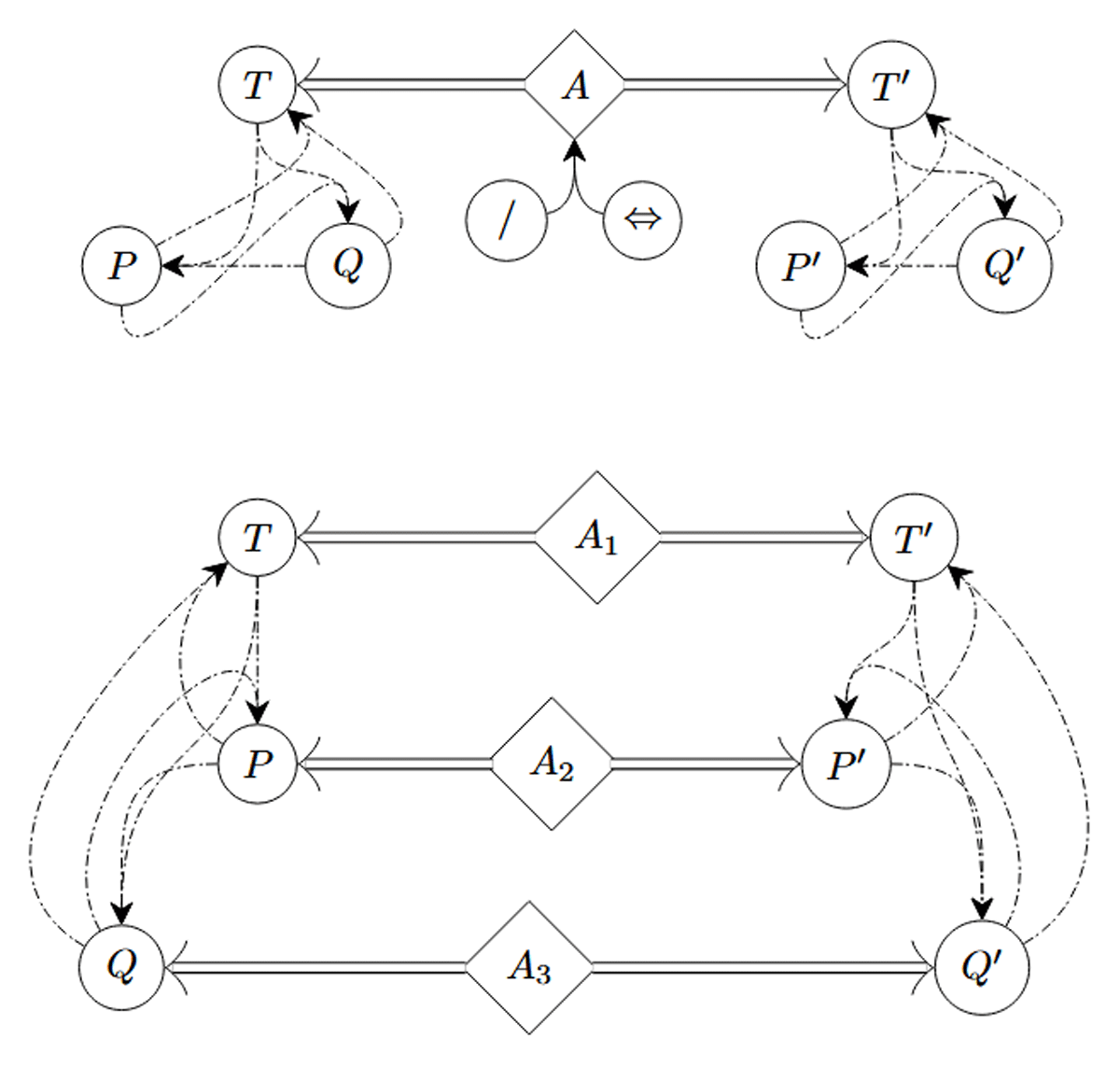
Figure 3
An example of an analogy derivation.
Note. Figure 3 depicts an analogy between two entailment meshes. The top illustration specifically represents an analogy between two topics where a semantic distinction / and an isomorphism ⇔ persists. Given the criteria of coherence, any analogy relation A that holds between two relations of two separate entailment meshes must hold for all topic relations between each mesh—as suggested by the bottom illustration. This permits logical correspondence to be underpinned by logical coherence within conversation theory. Modified by author from a diagram both sourced from and licensed by Nick Green (2006b) through the Creative Commons Attribution-Share Alike 3.0.
The form of a mutual understanding between two differing conceptions shares the following form, as depicted in Figure 3. A common or mutual understanding of some topic relation TA∩B is ultimately said to hold if and only if each participant’s topics intersect ∩ and an analogy ⇔ holds between their concepts.
A common understanding is not a priori synchronous, however. Synchronicity in the form of TA∩B must be established through interactions within the conversational architecture—see Figure 2.
Since the structure is permissive—such that it allows but does not necessitate the modulation of conceptual contents—it can embody what Brandom (1994) calls the giving and asking of reasons during a conversational interaction. This is both sufficient and necessary for the refinement of participants’ working models to converge towards a common understanding of a topic. This may be written as:
Which reads: As A’s understanding of a topic approaches the limit of B’s topic relation, then A’s understanding converges to a point of mutual understanding as to the significance of that topic with B.
This isn’t to say that conversational participants always converge towards a mutual understanding of a topic when calibrating their conceptions. New distinctions between conceptions are unravelled through the mutual unfoldment of each participant’s understanding during conversation. Distinctions that cannot be integrated into current working models induce each participant to provide further reasons as to why their models are compatible with each other. If they cannot, then there can be no shared concept between themselves: Their conceptions are incompatible.
Since concepts are cyclic processes that are calibrated and modulated in conversation within conversation theory, a concept can only come to exist when each participant synchronises their concept with their partners. This is the view of Vygotsky (1962), and why he thought true concepts only come to be after a certain point in a child’s development. This permits a peculiarity, however, in the case of conversation theory: How can concepts emerge if there is no one around to engage in conversation with?
The answer to this question—as has already been suggested in Pask (1975, p. 171)—is that there are processes within first-person subjective experience which act as conversational participants already. Mind and thought are already conversational by this interchange of teacher-like and student-like processes, which act to synchronize a priori asynchronous conceptual contents. This idea is not unique to Pask, however, as Hermans & Dimaggio (2004), Minsky (1986), and Hegel (1977) all imply a dialogical self within their works. But without this notion of a dialogical self, then it would be necessary to commit—like Vygotsky (1962)—to a view that concepts only emerge at a certain point of development.
In any case, I hope I have sufficiently explained to the reader (i) why I have labelled this reading calibrationist, and (ii) the equisignificance of conceptualisation and conversation with themselves. Currently within AI/ML only representationalist accounts of the term concept are considered. Since the use of the term concept determines how it is applied in research (see Lake et al., 2015; Mao et al., 2019; Ding et al., 2023) within the field of AI/ML, I have sought to stress that there needs to be more acknowledgement of the particular ontological commitments that practitioners may—implicitly and sometimes unintentionally—adopt in their use of the term concept whilst also signposting readers to a non-representational avenue for emulating concepts through Pask’s work in applied experimental philosophy. Since he actually designed and implemented experimental laboratories containing technologies to study conversation, cognition, and learning, I contend that it would not take much for researchers in AI/ML to repurpose the principles governing his work—for which only a small and limited sample have been discussed here—in order to emulate conceptualisation in a non-representational way using the calibrationist model described above and further documented in his work.
Conclusion
I have sought to argue for a fourth conceptual ontology, which—while arguably having historical precedence—has not been significantly examined within contemporary discussions in conceptual ontology. I have specifically felt the need to discuss the issue of conceptual ontology, due to certain limitations within the fields of AI/ML where specific uses of the term concept have been monopolised: This, I have suggested, has affected the scope of the research regarding the emulation of conceptualisation processes. This specific ontology I have labelled calibrationist, which is a non-localised process-oriented account of what a concept is. This account specifically uses the term to denote a cyclic coherence of relations that emerge during conversational interactions. I have argued—due to Pask’s previous work in human-computer interaction and educational technologies—that such an ontological framework is ripe to be applied to the emulation of conceptual processes within AI/ML, and that the issue of what a concept is for such researchers and practitioners materially impacts research relating to the mechanization of conceptualisation procedures within these fields.
Acknowledgements
I would like to thank Dr. Pangaro, Dr. Scott, Dr. Tilak, Mr. Douglass, Ms. Sahin, Mr. Carney, and finally Mr. van de Wijnckel for their various and miscellaneous contributions. Specific mention is made here to the various work done by my associates related to the Pask archive within the University of Vienna. I would also like to thank my anonymous reviewers, Dr. Sweeting, and the Cybernetics Society of Great Britian for allowing me an outlet to publish this work.
Competing Interests
The author has no competing interests to declare.