
Introduction
In traditional face-to-face learning, teachers deliver course content in the classroom, while students complete assignments outside class. The flipped classroom (FC) model reverses this structure: students first engage with instructional materials (typically online videos) before class, while in-class time is devoted to interactive activities, concept reinforcement, and addressing student questions (Mok, 2014). This approach fosters deeper cognitive engagement by shifting content acquisition outside the classroom and reserving class time for higher-order thinking tasks (Jia et al., 2023). Recent studies have also shown that flipped and technology-enhanced flipped models positively influence students’ thinking skills, motivation, and learning experiences (Alpat & Görgülü, 2024; Yavuz et al., 2025). The shift to online learning during the Covid-19 pandemic prompted an adaptation of the FC model into the Online Flipped Classroom (OFC) (Polat & Kayaduman, 2022; Polat & Taşlıbeyaz, 2024; Korkmaz & Mirici, 2023). While the OFC retains core FC elements – such as pre-class video lectures, activities, and quizzes – it differs in that all interactions occur online rather than in person (Polat & Taşlıbeyaz, 2024; Hew et al., 2020; Jia et al., 2022).
The OFC model also holds promise for mathematics education, a discipline where students often struggle due to its abstract nature (Schonfeld, 2016; Şenol et al., 2015). Factors such as low motivation, limited practice, and difficulties in conceptual understanding can further impede mathematical learning. The OFC model addresses these challenges by offering a flexible learning environment, allowing students to engage with materials at their own pace. Research indicates that students who prepare before class demonstrate higher engagement, motivation, and academic achievement (Jia et al., 2022), with particularly significant gains among low-achieving learners (Ruiz Palmero et al., 2023). By reducing anxiety and supporting self-confidence, the OFC model shows promise in improving mathematics outcomes. Despite its potential, empirical research on the effectiveness of the OFC model in mathematics education remains limited. Thus, this study examines the impact of the OFC model on learners’ academic achievement and motivation in mathematics education.
The Flipped Classroom (FC) Model
The Flipped Classroom (FC) model traces its origins to the innovative work of Jonathan Bergmann and Aaron Sams, high school chemistry teachers in the United States. To accommodate students who were unable to attend lectures, they began recording their lessons and distributing them digitally (Bergmann & Sams, 2012). This approach represents a fundamental shift from traditional face-to-face instruction, where teachers present content in class and assign homework for independent completion. In contrast, the FC model inverts this structure by having students first engage with instructional materials – typically in the form of online videos – before attending class. Classroom time is then dedicated to interactive activities, discussions, and teacher-guided problem-solving, allowing for deeper engagement with the material (Polat & Taşlıbeyaz, 2024; Jia et al., 2023).
One of the key strengths of the FC model is its emphasis on self-paced learning. Students can access asynchronous resources such as pre-recorded lectures and online quizzes at their convenience, which helps them build foundational knowledge at the comprehension level. Meanwhile, in-class sessions focus on higher-order cognitive tasks, including application, analysis, and synthesis, facilitated through collaborative exercises and teacher support (Lo & Hew, 2017; Santos Espino et al., 2020; Xu et al., 2022). This shift from passive content delivery to active learning fosters critical thinking, enhances conceptual understanding, and promotes the development of advanced cognitive skills (Bergmann & Sams, 2012; Xue et al., 2022). Additionally, the model redefines the teacher’s role from a primary source of information to a facilitator who guides students through the learning process, encouraging greater participation and engagement (Akçayır & Akçayır, 2018).
A growing body of research has demonstrated the benefits of the FC model. Studies suggest that it enhances academic achievement (Bhagat et al., 2016; Chao et al., 2015; Celik & Işık, 2025), increases student motivation (Hung, 2015), and improves retention of learned material (Bhagat et al., 2016). Moreover, the model fosters a greater sense of responsibility among learners (Chen et al., 2023). However, the COVID-19 pandemic disrupted the traditional implementation of the FC model by eliminating in-person classroom interactions. In response, educators and researchers adapted the approach to a fully online format, giving rise to the OFC (Polat & Kayaduman, 2022). This adaptation preserved the core advantages of the FC model while utilizing digital tools to maintain student engagement and support learning outcomes.
The Online Flipped Classroom (OFC) Model
The global suspension of face-to-face education during the COVID-19 pandemic necessitated a rapid shift to online learning (Jia et al., 2022; Korkmaz & Mirici, 2023). Among the various alternative solutions adopted during this challenging period, the OFC emerged as an effective adaptation of the traditional FC model (Polat & Kayaduman, 2022; Sablić & Mirosavljević, 2024). While preserving the core elements of the FC approach – such as pre-class video viewing and preparatory activities (Hew et al., 2020) – the OFC differs in that it is delivered entirely online, without any face-to-face interaction (Jia et al., 2022; Xu et al., 2023). This model is particularly effective in addressing common shortcomings of asynchronous online education, especially the lack of interaction and timely feedback.
The OFC model is also theoretically grounded in the Modern Expectancy-Value Theory (Eccles & Wigfield, 2002), which posits that motivation is driven by students’ ‘expectancy of success’ and ‘task value.’ In the context of this study, the OFC model specifically activates the ‘goal orientation’ dimension of motivation. Unlike traditional settings where learning pace is externally imposed, the OFC model requires students to autonomously manage their video viewing schedules. Theoretically, this shift from external regulation to self-directedness compels students to set specific learning goals to master the content. By mitigating the ‘cost’ (e.g., performance anxiety) through pause-and-rewind capabilities and enhancing ‘utility value’ through flexible scheduling, the OFC environment fosters a learning context where goal-setting behavior is not just encouraged but necessitated. Thus, the model is hypothesized to specifically enhance students’ goal orientation by transforming them from passive recipients to active architects of their learning process.
The widespread adoption of the OFC has spurred extensive research into its effectiveness. Studies have explored a range of outcomes, including academic performance (Pimdee et al., 2024), student motivation (Jiang et al., 2024; Yang et al., 2024), perceptions (Ma & Luo, 2022), self-regulation skills (Diningrat et al., 2024), problem-solving skills and creative thinking (Yıldırım, 2024) and satisfaction (Karaca et al., 2024). However, the findings present a nuanced picture. While some studies report significant improvements in academic performance – particularly when OFC is integrated with problem-based learning (Pimdee et al., 2024) or Metaverse-based approaches (Ibili et al., 2024) – others have found no statistically significant differences (Doyle et al., 2024), or even declines in performance (Lo et al., 2024).
Similarly, studies on motivation have produced mixed results. While some researchers report increased motivation driven by enhanced self-directed learning (Diningrat et al., 2024), others observe polarized effects depending on students’ levels of readiness (Jiang et al., 2024). These divergent findings underscore several critical factors influencing the effective implementation of the OFC model. Key challenges include accommodating individual differences in student preparedness (Stöhr et al., 2020), providing additional support for learners with comprehension difficulties (Diningrat et al., 2023), ensuring reliable technical infrastructure (Zainuddin et al., 2022), maintaining meaningful teacher-student interaction (Xue et al., 2022), and optimizing the length of instructional videos (Doyle et al., 2024).
In summary, the existing body of research indicates that the effective implementation of the OFC model depends on several critical design considerations. Studies emphasize that its full potential is more likely to be realized when implementations include targeted support mechanisms for students experiencing difficulties, sustained and meaningful teacher-student interaction, tailored instructional content, and deliberate efforts to enhance student engagement. Despite these insights, the literature also highlights the need for further investigation into practical strategies that address these implementation challenges. Additionally, the majority of empirical research on OFC effectiveness has been concentrated in East Asian (e.g., Jia et al., 2022) or Western contexts (e.g., Weinhandl et al., 2020), leaving a gap in understanding its application in developing educational contexts like Türkiye. Furthermore, the literature presents a sharp contrast: while some scholars argue that OFC’s flexibility inherently boosts motivation (Diningrat et al., 2024), others contend that without rigorous structure and interaction, this flexibility can lead to disengagement and lower achievement (Jiang et al., 2024). (H5) Therefore, there is a growing call for research exploring the effectiveness of the OFC model across diverse educational settings, particularly for mathematics education.
The FC Model in Mathematics Education
Existing research demonstrates that the FC model serves as an effective pedagogical approach in mathematics education (Song, 2020; Cevikbas & Kaiser, 2023), enhancing academic performance, motivation, and problem-solving skills, while simultaneously reducing anxiety and improving knowledge retention across various educational levels. Esperanza et al. (2023) highlight its positive impact on student achievement, although outcomes tend to vary according to student proficiency levels. For example, Bhagat et al. (2016) reported notable improvements among low-achieving students, whereas high-achieving students exhibited minimal differences. Similarly, Wei et al. (2020) observed the most significant academic gains among mid-level performers, suggesting that the FC model may be particularly advantageous for this group.
Beyond academic performance, the FC model has also been shown to positively influence affective factors in mathematics learning. Research indicates that it enhances student motivation, particularly among younger learners (Bahçeci & Çınar, 2023). Additionally, student satisfaction and perceptions of mathematics tend to improve when the model is implemented effectively (Vejar & Raspopović, 2015). Cognitive benefits are equally well-documented, with studies reporting improved conceptual understanding (Eisenhut & Taylor, 2015). Furthermore, Strayer (2012) and Hao (2016) emphasize that students engaged in active learning through the FC approach develop stronger abilities to construct and solve complex problems.
However, the success of the FC model appears contingent on several critical factors. Cevikbas (2021) stresses the importance of thorough student preparation before class, noting that students who arrive unprepared often perceive the model negatively and exhibit lower levels of engagement. Similarly, Fung et al. (2021) argue that passive activities, such as merely watching videos, are insufficient; active participation during classroom sessions is essential for meaningful learning. Additionally, Cevikbas et al. (2025) has also demonstrated that the use of explanatory videos within FC contributes to improved conceptual understanding in mathematical modelling education. In conclusion, pre-class activities play a crucial role in the effective implementation of FC practices in mathematics education.
The OFC Model in Mathematics Education
The transition to the OFC model has expanded across various educational levels, ranging from middle school to higher education. In middle school contexts, the study by Yıldırım Yakar et al. (2024) reports improvements in both academic achievement and attitudes toward mathematics. At the high school level, Ruiz Palmero et al. (2023) found that students in OFC settings outperformed their peers in traditional face-to-face classrooms, with particularly notable gains among low-achieving students who benefited from self-paced learning and the opportunity to revisit instructional videos. In higher education, similar positive outcomes have been observed, with Weinhandl et al. (2020) and Kreis et al. (2024) reporting enhanced performance among pre-service teachers enrolled in mathematics education courses.
Despite these promising findings, several challenges remain. Technical infrastructure limitations and difficulties in student adaptation have been identified as significant barriers to effective OFC implementation. Fu (2021) notes that some students struggled with the transition to online learning environments, occasionally resulting in decreased academic performance. Moreover, while the majority of studies highlight positive academic outcomes, others, such as Yıldırım Yakar et al. (2024), found no significant differences in achievement, despite students’ positive perceptions of the method. These mixed results suggest that institutional support and thorough assessments of student readiness are critical for maximizing the benefits of the OFC model.
A notable gap in the literature concerns the application of OFC to advanced mathematical concepts such as limits and continuity at the high school level. These topics are widely recognized as particularly challenging for both teaching and learning. Research by Liang (2016) and Baştürk and Dönmez (2011) highlights common student difficulties in mastering these concepts, while Elia et al. (2009) point to persistent instructional shortcomings in traditional teaching approaches. Given the foundational importance of limits and continuity in calculus (Ertem Akbaş & Baki, 2020) and the high-level cognitive demands they entail (Cornu, 2002; Kabael et al., 2015), investigating how the OFC model can address these challenges represents a valuable avenue for future research. The model’s potential to enhance conceptual understanding through digital tools may offer innovative solutions to longstanding pedagogical difficulties in advanced mathematics education.
The Present Study
While many studies have examined the OFC model across various disciplines, research specifically focusing on its application within mathematics education remains limited. Existing studies in mathematics have primarily explored the model’s impact on academic achievement, with investigations conducted at the middle school (Yıldırım Yakar et al., 2024), high school (Ruiz Palmero et al., 2023), and university levels (Cuetos, 2023). Notably, few studies have addressed the effect of OFC on student motivation within K-12 mathematics education, and comparative analyses between OFC, traditional F2F, and FC approaches are largely absent from the literature.
The current research landscape reveals several gaps that this study aims to address. First, although some studies have compared OFC with traditional online instruction (Yıldırım Yakar et al., 2024) or F2F teaching, limited research to date has systematically compared OFC with FC or simultaneously examined all three instructional approaches (OFC, FC, and traditional) within the context of mathematics education. Second, despite widespread acknowledgment of the challenges inherent in teaching advanced mathematical concepts, no studies have investigated the application of OFC to topics such as limits and continuity at the high school level – a significant gap given the foundational role of these concepts in calculus and their well-documented difficulty for students (Baştürk & Dönmez, 2011; Liang, 2016).
Despite the growing interest in innovative instructional approaches, research that specifically examines the implementation of the OFC remains limited. This limitation is particularly evident at the secondary school level, where empirical evidence regarding the extent to which OFC influences students’ mathematics achievement and motivational processes over time is still scarce. Moreover, comparative longitudinal investigations that simultaneously consider F2F, FC, and OFC instructional methods are notably underrepresented in the literature. Additionally, the primary goal of instructional processes is to facilitate meaningful learning in academic contexts. In this regard, understanding how different instructional approaches – particularly those emphasizing online learning environments – influence students’ learning outcomes has long been a central concern in educational research (Means et al., 2013; Bernard et al., 2009). In addition to instructional design, student motivation has been consistently identified as one of the most critical factors influencing academic achievement in online and blended learning settings (Schunk et al., 2014; Wigfield & Eccles, 2000). Both theoretical perspectives and empirical evidence also suggest a close relationship between learning outcomes and motivational processes, indicating that students’ achievement cannot be fully understood without considering their motivational dispositions (Pintrich, 2003). Accordingly, the present study seeks to evaluate the effects of the OFC model on 12th-grade students’ academic achievement and motivation in mathematics, with a specific focus on the topic of limits and continuity. By comparing three instructional approaches—traditional F2F, FC, and OFC—the study aims to provide comprehensive insights into their relative effectiveness. The research is guided by the following questions:
Do students’ academic achievement levels in mathematics differ over time across the three instructional methods (F2F, OFC, and FC)?
Do students’ overall mathematics motivation and its sub-dimensions (goal orientation, expectancy-value, and self-efficacy) exhibit different patterns of change over time based on the instructional method?
Method
Participants and Design
This study employed a quasi-experimental pretest-posttest control group design to investigate the effects of different instructional methods on student outcomes over time. The research was conducted during the 2023–2024 academic year with a total of 91 twelfth-grade students from a public high school, all of whom had no prior formal instruction in the concepts of limits and continuity. Participants were randomly assigned to one of three instructional conditions: Online Flipped Classroom (OFC, n = 30), Traditional Flipped Classroom (FC, n = 31), and Face-to-Face instruction (F2F, n = 30).
Following participant attrition (six students from the OFC group and two from the F2F group), the final sample consisted of 83 students: OFC (n = 24), FC (n = 31), and F2F (n = 28). A priori power analysis conducted using G*Power software indicated that a sample size of 66 participants would be sufficient to achieve 80% statistical power (α = .05) for detecting large effect sizes across the three groups, confirming the adequacy of the final sample.
Instructional delivery varied by group. The OFC group engaged with pre-recorded video lessons via the Edpuzzle platform and attended synchronous online sessions. The FC group accessed the same Edpuzzle-based content but received instruction in a face-to-face classroom environment. In contrast, the F2F control group received traditional teacher-led instruction without the use of flipped learning components. Written informed consent was obtained from all participants and their parents prior to the study. To ensure the internal validity of the study, participants were randomly assigned to the experimental and control groups, which minimized selection bias. Furthermore, a quasi-experimental pretest-posttest control group design was employed to control for potential threats such as history and maturation. Regarding external validity and generalizability, the study was conducted in a naturalistic high school setting within the standard national curriculum, rather than in a controlled laboratory environment. This approach enhances the ecological validity of the findings, suggesting that the results are generalizable to similar secondary education contexts involving advanced mathematics topics like limits and continuity.
Instruments
Achievement test
A 20-item multiple-choice test was developed by the researcher to assess students’ understanding of limit and continuity topics in the 12th-grade mathematics curriculum. Items were created based on the Ministry of National Education’s official materials and aligned with Bloom’s revised taxonomy. An initial pool of 40 items was reviewed by two mathematics teachers, one measurement and evaluation expert, and four subject-matter specialists. Based on expert feedback, items were revised for content validity, resulting in a 35-item draft.
The test was piloted with 142 first-year mathematics education students from four universities. Items with low discrimination (≤0.19) and extreme difficulty levels (≥0.85 or ≤0.15) were removed. In total, 15 items were excluded without compromising content validity. The final test had a mean difficulty of .60 and a KR-20 reliability coefficient of .75.
Mathematics motivation scale
To assess students’ motivation toward mathematics before and after the intervention, the Mathematics Motivation Scale developed by Kesici (2018) was used. This 12-item, 5-point Likert scale includes three sub-dimensions: goal orientation, expectancy-value, and self-efficacy. The overall reliability coefficient of the original scale was .87. Before using the mathematics motivation scale, an exploratory factor analysis was conducted using data from 353 high school students. The KMO value was .83, indicating sampling adequacy, and Bartlett’s test of sphericity was significant (χ² = 1819, p < .001), confirming factorability. Three sub-factors explained 63.49% of the total variance.
Process
The present study was designed and implemented in three sequential phases: (1) the development and validation of data collection instruments, (2) a pilot study, and (3) the main experimental application (see Figure 1). The primary objective of the initial phase was to ensure the validity and reliability of the instruments used. To this end, a mathematics achievement test was developed and initially administered to a sample of 142 first-year undergraduate students enrolled in a mathematics education program. Concurrently, the construct validity of the mathematics motivation scale was examined using data collected from 353 high school students, and its reliability was also confirmed. In the second phase, a pilot study was conducted with 55 senior high school students. The aim of this phase was to identify and address potential challenges related to both in-class and out-of-class learning contexts prior to the main intervention. Based on observations and feedback obtained during the pilot phase, necessary revisions were made to the instructional video materials, and decisions were finalized regarding their use in the main study. Moreover, the pilot study enabled the researcher to gain practical experience in the application process.
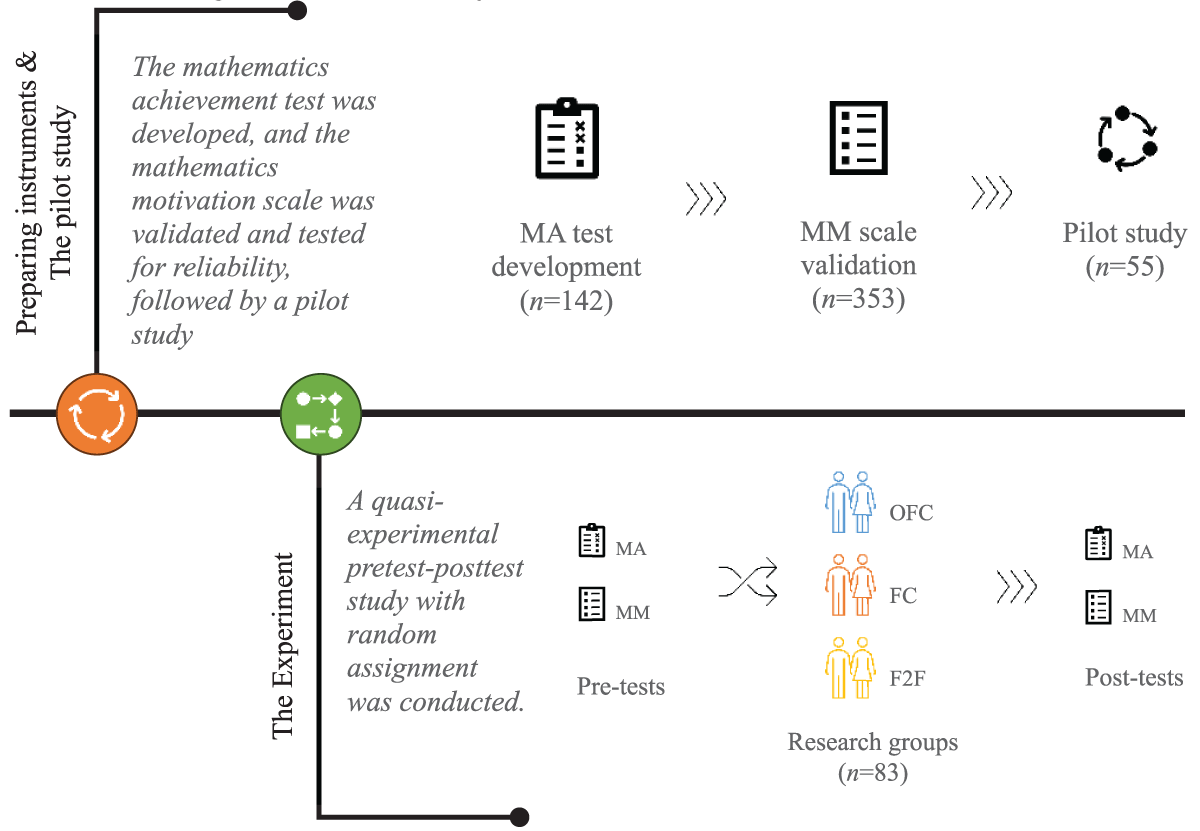
Figure 1
The research process.
Note. MA = Mathematics achievement, MM = Mathematics motivation.
The final phase of the study involved the actual implementation, which was conducted over a five-week period with a sample of 83 12th-grade high school students, who were distinct from the participants involved in the earlier phases. In the first week of this stage, the mathematics achievement test – covering the topics of limits and continuity – and the mathematics motivation scale were administered as pre-tests to the experimental and control groups. The instructional intervention was implemented over a three-week period. Throughout the intervention, the experimental group received instruction based on the OFC model, while the first control group followed the FC model, and the second control group received instruction through the F2F teaching method. In the fifth and final week, the same mathematics achievement test and mathematics motivation scale were re-administered as post-tests to assess the effects of the instructional interventions on student achievement and motivation.
During the instructional intervention, the Edpuzzle platform (https://edpuzzle.com) was used to manage online activities of the participants. The reason of selecting this platform is that the system records whether the students watched the videos shared, which parts of the videos they watched again, and the answers given by the students to the questions in the videos. In addition, multiple choice and fill-in-the-blank questions can be added to this platform, feedback can be given to students, and all activities of students can be reported.
The Edpuzzle system was used in the OFC and the FC groups. After the system was introduced to groups, the necessary introductions and activities were carried out by the researcher in order for all students to learn how to use the application. Since the students participating in the study were intensively preparing for the university exams, going to tutoring centers after school, taking private lessons and participating in mock exams, it was decided by the teachers and students to send the videos and other documents prepared before the lesson via Edpuzzle at least 3 days before the lesson and all the videos of the subject to be covered that week in bulk. Outside the class, groups were created on WhatsApp so that students could communicate with each other and their teachers quickly and easily. In this regard, WhatsApp was utilized to facilitate immediate communication and peer support, compensating for the lack of physical interaction in the online environment.
Prior to the in-class instructional activities, both the OFC and FC groups engaged with educational videos designed to support pre-class learning. These videos aligned with the Ministry of Education’s curriculum and textbook content. A total of 10 videos, each not exceeding 15 minutes in duration, were prepared to ensure learner engagement. The content of these videos, corresponding to the targeted learning outcomes, is detailed in Table 1.
Table 1
Video materials used in ofc and fc models.
| VIDEO NO | VIDEO CONTENT | DURATION | WEEK |
|---|---|---|---|
| 1 | Introduction (general expression on the subject) | 14:45 | Week 2 |
| 2 | Left-hand and right-hand limits and limits at endpoints of an interval | 07:28 | |
| 3 | Properties of limit 1 | 08:01 | |
| 4 | Properties of limit 2 | 09:39 | |
| 5 | Limits of composite functions | 06:17 | Week 3 |
| 6 | Limits of piecewise and absolute valued functions | 09:26 | |
| 7 | 0/0 indeterminate 1 | 14:28 | |
| 8 | 0/0 indeterminate 2 | 11:24 | |
| 9 | Continuity 1 | 07:58 | Week 4 |
| 10 | Continuity 2 | 11:24 |
Instructional activities conducted during both online and face-to-face sessions were designed to be consistent across all three groups. For instance, an instructional activity delivered online in the OFC group was mirrored as a face-to-face activity in the FC group. However, due to the inherent constraints of online environments, instructional activities in the OFC group were completed in a comparatively shorter time frame than those in the FC and F2F groups.
Data Analysis
For the first research question, a Mixed ANOVA was conducted to examine the effects of instructional methods (F2F, OFC, and FC) on students’ academic achievement in mathematics over time. This analysis allowed the researchers to assess not only the main effects of time and instructional method but also their interaction, thereby capturing potential differences in learning gains across groups throughout the intervention period. To address the second research question concerning the impact of instructional methods on students’ motivation toward mathematics, the same analytical procedure was applied.
A Mixed ANOVA was conducted using pre-test and post-test motivation scores to determine whether changes in motivation over time differed significantly across the three groups. Before the data analysis, a listwise deletion method was applied; participants who did not complete both the pre-test and post-test were excluded from the final analysis to ensure the integrity of the Mixed ANOVA results. Then, prior to the analysis, assumptions regarding normality (Shapiro-Wilk), homogeneity of variances (Levene), and homogeneity of covariance matrices (Box’s M) were examined. Based on these checks, the analysis proceeded under the premise that the data exhibited a distribution compatible with the requirements of the Mixed ANOVA. The open-source Jamovi software (version 2.3.28) was used to conduct all statistical analyses.
Findings
Results for mathematics achievement and motivation (overall and subcomponents: goal orientation, expectancy-value, self-efficacy) are presented sequentially. Using mixed-model ANOVA with method as between-subjects factor (three levels) and time as within-subjects factor (pre/post-test), we compared all three instructional approaches. We interpreted significant effects using Cohen’s (1988) η² thresholds (small = .01, medium = .06, large = .14). Table 2 presents complete descriptive statistics for all conditions.
Table 2
Descriptive statistics of quantitative findings.
| VARIABLE | F2F | OFC | FC | |||
|---|---|---|---|---|---|---|
| Pre-test M(SD) | Pos-test M(SD) | Pre-test M(SD) | Post-test M(SD) | Pre-test M(SD) | Post-test M(SD) | |
| Achievement | .09 (3.35) | 61.1 (20.7) | 1.25 (3.69) | 66.5 (21.6) | 1.45 (3.91) | 73.1 (23.5) |
| Motivation | 41.6 (5.09) | 42.2 (4.69) | 43.5 (4.82) | 44.7 (5.44) | 42.9 (5.30) | 42.1 (5.82) |
| Goal setting | 13.6 (3.65) | 13.2 (3.08) | 15.0 (3.08) | 16.2 (2.94) | 14.9 (3.61) | 14.3 (4.09) |
| Expectancy value | 14.1 (2.24) | 14.9 (1.90) | 14.6 (1.21) | 15.1 (1.86) | 14.2 (1.93) | 14.5 (2.01) |
| Self-efficacy | 13.9 (1.90) | 14.1 (2.01) | 13.8 (2.16) | 13.4 (2.69) | 13.8 (2.09) | 13.3 (2.05) |
Mathematics Achievement by Instructional Method Over Time
The mixed ANOVA results (Table 3) revealed several important findings regarding the effectiveness of the instructional methods. First, the analysis showed no statistically significant differences between the three-teaching method, F(2, 80) = 2.25, p > .05, indicating that no single method was superior to the others overall. Similarly, the non-significant time × method interaction, F(2, 80) = 2.01, p > .05, suggests that the pattern of improvement over time was consistent across all instructional conditions.
Table 3
Analysis of variance results for achievement scores.
| SOURCE | df | SS | MS | F | p | ηp2 |
|---|---|---|---|---|---|---|
| Within subjects | ||||||
| Time | 1 | 176985 | 176985 | 734.24 | < .001 | .808 |
| Time × Method | 2 | 970 | 485 | 2.01 | .140 | .004 |
| Error 1 | 80 | 19284 | 241 | |||
| Between subjects | ||||||
| Method | 2 | 1165 | 583 | 2.25 | .112 | .005 |
| Error 2 | 80 | 20717 | 259 | |||
However, we observed a significant main effect of time, F(1, 80) = 734.27, p < .001, with an exceptionally large effect size (Cohen, 1988). This indicates that all students showed substantial improvement in their understanding of limits and continuity concepts following instruction, regardless of which teaching method they experienced.
Post-hoc paired t-tests with Bonferroni correction confirmed these significant pre-to-post gains for each group. The F2F group improved by an average of 60.18 points, SE = 4.15, t(80) = 14.50, p < .001, the OFC by 65.21 points, SE = 4.48, t(80) = 14.55, p < .001, and the FC showed the largest gains of 71.61 points, SE = 3.94, t(80) = 18.16, p < .001. While all three instructional approaches were effective, the FC demonstrated numerically greater improvement (Figure 2).
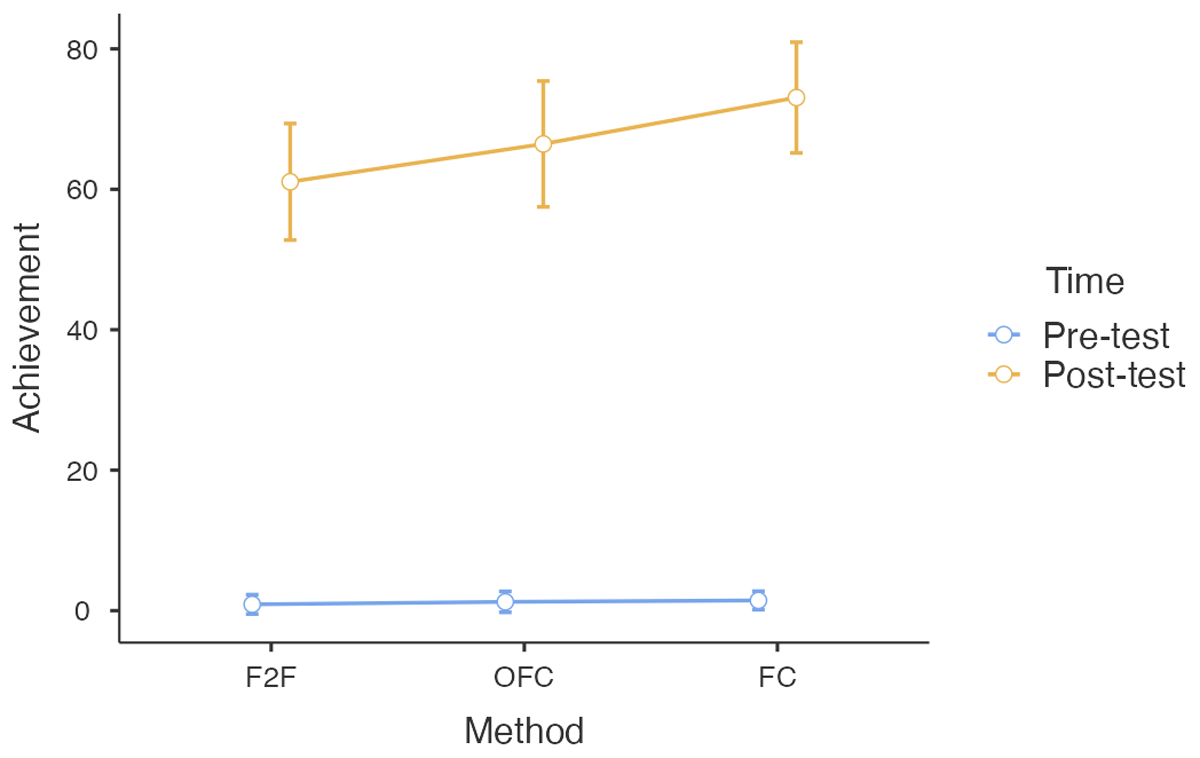
Figure 2
Comparison of pre-test and post-test mathematics achievement scores across all three instructional groups over time.
Mathematics Motivation by Instructional Method Over Time
The second question examined changes in students’ general mathematics motivation across three instructional approaches (F2F, OFC, FC) over time. As presented in Table 4, the analysis revealed no significant time × method interaction effect, F(2, 80) = .24, p > .05, suggesting that motivation patterns remained consistent across groups over time. Furthermore, neither instructional method alone, F(2, 80) = 1.54, p > .05, nor time independently, F(1, 80) = .38, p > 05, significantly influenced mathematics motivation. These results suggest that while the interventions effectively enhanced mathematical achievement, they did not differentially impact students’ overall motivation toward mathematics.
Goal Orientation by Instructional Method Over Time
The analysis of goal orientation – the first sub-dimension of mathematics motivation – revealed distinct patterns across instructional methods (Table 5). While no significant time × method interaction emerged, F(2, 80) = 2.78, p > .05, and time alone showed no effect, F(1, 80) = .03, p > .05, the instructional method significantly influenced goal orientation, F(2, 80) = 3.24, p < .05, ηp2 = .08, indicating medium effect size (Cohen, 1988), indicating that the choice of instructional model has a practical impact on students’ goal setting behaviors.
Table 5
Mixed ANOVA results for goal orientation.
| SOURCE | df | SS | MS | F | p | ηp2 |
|---|---|---|---|---|---|---|
| Within subjects | ||||||
| Time | 1 | .118 | .12 | .03 | .870 | <.001 |
| Time × Method | 2 | 24.293 | 12.15 | 2.78 | .068 | .07 |
| Error 1 | 80 | 349.683 | 4.37 | |||
| Between subjects | ||||||
| Method | 2 | 128 | 63.8 | 3.24 | .044 | .08 |
| Error 2 | 80 | 1576 | 19.7 | |||
Post-hoc Scheffé tests indicated that the OFC group (M = 15.6, SE = .64) demonstrated significantly higher goal orientation than the F2F group (M = 13.4, SE = .59) with a mean difference of –2.21, SE = .87, t(80) = –2.53, p = .046. As shown in Figure 3, only the OFC group exhibited an increase in goal orientation scores following the intervention. In contrast, both the FC and F2F groups experienced slight declines relative to their baseline scores. Notably, a divergent trend was observed in the sub-dimension of goal orientation compared to general achievement results. While other metrics showed uniformity, the OFC model uniquely fostered an increase in goal orientation scores.
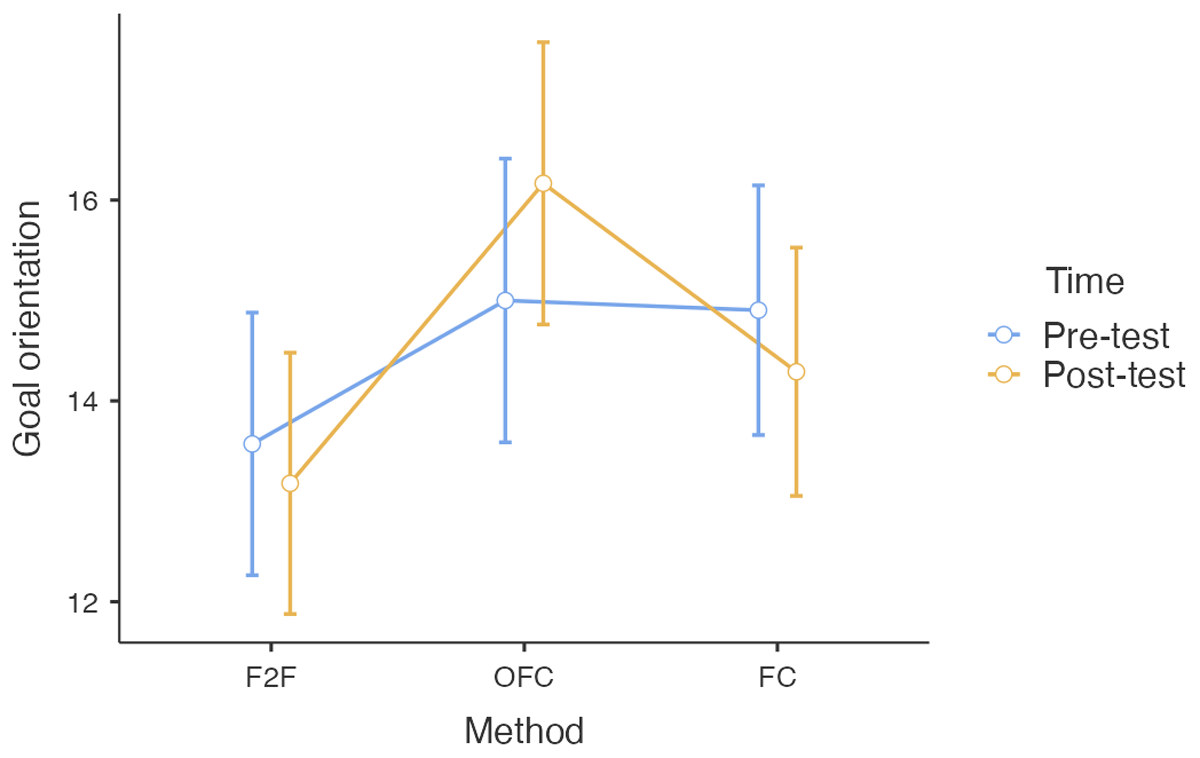
Figure 3
Goal Orientation scores by instructional method over time, highlighting the distinct increase observed only in the OFC group over time.
Expectancy-value by Instructional Method Over Time
The second sub-dimension of mathematics motivation is expectancy-value. Table 6 presents the results of the mixed ANOVA analysis examining how students’ expectancy-value scores changed over time based on the instructional method employed. The findings indicated that the interaction between instructional method and time was not statistically significant, F(2, 80) = .35, p > .05, nor was there a main effect of instructional method independent of time, F(2, 80) = .81, p > .05. However, a significant main effect of time was observed, F(1, 80) = 4.75, p < .05, ηp2 = .06 with a medium effect size (Cohen, 1988), suggesting that expectancy-value scores changed over time regardless of the instructional method. To further investigate which group(s) contributed to this time effect, paired-sample t-tests were conducted for each group using the Bonferroni correction (αnew = .05/3 = .02). The results revealed no statistically significant differences between pre- and post-test scores in the F2F, t(27) = 1.86, p = .07, OFC, t(23) = 1.27, p = .22, and FC groups, t(30) = .75, p = .46. Nevertheless, as shown in Table 2, the post-test scores of all groups were descriptively higher than their pre-test scores.
Self-efficacy by Instructional Method Over Time
The final sub-dimension of mathematics motivation is self-efficacy. Table 7 presents the results of the analysis examining the effect of instructional method on students’ self-efficacy over time. The findings revealed that there was no statistically significant interaction between instructional method and time, F(2, 80) = .76, p > .05, nor were there significant main effects of instructional method, F(2, 80) = .62, p > .05, or time, F(1, 80) = .80, p > .05, on students’ self-efficacy scores.
Discussion
This study investigated the effects of three instructional approaches – Online Flipped Classroom (OFC), Traditional Flipped Classroom (FC), and Face-to-Face (F2F) teaching – on students’ mathematics achievement and motivation. In this section, the research findings are first discussed in relation to each research question. Subsequently, considering the limitations of the present study, suggestions for future research are provided.
Interpretation of Mathematics Achievement Findings
Addressing the first research question, the results indicated no statistically significant interaction between instructional method and time for mathematics achievement. However, significant gains were observed within each group from pre- to post-test, suggesting that all three instructional approaches independently contributed to student learning improvements.
The absence of a significant interaction effect aligns with prior studies suggesting that the OFC model does not inherently outperform traditional methods in enhancing mathematics achievement (Doyle et al., 2024; Hew et al., 2020; Jia et al., 2022; Stöhr et al., 2020; Xue et al., 2022). Several factors may explain this finding. Research has consistently highlighted challenges associated with the OFC model, including reduced student-teacher interaction (Doyle et al., 2024; Şahin & Kılıç, 2025), limited active participation during sessions (Lo et al., 2024; Xu et al., 2023), and students’ insufficient self-regulation skills (Xue et al., 2022), all of which can diminish the model’s potential benefits.
In the present study, despite the use of pre-recorded videos and interactive tools like Edpuzzle during synchronous online sessions, students in the OFC group exhibited relatively lower levels of communication and engagement compared to their F2F peers. As final-year high school students preparing for university entrance exams, participants likely experienced significant work-load and time constraints, which may have affected their ability to engage fully with preparatory materials. Edpuzzle analytics further revealed inconsistent completion of pre-class tasks, supporting previous findings that the success of OFC heavily depends on students’ time management, motivation, and independent learning skills (Stöhr et al., 2020; Xue et al., 2022).
While some studies have reported that online learning environments can facilitate academic success and improve comprehension of abstract concepts (Ibili et al., 2024; Polat, Hopcan, & Arslantaş, 2022; Polat, Hopcan, Albayrak, et al., 2022), these outcomes are often contingent upon structured, active learning environments. The relatively unstructured nature of the current study’s digital environment may partially account for the lack of differential achievement gains across groups. Additionally, some studies in the literature have reported that the OFC model may negatively impact academic achievement (Du et al., 2023; Lo et al., 2024), which appears to contradict the findings of the present study. This discrepancy may be attributed to contextual and methodological differences. For instance, unlike Du et al. (2023), the current study was conducted within a naturalistic school setting, potentially offering a more authentic representation of the OFC model in practice.
Interestingly, although the instructional method did not significantly influence performance over time, the FC group demonstrated the greatest improvement in achievement, followed by the OFC and F2F groups, respectively. This trend suggests that models promoting active engagement and flexible learning opportunities – whether online or face-to-face – may offer more substantial academic benefits than traditional lecture-based instruction. The relatively smaller gains observed in the F2F group may reflect the more passive, teacher-centered nature of conventional classroom practices, which offer fewer opportunities for critical thinking and individualized feedback.
In summary, the findings of the present study underscore the importance of structured guidance, active engagement, and technological support in realizing the full potential of the OFC model. While OFC presents a viable alternative, particularly when face-to-face instruction is impractical, its success hinges on careful implementation that fosters consistent participation and supports student self-regulation.
Interpretation of Mathematics Motivation Findings
The second research question examined the effect of different instructional methods on students’ general mathematics motivation and its sub-dimensions: goal orientation, expectancy-value, and self-efficacy. The findings revealed no statistically significant difference between the groups over time in terms of general mathematics motivation. Nevertheless, the OFC group showed a greater increase in motivation scores compared to the other groups, albeit not at a significant level. This aligns with previous research reporting similar nonsignificant effects of OFC on motivation (Clark et al., 2022; Diningrat et al., 2023; Jia et al., 2022; Wang et al., 2022).
Several factors may underlie the lack of significant difference. Prior studies have emphasized that reduced student-teacher interaction (Clark et al., 2022; Wang et al., 2022), low participation rates (Jia et al., 2022), and insufficient peer communication (Diningrat et al., 2023) can limit motivational outcomes in OFC environments. In the present study, efforts were made to enhance interaction by creating a WhatsApp support group to provide real-time feedback and facilitate communication. However, while some students actively benefited from this, others remained passive, suggesting that asynchronous communication may not fully replicate the dynamic social interaction typical of F2F settings. Consequently, this diminished interaction may have contributed to the limited motivational gains observed in the OFC group, a conclusion supported by Clark et al. (2022).
In contrast, studies that integrated OFC with more structured, student-centered approaches – such as case-based learning (Yang et al., 2024) or regular collaborative activities (Diningrat et al., 2024) – reported more substantial motivational gains. The relatively limited incorporation of student-centered strategies in the current study may explain the comparatively modest motivational outcomes.
At the sub-dimensional level, the instructional method had no significant effect over time on expectancy-value or self-efficacy beliefs. However, a notable exception was observed in goal orientation, where the OFC group outperformed the F2F group. In this respect, the findings of the present study contribute to the existing literature by suggesting that OFC may represent a more effective instructional approach in terms of goal orientation. This finding suggests that the flexible and autonomous learning environment characteristic of OFC may align better with students’ intrinsic goals and learning preferences (Kesici, 2018). Interestingly, while goal orientation increased in the OFC group, it declined among students in the FC and F2F groups, indicating that OFC may offer unique motivational benefits under certain conditions. Given the medium effect size observed in goal orientation, this study also recommeds that practitioners can confidently adopt the OFC model to foster self-directed learning behaviors, particularly in advanced mathematics courses where student autonomy is critical. However, future research should explore whether this trend reflects a novelty effect or a more sustained shift attributable to the OFC structure.
Another notable observation was that some students did not consistently participate in the online sessions, which may be attributed to their lower expectancy-value beliefs and self-efficacy levels. This finding aligns with previous research suggesting that the OFC model does not significantly enhance students’ interest and that participation often declines over time (Jia et al., 2022). Although the OFC model is designed to offer flexibility and asynchronous access to learning materials – features intended to foster learner autonomy – this flexibility did not translate into increased motivation within the current study context. Students’ insufficient preparedness and limited opportunities for social interaction may have impeded their engagement, reinforcing prior conclusions that flexibility alone is not sufficient to sustain or enhance student motivation (Diningrat et al., 2023).
In conclusion, the findings suggest that challenges such as inconsistent participation, inadequate lesson preparation, and weak student-teacher communication can diminish the motivational benefits of OFC. Addressing these factors – by promoting active engagement, enhancing social presence, and ensuring task completion – may help unlock the full motivational potential of the model. Additionally, the increase in goal orientation among OFC participants indicates that students may perceive this model as more aligned with their academic aspirations. Future research should explore which specific components of the OFC approach most significantly contribute to fostering goal orientation in learners.
Limitation and Further Studies
Several limitations of this study should be considered when interpreting its findings. First, the research was conducted with senior high school students in their final year of study – a period characterized by intense exam preparation and numerous extracurricular demands. Due to their full schedules and limited availability outside classroom hours, some students were unable to consistently complete preparatory tasks or actively engage in online sessions. This limited engagement may have influenced the observed effects of the instructional methods on mathematics achievement and motivation.
Second, the instructional videos used in both the OFC and FC models were prepared by the researcher rather than the students’ regular classroom teachers. Although these materials were pedagogically aligned with the curriculum, future studies may benefit from involving course instructors in the development of instructional content. Teacher-generated materials, supported by appropriate technical training, could enhance the perceived relevance and authenticity of the content, potentially improving student engagement and, by extension, learning and motivational outcomes.
Third, student engagement emerged as a significant challenge during the implementation of the study. Some students, particularly those exhibiting lower intrinsic motivation or limited communication skills, demonstrated minimal involvement in both online and face-to-face activities. Future research should consider implementing proactive engagement strategies, such as early identification of less-involved students and collaboration with families and school counseling services to promote sustained participation.
Finally, the outcomes of this study may have been influenced by the specific choice of digital platforms (Edpuzzle and WhatsApp). The particular pedagogical affordances of these platforms may have shaped the observed findings. Therefore, this limitation should be taken into account when interpreting the results of the present study. Future research should further investigate how the findings may vary when different digital platforms with distinct pedagogical affordances are employed.
Given these limitations, it is recommended that future studies replicate this research design across diverse educational levels and contexts to enhance the generalizability of the findings. Expanding the participant pool to include different age groups, school types, or cultural settings may yield more comprehensive insights into the differential effects of instructional methods like OFC. Additionally, further research should explore which specific components of the OFC model are most influential in fostering student motivation – particularly goal orientation – and how these can be systematically strengthened in practice.
Conclusion
This study investigated the impact of the Online Flipped Classroom model on students’ academic achievement and mathematics motivation. Three instructional approaches were compared over time: the OFC model for the experimental group, the FC model for the first control group, and the traditional F2F method for the second control group.
The findings revealed that while there was no statistically significant difference among the groups in terms of overall academic achievement and general mathematics motivation, students in the OFC group exhibited a relatively greater increase in motivation levels. Notably, the OFC model had a significant positive effect on the “goal orientation” sub-dimension of mathematics motivation when compared to F2F instruction, suggesting that it may contribute to students’ sense of purpose in learning.
Taken together, the results suggest that although the OFC model may not produce immediate or significant gains in overall achievement and motivation under all conditions, it holds potential as a viable and flexible instructional alternative, especially in contexts where face-to-face learning is constrained. Drawing directly from the study’s finding that the OFC model significantly improved goal orientation, it is recommended that instructional designers specifically leverage the model’s flexible structure to foster learner autonomy in challenging topics. With appropriate design, preparation, and student support mechanisms, the OFC model can contribute meaningfully to students’ motivational development and serve as a complementary or substitute teaching strategy in diverse educational settings.
Sustainable Development Goals (SDGs)
This study is linked to the following SDG(s): Quality education (SDG 4), Industry, innovation and infrastructure (SDG 9), and Reduced inequalities (SDG 10).
Ethics and Consent
Ethical approval for the project was obtained from Erciyes University the Social Sciences and Humanities Scientific Ethics Committee with the decision numbered 571.
Data Accessibility Statement
The datasets used and/or analysed during the current study are available from the corresponding author on reasonable request.
Author Contributions (CRediT)
Emre Baysal: led the research experiment and played a key role in the study’s conception and design. Hamza Polat: contributed to the data analysis and interpretation of the results. Danyal Soybaş: provided valuable insights during the review process and contributed to the final revisions of the manuscript. All authors reviewed and approved the final version of the manuscript.