
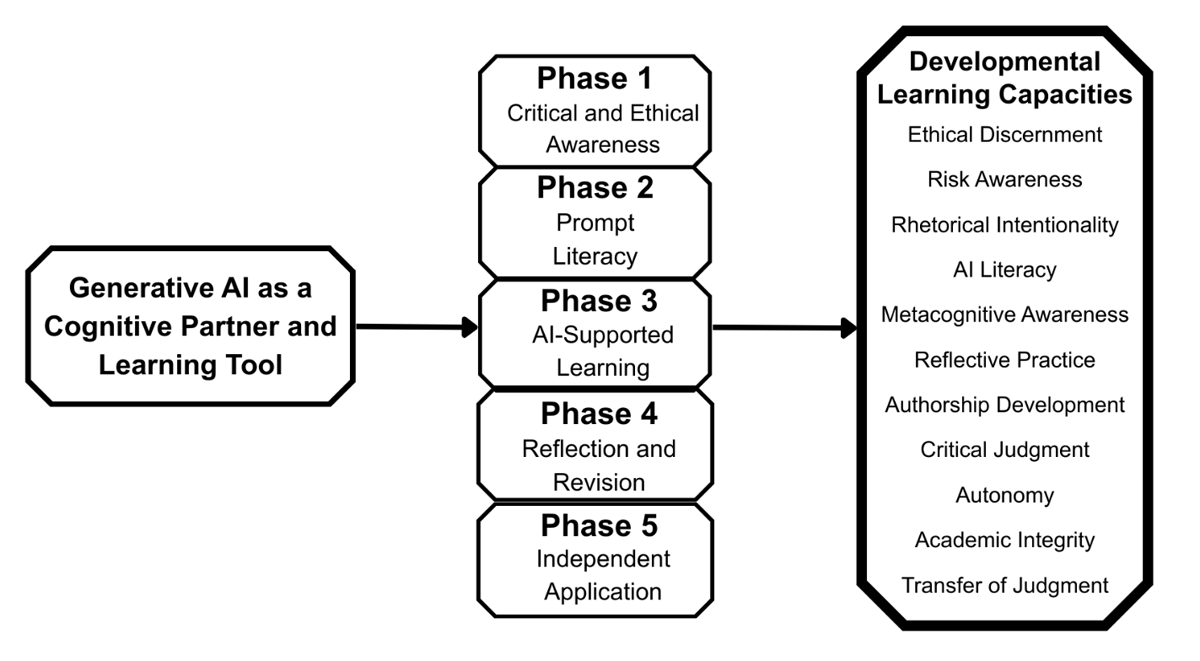
Figure 1
Instructional Model for Human-Centered Generative AI Engagement.
Table 1
Sample Rubric for Assessing Prompt Literacy.
| CRITERION | DEVELOPING | PROFICIENT | EXEMPLARY |
|---|---|---|---|
| Iterative Refinement | Submits a single prompt with little adjustment; accepts the first output. | Revise prompts across two or three attempts in response to output quality. | Systematically refines prompts, articulating why each change improves the response. |
| Critical Interpretation of Output | Accepts AI output at face value; little evaluation of accuracy or bias. | Identifies some inaccuracies, gaps, or biases in the output. | Rigorously evaluates output for accuracy, bias, and relevance, and explains the reasoning. |
| Reflective Revision | Uses AI output with minimal personal revision or reflection. | Revise the output and notes on how it shaped the final work. | Integrates and transforms output through substantive revision, reflecting critically on how AI influenced their thinking. |
Table 2
Instructional Model for Human-Centered Generative AI Engagement: Phases, Pedagogical Focus, and Developmental Outcomes.
| Phase | PEDAGOGICAL FOCUS | DEVELOPMENTAL OUTCOMES | |
|---|---|---|---|
| 1. | Critical and Ethical Awareness | Understanding Risks and Responsibilities | Ethical Discernment and Risk Awareness |
| 2. | Prompt Literacy | Engage with the Prompt Literacy Cycle | Rhetorical Intentionality and AI Literacy |
| 3. | AI-Supported Learning | Use LLMs for Brainstorming and Drafting | Metacognitive Awareness and Reflective Practice |
| 4. | Reflection and Revision | Critically Evaluate and Refine Work | Authorship Development and Critical Judgment |
| 5. | Independent Application | Apply AI Responsibly in Academic Work | Autonomy, Academic Integrity, and Transfer of Judgment |
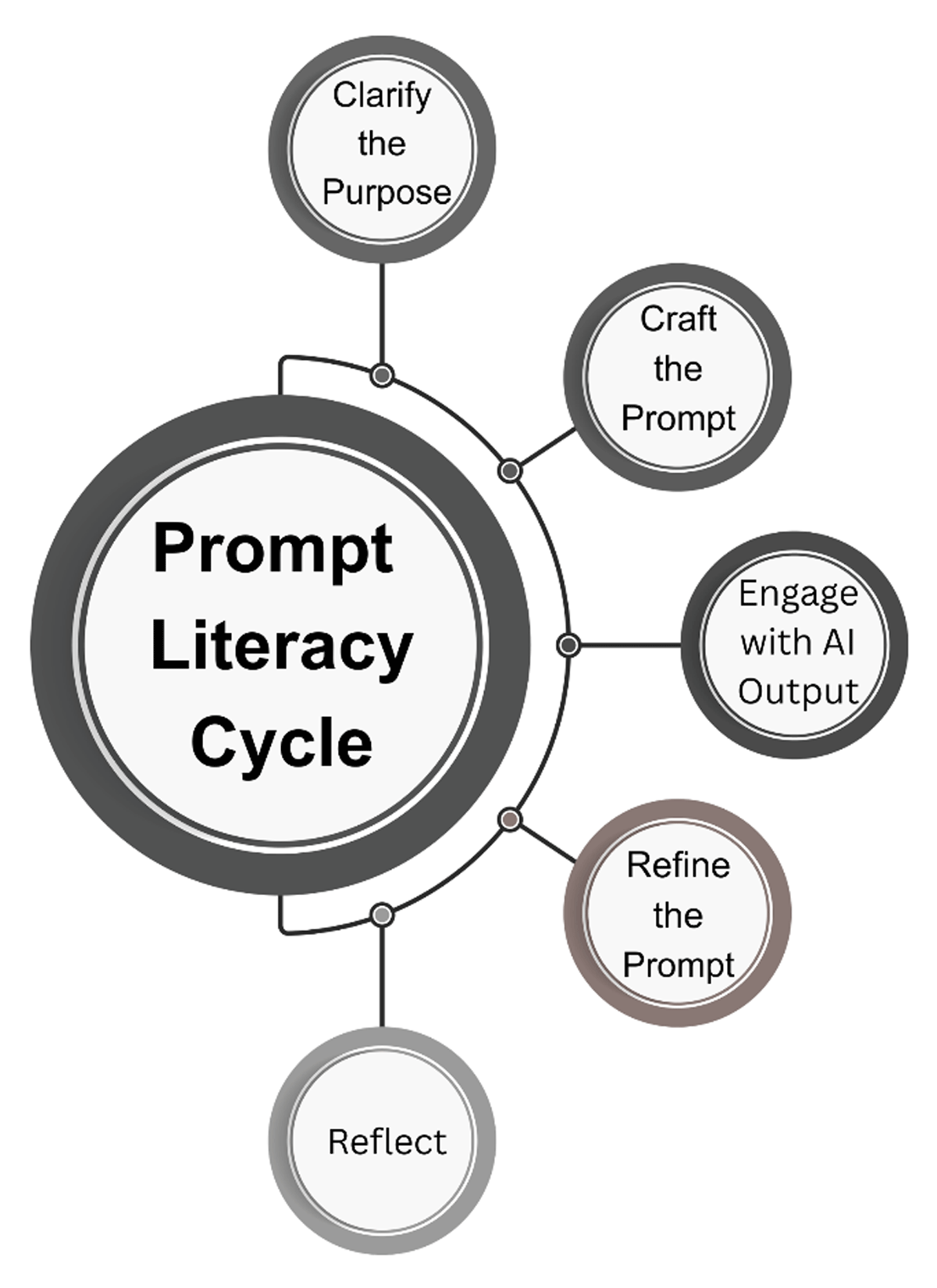
Figure 2
Prompt Literacy Cycle.
Table 3
Sample Teaching Applications.
| PHASE AND INSTRUCTIONAL GOAL | TEACHING APPLICATIONS |
|---|---|
| Phase 1: Critical and Ethical Awareness Goal: Introduce LLM basics, limitations, and ethics. |
|
| Phase 2: Prompt Literacy Goal: Teach students to engage with LLMs using the Prompt Literacy Cycle. |
|
| Phase 3: AI-Supported Learning Goal: Use LLMs to enhance, not replace, student work. |
|
| Phase 4: Reflection and Revision Goal: Promote metacognition and thoughtful LLM-influenced revision. |
|
| Phase 5: Independent Ethical Application Goal: Support transfer of skills beyond the classroom. |
|