
Introduction
AI in education is not only reshaping the educational paradigm but also human knowledge, cognition, and culture (Hwang et al., 2020; Jose et al., 2025). Despite the potential to shape human cognition that extends beyond the mere acquisition of information, AI is seen to put individuals’ cognition and cognitive development at risk, even in the face of the opportunities it offers (Cukurova, 2025; Dergaa et al., 2024; Jose et al., 2025; Katsantonis & Katsantonis, 2024; Kosmyna et al., 2025; Zhai et al., 2024). While skills such as critical thinking, problem-solving, productivity, literacy, and self-regulation can be enhanced by efficient AI usage, simply receiving ready-made answers through these tools, accepting these answers without questioning, or leaving the production process entirely to AI can weaken those skills. For instance, although AI supports students’ creative thinking potential and analytical skills, it is observed that the use of AI encourages students to be lazy in cognitive activities and makes them indecisive in taking personal initiative in their learning processes (Flores et al., 2025; Zhai et al., 2024). Therefore, considering students’ positive cognitive and emotional tendencies towards AI (Dergaa et al., 2024), it is important to direct these tendencies correctly to support cognitive development and meaningful learning (Giannakos et al., 2025; Katsantonis & Katsantonis, 2024).
Meaningful learning and cognitive development are contingent upon the effective and efficient use of cognitive resources (Mayer, 2013; Sweller, 2020). Research shows that perceived cognitive load can be reduced in AI-assisted language learning by using activities with individualized feedback, adaptive learning, interactive exercises, and data-driven insights (AlShaikh et al., 2024; Ebadi & Amini, 2024; Feng, 2025; Singha et al., 2024; Yin et al., 2024). However, these studies highlight the effectiveness of using AI in reducing extraneous cognitive load in practice-based applications. Conversely, studies examining the working memory processes and internal cognitive load suggest that AI use can elevate perceived cognitive load and erode the efficiency of cognitive resources (Cukurova, 2025; Jose, et al. 2025; Kosmyna et al., 2025).
Possessing the capacity to both enhance and diminish cognitive processes, AI embodies a paradoxical nature for educational paradigms (Jose et al., 2025). While AI technologies present numerous opportunities, they also raise concerns such as excessive dependence on technology and diminished human interaction (Akgun & Greenhow, 2022; Bond et al., 2024). In this regard, overreliance on AI may undermine essential cognitive functions, including creativity, memory, attention, and decision-making capacity. The Cognitive Miser Theory (CMT) clarifies the tendency by asserting that individuals seek to minimize cognitive effort during task performance and prefer heuristics and readily available information to the more demanding process of deep, analytical thought (Stanovich, 2021).
Employing AI in education to enhance social competence, emotional intelligence, and diverse metacognitive competencies is vital to ensuring that learning is informed as much by authentic, real-world interactions as by the assimilation of information (Cukurova, 2025; Mutlu-Bayraktar, 2024; Karaoglan Yilmaz & Yilmaz, 2025). Moreover, growing evidence indicates that intensive AI use may negatively affect critical thinking performance, epistemic judgement, and reflective reasoning by encouraging surface-level processing and answer-oriented engagement rather than problem-oriented inquiry (Flores et al., 2025; Jose et al., 2025; Zhai et al., 2024). Accordingly, it is considered essential to integrate AI effectively into learning experiences attuned to learners’ cognitive development. There is an urgent need to explore how AI, as it becomes increasingly integrated in education, can be leveraged to enhance learning potential without compromising cognitive abilities (Flores et al., 2025; Jose et al., 2025). Building on the previously stated concerns, this study aims to comprehend the influence of AI use on doctoral students’ cognitive processes, thinking strategies, and self-efficacy perceptions in self-regulated learning (SRL) through the lens of the CMT. From a broader educational standpoint, employing AI to foster social competence, emotional intelligence, and metacognitive regulation is essential for ensuring that learning remains grounded not only in information acquisition but also in authentic human interaction and reflective meaning-making (Cukurova, 2025; Mutlu-Bayraktar, 2024; Karaoglan Yilmaz & Yilmaz, 2025). Accordingly, AI should be integrated into learning environments in ways that support both cognitive development and social engagement, rather than replacing them. Yet, despite the rapid diffusion of AI in higher education, there remains a critical gap in understanding how learners strategically negotiate cognitive effort when AI becomes embedded in complex academic task performance, particularly at the doctoral level.
Addressing the aforementioned gap, the present study aims to examine the influence of AI use on doctoral students’ cognitive processes, thinking strategies, and perceptions of self-efficacy through the analytical lens of CMT. Focusing on doctoral students in educational technology and distance education, the study investigates how AI is utilized in the completion of difficult and complex academic tasks, such as literature synthesis, academic writing, research design, and analytical reasoning. Addressing this gap, the present study examines how doctoral students in educational technology and distance education use AI while completing cognitively demanding academic tasks, including literature synthesis, academic writing, research design, and analytical reasoning. Accordingly, the study seeks to answer the following research question:
“What are the critical factors in educational technology doctoral students’ artificial intelligence usage process in terms of completing difficult and complex tasks according to the Cognitive Miser Theory?”
Literature
Designing, developing, implementing, and evaluating learning experiences with the use of ever-changing and transforming technologies makes more interactive and human-centered experiences possible every day (Giannakos et al., 2025). By offering effective, interactive, and personalized learning experiences, AI technologies provide many advantages, including enhancing academic achievement, supporting participation and motivation in learning, and developing skills such as critical thinking and problem-solving (Akgun & Greenhow, 2022; Cukurova et al., 2020). It is possible to integrate diverse applications adapted to learning needs and preferences into key educational activities, specifically communication, feedback, and evaluation through AI by accounting for individual differences.
AI, which offers personalized and adaptive learning experiences, is becoming increasingly important in helping students manage their progress toward individual learning goals (Xia et al., 2026). By fostering learner autonomy and self-regulation, AI supports the “foresight,” “performance,” and “reflection” stages of Zimmerman’s (2002) SRL model in achieving individual learning goals (Banihashem et al., 2025; de Mooij et al., 2025; Panadero, 2017; Tsakeni et al., 2025; Wang & Lin, 2023). In SRL, which refers to an individual’s ability to set their own learning goals and manage their learning process accordingly, individual regulation strategies are evolving into AI-supported regulation strategies (Tsakeni et al., 2025). Consequently, AI, as a co-regulator of SRL, has become both a prerequisite and a tool for self-regulation. “Metacognition”, which refers to an individual’s awareness of their own learning processes and their capacity to regulate their cognition, is also a key prerequisite for successful SRL (Efklides, 2011; Flavell, 1979; Jin et al., 2023; Panadero, 2017; Schraw & Moshman, 1995; Tsakeni et al., 2025). Therefore, it is important to support the cognitive and metacognitive competencies necessary for its conscious and goal-oriented use in SRL with AI (Karaoglan Yilmaz & Yilmaz, 2025).
Ever-evolving AI technologies, which offer interactive and human-centered learning experiences, present both opportunities and significant risks that warrant careful consideration, namely cognitive, social, and ethical (Akgun & Greenhow, 2022; Cukurova, 2025; Giannakos et al., 2025; Han et al., 2024; Hwang et al., 2020; Jose et al., 2025). While social and ethical risks include dimensions such as security, surveillance, autonomy, plagiarism, transparency, algorithmic bias, and discrimination (Akgun & Greenhow, 2022; Zhai et al., 2024), concerns focusing on cognitive development touch on retention (recall), problem-solving, critical thinking, analytical thinking, decision-making, self-regulation, metacognitive awareness, cognitive flexibility, and creativity skills (Flores et al., 2025; Jose et al., 2025; Karaoglan Yilmaz & Yilmaz, 2025; Zhai et al., 2024). Therefore, recognizing not only social and ethical risks but also cognitive processes is crucial for the effective and efficient integration of AI into education.
Cognitive Concerns on AI Use
Artificial intelligence (AI), with the potential to improve cognitive processes, reshape educational methodologies, and provide adaptable personalized learning experiences, brings about concerns regarding its impact on the use of cognitive resources and learning efficacy, as well as social and ethical matters (Dergaa et al., 2024; Gkintoni et al., 2025; Han et al., 2024; Katsantonis & Katsantonis, 2024; Karaoglan Yilmaz & Yilmaz, 2025). In the context of retention, problem-solving, critical thinking, and creativity skills, the use of AI as a facilitator that supports SRL and meaningful learning is essential for cognitive development (Jose et al., 2025). Therefore, AI in educational contexts can act as a tool, agent, or method for externalizing, internalizing, or expanding human cognition. While externalization of cognition is the definition and modeling of tasks with an AI tool, in internalization processes, AI can be used to help change thought representations (Cukurova, 2025). In expanding human cognition, AI are being used in a hybrid approach based on human-AI interaction. Therefore learning, cognition, and AI paradigms should be examined within the context of cognitive load theories of learning (Mayer, 2013; Sweller, 2020) and are related to the effective management of cognitive resources (Jose et al., 2025).
By offering interactive, human-centered, and personalized experiences, AI supports cognitive processes and presents significant opportunities for focusing attention on information, retaining it in working memory, and integrating new information into long-term memory as prior knowledge (Cukurova et al., 2020; Giannakos et al., 2025; Sánchez Vera, 2024). In particular, AI has strong potential for reducing perceived cognitive load by enabling the offloading of working memory capacity to more complex cognitive tasks (AlShaikh et al., 2024; Ebadi & Amini, 2024; Feng, 2025; Gerlich, 2025; Meng et al., 2025; Singha et al., 2024; Yin et al., 2024). However, alongside compelling examples of AI reducing perceived cognitive load, there are concerns that it may diminish cognitive capacity due to excessive cognitive overload or cognitive offloading. In critical AI use, where expertise and metacognitive awareness are high, perceived cognitive load increases over time (Schulze et al., 2025). Conversely, in situations where expertise, metacognitive awareness, and a critical approach decline while cognitive offloading increases uncontrollably, AI use impairs the utilization of cognitive capacity (Kosmyna et al., 2025; Yiğit, 2025).
Studies examining situations in which students feel cognitively inadequate or exhibit automatic AI usage behavior when completing complex tasks indicate that such behaviors undermine metacognitive skills such as critical thinking and problem-solving (Jose el al., 2025; Kosmyna el al., 2025; Han et al., 2024; Schulze el al., 2025; Singha el al., 2024; Tsakeni el al., 2025; Zhai el al., 2024). Similarly, when AI is used automatically in time-pressured tasks, students tend to avoid using their cognitive resources, opt for shortcuts, rely on AI, become impatient, and experience a decline in motivation (Li et al., 2026; Kim et al., 2026). However, Li and colleagues (2026), who note that perceived cognitive load increases as task complexity rises, point out that students turn to AI to reduce this load and that this behavior leads them toward an AI dependency that distances them from critical thinking in order to reduce cognitive effort (e.g., cognitive offloading). The replacement of critical thinking with automated, intuitive use leads to cognitive overload and a decline in learner autonomy (Tsakeni et al., 2025). This phenomenon, also known as the “Google effect,” indicates a decline in cognitive resilience due to the loss of practice in tackling challenging tasks; it is likened to atrophy, similar to how a muscle wastes away when not used (Azarov & Gorokov, 2025; Khan & Suhluli, 2025; Gerlich, 2025; Strati, 2026).
The Relation of Cognitive Miser Theory and Complex/Difficult Tasks
The Cognitive Miser Theory (CMT) posits that individuals tend to conserve cognitive resources by processing only the amount of information they perceive as necessary to form an opinion or make a decision, rather than engaging in exhaustive analysis. This tendency often results in decisions made with insufficient information, as individuals are motivated to minimize mental effort unless the perceived benefit justifies greater cognitive investment (Todaro et al., 2023). People explicitly and implicitly seek to minimise cognitive effort in decision-making, interpreting any excessive use of cognitive resources as a cost. They typically expend only the effort required to reach a satisfactory, rather than optimal, decision (Todaro et al., 2023).
The theory is closely linked to dual-process models, which distinguish between fast, heuristic (Type 1) and slow, systematic (Type 2) processing. Cognitive misers default to heuristic processing whenever possible, relying on mental shortcuts, emotions, and surface-level information to make quick judgments (Toplak et al., 2014). There is a recognised trade-off between the effort invested in decision-making and the accuracy of the outcome. As cognitive effort decreases, decision accuracy may also decline, but individuals aim to balance effort and accuracy to achieve an adequate result without unnecessary cognitive expenditure. Also, due to high demands reduce efficiency and decision quality (Fan et al., 2025), perceived cognitive load (the total mental effort required) plays a pivotal role.
AI systems are designed to address cognitive challenges similar to those solved by humans, converting cognitive capabilities into computational formulas to solve problems and make decisions. The ultimate goal is to achieve human-level intelligence in machines, with applications spanning various domains such as education, business, and healthcare. In summary, the CMT provides a framework for understanding how doctoral students might interact with AI, often using them to minimise cognitive effort in complex academic tasks. This is because the limits of cognitive resources are closely related to not only the design of learning materials but also to the cognitive processes of individuals (Mayer, 2013; Mutlu-Bayraktar, 2024). This interaction is shaped by cognitive load considerations, trust in AI, and ethical decision-making, highlighting the intertwined roles of cognitive psychology and AI in academic research environments (Todaro et al., 2023). Such interaction shaped by cognitive resources can be limited by complex and difficult tasks, which include understanding, thinking, relating, planning or conducting a study, academic writing, making a holistic literature review, time and resource management, analyzing, synthesizing, and evaluating the information, etc. For the judicious management of cognitive resources, learning experiences should be designed to account for tasks that demand high cognitive involvement and complexity.
Examining AI in Education Within The Critical Lens of Cognitive Miser Theory
Cognitive miserliness can be a risk to meaningful learning and the cognitive processing stages (selection, organization, integration) (Mayer, 2013) in the realization of deeper learning. Although perceived cognitive load is predicted to decrease in AI-supported applied learning practices (Feng, 2025), the use of AI in active cognitive learning processes has been observed to increase perceived cognitive load and negatively affect the use of cognitive resources (Jose, et al. 2025; Kosmyna et al., 2025). This is thought to increase preferences for easy and unquestioning access to information, particularly in line with current AI-based learning approaches, thus jeopardizing cognitive development in academic tasks (Flores et al., 2025; Jose et al., 2025; Zhai et al., 2024). Therefore, for the effective and efficient use of AI in education, it is important to adopt an approach that focuses on cognitive development in AI-supported learning processes and ensures the efficient use of cognitive resources. It is important to preserve and develop skills such as retention, problem solving, critical thinking and creativity, especially in difficult and complex tasks where AI is used, by taking into account intuitive approaches that are fast, automatic, and performed with low cognitive effort.
Methodology
Guided by a qualitative research approach that allows for in-depth exploration and understanding of a situation (Creswell & Creswell, 2018), and using a single-case design (Yin, 2017) to investigate why doctoral students prefer AI for tasks that require cognitive effort, this research investigates the impact of doctoral students’ AI usage preferences on their thinking processes and self-efficacy perceptions regarding automated usage habits that develop over time. The primary reason for adopting the single-case design, which is suitable for use in situations that aim to clarify a specific case (Yin, 2017), is to examine the impact of AI usage reasons, which represent a multidimensional and contextual phenomenon, on academic tasks that require cognitive effort. This study adopted a holistic single-case design. Although participants were recruited from two universities, the institutions were not treated as separate units of analysis; rather, they provided contextual diversity within a single case. The research problem addresses how individual preferences in the use of AI are shaped by technological competencies, perceptions, academic context dynamics, and ethical considerations. The case covers the factors that influence why doctoral students in educational technology and distance education use artificial intelligence tools when completing difficult and complex academic tasks. Therefore, as the research problem encompasses social, technological, and cognitive dimensions with complex intertwined dynamics, the single-case design is considered appropriate for gaining an in-depth understanding of the complex dynamics.
Research Context
The data of this study were collected from two universities that offer educational opportunities through educational technology and distance education programs. Since there were only three doctoral-level educational technology programs in Türkiye, the target audience was expanded to include doctoral students in distance education programs. In accordance with the targeted criteria, doctoral students at two institutions were reached. Before participants were included in the study, the ethics committee of the university to which the researchers are affiliated reviewed and approved the study’s appropriateness. The necessary permissions to conduct the study were obtained, and the procedures in the study were carried out in accordance with the ethical standards of both institutions. The participants, who are pursuing degrees at two different universities in Türkiye, representing diverse educational backgrounds, were doctoral students studying educational technology and distance education. The participants included students who are currently in the thesis or course phase of their doctoral studies, use AI in their academic work on a daily basis, and have a long-time interaction and experience working with various AI tools. In this study, in which participation was entirely voluntary, no comparisons were made between participants’ individual or organizational uses of AI. Although this case study was conducted on two seperate organizations, the study sought to gain an in-depth understanding of the participants’ shared experiences with AI use. Because the participants comprised a diverse range of adult learners actively engaged with AI-enhanced learning resources, this group provided a methodologically relevant context for understanding the reasons for using AI in complex and difficult academic tasks. Data were collected through semi-structured interviews, allowing for the participation of individuals within a context relevant to the case identified within the study.
The participant group included in the study through purposive sampling (Table 1) consists of individuals (n = 7) who are continuing their doctoral studies in educational technology or distance education. The participant group was recruited via social media, prioritizing accessibility and ease of reach to maximize accessibility. Voluntary participation was fundamental to the inclusion of all participants. The criteria for including participants in the study were “having a postgraduate education at a state or private university in Türkiye”, “continuing doctoral studies in educational technology or distance education”, “frequently using AI in academic and independent learning processes”, and “voluntarily participating in research”.
Table 1
Participant demographic information.
| NO | FIELD | AFFILIATION | PROFESSION | AGE | GENDER |
|---|---|---|---|---|---|
| P1 | Educational Technology | U1 | Teacher | 40 | Female |
| P2 | Educational Technology | U1 | Teacher | 29 | Female |
| P3 | Distance Education | U2 | Instructional designer | 52 | Female |
| P4 | Educational Technology | U1 | Teacher | 30 | Female |
| P5 | Distance Education | U2 | Instructor | 39 | Male |
| P6 | Distance Education | U2 | Instructor | 43 | Female |
| P7 | Educational Technology | U1 | Teacher | 36 | Male |
The researchers, who are a full-time faculty member and a doctoral student at one of the two universities where the study was conducted, clearly disclosed their positions at the relevant institution prior to the semi-structured interviews to ensure the study’s transparency and reflexivity. Since participants were contacted through informal WhatsApp groups, necessary precautions were taken to minimize any biases that might arise from institutional ties. It was guaranteed that the study would be conducted based on the students’ voluntary participation, that students could withdraw from the study at any time, that they would not be subject to any grading or scoring system, and that the interviews would be free from academic pressure. In addition, it was clearly stated that the confidentiality of the data collected would be protected and that personal information would be concealed using pseudonyms.
Data regarding the defined situation were collected through semi-structured interviews with the participants between May and June 2025. The interview questions were prepared based on the Cognitive Miser Theory and expert opinions. Participants were informed about the research, and their approval for recording the interviews and for their voluntary participation was obtained. Each interview, facilitated through video conferencing, had an approximate duration of 30 minutes. The records obtained as a result of the interviews were transcribed.
Data Analysis
Thematic analysis of data obtained through semi-structured interviews was conducted using an open coding approach (Braun & Clarke, 2019). The codes and themes were generated inductively from participants’ accounts rather than being predetermined by the theory. Thematic analysis, which allows for an inductive approach to examine data obtained from different types of sources related to a situation, enables in-depth examination, classification, evaluation, correlation, description, and interpretation of different dimensions of situations (Fraenkel et al., 2023). In this research, the data obtained and transcribed were first read from beginning to end, and then, considering the general structure of these data, codes, subthemes, and themes were extracted using an inductive approach. The findings obtained were described and interpreted to answer the research question. The qualitative data obtained in this study were analyzed using the thematic analysis method suggested by Braun and Clarke (2019). Thematic analysis is defined as the process of identifying, analyzing, and reporting meaningful patterns within data and offers a flexible yet systematic approach to qualitative research. This study adopted an inductive approach to develop meaningful themes that directly address the research questions.
During the data analysis process, the data obtained from interview transcripts were first read repeatedly to gain awareness of the overall structure. Qualitative data analysis tools were not employed to achieve a comprehensive understanding of the situation under review. Instead, the analyses were conducted manually by the researchers. Meaningful data fragments were then extracted, and concise, descriptive codes based directly on participant discourse were developed. Similar or related codes were brought together to form meaningful subthemes (categories), which were then grouped under a more abstract theme. The developed theme structure was reviewed and overlapping or weak areas were reorganized.
Trustworthiness
Data obtained from participants during the interviews was verified through member checking (Fraenkel et al., 2023). For member checking, participants were first asked to confirm their responses during the interview in real time. Subsequently, the transcripts prepared after the interviews were presented to the participants for review, and member checking was thus conducted in two stages. Following the analysis phase, participants were asked to evaluate the codes and themes derived from the approved raw data. To ensure credibility, member checking was conducted by inviting participants to interpret and verify the analysis report (Creswell & Creswell, 2018; Tisdell et al., 2025).
Since the data were collected through semi-structured interviews, methodological triangulation was not claimed. Instead, credibility was supported through member checking, negative case analysis, theory triangulation, researcher cross-checking, and expert review. First, the fundamental perspectives of Cognitive Miser Theory were examined to establish a consistent rationale for the creation of codes and themes (Creswell & Poth, 2016; Miles & Huberman, 1994). Then, the analysis was conducted thematically, aligning with the Cognitive Miser Theory. As a third method to strengthen the transferability, negative or inconsistent information was also evaluated, aiming to provide a comprehensive and diversified depiction of the described situation (Miles & Huberman, 1994). The analysis was conducted thematically by the researchers. To ensure the dependability of the findings, the data were compared and interpreted using a codebook (Creswell & Creswell, 2018). The developed codes and themes were independently compared and cross-checked by the researchers (Fraenkel et al., 2023; Tisdell et al., 2025). In the final phase, a field expert confirmed the dependability of the results.
Findings
This research sought to answer the question: “What are the critical factors in educational technology doctoral students’ AI usage process in terms of completing difficult and complex tasks according to the Cognitive Miser Theory?”. The findings obtained from the interviews conducted in the study, which examined graduate students’ use of AI in the context of Cognitive Miser Theory, represent four themes: (1) the supportive role in decision-making, (2) the effects on cognitive processes, (3) the adaptive role in developing habits, and (4) the transformative role on strategic study approaches. A total of 12 subthemes were created under these four themes by analyzing the interviews (Figure 1).
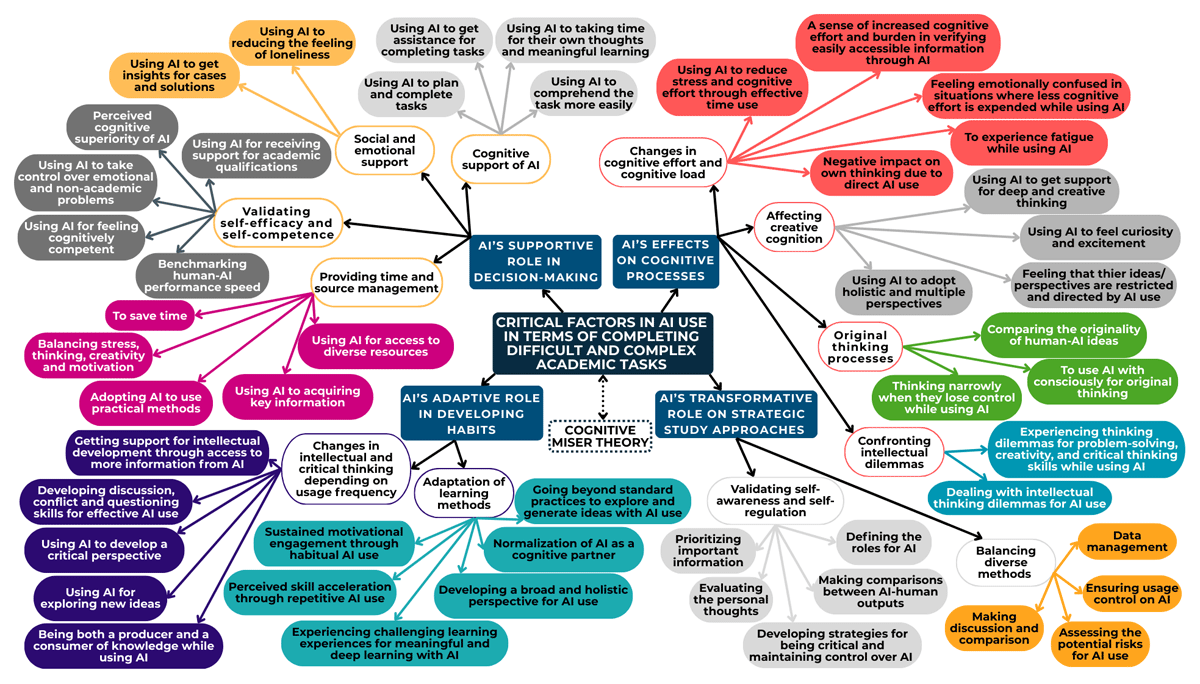
Figure 1
Themes, subthemes and codes.
The Role of AI in Academic Decision-Making
The findings obtained in the context of the theme titled “the supportive role in decision-making,” in which the students’ opinions about their thinking processes in difficult and complex academic tasks were taken, were coded under four headings: (a) cognitive support, (b) social and emotional support, (c) validating self-efficacy and self-competence, and (d) providing time and source management.
Students stated that in difficult and complex tasks, they first try to understand and stage the process with their own cognitive efforts and then use AI as an assistant that provides emotional support in managing resources, stress, and time. Although AI is a guide or a consulted information provider, students emphasized that they first made a cognitive effort to make sense of the process. In line with these findings examined under the subtheme of “cognitive support,” it can be stated that students receive assistance from AI in these processes where they exert intense cognitive effort, supporting their internal motivation in both academic and emotional dimensions. In this regard, students described themselves as more comfortable, less stressed, and more confident when using AI. Therefore, students are observed to seek support for structuring the learning process as a result of cognitive effort during the thought processes of AI use. Furthermore, using AI on difficult and complex tasks appears to have a positive emotional impact on students’ thought processes.
“I mean, when a difficult and complex task comes my way, for example, I used to be a more stressed person, but now that ChatGPT has come into my life, my stress has been cut in half. So, I don’t think that task is impossible anymore, given the resources I have now. I think I have an assistant, a helper, and I face it with more ease.” P2
“The first thing that comes to mind is, how can I actually solve this problem myself? I first look at it myself and try to understand myself. And then, I mean, there are points I don’t understand, yes (…) when I want to know, I ask the artificial intelligence. With the answer I get from it, I return to my own thoughts.” P3
Under the subtheme of “social and emotional support,” which includes the emotions underlying the intellectual processes and initial actions taken as a result of AI interaction, students expressed that there were both academic and emotional expectations in their orientation to use AI.
“Especially if you’re alone during your doctoral process or doing a study, you feel like you’re not alone. So, there’s emotional support.” P3
“If there is no one around me who has encountered a similar problem, I am looking for case studies where artificial intelligence has encountered such a problem and produced a solution.” P5
Among the findings examined under the subtheme of “validation self-efficacy and self-competence” are that students’ use of AI in difficult and complex tasks does not affect their feelings of competence and control on familiar topics, but they tend to lean more towards AI competence and control when they are on a new and unfamiliar topic or when AI outputs are used directly.
“Yes, I receive support in areas where I feel academically inadequate, but I feel competent when it comes to using artificial intelligence.” P1
“I left some control to AI in emotional and non-academic matters” P3
“I mean, if I take it as it is, it will affect me and I will feel incompetent and inadequate.” P6
Findings regarding the perceptions of competence and control in using AI in difficult and complex tasks reveal that another portion of students prioritize their own competence and use AI to reinforce these competencies and to manage resources and time.
“I mean, I actually see myself as a superior intelligence here. (…). I’m actually using it to save time. Otherwise, I don’t resort to it because I consider myself inadequate. I’m actually getting help from it so I can use my own capabilities, how can I put it, more effectively.” P3
“I know that I’m better than it, from a literal perspective (…). It has the capacity to work faster in the direction I want, faster than me, but I don’t think it’s more talented than me, for example. I think this is a very fine line. In some cases, yes, I also stop when I think it’s getting carried away, and I definitely… I double-check its work.” P3
In situations where tasks are complex and time-constrained, students report heightened anxiety, suggesting that AI use under temporal pressure may inadvertently reduce engagement with their own metacognitive competencies such as planning and monitoring. These findings emphasize that while AI can enhance control and efficiency, careful scaffolding and training are essential to prevent over-dependence and ensure meaningful learning.
“I mean, knowing my previous experiences, the path I know seems easier to me.” P4
“If we view AI as a tool rather than an end in itself, I think it gives us easy access to the information we need, and I feel in control when I’m doing my job. But if I’m pressed for time for a task, for example, or if I’m tasked with something I’m not prepared for, something outside my responsibility, I feel uneasy using it.” P5
In the “providing time and source management” theme, it was found that motivation, productivity, resources, stress and time management are among the main reasons why students turn to AI technologies when faced with time pressure or an unknown academic task. As can be seen from the findings, the relevant situations appear to involve practical rather than cognitive effort.
“If I don’t know what to do and I get stressed, meaning I think I can’t do it or produce it, that stresses me out. When I stress, my motivation plummets. My motivation, thinking, and productivity also diminish. That work can’t be finished in a week anyway. That’s why I’m turning directly to artificial intelligence, for example.” P1
“If time is short and workload is high, yes, I’d first consider getting help from an AI. I’d immediately consider it. Because, at the very least, it would be much faster than ours, allowing me to plan the process. So, first, I’d ask it to clear up and lay out the work I’m actually going to do during this process.” P3
The Cognitive Processes
The findings compiled in the theme examining the views on the cognitive effects of using AI in difficult and complex academic tasks were coded under four headings: (a) changes in cognitive effort and perceived cognitive load, (b) affecting creative cognition, (c) original thinking processes, and (d) confronting intellectual dilemmas. Findings regarding the impact of AI use on “changes in cognitive effort and perceived cognitive load” indicate that students’ direct access to information from AI reduces cognitive effort.
“When I do this, I actually relax cognitively with the AI. First, I feel relaxed because I’m using my time more effectively. For example, I also feel relaxed emotionally. This is also important to me. (…) That’s why I feel relaxed cognitively, and I think I can focus better on what I’m doing. Frankly, controlling it doesn’t make me any more tired cognitively.” P3
“Cognitively, I feel like I’ve expended less effort, but if you ask me how this affects my emotional state, I sometimes feel confused.” P5
Other findings regarding the effects of AI use on difficult and complex academic tasks on cognitive effort and load indicate that cognitive effort, and therefore perceived cognitive load, increases when the information presented by AI is restructured through students’ evaluations and questioning. In this regard, students are observed to expend a high level of cognitive effort in the stages of compiling commands given to AI, arriving at the correct conclusion, and compiling the obtained conclusion.
“At first, I thought it would reduce my cognitive load. Ultimately, the easier access, access to more accurate information, the ability to see things more broadly, and the ability to see from a broader perspective seemed to reduce cognitive load. But as I said, after reading and writing everything, I wondered if I wrote it correctly. Is there a mistake here? Even though I wrote it correctly, in my opinion, will there be plagiarism, and it actually added more cognitive load to me.” P4
“I sometimes wonder if I would have exerted less mental effort if I did it the way I already do from beginning to end. (…) I observe that there are no such changes in tools that require less mental effort, that is, less mental effort to control.” P7
When the cognitive effects of students’ AI use are examined under the heading of “affecting creative cognition”, it is seen that some students reported feelings of anxiety, intimidation, and insecurity, particularly when comparing their own ideas with AI-generated outputs, others experienced enhanced productivity and curiosity through critical and inquisitive engagement.
“Actually, I’m a little anxious, of course. No matter how much I try to include my own thoughts… I think of B, I say, ‘A’, ‘Look, he thought of that too,’ and we blend it together. (…) It scares me a little, to be honest. You know, not being able to look at it from every perspective… Of course, I’m a little intimidated.” P1
“It explains everything step by step, the process, the ingredients to be used, and then I say, ‘Oh, yes, I could have thought of that too.’ But I say, ‘It wasn’t that difficult. AI presented it in a structured way anyway. It wasn’t as difficult as I made it out to be.’” P5
The generated codes indicate that some students’ productivity and creativity were supported by their inquisitive and critical use of AI, which positively impacted their emotions.
“I think it might even be better cognitively because it’s a work that requires more in-depth thought, and I might even feel more productive. (…) Because I can look at it more holistically. I scan all the relevant resources and try to create a synthesis based on that, and I can analyze. I think this not only increases my productivity but also makes me feel more productive.” P2
“I’m the one producing it, (…) So, I’m actually doing all the work. That’s why it doesn’t make me unhappy, using it doesn’t make me less productive. Using it doesn’t make me less productive, it actually makes me more productive, it has a more positive effect.” P3
In the subtheme examining the cognitive impact of AI use on difficult and complex tasks, the codes obtained under the heading “original thinking processes” indicate that students’ original thinking processes are not negatively affected during AI use; on the contrary, they emphasize the importance of individual contribution and evaluation.
“I did something like this once in my doctoral dissertation. I created themes. I also said, ‘You create them,’ I was curious, so I compared them. For example, when I looked at it, I really said, ‘I had created more original themes. I had created more comprehensive themes, for example. (…)? In situations that require a lot of analysis, a little bit can remain there. I think it can be a little blander anyway. So, it needs to be evaluated in light of all kinds of human influences.” P3
“There are occasional slips, but as I said, I continue with more conscious and awareness. Also, it’s always in my head; this isn’t a goal; it’s a tool. It’s just a tool that guides, maybe accelerates, like a teacher. But fundamentally, I exist; because it’s born from my mind, fundamentally, I exist.” P4
The codes examined under the heading “confronting intellectual dilemmas” indicate that students’ cognitive awareness is high during AI use; accordingly, they do not experience any dilemmas that affect their original thinking. Furthermore, it has been found that AI use affects original thinking, critical thinking, and creative thinking skills, but the direction and magnitude of this effect are related to individuals’ approaches to AI use and their individual characteristics.
“Since I started by guiding it, I’m not saying it’s not my thinking, or the AI’s thinking. I’ve never had anything like that. I mean, I haven’t used it to that point anyway, I mean, I didn’t feel that way because I used it to support my own thinking or to take it there. Because I use everything it gives me, by filtering it through my own experience, I never feel like it’s not original in that way.” P2
“I’m faced with a dilemma. I don’t think original thinking and creative thinking skills can be related to artificial intelligence, but I think those are personal traits. (…). Problem solving, creativity, and critical thinking are already inherent in a person, they can be supported by artificial intelligence. But if you don’t already have these, you’re surrendering yourself to artificial intelligence. (…) I mean, I think I can think critically. So, artificial intelligence may have merely supported this.” P5
The Adaptive Role in Developing Habits
The codes compiled in the theme examining the opinions on the transformation of AI use into a habit in difficult and academic tasks were discussed under two headings: (a) changes in intellectual and critical thinking depending on usage frequency and (b) adaptation of learning methods.
The findings under the heading of “changes in intellectual and critical thinking depending on usage frequency” indicate that AI use is frequently repeated in students.
“I can say it helped me see things intellectually, not emotionally. In that sense, I actually like it.” P4
“I think my critical perspective has increased because we’re constantly checking to see if it’s right or wrong, etc.” P2
“I also feel like I’ve discovered something new. I’m using a new idea. (…). I also think I’ve added something new to myself. I feel like I’ve improved myself. I aim to use artificial intelligence not just as a consumer, but as a producer.” P5
The use of AI in academic tasks appears to have a positive impact on students’ perceptions of self-efficacy by supporting learning methods. Furthermore, students reported exhibiting more exploratory, deep, and innovative learning behaviors with AI.
“I think learning helps me gain better skills. I look at it holistically from a broader perspective when learning. It’s true that I might not have done this before, but I’m making these checks. (…). I’m experiencing a more challenging learning experience, and this leads to more memorable and deeper learning.” P2
“I also feel like I’ve discovered something new. I’m using a new idea. I think I’ve added something new to myself beyond the standard practices that normally come in a row. I also feel like I’ve improved myself. I aim to use artificial intelligence not only as a consumer but also as a producer.” P5
The Transformative Role on Strategic Study Approaches
In this theme, which examines opinions on strategic approaches to using AI for challenging and academic tasks, the compiled codes are categorized under two headings: (a) validating self-awareness and self-regulation and (b) balancing diverse methods when working with artificial intelligence. Among the strategies adopted to manage cognitive processes and ensure productivity through conscious awareness and self-regulation when using AI technologies, codes such as critical thinking and verification/verification were obtained. In this context, students’ leading strategy in using AI is to first understand the subject themselves and then seek support from AI.
“If it’s something very important, of course, I think about it myself first and then talk to AI about it. Otherwise, when you think, ‘Let me ask AI an opinion,’ you get carried away. ‘Oh, let me ask this, let me ask that.’ This time, there’s this real anxiety. ‘I asked this, I thought about it, or did ChatGPT give it to me?’ P1
“I create my own plan, without AI, to ask myself what I can do. Then I ask the same question to AI, for example. Sometimes there are topics where it’s similar, sometimes there are topics where it’s different. If I say, ‘If their idea is better, if their plan is better, I’ll go with that.’ But generally, when I encounter a problem, I first think about what I can do before sitting down with AI or a computer. Then, after I develop my own plan, I consult with them if I have any issues.” P5
The codes examined under the heading of “balancing diverse methods” encompass two fundamental normative concerns regarding AI use: cognitive and ethical.
“Sometimes I take that information and delete it so it doesn’t get interpreted differently. I sometimes delete things I wrote or asked that day.” P4
“I’m currently using artificial intelligence with a strategy of constantly being critical and controlling it because I’m afraid it might say the wrong thing.” P2
“It’s very rare that we agree. As a matter of fact, we argue constantly. We communicate arguments. It’s from certain cultures to, well, it’s not very common, actually. But I say it’s a bit of a habit, it might be related to that fascination, I have it too, I mean, we all have it. Because people now have something like this. As I said, I’m aware of its potential for negative influence.” P6
Discussion and Conclusion
In this study, which examines the use of AI for academic purposes by ET doctoral students in the context of the Cognitive Miser Theory (CMT), the reasons for the students’ preference in difficult and complex tasks, the effect of AI on thinking processes, and the frequency of the use of AI were investigated. This case study revealed students’ preferences for AI use stem from cognitive, affective, and social factors, underscores not only positive outcomes but also concerns that warrant attention. AI functions as a guide in managing time, stress, and resources, transforming rather than replacing intellectual effort. This aligns with studies highlighting the emotional benefits of AI-supported learning (Cukurova, 2025; Hamayun et al., 2025). Moreover, AI serves not only as a cognitive tool but also as a social-emotional support mechanism, particularly when peer or expert support is perceived as insufficient (Cukurova, 2025; Karaoglan Yilmaz & Yilmaz, 2025; Mutlu-Bayraktar, 2024). In this regard, this study confirms that AI should be used in a way that supports not only knowledge acquisition but also social, emotional, and metacognitive competencies (Çukurova, 2025; Mutlu-Bayraktar, 2024; Karaoglan Yılmaz & Yılmaz, 2025).
Consistent with Zimmerman’s (2000) SRL framework, students primarily employ AI after engaging in intensive cognitive planning, monitoring, and strategy selection. This finding supports the notion that metacognitive competencies directly influence the success of SRL (Xia et al., 2026) and that self-regulation is directly related to metacognitive competencies, particularly because it involves the strategic management of cognitive and behavioral skills aimed at appropriately applying knowledge in difficult and complex academic tasks (Tsakeni et al., 2025; Wang & Lin, 2023; Zimmerman, 2008). This relationship is supported by the cycle of metacognition, comprising “planning,” “monitoring,” and “evaluating” (Flavell, 1979; Schraw & Moshman, 1995) and the cycle of SRL, comprising “forethought,” “performance,” and “reflection” (Zimmerman, 2002). The fact that the relationship between metacognitive competencies and SRL is directly proportional is significant in terms of considering these two concepts together in the context of AI use. Therefore, it is important for AI to support the competencies necessary for its conscious and goal-oriented use in SRL processes (Karaoglan Yilmaz & Yilmaz, 2025).
In unfamiliar, time-constrained, or high-risk tasks, students tend to compensate for low metacognitive awareness by relying more heavily on AI. This tendency is explained by cognitive offloading employed to manage the increased cognitive load resulting from the task’s complexity (Gerlich, 2025; Jose et al., 2025; Risko & Gilbert, 2016; Strati, 2026; Yiğit, 2025). However, in situations where expertise and competence are low, there is a risk of atrophy in the use of cognitive resources due to heavy offloading to manage perceived cognitive load. In SRL, the delegation of metacognitive control to AI algorithms has been observed to lead to “cognitive surrender” behavior (Kim et al., 2026). In this regard, the automation bias, excessive trust and reliance on AI, leads to chronic skill atrophy (deskilling) (Kim et al., 2026; Macnamara et al., 2024; Rafner et al., 2021; Shukla et al., 2025). Due to the intense offloding of perceived cognitive load and the belief, developed without evaluating AI-generated misinformation and hallucinations, that these tools are error-free, it is observed that without AI support, individuals are unable to demonstrate decision-making, motivation, autonomy, performance, and creative thinking skills in difficult and complex tasks (Jose et al., 2025). Although students often report feeling inadequate in subject-matter knowledge, they simultaneously perceive themselves as competent in using AI. This finding underscores that AI literacy alone is insufficient; meaningful learning in SRL also requires strong metacognitive regulation (Zimmerman, 2000; Karaoglan Yilmaz & Yilmaz, 2025). However, when using AI, the risks of cognitive miserliness and cognitive surrender must be taken into account, considering both the specific context and the user’s level of expertise in using AI. In cognitive offloading processes, which are carried out to efficiently manage the perceived cognitive load in working memory, it is important to incorporate AI into SRL in a way that supports cognitive resources and cognitive development.
Doctoral students demonstrating elevated metacognitive competence exhibit more critical, confirmatory, and self-regulated AI usage patterns, thereby challenging assertions that AI uniformly erodes learner agency (Flores et al., 2025; Jose et al., 2025; Kosmyna et al., 2025). These learners conceptualize AI primarily as a process-management support tool rather than a substitute for autonomous judgment, suggesting that AI literacy may serve as a compensatory mechanism while simultaneously introducing risks of over-reliance and heightened perceived cognitive load (Bozkurt, 2024; Karaoglan Yilmaz et al., 2025). While AI integration in applied academic tasks can engender positive affective states, such as reduced anxiety, through the mitigation of both extraneous (Dergaa et al., 2024; Ebadi & Amini, 2024) and intrinsic cognitive load (AlShaikh et al., 2024; Ebadi & Amini, 2024; Feng, 2025; Singha et al., 2024; Yin et al., 2024), it may concurrently precipitate adverse emotional and cognitive consequences, including elevated intrinsic cognitive load in contexts demanding substantial cognitive effort, atrophy of cognitive resources, epistemic confusion, and diminished self-efficacy.
The heightened risk of cognitive overload, affective stress, and competency atrophy when completing time-constrained novel tasks with AI assistance underscores the imperative for balanced AI integration that sustains students’ active cognitive and metacognitive engagement rather than fostering dependence on AI-generated outputs (Deng & Deng, 2025; Fan et al., 2025; Gerlich, 2025; Jose et al., 2025). However, the affordances of expedient access and automated information generation inherent in AI tools orient students toward automated regulation of learning processes at the expense of deep cognitive engagement, thereby prompting “cognitive miser” behaviors characterized by minimized allocation of cognitive resources and diminished cognitive effort. When cognitive miserliness is examined in the context of learning, it is observed that students tend to internally maintain cognitive comfort and avoid effort when faced with a difficult and complex academic task (Deng & Deng, 2025). The findings suggest that excessive AI reliance may precipitate either cognitive miserliness or overload, indicating that AI integration in educational contexts should be critically evaluated through the theoretical lenses of Cognitive Load Theory and Cognitive Miser Theory, with particular emphasis on cultivating higher-order cognitive competencies. Longitudinal investigation of these concerns’ impact on learning motivation is essential to ensure the realization of meaningful and enduring learning outcomes.
From the perspective of Cognitive Miser Theory, the study demonstrates that students encounter intellectual and emotional challenges in managing their originality, competence, control, and productivity skills when engaging in critical AI use. Research shows that students tend to adopt AI as a kind of cognitive shortcut, especially when faced with unfamiliar or challenging tasks (Fan et al., 2025; Kim et al., 2026). Consequently, this situation acts as a catalyst, triggering the cognitive frugality miserliness inherent in the human brain (Jose et al., 2025). The lack of critical thinking strategies in AI use leads to uncertainty and anxiety, resulting in both emotional and cognitive costs (Karaoglan Yilmaz et al., 2025; Varghese & Sharma, 2024). Creative cognition, which facilitates the integration of knowledge in novel ways (Ward et al., 1999), along with metacognitive competencies, enhances individuals’ problem-solving abilities, idea generation, and capacity to restructure knowledge. The findings underscore the need to maintain students’ initiative in AI-supported learning, foster creative cognitive competencies, and establish metacognitive frameworks to ensure productive, critical, and ethical AI use. In academic contexts, cognitive flexibility and creative cognitive competencies (Karaoglan Yilmaz & Yilmaz, 2025) are anticipated to mediate the development of SRL and metacognitive skills (Flores et al., 2025; Gerlich, 2025).
From an ethical and critical perspective, students demonstrated heightened vigilance regarding algorithmic bias, misinformation, and manipulation. Their increased cognitive effort stems partly from low epistemic trust in AI (Jose et al., 2025; Kosmyna et al., 2025), confirming that responsible AI use requires both ethical sensitivity and deliberate cognitive regulation (Bond et al., 2024; Cukurova et al., 2020; Giannakos et al., 2025; Zhai et al., 2024). These findings emphasize that integrating AI literacy with ethical and metacognitive scaffolding is essential for sustaining epistemic agency and productive learning in AI-mediated higher education.
The frequency of AI use produces diverse cognitive, emotional, and social effects on students and is associated with positive attitudes toward AI adoption (Dergaa et al., 2024; Han et al., 2024). However, increased AI use in academic tasks can elevate students’ perceived cognitive load by requiring greater cognitive effort, making it essential to balance the cognitive resources allocated to critical thinking processes (Karaoglan Yilmaz & Yilmaz, 2025). For students with problem-solving, creativity, and critical-thinking skills, AI can facilitate accelerated learning. In contrast, students lacking these competencies may experience reduced participation and cognitive development due to a passive reliance on AI. To prevent routinized learning in AI-supported environments, innovative, student-centered approaches that engage active working memory are necessary. Given the challenges of critical thinking, even among individuals with advanced expertise in AI, it is imperative to implement rigorous methods to develop these competencies at all educational levels.
Limitations and Suggestions
This study is subject to several contextual and methodological limitations. The participant group was restricted to doctoral students at the coursework and thesis stages, as proficiency-stage students did not participate voluntarily. One limitation of this study is that, at the time of the research, there were only three doctoral programs in educational technology in Türkiye. Although the target audience was expanded to include doctoral students in distance education programs, a broader understanding could be gained by incorporating additional units of analysis (universities) into future studies. Since the convenience sampling of seven participants and their selection via WhatsApp groups may limit the transferability of the findings, the topic should be reexamined using different types of data in larger or different samples with a more in-depth and/or generalizable analysis, where the principles of voluntariness are applied more strictly. This limits the transferability of the findings across different academic levels and constrains the examination of AI use in advanced analytical, synthetic, and interpretive cognitive processes that are central to higher-order learning within the CMT framework. Because cognitive resource management, self-efficacy, higher-order thinking, and cognitive control were examined through self-reported narratives, some cognitive and metacognitive strategies could only be inferred indirectly. The pre-reflective and automatically regulated nature of many metacognitive processes further limited participants’ ability to fully articulate their cognitive strategies, thereby restricting the conceptual depth of the findings from a CMT perspective.
By using AI in complex academic tasks, concepts such as cognitive resource management, self-efficacy, higher cognitive skills, and cognitive control are thought to play an unconscious role in individuals’ cognitive processes. While depicting these processes, the participants are likely to have given limited or incomplete feedback depending on their own level of awareness. In this context, it was difficult for the participants to clearly express which upper-cognitive strategies they used during AI use; some tendencies were only allowed to be understood indirectly. This is an important factor that limits the exposure of artificial intelligence-supported thinking processes within the framework of the CMT. Furthermore, since the metacognitive strategies often contain pre-thought and planned mental processes, individuals are not always able to recall and make sense of these processes. This situation created a certain lack of awareness in the process of data collection based on subjective narratives and led to a partial limitation of depth at the conceptual level. Therefore, it is important to develop curricula focused on AI-supported research literacy (verification skills, citation, critical evaluation, etc.) and to provide awareness training to all stakeholders involved in the learning process.
Despite these limitations, the results demonstrate that awareness of AI use is closely linked to learners’ cognitive resource management, self-regulation, and metacognitive competencies. Accordingly, future research is encouraged to examine AI use through the integrated lenses of AI literacy, metacognitive regulation, cognitive flexibility, and creative cognition to support deep cognitive engagement and epistemic agency in AI-mediated learning contexts.
Practical Suggestions
The findings suggest that AI literacy in doctoral education should not be taught as a standalone technical skill. Instead, it should be integrated with metacognitive awareness, self-regulated learning, and cognitive effort management. Doctoral students need to learn not only how to use AI tools, but also how to monitor, question, verify, and justify their use during complex academic tasks. Students should be encouraged to compare AI responses with scholarly sources, evaluate their accuracy, explain their limitations, and reflect on how AI influenced their thinking. Such practices can support more critical and responsible AI use while reducing the risk of cognitive offloading and cognitive complacency.
Future studies should do:
Future research should examine the causal effects of AI use on perceived cognitive load, cognitive effort, and metacognitive regulation through experimental and mixed-methods designs. Longitudinal studies are also needed to understand how sustained AI use shapes learning habits, cognitive miserliness, and self-regulated learning over time. Also, future studies should include broader cognitive and ethical variables such as creative cognition, epistemic trust, ethical sensitivity, academic self-efficacy, learner autonomy, and intellectual ownership.
Data Accessibility Statement
The datasets used and/or analysed during the current study are available from the corresponding author on reasonable request.
Sustainable Development Goals (SDGs)
This study is linked to the following SDG (s): Good health and well-being (SDG 3), Quality education (SDG 4).
Ethics and Consent
Ethical approval to conduct this study was obtained from Bahcesehir University.
Acknowledgements
This study was presented at the 5th International Conference on Educational Technology and Online Learning.
Author Contributions (CRediT)
Sehla Ertan: Conceptualization, investigation, methodology, data curation, formal analysis, visualization, writing—original draft preparation; Sezin Esfer: Conceptualization, investigation, supervision, methodology, validation, writing—review and editing. All authors have read and agreed to the published version of the manuscript.