
Table 1
Accessibility-related provisions reported for major MOOC platforms (2024–2025).
| PLATFORM | REPORTED ACCESSIBILITY TARGET AND AUDIT STATUS | CAPTIONING AND TRANSCRIPTS (REPORTED/OBSERVED) | ALTERNATIVES FOR VISUALS (REPORTED/OBSERVED) | REAL-TIME TRANSCRIPTION | RECURRING GAPS REPORTED IN EVALUATIONS |
|---|---|---|---|---|---|
| Coursera (Coursera Support, 2025) | Reports a WCAG 2.2 Level AA target; biannual independent audits reported | Yes, for many videos; quality varies by course | Limited; often instructor-dependent | Not reported as a standard feature | Accessibility metadata inconsistent; variable screen-reader experience; course-level implementation uneven |
| edX (EdX, 2025) | Reports a WCAG 2.1 Level AA target; transition to WCAG 2.2 varies | Yes; captions provided, but upload/review practices vary | Limited; varies by course | Not reported as a standard feature | Instructor-dependent implementation; uneven automation/verification |
| Khan Academy (Support-Khan Academy, 2025) | Reports partial coverage of accessibility requirements; gaps acknowledged | Yes; auto-captions via YouTube for some content; accuracy varies | Minimal; limited coverage reported | Not reported as a standard feature | Limited built-in speech interaction; variable assistive-technology compatibility |
| FutureLearn (FutureLearn, 2025) | Reports a WCAG 2.2 Level AA target; improvements ongoing | Yes; captions on many videos; quality varies | Limited; not uniform | Not reported as a standard feature | Limited multilingual/cognitive supports; dependence on partner institutions |
Table 2
Comparison of GenAI Chatbots and Accessibility Features.
| SYSTEM | PRIMARY FUNCTION (REPORTED) | ACCESSIBILITY-RELEVANT INTERACTION SUPPORTS REPORTED | MULTILINGUAL SUPPORT REPORTED | UDL MAPPING OR CHECKPOINT LOGIC REPORTED | LIMITATIONS |
|---|---|---|---|---|---|
| Khanmigo (Support-Khan Academy, 2025) | Tutoring/guidance | TTS for chatbot responses (coverage varies by context) | Partial | Not reported | Limited STT; partial content coverage (Caelen & Blete, 2024) |
| Jill Watson (Goel & Polepeddi, 2018) | Forum/LMS Q&A | Not reported as accessibility-oriented support | Not reported | Not reported | Forum-bound; accessibility supports not reported |
| Coursera AI (Coursera Support, 2025) | Assistance/recommendation | Captions; indirect UX support | Varies | Not reported | Accessibility-aware discovery not explicit |
| Duolingo AI (Ouyang et al., 2024) | Language learning dialogue/feedback | TTS, visual aids, gamified interaction | Yes | Partial | Domain-specific; limited transfer to MOOC discovery |
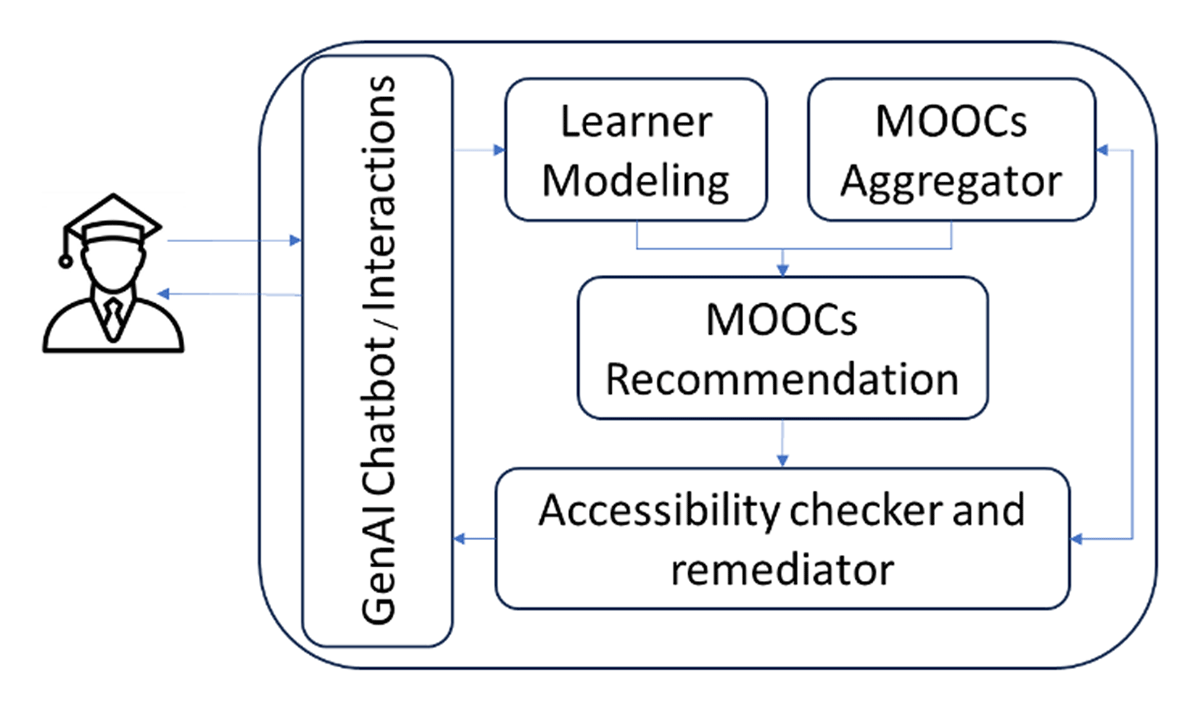
Figure 1
Overview of the RECMOOC4ALL system architecture.
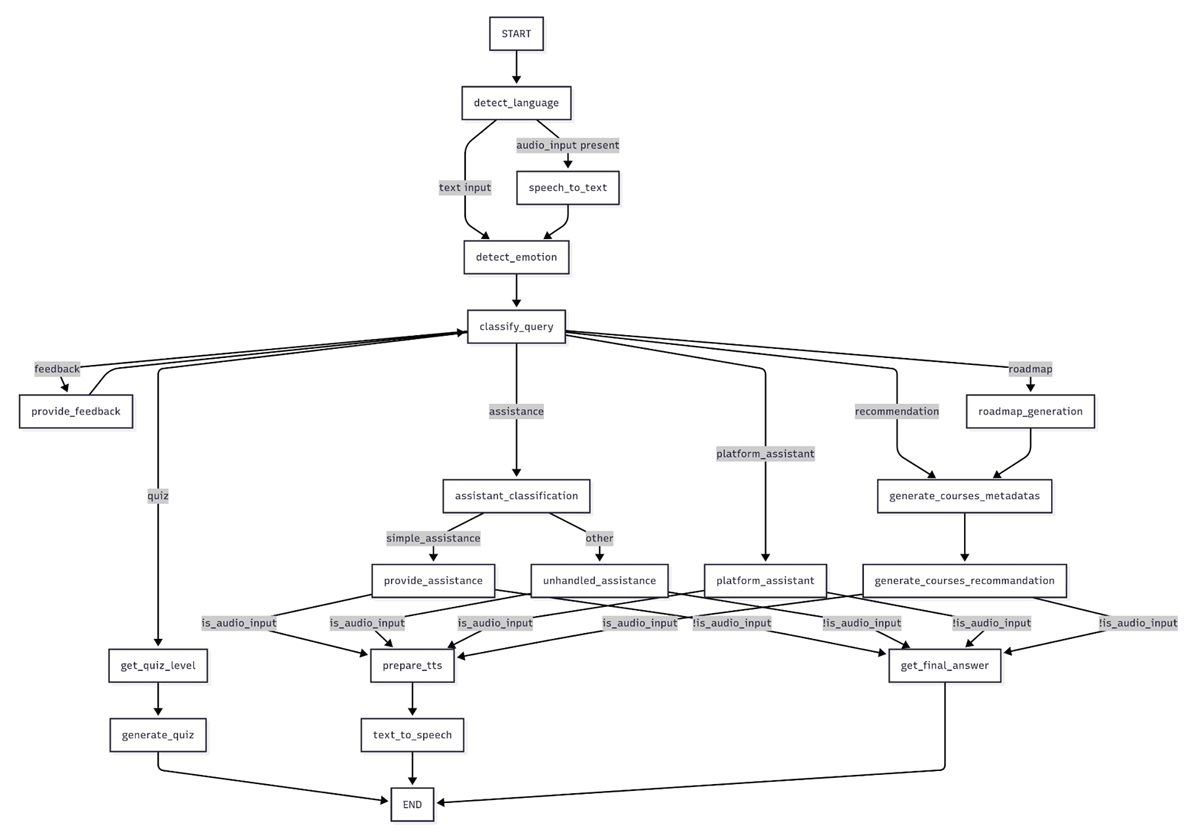
Figure 2
Global architecture of the RECMOOC4All chatbot subsystem.
Table 3
Accessibility mapping in RECMOOC4All.
| ACCESSIBILITY NEED | SYSTEM FEATURE |
|---|---|
| Visual Impairment | TTS output; screen-reader-compatible; voice input via Whisper STT |
| Cognitive Impairment | Simplified language; stepwise guidance; reduced information density (low-density formatting) |
| Multilingual Access | Real-time Neural Machine Translation (NMT) (M2M-100, OPUS-MT) with glossary control for accessibility and pedagogical terminology |
| Motor Impairment | Keyboard-first interaction flows; voice input via STT as an alternative to pointer-dependent interaction |
Table 4
Overview of integrated datasets.
| DATASET/SOURCE | DATA TYPE | PURPOSE |
|---|---|---|
| MOOC Q&A pairs (Coursera, edX, Udemy) | Text (QA pairs) | Base corpus for intent modeling and accessibility-aware response patterns |
| Paraphrase-augmented Q&A (GPT-2/GPT-3.5 + BERT checks) | Text | Increase lexical robustness while controlling meaning drift |
| Dual-labeled classification set (n = 14,082) | Text + labels | Train/validate intent routing and accessibility-aware dispatch |
| Assistance dataset (n = 2,597) | Text (query–response pairs) | Dialogue patterns for early navigation support |
| Synthetic speech set (TTS → Whisper STT transcripts) | Audio → text (+ confidence/timestamps) | Validate multimodal routing and voice interaction under controlled conditions |
| Translation resources (M2M-100, OPUS-MT; optional Google Translate) | Multilingual text | Real-time multilingual mediation with glossary control for domain terminology |
| Language-ID benchmark (Zarajamshaid; public) | Text | Benchmark language identification before translation/routing |
| Translation validation corpus (OPUS-100; public) | Text (parallel translations) | Quality checks for translation adequacy |
| Pilot interaction & feedback logs (consented) | Text + telemetry/metadata | Evaluation and feedback-driven refinement |
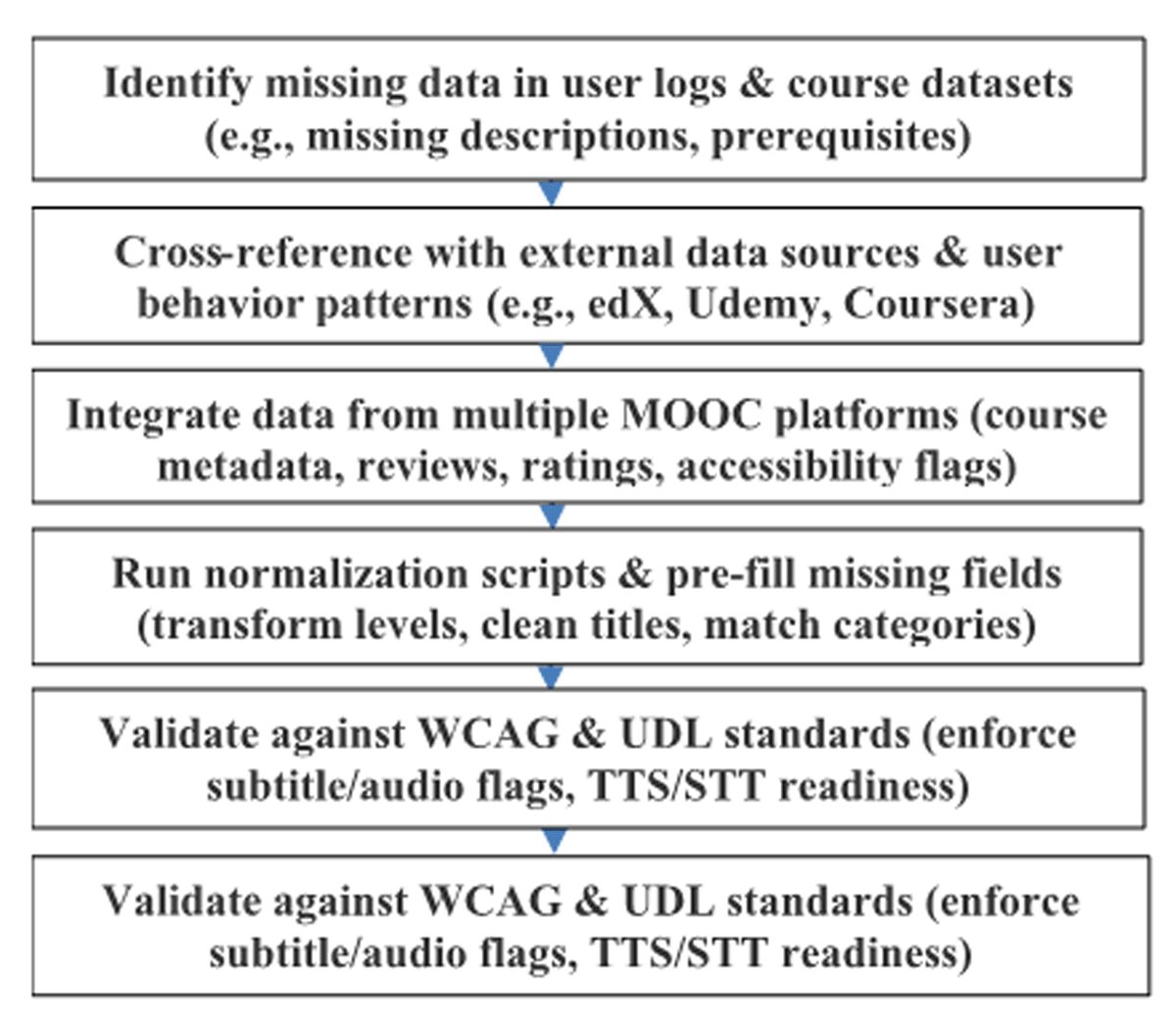
Figure 3
Data refinement proces.
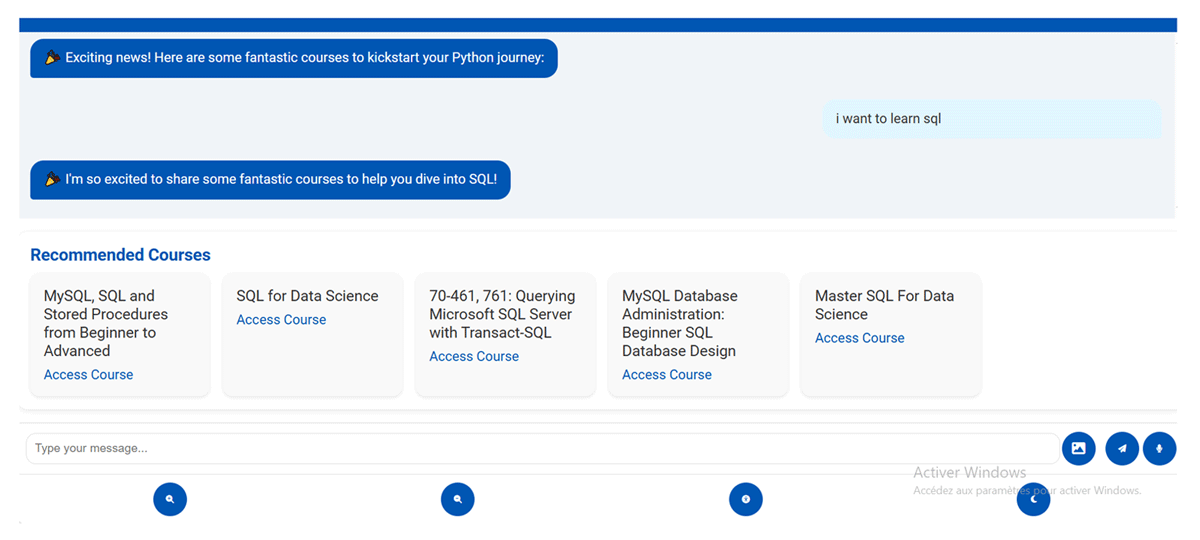
Figure 4
SQL course recommendations for a sighted learner using English text input.
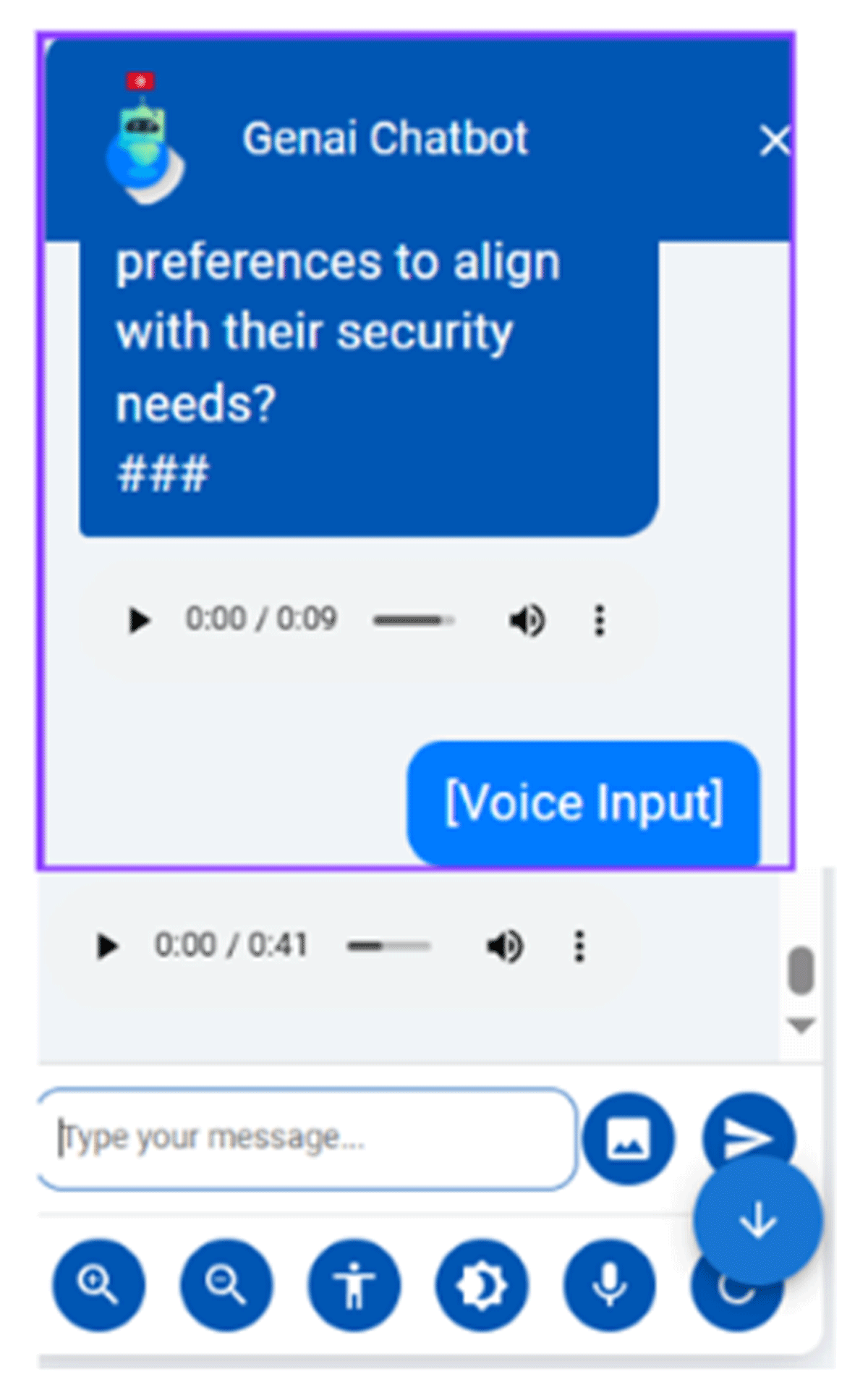
Figure 5
Arabic voice interaction with TTS output for a visually impaired learner.
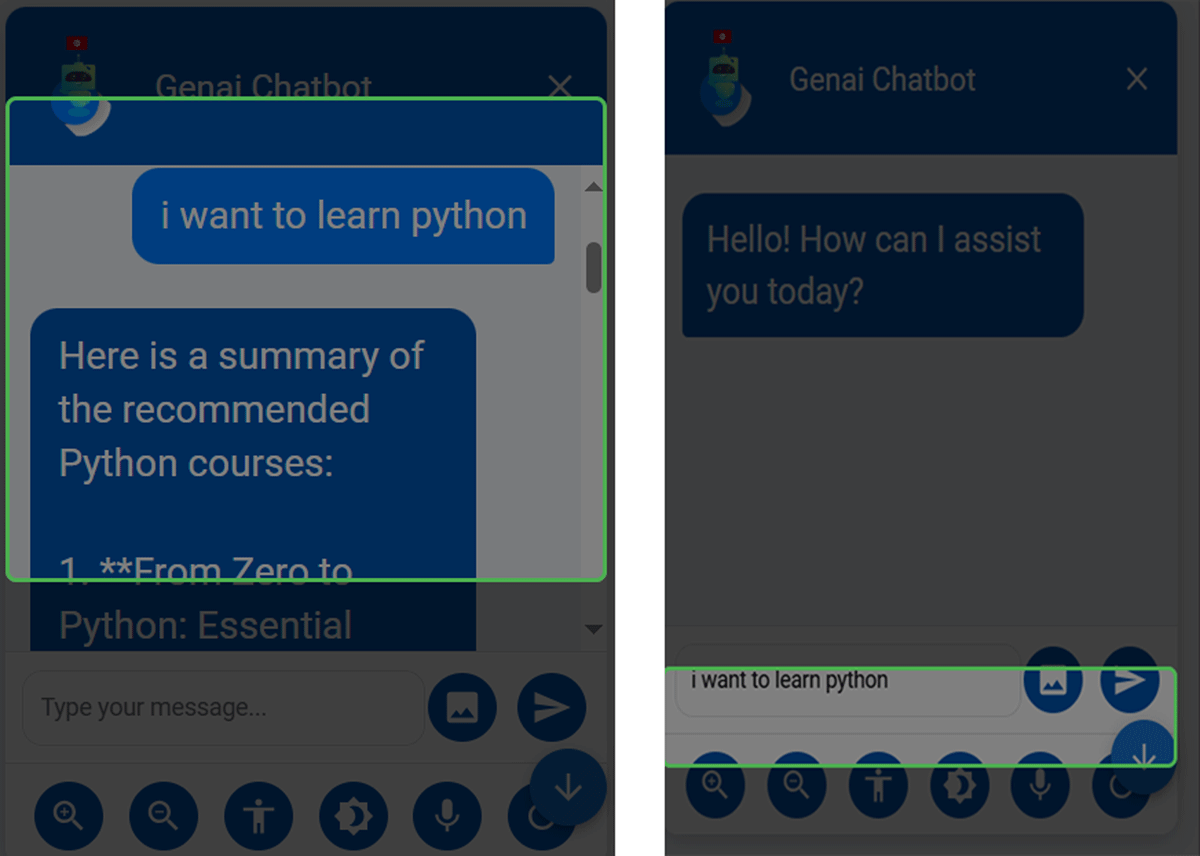
Figure 6
Simplified UI interaction for a learner with cognitive challenges.
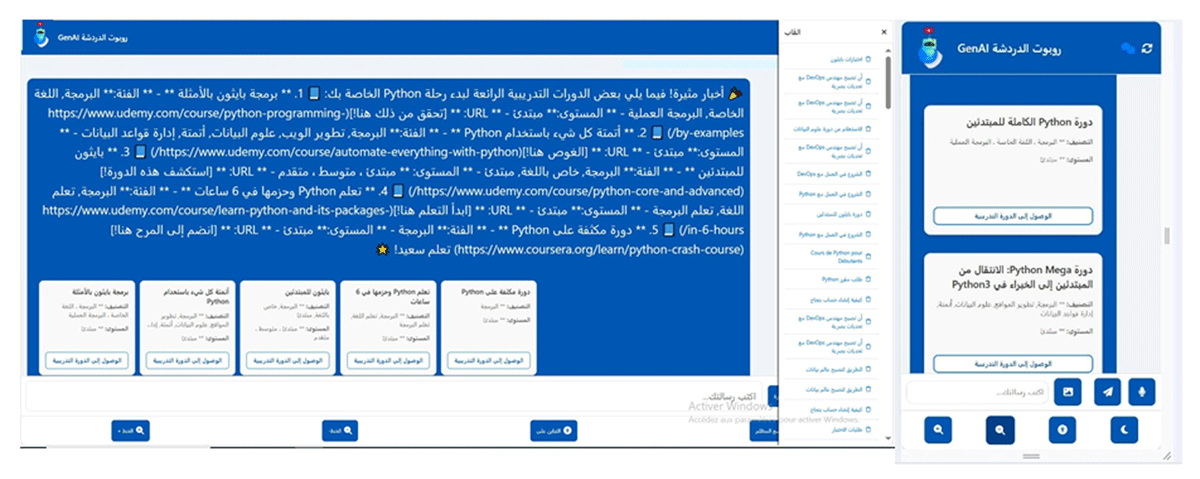
Figure 7
Multilingual voice input with adapted output for a learner with combined needs.
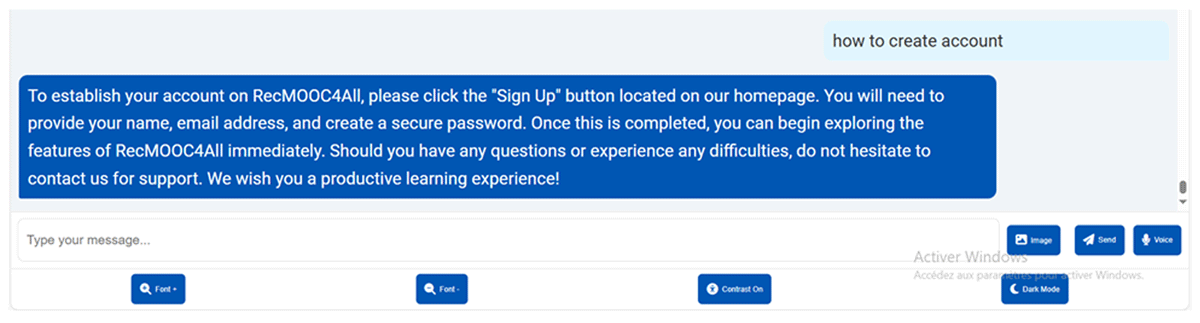
Figure 8
Account creation guidance via GenAI chatbot.
Table 5
Descriptive comparison of educational GenAI chatbots and RECMOOC4All chatbot.
| FEATURE | PRIOR SYSTEMS (KHANMIGO, JILL WATSON, COURSERA AI, DUOLINGO AI) | RECMOOC4ALL CHATBOT |
|---|---|---|
| Accessibility support (interaction layer) | Partial (basic captions, limited TTS/STT) | Accessibility-first interaction supports (STT/TTS options, simplified/chunked responses, keyboard-first flows) informed by WCAG 2.2/UDL design references |
| Primary GenAI role | Tutoring/personalization, assistance, content support | Discovery/onboarding assistance with accessibility-aware prompts and surfacing of available accessibility signals |
| Adaptation logic | Often opaque or platform-dependent | Rule-based adaptation triggers and logged state transitions (prototype) |
| Integration Scope | Single platform/ecosystem | Aggregator-level interface connecting to metadata, recommender, and checker outputs |
| Multilingual Support | Varies; often limited to major languages | NMT-mediated interaction (OPUS-MT/M2M-100) with glossary constraints for key accessibility terms |
[i] Note. Comparison is descriptive and based on publicly documented feature sets; “WCAG/UDL” refers to design references for the chatbot interface, not conformance of external course content.