
Introduction
Open, distance, and digital education (ODDE) has long been associated with the promise of widening participation and making education more inclusive, flexible, and accessible (Wilson, 1971; Tait, 2008; Bozkurt et al., 2023). From early models of correspondence education to contemporary forms of online and artificial intelligence (AI)-supported learning, the field has been shaped by a persistent normative aspiration: to overcome structural barriers and extend educational opportunities to more diverse populations (Stöter et al., 2014). In the context of global policy agendas such as the Sustainable Development Goals (SDGs), and in particular SDG 4’s commitment to inclusive and equitable quality education and lifelong learning for all, these expectations have gained renewed urgency. Digital technologies are widely seen as key enablers in this process, offering new possibilities for access, personalisation, and participation across geographical, social, and institutional boundaries.
However, both historical and contemporary research in ODDE suggests that openness and digitalisation do not automatically lead to more equitable education (Czerniewicz, 2018a; Warschauer, 2004). The concept of openness itself has evolved from a narrow focus on access to a broader and more complex understanding that includes flexibility, equity, social justice, participation, and agency (Kalz, 2023; Tait, 2008; Zawacki-Richter et al., 2020). This expanded understanding highlights that widening access is only one dimension of educational inclusion. For many learners, particularly those balancing education with work, family responsibilities, and precarious living conditions, formal access does not necessarily translate into meaningful participation and educational outcomes. Despite widening access, Tait (2000) demonstrates that without adequate student support systems, distance education often results in unequal success and attrition. Archer and Prinsloo (2017) highlight this dilemma by calling for an ethics of care, arguing that “providing access without providing reasonable care to ensure success is actually justice denied” (p. 274).
This tension is further intensified by ongoing processes of digital transformation. While digital infrastructures and platforms have expanded opportunities for learning at scale, they have also introduced new forms of stratification. Differences in access to reliable technology, variations in digital skills, and unequal institutional support structures shape participation in complex ways. Moreover, emerging technologies such as AI add a new layer of ambivalence (Selwyn, 2019, 2024). On the one hand, AI-driven systems offer potential for personalised learning and scalable support; on the other hand, they raise critical concerns related to fairness, accountability, transparency, and ethics (FATE), as well as global inequalities embedded in AI production processes (see Memarian & Doleck, 2023; Karan & Angadi, 2024; Cefa et al., 2025). These developments suggest that digitalisation reconfigures rather than eliminates inequality.
Against this background, the concept of digital educational equity is becoming increasingly relevant, yet it remains insufficiently theorised. Existing research is fragmented across multiple strands, including studies on the digital divide, theories of social inequality, critical and postdigital theories, work on open education and lifelong learning opportunities, and emerging research on sustainability and AI in education. Kuhn et al. (2023) conceptualise digital inequality as a “theoretical kaleidoscope”, highlighting the multiplicity of existing perspectives. While this theoretical pluralism enriches the field, it also complicates efforts to develop coherent analytical frameworks for specific domains such as ODDE.
This paper builds on this insight but takes a different approach. Rather than mapping theoretical perspectives, it aims to develop a systems-theoretical understanding of digital educational equity in ODDE that integrates macro-level as structures, meso-level as institutional practices, and micro-level as learner capabilities into a multi-level framework.
Building on the 3M model (Zawacki-Richter, 2009; Zawacki-Richter & Bozkurt, 2023) and Therborn’s equality/inequality framework (Therborn, 2013), it conceptualises equity across macro, meso, and micro levels of analysis. At the macro level, the paper situates ODDE within global policy agendas, sustainability debates, and broader societal structures, examining how digitalisation intersects with social inequality and the goals of lifelong learning. At the meso level, it focuses on organisations and institutional practices, including governance, support structures, and the role of open education, Open Educational Resources (OER), and AI in shaping access and participation. At the micro level, the paper turns to learners’ resources, capabilities, and participation patterns, particularly in relation to non-traditional learners and those navigating structurally challenged learning conditions.
The framework is theoretically grounded in a dialogue between systems theory and approaches to social inequality. Drawing on a systems-theoretical perspective (Luhmann, 2005, 2012, 2013), ODDE is understood as a communicatively constituted and differentiated system that evolves through processes of inclusion and exclusion (Zawacki-Richter, 2026a). From Luhmann’s perspective, inclusion refers to the ability to participate in educational communication, while exclusion denotes the absence or limitation of such participation. Importantly, ODDE does not eliminate exclusion but transforms its forms, as new barriers emerge through digital infrastructures, institutional practices, and technological mediation. This perspective is complemented by theories of inequality, particularly Bourdieu’s (1986) conceptualisation of capital and habitus, which explains how social and cultural resources shape educational trajectories, and Sen’s (1992, 1999) capability approach, which shifts attention from resource distribution to individuals’ real opportunities to achieve valued forms of participation.
The central argument of the paper is that digital educational equity in ODDE cannot be reduced to issues of technological access or formal openness. This access-oriented perspective is particularly deeply rooted in the field of open and distance learning itself. Since its origins, ODDE has been closely associated with the goal of widening participation and expanding access to education for non-traditional learners.
Also, research on digital inequality has tended to privilege access-based explanations. As Kuhn et al. (2023) note, “the supercomplex nature of digital inequality has been underplayed and under-theorised. Traditional accounts of digital inequality have centred on the lack of access to ICTs, framing the discussion in terms of the ‘haves’ and ‘have-nots’” (p. 895).
The purpose of this paper is to develop a systems-based theoretical framework for understanding digital educational equity in ODDE. More specifically, the paper addresses the following guiding questions:
How can digital educational equity in ODDE be conceptualised beyond access-based approaches?
How do macro-, meso-, and micro-level dynamics interact in shaping inclusion and exclusion in ODDE?
In what ways does AI amplify or transform inequalities across these levels?
The next sections turn to the conceptual foundations of digital educational equity. To move beyond descriptive accounts of access and participation, it is necessary to clarify the key concepts and theoretical perspectives that underpin an equity-oriented analysis of ODDE. This provides the analytical lens through which digital educational equity can be more systematically understood and examined.
Conceptual Approach and Scope
This article is a conceptual and theoretical contribution rather than an empirical study, evaluation paper, or systematic literature review. Its aim is to develop a systems-based framework for understanding digital educational equity in ODDE by bringing together systems theory, social inequality theory, digital divide research, and scholarship on ODDE, sustainability, and AI in education. The literature discussed is therefore used analytically and theoretically, not as the result of a systematic review procedure. The contribution lies in the conceptual integration of these perspectives into a multi-level framework that can inform future theoretical development and empirical research.
The selected theoretical perspectives were chosen because they address complementary dimensions of digital educational equity in ODDE. Systems theory provides a relational understanding of educational communication, inclusion, and exclusion across interconnected levels of the education system. Therborn’s multidimensional theory of inequality adds a differentiated understanding of resource, existential, and vital inequalities, while Bourdieu and Sen help explain how structural conditions are mediated through learners’ capitals, dispositions, and capabilities. Digital divide research complements these perspectives by foregrounding the evolving forms of digital inequality related to access, skills, participation, and outcomes. Together, these approaches enable a multi-level and relational conceptualisation of digital educational equity that moves beyond access-based explanations.
Conceptual Foundations of Digital Educational Equity in ODDE
This section outlines the conceptual foundations for analysing digital educational equity in ODDE. It begins by distinguishing between educational equality and equity and extends this distinction to digital education, introducing a multidimensional understanding of digital inequality encompassing access, use, skills, participation, outcomes, and agency (Section 2.1). It then situates digital educational equity within ODDE and links it to debates on sustainability, particularly in relation to the SDGs (Section 2.2). Finally, it integrates these perspectives by conceptualising digital educational equity as a core dimension of social sustainability in ODDE, connecting educational participation to broader socio-economic conditions and long-term development goals (Section 2.3). Together, these sections provide the theoretical grounding for the analysis that follows.
Digital Educational Equity vs. Equality
The concept of digital educational equity builds on, but extends beyond, established distinctions between equality and equity in education. Educational equality generally refers to the provision of the same resources or opportunities to all learners, irrespective of their individual circumstances. In contrast, educational equity recognises that learners are differently positioned due to social, economic, and cultural conditions, and therefore require differentiated forms of support to achieve meaningful participation and comparable outcomes. From this perspective, equal provision does not necessarily result in fair or just outcomes, particularly in contexts marked by structural inequalities (Sen, 1999). Heckman (2006) similarly argues that equal treatment is insufficient in the presence of unequal starting conditions, highlighting the need for targeted interventions. This distinction also resonates with liberal political debates that differentiate between equality of opportunity, ensuring fair starting conditions, and equality of outcome.
A broader sociological understanding of inequality further sharpens this distinction. Therborn (2013) builds on Sen’s (1992) capability approach and defines equality succinctly as the “capability to function as a human being […] inequalities are therefore violations of human rights” (p. 41). To unpack what it means to function as a human being, Therborn conceptualises humans in three interrelated ways: as organisms who are vulnerable to pain, suffering, and death; as persons who develop identities and meanings within emotional and cultural contexts; and as actors who are able to pursue goals and shape their lives. From this understanding, he derives three forms of inequality: vital inequality (differences in life chances and well-being), existential inequality (inequalities in self-development, autonomy, freedom, dignity, and respect), and resource inequality (unequal distribution of material and social resources to act).
Education and knowledge are potent aspects with regard to ressource inequality. However, Therborn’s framework underscores that educational inequality is not limited to access to resources but also encompasses the conditions for participation and the outcomes of educational processes. It therefore provides a useful lens for analysing digital educational equity as a phenomenon that spans structural, institutional, and individual dimensions, i.e. macro, meso, and micro level conditions.
In the context of digital education, this distinction becomes particularly salient. Early policy and research debates on the digital divide, prominently introduced in the Falling Through the Net report (U.S. Department of Commerce, 1995), primarily conceptualised inequality in terms of access to information and communication technologies, emphasising disparities between those who had Internet connectivity and those who did not. This “first-level” digital divide perspective was further developed in early scholarly work (van Dijk, 2005; Warschauer, 2004). Subsequent research has demonstrated that access alone is insufficient to ensure equitable participation. As Hargittai (2002) shows, differences in skills, usage patterns, and the capacity to translate access into meaningful outcomes give rise to more complex, layered forms of digital inequality that extend well beyond the simple distinction between the “haves” and “have-nots.” Building on earlier distinctions between first-, second-, and third-level digital divides, Helsper (2021) reframes digital inequality as a form of social-digital inequality, emphasising that differences in access, skills, and outcomes are deeply embedded in and mutually reinforce broader social inequalities rather than constituting a separate or purely technological divide.
Thus, digital inequality unfolds across multiple dimensions, including differences in usage patterns, skills, and the capacity to translate digital engagement into educational, social, and economic outcomes. As a result, a narrow focus on technological provision risks overlooking deeper forms of stratification that shape participation in digital learning environments (Selwyn, 2022).
Against this background, digital educational equity is conceptualised here as a multi-dimensional construct comprising several interrelated dimensions. First, access refers to the availability of reliable digital infrastructure, devices, and connectivity, which has been identified as the foundational layer of digital inequality (van Dijk, 2005; Warschauer, 2004). Second, use captures how technologies are engaged with in practice, including frequency, purpose, and quality of use, reflecting differences in meaningful engagement with digital resources and communication tools (van Dijk, 2005). Third, skills (or digital literacies) denote the competencies required to effectively navigate and benefit from digital learning environments, which are unevenly distributed across social groups (Hargittai, 2002; van Deursen & van Dijk, 2014). Fourth, participation concerns the extent to which learners are able to engage meaningfully in educational processes, including interaction, collaboration, and persistence, which is central to research on online and distance learning (Zawacki-Richter & Anderson, 2014). Fifth, outcomes refer to the results of participation, such as learning achievement, progression, and broader life chances, corresponding to third-level digital divide research that highlights unequal returns from technology use (Wei et al., 2011). Finally, agency highlights learners’ capacity to make informed choices, shape their learning trajectories, and use digital education in ways they have reason to value, drawing on the capability approach (Sen, 1999).
Based on these considerations, digital educational equity can be defined as follows:
Digital educational equity refers to the extent to which individuals, across diverse social contexts, have the capabilities and support to access, use, and benefit from digital educational opportunities in ways that enable meaningful participation in educational communication and lead to equitable outcomes.
This understanding resonates with an equity perspective in ODDE that emphasises the need to address the complex conditions of participation in postdigital societies. As Czerniewicz and Carvalho (2023) argue:
Equitable participation in education means that ODDE is designed to address the challenges of co-existing issues in postdigital society which is itself inequitable, where education is being differentially datafied and digitized, and where new forms of provision are emerging. (p. 443).
Building on this perspective, equity in ODDE is not a static condition but an emergent property of communicative inclusion, shaped by the interplay of structural conditions, institutional arrangements, and individual capabilities. It therefore provides a conceptual foundation for analysing digital inequality across macro, meso, and micro levels.
Framing Digital Educational Equity: ODDE and Sustainability
Questions of access, participation, and outcomes in digital education cannot be understood in abstraction from the educational systems in which they are embedded. It is therefore necessary to clarify ODDE as a heterogeneous field that shapes the conditions under which digital educational equity is realised. At the same time, the growing alignment of education with global sustainability agendas, particularly the SDGs, requires situating digital educational equity within broader concerns of social sustainability.
ODDE
Clarifying the terminology of ODDE requires revisiting the theoretical and practical roots of open and distance learning. The term distance education was introduced by Otto Peters, founding rector of the German FernUniversität in Hagen in 1974 (Germany’s dedicated, state-funded distance teaching university; Zawacki-Richter, 2023). Peters’ work laid the foundation for much of the theoretical discourse in the field. The origins of open and distance learning can be traced to the transition from elitist higher education of the 1950s to the massification of higher education in the post-World War II era. Open universities, such as the Open University in the United Kingdom (OUUK), were founded to widen participation for non-traditional learners (Wedemeyer, 1981). As Prime Minister Harold Wilson famously stated, the OUUK aimed to provide “a second chance” to those previously excluded from higher education (Wilson, 1971).
This widespread adoption of digital and online modes of teaching (accelerated through the COVID-19 pandemic) has led to a significant convergence between conventional and distance education. Zawacki-Richter and Jung (2023) adopt the term ODDE to emphasise both continuity and innovation, recognising the historical roots of open and distance education in this tradition while incorporating digital education to capture newer forms of teaching and learning enabled by digital media:
We conceptualize ODDE as an overarching term to refer to all kinds of learning and teaching processes in which knowledge and skill base of educational technology, digital media, and tools are used to present and deliver content, as well as facilitate and support communication, interaction, collaboration, assessment, and evaluation. Thus, ODDE is not monolithic in form. It includes various practices, from technology-enhanced education, to flipped learning and blended learning to fully online education. (Zawacki-Richter & Jung, 2023, p. 4)
Building on this understanding of ODDE, the following section situates its development within broader frameworks of sustainability that shape contemporary educational policy and practice.
Sustainability
Contemporary understandings of sustainability are shaped in large part by the work of the 1983 United Nations Commission on Environment and Development (the Brundtland Commission). Its 1987 report, Our Common Future, introduced the widely cited definition of sustainable development as “development that meets the needs of the present without compromising the ability of future generations to meet their own needs” (Brundtland, 1987, p. 374). Sustainability is generally conceptualised in terms of three interrelated dimensions: environmental, social, and economic. The 2030 Agenda for Sustainable Development, declared by the United Nations in 2015, reaffirmed this perspective, articulating 17 Sustainable Development Goals (SDGs) and 169 targets designed to balance these dimensions.
For education, SDG 4 is of particular relevance, calling for “inclusive and equitable quality education” and the promotion of “lifelong learning opportunities for all” (United Nations, 2015). Progress on SDG 4 underpins advancement across multiple goals, including poverty reduction (SDG 1), health and well-being (SDG 3), decent work and economic growth (SDG 8), responsible consumption (SDG 12), and climate action (SDG 13). SDG target 4.7 further calls for all learners to acquire the knowledge and skills needed to promote sustainable development, including through education for sustainable development, sustainable lifestyles, human rights, gender equality, and global citizenship.
ODDE and social sustainability
As mentioned above, the origins of ODDE are closely connected to the expansion of higher education systems and the open education movement (Kalz, 2023), which led to the creation of open universities (Zawacki-Richter et al., 2020). These institutions sought to provide socially equitable and inclusive access to higher education, regardless of social background, thus opening opportunities for non-traditional learners (Wedemeyer, 1981; Stöter et al., 2014; Xiao, 2018). Over the past five decades, some open universities have developed into “mega-universities” with enrolments exceeding 100,000 students (Daniel, 1996; Nichols, 2025). Yet the ambition to widen access at scale brings with it a corresponding challenge: student success is strongly tied to the quality of academic support. This produces what might be termed the dilemma of scale and personalisation (Zawacki-Richter, 2026b): without high-quality support, distance learners face high dropout rates, meaning that access alone is not sufficient. This tension reflects a structural feature of ODDE rather than a temporary limitation. The very conditions that enable large-scale access often constrain the capacity for sustained, individualised engagement, raising persistent questions about how equity is to be realised in practice.
In response, learner support (eco-)systems (see Cefa, 2025) have been developed within ODDE, including tutoring, mentoring, and structured feedback mechanisms designed to mitigate the risks associated with learner isolation. Nevertheless, the effectiveness of such measures varies considerably across contexts, and resource constraints often limit their scalability. As a result, the aspiration to provide equitable access is frequently accompanied by persistent challenges in ensuring equitable outcomes.
A further dimension of social sustainability concerns the conditions under which participation is sustained over time, particularly for learners balancing study with work, family, and other responsibilities. While ODDE has long been associated with flexibility, this flexibility is not evenly experienced. For many learners, especially those from disadvantaged backgrounds, the demands of self-regulated learning, limited access to stable digital infrastructure, and competing life commitments can create significant barriers to persistence. As a result, participation in ODDE often reflects not only formal access, but also the uneven distribution of time, resources, and support that shape learners’ capacity to engage meaningfully with their studies. This highlights the importance of understanding social sustainability not simply in terms of enrolment, but in terms of the conditions that enable sustained participation and progression. In this respect, questions of equity extend beyond institutional design to encompass broader socio-economic contexts, including employment conditions, digital access, and household environments. Recognising these factors shifts attention from individual learners to the structural conditions within which learning takes place, reinforcing the need for approaches to ODDE that are attentive to both flexibility and support, and that acknowledge the limits of technological solutions in addressing deeply rooted social inequalities.
Openness also extends beyond access to participation in formal programmes to include access to learning materials, particularly through open educational resources (OER), as well as massive open online courses (MOOCs), both of which support more flexible and scalable forms of learning and have been linked to the advancement of SDG 4 (Aksoy et al., 2025; Laurillard, 2024). However, the extent to which these models translate into meaningful participation remains uneven, as patterns of access, engagement, and completion continue to reflect broader socio-economic inequalities. Research has shown that MOOC students are largly coming from developed countries and are predominantly highly educated and employed (Czerniewicz, 2018a). Also Hansen and Reich (2015) conclude: “Our findings raise concerns that MOOCs and similar approaches to online learning can exacerbate rather than reduce disparities in educational outcomes related to socioeconomic status” (p. 1245).
These inequalities are further reflected in the production of digital technologies themselves. Studies of AI supply chains show that much of the labour involved in data annotation and content moderation is outsourced to workers in the Global South, often under precarious conditions and very low wages (Muldoon et al., 2025).
Digital Educational Equity as a Dimension of Social Sustainability in ODDE
The preceding discussion has situated digital educational equity at the intersection of ODDE, sustainability, and global policy frameworks such as the SDGs. Bringing these strands together suggests that digital educational equity cannot be adequately understood as a purely educational or technological issue. Rather, it is embedded in broader dynamics of social inequality and sustainability, which shape both the conditions of access and the possibilities for meaningful and sustained participation in education.
From a sustainability perspective, particularly in terms of social sustainability, the focus shifts from access to the conditions that enable sustained and meaningful participation over time. This includes not only technological infrastructure, but also institutional support, flexibility, and the socio-economic contexts in which learners are embedded.
Taken together, digital educational equity can be understood as a central dimension of social sustainability in ODDE. It reflects the extent to which educational systems enable not only access, but also inclusive, meaningful, and sustainable participation over time, thereby linking the goals of equitable education with broader concerns of social development.
A Multi-Level Framework of Digital Educational Equity in ODDE
Building on the conceptual foundations developed in the previous section, the following part advances a multi-level framework for analysing digital educational equity in ODDE. While the previous sections clarified key concepts and situated digital educational equity within broader debates on inequality and sustainability, the focus now shifts to how these dynamics unfold across different levels of the educational system: the macro level of societal structures and global inequalities, the meso level of organisational practices and institutional mediation, and the micro level of learners’ participation, capabilities, and outcomes.
By integrating these levels, this section develops a framework that captures how digital educational equity is produced and reproduced in ODDE, highlighting both the potential of digitalisation to widen participation and its role in reconfiguring existing inequalities.
Macro Level: Structural Conditions and Global Inequalities in ODDE
At the macro level, digital educational equity in ODDE is shaped by broader societal structures, global policy agendas, and the unequal distribution of resources, infrastructures, and opportunities across and within countries. From a systems-theoretical perspective, these conditions form the environment of the education system, influencing how inclusion and exclusion are structured (Luhmann, 2005). ODDE operates within this environment, structurally coupled with other social systems such as the economy, politics, and technology, all of which contribute to shaping the conditions under which the ODDE system evolves, and educational communication becomes possible.
Global policy frameworks, notably the SDGs, play a central role in defining normative expectations for equity in education. SDG4 establishes a global reference point for evaluating educational systems, including ODDE. However, the realisation of these goals is uneven, reflecting significant disparities in national education systems, digital infrastructures, and socio-economic conditions (UNESCO, 2020; World Bank, 2021). From Therborn’s (2013) perspective, these disparities can be understood as manifestations of resource inequality, particularly in terms of access to reliable internet connectivity, digital devices, and institutional capacity to deliver high-quality digital education (van Dijk, 2005; Warschauer, 2004).
At the same time, macro-level inequalities extend beyond material resources. Existential inequalities are reflected in uneven participation in global knowledge production and educational discourse (Prinsloo, 2025). While ODDE has the potential to connect learners and institutions across geographical boundaries, participation in these networks is often dominated by actors from the Global North (Connell, 2020; Czerniewicz, 2018b). This asymmetry influences whose knowledge is represented, whose voices are heard, and whose educational needs are prioritised. In this sense, digital educational equity is also a question of epistemic inclusion and recognition within global educational communication.
Vital inequalities, in turn, become visible in the differentiated outcomes associated with participation in ODDE. Educational opportunities mediated through digital technologies can contribute to improved life chances, employability, and social mobility. However, these benefits are unevenly distributed, as learners in more advantaged contexts are typically better positioned to translate participation into tangible outcomes (Wei et al., 2011; Robinson et al., 2015). Thus, digitalisation does not eliminate structural inequalities but may reinforce them by amplifying existing advantages (Selwyn, 2022).
Recent developments in AI further illustrate the ambivalence of macro-level dynamics. On the one hand, AI technologies promise scalable solutions for personalised learning and expanded access. On the other hand, their development and deployment are embedded in global economic structures characterised by concentration of power, data, and technological expertise (O’Neil, 2016; Zuboff, 2019). Moreover, the production of AI systems often relies on labour in the Global South under precarious conditions, raising questions about the broader social sustainability of digital education systems (Muldoon et al., 2025; Graham et al., 2017; Zawacki-Richter, 2026b). These dynamics highlight that ODDE is not only shaped by educational policy but also by the global political economy.
That being said, the macro level reveals that digital educational equity in ODDE is deeply embedded in global structures of inequality. It depends not only on educational provision but also on the distribution of resources, recognition, and opportunities across societies. These conditions define the horizon within which inclusion and exclusion in educational communication occur. This underscores that efforts to promote equity in ODDE must engage with broader societal and global dynamics, rather than focusing solely on technological or institutional solutions.
Meso Level: Institutional Mediation and Organisational Practices in ODDE
At the meso level, digital educational equity in ODDE is mediated by organisations and institutional practices that structure how educational opportunities are designed, delivered, and experienced. From a systems-theoretical perspective, organisations can be understood as decision-making systems that stabilise expectations and coordinate communication within the broader education system (Luhmann, 2005). Universities, open universities, and digital platforms thus play a central role in shaping the conditions under which inclusion and exclusion in educational communication occur.
Institutional arrangements influence digital educational equity in multiple ways. Governance structures, funding models, and strategic priorities determine the extent to which institutions invest in digital infrastructures, pedagogical innovation, and student support. In ODDE, this is particularly evident in the long-standing emphasis on learner support systems, which have been identified as critical for student success (Tait, 2000; Simpson, 2002; Cefa, 2025; Cefa & Zawacki-Richter, 2025). As Therborn’s (2013) framework suggests, these institutional conditions can be interpreted as mediating resource inequalities, as they shape the availability and quality of educational provision and support across different contexts.
A central tension at the meso level is the so-called dilemma between scale and personalisation (Zawacki-Richter, 2026b). ODDE enables institutions to reach large and diverse student populations, often at comparatively low cost. This was the raison d’être for the foundation of open universities, widening access, i.e. enabling mass higher education (Peters, 1998). However, with scaling up provision, quality problems come in, that can constrain the capacity to offer individualised support, which is crucial for sustaining participation and ensuring equitable outcomes (Zawacki-Richter & Naidu, 2016). Without adequate support structures, increased access may lead to higher dropout rates and unequal patterns of success, particularly among non-traditional learners (Simpson, 2003; Woodley & Simpson, 2014). This tension reflects not merely a practical challenge but a structural feature of massified digital education.
In response, institutions have developed a range of support mechanisms, including tutoring systems, mentoring, feedback processes, and increasingly, digitally mediated support structures such as learning analytics and AI-based tools. These developments can be understood as attempts to stabilise participation in educational communication by compensating for the reduced face-to-face interaction characteristic of distance education. However, the effectiveness of these measures varies considerably depending on institutional resources, pedagogical design, and student characteristics. As Cefa (2025) argues, learner support in ODDE is best conceptualised as part of a broader communicative ecosystem, rather than as a set of isolated services.
Beyond support structures, pedagogical models and learning design also play a crucial role in shaping digital educational equity. Approaches such as blended learning, open education, and flexible learning pathways can expand opportunities for participation, but their benefits are not distributed evenly. Learners with greater prior experience, digital skills, and cultural capital are often better positioned to navigate flexible and self-directed learning environments (Selwyn, 2022). Thus, institutional designs that prioritise flexibility without sufficient scaffolding may inadvertently reproduce existing inequalities.
Also, open educational practices, including Open Educational Resources (OER) and Massive Open Online Courses (MOOCs), have been widely promoted as instruments for widening access and supporting lifelong learning (Weller, 2014; Zawacki-Richter et al., 2020). While these initiatives contribute to reducing barriers to entry and access to learning materials, research consistently shows that participation and completion rates are socially stratified, with learners from more advantaged backgrounds more likely to benefit (Hansen & Reich, 2015). From a systems perspective, this suggests that openness at the level of provision does not automatically translate into inclusion at the level of participation.
Recent developments in datafication and AI further transform institutional practices in ODDE. Learning analytics and AI-driven systems enable new forms of monitoring, prediction, and personalisation, potentially enhancing student support and institutional decision-making (Siemens & Baker, 2012; Zawacki-Richter et al., 2019; Bond et al., 2024). At the same time, these technologies raise concerns related to bias, transparency, and governance, as algorithmic systems may reproduce existing inequalities or introduce new forms of exclusion (Selwyn, 2019, 2024; Williamson et al., 2020). Institutional choices regarding the design, implementation, and regulation of such technologies, therefore play a critical role in shaping digital educational equity.
Taken together, the meso level highlights the central role of institutions as mediators between structural conditions and individual participation. Organisational practices, pedagogical models, and technological infrastructures do not merely implement educational provision; they actively shape the conditions under which learners can access, engage with, and benefit from ODDE. From a systems perspective, these practices can be understood as mechanisms through which inclusion and exclusion are organised within the education system, underscoring the importance educational leadership and organizational development for achieving digital educational equity.
Micro Level: Learner Capabilities, Participation, and Agency in ODDE
At the micro level, digital educational equity in ODDE is realised – or constrained – through learners’ capacities to participate meaningfully in educational communication. While macro-level structures and meso-level institutional arrangements shape the conditions of access and provision, it is at the level of individual learners that these conditions are translated into actual participation, engagement, and outcomes. From a systems-theoretical perspective, individuals are not part of the education system per se but belong to its environment; inclusion occurs only insofar as individuals are able to participate in educational communication (Luhmann, 2005). This shifts the analytical focus from formal access to the conditions that enable or hinder meaningful engagement.
Learners enter ODDE with heterogeneous resources, dispositions, and life circumstances. Drawing on Bourdieu (1986), differences in economic, cultural, and social capital shape learners’ abilities to navigate digital learning environments. These differences can be interpreted, following Therborn (2013), as forms of resource inequality at the individual level, including access to devices, stable connectivity, time for study, and supportive learning environments. Such resources are unevenly distributed and contribute to persistent inequalities in participation and success, particularly among non-traditional learners who constitute a core target group of ODDE (Stöter et al., 2014).
From the perspective of the capability approach, digital educational equity depends on learners’ real freedoms to achieve valued forms of participation (Sen, 1999). Constraints such as time poverty, precarious employment, caregiving responsibilities, and limited digital skills can significantly restrict these capabilities, even where formal access is provided. These constraints relate closely to what Therborn (2013) conceptualises as existential inequalities, that is, inequalities in recognition, participation, and the ability to be meaningfully included in social processes. In ODDE, this becomes visible in learners’ varying capacities to engage in interaction, collaboration, and knowledge construction within digital learning environments.
Research on digital inequality further highlights that disparities at the micro level unfold across multiple dimensions, including differences in usage patterns, skills, and outcomes (van Dijk, 2005; van Deursen & van Dijk, 2014). Learners differ not only in their access to technology but in how they use it, the extent to which they engage in interactive and collaborative learning activities, and their ability to critically evaluate digital information. These differences shape both participation and the benefits derived from it, reinforcing what has been described as the “second-” and “third-level” digital divide (Hargittai, 2002; Wei et al., 2011). Helsper (2021) emphasizes that digirtal divides are not only digital but also social: “social-digital inequalities are systematic differences between individuals from different backgrounds in the opportunities and abilities to translate digital engagement into benefits and avoid the harm that might arise from engagements with ICTs” (p. 8).
Participation itself is a central dimension of digital educational equity at the micro level. In ODDE, participation encompasses not only enrolment but sustained engagement, interaction, and persistence over time. However, participation is fragile and unevenly distributed. High dropout rates in distance and online education are well documented and are often linked to a lack of academic and social integration (Tinto, 1986; Simpson, 2003, Cefa & Zawacki-Richter, 2025). These patterns can be understood in terms of vital inequalities (Therborn, 2013), as they translate into differentiated educational outcomes, progression, and ultimately life chances. Learners who are unable to sustain participation are effectively excluded from the longer-term benefits of education, even if they initially had access.
The growing use of AI and data-driven technologies further reshapes learner experiences at the micro level. On the one hand, AI-driven systems such as intelligent tutoring systems and recommender systems can provide personalised feedback and support, potentially enhancing learning outcomes. On the other hand, these systems may introduce new forms of inequality, for example through biased algorithms, differential access to advanced tools, or varying levels of trust and acceptance among learners (Selwyn, 2019, 2024). Moreover, the increasing reliance on data-driven decision-making raises questions about learners’ agency, autonomy, and privacy, as educational processes become more closely monitored and steered by algorithmic systems. This datafication of education involves “classification, sorting, ordering, and categorizing people and things, which defines how they are known and treated” (Williamson, 2020, p. 352).
This being said, the micro level reveals that digital educational equity in ODDE is fundamentally shaped by learners’ capabilities to convert educational opportunities into meaningful participation and outcomes. Inequalities arise not only from differences in access or institutional provision, but from the uneven distribution of resources (resource inequality), opportunities for participation and recognition (existential inequality), and the outcomes of educational engagement (vital inequality). Drawing on Bourdieu, García-Alonso (2026) argues that “algorithmic capital” (p. 2) refers to the capacity to understand, navigate, and strategically engage with algorithmically mediated systems, which increasingly shape educational participation and opportunities in AI-driven environments. Learners who possess higher levels of such capital are better positioned to use AI tools critically and productively, while others may remain dependent on opaque automated systems or excluded from their potential benefits.
Future empirical research may further operationalise “algorithmic capital” through indicators such as learners’ abilities to critically evaluate AI-generated outputs, strategically use generative AI tools for learning, understand algorithmic limitations and biases, protect data privacy, and integrate AI tools into self-regulated learning practices. Such dimensions may help examine whether AI-mediated educational environments reproduce or mitigate existing digital inequalities.
From a systems perspective, inclusion is therefore contingent and fragile, depending on whether individuals are able to sustain participation in educational communication over time. This underscores the importance of approaches to ODDE that recognise learners’ diverse circumstances and support their capacity to engage meaningfully with digital learning environments.
Integration: The Interplay of Macro, Meso, and Micro Levels
Building on the preceding analysis, this section integrates the macro, meso, and micro perspectives into a systems-based, multi-level framework for understanding digital educational equity in ODDE.
From a systems-theoretical perspective, the three analytical levels are structurally coupled and cannot be understood in isolation. While the framework builds on established approaches to digital inequality, including Helsper’s (2021) concept of social-digital inequalities and Kuhn et al.’s (2023) “theoretical kaleidoscope”, it differs in several respects. Rather than mapping or comparing perspectives, this article develops an integrated systems-based framework specifically tailored to ODDE. In addition, it explicitly addresses AI as a cross-cutting force that reshapes inequalities across interconnected levels of the system.
The macro level defines the broader horizon of possibilities through socio-economic conditions, global inequalities, and policy frameworks such as the SDGs. At this level, inequalities are particularly visible as resource inequalities, for example, in the uneven distribution of digital infrastructures, institutional capacities, and financial means across and within countries. At the same time, existential inequalities emerge in asymmetries of recognition and participation in global knowledge production, shaping whose perspectives are represented in educational systems. The meso level translates these conditions into organisational decisions, pedagogical models, and technological infrastructures, thereby mediating both resource and existential inequalities through institutional practices. The micro level reflects how these mediated conditions are enacted through learners’ participation in educational communication, where inequalities become visible as differentiated capabilities to engage and as unequal educational trajectories, corresponding to vital inequalities in terms of outcomes and life chances.
Importantly, these relationships are not linear or deterministic. Rather, they operate through recursive feedback loops. Macro-level policy agendas shape institutional strategies, which in turn influence patterns of participation and outcomes at the micro level. At the same time, aggregated data on learner engagement and success increasingly feeds back into institutional decision-making and policy development, particularly in the context of data-driven governance and learning analytics. From Therborn’s perspective, this recursive dynamic also implies that resource, existential, and vital inequalities are not fixed categories but are continuously reproduced and transformed through interactions across levels. Digital educational equity thus emerges from the ongoing interplay of these levels and dimensions, rather than from any single factor.
AI occupies a particularly significant position within this framework, as it operates across all three levels and reshapes their interrelations. At the macro level, AI development is embedded in global economic structures characterised by the concentration of data, platform capitalism, and technological expertise, reinforcing existing resource inequalities at a global scale. At the meso level, institutions adopt AI systems for purposes such as learning analytics, assessment, and personalisation, thereby shaping organisational practices and potentially reproducing or challenging existential inequalities, for instance through algorithmic classification, categorisation, and differential treatment of learners. At the micro level, AI directly shapes learners’ experiences through adaptive learning environments, automated feedback, and algorithmic recommendations, influencing participation patterns and outcomes, and thus contributing to vital inequalities in terms of success, progression, and life chances. For example, AI-driven early warning systems designed to identify students at risk of dropout may support timely interventions and personalised support. At the same time, such systems may reproduce existing inequalities if predictive models are based on historically biased participation and performance data. Similarly, generative AI tools may enhance learning opportunities for digitally skilled learners while disadvantaging those with limited access, lower digital literacies, or weaker forms of algorithmic capital.
From this perspective, AI can act both as an amplifier and a transformer of inequality. It may amplify existing inequalities by reinforcing biases in data, privileging certain forms of knowledge, or disproportionately benefiting learners with higher levels of digital literacy and access to advanced tools. At the same time, AI has the potential to transform educational processes by enabling new forms of support, personalisation, and scalability that could, under certain conditions, mitigate resource constraints, enhance recognition, and improve outcomes. However, these potentials are not realised automatically; they depend on how AI systems are designed, governed, and embedded within educational practices.
As depicted in Figure 1, digital educational equity is a dynamic and relational phenomenon that cannot be reduced to access, individual characteristics, or institutional provision alone. Instead, it emerges from the alignment or misalignment between macro-level conditions, meso-level mediation, and micro-level capabilities, as well as from the interaction of resource, existential, and vital inequalities across these levels. AI acts as a cross-cutting force that both amplifies and transforms existing inequalities. From a systems perspective, inclusion in ODDE is contingent and fragile, depending on whether learners are able to sustain meaningful participation in educational communication over time and translate this participation into desired outcomes.
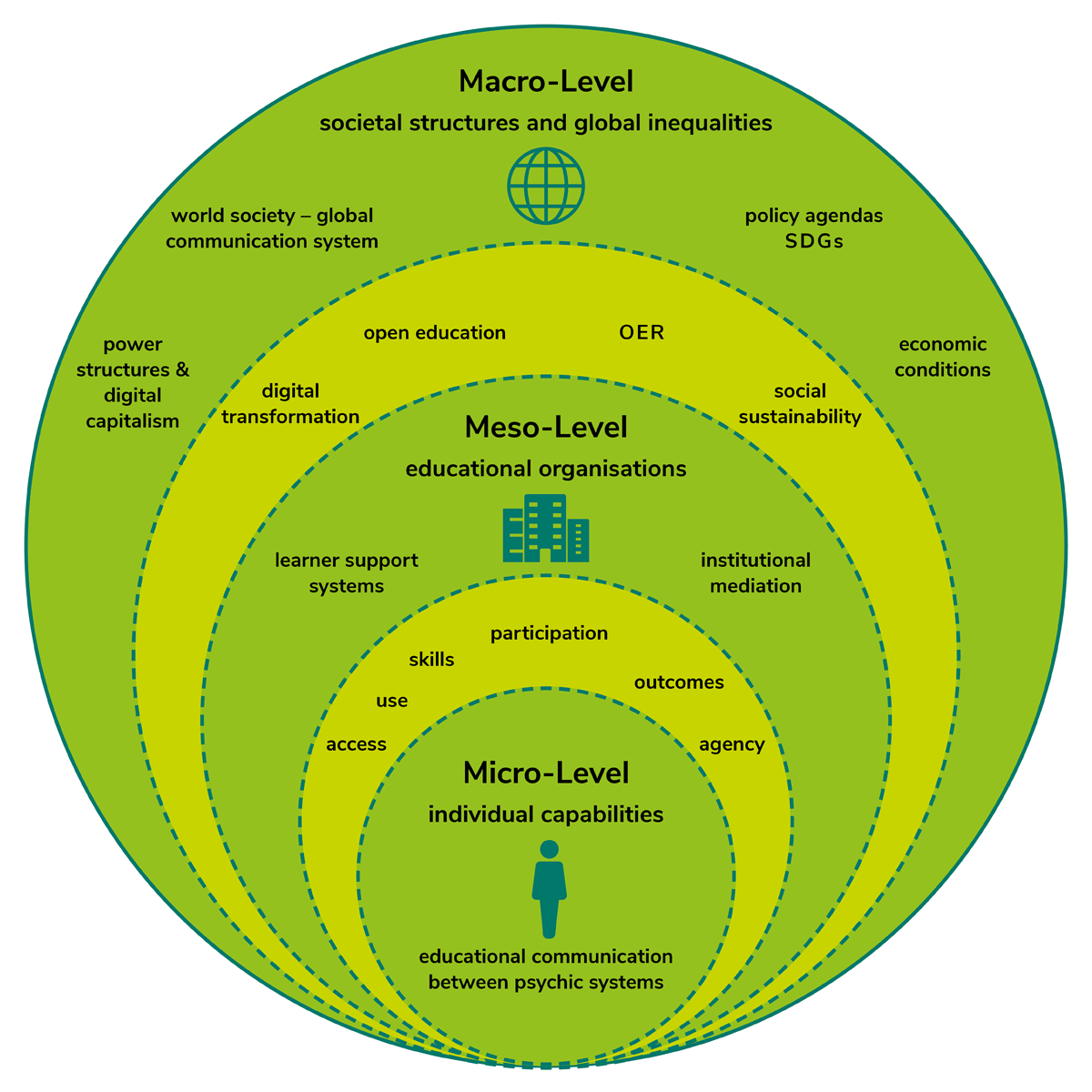
Figure 1
A multi-level systems framework of digital educational equity in ODDE.
Conclusions and Implications for Further Research
This paper set out to develop a systems-theoretical framework for understanding digital educational equity in ODDE. It argued that digitalisation does not automatically democratise education but reconfigures existing inequalities across multiple levels. By integrating systems theory with approaches to social inequality and digital divide research, the paper conceptualised digital educational equity as an emergent property of participation in educational communication, shaped by the interplay of macro-level conditions, meso-level institutional practices, and micro-level learner capabilities.
While access to digital technologies remains necessary, it is not sufficient for ensuring meaningful participation or equitable outcomes. Inclusion in ODDE depends on sustained engagement in educational communication and on the alignment between structural conditions, institutional mediation, and individual capabilities.
This multi-level perspective also moves beyond dichotomies between structural and individual explanations of inequality. Instead, it highlights their interdependence: organisational practices mediate between societal conditions and learner participation, while aggregated patterns of participation increasingly feed back into institutional and policy contexts. Digital educational equity is therefore best understood as a dynamic and relational phenomenon shaped by recursive processes across the system.
AI exemplifies these dynamics in particularly visible ways. Operating across all three levels, AI can act both as an amplifier and a transformer of inequality. It may reinforce disparities through biased data, unequal access, and asymmetries in digital skills, while also enabling new forms of personalised support and scalable provision. Emerging research suggests that the benefits of AI-driven education often accumulate disproportionately among already advantaged groups, while vulnerable learners risk further marginalisation due to unequal access to resources and differing capacities to engage with AI-mediated environments (Li, 2023). Whether AI contributes to inclusion or exclusion therefore depends on how it is designed, governed, and embedded within educational systems. Technological innovation alone cannot resolve issues of equity.
The framework opens several avenues for further theoretical work. First, there is a need to deepen the integration of systems theory and inequality research in ODDE, particularly in relation to datafication, platformisation, and AI-driven environments. Second, Therborn’s multidimensional framework requires further refinement in digital contexts, especially regarding how resource, existential, and vital inequalities interact across levels and over time. Third, closer engagement with complementary perspectives, such as the capability approach and critical data studies, can strengthen the analysis of agency, power, and governance in digital education.
The framework calls for more integrated, multi-level research designs that examine how macro-, meso-, and micro-level factors interact to shape participation and outcomes in ODDE. Longitudinal studies are particularly important for understanding how inequalities evolve over time, especially in relation to persistence and life chances. More comparative and context-sensitive research is also needed, given the current concentration of evidence in the Global North. The growing role of AI further requires targeted empirical investigation into how such systems are designed, implemented, and experienced, including issues of bias, transparency, and trust.
The proposed framework also has limitations. As a conceptual and theory-building contribution, it does not provide empirical validation of the relationships described across macro-, meso-, and micro-levels. Moreover, the framework foregrounds systems-theoretical and inequality-oriented perspectives and therefore gives less attention to other potentially relevant approaches, such as intersectional, postdigital, or decolonial perspectives. Future work may further expand and refine the framework by integrating these perspectives and testing its applicability across diverse educational and cultural contexts.
The framework may also inform institutional and policy discussions on learner support, digital infrastructures, and the governance of AI in ODDE. However, translating these conceptual considerations into concrete policy and practice requires further context-sensitive empirical research.
In the historical tradition of distance education institutions and open universities, a distinctive contribution to advancing (digital) educational equity can be found. From their inception, these institutions were explicitly designed to widen participation and provide opportunities for learners excluded from conventional higher education. Early conceptualisations of distance education emphasised not only access, but also the responsibility to support learners in overcoming structural barriers. In this sense, distance teaching universities can be understood as helping institutions (Delling, 1971), characterised by a strong commitment to learner support, flexibility, and responsiveness to diverse life circumstances. This tradition foregrounds equity not merely as a question of provision, but as an ongoing institutional duty to enable meaningful participation and success (Archer & Prinsloo, 2017). As ODDE continues to evolve in increasingly digital and AI-mediated contexts, this foundational orientation offers an important reference point for addressing contemporary forms of educational inequality.
Data Accessibility Statement
No empirical data were generated or analysed for this study. The paper is based on conceptual and theoretical analysis of existing literature.
Sustainable Development Goals (SDGs)
This study is linked to the following SDG(s): good health and well-being (SDG 3), quality education (SDG 4), gender equality (SDG 5), decent work and economic growth (SDG 8), reduced inequalities (SDG 10).
Ethics and Consent
No ethical approval was required for this study, as it is a conceptual/theoretical paper and did not involve human participants, personal data, or experimental procedures. Therefore, ethics review and informed consent were not applicable.
Author Contributions (CRediT)
This is a single author paper. The author is responsible for all parts of the manuscript. The author has read and agreed to the published version of the manuscript.
Author Notes
Based on Academic Integrity and Transparency in AI-assisted Research and Specification Framework, the author of this paper acknowledges that the paper was proofread with the assistance Generative AI, complementing the human editorial process. The human authors critically assessed and validated the content to maintain academic rigor. The authors also assessed and addressed potential biases inherent in the AI-generated content. The final version of the paper is the sole responsibility of the human authors.