
Introduction
Textbook affordability and format continue to shape who has timely access to course materials and how learners engage with them in higher education. While university libraries and academic units increasingly invest in textbook-affordability initiatives and open educational resources (OER), the practical question of whether students learn equally well and experience better access when using online open textbooks versus traditional print remains salient for open and distance education research and practice (Wilkinson, 2024). Recent evidence syntheses underscore both the growth of OER and the need for stronger study designs that isolate format and licensing from other instructional changes (Mishra, 2025).
Research summaries show that students usually achieve similar results with OER and commercial textbooks. On average, differences are small, and any effects depend on the context, such as the discipline, course level, and how materials are designed (Cho & Permzadian, 2024; Tlili et al., 2023). At the same time, a complementary line of research highlights that “open” does not automatically guarantee usable or inclusive access: many open textbooks still fall short on accessibility criteria, and open practices must deliberately address inclusion, representation, and usability in design and delivery (Andersen, 2024; Azadbakht et al., 2021). These converging literatures on outcomes and on accessibility point to the importance of examining not only grades but also students’ access experiences and perceptions with different textbook modalities.
Student preferences are also evolving. Studies in diverse contexts report strong interest in digital or hybrid access models, often citing portability, immediacy, and searchability, even as some learners still favor print for extended study and annotation (Amirtharaj et al., 2023). Within open education, the SCOPE framework (Social justice, Cost, Outcomes, Perceptions, Engagement) offers a useful lens for integrating these dimensions, linking equity aims to concrete indicators such as learning performance, perceived usefulness, and accessibility (Clinton-Lisell et al., 2023). Furthermore, studies of equity, diversity, and inclusion in OER adoptions recommend attending to how affordability gains translate (or fail to translate) into equitable experiences for different student groups (Sergiadis et al., 2024).
This study responds to these calls by conducting a single-course (two sections), controlled comparison in a first-year undergraduate biology context where both sections under consideration are taught under consistent instructional conditions. Specifically, we compare students using an online open textbook with those using a traditional print textbook on four outcomes: (a) course performance (final grades), (b) perceived accessibility and usability, (c) satisfaction, and (d) perceived learning effectiveness. Guided by recent syntheses and frameworks, we test three propositions: (1) academic performance will be equivalent across textbook conditions (Cho & Permzadian, 2024; Tlili et al., 2023); (2) students using the online open textbook will report higher perceived accessibility and usability (Andersen, 2024; Azadbakht et al., 2021); and (3) students – regardless of assigned condition – will express future preferences that favor digital or hybrid access (Amirtharaj et al., 2023).
Our contribution to open and distance education’s equity mission is twofold. First, by pairing survey evidence on access, satisfaction, and perceived learning with course-grade data in a controlled, single-course design, we add fine-grained evidence to the ongoing debate about whether OER adoption, and specifically an online open textbook, can support effective learning without compromising outcomes. Second, by foregrounding accessibility and student preference within a biology course, we speak directly to open and distance education’s equity mission, clarifying whether usability gains align with broader institutional goals to reduce cost barriers while maintaining academic value (Clinton-Lisell et al., 2023; Sergiadis et al., 2024; Wilkinson, 2024).
Finally, the results of this study will be used at the first author’s local institution as evidence to support adoption of open textbooks for undergraduate first year Biology courses to replace expensive, static traditional print textbooks. This is aligned with our university’s commitment to advancing Open Education to reduce barriers to learning and enhance student success as the institution supports Zero Textbook Cost (ZTC) approaches that replace commercial textbooks with open educational resources (OER) and/or library-licensed materials which lowers costs while keeping high-quality learning materials in students’ hands.
Literature
Textbooks remain central to teaching and learning in content-heavy disciplines such as biology, where students access definitions, diagrams, worked examples, and conceptual frameworks to support their learning. Open educational resources (OER), specifically open textbooks, deliver improved access and pedagogical flexibility by reducing or eliminating cost while enabling local adaptation through open licenses (Clinton-Lisell & Kelly, 2024; Wilkinson, 2024). In addition, student intention to use OER is positively associated with perceived usefulness, perceived ease of use, and zero-price availability, factors that map directly onto accessibility and day-to-day study convenience (Adedoyin & Altinay, 2023). Building on these conceptual advantages, recent institutional and policy-level initiatives have sought to operationalize OER adoption as a matter of educational equity rather than simple cost reduction.
Institutions have scaled textbook-affordability and OER programs as a matter of equity strategy, with libraries and teaching units often leading policy and support (Sergiadis et al., 2024; Squibb et al., 2023; Wilkinson, 2024). Together, these developments raise a practical and empirical question for instructors: when the “same course” is taught with different textbook formats, do learning, access, and student perceptions diverge in meaningful ways? Empirical work over the past decade has begun to address this question through meta-analyses and large-scale studies examining not only achievement but also demographic and contextual moderators of OER impact.
Recent five-year summaries reach a cautiously positive conclusion about learning outcomes. Two meta-analyses report that student achievement in courses adopting OER is, on average, equivalent to or slightly better than in courses using commercial materials (Cho & Permzadian, 2024; Tlili et al., 2023). A complementary multi-institutional analysis indicates that OER efficacy can vary with student age and course modality, notably, non-traditionally aged and online learners sometimes realize equal or improved outcomes relative to their peers when OER are adopted (Clinton-Lisell, 2023). In specific disciplinary contexts, recent studies similarly document null or positive differences after OER adoption, for example, higher course GPAs in writing-intensive courses (LeMire, 2024) and equivalent learning gains in reciprocal-design comparisons of OER and commercial texts (Spencer et al., 2025). These findings align with guidance that urges researchers to examine outcomes alongside cost, perceptions, and engagement, the broader SCOPE framework for open-education research (Clinton-Lisell et al., 2023). Beyond affordability, a sustainability lens emphasizes the systems that make open textbooks findable, adaptable, and durable over time; framing OER within a distributed learning ecosystem clarifies how metadata, repositories, and policy linkages support ongoing reuse and improvement (Otto & Kerres, 2022). However, equivalence in learning outcomes does not automatically ensure equitable or effective access; a growing body of accessibility-focused scholarship cautions that design and usability remain uneven across open resources.
“Open” doesn’t always mean accessible, either technically or in how students use it. Audits and case studies show that many open textbooks still fall short of Web Content Accessibility Guidelines (WCAG) on basics such as alternative text, heading structure, and tagged tables (Azadbakht et al., 2021). Critiques of equity within library and OER publishing further highlight representational gaps and authoring privilege that can limit the cultural inclusivity of open textbooks, even as programs aim to widen access (Andersen, 2024; Salisbury et al., 2023; Sergiadis et al., 2024). Repositories of OER vary widely in accessibility and usability, implying that students’ “real” access depends not only on open licensing but also on design, hosting, and connectivity (Iniesto & Rodrigo, 2024; Perifanou & Economides, 2023). These strands collectively suggest that researchers should measure accessibility and usability, not only affordability, when comparing textbook conditions. This emphasis on accessibility and usability complements but also complicates the conversation about how students experience and engage with open and traditional materials in practice.
Student perceptions and practices provide another lens for evaluation. Studies of open-pedagogy implementations and OER-enabled assignments consistently report that students value the authenticity, shareability, and public orientation of their work, citing increased motivation and perceived relevance (Chen & Hendricks, 2023; Lazzara et al., 2024). Beyond affordability and format, integrating open-pedagogy practices can build students’ skills in transparency, reproducibility, and evidence appraisal; a critical review finds growing but uneven evidence that such approaches enhance research literacy and engagement (Pownall et al., 2023). During the pandemic, with an accelerated shift to online learning, learners in multiple contexts also reported increased perceived usefulness of OER for supplementing textbooks and completing assignments, particularly in fully online modes (Cheung et al., 2023). At the same time, empirical work on reading media suggests that any disadvantages of digital reading for comprehension are small and moderated by task and text type, with domain-specific results mixed (Fontaine et al., 2021; Schwabe et al., 2022; Stiegler-Balfour et al., 2023). Surveys of higher-education students often reveal heterogeneous preferences, with many favoring hybrid access (print and digital) when available (Amirtharaj et al., 2023). These findings imply that students’ experience of a textbook i.e. its searchability, portability, and alignment with their study workflows, may be as consequential as the format itself. These findings collectively reinforce that textbook evaluation must encompass not only measurable outcomes but also student perceptions, engagement, and learning context which should inform institutional strategies and open-pedagogy practice.
For instructors and institutions, the practical stakes extend beyond grades. Open textbook programs are now commonly justified through a combination of cost relief, inclusivity aims, and support for adaptable pedagogy (Reid & Maybee, 2022; Wilkinson, 2024). Continuous – improvement and publishing case studies show that open textbooks can be iteratively refined across editions to address local curricular needs, cultural relevance, and accessibility gaps – benefits that are difficult to realize with closed, fixed-format texts (Andersen, 2024; Castellanos-Reyes et al., 2024; Salisbury et al., 2023). Library – led initiatives similarly document reduced student spending and broad student approval for zero-cost courses, while emphasizing that affordability efforts must be coupled with equitable design and robust student support (Squibb et al., 2023; Sergiadis et al., 2024). Despite these advances, disciplinary differences remain underexplored, particularly in laboratory-based or visually intensive fields such as biology, where format may interact with cognitive and representational demands.
What remains notably under-examined in STEM is the effect of format when content is controlled. Many outcome studies compare courses that differ on multiple dimensions (materials, assignments, pedagogy, or assessments). Even recent discipline-specific comparisons often entail concurrent curricular adjustments or changes in instructional approach (LeMire, 2024; Lantrip & Button, 2025). In content, heavy biology courses where cognitive load and representational fluency (e.g., reading diagrams, interpreting figures) are central, a same-course, different-textbook design helps isolate whether observed differences derive from the format itself or from surrounding instructional changes. Moreover, such a design can investigate factors such as instant availability, device portability, offline options, text search, and assistive-technology compatibility, all which shape study habits and perceived effectiveness, particularly for commuter, working, or first-generation learners (Clinton-Lisell, 2023; Perifanou & Economides, 2023). Consequently, a research gap persists at the intersection of format, cognition, and disciplinary learning, highlighting the need for controlled, same-course comparisons that disentangle the effect of textbook medium from other pedagogical factors.
Theoretical Framework
This study integrates open education frameworks with theories of technology acceptance, accessibility-by-design, and cognitive processing to explain how textbook format (open digital vs. print) may shape student experiences and outcomes. We use SCOPE (social justice, cost, outcomes, perceptions, engagement) to foreground equity-oriented access while retaining COUP’s emphasis on Cost, Outcomes, Use, and Perceptions as core domains for comparative research (Bliss et al., 2013; Clinton-Lisell, 2023). Our focal variables, perceived accessibility/usability, perceived effectiveness, satisfaction, future preference, and performance, map directly onto these lenses and justify measuring both proximal perceptions and distal outcomes.
User acceptance theory explains how students’ attitudes connect textbook format to continued use. In the Technology Acceptance Model (TAM), two beliefs drive satisfaction and intention to use: perceived ease of use (how easy it is to navigate and read) and perceived usefulness (how well it supports learning) (Davis, 1989). This helps explain why students may prefer open digital materials even when performance is similar across formats. To define “access” as more than cost, we pair UDL, which advances multiple means of engagement, representation, and action, with Web Content Accessibility Guidelines (version 2.2) testable criteria for perceivability, operability, and understandability. Alignment with these standards should elevate students’ perceived accessibility/usability, especially for mobile and assistive-technology users (CAST, 2024; W3C, 2024).
Cognitive theories show how design affects learning. The cognitive theory of multimedia learning (CTML) suggests that digital texts using cues, small segments, and close placement of related elements reduce unnecessary mental effort and support deeper processing (Mayer, 2021). Cognitive load theory (CLT) complements this by emphasizing limits on working memory and the need to minimize extraneous load (Sweller et al., 2019). Together, these theories imply that any performance differences are more about usability and design quality than format itself. Our model therefore proposes the following: format → perceived accessibility/usability (UDL/WCAG) → perceived usefulness and satisfaction (TAM) → future preference and, via use, performance (SCOPE/COUP).
Methodology
Research Method
At our institution, large first-year courses are divided into multiple sections to accommodate enrolment. Each section is taught by a different instructor but follows the same course outline, learning outcomes, and assessments. We conducted a comparative cross-sectional study of two sections of the same first-year biology course (BIOL 1110), comparing an open online textbook with a traditional print textbook on student perceptions (accessibility/usability, satisfaction, perceived effectiveness, future preference) and academic performance (final percentage grades). The survey administered to participants included items rated on a five-point Likert scale (1 = Strongly Disagree, 2 = Disagree, 3 = Neutral, 4 = Agree, and 5 = Strongly Agree). Analyses used non-parametric tests appropriate for ordinal outcomes and non-normal distributions (Wilcoxon rank-sum for Likert items; Fisher’s exact test for associations), with α = 0.05. Final grades were additionally summarized with Cohen’s d to gauge practical magnitude.
Research Design
Design-wise, the study uses a “same-course, different-textbook” comparison across two sections to help isolate format effects while keeping course content and assessments consistent. Conceptually, our model derived from the theoretical framework proposes the following: format → perceived accessibility/usability → perceived usefulness & satisfaction → future preference and, via use, performance. Teaching in class was delivered by different instructors, so an instructor effect remains a potential confounding factor.
Data Collection Tools
Two Sources of data were employed as follows:
Student survey: A structured instrument captured (among others) clarity/usefulness of the text, study use, readability, visual design, navigation, connections to course material, retention, use and usefulness of interactive features, perceived accessibility (Q15), future preference (Q16), and overall satisfaction (Q18). Items were recorded on ordered response scales suitable for non-parametric analysis. It should be noted that all students in both sections of the course under investigation were given access to both the open textbook as well as the traditional print textbook. In one section, the instructor indicated that the primary class resource would be the open textbook, and they designed lectures and class activities around that resource. In the other section, the instructor indicated that the primary class resource would be the traditional print textbook, and designed lectures, class activities etc. using that resource. All students in both sections were administered the exact same survey. To differentiate results, different SurveyMonkey® links were used to administer the survey to each section, so data was collected separately for each section. Survey participation was optional, and students provided responses (Y/N etc.) or gave their assessment of perception etc. on the Likert Scale based on their assigned textbook type for the questions and statements outlined in Table 1.
Performance data: Anonymized final course percentage grades were obtained for both sections.
Table 1
Mapping of survey questions to cleaned column names.
| ORIGINAL SURVEY QUESTION | CLEANED COLUMN NAME |
|---|---|
| What is your preferred mode of studying? | Q1_Preferred_Study_Mode |
| What type of textbook did you primarily use for this course? | Q2_Textbook_Type_Used |
| Have you used open online textbooks in any other courses before? | Q3_Prior_Open_Textbook_Experience |
| The textbook provided clear explanations of key concepts. | Q4_Clear_Explanations |
| The textbook helped me understand difficult topics in biology. | Q4_Understanding_Difficult_Topics |
| The textbook included useful examples or applications of biological concepts. | Q4_Useful_Examples |
| I feel the textbook contributed to my overall success in this course. | Q4_Overall_Success_Contribution |
| How often did you use the textbook to prepare for class or exams? | Q5_Textbook_Use_Preparation_Frequency |
| Did you find the textbook to be effective for completing assignments or studying? | Q6_Textbook_Effectiveness_Assignments_Studying |
| Text readability | Q7_Engagement_Text_Readability |
| Visual design (e.g., images, tables) | Q7_Engagement_Visual_Design |
| Navigation (e.g., ease of finding sections/topics) | Q7_Engagement_Navigation_Ease |
| To what extent did the textbook enhance your ability to connect with course material? | Q8_Textbook_Enhancement_Course_Connection |
| To what extent did the textbook contribute to retaining information for exams? | Q9_Textbook_Contribution_Retention |
| Did you use any interactive features in the textbook? | Q10_Used_Interactive_Features |
| How often did you use these features? | Q11_Interactive_Feature_Usage_Frequency |
| How useful were these features for your learning? | Q12_Interactive_Feature_Usefulness |
| Understanding key concepts | Q13_Effectiveness_Understanding |
| Retaining information for exams | Q13_Effectiveness_Retention |
| Applying concepts to assignments | Q13_Effectiveness_ApplyingConcepts |
| Revising or reviewing material | Q13_Effectiveness_Reviewing |
| Other (Effectiveness – write-in) | Q13_Effectiveness_Other |
| How accessible did you find the textbook? | Q15_Textbook_Accessibility |
| Which type of textbook would you prefer for future courses? | Q16_Textbook_Preference_Futur |
| Did you find the textbook distracting compared to other types of textbooks you’ve used? | Q17_Textbook_Distracting |
| Overall, how satisfied were you with the textbook you used? | Q18_Overall_Satisfaction |
Research Group
Participants were undergraduate students enrolled in two different sections of the same first-year course – Principles of Biology I (BIOL 1110). The voluntary survey yielded 77 responses (online n = 49; traditional n = 28). For performance analyses, anonymized grades were available for 145 students (online n = 71; traditional n = 74). Each section adopted a different textbook format whilst course outlines, content and assessments were standardized across both sections, though instructors differed.
Research Procedures
Each section used a distinct textbook format (open online vs. traditional print) under a common syllabus and shared assessments. Students completed a voluntary survey aligned to study constructs; final grades were retrieved in anonymized form.
Data was cleaned and processed using R (4.4.3). The two survey datasets collected from separate course sections were merged into a unified data frame. A new variable, textbook_type, was created to identify the source of each response as “Online” or “Traditional.” All ordinal variables (e.g., Likert items) were converted into ordered factors to preserve ranking information. Additionally, future textbook preferences (Q16) were recoded into binary categories: “Digital-friendly” (online or both formats) and “Traditional-only.” Missing values were removed on a per-variable basis using listwise deletion. No imputation (replacement of missing data) was applied.
Statistical testing proceeded at α = 0.05 using Wilcoxon rank-sum and Fisher’s exact tests; normality of grade distributions was checked with Shapiro–Wilk, and effect sizes for grade differences were summarized with Cohen’s d. Statistical methods were selected based on the type of data (ordinal or categorical) and whether it met assumptions of normality. All tests were conducted at a significance level of α = 0.05.
The following statistical tests were employed:
Wilcoxon Rank-Sum Test (Mann–Whitney U test): This non-parametric test was used to compare Likert-scale responses (e.g., satisfaction, accessibility, effectiveness) between the two textbook groups. It does not assume normally distributed data and is suitable for ordinal scales. The test evaluates whether values from one group tend to be systematically higher or lower than the other.
The Wilcoxon test calculates the sum of ranks and compares distributions across groups, especially useful for variables like textbook effectiveness and satisfaction.
Fisher’s Exact Test for categorical association: This test was used to examine the association between textbook type and future format preference. It is especially appropriate when sample sizes are small, or cell counts are sparse in a contingency table. Fisher’s test evaluates the probability of obtaining this distribution or more extreme, under the null hypothesis of independence between rows and columns.
Shapiro-Wilk Test for Normality: Applied to final grade percentages in both groups to assess whether they follow a normal distribution. The test computes a W statistic that compares the order statistics of the data to those expected under a normal distribution.
If the p-value is below 0.05, the data is considered non-normal. This was the case for both online and traditional marks, justifying the use of non-parametric comparison.
Cohen’s d Effect Size: This standardized measure was used to estimate the practical magnitude of the difference in final grades between the groups, independent of sample size.
Interpretations typically follow these guidelines:
|d| < 0.2 = negligible, 0.2 ≤ |d| < 0.5 = small, 0.5 ≤ |d| < 0.8 = moderate
Validity and Reliability Measures
Internal validity was addressed by standardizing course content and assessments across sections to minimize curricular variance. However, each section was taught by a different instructor, and this potential instructor effect is acknowledged as a limitation of the design. Assumptions were examined using the Shapiro–Wilk test, and non-parametric procedures were applied when data were ordinal or non-normally distributed, supporting appropriate inferential claims. Measurement validity was supported by designing survey items to align directly with the study’s framework. The items explicitly targeted accessibility and usability, satisfaction, perceived effectiveness, and format preference, and analyses were conducted at the item level rather than by aggregating items into multi-item scales. Reliability estimates such as Cronbach’s alpha were not computed because outcomes were analyzed as single items (e.g., perceived accessibility, satisfaction). Future studies could cluster related items (e.g., design/usability or perceived effectiveness) to enable internal-consistency estimation and more robust reliability assessment. No additional reliability statistics are available for the present dataset. Statistical conclusion validity was strengthened by setting the significance threshold at α = .05, reporting effect sizes for course grades using Cohen’s d, and selecting statistical tests that were appropriate for the level of measurement and the observed distributional properties. External validity is necessarily bounded by the study context: findings derive from a single course at one institution with voluntary survey participation. As such, generalizability should be interpreted cautiously and with attention to institutional and course-level similarities when considering transfer to other settings.
Findings
We report results in two parts: 1) student perceptions from the survey and 2) academic performance from final course grades. This dual approach allows us to evaluate both subjective and objective outcomes related to textbook type (online vs. traditional). Analyses used nonparametric tests at α = 0.05, chosen for the scale and distribution of the data.
Student Perceptions: Survey-Based Comparison of Textbook Types
Accessibility – Students using the online open textbook rated accessibility higher than students using the traditional print textbook (Wilcoxon rank sum: W = 768.5, p = .013; see Figure 1a and Table 3). In practical terms, more online users chose the upper categories (e.g., “Very” or “Extremely” accessible), while print users were more spread across lower categories. This is a clear, statistically reliable difference that likely reflects everyday benefits of the online format, instant availability, searchability, and portability.
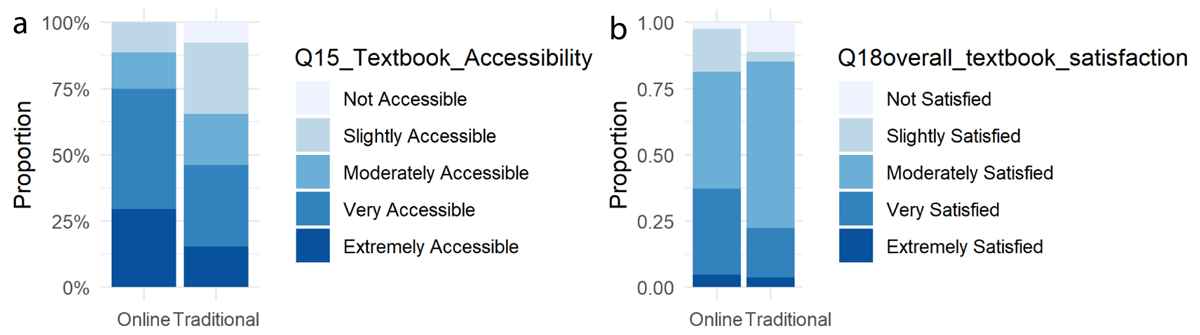
Figure 1
Comparison of (a) accessibility and (b) satisfaction between students using online and traditional textbook.
(a) Perceived accessibility by textbook type. (b) Overall satisfaction by textbook type.
Satisfaction – Overall satisfaction with the assigned textbook was similar across groups (W = 645.5, p = .396; see Figure 1b and Table 3). Most students in both conditions selected mid to high satisfaction categories. The absence of a statistically significant difference suggests that adopting an online open textbook did not reduce students’ overall satisfaction with the course materials.
Perceived effectiveness for studying/assignments – Ratings of how well the textbook supported studying and completing assignments were also comparable between groups (W = 607.5, p = .757; see Figure 2a and Table 3). Students in both conditions most often selected “Somewhat effective” or “Very effective,” indicating that both formats functioned similarly for core study tasks.
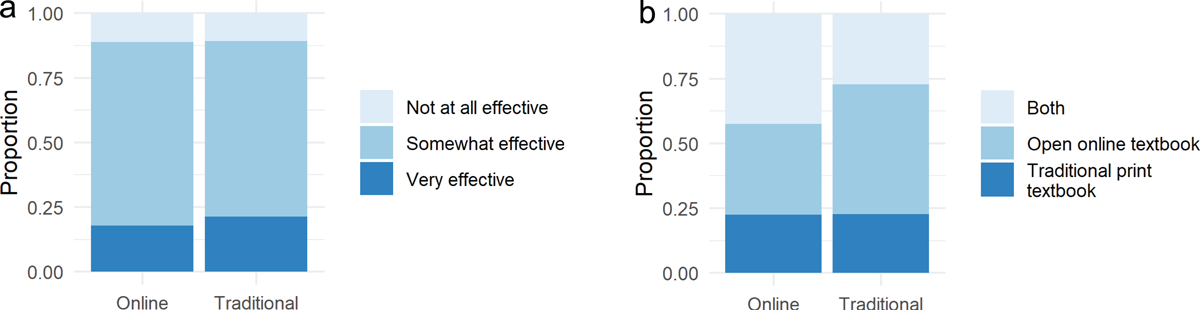
Figure 2
Panel (a) shows students’ ratings of textbook effectiveness for studying, indicating comparable perceptions for online and traditional formats. panel (b) presents textbook format preferences for future courses, showing a tendency toward open online materials or mixed-format use.
(a) Perceived effectiveness of textbook for studying. (b) Preferred textbook format for future courses.
Future preference – When asked what format they would prefer in future courses, students in both groups tended to choose either an online textbook or a mixed option (online + print). Only a small minority preferred print only. Statistical tests found no association between textbook used in this course and future format preference (χ2 = 1.74, p = .63; Fisher’s exact p = 1.00; see Figure 2b and Table 3). This pattern implies that students’ future preferences are broadly digital friendly regardless of current exposure.
Perception summary – The perceptions data show a consistent pattern: the online textbook was experienced as more accessible (Figure 1a; Table 3), while satisfaction and perceived effectiveness were equivalent (Figures 1b, 2a; Table 3). Preferences for future courses leaned toward digital or hybrid access in both groups (Figure 2b; Table 3). These results align with our expectation that online open materials improve access without harming perceived usefulness or overall satisfaction.
Academic Performance: Marks and Grades
To determine whether textbook type influenced actual academic performance, final course marks and letter grades were compared between students who used online versus traditional textbooks. This second phase of analysis provides an objective measure to complement the survey-based perceptions discussed above.
Final percentage grades did not follow a normal distribution in either group (Shapiro–Wilk tests; see Methods). Accordingly, non-parametric comparisons were used and supplemented with effect size estimation.
There was no statistically significant difference in final course marks between the online and traditional groups (p = .30; Cohen’s d = –0.25; see Figure 3a and Table 3). The standardized mean difference was small and negligible in magnitude, indicating performance equivalence for instructional purposes. These findings align with broader research demonstrating that open and traditional textbook use yield comparable learning outcomes. Tlili et al. (2023) conducted a comprehensive meta-analysis and research synthesis on open educational resources and open educational practices, concluding that OER use does not significantly differ from traditional materials in terms of learning achievement. Their findings support the interpretation that the pedagogical design and instructional context, rather than the textbook format itself, are the primary drivers of student success.
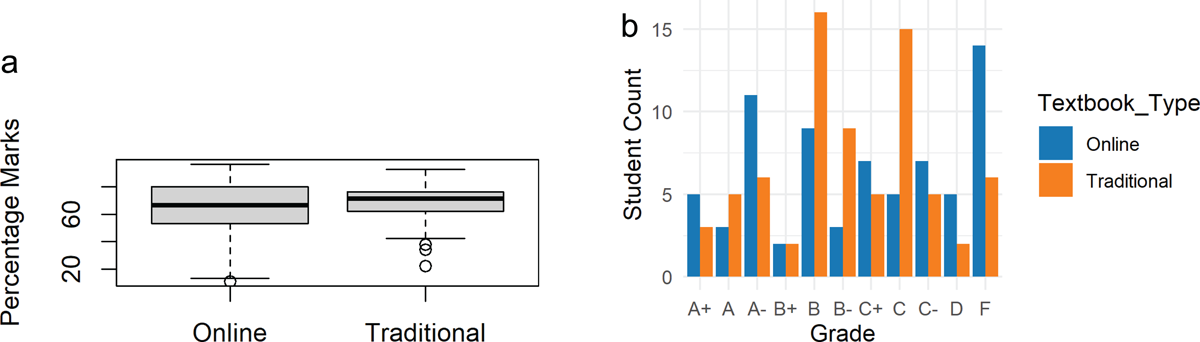
Figure 3
Summary of student performance across online and traditional textbook groups. while median scores were comparable, online users showed greater grade variability, achieving more a’s and f’s.
(a) Comparison of final course marks by textbook type. (b) Distribution of letter grades by textbook type.
The letter grade distribution helps explain the small effect size. Online textbook users showed greater spread: more top grades and more failing grades. For context, the online group included 16 A range grades (A or A+) out of 71 students, about 23% and 14 F grades, about 20%. The traditional group included 9 A range grades out of 74, about 12% and 6 F grades, about 8%. Traditional users were more concentrated in the middle ranges (notably B and C) (see Figure 3b and Table 2). Thus, the central tendency (median) is similar across groups, but the online group’s outcomes are more widely dispersed.
Table 2
Distribution of final course grades by textbook format. the online group had more a– and a+ grades, but also more failing grades (f). traditional students were more concentrated in the mid-grade range (b and c).
| CATEGORY | GRADE | ONLINE | TRADITIONAL |
|---|---|---|---|
| HIGH | A+ | 5 | 3 |
| A | 3 | 5 | |
| A- | 11 | 6 | |
| MID | B+ | 2 | 2 |
| B | 9 | 16 | |
| B– | 3 | 9 | |
| C+ | 7 | 5 | |
| C | 5 | 15 | |
| C– | 7 | 5 | |
| LOW | D | 5 | 2 |
| F | 14 | 6 |
The wider spread in the online group suggests heterogeneity in how students use the digital text. Some students may have leveraged features such as search, linking, and anytime access to excel, while others may have struggled with study routines, competing distractions, or device access. Because instructors differed between sections, instructor effects may also contribute to variability. Importantly, despite the wider spread, there is no evidence of an academic penalty for using the online textbook: the median performance is comparable, and the overall difference is non-significant with a negligible effect size (Figure 3a–3b; Table 3). The distribution plots further illustrate this pattern (Figure 4).
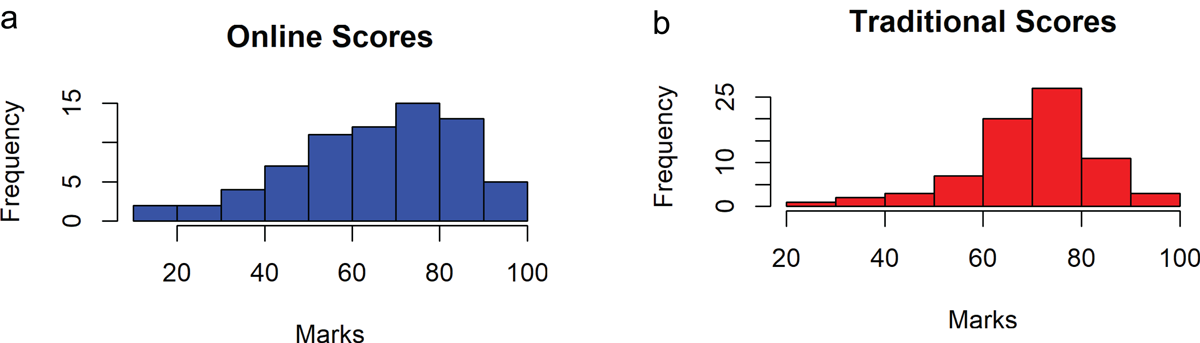
Figure 4
Distribution of scores (marks) between the online textbook users.
(a) Distribution of final scores for online textbook users. (b) Distribution of final scores for traditional users.
The results indicate performance equivalence across formats, with the online condition supporting both high achievement (more A range grades) and, for a subset, lower outcomes (more F grades) (Figures 3, 4; Table 2). This pattern underscores the importance of course level supports (e.g., brief orientation to navigation, offline/PDF options, and study guidance for using digital texts effectively) to help more students realize the potential benefits of the online format.
A summary of the key statistical comparisons between online and traditional textbook formats is presented in Table 3.
Table 3
Summary of key findings across textbook formats.
| OUTCOME | RESULT | p-value | INTERPRETATION |
|---|---|---|---|
| Accessibility | Online rated higher | p = 0.013 | Statistically significant |
| Satisfaction | Comparable | p = 0.396 | Slightly higher for online |
| Effectiveness | Comparable | p = 0.757 | No difference |
| Future Preference | Comparable | p = 0.63 | Most prefer online/mix |
| Academic Performance | Comparable | p = 0.30 | No disadvantage for online |
| Effect Size | Cohen’s d = –0.25 | – | Small, negligible |
The study shows a coherent picture across data sources. Students experienced the online open textbook as more accessible (Figure 1a; Table 3). They were just as satisfied and found it just as effective for studying as print (Figures 1b, 2a; Table 3). Preferences for the future favored digital or mixed formats regardless of what students used in this course (Figure 2b; Table 3). On objective outcomes, final marks were equivalent across groups, with only a small, non-meaningful difference and greater variability in the online group (Figures 3, 4; Tables 2, 3). The practical takeaway is straightforward: adopting an online open textbook can improve access without compromising learning, provided instructors pair the resource with light touch guidance on how to use digital features and ensure accessible, low bandwidth alternatives where needed.
Taken together, these results indicate that while students using open digital textbooks achieved similar academic outcomes to those using traditional print materials, they reported greater perceptions of accessibility and flexibility. This convergence between performance equivalence and enhanced access suggests that textbook format alone does not dictate learning success, but may influence students’ engagement, motivation, and study behaviors. To further interpret these findings, the following section situates them within current research and explores their broader theoretical and policy implications for open education and digital learning.
Discussion
The equivalence in academic performance between students using open and traditional textbooks observed in this study aligns with recent empirical evidence showing that open resources generally sustain comparable learning outcomes while advancing broader educational goals of access and inclusivity. Lantrip and Button (2025) found that a faculty-developed open textbook produced no significant differences in student grades relative to a commercial text, mirroring our findings of performance parity. Similarly, Sheu and Grissett (2020) demonstrated that when students were blinded to cost and source, their evaluations of open and non-open materials were nearly identical, further reinforcing that format alone does not determine learning efficacy. These consistent results highlight the importance of focusing not merely on textbook type but on pedagogical design and learner interaction. This interpretation is congruent with cognitive load theory (Sweller et al., 2019), which posits that instructional effectiveness hinges on optimizing the mental processing demands imposed by educational materials. Open textbooks, when well-structured and clearly segmented, may help manage intrinsic load by supporting coherence and accessibility while minimizing extraneous processing demands.
Beyond cognitive explanations, theoretical perspectives on technology acceptance provide insight into students’ positive perceptions of open texts. According to the Technology Acceptance Model (TAM; Davis, 1989), perceived usefulness and ease of use drive users’ willingness to adopt digital innovations. Clinton-Lisell and Kelly (2024) reported that students perceive OER-using instructors as more approachable and innovative, enhancing both engagement and motivation. This behavioral acceptance may explain why students in our study rated the online format higher in accessibility and satisfaction, even in the absence of significant grade differences. Lazzara, Bloom, and Clinton-Lisell (2024) similarly found that open, renewable assignments foster greater intrinsic motivation by increasing perceived relevance and ownership. These features are consistent with the social dimensions of the technology acceptance framework. These results suggest that student success in OER environments may depend as much on affective and motivational variables as on cognitive ones.
At a policy level, these findings reinforce the growing case for integrating open resources as a viable and equitable component of institutional strategy. Studies examining the economics of learning materials (Lo et al., 2023; Wittkower & Lo, 2019) show that textbook affordability remains a barrier to retention, particularly for students from underrepresented groups. By maintaining performance outcomes while reducing financial burden, open materials directly support policy objectives around access, persistence, and inclusion. Moreover, Pfannenstiel (2020) demonstrated that prior beliefs about textbook usefulness and accessibility influence student engagement, suggesting that institutional support for open literacy such as training students to locate, evaluate, and use OER effectively can maximize the benefits of open adoption. Collectively, these converging strands of evidence indicate that open textbook integration, when paired with attention to cognitive design, learner support, and institutional commitment, has the potential to enhance both the effectiveness and equity of higher education systems.
Conclusion, Implications and Suggestions
This study compared an open online textbook with a traditional print textbook in the same course. Students rated the online textbook as more accessible, and satisfaction and perceived effectiveness were similar across formats. Final marks were also similar, with a negligible difference. Together, the results indicate that the open online option improved access without lowering academic performance.
At a practical level, instructors can adopt an open online textbook with confidence that learning outcomes remain comparable while access improves. Most students also preferred digital or mixed access in future courses, which supports offering online materials by default and keeping print as a complementary option when needed. For program and institutional leaders, these results support textbook-cost reduction strategies (e.g., ZTC) that preserve academic value while improving usability.
We observed a wider grade spread in the online section: more top grades and more failing grades than in the print section. This pattern suggests that some learners thrive with the flexibility and features of digital texts, while others may need more structure. Light-touch supports e.g. a brief orientation to navigation, tips for focused screen reading, downloadable/PDF options, and reminders about accessibility tools are likely to reduce variability and help more students benefit.
Some limitations should be taken into consideration when interpreting these results. Whilst we assume that both sections of the course under investigation included students possessing a normal distribution of academic abilities, so differences in outcomes are unlikely to reflect pre-existing differences in student ability, the two sections were however, taught by different instructors. Although course content and assessments were standardized, instruction was not experimentally controlled, introducing a potential instructor effect. Survey participation was voluntary, which may have produced response bias, and listwise deletion of missing data could affect generalizability. In addition, the analysis focused on end-of-course outcomes without usage analytics, making it difficult to link specific study behaviors to results. The design involved one course at a single institution and compared different textbooks that also differed in format, so observed differences (or equivalence) may partly reflect content and design features rather than format alone. Finally, relatively modest group sizes in the survey (online n = 49; traditional n = 28) limit power to detect small effects.
Future studies should use designs that minimize instructor and section effects (e.g., randomized or cross-over assignments within instructors), collect learning-analytics on actual textbook use, and test mediation pathways linking perceived accessibility/usability to satisfaction, preference, and performance. Reliability measures could be enhanced in future studies by computing internal consistency (e.g., Cronbach’s alpha) for grouped survey items. Stratified analyses by learner characteristics (e.g., device access, commuting status) and multi-course, multi-term replications would extend external validity. Where possible it would also be useful to choose textbooks that cover the same material in the same order, so any differences reflect format and interface, not content.
Data Accessibility Statement
The datasets generated and/or analyzed during the current study are available in the GitHub repository at https://github.com/nramroopsingh/OpenPraxis2025/tree/main.
Sustainable Development Goals (SDGs)
This study is linked to the following SDG(s): Quality education (SDG 4) & Reduced inequalities (SDG 10).
Author Notes
The authors confirm that no generative artificial intelligence (AI) tools were used in the writing, editing, data analysis, or preparation of this manuscript. All content was created and reviewed entirely by the authors.
Ethics and Consent
Ethics approval for this research project was obtained from the university’s Research Ethics Board (REB). Participation was entirely voluntary, and students were informed that their decision to participate – or not – would have no impact on their course grades or academic standing. No personal identification was used in the analysis or reporting, and all data was stored securely.
Competing Interests
The authors have no competing interests to declare.
Author Contributions
Natasha Ramroop Singh: Funding Acquisition, Conceptualization, Investigation, Methodology, Project Administration, Supervision, Writing – original draft. Ayisha Najeeha C O K: Data curation, Formal analysis, Validation, Visualization, Writing – review & editing. Olivia Mendez Romero: Writing—review and editing. All authors have read and agreed to the published version of the manuscript.