
Introduction
The advent of digital technologies has significantly transformed global educational practices, with Massive Open Online Courses (MOOCs) emerging as a pivotal innovation for faculty development in higher education (Bonk et al., 2015; Shah, 2019). As institutions seek scalable and cost-effective models for continuous professional learning, MOOCs offer the potential to overcome traditional constraints, such as limited accessibility, scheduling conflicts, and high costs (Laurillard, 2016; Misra, 2018). In developing countries like India, characterised by extensive higher education networks, MOOCs present a compelling opportunity to reach dispersed academic communities (Kayal, 2020).
Similar patterns of MOOC adoption for teacher professional development are emerging across developing nations, though with varying levels of success and institutional backing. China’s implementation through national platforms has shown significant teacher engagement, with studies indicating that over 15% of enrolled teachers continue across multiple course iterations (Chen et al., 2020). Other developing countries have tested different models, from state-supported integration into certification programmes to community-based approaches emphasising locally developed content and cultural adaptation. These diverse implementation strategies across different national contexts highlight the need for context-sensitive research that examines how policy frameworks, technological infrastructure, and cultural factors influence MOOC effectiveness for teacher professional development in developing countries.
MOOCs, originally designed to democratise education, have evolved into recognised platforms for formal and non-formal professional development (Jobe et al., 2014). Their flexibility, scalability, and low cost position them as ideal tools for Teacher Professional Development (TPD), particularly in situations where conventional methods are logistically and economically prohibitive (Patru & Balaji, 2016). Recognising their potential, several Asian nations, including India, have launched national MOOC platforms to support teacher training (Kim, 2015). India’s SWAYAM initiative exemplifies this trend, offering over 2,000 courses, including the Annual Refresher Programme in Teaching (ARPIT), which aims to enhance faculty competencies (Ministry of Education, 2020).
In line with the vision of the National Education Policy (NEP) 2020, which promotes technology-enabled professional development, MOOCs are increasingly regarded as tools to enhance educator capacity and cultivate inclusive, digital learning environments. Nonetheless, the effective integration of MOOCs into professional development frameworks relies on educators’ perceptions, attitudes, and the contextual factors that affect engagement (Ertmer & Ottenbreit-Leftwich, 2010).
Despite the increasing implementation of MOOCS, empirical research remains focused on student experiences, with limited inquiry into how higher education faculty perceive and utilise MOOCs, particularly within the Indian context (Koukis & Jimoyiannis, 2020; Singh, 2022). This underrepresentation restricts our understanding of adoption patterns, especially in non-Western settings where MOOCs may play unique educational roles. Furthermore, existing studies largely emphasise broad usage statistics or general user traits, providing little insight into the psychological and contextual dimensions—such as perceived usefulness or institutional support—that underpin faculty engagement (Altalhi, 2021; Koukis & Jimoyiannis, 2019).
A further gap exists in the lack of psychometrically sound instruments tailored to assess teacher perceptions and attitudes towards MOOCs. Most research adapts generic technology acceptance models (e.g., TAM; Davis, 1989; Venkatesh et al., 2003), without adequately capturing the specificities of MOOCs for faculty development. The absence of validated, context-sensitive measurement tools hinders efforts to systematically evaluate faculty engagement and inform targeted interventions.
The Indian higher education landscape presents distinct conditions, such as the integration of SWAYAM into formal credit systems (Class Central, 2020), that necessitate contextually grounded exploration. Furthermore, while some studies indicate that factors like age, teaching experience, and institutional affiliation may influence technology uptake (Rogers, 2003), their interaction with MOOC-related attitudes remains inadequately examined. Understanding which perceptual factors predict positive attitudes is essential for designing effective, inclusive development programmes.
This study addresses these gaps by developing and validating two scales to measure Indian higher education teachers’ perceptions and attitudes towards MOOCs for professional development. In addition to methodological advancement, the study investigates faculty engagement across demographic variables and explores predictive relationships between perceptions and attitudes.
Methodologically, the research contributes by creating robust, multi-dimensional instruments to assess MOOC-related constructs, suitable for replication in diverse contexts. Substantively, the findings offer valuable insights into teacher engagement with digital platforms, informing the design and implementation of professional development initiatives. As other developing nations navigate similar educational reforms, the outcomes offer valuable reference points for comparative studies and policymaking.
Ultimately, the research aligns with NEP 2020’s emphasis on enhancing teacher capacity through digital methods. By identifying the enabling and constraining factors that influence MOOC engagement, the study provides actionable recommendations for institutional leaders, developers, and policymakers aiming to improve faculty professional development in digitally enriched environments.
Review of Literature
This literature review examines the integration of MOOCs into teacher professional development, theoretical perspectives on technology adoption, and measurement tools relevant to evaluating perceptions and attitudes, while identifying critical research gaps that this study addresses.
MOOCs and Teacher Professional Development
MOOCs have emerged as a scalable and cost-effective model for teacher professional development, particularly since 2018 (Misra, 2018). They offer flexibility, affordability, and the capacity to reach large, dispersed educator populations, advantages that are especially valuable in resource-constrained settings.
Evidence from recent studies supports the potential of MOOCs to enhance teacher development. For example, Rodés et al. (2021) reported that MOOC-based strategies provided meaningful alternatives for emergency remote teaching during COVID-19. Teachers’ expectations tend to favour MOOCs that offer vocational relevance and future applicability (Herranen et al., 2021). The evolution of MOOC formats, blending cMOOC and xMOOC features, now emphasises collaboration, engagement, and reflective learning, addressing past critiques of learner isolation (Koukis & Jimoyiannis, 2020).
However, research from non-Western settings uncovers more nuanced patterns of MOOC adoption and effectiveness. Chen et al. (2020) examined teacher engagement in a Chinese professional development MOOC across seven iterations, finding that 16% of all 105,370 teacher-learners enrolled in multiple runs of the same course. These “persistent learners” showed diverse motivations for re-enrollment, such as refreshing conceptual understanding, achieving higher scores, earning certification, and solving practical problems. Notably, persistent teacher-learners developed better self-regulated learning skills and achieved significantly higher learning outcomes than those who only enrolled once. This challenges the common Western narrative of low MOOC completion rates by showing that repeated engagement might be a more meaningful measure of success than traditional completion metrics in professional development contexts.
Research from the Indian context highlights additional complexities in MOOC adoption. Singh and Chauhan (2017) found that while teacher educators had a basic understanding of MOOC concepts and benefits, significant confusion persisted regarding MOOCs’ role in teacher training, with limited awareness of national initiatives like SWAYAM. This indicates that successful MOOC integration for professional development requires not only platform availability but also systematic awareness-raising and institutional support frameworks.
These non-Western studies underscore the inadequacy of applying Western-derived engagement models universally without considering cultural, economic, and institutional contexts that influence professional learning needs and motivations.
National MOOC Platforms and Quality Initiatives
National MOOC initiatives across Asia highlight notable gaps between policy goals and how they are put into practice. Countries such as India, Malaysia, and South Korea have established national MOOC platforms like SWAYAM and K-MOOCs to promote educational equity (Misra, 2018). Nonetheless, a critical review points to fundamental issues in government-led strategies.
SWAYAM, introduced by AICTE in 2016, supports large-scale faculty training through initiatives like ARPIT, which reached nearly 200,000 teachers across two cycles (AICTE, 2017; Razia, 2020). Despite impressive enrolment figures, completion rates remain at approximately 5%, raising questions about the actual learning impact. Studies indicate persistent uncertainty among educators regarding MOOCs’ relevance and role within professional training frameworks, suggesting misalignment between top-down implementation and ground-level needs.
The Commonwealth of Learning’s Technology-Enabled Learning (TEL) MOOC demonstrates evidence-based improvement, with completion rates increasing from 11% to 18% through iterative design (Commonwealth of Learning, 2018). Comparative evaluations have found MOOCs to surpass Learning Management Systems in areas such as clarity, collaboration, and practical relevance (Pellas, 2025), highlighting the tension between rapid deployment and pedagogical quality in national initiatives.
Theoretical Frameworks: Technology Acceptance and Beyond
Although the Technology Acceptance Model (TAM) has been widely adopted to understand faculty engagement with educational technologies, including MOOCs (Davis, 1989), its use reveals both strengths and significant limitations within professional development settings. TAM’s fundamental principle—that perceived usefulness and ease of use influence user attitudes and intentions—has demonstrated predictive validity in various studies of teacher technology adoption (Pan, 2020; Scherer et al., 2019). However, since this framework originated in corporate technology adoption, it may not fully account for the complex motivational and contextual factors that shape educator behaviour.
Recent extensions incorporating self-efficacy, feedback quality, and engagement reflect efforts to address TAM’s limitations (Kemp, 2024; Fuchs, 2022), yet these modifications often result in more complex models that sacrifice simplicity without necessarily improving predictive power. The proliferation of TAM variants suggests theoretical fragmentation rather than an increase in understanding, with researchers adding variables to suit specific contexts instead of developing more fundamentally suitable frameworks for educational environments.
Furthermore, while systematic reviews indicate that teachers generally view technology integration positively (Akram et al., 2022), the gap between positive attitudes and sustained implementation remains poorly explained by TAM-based approaches. This suggests that professional development for technology adoption may need frameworks that emphasise pedagogical compatibility, institutional support, and community factors rather than solely focusing on individual cognitive processes.
Measurement Tools and Scale Development
The measurement of teacher attitudes towards MOOCs highlights significant methodological fragmentation that hinders the accumulation of knowledge in the field. Although instruments exist to evaluate general attitudes towards online learning, the proliferation of context-specific tools lacking systematic validation presents an epistemological issue. Tools developed by Sangwan et al. (2021) show promising reliability (α = 0.88), but their generic focus on online learning fails to address MOOC-specific constructs such as massive scale effects, open accessibility, or competency-based progression that set MOOCs apart from traditional e-learning platforms.
Similarly, Herranen et al. (2021) developed relevance-based questionnaires that, although methodologically robust, concentrate on individual dimensions rather than offering comprehensive measurement frameworks. This reductionist approach mirrors a wider trend in educational technology research to prioritise statistical reliability over construct validity, leading to instruments that measure consistently but may not fully capture the phenomena they aim to assess.
The gap between theoretical frameworks and measurement tools is illustrated by Koukis and Jimoyiannis (2020), who created comprehensive design principles for MOOC-based teacher development but did not provide any validated instruments. This disconnect sustains ad hoc measurement methods that hinder cross-study comparability. Additionally, the Western-centric origins of existing tools raise fundamental validity concerns for developing contexts like India, where policy environments, technological infrastructure, and professional development cultures differ significantly.
Summary of Research Gaps
This review highlights several intersecting gaps:
Methodological Gaps
Lack of validated scales focused specifically on MOOC-related teacher attitudes.
Limited tool development in non-Western or developing educational settings.
Empirical Gaps
Scarcity of research examining teachers’ MOOC experiences, with most studies focusing on students or Western faculty (Misra, 2018; Singh, 2022).
Limited understanding of how teacher characteristics (e.g., experience, institutional affiliation) relate to MOOC engagement.
Theoretical and Practical Gaps
Overreliance on singular frameworks like TAM, without integrating broader motivational or contextual variables (Pan, 2020; Scherer et al., 2019).
Insufficient exploration of how national policies, such as India’s NEP 2020, translate into faculty-level MOOC adoption (Mishra, 2024).
Lack of quality assurance frameworks for MOOC-based teacher development despite wide-scale roll-outs like ARPIT (Razia, 2020).
This study addresses these gaps by developing and validating MOOC-specific, psychometrically sound instruments tailored to the Indian higher education context. It further explores the relationship between perceptions, attitudes, and demographic variables to inform faculty development strategies and contribute to theory-building in digital learning adoption.
Research Questions
This study addresses the following research questions:
RQ1: What is the construct validity and internal consistency of the newly developed scales measuring teachers’ perceptions and attitudes towards MOOCs for professional development?
RQ2: What are the perceptions of higher education teachers regarding the use of MOOCs in their professional development?
RQ3: What are the attitudes of teachers towards MOOCs as a means of continuous professional learning?
RQ4: What is the relationship between teachers’ attitudes and their perceptions of MOOCs?
RQ5: Do perceptions and attitudes differ based on demographic characteristics such as gender, designation, and teaching experience?
RQ6: What is the predictive influence of perceptions on attitudes towards MOOCs?
Research Methodology
Research Design
This study employed a quantitative, cross-sectional survey design to explore higher education teachers’ perceptions and attitudes toward MOOCs for professional development, while also validating a newly developed measurement tool.
Participants and Sampling
Participants included higher education faculty members from colleges and universities in Jammu City, India. Using a random sampling approach, 76 teachers who had enrolled in or completed at least one MOOC were selected, representing a variety of institutional affiliations and academic ranks. Among these, 49 were female and 27 male. The majority were Assistant Professors (n = 61), followed by Associate Professors (n = 12) and Professors (n = 3). Most participants were college-based (n = 71), with a smaller number from universities (n = 5). Teaching experience varied significantly, with 20 participants having up to five years and three having over 25 years. Concerning MOOC engagement, most (n = 66) had completed up to ten MOOCs; 64 enrolled in 0–5 MOOCs annually, while four had completed more than 30 MOOCs over time.
Instrumentation
Scale Development Process
The development of both scales followed a systematic, iterative approach based on established principles of scale development (DeVellis, 2017; Hinkin, 1998). The process involved four phases:
Phase 1: Literature-Based Item Generation: A comprehensive review of literature on MOOCs, technology acceptance, and teacher professional development was carried out to identify relevant constructs and measurement approaches. Key theoretical frameworks included the Technology Acceptance Model (Davis, 1989), MOOC effectiveness research (Koukis & Jimoyiannis, 2020), and existing teacher attitude scales (Sangwan et al., 2021). This thorough literature synthesis initially resulted in 60 items across 12 theoretical domains, capturing various aspects of teachers’ perceptions and attitudes towards MOOCs.
Phase 2: Expert Content Validation: The initial item pool was evaluated for content validity by three specialists in educational technology. They reviewed items for theoretical relevance, clarity, and suitability for assessing MOOC-related constructs within the Indian higher education context. Their feedback helped guide further refinement of items and restructuring of the domain.
Phase 3: Item Refinement and Domain Consolidation: After expert review, the item pool was systematically refined to remove redundancy and overlap. Items with similar content or constructs were combined, and domains were reorganised based on conceptual coherence and theoretical alignment. This iterative process reduced the original 12 domains and 60 items to a more streamlined structure while still covering key constructs comprehensively.
Phase 4: Final Scale Construction: The final scales were standardised to ensure consistency across domains. The Teachers’ Perceptions Scale consisted of 45 items across nine domains (five items per domain), while the Teachers’ Attitudes Scale included 20 items across four domains (five items per domain). All items used 5-point Likert scales (1 = Strongly Disagree to 5 = Strongly Agree), following established practices in educational measurement.
Final Questionnaire
A self-developed questionnaire was employed to evaluate teachers’ perceptions and attitudes towards MOOCs. The instrument consisted of two primary components:
Teachers’ Perceptions Scale: The scale included 45 items across nine domains; each rated on a 5-point Likert scale. The domains are presented in Table 1.
Teachers’ Attitudes Scale: The scale consisted of 20 items grouped into four domains, also rated on a 5-point Likert scale, as shown in Table 2.
Table 1
Domains of the Teachers’ Perceptions Scale.
| DOMAIN | DESCRIPTION |
|---|---|
| Relevance and Content Quality | Perceived relevance and quality of MOOC content for professional growth. |
| Flexibility and Accessibility | Ability of MOOCs to fit into teachers’ schedules and contexts. |
| Interaction and Engagement | Opportunities for peer interaction and active learning in MOOCs. |
| Practical Application | Relevance of MOOC content to teaching practices. |
| Time and Commitment | Balancing teaching workload and MOOC participation. |
| Assessment and Feedback | Quality of evaluation and feedback mechanisms within MOOCs. |
| Cost and Resource Considerations | Perceived affordability and sufficiency of MOOC resources. |
| Technical Support and Platform Experience | Usability and reliability of MOOC platforms. |
| Integration into Teaching Practice | Extent to which MOOCs inform and enrich teaching practices. |
Table 2
Domains of the Teachers’ Attitudes Scale.
| DOMAIN | DESCRIPTION |
|---|---|
| Perceived Benefits | Anticipated professional benefits of engaging in MOOCs. |
| Barriers and Concerns | Challenges or reservations about MOOCs. |
| Perceived Support and Resources | Availability of institutional and technical support for MOOC use. |
| Future Engagement | Willingness to continue or recommend MOOCs in the future. |
Demographic data were also collected. Notably, the scales were not pilot-tested, as instrument validation was a core objective of the study.
Data Collection Procedure
The questionnaire was administered online via Google Forms from January to March 2025. Ethical clearance was obtained from the institution’s Research and Development Cell. Participation was voluntary, with informed consent, anonymity, and confidentiality guaranteed throughout.
Data Analysis
Data were analysed using IBM SPSS Version 28 and aligned with the six research objectives:
Descriptive statistics were used to summarise demographics and overall trends.
Exploratory Factor Analysis (EFA), with PCA and Varimax rotation, tested construct validity.
Cronbach’s alpha was used to assess internal consistency for all scale domains.
Pearson correlations were used to explore relationships between perception and attitude variables.
T-tests and ANOVAs were used to examine differences across gender, experience, rank, and institutional affiliation.
Multiple regression analysis was used to identify predictors of teacher perceptions.
All analyses adhered to a significance level of p < .05, supporting rigorous interpretation and validation of the instruments.
Results
This section presents the results aligned with the study’s six research questions. All analyses were conducted using IBM SPSS Statistics Version 28, with significance set at p < .05.
Demographic Characteristics of Participants
A total of 76 higher education teachers took part in the study. As illustrated in Table 3, the sample comprised 49 females (64.5%) and 27 males (35.5%). The majority of respondents were Assistant Professors (80.3%), followed by Associate Professors (15.8%) and Professors (3.9%). Regarding teaching experience, participants were distributed across various career stages: 26.3% had up to five years of experience, 25% had five to ten years, and 17.1% had ten to fifteen years. Those with over twenty years’ experience constituted a smaller segment (17.1%). Most respondents (93.4%) were affiliated with colleges, while only 6.6% were associated with universities. Concerning MOOCs, 84.2% reported enrolling in up to five MOOCs annually, whereas 2.6% enrolled in more than fifteen. Over 85% had completed up to ten MOOCs throughout their careers.
Table 3
Demographic Characteristics of Participants (N = 76).
| CHARACTERISTIC | FREQUENCY | PERCENTAGE |
|---|---|---|
| Gender | ||
| Female | 49 | 64.5 |
| Male | 27 | 35.5 |
| Academic Designation | ||
| Assistant Professor | 61 | 80.3 |
| Associate Professor | 12 | 15.8 |
| Professor | 3 | 3.9 |
| Teaching Experience | ||
| 0–5 Years | 20 | 26.3 |
| 5–10 Years | 19 | 25.0 |
| 10–15 Years | 13 | 17.1 |
| 15–20 Years | 11 | 14.5 |
| 20–25 Years | 10 | 13.2 |
| Greater Than 25 Years | 3 | 3.9 |
| Institutional Affiliation | ||
| College | 71 | 93.4 |
| University | 5 | 6.6 |
| Annual MOOC Enrolment | ||
| 0–5 MOOCs | 64 | 84.2 |
| 5–10 MOOCs | 10 | 13.2 |
| More than 15 MOOCs | 2 | 2.6 |
| Total MOOCs Completed | ||
| 0–10 MOOCs | 65 | 85.5 |
| 10–20 MOOCs | 3 | 3.9 |
| 20–30 MOOCs | 3 | 3.9 |
| More Than 30 MOOCs | 5 | 6.6 |
RQ1: What is the construct validity and internal consistency of the newly developed scales measuring teachers’ perceptions and attitudes towards MOOCs for professional development?
To answer the first research question, the construct validity and internal consistency of the newly developed scales assessing higher education teachers’ perceptions and attitudes towards MOOCs for professional development were calculated. Exploratory Factor Analysis (EFA) and Cronbach’s alpha were utilised for psychometric validation.
EFA: Teachers’ Perceptions Scale
The 45-item perceptions scale was evaluated for factorability using the Kaiser-Meyer-Olkin (KMO) and Bartlett’s tests. The KMO measure was .861, indicating excellent sampling adequacy (Kaiser & Rice, 1974). Bartlett’s test of sphericity was highly significant (χ² = 4114.578, df = 990, p < .001), confirming that the correlation matrix was appropriate for factor analysis (Bartlett, 1951).
Principal Component Analysis with Varimax rotation extracted six factors with eigenvalues >1, cumulatively explaining 76.77% of the variance (see Table 4). The first factor accounted for 59.47%, highlighting a strong general factor (Kaiser, 1960; Hair et al., 2019). Scree plot analysis (Figure 1) supported a six-factor solution.
Table 4
Exploratory Factor Analysis Results for Teachers’ Perceptions Scale.
| FACTOR | EIGENVALUE | % VARIANCE | CUMULATIVE % | ITEMS LOADING |
|---|---|---|---|---|
| 1 | 26.759 | 59.465 | 59.465 | 9 |
| 2 | 1.992 | 4.426 | 63.891 | 8 |
| 3 | 1.814 | 4.031 | 67.921 | 7 |
| 4 | 1.580 | 3.511 | 71.432 | 6 |
| 5 | 1.344 | 2.987 | 74.419 | 8 |
| 6 | 1.058 | 2.352 | 76.771 | 7 |
| Total | 76.771 | 45 |
[i] Note. Extraction method: Principal Component Analysis with Varimax rotation. KMO = .861, Bartlett’s χ² = 4114.578, df = 990, p < .001.
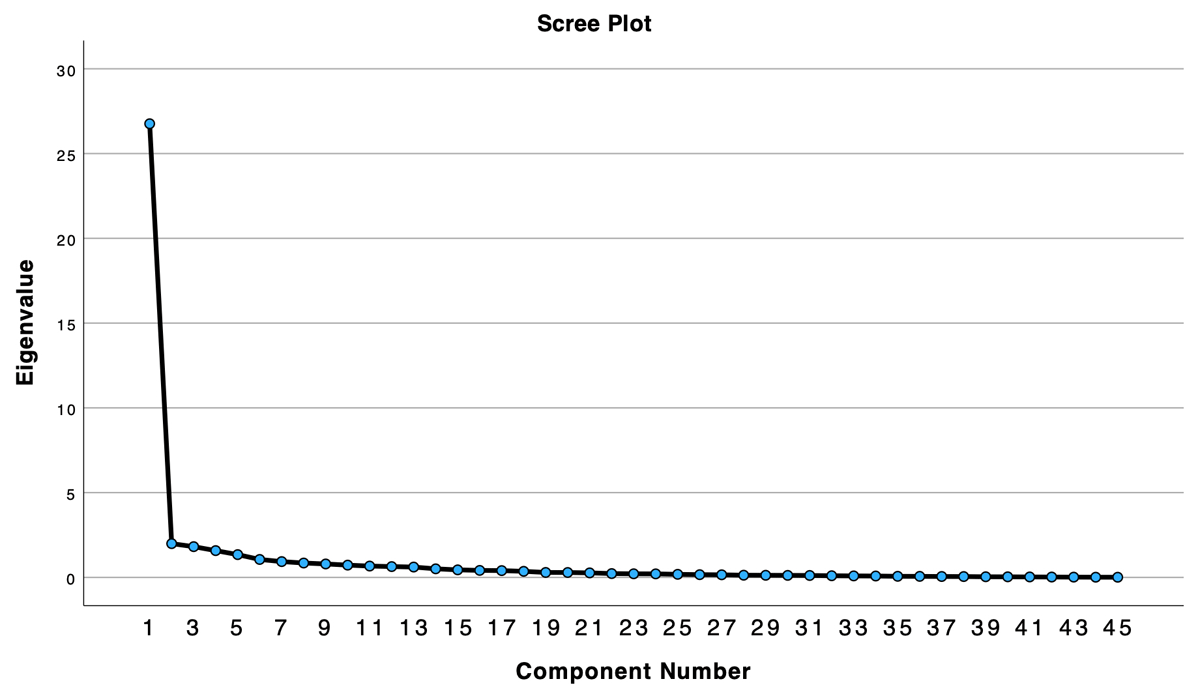
Figure 1
Scree Plot for Teachers’ Perceptions Scale Factor Analysis.
Communalities ranged from .659 to .868, all exceeding the .50 threshold, thereby confirming substantial shared variance (Tabachnick & Fidell, 2019). Most factor loadings surpassed .50, with many exceeding .70, indicating robust item-factor associations (Stevens, 2012).
EFA: Teachers’ Attitudes Scale
The 20-item attitudes scale displayed strong factorability. The KMO was .899, close to the ideal of 1.0, and Bartlett’s test was significant (χ² = 1267.672, df = 190, p < .001), confirming its suitability for EFA (Field, 2018). As shown in Table 5, three factors were extracted with eigenvalues of 10.228, 2.619, and 1.365, which accounted for 71.06% of the total variance. An inspection of the scree plot (Figure 2) confirmed this three-factor structure.
Table 5
Exploratory Factor Analysis Results for Teachers’ Attitudes Scale.
| FACTOR | EIGENVALUE | % VARIANCE | CUMULATIVE % | ITEMS LOADING |
|---|---|---|---|---|
| 1 | 10.228 | 51.139 | 51.139 | 8 |
| 2 | 2.619 | 13.097 | 64.236 | 7 |
| 3 | 1.365 | 6.823 | 71.058 | 5 |
| Total | 71.058 | 20 |
[i] Note. Extraction method: Principal Component Analysis with Varimax rotation. KMO = .899, Bartlett’s χ² = 1267.672, df = 190, p < .001.
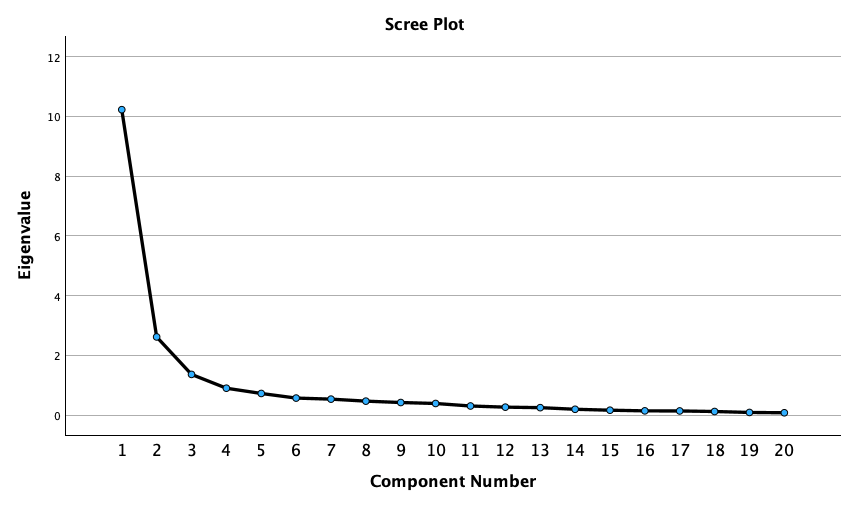
Figure 2
Scree Plot for Teachers’ Attitudes Scale Factor Analysis.
Communalities ranged from .526 to .826, all above the acceptable .50 benchmark (Tabachnick & Fidell, 2019). Factor loadings mostly exceeded .60, supporting strong internal coherence. This structure aligns with theoretical models of attitude formation encompassing cognitive, affective, and behavioural dimensions (Eagly & Chaiken, 1993).
Internal Consistency Reliability: Teachers’ Perceptions Scale
The 45-item perceptions scale demonstrated excellent internal consistency, with an overall Cronbach’s alpha of .984, which is well above the 0.70 threshold for acceptable reliability and approaches the .95 mark suitable for individual assessments (Nunnally & Bernstein, 1994; DeVellis, 2017). As presented in Table 6, domain-specific alphas ranged from .854 (Cost and Resource Considerations) to .939 (Integration into Teaching Practice), with seven of nine domains exceeding .90. These results reflect very high internal coherence across domains (George & Mallery, 2019).
Table 6
Internal Consistency Reliability for Teachers’ Perceptions Scale.
| DOMAIN | ITEMS | CRONBACH’S α |
|---|---|---|
| Relevance and Content Quality | 5 | .892 |
| Flexibility and Accessibility | 5 | .914 |
| Interaction and Engagement | 5 | .904 |
| Practical Application | 5 | .918 |
| Time and Commitment | 5 | .908 |
| Assessment and Feedback | 5 | .921 |
| Cost and Resource Considerations | 5 | .854 |
| Technical Support and Platform Experience | 5 | .908 |
| Integration into Teaching Practice | 5 | .939 |
| Overall Perceptions Scale | 45 | .984 |
Internal Consistency Reliability: Teachers’ Attitudes Scale
The overall reliability of the 20-item attitudes scale was also excellent (α = .942), confirming high internal consistency (Cronbach, 1951). As shown in Table 7, domain-level alpha coefficients ranged from .849 (Barriers and Concerns) to .931 (Perceived Benefits), with three domains exceeding .90. These values affirm the scale’s robustness in capturing distinct yet interrelated aspects of attitudes towards MOOCs.
Table 7
Internal Consistency Reliability for Teachers’ Attitudes Scale.
| DOMAIN | ITEMS | CRONBACH’S α |
|---|---|---|
| Perceived Benefits of MOOCs | 5 | .931 |
| Barriers and Concerns | 5 | .849 |
| Perceived Support and Resources | 5 | .876 |
| Future Engagement with MOOCs | 5 | .923 |
| Overall Attitudes Scale | 20 | .942 |
Together, the EFA and reliability analyses provide strong evidence of the construct validity and internal consistency of both instruments, supporting their application in assessing MOOC-related perceptions and attitudes among Indian higher education faculty.
RQ2: What are the perceptions of higher education teachers regarding the use of MOOCs in their professional development?
The second research question was explored by examining teachers’ perceptions of MOOCs for professional development. Descriptive statistics for the nine perception domains (Table 8) show an overall positive response, with mean scores ranging from 3.72 to 4.00 on a 5-point Likert scale.
Table 8
Descriptive Statistics for Teachers’ Perceptions Scale Domains (N = 76).
| DOMAIN | MEAN | SD | MIN | MAX |
|---|---|---|---|---|
| Flexibility and Accessibility | 4.00 | 0.83 | 1.00 | 5.00 |
| Relevance and Content Quality | 3.91 | 0.84 | 1.00 | 5.00 |
| Interaction and Engagement | 3.91 | 0.83 | 1.00 | 5.00 |
| Practical Application | 3.89 | 0.79 | 1.20 | 5.00 |
| Technical Support and Platform Experience | 3.84 | 0.82 | 1.20 | 5.00 |
| Assessment and Feedback | 3.82 | 0.85 | 1.40 | 5.00 |
| Time and Commitment | 3.78 | 0.89 | 1.20 | 5.00 |
| Cost and Resource Considerations | 3.73 | 0.78 | 1.20 | 5.00 |
| Integration into Teaching Practice | 3.72 | 0.87 | 1.00 | 5.00 |
[i] Note. Responses measured on a 5-point Likert scale: 1 = Strongly Disagree, 5 = Strongly Agree.
Teachers reported the highest perception of Flexibility and Accessibility (M = 4.00, SD = 0.83), emphasising the importance of time- and place-independent learning, a widely recognised strength of online education (Anderson & Dron, 2011). Relevance and Content Quality, along with Interaction and Engagement, followed closely (both M = 3.91), indicating that MOOCs are generally viewed as professionally relevant and pedagogically engaging. Similarly, Practical Application (M = 3.89) received high ratings, suggesting that teachers considered MOOC content relevant to their classroom contexts. This supports the idea that effective professional development must result in transferable instructional practices (Guskey, 2002).
Moderate scores were recorded for Technical Support and Platform Experience (M = 3.84) and Assessment and Feedback (M = 3.82), indicating potential areas for improvement. Time and Commitment (M = 3.78) also demonstrated moderate positivity; however, the higher standard deviation (SD = 0.89) suggests varied experiences in balancing MOOCs with workload. The lowest, yet still positive, ratings were for Cost and Resource Considerations (M = 3.73) and Integration into Teaching Practice (M = 3.72), which highlight ongoing concerns about applying MOOC learning to routine teaching. In summary, teachers view MOOCs positively for professional development, with flexibility identified as the most appreciated feature.
RQ3: What are the attitudes of teachers towards MOOCs as a means of continuous professional learning?
Research question 3 examined teachers’ attitudes towards MOOCs as tools for continuous professional development. As shown in Table 9, all four domains received positive mean scores, ranging from 3.32 to 3.91.
Table 9
Descriptive Statistics for Teachers’ Attitudes Scale Domains (N = 76).
| DOMAIN | MEAN | SD | MIN | MAX |
|---|---|---|---|---|
| Future Engagement with MOOCs | 3.91 | 0.85 | 1.00 | 5.00 |
| Perceived Benefits of MOOCs | 3.84 | 0.86 | 1.00 | 5.00 |
| Perceived Support and Resources | 3.75 | 0.80 | 1.20 | 5.00 |
| Barriers and Concerns | 3.32 | 0.91 | 1.20 | 5.00 |
[i] Note. Responses measured on a 5-point Likert scale: 1 = Strongly Disagree, 5 = Strongly Agree.
The highest rating was for Future Engagement (M = 3.91, SD = 0.85), indicating a strong behavioural intention to continue using MOOCs. This aligns with the Theory of Planned Behaviour, which suggests that intention is a key predictor of actual behaviour (Ajzen, 1991). Similarly, Perceived Benefits also scored highly (M = 3.84, SD = 0.86), reflecting positive cognitive assessments of MOOCs’ utility, a vital component in sustained technology use (Davis, 1989). These scores show that teachers view MOOCs as valuable professional learning opportunities.
Perceived Support and Resources received a moderate positive rating (M = 3.75, SD = 0.80), indicating generally adequate yet improvable institutional support for MOOC engagement. Conversely, Barriers and concerns received the lowest score (M = 3.32, SD = 0.91), suggesting moderate challenges. The higher standard deviation reflects variability in perceived constraints. As noted in earlier research, common barriers include time limitations, technical difficulties, course quality concerns, and limited organisational support (Liyanagunawardena et al., 2013).
Overall, teachers expressed a favourable attitude towards MOOCs, particularly regarding future engagement and perceived benefits. Nonetheless, addressing support gaps and minimising barriers could enhance adoption and facilitate long-term integration into professional development strategies.
RQ4: What is the relationship between teachers’ attitudes and their perceptions of MOOCs?
The fourth research question explored the connection between teachers’ attitudes and perceptions of MOOCs using Pearson correlation analysis. The findings, shown in Table 10, reveal statistically significant positive relationships across all domains (p < .001).
Table 10
Correlations Between Teachers’ Attitudes and Perceptions of MOOCs (N = 76).
| PERCEPTION DOMAIN | PERCEIVED BENEFITS | BARRIERS & CONCERNS | SUPPORT & RESOURCES | FUTURE ENGAGEMENT |
|---|---|---|---|---|
| Relevance and Content Quality | 0.88** | 0.39** | 0.74** | 0.78** |
| Flexibility and Accessibility | 0.76** | 0.33** | 0.59** | 0.73** |
| Interaction and Engagement | 0.75** | 0.45** | 0.62** | 0.69** |
| Practical Application | 0.81** | 0.45** | 0.65** | 0.69** |
| Time and Commitment | 0.84** | 0.45** | 0.74** | 0.76** |
| Assessment and Feedback | 0.83** | 0.35** | 0.62** | 0.71** |
| Cost and Resource Considerations | 0.78** | 0.56** | 0.72** | 0.78** |
| Technical Support and Platform Experience | 0.82** | 0.39** | 0.76** | 0.80** |
| Integration into Teaching Practice | 0.88** | 0.41** | 0.70** | 0.76** |
[i] Note. ** p < 0.001. All correlations are statistically significant.
The strongest correlations appeared between Perceived Benefits and perception domains, especially Relevance and Content Quality (r = 0.88) and Integration into Teaching Practice (r = 0.88). These results indicate that teachers who see MOOC content as relevant and applicable to their classrooms are more likely to recognise significant professional value—an observation in line with Ertmer and Ottenbreit-Leftwich (2010). Likewise, Time and commitment were also strongly correlated with perceived benefits (r = 0.84), implying that the manageability of MOOCs within teachers’ schedules increases their recognition of benefits.
Future Engagement showed strong positive links with most perception areas, including Technical Support and Platform Experience (r = 0.80) and Relevance and Content Quality (r = 0.78). These results support Davis’ (1989) Technology Acceptance Model, highlighting ease of use and perceived usefulness as factors that encourage ongoing adoption. However, perceived support and resources showed moderate to strong correlations with perception domains (range: r = 0.59 to 0.76), with the strongest connection to technical platform experience (r = 0.76), emphasising the crucial role of backend infrastructure in building user confidence.
In contrast, Barriers and Concerns showed weaker yet still significant correlations (range: r = 0.33 to 0.56). The strongest correlation was with Cost and Resource Considerations (r = 0.56), while the weakest was with Flexibility and Accessibility (r = 0.33), indicating that barriers are more likely to stem from systemic or contextual issues rather than from platform flexibility (Liyanagunawardena et al., 2013). Overall, the findings confirm that positive attitudes are closely tied to favourable perceptions, and improvements in MOOC design, support, or applicability could enhance both.
RQ5: Do perceptions and attitudes differ based on demographic characteristics such as gender, designation, and teaching experience?
The fifth research question investigated how teachers’ perceptions and attitudes towards MOOCs differed by gender, organisational affiliation, and other demographic variables, using t-tests and ANOVAs. Effect sizes were calculated with Cohen’s d.
Gender Differences
Independent samples t-tests revealed no significant differences in perceptions based on gender (p > .05), although females consistently reported higher means. The largest effects were observed for Interaction and Engagement (d = 0.423) and for Relevance and Content Quality (d = 0.377), as shown in Table 11.
Table 11
Gender Differences in Perceptions and Attitudes Towards MOOCs.
| DOMAIN | FEMALE (n = 49) | MALE (n = 27) | t | p | d |
|---|---|---|---|---|---|
| M (SD) | M (SD) | ||||
| Perceptions | |||||
| Relevance and Content Quality | 4.02 (0.84) | 3.70 (0.80) | 1.57 | .120 | 0.377 |
| Interaction and Engagement | 4.04 (0.81) | 3.69 (0.84) | 1.76 | .082 | 0.423 |
| Integration into Teaching Practice | 3.82 (0.85) | 3.55 (0.90) | 1.30 | .199 | 0.311 |
| Attitudes | |||||
| Perceived Benefits of MOOCs | 4.00 (0.80) | 3.56 (0.91) | 2.17 | .033* | 0.520 |
| Future Engagement with MOOCs | 4.00 (0.78) | 3.75 (0.96) | 1.26 | .212 | 0.302 |
[i] Note. Only domains with d ≥ 0.30 shown. *p < .05. Effect size interpretation: small (0.20–0.49), medium (0.50–0.79), large (≥0.80).
For attitudes, a significant gender difference was found for Perceived Benefits (t(74) = 2.17, p = .033, d = 0.520), favouring female teachers (M = 4.00) over their male counterparts (M = 3.56). Small-to-moderate effects were also noted for Future Engagement (d = 0.302), while Barriers and Concerns exhibited negligible differences (Table 11).
Organisational Affiliation Differences
No significant differences were observed between college and university teachers, although college faculty consistently reported higher averages across most perception domains. Moderate effect sizes were noted for Relevance and Content Quality (d = 0.390), Technical Support (d = 0.362), and Interaction and Engagement (d = 0.350). University teachers reported fewer barriers and concerns (d = 0.621), although this difference was not statistically significant, likely due to the small sample size of the university (n = 5). These findings suggest that female faculty may be more receptive to MOOC-based development, while organisational differences merit further exploration.
Perceptions Across Demographic Characteristics (ANOVA)
One-way ANOVAs examined whether perceptions differed by academic rank, teaching experience, annual MOOC enrolment, and total MOOCs completed. As shown in Table 12, no significant differences were found across any domain (p > .05), indicating broad consistency across demographic categories.
Table 12
ANOVA Results for Demographic Differences in Perceptions (N = 76).
| PERCEPTION DOMAIN | DESIGNATION | EXPERIENCE | ANNUAL MOOCs ENROLMENT | TOTAL MOOCs COMPLETED |
|---|---|---|---|---|
| Integration into Teaching Practice | F(2,73) = 1.504, p = .221 | F(5,70) = 1.504, p = .221 | F(2,73) = 1.504, p = .221 | F(3,72) = 1.504, p = .221 |
| Assessment and Feedback | F(2,73) = 1.210, p = .312 | F(5,70) = 1.210, p = .312 | F(2,73) = 1.210, p = .312 | F(3,72) = 1.210, p = .312 |
| Cost and Resource Considerations | F(2,73) = 1.158, p = .332 | F(5,70) = 1.158, p = .332 | F(2,73) = 1.158, p = .332 | F(3,72) = 1.158, p = .332 |
| Technical Support and Platform Experience | F(2,73) = 1.157, p = .332 | F(5,70) = 1.157, p = .332 | F(2,73) = 1.157, p = .332 | F(3,72) = 1.157, p = .332 |
| Practical Application | F(2,73) = 1.025, p = .387 | F(5,70) = 1.025, p = .387 | F(2,73) = 1.025, p = .387 | F(3,72) = 1.025, p = .387 |
| Relevance and Content Quality | F(2,73) = 0.869, p = .461 | F(5,70) = 0.869, p = .461 | F(2,73) = 0.869, p = .461 | F(3,72) = 0.869, p = .461 |
| Time and Commitment | F(2,73) = 0.690, p = .561 | F(5,70) = 0.690, p = .561 | F(2,73) = 0.690, p = .561 | F(3,72) = 0.690, p = .561 |
| Interaction and Engagement | F(2,73) = 0.649, p = .586 | F(5,70) = 0.649, p = .586 | F(2,73) = 0.649, p = .586 | F(3,72) = 0.649, p = .586 |
| Flexibility and Accessibility | F(2,73) = 0.260, p = .854 | F(5,70) = 0.260, p = .854 | F(2,73) = 0.260, p = .854 | F(3,72) = 0.260, p = .854 |
[i] Note. All domains showed p > .05, indicating no significant differences across demographic variables.
Attitudes Across Demographic Characteristics (ANOVA)
Similarly, no statistically significant differences were found in attitude domains across designation, experience, enrolment, or completion levels (p > .05), as shown in Table 13.
Table 13
ANOVA Results for Demographic Differences in Attitudes (N = 76).
| ATTITUDE DOMAIN | DESIGNATION | EXPERIENCE | ANNUAL MOOCs ENROLMENT | TOTAL MOOCs COMPLETED |
|---|---|---|---|---|
| Perceived Benefits of MOOCs | F(2,73) = 0.406, p = .668 | F(5,70) = 1.259, p = .292 | F(2,73) = 0.406, p = .668 | F(3,72) = 0.406, p = .668 |
| Barriers and Concerns | F(2,73) = 0.642, p = .529 | F(5,70) = 1.125, p = .355 | F(2,73) = 0.642, p = .529 | F(3,72) = 0.642, p = .529 |
| Perceived Support and Resources | F(2,73) = 0.072, p = .931 | F(5,70) = 1.596, p = .173 | F(2,73) = 0.072, p = .931 | F(3,72) = 0.072, p = .931 |
| Future Engagement with MOOCs | F(2,73) = 0.048, p = .954 | F(5,70) = 0.724, p = .608 | F(2,73) = 0.048, p = .954 | F(3,72) = 0.048, p = .954 |
[i] Note. All domains showed p > .05, indicating no significant differences across demographic variables.
The absence of significant differences suggests that teachers’ perceptions and attitudes towards MOOCs are fairly consistent across professional ranks and levels of engagement. This uniformity signifies that MOOCs may attract a diverse range of faculty members, with structural or institutional factors potentially playing a more prominent role in influencing engagement.
RQ6: What is the predictive influence of perceptions on attitudes towards MOOCs?
The sixth research question examines the predictive influence of teachers’ perceptions on their attitudes towards MOOCs. Four separate multiple regression analyses were conducted, each with a different attitude domain as the dependent variable and the nine perception domains as predictors.
Model 1: Predicting Perceived Benefits of MOOCs
This model demonstrated an excellent fit, F (9, 66) = 44.335, p < .001, with R² = .858, indicating that perceptions accounted for 85.8% of the variance in perceived benefits (Table 14). The significant predictors were:
Relevance and Content Quality (β = 0.456, p < .001)
Integration into Teaching Practice (β = 0.353, p = .006)
Cost and Resource Considerations (β = 0.176, p = .036)
Table 14
Regression Analysis: Predicting Perceived Benefits of MOOCs.
| PREDICTOR | B | SE B | β | t | p | VIF |
|---|---|---|---|---|---|---|
| Relevance and Content Quality | 0.470 | 0.123 | 0.456 | 3.831 | <.001 | 6.600 |
| Cost and Resource Considerations | 0.194 | 0.091 | 0.176 | 2.146 | .036 | 3.137 |
| Integration into Teaching Practice | 0.351 | 0.123 | 0.353 | 2.842 | .006 | 7.193 |
[i] Note. Only significant predictors shown. Model: R² = 0.858, Adjusted R² = 0.839, F (9, 66) = 44.335, p < .001.
These findings suggest that content relevance and practical applicability are fundamental to recognising the benefits of MOOCS.
Model 2: Predicting Barriers and Concerns
This model demonstrated moderate predictive power, F (9, 66) = 4.969, p < .001, R² = .404. The significant predictors were:
Cost and Resource Considerations (β = 0.718, p < .001)
Assessment and Feedback (β = –0.548, p = .021)
Teachers who perceived cost as a constraint showed higher concerns, while effective feedback mitigated these perceived barriers (Table 15).
Table 15
Regression Analysis: Predicting Barriers and Concerns.
| PREDICTOR | B | SE B | β | t | p | VIF |
|---|---|---|---|---|---|---|
| Assessment and Feedback | –0.585 | 0.247 | –0.548 | –2.372 | .021 | 5.915 |
| Cost and Resource Considerations | 0.835 | 0.196 | 0.718 | 4.264 | <.001 | 3.137 |
[i] Note. Only significant predictors shown. Model: R² = 0.404, Adjusted R² = 0.323, F (9, 66) = 4.969, p < .001.
Model 3: Predicting Perceived Support and Resources
This model was strong, F(9, 66) = 16.095, p < .001, R² = .687. Only one significant predictor emerged:
Cost and Resource Considerations (β = 0.390, p = .002)
This suggests that affordability shapes feelings of institutional and technical support (Table 16).
Model 4: Predicting Future Engagement with MOOCs
This model demonstrated strong predictive validity, F (9, 66) = 24.046, p < .001, R² = .766. The significant predictors were:
Cost and Resource Considerations (β = 0.405, p < .001)
Flexibility and Accessibility (β = 0.235, p = .026)
Findings confirm that accessibility and cost are key drivers of ongoing engagement (Table 17).
Table 17
Regression Analysis: Predicting Future Engagement with MOOCs.
| PREDICTOR | B | SE B | β | t | p | VIF |
|---|---|---|---|---|---|---|
| Flexibility and Accessibility | 0.241 | 0.106 | 0.235 | 2.273 | .026 | 3.023 |
| Cost and Resource Considerations | 0.442 | 0.115 | 0.405 | 3.842 | <.001 | 3.137 |
[i] Note. Only significant predictors shown. Model: R² = 0.766, Adjusted R² = 0.734, F (9, 66) = 24.046, p < .001.
Summary of Predictive Patterns
The regression analyses identified predictively coherent patterns that align with established technology acceptance models. Cost and resource considerations emerged as the most reliable and consistent predictors across all attitude domains, showing particularly strong effects for Barriers and Concerns (β = 0.718) and Future Engagement (β = 0.405). This pattern indicates that affordability and resource sufficiency serve as fundamental enablers of MOOC adoption, in line with Rogers’ (2003) diffusion of innovations theory, where relative advantage and compatibility drive technology acceptance.
Relevance and Content Quality (β = 0.456) and Integration into Teaching Practice (β = 0.353) significantly predicted Perceived Benefits, reinforcing the Technology Acceptance Model’s emphasis on perceived usefulness (Davis, 1989). These findings indicate that teachers’ recognition of MOOC value mainly depends on content applicability to their professional contexts, supporting situated learning theory’s focus on authentic, contextually relevant learning experiences.
The unique role of Assessment and Feedback (β = –0.548) in reducing concerns emphasises the importance of quality assurance mechanisms in addressing teacher scepticism about online learning. This finding extends previous research by demonstrating that effective evaluation systems can actively lessen adoption barriers rather than merely supporting engagement.
The variation in explanatory power among models with Perceived Benefits (R² = .858) and Future Engagement (R² = .766), showing the strongest relationships, indicates that cognitive evaluations of MOOC usefulness are more directly affected by perceptual factors than emotional or barrier-related issues. This pattern suggests that improving content relevance and integration support might produce greater benefits for adoption efforts than solely tackling technical or structural barriers.
Discussion
This study investigated the perceptions and attitudes of higher education teachers towards Massive Open Online Courses (MOOCs) for professional development, validated new measurement instruments, and explored demographic and predictive patterns. The findings offer valuable insights for institutional and policy-level planning, particularly within the Indian higher education context.
The high internal consistency and strong factor structures of the developed scales affirm their psychometric robustness. The reliability coefficients (α = .984 for perceptions and .942 for attitudes) exceed previous benchmarks, such as Sangwan et al.’s (2021) α = .88, thereby contributing to a validated tool for future research on MOOC adoption within the Indian setting.
The study found no significant perceptual or attitudinal differences across academic ranks, experience levels, or MOOC engagement, suggesting that perceptions may be more influenced by institutional or pedagogical environments than by individual demographics. This uniformity indicates that MOOCs are broadly acceptable across professional categories, supporting large-scale, inclusive faculty development initiatives.
Positive perceptions were particularly evident in areas such as relevance, flexibility, and applicability, attributes aligned with India’s NEP 2020 vision for technology-enabled learning. These findings resonate with Rodés et al. (2021), who highlighted the utility of MOOCS during emergency remote teaching and suggest their potential for sustainable professional learning.
The mean score for Interaction and Engagement (M = 3.91) supports Koukis and Jimoyiannis’s (2020) hybrid MOOC design principles, which blend cMOOC and xMOOC features to encourage collaboration. However, concerns regarding technical support and workload highlight the necessity for institutional improvements.
Regression analyses confirmed that Relevance and Content Quality (β = 0.456) and Integration into Teaching Practice (β = 0.353) significantly predicted perceived benefits, paralleling findings by Herranen et al. (2021) on vocational relevance. Cost and Resource Considerations emerged as the most consistent predictor across attitude domains, supporting Misra’s (2018) advocacy for cost-effective teacher development via MOOCs. Furthermore, Assessment and Feedback (β = –0.548) reduced perceived barriers, underlining the importance of responsive evaluation systems.
These patterns align closely with the Technology Acceptance Model (Davis, 1989), which posits that perceived usefulness (reflected in content relevance) and perceived ease of use (through flexibility) are central to adoption. Our findings support Scherer et al.’s (2019) meta-analysis, which confirms TAM’s relevance in explaining technology uptake by educators.
Theoretical Implications
This study expands the Technology Acceptance Model (TAM) by situating it within the context of Massive Open Online Courses (MOOCs)- based faculty development in a developing country. It demonstrates that the core TAM constructs, usefulness and ease of use, remain predictive when operationalised as content relevance, cost, and platform accessibility.
Cultural and Institutional Context
These findings should be considered within the context of India’s educational system. The centralised governance model, as demonstrated by SWAYAM and the Annual Refresher Programme in Teaching (ARPIT), provides institutional legitimacy to massive open online courses (MOOCs). Such legitimacy is often lacking in decentralised systems and may lead to consistently positive perceptions among diverse demographic groups.
The lack of significant differences across academic ranks highlights the democratizing influence of MOOC participation, contrasting with the hierarchical structures common in Indian academia. This aligns with the National Education Policy (NEP) 2020, which promotes inclusive professional development. Digital platforms seem to break down traditional barriers that have restricted junior faculty access to quality development opportunities.
Cost and resource considerations as consistent predictors reflect the resource constraints faced by many Indian institutions, where affordability is a necessity rather than a convenience. This economic sensitivity explains the influence of cost perceptions on both engagement and support, highlighting the impact of institutional resource limitations on faculty development.
The focus on Content Relevance and Integration (β = 0.456) reflects the practical focus typical of Indian educational culture, where professional development is appreciated for its direct relevance to teaching. This finding indicates that MOOC design for this setting should emphasise real, transferable skills rather than abstract pedagogical theories.
Practical Implications
Policymakers and institutional leaders must prioritise affordability, platform reliability, and support systems. Cost and resource considerations have significantly influenced perceived support, benefits, and engagement, highlighting the necessity for budget-sensitive implementation strategies.
Designers should prioritise content relevance, promote active learning opportunities, and ensure seamless integration with teaching practices. Robust assessment and feedback structures can help to address concerns and foster deeper engagement. Gender-based differences—particularly higher benefit perceptions among women—suggest the value of gender-sensitive outreach and support.
Limitations and Future Research
Although informative, this study is limited by its cross-sectional design and region-specific sample. Several demographic limitations also affect the generalisability of findings. The sample was mainly composed of Assistant Professors (80.3%), with limited representation from Associate Professors (15.8%) and Professors (3.9%), which may restrict insights from senior faculty perspectives on MOOC adoption. Additionally, 93.4% of participants were college-based, with minimal university representation (6.6%), potentially limiting understanding of MOOCs in different institutional contexts. The gender distribution also showed an imbalance, with 64.5% female participants, which could influence the generalisability of findings across gender demographics.
Longitudinal studies could track changes in attitudes over time and provide causal insights. Broader, multi-site research would enhance generalisability and capture regional or institutional variability.
Finally, as participants were already engaged with MOOCS, the findings may reflect the perspectives of technologically inclined faculty members. Future research should also investigate the perceptions of non-users to gain a better understanding of the barriers to initial adoption and to inform targeted interventions.
Practical Recommendations
To enhance MOOC adoption among faculty, institutions should invest in content quality, affordability, and assessment mechanisms—key drivers of positive attitudes identified in this study. Gender-sensitive outreach strategies may further improve engagement. MOOC designers must ensure contextual relevance and technical reliability to support long-term use. These actionable insights provide a blueprint for policymakers, academic leaders, and platform developers aiming to scale professional development through MOOCs in alignment with NEP 2020 priorities.
Conclusion
This study validated new scales for measuring teachers’ perceptions and attitudes towards MOOCs and found largely positive and uniform perceptions across demographic groups, with specific perception domains significantly predicting attitudes. The development of psychometrically sound measurement instruments provides researchers with essential tools for future investigations into faculty technology adoption. At the same time, the substantive findings reinforce the potential of MOOCs as tools for faculty development.
From a theoretical perspective, the study contributes to the discourse on digital learning adoption in higher education, particularly within developing nation contexts. Practically, it provides validated instruments for future research and actionable insights for faculty development initiatives, MOOC design, and institutional support systems.
Ultimately, realising the vision of technology-enabled and continuous professional learning will require collaborative efforts between faculty, institutions, and policymakers. MOOCs, when strategically integrated and supported, can become a cornerstone of this transformation, fostering reflective, adaptive, and digitally skilled educators prepared to meet the challenges of a dynamic higher education landscape. The findings of this study provide a foundation for evidence-based decision-making in the design, implementation, and support of MOOC-based teacher professional development initiatives.
Data Accessibility Statement
The datasets used and/or analysed during the current study are available from the corresponding author on reasonable request.
Sustainable Development Goals (SDGs)
This study is linked to the following SDG(s): Quality education (SDG 4) and Reduced inequalities (SDG 10).
Ethics and Consent
Ethical approval was obtained from the Research and Development Cell of MIER College of Education. The study involved non-invasive, anonymous survey responses from higher education teachers. All procedures were conducted in accordance with institutional guidelines for ethical research. Informed consent was obtained from all participants prior to data collection. Participants were clearly informed about the purpose of the study, the voluntary nature of their participation, and their right to withdraw at any stage.
Acknowledgements
The authors acknowledge the support of the Research and Development Cell of MIER College of Education and thank all the higher education teachers who participated in this study.
Competing Interests
The authors have no competing interests to declare.
Author’s Contributions (CRediT)
Adit Gupta: Conceptualization, methodology, supervision, project administration, resources, writing—review and editing, validation; Arpana Koul: Investigation, data curation, formal analysis, methodology, writing—original draft preparation, visualization; Ankur Gupta: Conceptualization, software, formal analysis, writing—original draft preparation, writing—review and editing, validation. All authors have read and agreed to the published version of the manuscript.
Author Notes
The authors acknowledge the use of AI tools (ChatGPT and Claude AI, 2024–2025) in facilitating various stages of manuscript organisation, language editing, and improving writing clarity, following established guidelines for ethical AI use in academic research (Bozkurt, 2024). All contributions from the AI were reviewed, critically edited, and validated by the human authors to ensure academic rigor and adherence to ethical standards. The authors also assessed and addressed potential biases inherent in the AI-generated content. The final content, conclusions, and assertions in this paper are the sole responsibility of the human authors.