
Table 1
Literature Review Studies about Blended Learning.
| TITLE | NP | DBS | PY | HIGHLIGHTS |
|---|---|---|---|---|
| Self-regulation strategies in blended learning environments in higher education: A systematic review (Eggers et al., 2021) | 21 | ERIC, PsycINFO, WoS, Scopus | 2013–2019 | Studies mainly addressed metacognitive strategies, with tool-based methods and peer collaboration shown as effective; motivational and management strategies remain underexplored. Instructor support and targeted SRL scaffolds (planning/monitoring) are key to reducing access gaps and fostering inclusion in BL contexts. |
| Blended learning in higher education for the development of intrinsic motivation: a systematic review(Alonso et al., 2025) | 15 | PubMed, Scopus, WoS, ProQuest | 2020–2024 | BL interventions generally boosted intrinsic motivation by fostering autonomy, competence, relatedness—through supportive environments, instructor presence, personalization, gamification, and diverse tools. |
| The effectiveness of self-regulated learning strategies in higher education blended learning: A five years systematic review (Luo & Zhou, 2024) | 15 | EBSCO, ERIC, WoS, Scopus, ProQuest, PubMed | 2019–2023 | SRLS studies mainly focused on resource management, motivational beliefs, and metacognitive knowledge, showing strong positive effects on academic success; cognitive strategies and task-value beliefs remain underexplored. |
| Motivate students for better academic achievement: A systematic review of blended innovative teaching and its impact on learning (Daniel et al., 2024) | 47 | ERIC, PsycINFO, Scopus, WoS | 2009–2023 | Innovative BL strategies generally boosted motivation, engagement, and achievement—especially when supported by clear instructor guidance and scaffolding. While these methods foster autonomy and belonging, their success depends on equity factors such as digital readiness, infrastructure, and manageable teacher workload. |
| Self-regulated learning strategies and non-academic outcomes in higher education blended learning environments: A one decade review (Anthonysamy et al., 2020) | 14 | ScienceDirect, SpringerLink, Emerald, ERIC | 1999–2019 | Research mainly highlighted positive links between non-academic outcomes (satisfaction, engagement, perceived learning) and motivational beliefs (self-efficacy, goal orientation) as well as metacognitive strategies (planning, monitoring, reflection), while cognitive strategies remained underexplored. |
| Synthesizing research evidence on self-regulated learning and academic achievement in online and blended learning environments: A scoping review (Xu et al., 2023) | 163 | ERIC, PsycINFO | 2011–2022 | SRL research has expanded rapidly post-COVID, mostly in higher education, and Asia-Pacific/US contexts, with quantitative dominance and frequent use of modified self-report scales; however, studies often relied on small samples, underexplored planning and emotion regulation phases, and made very limited use of behavioral data. Findings show generally positive effects on achievement, but highlight urgent gaps in K–12 contexts and emotional dimensions. |
| Defining an effective approach to blended learning in higher education: A systematic review (McCarthy & Palmer, 2023) | 23 | WoS, Scopus, ERIC | 2001–2021 | Research mostly addressed conceptual clarity in blended learning, with fewer studies on frameworks and very limited attention to institutional implementation; key factors include curriculum, pedagogy, technology, and roles of students, teachers, and institutions, yet challenges remain such as lack of a universal definition and difficulty scaling strategies beyond the course level. |
| Strategies for enhancing online flipped learning: a systematic review of empirical studies during the COVID-19 pandemic (Lo, 2023) | 70 | 11 DBs | 2020–2021 | Challenges of flipped learning fall into three categories: student-related (overload, low participation, anxiety), faculty-related (workload, management difficulties), and operational (technical issues, IT skill gaps, limited real practice, weak communication). |
| Blended Learning Adoption and Implementation in Higher Education: A Theoretical and Systematic Review (Anthony et al., 2022) | 94 | ScienceDirect, Emerald, IEEE, Sage, Taylor & Francis, Springer, Wiley | 2004–2020 | Blended learning research has been dominated by quantitative surveys, focused mainly on students, with Malaysia, USA, Australia, and the UK as leading contexts. Findings stress that successful BL adoption requires more than pedagogy and technology—it depends on institutional strategies, governance, infrastructure, and policy alignment, highlighting the need for stronger multi-stakeholder engagement. |
| Bibliographic Review of the Flipped Classroom Model in High School: A Look from the Technological Tools (María Pastes Urbano et al., 2020) | 61 | WoS, Scopus | 1999–2019 | Flipped classroom studies were concentrated in mainly China, USA, Spain, covering diverse subjects and using tools like Moodle, Google Classroom, Khan Academy, Edpuzzle, and even QR codes, GoPro videos, and video games; benefits included stronger self-regulated learning, motivation, and academic performance. |
| Challenges in the online component of blended learning: A systematic review (Rasheed et al., 2020) | 30 | WoS, ScienceDirect | 2014–2018 | Challenges in blended learning span students (self-regulation, tech skills, isolation, access, tool complexity), teachers (tech literacy, workload, skepticism, video production), and institutions (costs, insufficient training, limited support staff), showing systemic barriers to effective implementation. |
| A Systematic Review of Critical Success Factors in Blended Learning (Min & Yu, 2023) | 82 | WoS | 2008–2022 | Six CSF domains (learner, instructor, course, design, technology, environment) shape BL outcomes, with self-efficacy, teacher attitudes, and design quality emerging as the strongest predictors of student satisfaction and performance, while infrastructure effects remain inconsistent. |
| Unleashing the potential of flipped learning in K–12: A review of experimental studies (Kaya & Çebi, 2025) | 29 | WoS, Scopus | up to 2023 | Flipped learning studies across diverse countries and subjects generally reported positive effects on achievement, motivation, and engagement, often outperforming other pedagogies; common activities included short, interactive videos outside class and collaborative/active learning tasks in class. Effective implementation requires careful design—visually rich, age-appropriate videos, teacher collaboration, parental monitoring, and use of familiar tools. |
| Role of AI in Blended Learning: A Systematic Literature Review (Park & Doo, 2024) | 30 | ERIC, WoS | 2007–2023 | AI in blended learning mainly supports asynchronous, individualized learning through personalization, automated feedback, and analytics, with roles as direct mediator, assistant, or new agent; however, K–12 contexts and affective outcomes remain underexplored, and generative AI is only emerging. |
| A Systematic Review on the Flipped Classroom Model as a Promoter of Curriculum Innovation (Lencastre et al., 2020) | 11 | WoS, ERIC | 2010–2019 | Flipped classroom supports student-centered, constructivist practices, but most evidence comes from short-term studies focusing on achievement, engagement, and critical thinking; adoption is influenced by teacher beliefs, exam pressures, and cultural context, with gaps in European research. |
| A Review of Integrating AI-Based Chatbots into Flipped Learning: New Possibilities and Challenges (Lo & Hew, 2023) | 10 | 11 DBs | –2023 | Chatbots in blended learning, mostly implemented in higher education and built via Dialogflow, Watson, or messaging apps, were used for learning, assistance, and mentoring. Reported benefits include immediate feedback, stronger pre-class preparation, confidence gains, and teacher insights through analytics, though technical limitations and low authenticity remain challenges. Despite limited and mostly self-report evidence, chatbots show potential to enhance equity through 24/7 adaptive support. |
| Flipped Learning in Higher Education for the Development of Intrinsic Motivation: A Systematic Review (Alonso et al., 2023) | 17 | WoS, PubMed, Scopus, ProQuest | –2023 | Most flipped learning interventions enhanced intrinsic motivation by supporting autonomy, competence, and relatedness; effective designs used clear preparation, interactive/gamified activities, strong teacher support, varied materials, and peer collaboration, with gamification often boosting engagement further. |
| The Link Between Flipped and Active Learning: A Scoping Review (Li et al., 2023) | 155 | ERIC, WoS, Scopus | 2000–2019 | Flipped learning research is eclectic and under-theorized, with ~65% of studies lacking explicit frameworks; when applied, constructivism dominates, alongside SRL, SDT, and Bloom’s taxonomy. Most studies are small-scale, STEM/health-focused, and methodologically varied, generally showing positive effects on grades, critical thinking, teamwork, and motivation, though challenges include workload and student resistance. |
| Design Principles for Supporting Self-Regulated Learning in Flipped Classrooms: A Systematic Review (Liu et al., 2024) | 22 | ACM DL, IEEE, ProQuest, PubMed, ScienceDirect, Scopus, WoS, EBSCO | –2021 | Most SRL-support interventions in blended learning were in higher education, focusing on out-of-class activities like reflective reports, feedback (including dashboards), prompts, and forums. |
| Flipped Classroom in Higher Education: A Systematic Literature Review and Research Challenges (Baig & Yadegaridehkordi, 2023) | 30 | ScienceDirect, Taylor & Francis, MDPI, Sage, SpringerLink, Wiley, IEEE | 2014–2023 | Flipped classroom implementations use diverse technologies (video tools, LMSs, repositories, collaboration platforms, assessment apps) and discipline-specific pedagogical activities (e.g., case-solving in management, simulations in engineering, debates in medical/science). Challenges include time-intensive prep, low student motivation, and tech/resource gaps; solutions emphasize short high-quality videos, gamification, graded pre-class tasks, online Q&A, and training. Equity depends on ensuring access, balanced workload, and inclusive digital supports. |
| A Systematic Review of the Use of Gamification in Flipped Learning (Ekici, 2021) | 22 | WoS, Scopus, Wiley, ERIC, ScienceDirect | 2010–2019 | Gamified flipped learning studies (mainly in higher education and STEM) showed overall positive effects on achievement, motivation, engagement, and perceptions, using tools like Moodle, Kahoot, and Socrative with game elements such as points, badges, and leaderboards; however, most studies were short-term, small-scale, and novelty effects limited generalizability. |
| Flipped Classroom in Teacher Education: A Scoping Review (Han & Røkenes, 2020) | 33 | ERIC, WoS | 2014–2019 | Flipped classroom research in teacher education (mainly USA, Turkey, Spain) is dominated by mixed-methods studies with pre-service teachers, focusing on perceptions (attitudes, environment, engagement) and academic performance, which showed mixed but often positive outcomes. |
| Learning Analytics in Flipped Classrooms: A Scoping Review (Algayres & Triantafyllou, 2020) | 49 | Scopus, ProQuest, WoS, JSTOR | 2009–2019 | Learning analytics in flipped classrooms, mostly in higher education STEM fields, relied heavily on LMS and video traces, using clustering, sequential analysis, and predictive models. Findings showed links between online engagement and grades, learner profiling, SRL gains through feedback, motivation boosts, and early warning for at-risk students, though engagement measures were often superficial. While LA holds promise for personalization and equity, current research is limited in scope, theory, and diversity. |
| Bibliometric analysis of the flipped classroom pedagogical model: Trends and strategic lines of study (Del Arco et al., 2022) | 2,194 | WoS | 2007–2021 | Flipped classroom research has grown exponentially since 2013, with strong contributions from the USA, China, and Spain, and leading outlets in education and STEM fields. Bibliometric trends highlight clusters around teacher/student roles, innovation (analytics, SRL), pandemic-driven blended learning, collaboration, and instructional design, with major authors like Hwang, Hew, and McLaughlin shaping the field. Evidence points to improved motivation, satisfaction, and relative performance, but proof of long-term learning and broader disciplinary/generalizability remains weak. |
| A Retro Perspective on Blended/Hybrid Learning: Systematic Review, Mapping and Visualization of the Scholarly Landscape (Bozkurt, 2022) | 1,986 | Scopus | 2019–2021 | Blended learning publications surged during 2019–2021, especially in social sciences, with strong interdisciplinary links to technology and applied fields. Thematic patterns include comparisons of onsite vs. online learning, technology-mediated BL, teacher training, and performance-focused research, with conceptual evolution from theory and ICT integration to COVID-19 flexibility. |
| Mapping of Scientific Production on Blended Learning in Higher Education (Castro-Rodríguez et al., 2021) | 508 | Scopus, WoS | 2010–2020 | Bibliometric analysis shows growth peaking in 2019 with strong author networks (e.g., Graham/BYU) and high-impact venues like Computers & Education. Findings confirm classic bibliometric laws and report consistent positive effects of BL on motivation, autonomy, achievement, and higher-order thinking, though outcomes remain context-dependent on culture, access, and institutional factors. Key equity gaps include the digital divide, geographic underrepresentation (Africa, Central/South America), lack of socio-demographic analysis beyond age/gender. Recommendations stress teacher digital skills, methodological diversity, platform personalization, and systematic EDI tracking. |
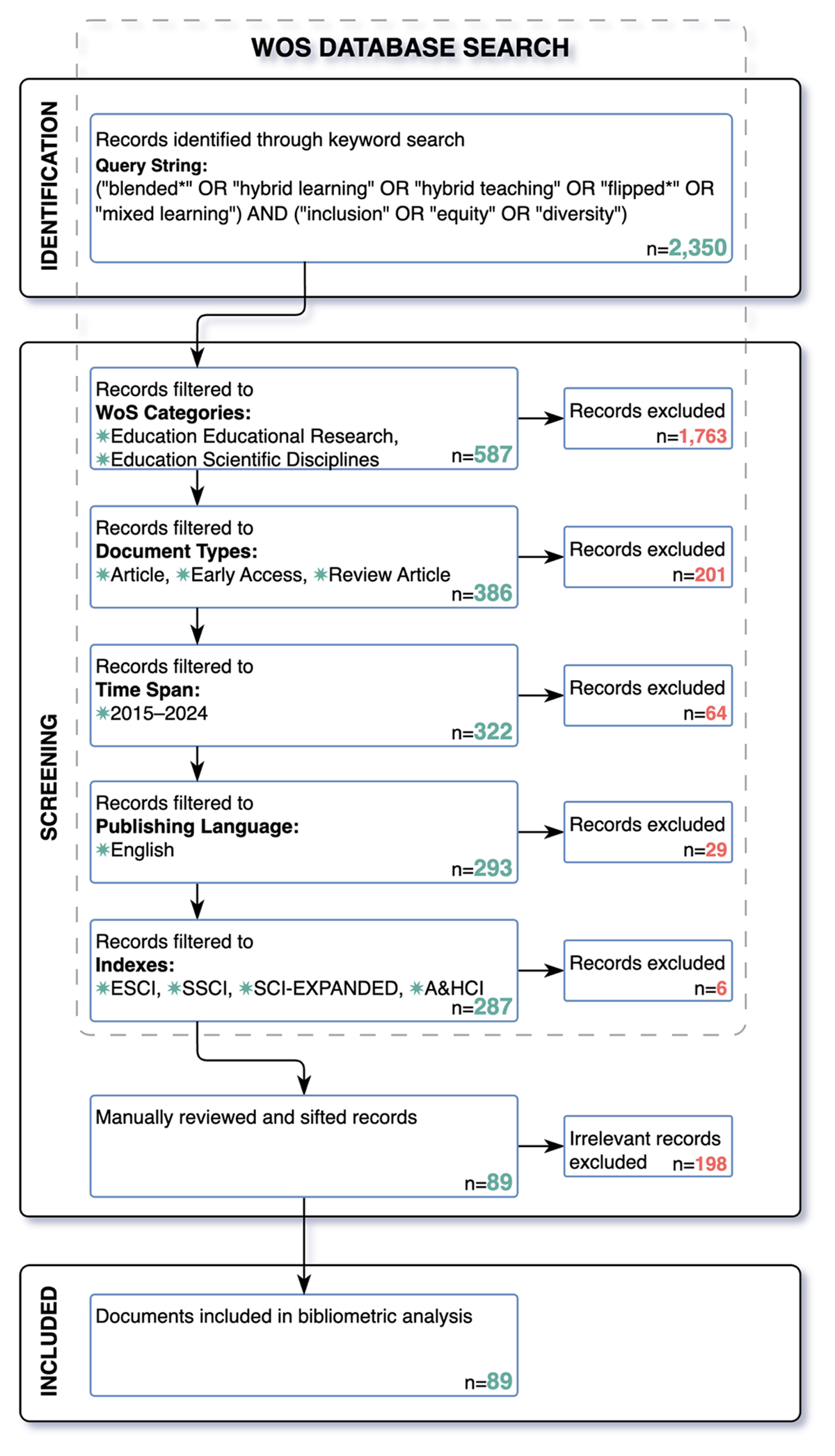
Figure 1
PRISMA flowchart for outlining the procedures of the bibliometric analysis in this study.
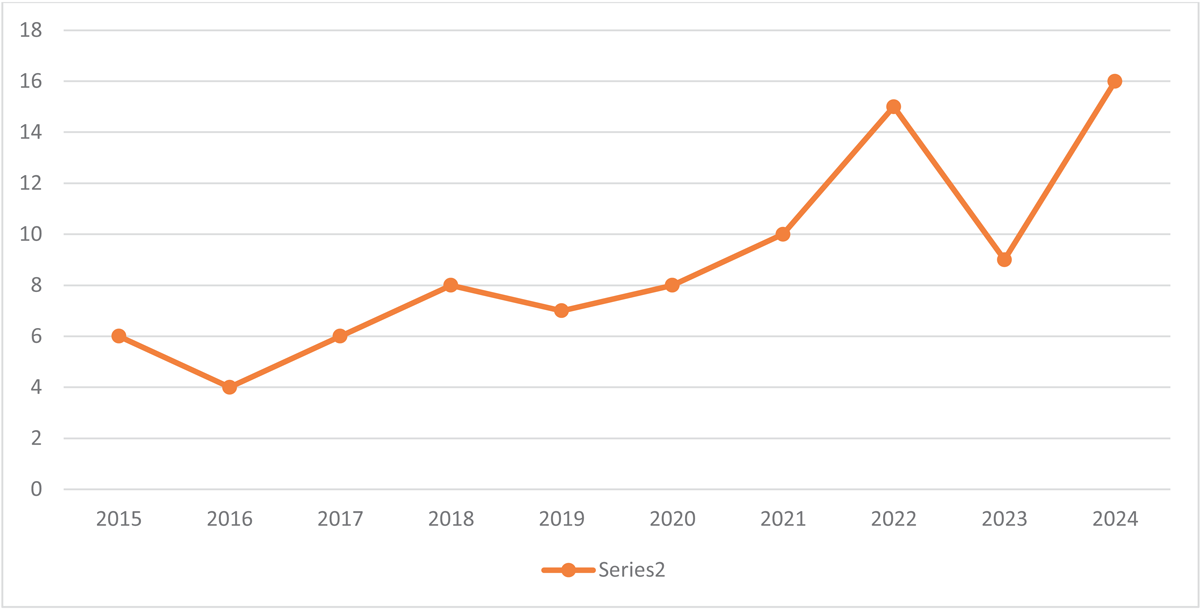
Figure 2
Number of publications by year.
Table 2
Participant descriptions of included studies.
| PARTICIPANTS | FREQUENCY | RANGE OF SAMPLE SIZE |
|---|---|---|
| Undergraduate Students | 20 | 9–1623 |
| Academics and Staff | 13 | 20–666 |
| Graduate Students | 9 | 8–84 |
| K12 Students | 8 | 18–7,178 |
| Other | 3 | – |
Table 3
Data collection tools.
| DATA COLLECTION TOOLS | FREQUENCY |
|---|---|
| Questionnaires/Surveys | 30 |
| Interviews | 24 |
| Document Analysis | 20 |
| Observations | 11 |
| Performance/Grade Data | 4 |
| Focus Groups | 3 |
| Video/Data Analytics | 2 |
| Other | 5 |
[i] *One study may employ more than one data collection tools.
Table 4
Variables/research interests.
| VARIABLES | FREQUENCY |
|---|---|
| Engagement | 16 |
| Academic outcome | 5 |
| Motivation | 4 |
| Collaboration/communication | 3 |
| Technological use | 2 |
| Other | 3 |
[i] *One study may employ more than one variable.
Table 5
Frequencies of methods and models/designs.
| RESEARCH METHODS | f | RESEARCH DESIGNS/MODELS | f |
|---|---|---|---|
| Quantitative | 15 | Survey | 9 |
| Experimental | 7 | ||
| Correlational | 4 | ||
| Qualitative | 23 | Case Study | 16 |
| Descriptive | 5 | ||
| Narrative | 2 | ||
| Content Analysis | 1 | ||
| Discourse Analysis | 1 | ||
| Phenomenology | 1 | ||
| Mixed/Triangulation | 20 | Convergent parallel | 15 |
| Explanatory sequential | 3 | ||
| Embedded | 2 | ||
| Other/Theoretical/Descriptive | 11 | Systematic review | 7 |
| Position paper | 2 | ||
| Comparative | 1 | ||
| Report | 1 | ||
| Network analytics/Digital/Innovative | 3 | Learning analytics | 3 |
| Practice Based | 4 | Design-based research | 3 |
| Action research | 1 |
[i] *One study may employ more than one research design/model.
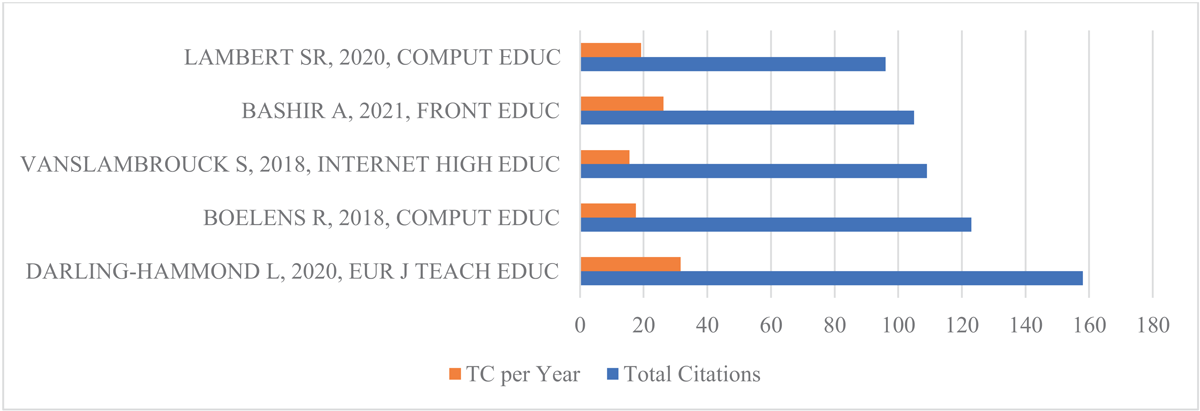
Figure 3
Most cited articles in BL and EDI research.
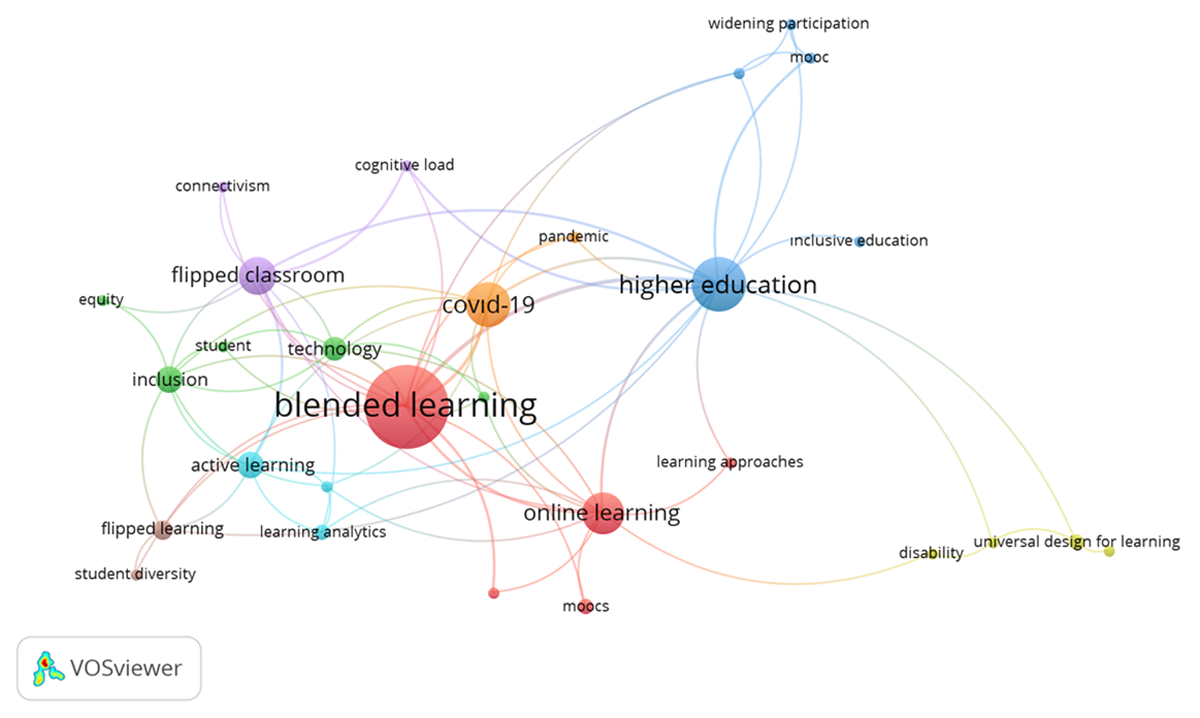
Figure 4
Analysis of keywords.