
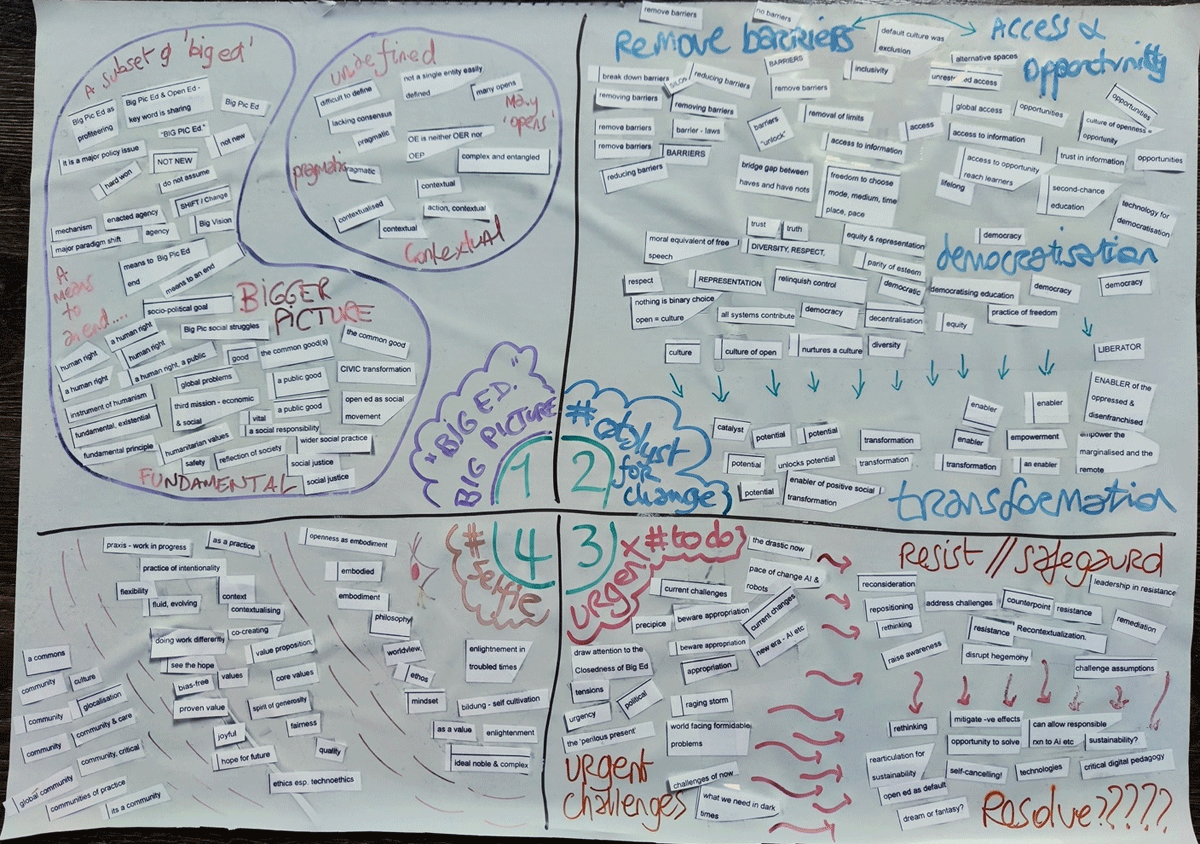
Figure 1
Interpretative Phenomenological Analysis in process – themes being generated from patterns in testimonials of experience of Openness in Education recorded in Bozkurt et al. (2023).
Table 1
Master table of Group and Personal Experiential Themes (GETs and PETs) from an Interpretative Phenomenological Analysis of testimonials (n = 54) invited from experienced open scholars by Bozkurt et al. (2023) in response to the prompt “Openness in Education – why it is important and why is it needed at this moment?” Verbatim quotes from testimonials are in italics.
| GETs | PETs |
|---|---|
| Openness in Education is embedded in a bigger picture | i. Openness in Education is a subset of education as a fundamental principle, a human right, a social responsibility for the common good … the only viable, realistic, and humane way, to achieve education for all |
| … it is rooted in the human right to access high-quality education | ii. Openness in Education is not new. It is a means to an end … we become educators because we want to create and share knowledge – openness is the most effective means to realise this |
| … not a new concept, has always been needed | iii. Openness in Education is complex, and difficult to define … not a single entity … an umbrella term … education has many opens … there is no one-size-fits-all …‘open’ must be spelt out, not assumed |
| Openness in Education is a catalyst for change | i. Openness in Education can remove barriers, unlocks access to information and opportunity. … open matters differently for those who face walls, for those with no keys … barriers are different in different contexts and spaces |
| … should be viewed beyond what it does to what is meant to achieve | ii. Openness in Education leads to democratisation … potentially democratise and open up education … the essence of open education lies in sharing with others |
| … catalyst for innovation, cultural change, civic participation | iii. Openness in Education realises potential and enables transformation … create spaces for differences … harness the immense potential of open education practices for collaborative and lifelong learning |
| Openness in Education as urgent safeguard | i. Openness in Education must acknowledge and address current challenges … the only set of practices we have as a society that operates across the technical, social, and pedagogical fields that are being enclosed by vendors |
| … address the diverse challenges we face | ii. Openness in Education must act as counterpoint, resisting and remediating … it is not a choice, but a basic need, a public good … assumption should be that all educational opportunities must be open; it is the closedness we should draw attention to |
| … advocate for open education that recognises, values, and serves all | iii. Openness in Education can resolve such challenges, to be self-cancelling … open education would be the default … vital for the sustainability of educational systems that are responsive and adaptable to global issues and local needs |
| Open in Education as embodied in the self within a community | i. Open educators work together as community, culture, commons … overcome estrangement and alienation through community and authentic connection … to promote a culture of collaborative practices … move towards a more open, participatory, creative and sharing culture |
| … open education is a community | ii. Open educators enact agency, in context, in their practice and praxis … commit to open education … a spectrum of modalities for open education in order to cater for all … the sum total of an educator’s internal ethos and acts of hospitality in relationships as well as scholarship, community activism, and professional identity |
| … the conceptual shift of understanding openness as embodiment | iii. Open educators consider it to be embodied, mindset, philosophy, ethos … openness is a worldview and a way of being … enlightenment … it’s inside my heart … both openness as a mindset and open as a mechanism … characterised as, truly, the practice of freedom … open is the only way to be |