
Introduction
This paper was prompted by reading Bozkurt et al. (2023), an editorial which presented a kaleidoscopic view of openness in education, a collection of individual testimonials from its 54 authors, echoing the spirit of the testimonios which Yúdice (1991, p. 15) calls “an act of identity formation which is simultaneously individual and collective”. This collective authorship records voices of experience as educators in open ecosystems of the scholarly landscape, each invited to testify to the importance and critical need for Openness in Education as a praxis. The variety in the testimonials, both content and format wise, is remarkable – short and long, prose and poetry, historical and geographical, political and personal. This is not surprising given that the question under discussion refers to a phenomenon for which there is no one definition. A direct prompt from the Bozkurt et al., (2023, p. 79) paper invited the reader to “delve into each testimonial individually, formulating their own interpretations: Readers are invited and encouraged to critically reflect and analyse how valuable the testimonials are for their perspectives and practices”. This is a very close match to the method of choice for this reader; the invitation was accepted and the response – an interpretative phenomenological analysis (Smith et al., 2009) of the testimonials was carried out and the group and personal experiential themes generated therein – is reported and discussed here.
Literature Review
As the collection of testimonials that is the subject of this paper contains the conceptualising, defining, aspirations for openness in education, other literature was examined for expression of viewpoints, attitudes, and perspectives by scholars, practitioners, and participants.
Openness in education was called a ‘promise’ in the very title of Capetown Declaration (2007) which called on educators to actively participate in this emerging movement of open sharing, and on policy makers to make it a priority. Since then it has been depicted as emergent (Beetham et al., 2012, Veletsianos and Kimmons, 2012); a continuum (Olcott, 2013); alternative (Baker, 2017); complementary not competitive (Shear et al., 2015); a kaleidoscope (Conole and Brown, 2018); a philosophy (Bozkurt and Stracke., 2023); Cronin and McClaren (2018) ask us if it is a slogan or a philosophy, a metaphor, model, or movement? There is agreement among scholars that it is easier to describe openness in education (benefits are communal, Beetham et al., 2012; it is collaborative, Cronin, 2017; it can connect research, practice, and management in education, Weller et al., 2018) than to define it (Katz, 2023). Nascimbeni and Burgos (2016) state that the capacity in openness points to the need for a holistic definition; the difficulty in this is in the nature of openness being seen to date an umbrella term, flexible and liquid (Baker, 2017), and that it is not a discipline, there is no agreed cannon (Weller et al., 2018). Cronin’s (2017) research which frames open practice as complex, personal, contextual and continually negotiated substantiates this dilemma of definition.
Although there is not a huge body of work directly asking or analysing attitudes among, what there is gives great insight. Tlili et al., (2022), revisiting Rolfe’s benchmarking study (2010, 2012), remind us how critical it is that intention to engage is driven by attitudes, the strongest of those being belief in open education and concern for clear strategy and vision of purpose. Prominent among what Weller et al., (2018) call the variety of perspectives evolving are attitudes that openness promotes a culture of sharing (Baker, 2017); that is a force for good (Atenas et al., 2022); that open educators’ approaches, attitudes and identities are transversal (García-Holgado et al., 2020); and that it is a spirit of change which starts within (Zawacki-Richter et al., 2020). There is a tangible vein in the literature of future-facing aspiration and intent, manifested by statements of need. Veletsianos and Kimmons (2012) speak of educators who must remain critical, questioning assumptions and practices, to ‘shape or be shaped’. Openness in education is keenly regarded as under-explored fertile ground (Shear et al., 2015, Bozkurt et al., 2019, Zawacki-Richter et al., 2020) with calls for research to add new voices and new stances (Bali et al., 2020); research on values based policy (Atenas et al., 2022); research on attitudes (Bozkurt and Stracke, 2023); and research to analyse the richness of this ecology (Stracke et al., 2023).
Method
Interpretative phenomenological analysis (IPA) was both methodology and method in this process. IPA as methodology is described by Powell et al. (2008, p. 11) as a hybrid of systematic and naturalistic inquiry. IPA founder Smith (1996, p. 262) defined it as a “qualitative approach developed within psychology for the examination of personal lived experience”. IPA aims at identifying the essential components of a phenomenon in an interpretative analysis which retains the voice of the participants (Pietkiewicz and Smith, 2012). Using IPA for sensemaking among a community draws on situational sense-making, which searches for patterns in how people construct sense (Dervin, 1983, 2003) and uses them in the “ongoing retrospective development of plausible images that rationalize what people are doing” (Weick et al., 2005, p. 409).
As a method, Smith et al. (2009, p. 21) characterise the IPA process as an “inductive, data driven” procedure combining “strong data … purposive sample …interpretative commentary … convergence and divergence”, leading to the “unfurling of perspectives and meanings”. IPA operates with a double hermeneutic, as “the researcher is trying to make sense of the participants trying to make sense of their world” (Smith and Osborn, 2003, p. 26); this is vital to the systematic application of IPA in which the role of analyst-as-instrument is to make sense of the sensemaking of the participants. Although it is most commonly used with interviews, Biggerstaff and Thompson (2008, p. 8) advise that as IPA has evolved and matured, “data need not be confined to interviews … other useful sources are … personal accounts … documenting their thoughts and experiences”, making a case for analysing data such as these testimonials.
The procedure for IPA as outlined by Smith at al. (2009, p. 75) is a series of methodical cycles of (i) reading each testimonial in turn; (ii) writing exploratory notes; (iii) exploring themes, making connections; (iv) extracting the compelling personal experiential themes from each; (vi) looking for cross-case patterns, identifying the most potent group experiential themes (Figure 1). Finally the synthesis of these PETs and GETs is formalised and presented in a master table, accompanied by a report. IPA reports are narrative, rich with verbatims which illustrate the themes being generated from iterative language, descriptions, concepts, and context in respondents’ testimonials. Ensuring validity and reliability in IPA findings is tied up in the iterative auditing of meticulous data and decision trails, and the use of the rich and thick verbatim descriptions within the interpretation. The importance of foregrounding participants’ voices in phenomenological method is stressed by Willig (2007, p. 210) who says “direct quotations … contribute greatly to invoking the emotional tone and experiential quality of an experience”, and who cites van Manen’s maxim that it is important that we find ways of letting the emotional tone of our research participants’ narratives speak to the readers of our research texts.
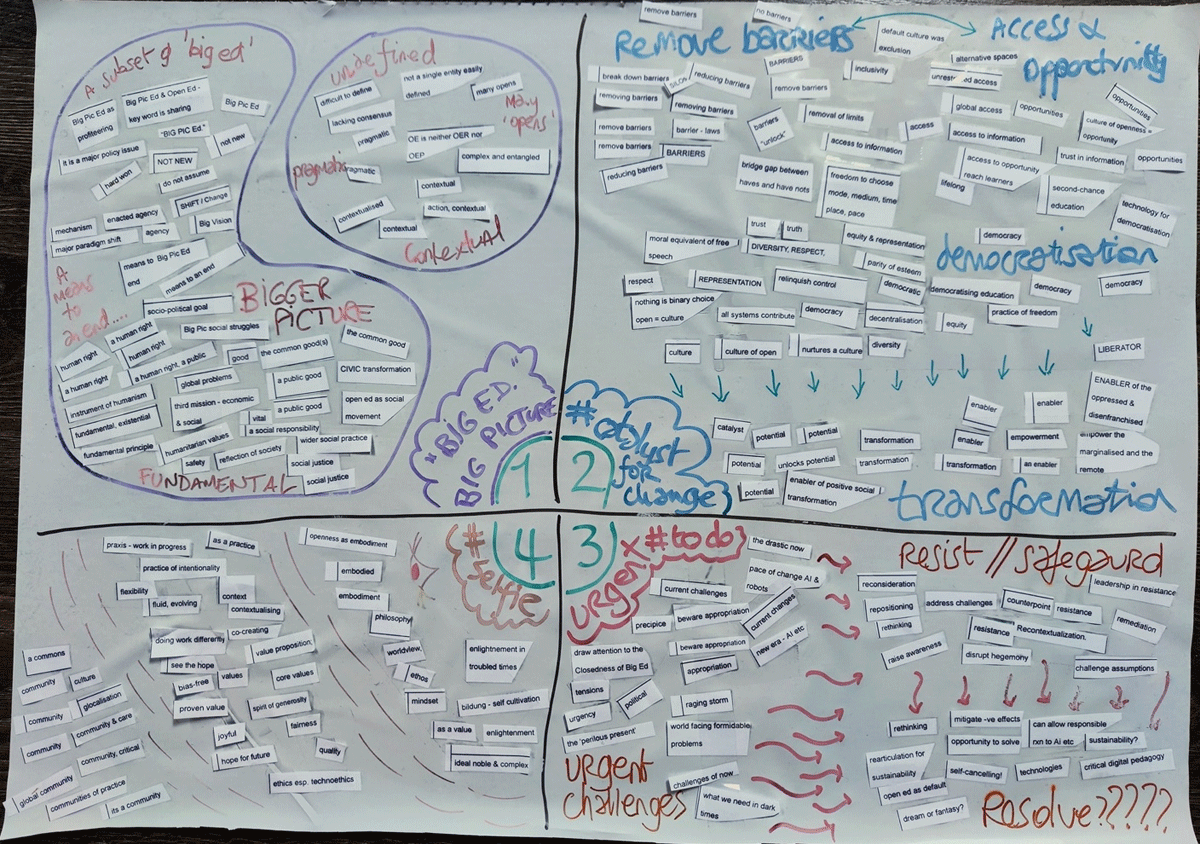
Figure 1
Interpretative Phenomenological Analysis in process – themes being generated from patterns in testimonials of experience of Openness in Education recorded in Bozkurt et al. (2023).
Results
This IPA of the 54 testimonials on the importance of and current need for openness in education generated four group experiential themes (GETs) – openness in education as embedded in a bigger picture, as a catalyst for change, as an urgent safeguard, and as embodied in the self within a community. The first three themes look outward and around at openness in education; the fourth looks inward and around at openness in educators. Each of the four GETs encompasses three personal experiential themes (PETs), summarised as a master table (Table 1) which names each theme and shows a selection of verbatim quotes that prompted that naming. One challenge for the IPA analyst can be ensuring balance when synthesising very many PETs into very few GETs, using judgement without imposing personal bias, ensuring themes that are entangled but also independent. Sometimes there may be an order of priority visible among emergent themes; in this analysis there is no hierarchy other than the order in which the themes showed themselves. There was however an increasing intensity to each theme as it unfurled during analysis, flowing from global transactional affairs to personal transformational matters.
Table 1
Master table of Group and Personal Experiential Themes (GETs and PETs) from an Interpretative Phenomenological Analysis of testimonials (n = 54) invited from experienced open scholars by Bozkurt et al. (2023) in response to the prompt “Openness in Education – why it is important and why is it needed at this moment?” Verbatim quotes from testimonials are in italics.
| GETs | PETs |
|---|---|
| Openness in Education is embedded in a bigger picture | i. Openness in Education is a subset of education as a fundamental principle, a human right, a social responsibility for the common good … the only viable, realistic, and humane way, to achieve education for all |
| … it is rooted in the human right to access high-quality education | ii. Openness in Education is not new. It is a means to an end … we become educators because we want to create and share knowledge – openness is the most effective means to realise this |
| … not a new concept, has always been needed | iii. Openness in Education is complex, and difficult to define … not a single entity … an umbrella term … education has many opens … there is no one-size-fits-all …‘open’ must be spelt out, not assumed |
| Openness in Education is a catalyst for change | i. Openness in Education can remove barriers, unlocks access to information and opportunity. … open matters differently for those who face walls, for those with no keys … barriers are different in different contexts and spaces |
| … should be viewed beyond what it does to what is meant to achieve | ii. Openness in Education leads to democratisation … potentially democratise and open up education … the essence of open education lies in sharing with others |
| … catalyst for innovation, cultural change, civic participation | iii. Openness in Education realises potential and enables transformation … create spaces for differences … harness the immense potential of open education practices for collaborative and lifelong learning |
| Openness in Education as urgent safeguard | i. Openness in Education must acknowledge and address current challenges … the only set of practices we have as a society that operates across the technical, social, and pedagogical fields that are being enclosed by vendors |
| … address the diverse challenges we face | ii. Openness in Education must act as counterpoint, resisting and remediating … it is not a choice, but a basic need, a public good … assumption should be that all educational opportunities must be open; it is the closedness we should draw attention to |
| … advocate for open education that recognises, values, and serves all | iii. Openness in Education can resolve such challenges, to be self-cancelling … open education would be the default … vital for the sustainability of educational systems that are responsive and adaptable to global issues and local needs |
| Open in Education as embodied in the self within a community | i. Open educators work together as community, culture, commons … overcome estrangement and alienation through community and authentic connection … to promote a culture of collaborative practices … move towards a more open, participatory, creative and sharing culture |
| … open education is a community | ii. Open educators enact agency, in context, in their practice and praxis … commit to open education … a spectrum of modalities for open education in order to cater for all … the sum total of an educator’s internal ethos and acts of hospitality in relationships as well as scholarship, community activism, and professional identity |
| … the conceptual shift of understanding openness as embodiment | iii. Open educators consider it to be embodied, mindset, philosophy, ethos … openness is a worldview and a way of being … enlightenment … it’s inside my heart … both openness as a mindset and open as a mechanism … characterised as, truly, the practice of freedom … open is the only way to be |
Openness in Education is Embedded in a Bigger Picture
This first theme lays out the facts from past to present, lays the foundation of the sensemaking. Openness in education may not always have been manifested, but it is not new; it is an integral part of education as a right for everyone, and of ensuring delivery of that right. It is seen a socially responsible and reasonable means to an end which ensures education for all as a fundamental principle. And yet its complexity and many facets mean it must not be taken for granted; there is more than one ‘open’ in education.
Openness in Education is a Catalyst for Change
Openness in this second theme is metaphorically and poetically described as a catalyst reaching for and beyond innovation, change, and civic participation in education. It is looking at past, present and future. It is a tool to unlock and break down barriers, that matters for those for whom access to opportunities and information is blocked in many different contexts and spaces. Success in such opening, the releasing and sharing with others, is the essence of democratisation of education. This realisation of potential can enable transformation and create spaces for collaborative and lifelong learning.
Openness in Education is an Urgent Safeguard
The tone in this third theme is urgent, anxious. The adverb is must. The verbs are action verbs – address, advocate, act, resist, remediate, resolve. People are acknowledging the precarious present, drawing attention to a growing spectre of closedness, and declaring the need to act as counterpoint and make open education a responsive and adaptable default response to global issues and local needs.
Openness in Education is Embodied
The first three themes testified to the global system of education, looking outward. The words and comments in this final theme came from revelations in the testimonies that afford an inward glimpse at the educators inside the system. The words and comments in this theme revealed the embodiment of openness manifested in the respondents as the most intense and potent variable – unfurling as three layers of meaning: an outer layer of openness as community and commons; a central layer of openness as practice and praxis; and an inner layer of openness as the self, reflecting and revealing both the educator in the open and the openness in the educator. These testimonials are imbued with ambition to move towards a collaborative and connected culture of participative sharing. This commitment to enacted agency suggests educators whose professional practice openly identifies their internal ethos. This collective considers openness to be entangled within their individual selves – in their mindset, philosophy, ethos, along a continuum from a way of being to the only way to be.
Discussion
The significance of shared principles is highlighted in the work of Weller et al. (2018, p.110), which maps key historic papers, authors and themes in open education research, pointing out that “even though practitioners may be working in tightly focused and defined areas of interest, there are commonalities across much of open education”. Although the testimonials analysed here came from 54 different viewpoints, the commonalities were stark; the hermeneutic cycle of IPA generated those group experiential themes of embeddedness, catalysis, safeguarding and embodiment. During the iterative reading of the testimonials there was a recurring thought prompted by each of the many instances of the word ‘potential’. Potential in the purest scientific sense means energy held due to relative position, only becoming kinetic when action is taken. In this analysis however, the emergent experiential themes began to remind of the Mycroft (2020, p. 20) application of Spinoza’s potentia as ‘drivers of affirmative ethics in education’. Spinoza’s potestas was the politics of ‘power over’; whereas potentia is “joyful activist energy, collective, ‘power with’” (Mycroft, 2022, p.1). Three of the four group experiential themes portrayed openness in education in terms of what has been done, what can be done, and what needs to be done; the fourth portrayed the doers themselves. The first three make a cycle of action and aspiration – it is there, ready to be used to do positive actions; it can bring about those positives powerfully and swiftly; and those positive things can both prevent and reverse negatives. The fourth is the potentia in the truest Mycroft sense – the resolve and belief visible in the practitioners, wherein lies the power to release the potential of the first three.
The first theme of the embeddedness of openness in education was generated in repeated declarations that it is there already, albeit in a more potential than kinetic state – as Olcott (2013), Hilliger (2020) and Havemann and Roberts (2021) say, as more of a continuum than a binary. Its inherent complexity can mean that its openness is hidden from many. This stresses the importance of a need for educators to “pay mapping out of tensions and contradictions” as called for by Cronin and Czerniewicz (2024, p11)
“We think that naming and analysing these issues is essential in moving toward better futures. There is valuable work happening in other parts of the open system, yet these analyses rarely mention open education, even where they are relevant. We also think we need to do more analysis within the open education community itself, work that requires us all.”
The second theme of the catalytic potential of openness in education reflects a ‘do something about it’ attitude in the testimonials, suggests the “agency of enactment” which Barad (2007, p. 235) ascribes to those taking action to translate ideas into reality. What Hilliger (2020 p.1) says about openness in general is directly parallel to what the testimonials say for openness in education, pointing to the necessity for people who will be the catalysts: “Open tools need open people, and open people are open to change, open to thinking, open to empathy”.
The third theme of the urgent needs for safeguarding by challenging, resistance and remediation again reflects Hilliger (2020 p.15)
“Open practices are not just about using open licences or open technologies. Openness is about showing up, being who you are, and contributing the best you have to offer to your communities. It takes courage to work openly.”
It is important to mention here that even though these testimonies were written in 2023, and artificial intelligence did not emerge as a discrete group theme in itself, it was briefly alluded to by many as something to be cautious about, an elephant looking into the room. It was seen by some as a challenge to be addressed responsibly … a threat … a so-called threat … looming large … booming, by some as a glimpse of … a New Age. For some it poses questions … what will be the new meaning of open? Will artificial intelligence turn out to potestas or potentia in openness? This will without doubt become a focus of future research.
The fourth theme of embodiment, or ‘the selfie’ which was its working title as it emerged from the testimonies, was the surprise and the delight of this work. Given that the question being addressed was about the importance of openness in education and why it is critically needed at this moment, a reasonable expectation was that the answers would be, as the first themes were, borne of informed professional experience and observation in practice. They were; but there was more. The ‘selfies’ offered in these transcripts realised a theme of embodiment of openness in the educators themselves, their embodied open practice influencing and being influenced by their … heart, mind, being.
Smith (2011, p.7) refers to the power of the idiographic nature of interpretative phenomenological analysis as residing in the gems that stand out when you’re reading a transcript, that demand attention and prompt further analytic work. There were many shining gems in the 54 testimonials, but the diamond flash was the line: open is the only way to be (Bali in Bozkurt et al., 2023, p. 81). Coming as it does at the end of a poem-as-testimonial which resonated with metaphor and meaning, it seeded the crystallisation process that became this IPA.
One limitation to this analysis is that the greater portion of the testimonials had origins in the western sector of the global north. Intentional inclusion of and invitation to new voices from new places, as called for within the literature, will make future iterations of this research even richer; it will be interesting to see how an extended reach combined with views on the effect of the ever-evolving AI phenomenon would affect the testimonials and themes. Another limitation is that the process of IPA carries the inherent need to prevent researcher bias inadvertently shaping the analysis. In mitigating this risk, maintaining reflexivity is crucial, as is constant checking that interpretation is evidenced and grounded in raw data; both of these were central features of this IPA. This analysis of invited testimonios from experienced and expert scholars has one undeniable implication for global education institutions, policy makers, practitioners and researchers – that whatever future research pursues, the answers will lie within the global community that is already committed to practice and praxis of openness in education.
Conclusion
The scholars in Bozkurt et al. (2023, p.78) say the study of openness in education, is “not a destination but a continuous journey”. By overtly inviting others to respond to their own testimonials, they practice a dynamic open scholarship which is embracing and refreshing.
In response, this interpretative phenomenological analysis of their testimonials reveals a collective urgent eagerness to safeguard the good of the openness already embedded in education and use it as a catalyst to bring about what Czerniewicz and Cronin (2024, p.17) would say is ‘our best future’; to which end the most forceful of the potentia for energising the necessary resistance, remediation, transformation is the embodied passion of the practitioners themselves being willing to journey in the continuum of openness in education, alone and together.
Data Accessibility Statement
All data analysed during this study are published at https://doi.org/10.55982/openpraxis.15.2.574.
Sustainable Development Goals (SDGs)
This study is linked to the following SDG(s): Quality education (SDG 4), Reduced inequalities (SDG 10), Peace, justice, and strong institutions (SDG 16).
Ethics and Consent
As this article used published sources an ethics review was not applicable.
Acknowledgements
The author acknowledges the authors of the testimonials analysed in this article.
Competing Interests
The author has no competing interests to declare.
Author Contributions (CRediT)
Mags Amond: Conceptualization, Data curation, Formal Analysis, Methodology, Visualization, Writing – original draft, review and editing.