
Table 1
Databases searched for literature on AI competency frameworks in education.
| DATABASE | SCOPE AND RELEVANCE |
|---|---|
| Google Scholar | Broad academic search (articles, theses, books, conferences) across disciplines. |
| PubMed | Life sciences and biomedical literature (for AI in medical education contexts). |
| IEEE Xplore | Engineering and technology literature (key for technical AI competency studies). |
| SpringerLink | Multidisciplinary journals and books (for diverse perspectives on AI in education). |
| ACM Digital Library | Computing and IT research (critical for studies on educational AI tools and systems). |
Table 2
Inclusion and exclusion criteria for study selection.
| INCLUSION CRITERIA | EXCLUSION CRITERIA |
|---|---|
| Published in peer-reviewed journals or reputable conferences. | Not available in full text (abstracts without full papers). |
| Focused on AI competency frameworks or AI literacy in educational settings (research articles, reviews, or conceptual papers). | Non-English publications (this review included only English-language studies). |
| Addresses at least one of: theoretical knowledge, practical applications, or ethical considerations of AI in education. | Studies not centered on educational settings (e.g., AI in industry without educational context) or not addressing AI competencies/frameworks. |
| Presents empirical findings, a proposed framework/model, or a systematic review relevant to AI in education. | Articles with minimal relevance to AI education (e.g., using AI to solve a pure computing problem with no education focus). |
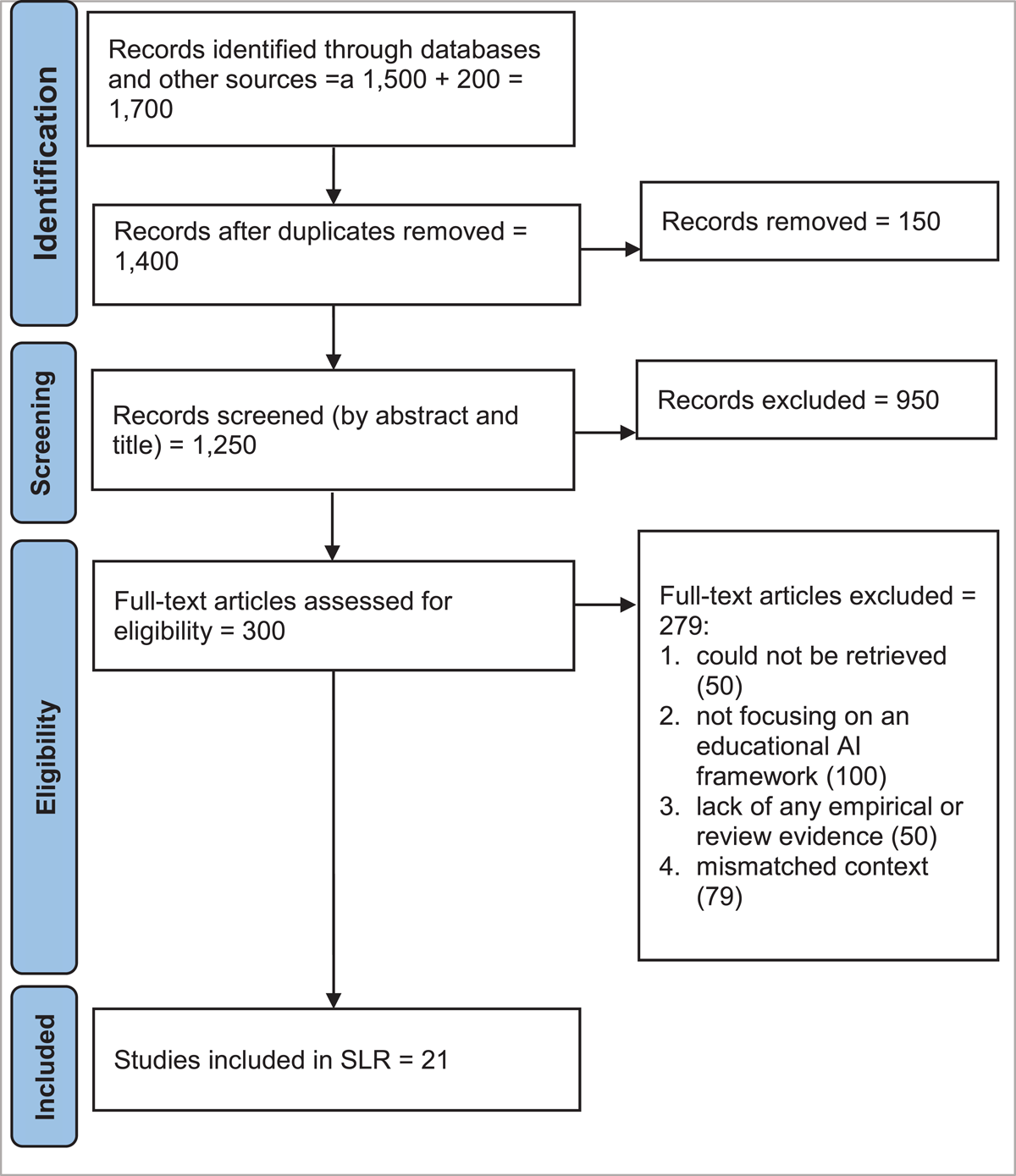
Figure 1
PRISMA Diagram.
Table 3
Overview of the AI Education Competency Framework pillars.
| PILLAR | FOCUS AND OBJECTIVES |
|---|---|
| Foundation | Building fundamental AI knowledge and literacy among all stakeholders. Basic competencies include understanding AI concepts, tools, and terminology. |
| Integration | Embedding AI into curricula, pedagogy, and administrative processes. This involves training educators, updating curriculum content to include AI, and implementing AI tools to enhance teaching, learning, and operations. |
| Innovation | Fostering the development and adoption of new AI-driven educational tools, methods, and research. Encourages experimental initiatives like AI labs, pilot projects, and interdisciplinary AI collaborations. |
| AI Citizenship | Ensuring ethical, responsible use of AI and addressing its societal implications. Focuses on competencies in AI ethics, data privacy, fairness, inclusivity, and developing policies for responsible AI deployment. |
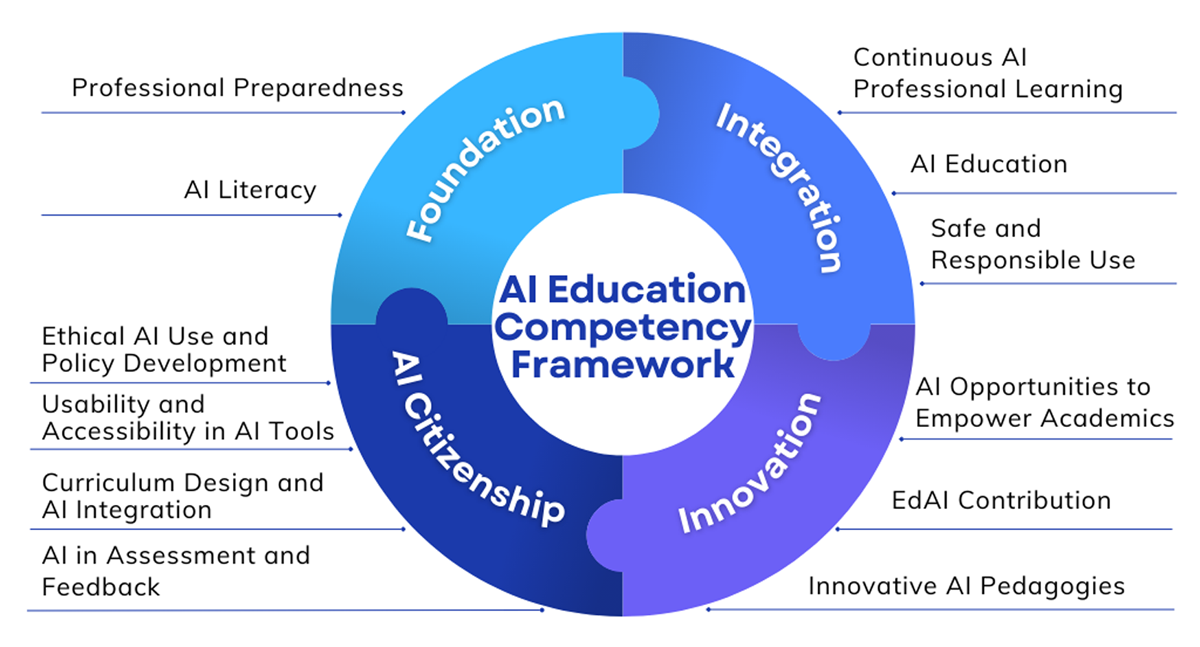
Figure 2
AI education competence framework.