
Introduction
Feedback identify learners’ strengths and weaknesses and increases their awareness of the subject matter. With technological advancements and the growth of online learning opportunities, automated formative feedback has gained prominence. Since research on automated feedback is conducted extensively (Hwang et al., 2021), the question of “how feedback should be provided and to which degree it should contain information” gained recognition. Despite this, there is still no clear consensus on the optimal effectiveness of automated feedback.
The degree of information that feedback contains impacts the success and perceived usefulness of feedback. Studies on content-related automated feedback have reported the effectiveness of elaborated feedback (Cai et al., 2023; Petrović et al., 2017; van der Kleij et al., 2015). Students feel more comfortable receiving elaborated feedback (Kuklick & Lindner, 2023). However, models that address feedback highlight the multidimensional nature of feedback messages, which contain the cognitive dimension (Hattie & Timperley, 2007; Narciss & Huth, 2006). Regarding this issue, Heckler and Mikula (2016) stated that providing affective feedback with cognitive feedback can support performance. Cavalcanti et al. (2021), Dawson et al. (2019), and Hattie and Timperley (2007) argued that feedback should not only provide content-related information but should support the affective aspect, which fosters motivational beliefs and provides information that guides teaching. Considering these views, providing affective support with extra information in elaborated feedback could affect students positively. This is especially important since affective feedback has become more prominent with the proliferation of digital environments (Jiménez et al., 2018, p. 11; Jimenez et al., 2018). Thus, this research will investigate whether the effect of automated elaborated feedback can be boosted by affective feedback.
Affective feedback includes statements supporting ideas or emotional responses toward work (Cheng & Hou, 2015; Tsai & Liang, 2009). This type of feedback can be provided using gestures, voice tone, and facial expressions (Jiménez et al., 2018, p. 11), as well as text (Jimenez et al., 2018). In addition, affective support, hinging on the situation, can be classified as congratulation, eulogy and encouragement (Jimenez et al., 2018). Also, the feedback can consist of criticism, summary, or comments about the quality of work (Lu & Law, 2012; Nelson & Schunn, 2009). Affective feedback provides information that increases positive motivational beliefs and guides teaching, which in turn results in an increase in the performance of students (Hattie & Timperley, 2007; Lu & Law, 2012; Tseng & Tsai, 2007). Affective feedback has been usually examined in peer feedback studies (Cheng et al., 2015; Kerman et al., 2022; Lu & Law, 2012; Tsai & Liang, 2009) and has been discussed within studies on a limited number of intelligent tutoring systems. In the relevant studies on peer feedback, how affective feedback (negative or positive comments) impacts writing performance and which type of feedback students provide are examined (Cheng et al., 2015; Kerman et al., 2022; Lu & Law, 2012; Tsai & Liang, 2009). In the context of intelligent tutoring systems, the feedback provided is not assessment-oriented. These studies focused on how affective feedback is utilized in the interaction with the system (Cabestrero et al., 2018; Jimenez et al., 2018). From this standpoint, automated assessment feedback-oriented studies will extract important information for human-computer interaction, especially ITS.
Moreover, a growing body of research has begun to move beyond academic outcomes to examine how students perceive feedback. The anchor point of this view is learner-feedback interaction within the social constructivist approach (Lipnevich et al., 2016; Song, 2022). So, perceived usefulness towards feedback (Jonsson & Panadero, 2018; Shute, 2008) and self-efficacy (Deci & Ryan, 2000) appear as two important structures. Another perception discussed in this study is intrinsic motivation, expressed in theories of feedback (Hondrich et al., 2018; Koenka, 2020). According to the results in the literature, an increase in learners’ perception is expected.
As noted earlier, online environments have become widespread during the pandemic, making practical formative assessments and providing feedback have gained importance. These types of feedback are provided automatically in intelligent tutoring systems. Teachers can decide the feedback timing in different learning management systems outside intelligent tutoring systems (Hassan et al., 2019). Although feedback is related to achievement, examining how feedback affects students’ perceptions will provide information about effective feedback. This information will guide both system developers and teachers.
This experimental study investigated the effects of different types of feedback on situational intrinsic motivation, self-efficacy for performance and learning, and perceived usefulness towards feedback. In the following sections, we will address perceived usefulness towards feedback, situational intrinsic motivation, and self-efficacy for performance and learning and summarize the related literature.
Literature
Perceived Usefulness Towards Feedback
Designers and teachers presume learners perceive feedback as they want (Harks et al., 2014). However, when students do not understand feedback, they overlook it or cannot use it since they do not know how to use it. As a result, students cannot perceive feedback as useful. Perceiving feedback as useful is critical for correcting mistakes (Rakoczy et al., 2019) and using feedback formatively (Jonsson, 2013).
Perceived usefulness is the belief that feedback is useful for the desired aims and results (Zhu & Mok, 2018). Walter et al. (2015) defined it as “the degree to which a person believes that the feedback helps to increase his or her performance.”. In order to enhance the perception of feedback usefulness, feedback must be student-oriented (Henderson et al., 2019).
Based on this rational, we formulated the sub-questions as:
What are the effects of types of feedback on perceived usefulness towards feedback?
The Situational Intrinsic Motivation
Motivation is essential to learning (Hattie & Timperley, 2007). According to self-determination theory (Deci & Ryan, 1985; as quoted in Guay, Vallerand & Blanchard, 2000), different motivation types are the basis of human behavior. Guay et al. (2000) addressed the situational motivation theory grounded on self-determination theory. Situational motivation is the motivation learners experience in an activity they currently participate in and consists of intrinsic motivation, extrinsic motivation and amotivation.
Intrinsic motivation refers to individuals’ reactions to their inner needs (Akbaba, 2006). Deci and Ryan (2000) stated that when compared to students with external motivation, intrinsically motivated students would perform better and be eager to learn. Intrinsically motivated students think their effort is worth learning and would think the same while reading or applying feedback to learning (Akbaba, 2006; Shin et al., 2018). Also, feedback provided triggers intrinsic motivation (Hondrich et al., 2018; Koenka, 2020). From this point, we hypothesized that specifying which types of feedback affect intrinsic motivation would increase the effect of feedback on performance.
Building on these arguments, we formulated the sub-questions as:
What are the effects of types of feedback on situational intrinsic motivation?
Self-Efficacy for Learning and Performance
Self-efficacy is people’s confidence to complete and perform tasks (Artino, 2012). Deci and Ryan (2000) reported that self-efficacy positively affects motivation, while Rakoczy et al. (2019) demonstrated that formative assessment directly affected self-efficacy and perception of usefulness toward feedback. In addition, positive effects of self-efficacy on performance have been reported in face-to-face and Web-based environments (Wang & Wu, 2008).
If students cannot associate the feedback with poor performance, their sense of self-efficacy may suffer. A positive change in the student’s feelings will lead the student to learn more (Hattie & Timperley, 2007). It was stated in the literature that the perception of self-efficacy affected intrinsic motivation. In this regard, Bandura (1989) emphasized that the higher individuals’ self-efficacy, the more motivated they were. In this respect, there is a need to examine how feedback affects the student’s perception of self-efficacy.
Considering these findings and theoretical perspectives, we formulated the sub-questions as:
What are the effects of different types of feedback on self-efficacy for learning and performance?
Methods
The design of this study was the static-group comparison design. The participants were 74 students from a state university who took the “Research Designs in Education” course. We obtained all necessary permissions for using all instruments, and the ethical committee approved the research. Participation to the study was voluntary and informed consent was obtained from all participants prior to their involvement in the study.
Data Collection Tools
The instruments used in the study were The Situational Intrinsic Motivation Scale (Guay et al., 2000), the Perceived Usefulness Towards Feedback Scale (Daniels & Bulut, 2019), the Self-Efficacy for Learning and Performance Scale (Pintrich et al., 1991). The Situational Intrinsic Motivation Scale (Guay et al., 2000) and Perceived Usefulness Towards Feedback Scale (Daniels & Bulut, 2019) were adapted into Turkish after obtaining the permissions. Then, the items were translated into Turkish from English, and the scale was sent to three experts from Computer Education and Instructional Technology to examine the language’s validity. After the items were revised according to feedback, they were applied to 84 freshmen who took the computer course online. The Situational Intrinsic Motivation Scale and Perceived Usefulness Towards Feedback Scale were used together in the adaptation.
Perceived Usefulness Towards Feedback Scale
Perceived Usefulness Towards Feedback Scale is a 5-point Likert scale (1 = strongly disagree to 5 = strongly agree). It consists of 5 items.
Data were pre-processed, and Mahalanobis distances were calculated to detect outliers. Five outliers (p < 0.05) were removed from the dataset. The KMO and Bartlett’s tests were used to check the suitability of factor analysis. The KMO value was 0.815, and the Bartlett test was statistically significant (106.089(10), p < 0.001). The results indicated the factorability of the data. Confirmatory factor analysis was conducted to assess the single-factor model in AMOS 23. After analysis, one item was removed from the scale due to low factor loading, and the study continued with four items.
The error and fit indices of the 4-item scale were determined to be in line with the demanded criteria: the χ2/df value being below 3, the RMSEA value being below 0.08, and the GFI, CFI, and NFI values being greater than 0.90 are indicators of good model-data fit in the literature (Schermelleh-Engel et al., 2003). The values in Table 1 demonstrated that χ2/df, RMSEA, GFI, CFI, and NFI fit and error indexes’ values were a good fit. The CFA confirmed the single-factor model.
Table 1
The values of the Perceived Usefulness Towards the Feedback Scale.
| MODEL | χ2/df | RMSEA | GFI | CFI | NFI |
|---|---|---|---|---|---|
| Cuf-off Criteria | (<3) | (<0.08) | (>0.90) | (>0.90) | (>0.90) |
| One-factor model | 1.222 | 0.06 | 0.98 | 0.99 | 0.97 |
Figure 1 demonstrates the standardized factor loadings. Factor loadings are between 0.66 and 0.78. The values are statistically significant since the values of factor loadings t values are above 0.05. The average variance extracted is 0.531. As the value is greater than 0.50, the convergent validity is at an acceptable level (Fornell & Larcker, 1981).
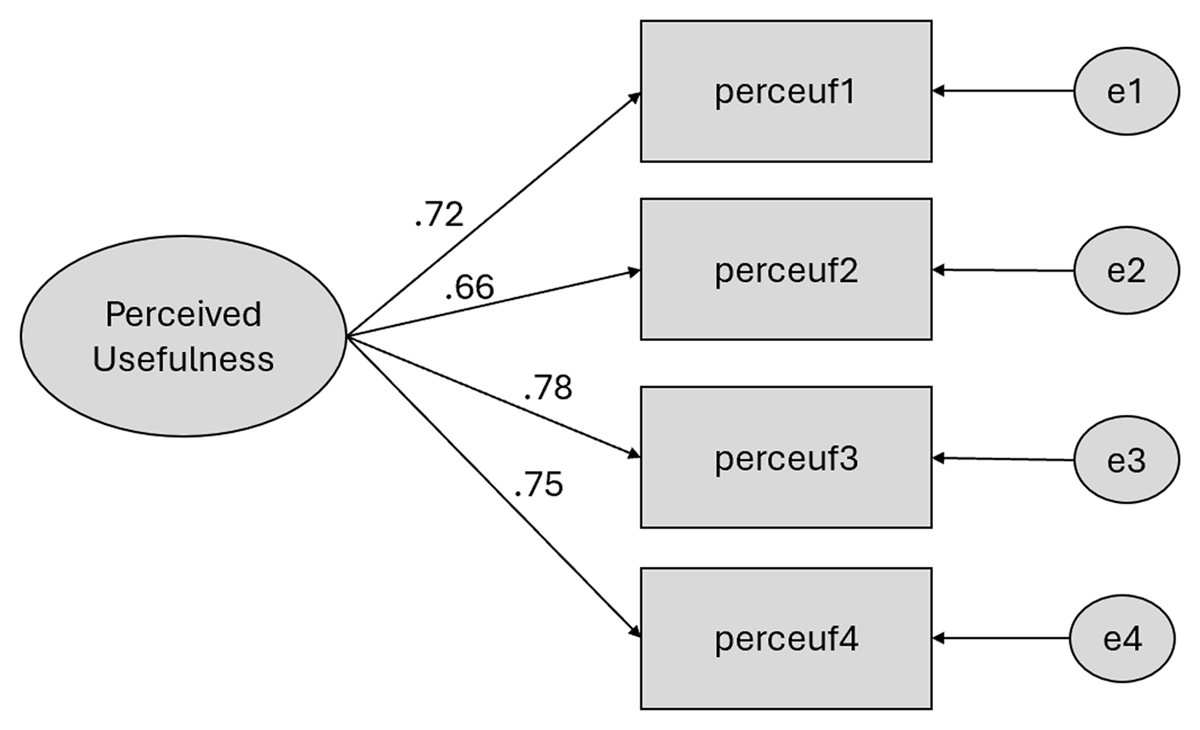
Figure 1
Standardized factor loadings of the Perceived Usefulness Towards Feedback Scale.
Cronbach’s alpha was used to assess internal consistency. In Table 2, Cronbach’s alpha internal consistency value is greater than 0.70; therefore, the scale points are reliable (Nunnally & Bernstein, 1994).
The Situational Intrinsic Motivation Scale
The Situational Intrinsic Motivation Scale was prepared by Guay et al. (2000). It consists of 4 items and is a 7-point Likert scale (1 = does not correspond at all to 7 = corresponds exactly).
Data were pre-processed, and Mahalanobis distances were calculated to detect outliers. Five outliers (p < 0.05) were removed from the dataset. The KMO and Bartlett’s tests were used to check the suitability of factor analysis. The KMO value was 0.80, and the Bartlett test was statistically significant (229.77(6), p < 0.001). The results indicated the factorability of the data. Confirmatory factor analysis was conducted to assess the single-factor model in AMOS 23.
The ratio of chi-square to degrees of freedom (χ2/df) value less than 2 indicates a good fit for the model. In this study, the ratio of chi-square to degrees of freedom (χ2/df) is 1.35. The GFI was 0.99. The CFI was 0.99, and The NFI was 0.99. The GFI, CFI, and NFI were greater than 0.90, which is a sign of a good fit (Schermelleh-Engel et al., 2003). The CFA confirmed the single-factor model. Table 3 demonstrates goodness-of-fit measures.
Table 3
The values of the Situational Intrinsic Motivation Scale.
| MODEL | χ2/df | RMSEA | GFI | CFI | NFI |
|---|---|---|---|---|---|
| Cut-off Criteria | (<3) | (<0.08) | (>0.90) | (>0.90) | (>0.90) |
| One-factor model | 1.35 | 0.07 | 0.99 | 0.99 | 0.99 |
Figure 2 demonstrates the standardized factor loadings. Factor loadings are between 0.72 and 0.97. The values are statistically significant since the values of factor loadings t values are above 0.05. The average variance extracted is 0.745. As the value is greater than 0.50, the convergent validity is at an acceptable level.
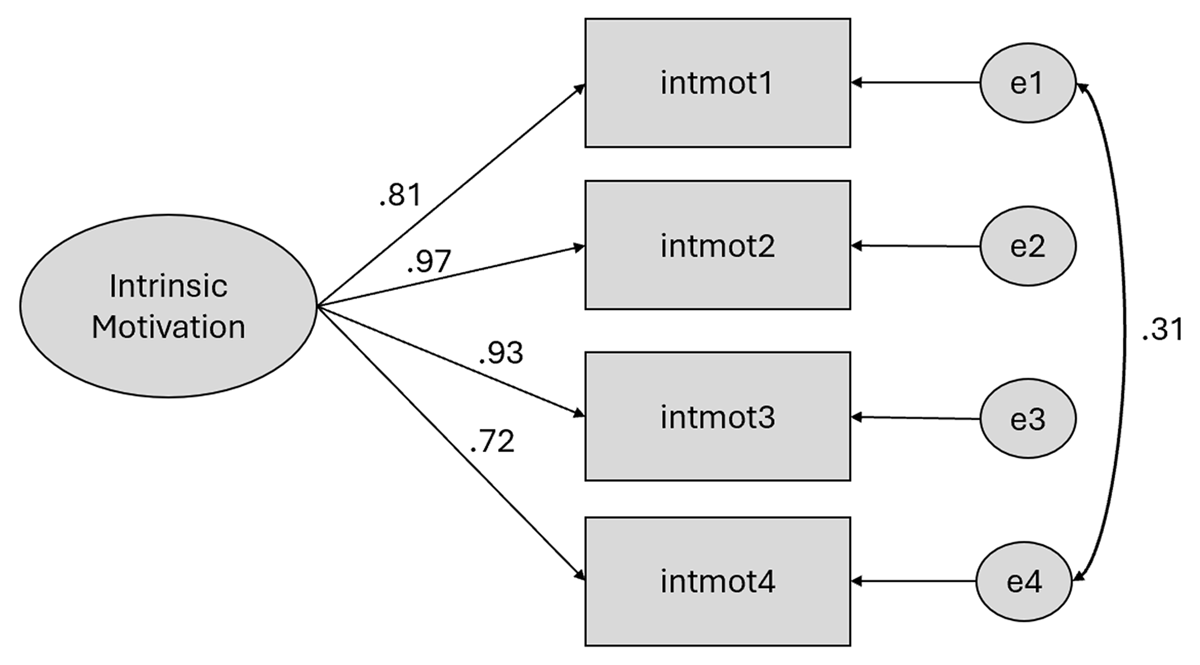
Figure 2
Standardized Factor Loadings of the Situational Intrinsic Motivation Scale.
Cronbach’s alpha was used to assess internal consistency. In Table 4, Cronbach’s alpha internal consistency value is greater than 0.70; therefore, the scale points are reliable (Nunnally & Bernstein, 1994).
Self-Efficacy for Learning and Performance Scale
Motivated Strategies for Learning Questionnaire’s subscale Self-Efficacy for Learning and Performance Scale (Pintrich et al., 1991) was used to measure learners’ self-efficacy. It is adapted to Turkish by Büyüköztürk et al., (2004). It is a 7-point Likert scale (1: not at all true of me, 7: very true of me). Internal consistency reliability for the original is 0.93, and for the adaptation study, it is 0.86. For this study, internal consistency reliability is 0.98.
Procedure
The Research Ethics Committee approved the study. Data collection took place in two sections during the fall season of the 2020–2021 academic year. The online intervention was done through Moodle. The students were assigned to two groups and answered the data collection tools . Figure 3 illustrates the data collection procedure.
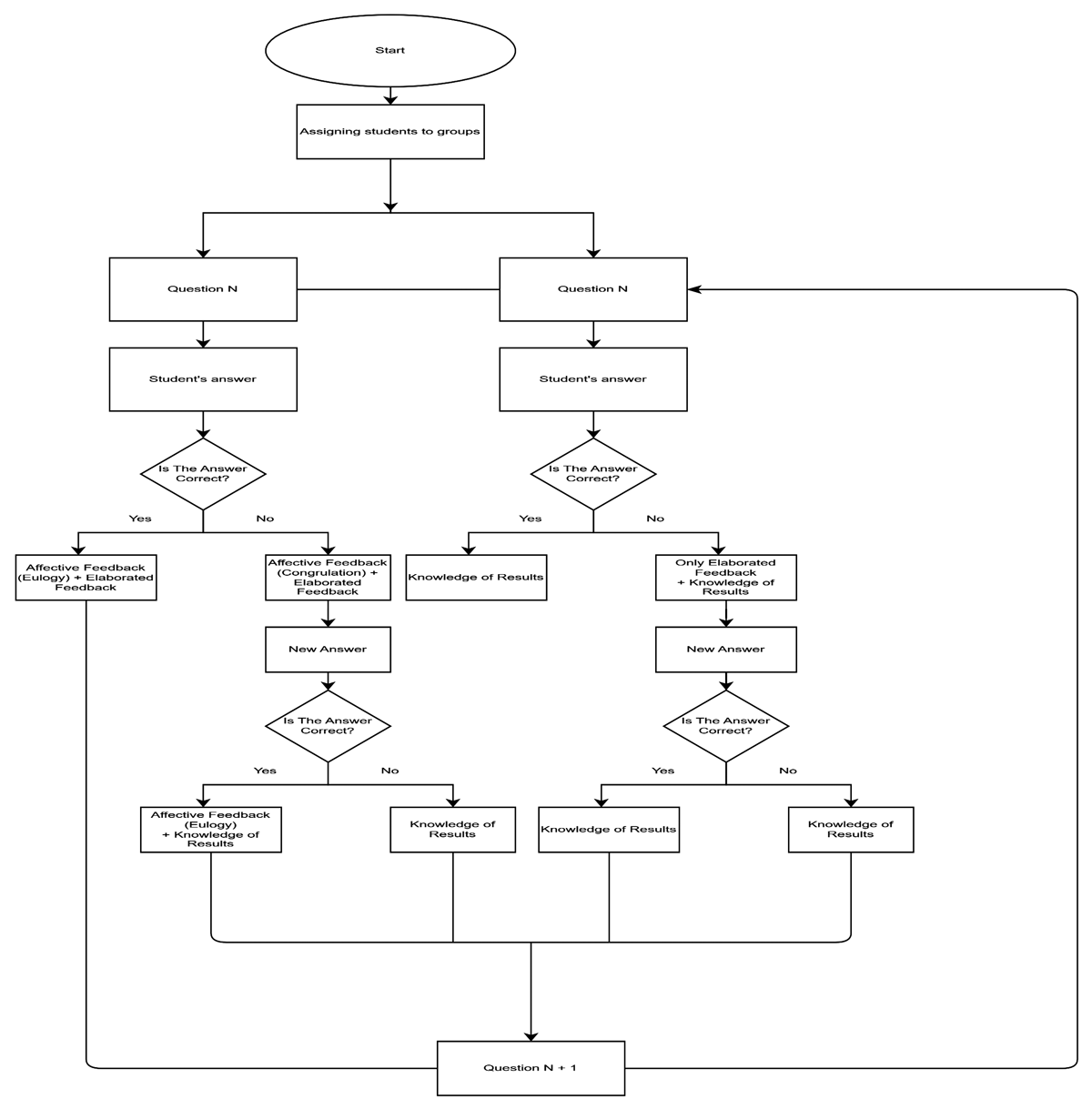
Figure 3
The schematic overview of the procedure.
The questions and feedback in the self-assessment test were prepared by researchers, taking expert opinions. It consists of 10 questions, with nine being multiple-choice and the remaining one being fill-in-the-blanks. Feedback provided in the self-assessment test was adapted from Jimenez et al. (2018), and Table 5 presents examples of encouragement, eulogy, and congratulation.
Table 5
Affective feedback examples (Jimenez et al., 2018).
| ENCOURAGEMENT PHRASES | EULOGY PHRASES | CONGRATULATION PHRASES |
|---|---|---|
| Come on! | Very good! | Correct! |
| Try harder! | Well done! | Great! |
| Focus! | You are a winner! | Excellent |
| Do not be disappointed! | Perfect! | You got it! |
| You will do it! | You are good! | You did it well! |
| You are doing well! | You are great! | I know you can do it! |
| Keep going! | You are smart! | You have improved! |
In this study, different types of feedback were provided based on the answer. In case of the correct answer, affective feedback in the eulogy form was provided. Figure 4 illustrates an example of automated elaborated feedback with affective feedback (if the answer is wrong).
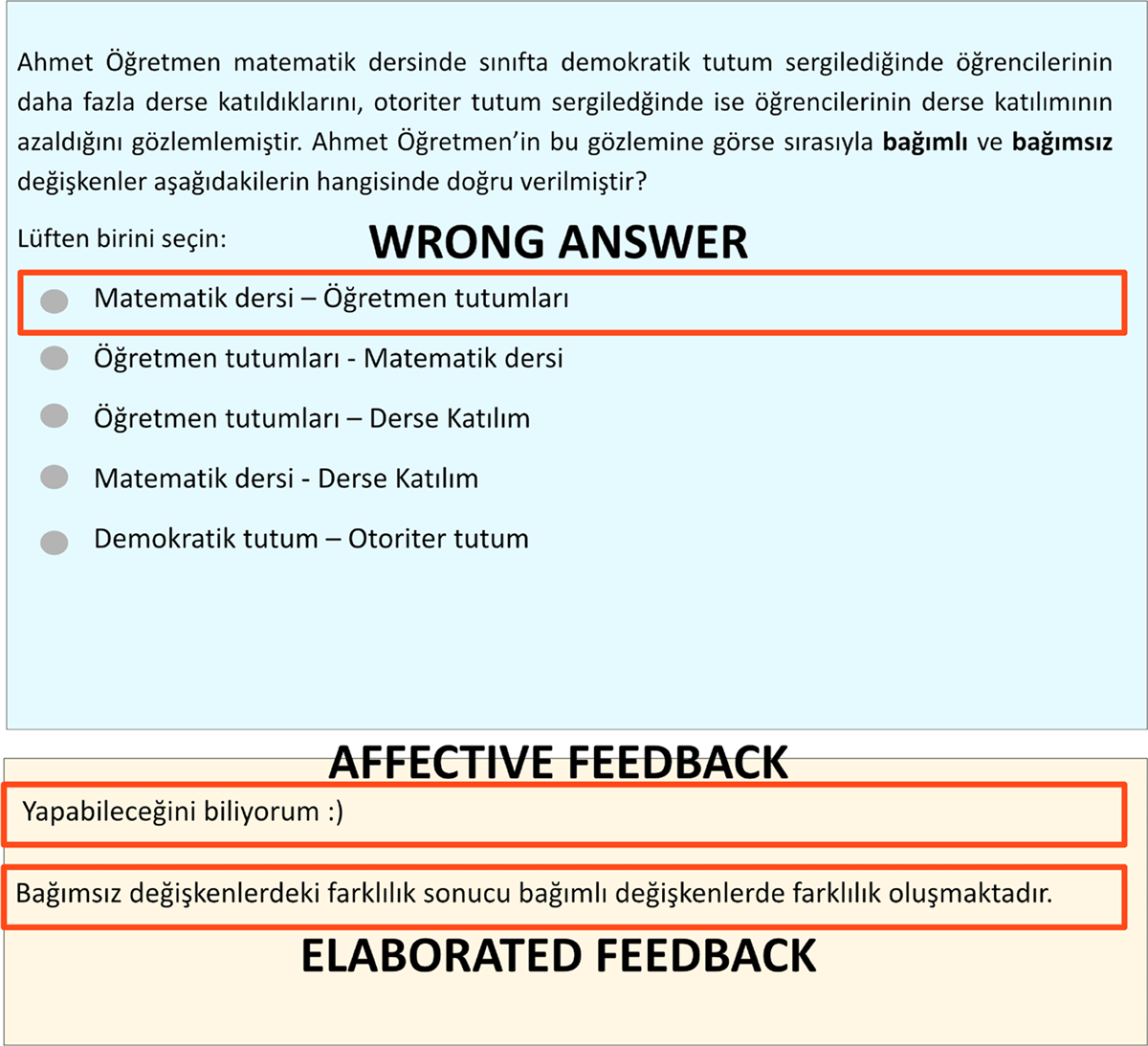
Figure 4
Automated elaborated feedback with affective feedback example (if the answer is wrong).
Table 6 demonstrates the affective feedback provided in the test. The table demonstrates feedback provided in Turkish and English.
Table 6
Affective feedback used in the study.
| ENCOURAGEMENT (TR) | ENCOURAGEMENT (EN) | EULOGY | EULOGY (EN) |
|---|---|---|---|
| Aşağıdaki ipucunu dikkate alarak bir daha denemeye ne dersin? :) | How about trying again, taking into consideration the hint below? :) | Very good! | Çok başarılısın :) |
| Daha dikkatli şekilde bir daha denemelisin :) Aşağıdaki açıklama yardımcı olabilir | You should try again carefully :) The explanation could be more helpful. | You are very successful! | Çok iyisin :) |
| Tekrar denemeye ne dersin. İşte sana bir ipucu :) | How about trying again. Here is a hint for you. | You are great! | Harikasın :) |
| Yapabileceğini biliyorum :) | I know you can do it. | Perfect! | Mükemmel :) |
| Verilen ipucuna bakarak bir daha dene, başaracaksın :) | Try one more time by looking at the given hint. You will succeed. |
[i] *Writers translate feedback phrases.
Findings
This study investigated the effect of different feedback types on situational intrinsic motivation, feedback on perceived usefulness towards feedback, and self-efficacy for learning and performance. An independent sample t-test was performed on situational intrinsic motivation and self-efficacy for learning and performance. In contrast, a Mann-Whitney U test was performed on perceived usefulness towards feedback.
The Effect of Automated Elaborated and Affective Feedback on the Situational Intrinsic Motivation
First, the assumptions were tested to investigate the effect of feedback on situational intrinsic motivation. The results of the Shapiro-Wilk test demonstrated that the points were normally distributed (p > .05) (Table 7), and the assumption of homogeneity of variance was met (Table 8). Although the automated elaborated feedback provided with the affective feedback group’s mean (X̃ = 20.36) is greater than the automated elaborated feedback group (X̃ = 19.18), the difference between the groups was not statistically significant (p > 0.05) (Table 9).
Table 7
Shapiro-Wilk values the intrinsic motivation of students who received different types of feedback.
| FEEDBACK TYPE | SHAPIRO-WILK | p |
|---|---|---|
| Elaborated + affective | 0.965 | 0.461 |
| Only elaborated | 0.967 | 0.536 |
Table 8
Levene’s test of homogeneity of variance of intrinsic motivation according to feedback type.
| F | P | |
|---|---|---|
| Intrinsic motivation | 0.082 | 0.776 |
The Effect of Automated Elaborated and Affective Feedback on Perceived Usefulness Towards Feedback
First, the assumptions were tested to investigate the effect of feedback on perceived usefulness towards feedback. The results of the Shapiro-Wilk test demonstrated that the points were not normally distributed (p > .05) (Table 10). Although the automated elaborated feedback provided with the affective feedback group’s median (M = 17) was almost equal to the automated elaborated feedback group (M = 16), the difference between the groups was not statistically significant (p > 0.05) (Table 11).
The Effect of Automated Elaborated and Affective Feedback on Self-Efficacy for Learning and Performance
First, the assumptions were tested to investigate feedback’s effect on learning and performance self-efficacy. The results of the Shapiro-Wilk test demonstrated that the points were normally distributed (p > .05) (Table 12), and the assumption of homogeneity of variance was met (Table 13). Although the automated elaborated feedback provided with the affective feedback group’s mean (X̃ = 42.32) is greater than the automated elaborated feedback group (X̃ = 39.70), the difference between the groups was not statistically significant (p > 0.05) (Table 14).
Table 12
Shapiro-Wilk values of self-efficacy scores of students who received different types of feedback.
| FEEDBACK TYPE | SHAPIRO-WILK | P |
|---|---|---|
| Elaborated + affective | 0.969 | 0.566 |
| Only elaborated | 0.922 | 0.051 |
Discussion
Feedback is an indispensable part of the learning process. While studies on feedback focus on who gives the feedback message and which individual differences trigger a change in learners’ perceptions of feedback, they also investigate how the design of feedback messages should be (Lipnevich & Smith, 2022; Panadero & Lipnevich, 2022). Feedback message design comes forward regarding learners’ reading and understanding of feedback (Lipnevich & Smith, 2022). Recently, there has been a rise in studies about how to design computer-based feedback messages, and these studies have shown that elaborated feedback can positively influence how learners think and feel about their learning. While the studies focus on cognitive feedback types, this study examined whether affective feedback significantly affects the learning processes.
While elaborated feedback is a type of cognitive feedback, it can be claimed that presenting it together with the affective dimension will affect learner perceptions more positively. The Self Determination Theory of Deci and Ryan (2000) states that individuals feeling competent (self-efficacy) and valued are the basic components that support intrinsic motivation, and affective feedback may support those needs. While the existence of affective messages in elaborated feedback is expected to boost the effectiveness of feedback, in this study, no statistically significant difference was found in the learners’ perceptions of intrinsic motivation for the situation, usefulness of feedback, and self-efficacy for learning and performance. However, when the scores of the groups were examined, both groups took scores above the mean value. Accordingly, the elaborated feedback in both groups may have provided this effect. The studies that compare other cognitive feedback types (knowledge of the result and knowledge of the correct response) with elaborated feedback demonstrated that students who received elaborated feedback had higher intrinsic motivation (Hondrich et al., 2018; Koenka, 2020), found feedback more useful (Daniels & Bulut, 2019; Harks et al., 2014; Rakoczy et al., 2013; Rakoczy et al., 2019; Van der Kleij et al., 2012) had higher self-efficacy perceptions (Beatson et al., 2018; Rakoczy et al., 2019; Wang & Wu, 2008), and our results are consistent with the studies in the literature.
Nevertheless, regarding the Self-Determination Theory, we can say that affective feedback in this study is insufficient for the learner to feel competent and valuable or that such a support mechanism is unnecessary. Besides that, while the studies emphasize providing positive affective feedback at assessment tasks that contain higher-level thinking skills (preparing reports and creating projects), we provided feedback on multiple-choice or fill-in-the-blank type tasks in this study. This would be one of the reasons that affective feedback does not significantly affect the scope of this type of assessment task. Accordingly, there is a need for studies on assessment tasks at different levels. Nonetheless, meta-analytical proofs demonstrated the motivational effects of feedback being lower and, under specific circumstances, decreasing the learner’s motivation (Kuklick & Lindner, 2023; Wisniewski et al., 2020). Based on this, there is a need for new frameworks and research in this field.
Suggestions
Since the lessons constitute the context of elaborated feedback, the effect of feedback types can be examined in the other courses besides “Scientific Research Methods”. In addition, the effect of affective feedback can be examined in the different types of assessments. By making tests frequently, the changes in students’ perception can be observed effectively.
The literature uses affective, cognitive, and meta-cognitive feedback together or separately. Studies focused on the effect of using different types of feedback will contribute to the relevant literature.
In this study, a group was not created for only affective feedback. Forming groups that receive different types of cognitive feedback will assist in interpreting the effect of elaborated feedback alone. In parallel with this, there is a need for research in which feedback types are diversified.
Identifying students’ self-efficacy for learning and performance before implementation, the perception in groups for self-efficacy can be researched to determine whether there is a change.
Limitations
Some limitations of the study need to be considered. First, the participants are undergraduate students, and the effect of feedback can vary with age. Second, the non-controllable variables could influence the homogeneity of the groups, owing to the static group comparison design. This design may bring about bias in the results. Third, data gathered from the study was restricted by the data collection tools that were used.
Data Accessibility Statement
The datasets used and/or analysed during the current study are available from the corresponding author on reasonable request.
Sustainable Development Goals
This study is linked to the following SDG(s): Quality education (SDG 4).
Ethics and Consent
Participation was voluntary. Appropriate permissions and ethical approval were requested and granted. The Hacettepe University Ethics Committee also approved the study.
Acknowledgements
This article is adapted from the first author’s dissertation under the supervision of the second author.
Competing Interests
The authors have no competing interests to declare.
Author Contributions
Deni̇z Yeşi̇l: Conceptualization, methodology, formal analysis, investigation, data curation, writing—original draft preparation, writing—review and editing, validation. Fatma Bayrak: Supervision, conceptualization, methodology, writing—review and editing, validation. All authors have read and agreed to the published version of the manuscript.
Authors Notes
Based on Academic Integrity and Transparency in AI-assisted Research and Specification Framework (Bozkurt, 2024), the authors of this paper acknowledge that the paper was edited, and refined with the assistance of OpenAI’s ChatGPT-4o (Versions as of June 2025), complementing the human editorial process. The human authors critically assessed and validated the content to maintain academic rigor. The authors also assessed and addressed potential biases inherent in the AI-generated content. The final version of the paper is the sole responsibility of the human authors.