
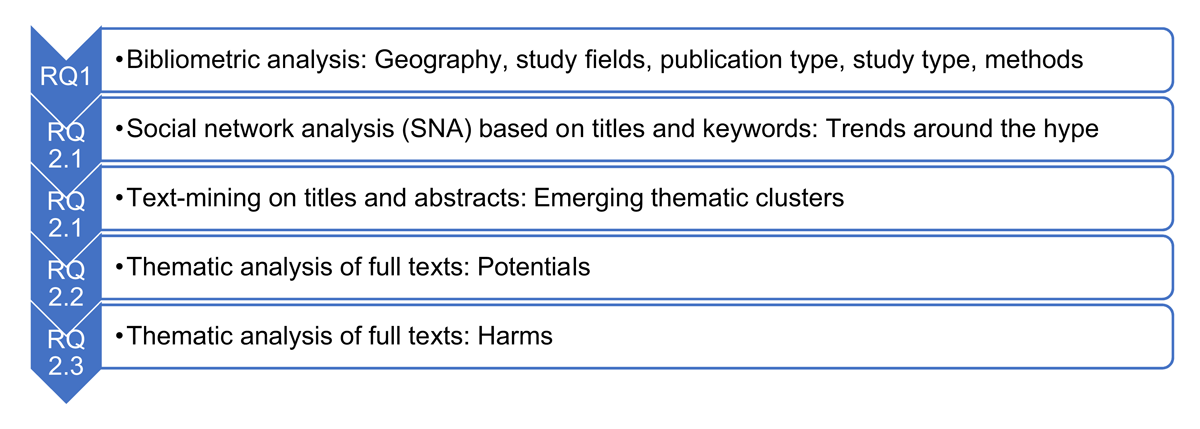
Figure 1
The study design.
Table 1
Search string.
| CONCEPT | SEARCH TERMS WITH BOOLEAN OPERATORS |
|---|---|
| ChatGPT | “ChatGPT” OR “GPT-3.5” OR “text-davinci” OR “chat gpt”) |
| Education | AND (educat* OR school OR academi*) |
| Limitation | (LIMIT-TO (LANGUAGE, “English”)) AND (LIMIT- (SRCTYPE, “j”)) |
Table 2
Inclusion and exclusion criteria.
| CRITERIA | INCLUSION | EXCLUSION |
|---|---|---|
| Language | English | Not in English |
| Publication Type | All document types in journals indexed in Scopus | – |
| Study scope | About education and academia | Not education or academia-related |
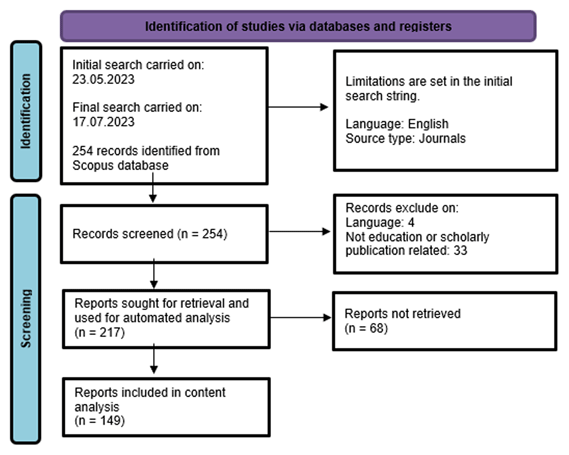
Figure 2
PRISMA diagram (slightly modified after Brunton & Thomas, 2012, p. 86; Moher et al., 2009, p. 8).
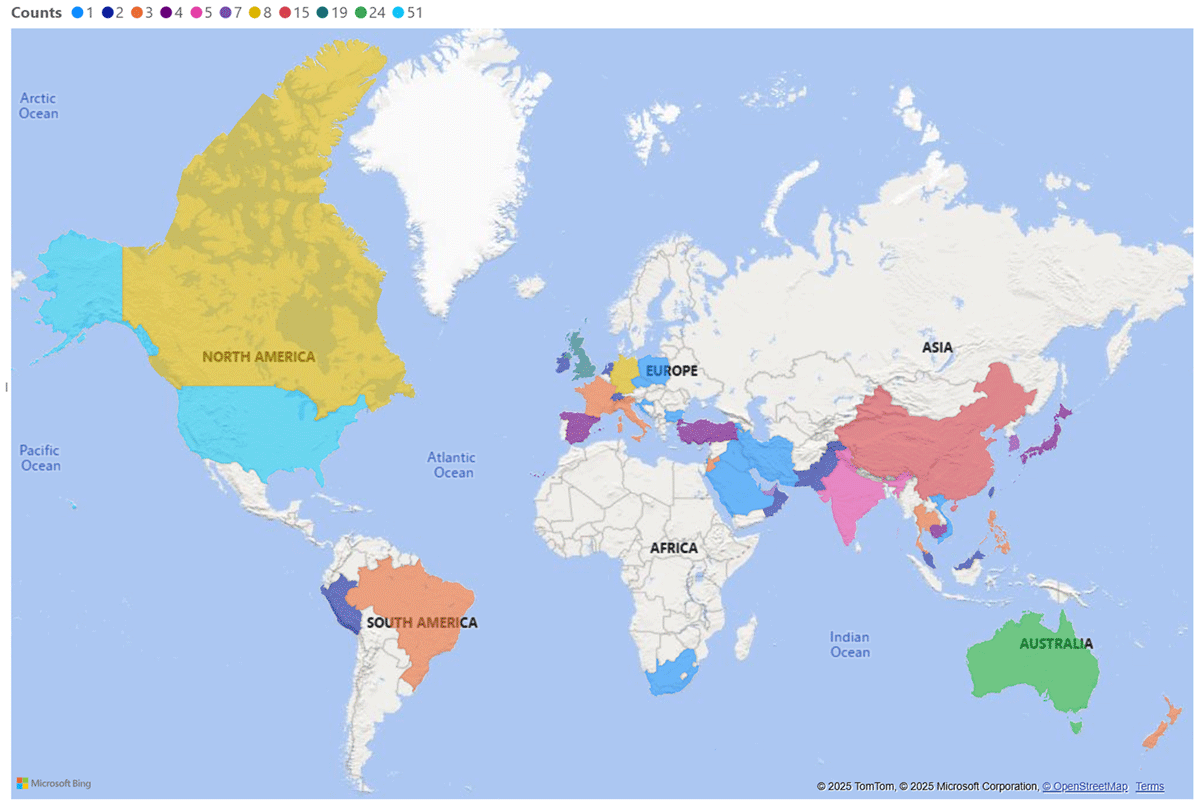
Figure 3
Geographical distribution of authors.
Table 3
Types of research published in the corpus (N = 217).
| TYPE OF ARTICLES | NUMBER OF ARTICLES (n) | PERCENTAGE (%) |
|---|---|---|
| Conceptual | 168 | 77.0 |
| Empirical | 49 | 23.0 |
Table 4
Types of conceptual research (n = 168).
| TYPE OF CONCEPTUAL RESEARCH | NUMBER OF STUDIES (n) | PERCENTAGE (%) |
|---|---|---|
| Commentary/letter to editor | 53 | 31.7 |
| Discussion | 48 | 28.7 |
| Editorial | 23 | 13.8 |
| Q&A with ChatGPT | 17 | 10.2 |
| Review | 16 | 9.6 |
| Intervention | 8 | 4.8 |
| Other | 2 | 1.2 |
Table 5
Types of Empirical Research in the corpus (n = 49).
| NUMBER OF STUDIES (n) | PERCENTAGE (%) | |
|---|---|---|
| Test ChatGPT | 17 | 34.0 |
| Qualitative | 15 | 30.0 |
| Quantitative | 13 | 26.0 |
| Mixed | 5 | 10.0 |
Table 6
Disciplines of authors.
| DISCIPLINE | COUNTS | PERCENTAGE (%) |
|---|---|---|
| Health & Medicine | 69 | 31.8 |
| Education | 36 | 16.6 |
| Business & Law | 27 | 12.4 |
| STEM | 21 | 9.7 |
| Arts, Humanities, & Social Science | 18 | 8.3 |
| Computer & Information Science | 10 | 4.6 |
| Library & Support Services | 3 | 1.4 |
| other | 1 | 0.5 |
| not mentioned | 32 | 14.7 |
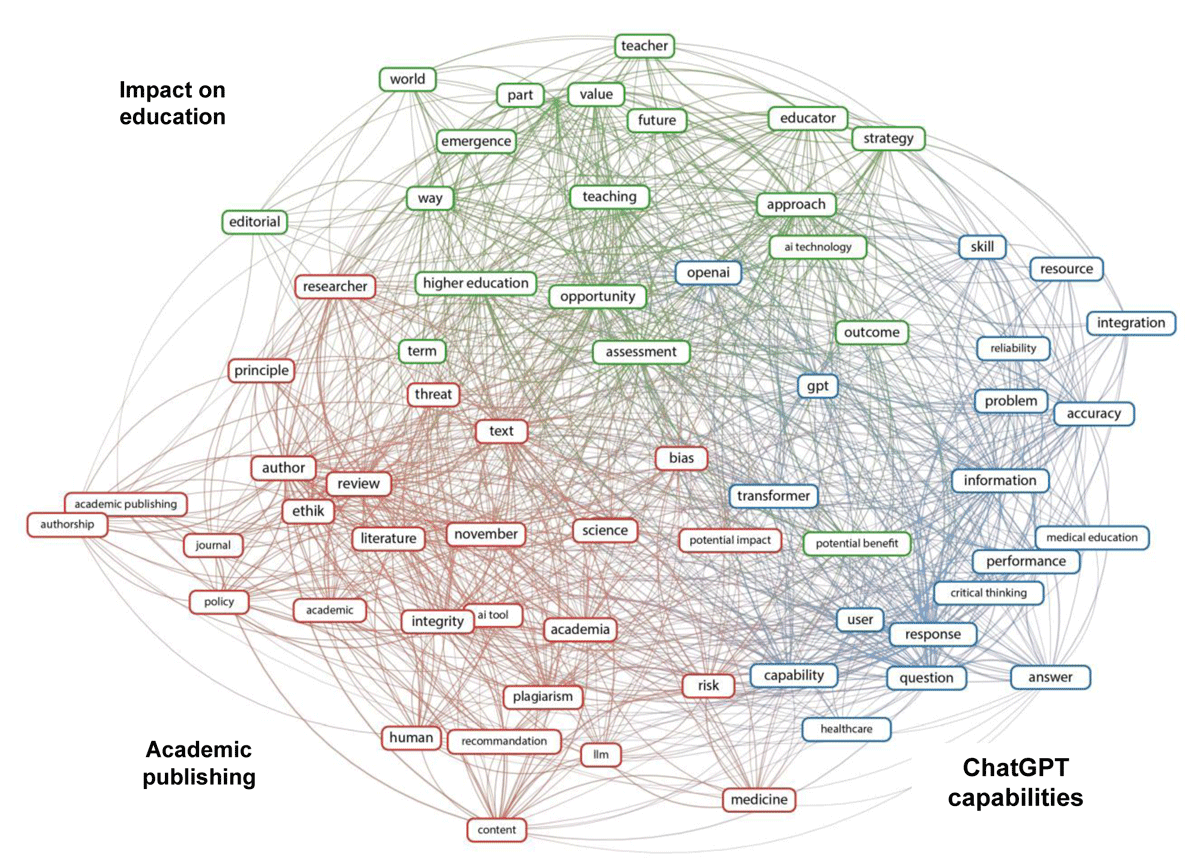
Figure 4
Main themes based on titles and keywords (N = 217).
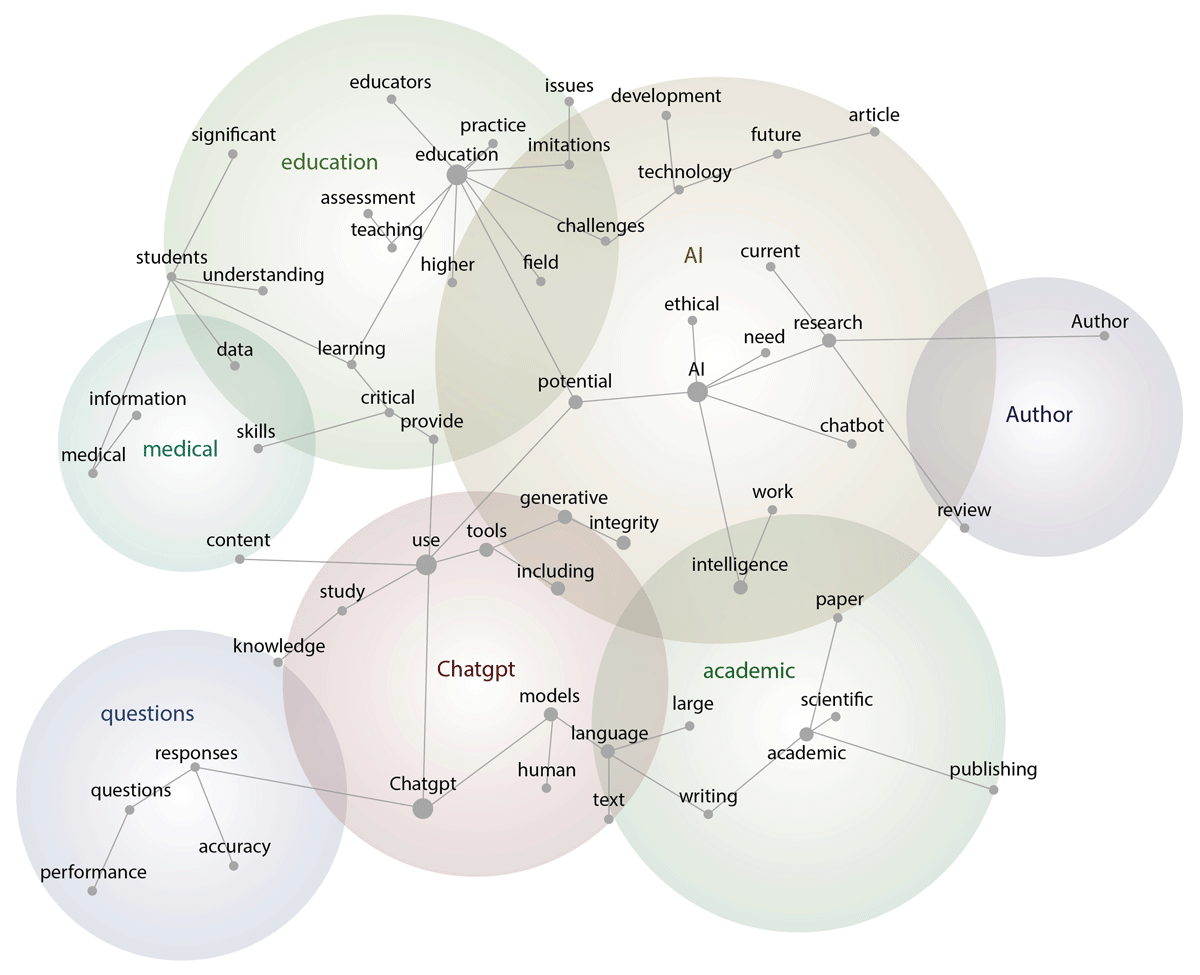
Figure 5
Concept map based on titles and abstracts (N = 217).
Table 7
Potential uses of ChatGPT in education and scholarship (n = 149).
| MAIN USES | SUB-FIELDS | REPRESENTATIVE EXAMPLES |
|---|---|---|
| Learner support | Information service and source |
|
| Personalized learning |
| |
| Feedback and assessment |
| |
| Critical thinking reinforcement |
| |
| Authorship assistance | Co-authoring |
|
| Assistant bot |
| |
| Democratization of science |
|
Table 8
Harms and concerns about ChatGPT in education and scholarship (n = 149).
| HARMS/ CONCERNS | SUB-CATEGORIES | REPRESENTATIVE EXAMPLES |
|---|---|---|
| Limited knowledge production and co-construction | Biased information dissemination and reproduction |
|
| Over-reliance on biased knowledge |
| |
| Data ownership & privacy | Reliance on few original research contributions |
|
| Privacy & Security |
| |
| Accessibility, Accountability, and Social Justice | Ownership |
|
| Social justice |
| |
| Academic Integrity, Ethics, and Plagiarism | Plagiarism |
|
| Publication integrity & ethics |
|