
Introduction and Background
Higher education institutions (HEIs) play a significant role in equipping students to navigate the complexities of the 21st century by enabling students to address global challenges in an increasingly interconnected world (Marginson, 2011). García-Gutierrez (2021) further highlight that HEIs are not only there to provide high-quality academic preparation, but also to indulge in the social, political and economic needs of the environment. The institutions furthermore have the responsibility of developing students’ social responsibility of interconnectedness. Traditional educational methods, such as lecture-based learning, fall short of meeting this demands of the modern era (Butler, 2016). Therefore, HEIs must adopt dynamic approaches that foster critical thinking, problem-solving, and collaborative learning across borders. In addition, Garcia-Gutierrez (2021) highlights that students in HEIs often experience a significant detachment from hands-on learning during their studies. However, virtual exchange (VE) programs can bridge the gap between theory and practice, fostering opportunities for professional development and civic engagement.
Altbach et al. (2009) and UNESCO (2015) call for a stronger emphasis on global citizenship education (GCE) to ensure that students can contribute meaningfully to a globalised society. According to UNESCO (2015), GCE seeks to cultivate students’ awareness of interconnectedness and their roles in promoting sustainable and equitable development. Furthermore, GCE encourages students to engage with pressing global issues that all global citizens face, such as human rights, social justice, and environmental sustainability (Davies, 2006). Global citizenship (GCS) entails understanding the interconnectedness of all people and that one’s responsibilities extend beyond one’s immediate community or nation (Oxley & Morris, 2013). In addition, the development of GCS occurs within an interactive context; thus, based on the experience of the authors from two geographically parted HEIs, we agree with Davies 2006 that HEIs must create an environment that allows students to explore and critically engage with global issues all nations face (Davies, 2006). Banks (2008) concurs that creating these types of environments could cultivate students’ ability to think globally while acting locally.
VE projects have proven to be a suitable ideal environment to sensitise students regarding the gap between global issues and local contexts (Commander et al., 2022). VE projects enable students from different and diverse countries to collaborate on projects and to engage in cross-cultural engagement, enhancing their understanding of global issues (O’Dowd, 2021). Commander et al. (2022) highlight that VE projects provide students with unique opportunities to interact with peers from different cultural backgrounds, fostering an understanding of global challenges from multiple perspectives. Similarly, Guth and Helm (2011) also argue that VE projects significantly promote intercultural competence, empathy, and a broader global perspective. VE projects also expose students to diverse cultures, enhancing their critical thinking skills and comprehension of global interconnectedness (de Wit, 2013). By facilitating collaborations across geographical borders, VE encourages students to reassess their preconceived notions, and this could also expose students to new ways of knowing, being and doing (de Wit, 2013).
According to Deardorff (2006), intercultural competence, a key outcome of VE projects, is essential for functioning in diverse, multicultural environments. Developing intercultural competence directly correlates with GCS. Heymans et al. (2024) echo Deardorff (2006) who highlights that VE enables students to gain new perspectives on various cultures and fosters greater open-mindedness. Their research further underscores the importance of educating cultural competence to equip current students to address global health challenges in the future effectively. The authors of the present study concur, and to this end, have utilised the potential of a VE project as a vehicle within an existing curriculum to develop GCS and promote Sustainable Development Goal 3.4 (SDG 3.4).
Adopted in 2015 as part of the United Nations’ 2030 Agenda for Sustainable Development, the broad purpose of the 17 SDGs is to address global challenges by promoting social, economic, and environmental sustainability, aiming to eradicate poverty, protect the planet, and ensure prosperity and well-being for all by 2030. This study focused on SDG 3.4, which, within the broader SDG 3, namely Good Health and Well-being, aims to reduce premature mortality from noncommunicable diseases (NCDs) by one-third by 2030 (World Health Organization, 2018). According to the World Health Organization (2018) NCDs pose significant global health challenges. Kickbusch et al. (2016) state that dealing with global health challenges requires a multifaceted approach encompassing education, policy, and community engagement.
Madhok et al. (2018) highlight, in agreement with Kickbusch et al. (2016), that the growing burden of disease and ongoing health inequalities are significant global challenges. To effectively tackle these issues, it is essential to strengthen health systems with a workforce that is not only adequate in size but also properly trained. However, current workforce development models have proven inadequate to meet these demands, pointing to an urgent need for innovative and updated strategies to build a skilled and adaptable health workforce. The authors agree that education is crucial in raising awareness about NCD prevention and management to allow students, as emerging health professionals, to gain insight into how different countries address NCDs. In addition, the authors hold the view that a VE project may contribute to the development of GCS and the of promotion SDG 3.4 as conducted in a VE project between the North-West University (NWU) and Georgia State University (GSU).
Setting
Founded in 1913 is GSU, located in downtown Atlanta Georgia, and is one of the largest and most innovative multi-campus public research universities in the United States of America (USA), offering a wide range of academic programmes across diverse disciplines (Georgia State University, 2024). Established in 2004, the NWU, a public university in South Africa (SA) has a strong focus on research and offers an extensive range of undergraduate and postgraduate programmes (North-West University, 2024). In 2018, GSU and the NWU signed a memorandum of understanding (MOA) to promote collaborative learning between their lecturing staff and students, reflecting both institutions’ shared commitment to GCE. This partnership enabled the implementation of VE projects, exposing lecturers and students from both institutions to diverse cultures, languages, and perspectives aimed at enriching their learning experience within a multicultural learning environment (Georgia State University, 2024; North-West University, 2024). Making use of the opportunity to collaborate across geographical boundaries, the lecturers at both institutions worked collaboratively to design a VE project aimed at developing GCS and promoting SDG 3.4.
Description of Virtual Exchange Project
The VE project consisted of two phases: the teaching and learning phase, and the research phase. The teaching and learning phase was conducted over two weeks and focused on GCS and SDG 3.4, which addressed NCDs within the respective courses’ existing curricula. The research phase commenced after Phase 1 was completed. Before the start of the project, students from both institutions were grouped. Groups comprised of three GSU students and three NWU students. Using Zoom as an online collaborative platform, which the groups transitioned to their designated breakout rooms to engage in activities. To establish an online social presence, each breakaway session started with an ice-breaker activity, and members were encouraged to keep their cameras on to facilitate interaction. The icebreaker was followed by an activity where students had to discuss a specific topic. Padlet, a cloud-based virtual collaborative and communications platform was used, with pre-populated activities and questions guiding the students during the discussion. Discussions revolved around the prevention and management of NCDs. Following each breakaway session, the students returned to the main room, where they participated in a facilitated discussion, with groups, giving feedback on the discussion in the breakout rooms. At the end of phase one, students had the opportunity to post parting messages and exchange contact information. Thereafter, phase 2 commenced, which comprised of the empirical research, which set out to investigate how undergraduate health students perceive the use of VE to develop GCS and promote SDG 3.4. In the section below, the authors provide insight into the research design and methodology within the VE project.
Research Design and Method
This qualitative study was grounded in a constructivist-interpretivist paradigm and a phenomenology approach. It aimed to investigate the perceptions of undergraduate health students on the use of VE to develop GCS and promote SDG 3.4. McMillan and Schumacher (2014) describe the constructivist-interpretivist paradigm as a research approach that emphasises the subjective construction of reality as it is shaped by individuals’ experiences. McMillan and Schumacher (2014) further argue that a constructivist-interpretivist paradigm is suitable when using qualitative methods, where meaning is made in contexts where knowledge is co-constructed.
Phenomenology in similar line seeks to understand the essence of individuals’ lived experiences related to a particular phenomenon (Creswell & Cresswell, 2018). It involves exploring how people perceive, experience, and give meaning to observable events or occurrences, thus supporting the constructivist-interpretivist paradigm by focusing on understanding participants’ lived experiences and perceptions (Swanwick et al., 2019). The authors viewed a qualitative constructivist-interpretivist paradigm grounded in phenomenology as an appropriate approach for this study because it allows the researchers to gain insight into the participants’ perceptions on the use of VE to develop GCS and promote SDG3.4.
Study Population, Inclusion Criteria, Recruitment and Sample
The study population comprised of undergraduate students enrolled in designated health science modules at the NWU and GSU. The researchers used non-probability sampling, with the accepted main method being all-inclusive voluntary sampling. Students who complied with the inclusion criteria, namely that they were registered for the relevant modules in 2024 and were skilled in English (as the VE was conducted in English), could participate in the project. Ethics approval for the study was obtained from the appropriate institutional ethics committees (NWU-HREC00050-24-A1; NWU-GK-24–232; GSU-IRB:H20500). After obtaining ethics approval, participants were recruited via the different institutions’ learning management systems. To enhance anonymity, privacy and confidentiality, the researchers utilised the services of a neutral and independent research support member. Prospective participants were invited to attend an online information session where author 1 explained the research and a neutral and independent research support member explained the consent and the requested students’ consent. In total, 54 GSU and 54 NWU students participated in the VE project – they also provided consent for their anonymous reflections to be analysed for research purposes.
Data Collection
The researchers collected data using an online reflection activity consisting of eight open-ended questions. This reflection was designed to explore how students perceived the use of VE to develop GCS and promote SDG 3.4. The reflection activity was hosted on secure web-based platforms (QuestionPro for NWU participants and Qualtrics for GSU participants). Data collection commenced at the end of phase 1, and participants had seven days to complete the reflection activity. The neutral and independent research support member downloaded the data and, to ensure anonymity replaced identifiable information with a code. Once the data set had been de-identified, the neutral and independent research support member provided it to the researchers in PDF format for analysis.
Data Analysis
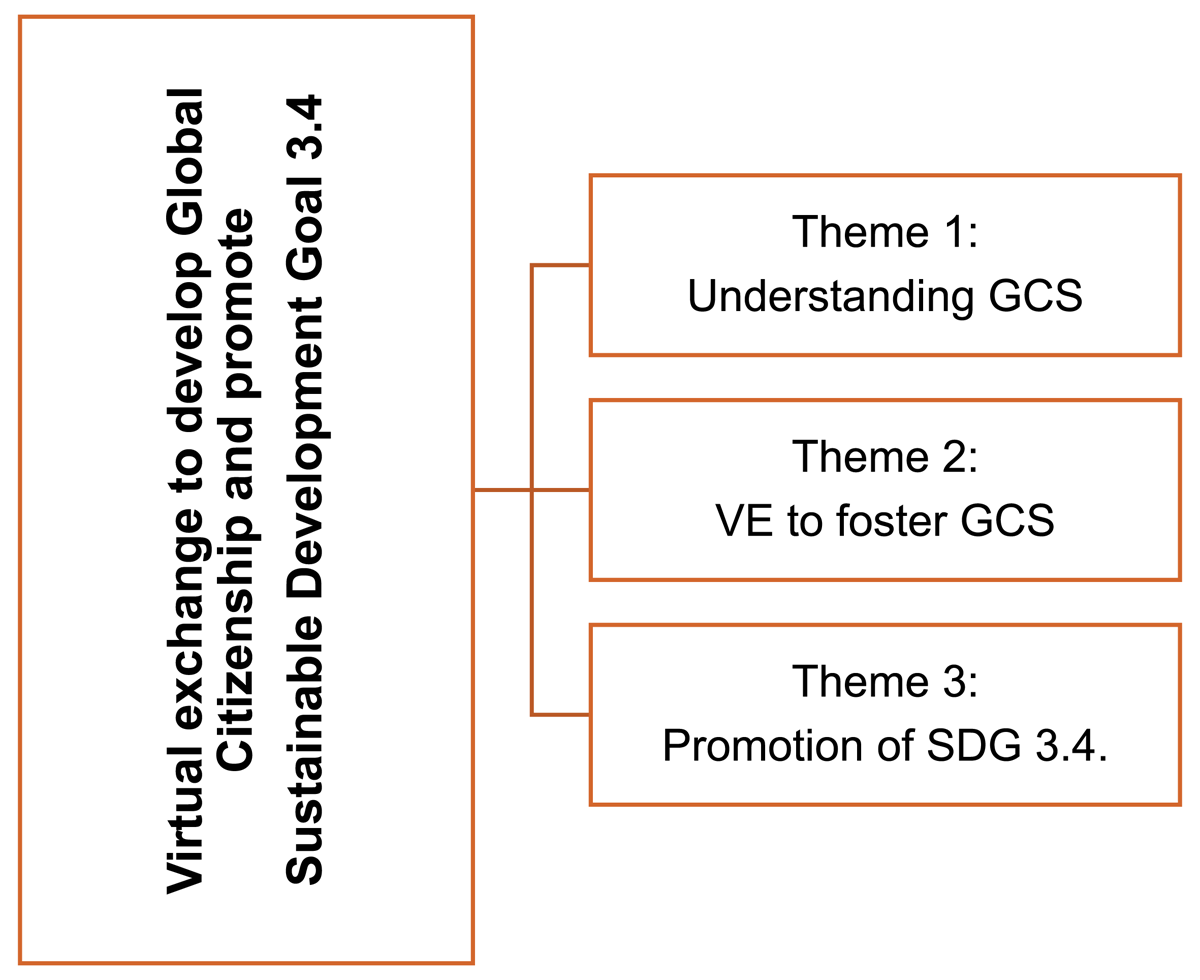
The anonymized data sets from NWU and GSU were merged into a single data set for thematic analysis, as this study was not intended to compare the two institutions. Data analysis was conducted using ATLAS.ti 24 and applying the data analysis steps of Creswell and Clark (2018), the researchers then analysed the data. Author one served as the primary coder, with author two acted as co-coder. Guided by the literature review and the research objectives, authors one and two compiled an initial code list and separately coded the data deductively. As new codes emerged, the coders added the new codes to the initial code list, whereafter authors one and two finalised the code list. Through careful examination of the data, authors one and two coded the data. After this, authors three and four scrutinised the data analysis during a data analysis consistency meeting. Data was clustered into three main themes, namely: Theme 1: Understanding GCS, Theme 2: VE to foster GCS, and Theme 3: Promotion of SDG 3.4. In the following discussion, the authors explain the three themes with quotations to illustrate the findings.
Findings and Discussion
Participants’ responses to the eight open-ended reflection questions offered insights into their perceptions of VE’s role in developing their understanding of GCS, their becoming global citizens (GC), and their insight and awareness of SDG 3.4. The participants’ reflections provided insight into their personal experiences and evidence of individual development, underscoring the depth and breadth of the research.
Theme 1: Understanding Global Citizenship
Understanding how participants perceived GCS was a central focus in the reflections. This theme encompasses characteristics such as respecting human rights and dignity, recognising global interconnectedness, a sense of personal responsibility, and an awareness of belonging to a shared global community and pressing global issues. The data revealed that participants viewed themselves as part of a larger world transcending local, national, and global boundaries. They articulated an understanding of responsibility toward others and the broader world, acknowledging that actions can have a broader impact. These insights align with the core characteristics of GCS, as demonstrated by the following quotes.
“… people have obligations for the welfare of others and the earth and that they are members of a bigger, linked world community… as well as making informed decisions that reflect the broader impact.”
“… individuals are part of a global community with rights and responsibilities that transcend local and national borders. It highlights the interconnectedness of pressing global issues…”
Expanding on the point of global interconnectedness, many participants viewed a GC as every person living in this world, regardless of diversity in terms of social, political, cultural, economic, technological, and environmental differences. Many participants demonstrated the belief that GCS is an action, connection, understanding, acknowledgement, or awareness, as evident from the following quotes.
“Global citizenship is that every person from any country, culture and economic status is recognised as a global citizen…”
“The term “global citizenship” refers to a person who is consciously aware of and involved in the global concerns and cultures of other communities around the world…”
The participants’ reflections align with UNESCO’s (2015) statement that they have a sense of belonging and interconnectedness with a broader community transcending local and national border. Participants emphasised the diversity of GSC across social, political, cultural, economic, technological, and environmental boundaries, a notion that aligns with the work of Murdoch-Eaton and Bezuidenhout (2014). These findings also support the perspective of Stoner et al. (2020) that GCS has a responsibility and obligation towards global issues, as well as Cantón and Garcia (2018) definition of GCS as a mindset that involves acting on global issues. Furthermore, the above findings are consistent with the assertion by Buzdar et al. (2019) that GCS applies to citizens of any country, and that each GC has rights, as also indicated by Cantón and Garcia (2018).
Theme 2: Virtual Exchange to Develop Global Citizenship
Under theme two, VE to develop GCS, data was clustered under five sub-themes: awareness, knowledge, skills, attitude, and contribution.
Several participants indicated that participating in the VE project made them more aware of their roles and responsibilities as GC to find solutions for global challenges. Many participants highlighted that participating in the VE project exposed them to diverse ways of knowing, being, and doing. Furthermore, participants also acknowledged that they have a larger role to play outside their local context and expressed an appreciation of humanity’s similarities and interconnectedness. A smaller group of participants also highlighted that participating in the VE project deepened their understanding of global issues:
“…this [participating in the VE project] experience helped me see beyond my local context and appreciate the interconnectedness of our world… cultivating a sense of responsibility towards contributing to global solutions, reinforcing my commitment to be an active, informed global citizen.”
“It [participating in the VE project] stretched my thinking way that it brought me to understand a different reality from my own, learning how to engage with people different from me and understanding that at the end of the day we are not that different from each other.”
Gaining knowledge about health, SDGs, and SDG 3.4 was another significant contribution to participating in the VE project. Many participants emphasised the value of being exposed to diverse perspectives regarding education, health care, the use of alternative medicine and social issues. A few participants noted that the experience provided them with insights that could directly benefit their future practice as health professionals:
“Engaging with students from a different country allowed me to gain a deeper understanding of global perspectives on education, health care and social issues…”
“…because as an aspiring pharmacist, I learned about the different traditional medicines available for different conditions instead of modern medicine which broadened my knowledge on different ways to help everyone in need…”
Participants identified skills development, especially when it comes to collaboration, communication, and problem-solving, as another gain emanating from their participation in the VE project. Engaging in collaborative activities with peers from diverse cultural backgrounds enhanced their ability to work across borders and promote skills that are essential for navigating complex health challenges. Although only a few participants noted improvements in their communication skills, it was clear that participating in the VE project provided a platform for skills refinement, as illustrated by the following quotations from participants:
“I also think my communication skills developed in terms of being able to express myself as well as listening to other people’s thoughts.”
“Engaging with students from a different country allowed me to gain a deeper understanding of global perspectives… By working collaboratively in a cross-cultural setting, I became more aware of the importance of diversity and inclusivity not just in academia but in everyday life. It challenged me.”
“to think critically about global challenges and how they affect different communities. This broadened perspective helped me recognise my role in addressing issues like inequality and social justice on a larger scale…”
In terms of attitudes, many participants reported a shift in their mindset toward diverse cultures, fostering a more profound sense of respect and openness. Some reflected on the experience as an opportunity to appreciate their circumstances, cultivating gratitude. However, it is noteworthy that a few participants felt that VE had a minimal impact on their personal development because they came from another country and had previously experienced collaboration between cultures. This sentiment is echoed in the following participants’ reflections.
“… It [participating in the VE project] allowed me to further strengthen my gratitude for what opportunities I do and even don’t have…”
“It [participating in the VE project] did not help much in my development of global citizenship because I was born in a different country, and I am aware in how other cultures may approach things.”
“I realised that there were shutters in front of my eyes not allowing me to see the magnitude of the problems or the blessings of both the world but also my home country.”
“Because of this experience I am able to embrace things from other countries and cultures and has opened my mind and reminded me that there is life outside of South Africa. This experience has allowed me to be more accepting of other people’s opinions and ways.”
Findings from theme two illustrate that participating in the VE project effectively fosters the development of GCS among undergraduate health students by contributing towards their awareness, knowledge, skills, attitudes, and sense of contribution. Participants reported an increased awareness of health challenges from different perspectives, aligning with UNESCO’s (2015) emphasis on GCS as a sense of belonging to a broader community and reflecting interconnectedness. Additionally, participants highlighted how the experience helped them to understand diverse ways of knowing and being and doing, echoing Cantón and Gracia’s (2018) conceptualisation of GCS as a mindset that acknowledges the interconnected global landscape and embraces a shared responsibility for addressing global challenges.
Skills development, particularly in communication, collaboration, and problem-solving, emerged as a prominent outcome of the VE experience. This aligns with Lilley et al.’s (2015) emphasis on metacognitive capabilities such as criticality, relationality, and reflexivity, skills that are essential for transformative learning experiences that can broaden global perspectives. Participants’ reflections further supported Buzdar’s (2019) assertion that developing such skills is crucial for fostering global competence, social responsibility, and civic engagement.
The shift in attitudes towards diverse cultures and the appreciation of diversity reported by participants are consistent with Murdoch-Eaton and Bezuidenhout’s (2014) argument that a GC is characterised by a profound respect for diversity and an active commitment to fostering a more inclusive and equitable world. Furthermore, the literature suggests that GCE must prepare students to work collaboratively across borders, a sentiment echoed by participants who noted a heightened readiness to engage with peers from diverse cultural backgrounds (Tawil, 2013; UNESCO, 2015).
However, the study also reveals a gap between the theoretical assumptions and individual experiences, since some participants expressed that the VE project had a minimal impact on their personal development. This finding suggests that VE is a powerful tool for developing GCS, but its effectiveness may vary according to individual contexts and prior exposure to global learning experiences. This discrepancy highlights the importance of incorporating tailored approaches considering varying levels of student engagement and readiness for global learning (Stoner et al., 2020; Waghid, 2024).
Overall, integrating a VE project into health science education offers a meaningful opportunity to cultivate GCS in students, equipping them with the knowledge, skills, and attitudes needed to address the complex challenges of the 21st century. As Alshawi (2023) notes, fostering these competencies is essential for preparing students as emerging health care professionals to navigate the evolving global landscape and to become proactive contributors to a sustainable and socially just world.
Theme 3: Promotion of Sustainable Development Goal 3.4
SDG 3.4 aims to reduce premature mortality from NCDs by one-third by 2030. NCDs, which include cardiovascular diseases, diabetes, cancer, and chronic respiratory diseases, are influenced by lifestyle choices, environmental factors, and socio-economic disparities. A substantial number of participants mentioned that the effective implementation of SDG 3.4 can be achieved through partnerships. Participants also shared that they were exposed to global health issues during the VE project, issues like the availability or resources and cultural approaches. Participants also noted that they were exposed to how diverse cultures and countries address the burden of NCDs. Through collaborating, students could exchange knowledge and skills, finding holistic solutions for NCDs. This is reflected in the following quotes:
“It [participating in the VE project] contributed a lot because we shared our knowledge and skills with each other to find holistic solutions to the Sustainable Development Goal 3.4. We learned that different countries struggle with different problems, but there are also similarities that can be worked on together to be solved…”
“This collaborative learning experience [participating in the VE project] allowed me to engage with peers from diverse cultural and healthcare backgrounds, giving me insights into how different countries address the prevention and management of noncommunicable diseases and mental health challenges. The discussions we had highlighted the global nature of health issues, showing how health strategies differ depending on resources, policies, and cultural approaches…Through our collaboration, I gained a better understanding of the importance of international cooperation in achieving Sustainable Development Goal 3.4. It emphasised the need for collective action in reducing the global burden of noncommunicable diseases and improving mental health, reinforcing my belief in the role of cross-border partnerships in promoting health and well-being worldwide.”
When asked to reflect on the extent to which, if any, the VE project contributed to them developing a better understanding of SDG 3.4, some participants indicated that they became more aware of SDG 3.4, and that they understood the need for collective action and management of NCDs. Additionally, many participants highlighted various barriers that must be addressed to achieve SDG 3.4. The findings suggest that participants were aware that the appropriate resources and education could be crucial in combating NCDs; however, participants did not prominently indicate health promotion as a strategy to prevent NCDs. Some students did mention the psychological well-being of patients and the impact of lifestyle choices on NCDs. The following quotes substantiate this finding:
“Throughout this study, I have learned that in order to achieve Sustainable Development Goal 3.4, one needs to educate…I have seen the need for mental health advocacy …”
“It [participating in the VE project] contributed in the sense that I got to learn what Sustainable Development Goal 3.4 is about…encouraging communities to adopt healthier lifestyles to decrease premature deaths from these types of diseases.”
“…I also understood some of the barriers preventing the implementation of care to patients, such as remote or rural areas where modern technology is not accessible or simply a lack of trust in the progression of medical science, especially among the elderly or those without access to education.”
Most students indicated that participating in the VE project contributed significantly towards developing a better understanding of SDG 3.4. However, a few participants mentioned that the experience did not contribute to their understanding of SDG 3.4. In retrospect, this may be due to a lack of emphasis on the theoretical background of SDG 3.4 during phase 1, as it was assumed that students pursuing a health-related course would already be familiar with this goal:
“… I feel as if I didn’t have much time to really learn more or understand how to move closer towards Goal 3.4.”
“I did not learn or experience a better understanding of the Sustainable Development Goal…”
The students’ reflections align with Davim (2017), who emphasises that partnerships are crucial for the effective implementation and achievement of SDG 3.4. This theme is also supported by the World Health Organization (2018), which advocates for holistic health strategies that address the physical aspects of disease and the broader social and environmental determinants of health. The students’ recognition of the need for a collaborative and holistic approach reflects this view.
Furthermore, as Luna and Luyckx (2020) highlight, the findings suggest that participants realised the need for a shift towards prioritising global health, particularly NCDs, which have historically been under-prioritised due to financial constraints. It is evident from the findings that participants realised that NCDs pose significant global health challenges, and that traditional medicine could play an important role in managing NCDs in low-and medium-income countries (World Health Organization, 2018). This notion is reinforced by Luna and Luyckx’s (2020) call for increased attention and resources toward NCDs.
Conclusion
HEIs play a vital role in preparing students to address global challenges in an interconnected world. Traditional lecture-based learning is insufficient for the present era, which requires dynamic approaches that promote critical thinking, problem-solving, and cross-border collaboration. To ensure that students can contribute meaningfully towards a globalised society, there is a growing emphasis on GCE. This study investigated undergraduate health students’ perceptions of VE as a vehicle to develop GCS and promote SDG 3.4. The project was aligned with the promotion of SDG 3.4, which focuses on reducing NCD mortality through prevention and treatment.
Findings from the project indicate that the VE project significantly impacted students’ understanding of GCS. Participants’ reflections indicated that they have gained meaningful insights into what it means to be a GC and that they developed a deeper awareness of their role in promoting global health and well-being, in alignment with SDG 3.4. The VE provided a platform where students could engage with diverse perspectives, which enhanced their cultural competence and broadened their world perspective, reinforcing the value of integrating such projects into higher education.
Participants highlighted the transformative potential of VE in fostering personal growth and professional development. Many participants also expressed a deeper sense of responsibility and awareness towards global health issues, demonstrating how such exchanges can help develop more informed, empathetic, and globally engaged future health professionals. This study underscores the importance of incorporating VE projects in health education curricula to promote GCS aligned with SDG 3.4. By cultivating students’ understanding of GCS and their role in achieving SDG 3.4, HEIs can prepare health professionals equipped to address the challenges of the 21st century.
Limitations
Despite the positive outcomes yielded by this study, the authors would like to note a few limitations that may have had a bearing on the findings and overall outcomes. Participants in the VE project was voluntary, and only capturing the voices of the students who, as self-directed learners, embraced the opportunity to engage with students from another country and context. This may have resulted in the authors losing out on collecting the responses of students who was not as optimistic about VE and cross- boundary learning. As noted earlier, the authors assumed that students pursuing a health-related course would already be familiar with SDG 3.4. For this reason, the authors did not focus on imparting the theory of SDG 3.4. Not including a theoretical lesson on SDG 3.4 may have resulted in some students not having a clear understanding of SDG 3.4, which could have impacted how they answered the reflective questions focusing on SDG 3.4.
Data collection in this research only comprised of eight open-ended questions. Using focus groups as an additional data collection tool may have yielded additional insights into the participants’ perceptions. Lastly, the dual role of the lecturers as researchers in this study may have introduced a measure of bias, as their involvement in both facilitating the sessions and analysing the data could have influenced the interpretation of the findings. To mitigate this risk, the authors utilised the services of a neutral and independent research support member to assist with phase 2 of the VE project. Despite these limitations, the authors believe that the study’s findings provide valuable insights and implications for university educators, faculty management, and other stakeholders who are interested in implementing VE collaboration as a vehicle to develop GC and promote SDG 3.4.
Data Accessibility Statement
The datasets used and analysed during the current study are available from the corresponding author on reasonable request.
Ethics and Consent
Ethical approval was obtained for the work described in this article from:
North-West Health Research Ethics Committee (NWU-HREC)
NWU-HREC00050-24-A1; NWU-GK-24-232, and
Georgia State University Institutional Review Board (IRB)
GSU-IRB:H20500
Competing Interests
The authors have no competing interests to declare.
Author Contributions (CRediT)
Wynina Jansen van Vuuren: Conceptualisation, Data collection, Formal Analysis, Investigation, Methodology, Resources, Software, Supervision, Validation, Writing – original draft, Writing – review and editing. All authors have read and agreed to the published version of the manuscript. Yolande Heymans: Conceptualisation, Data analysis, Investigation, Methodology, Project administration, Resources, Software, Validation, Writing – review and feedback; Courtney Strosnider: Conceptualisation, Data analysis evaluation and consistency, Investigation, Methodology, Project administration, Resources, Software, Supervision, Validation, Writing – review and feedback; Jessica Pool: Conceptualisation, Data analysis evaluation and consistency, Investigation, Methodology, Resources, Software, Validation, Writing – review & feedback. All authors have read and agreed to the published version of the manuscript.
Sustainable Development Goals (SDGs)
This study is linked to SDG 3: Good health and Well-being with specific focus on SDG 3.4, namely NCDs and mental health.
Authors Notes
Based on Academic Integrity and Transparency in AI-assisted Research and Specification Framework (Bozkurt, 2024), the authors of this paper acknowledge that this paper utilized the assistance of Generative AI – ChatGPT4.0 as well as Grammarly and Writefull during the writing process for refinement, complementing the human editorial process. The human authors critically assessed and validated the suggestions to maintain academic rigor. The authors also assessed and addressed potential biases inherent in the AI-generated content. The final version of the paper is the sole responsibility of the human authors.