
Introduction
Open and Distance Learning (ODL) is an educational approach that emphasizes removing barriers of time, space, and place to provide learners with flexible learning opportunities (Nketekete & Mojalefa, 2024). In this context, capacity building is a pivotal part of enhancing organizational performance and productivity, ensuring that instructors and institutions are equipped with the necessary resources and skills to deliver high-quality education. Capacity building is defined as any process that improves the efficiency and effectiveness of an organization, enabling underperforming or weak capacities to reach their optimal level of efficiency (Amini & Oluyide, 2016). Flexible learning opportunities provided by ODL are increasingly crucial in higher education, as capacity building increasingly revolves around fostering digital competence among faculty members.
Developing instructional capacity-building strategies involves several steps, such as assessing faculty members’ needs, identifying goals, developing a plan, using various training methods, providing ongoing support, and evaluating a program’s effectiveness. In light of this, we conducted research to predict the digital competence of faculty members. Understanding their digital competence allows us to create more targeted and effective capacity-building strategies to improve their instructional skills.
At the heart of capacity building lies digital competence, skills, and knowledge required to effectively use digital technologies in various contexts. The UNESCO ICT Competency Framework for Teachers (2018) underscores the pivotal role of digital competence in capacity building, highlighting its significance in enhancing teaching practices and improving educational outcomes. Similarly, the European Commission (2018) recognizes digital competence as a fundamental enabler of lifelong learning and employability in the 21st century. This competence is paramount in higher education institutions, where faculty members need to integrate technology into their teaching practices effectively and to support students’ digital literacy development. Consequently, we investigated these factors as predictors of faculty members’ digital competence to develop effective capacity-building strategies.
Literature
To further elucidate the concept of digital competence, we turn to the European Framework for the Digital Competence of Educators; DigCompEdu (Punie & Redecker, 2017). This aims to capture educator-specific digital competence in six key areas. These areas range from professional engagement to facilitating learners’ digital competence. The DigCompEdu framework further breaks down these six areas into various sub-dimensions, offering a comprehensive roadmap for developing educators’ digital competence, as shown in Figure 1. It also helps educators assess their digital skills at various levels; Newcomer (A1), Explorer (A2), Integrator (B1), Expert (B2), Leader (C1), and Pioneer (C2).
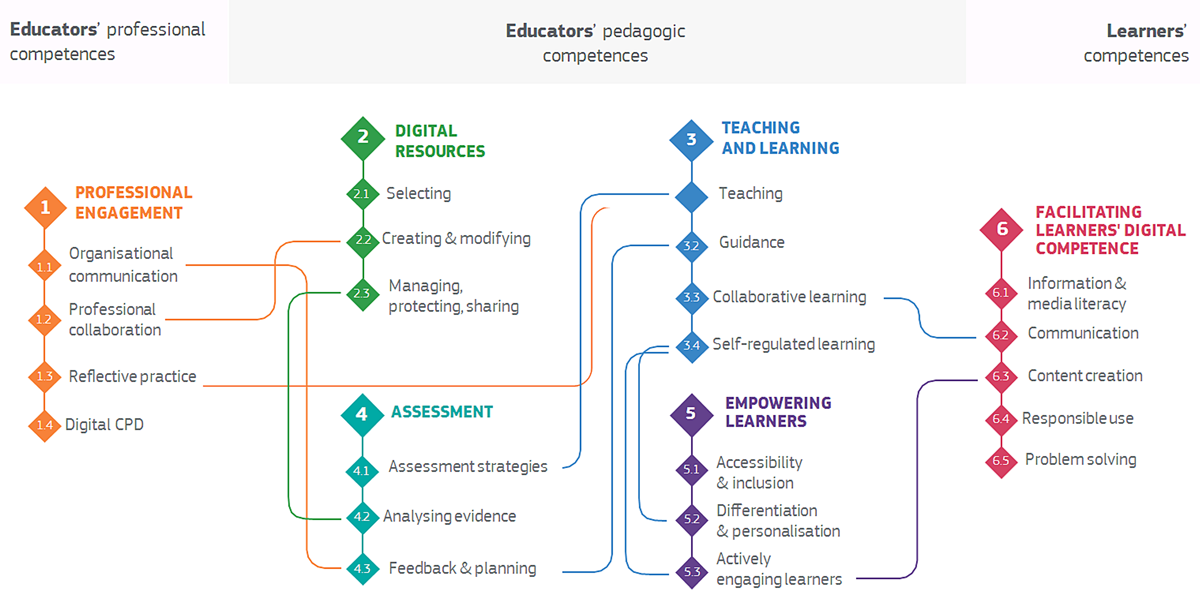
Figure 1
The sub-dimensions of six areas of DigiCompEdu competence and their connections (Punie & Redecker, 2017).
Several factors play a role in shaping faculty members’ digital competence, including age, gender, prior teaching experience, technology access, institutional support, self-efficacy regarding technology, and perceptions toward distance education. Individual, institutional, and technological factors are impacting their ability to effectively integrate technology into their teaching and research practices. Individually, age, gender, prior experience, attitudes, and self-efficacy in technology use are key drivers (Keržič, et al., 2021; Mumtaz, 2000; Kim, et al., 2012; Bandura,1997; Teixeira, 2023). Institutionally, robust support systems, strong leadership that champions technology integration, and a supportive institutional culture are crucial (D’Angelo & Kchir, 2023; Gardner & Rich, 2014). Technological factors, such as reliable access to technology, user-friendly tools, and readily available technical support, significantly impact faculty members’ ability to effectively integrate technology into their teaching and research practices (Moore & Kearsley, 2011; Prifti, 2022; Teo & Noyes, 2011).
Access to technology and support is a critical aspect of digital competence. Individuals with access to up-to-date technology and adequate support are more likely to develop their digital skills and become competent in digital tools (Moore & Kearsley, 2011). Faculty support significantly influences digital competence. Administrative support to faculty in ODL is seen as crucial to maintaining the quality of the teaching and learning experience (Teixeira, 2023). It has been acknowledged as essential in preventing student dropout, enhancing teaching efficacy, and facilitating learning achievement.
Perception toward distance education is another factor that influences digital competence. Perception shapes an individual’s understanding and interpretation of the world, which can significantly affect decisions and behaviour (Otter et al., 2013). Over the years, perceptions of distance education have evolved due to technological advancements, increased internet accessibility, and the ongoing COVID-19 pandemic (Scherer et al., 2018; Siddiq et al., 2016). The integration of technology has blurred the lines between traditional classroom settings and remote learning, creating a more flexible and inclusive educational landscape and technological advancements have revolutionized distance education, transforming it from a passive mode of learning to an interactive and engaging experience (Maqbool et al., 2024). The emergence of artificial intelligence, video-based learning, social collaboration platforms, mobile learning, gamification, and micro-learning has significantly enhanced accessibility and engagement. Consequently, these perceptions impact the acquisition of digital competence.
Self-efficacy is another key determinant of digital competence. It refers to an individual’s belief in their ability to successfully perform a specific task or achieve a particular goal (Bandura, 1997; Stajkovic & Luthans, 1998). Individuals with high self-efficacy are more likely to engage in digital activities, use digital tools and technologies effectively, and adopt new technologies quickly (Prifti, 2022; Teo & Noyes, 2011). Therefore, individuals exhibiting elevated levels of self-efficacy will likely demonstrate greater competence in digital skills.
The culture surrounding an organization’s error management also shapes digital competence (D’Angelo & Kchir, 2023; Gardner & Rich, 2014). Error management involves creating an environment where employees feel comfortable, speaking about errors and mistakes and reporting them without fear of punishment or retribution (Keith & Frese, 2005; van Dyck et al., 2005; Van Steenbergen et al., 2019). The focus is on learning from errors (Helmreich & Merritt, 1998; Spath & Kelly, 2017), identifying the root causes, and preventing them from reoccurring (Javed et al., 2020; Reason, 1990). In an error-averse culture, mistakes are often concealed, leading to a lack of accountability and missed learning opportunities.
Having recognized the importance of digital competence in ODL and its various influencing factors, our study focuses on identifying the predictors of digital competence among faculty members.
Methods
Our research aims to identify the predictors of faculty members’ digital competence. A quantitative, descriptive, and correlational design was employed. Data collection was conducted using the DigiCompEdu (2021) survey, supplemented by questions regarding faculty demographics, access to technology, perceptions of distance education, self-efficacy in technology, and a measure of error management culture derived from the instrument developed by van Dyck et al. (2005). This design was appropriate for examining the influence of technology access and institutional support, perceptions of distance education, self-efficacy, and error management culture on faculty members’ digital competence.
The quantitative approach was guided by the objective of identifying variables that influence an outcome (Creswell, 2009). Specifically, this study investigated how access to technology and institutional support, perception towards distance education, self-efficacy regarding technology, error management, and prior experience influences digital competence and assesses the role of age, gender, teaching experience, digital experience in digital competence among faculty members.
Descriptive statistics were generated from demographic data and responses to the DigiCompEdu survey, which is divided into six sections. To evaluate relationships between levels of digital competence and various predictors, statistical analyses were conducted. These analyses explored associations between digital competence and selected demographic characteristics, access to technology and institutional support, perceptions of distance education, self-efficacy, error management, and prior experience. The findings were presented using statistical tables, charts, and narratives to discuss their alignment with the research hypotheses (Neuman, 2003).
A descriptive and correlational design was followed to address the following specific research questions:
Do access to technology and support, perception towards distance education, self-efficacy, and error management affect the digital competence of faculty members?
How far do access to technology and support, perception towards distance education, self-efficacy, and error management predict the digital competence of faculty members?
How do personal factors such as age, gender, teaching experience, digital experience differ in digital competence of faculty members?
Samples
The research was conducted at a foundation university on the Anatolian coast in late 2022. Two hundred and seventy-two faculty members (53.3% female, 46.7% male) voluntarily participated in the study.
Data Gathering Tools
Data was collected through a fifty-two-question survey divided into six sections, each addressing specific themes related to the research objectives. Table 1 provides a detailed breakdown of the survey sections.
Table 1
The survey sections.
| SECTION | FOCUS AREA | DETAILS | SCALE/MEASURE |
|---|---|---|---|
| Demographic Data | Demographic information | Included four questions on age, gender, prior teaching experience, and digital experience. | |
| Technology Access | Technology access and university support | Included six questions on digital technology integration, technical infrastructure, devices, reliable internet, and technical support. | 5-point Likert scale (1 = strongly disagree, 5 = strongly agree) |
| Perceptions | Faculty perceptions of distance education | Included six questions on motivation, perceived quality of online education, and stress levels. | |
| Self-Efficacy | Faculty self-efficacy in technology use | Included five questions on the use of computers, the Internet, and new apps/programs. | 5-point Likert scale (1 = strongly disagree, 5 = strongly agree) |
| Error Management | Error management culture | Included seven questions using an error management culture measure derived from an instrument by van Dyck et al. (2005). | |
| Digital Competence | Digital competence based on the DigiCompEdu framework | Included twenty-four questions covering six competence areas: Professional Engagement, Digital Resources, Teaching and Learning, Assessment, Empowering Learners, and Facilitating Learners’ Digital Competence (Vuorikari et al., 2022). | Total or separate score for each competence area based on the framework. |
This structured approach facilitated a thorough assessment of demographic characteristics, access to technological resources, and faculty attitudes and competencies relevant to the research objectives.
Ethical Considerations
Ethical considerations were observed throughout the research process. The Ethics Committee approved the study. Data collection and protection were covered by data protection laws. We analysed the anonymised data, and the participants were informed of their right to withdraw from the study.
Limitations
This study, while valuable, has certain limitations. It is exclusively based on one foundation university on the Anatolian coast of Turkey, limiting its generalizability. Future studies should explore digital competence predictors in similar universities for comparison. It is also solely quantitative, potentially narrowing the research scope. A blend of quantitative and qualitative methods could give a more comprehensive view of digital competence in academia.
Findings and Discussion
The results section is organized into four parts: the distribution of DigiCompEdu scores based on demographic data; the Digital Competence Level of faculty according to the DigiCompEdu sub-area scores; the mean measurements of the survey sub-sections; and the correlations between the measures.
Distribution of the DigiCompEdu Scores based on the Demographic Data
Table 2 shows the level of digital competence among faculty members based on age, gender, teaching experience, and digital experience. All the faculty members have achieved at least B1 digital competence level.
Table 2
Distribution of the DigiCompEdu scores based on the demographic data.
| DigiComp LEVEL | INTEGRATOR B1 | EXPERT B2 | LEADER C1 | PIONEER C2 | TOTAL | |||||
|---|---|---|---|---|---|---|---|---|---|---|
| n | % | n | % | n | % | n | % | n | % | |
| Gender | ||||||||||
| Female | 7 | 33.3 | 35 | 46.1 | 47 | 50.5 | 56 | 68.3 | 145 | 53.3 |
| Male | 14 | 66.7 | 41 | 53.9 | 46 | 49.5 | 26 | 31.7 | 127 | 46.7 |
| Age | ||||||||||
| [39 or below] | 7 | 33.3 | 22 | 28.9 | 29 | 31.2 | 35 | 42.7 | 93 | 34.2 |
| [40–49] | 7 | 33.3 | 26 | 34.2 | 35 | 37.6 | 31 | 37.8 | 99 | 36.4 |
| [50 or more] | 7 | 33.3 | 28 | 36.8 | 29 | 31.2 | 16 | 19.5 | 80 | 29.4 |
| Teaching Experience | ||||||||||
| [5 or less] | 2 | 9.5 | 13 | 17.1 | 10 | 10.8 | 14 | 17.1 | 39 | 14.3 |
| [6–9] | 4 | 19.0 | 13 | 17.1 | 16 | 17.2 | 16 | 19.5 | 49 | 18.0 |
| [10–14] | 5 | 23.8 | 16 | 21.1 | 24 | 25.8 | 23 | 28.0 | 68 | 25.0 |
| [15 or more] | 10 | 47.6 | 34 | 44.7 | 43 | 46.2 | 29 | 35.4 | 116 | 42.6 |
| Digital Experience | ||||||||||
| [Less than three years] | 15 | 71.4 | 29 | 38.2 | 21 | 22.6 | 18 | 22.0 | 83 | 30.5 |
| [4–9 years] | 2 | 9.5 | 27 | 35.5 | 30 | 32.3 | 33 | 40.2 | 92 | 33.8 |
| [10 years or more] | 4 | 19.0 | 20 | 26.3 | 42 | 45.2 | 31 | 37.8 | 97 | 35.7 |
Female faculty members dominate the highest level (C2) at 68.3%, while male faculty members are predominant in the lower levels, especially at B1 (66.7% male). Overall, more female faculty members (53.3%) are distributed across all levels. They often integrate digital technologies in various contexts. However, female faculty members excel at the highest levels (C1–C2), where they share their expertise, experiment with complex technologies, and develop new teaching and assessment strategies. Those with more teaching experience generally have higher digital competence.
Faculty members aged 39 or below are less represented in the higher levels (C1: 31.2%, C2: 42.7%) compared to those aged 40–49 and Faculty members aged 50 or more dominate the lower levels (B2: 36.8%) but have fewer representatives at C2 (19.5%).
Faculty members with 15 or more years of experience dominate all levels, especially at C1 (46.2%) and C2 (35.4%). Those with 5 or fewer years of teaching experience are least represented in all levels (only 14.3% overall).
Faculty members with 10 years or more of digital experience dominate the C1 (45.2%) and C2 (37.8%) levels. But faculty members with less than 3 years of digital experience dominate at B1 (71.4%) and are less represented in higher levels.
Digital Competence Level of Faculty Members According to Sub-Area Scores of DigiCompEdu
The Digital Competence Framework for Educators (DigCompEdu, 2021) serves as a valuable tool for self-reflection on digital competence in higher and further education. Table 3 provides sub-area scores for each of the six areas of digital competence, which can be used to identify the overall level of competence achieved by faculty members.
Table 3
Descriptive of digital competence level/area of faculties.
| NEWCOMER A1 | EXPLORER A2 | INTEGRATOR B1 | EXPERT B2 | LEADER C1 | PIONEER C2 | ||||||||
|---|---|---|---|---|---|---|---|---|---|---|---|---|---|
| n | % | n | % | n | % | n | % | n | % | n | % | ||
| Digital Competence Level of Faculties | Female | 7 | 2.6 % | 35 | 12.9 % | 47 | 17.3 % | 56 | 20.6 % | ||||
| Male | 14 | 5.1 % | 41 | 15.1 % | 46 | 16.9 % | 26 | 9.6 % | |||||
| Area 1: Professional Engagement | Female | 5 | 1.8 % | 20 | 7.4 % | 39 | 14.3 % | 81 | 29.8 % | ||||
| Male | 4 | 1.5 % | 30 | 11.0 % | 47 | 17.3 % | 46 | 16.9 % | |||||
| Area 2: Digital Resources | Female | 1 | 0.4% | 4 | 1.5 % | 8 | 2.9 % | 22 | 8.1 % | 53 | 19.5 % | 57 | 21.0 % |
| Male | 4 | 1.5 % | 13 | 4.8 % | 30 | 11.0 % | 47 | 17.3 % | 33 | 12.1 % | |||
| Area 3: Teaching and Learning | Female | 4 | 1.5 % | 19 | 7.0 % | 48 | 17.6 % | 74 | 27.2 % | ||||
| Male | 14 | 5.1 % | 23 | 8.5 % | 48 | 17.6 % | 42 | 15.4 % | |||||
| Area 4: Assessment | Female | 4 | 1.5 % | 19 | 7.0 % | 42 | 15.4 % | 34 | 12.5 % | 46 | 16.9 % | ||
| Male | 4 | 1.5 % | 29 | 10.7 % | 39 | 14.3 % | 32 | 11.8 % | 23 | 8.5 % | |||
| Area 5: Empowering Learners | Female | 1 | 0.4% | 10 | 3.7 % | 23 | 8.5 % | 35 | 12.9 % | 38 | 14.0 % | 39 | 14.3 % |
| Male | 9 | 3.3 % | 35 | 12.9 % | 40 | 14.7 % | 21 | 7.7 % | 21 | 7.7 % | |||
| Area 6: Facilitating Learners’ Digital Competence | Female | 2 | 0.7% | 5 | 1.8 % | 18 | 6.6 % | 50 | 18.4 % | 38 | 14.0 % | 32 | 11.8 % |
| Male | 3 | 1.1% | 6 | 2.2 % | 34 | 12.5 % | 41 | 15.1 % | 26 | 9.6 % | 17 | 6.3 % | |
In professional engagement, 79% of faculty members at the highest levels (C1–C2) use technology to enhance their professional development and collaboration with their colleagues.
Regarding digital resources, 70% of faculty members at the highest levels (C1–C2) can proficiently use various digital tools to create and curate resources for their students. Additionally, 27% of faculty members at the intermediate level (B1–B2) manage and use digital content responsibly.
In teaching and learning, 78% of faculty members at the highest levels (C1–C2) excel at using digital tools for designing and delivering effective instruction. They successfully implement digital technologies at various phases and settings of the learning process.
In assessment, 49% of faculty members at the highest levels (C1–C2) develop or facilitate innovative assessment approaches. Additionally, 48% of faculty members at the intermediate level (B1–B2) can harness digital tools to assess and adjust their teaching strategies.
In empowering learners, 93% of faculty members utilize digital technologies in education to support learner-centered pedagogical strategies. However, only 44% of faculty members at the highest levels (C1–C2) leverage digital technologies to cater to learners’ diverse needs, enhancing active learner participation in the learning process.
Regarding fostering learners’ digital competence, 52% of intermediate-level (B1–B2) faculty members implement activities to enhance this. Additionally, 42% of faculty members at the highest levels (C1–C2) incorporate learning activities, assignments, and assessments that require learners to use digital technologies effectively and responsibly for communication, collaboration, and engagement.
Measurement Means of Sub-Sections of the Survey
Table 4 presents the mean for the faculty members’ access to technology and support, their perception of distance education, self-efficacy, error management, and digital competence points.
Table 4
Descriptive of the faculty members’ access to technology and support, their perception of distance education, self-efficacy, error eversion, error management, and digital competence points of faculties.
| DESCRIPTIVE | n | MEAN | STANDARD DEVIATION | |||
|---|---|---|---|---|---|---|
| FEMALE | MALE | FEMALE | MALE | FEMALE | MALE | |
| Access to technology and support | 145 | 127 | 3.92 | 3.89 | 0.91 | 0.80 |
| Perception of distance education | 145 | 127 | 3.35 | 3.13 | 0.88 | 0.88 |
| Self-efficacy | 145 | 127 | 4.33 | 4.42 | 0.65 | 0.58 |
| Error management | 145 | 127 | 3.58 | 3.52 | 0.69 | 0.70 |
| Digital competence points | 145 | 127 | 74.00 | 67.50 | 15.10 | 14.50 |
Overall, the means for all variables are quite similar between the female and male faculty members. Both groups have high access to technology and support, with mean scores of 3.92 and 3.89 for females and males, respectively. Both groups also have a relatively positive perception of distance education, with mean scores of 3.35 for the females and 3.13 for the males.
The self-efficacy scores are high for both groups, with females and males scoring 4.33 and 4.42, respectively. The error management scores are similar for the two groups, with both variables having mean scores of around 3.50.
Finally, the mean digital competence score is slightly higher for the female faculty members (74.00) than for the male faculty members (67.50), with standard deviations of 15.10 and 14.50, respectively. This result might suggest that the female faculty members are slightly more digitally competent overall, though the difference is modest.
Correlations between measures
Bartlett’s test of sphericity, which tests the overall significance of all the correlations within the correlation matrix, was significant (χ2 (406) = 3967, p < .001), indicating that using the factor analytic model on this data set was appropriate. The Kaiser-Meyer-Olkin measure of sampling adequacy indicated that the strength of the relationships among the variables was high (KMO = .82). Therefore, it was acceptable to proceed with the analysis. A series of factor analyses were conducted, which indicated that the factors gave the most interpretable solution. A varimax rotation was performed since the factors were expected to be correlated.
A Pearson product-moment correlation coefficient was computed to assess the relationship between the faculty members’ digital competence, access to technology and support, perception of distance education, self-efficacy, and error management. There was a moderate positive and negative correlation between the variables given in Table 5 below:
Table 5
Correlations between measures.
| DIGITAL COMPETENCE | ERROR MANAGEMENT CULTURE | ACCESS TO TECHNOLOGY AND SUPPORT | PERCEPTION OF DISTANCE EDUCATION | SELF-EFFICACY | ||
|---|---|---|---|---|---|---|
| Digital Competence | Pearson’s r | — | ||||
| p-value | — | |||||
| Error Management | Pearson’s r | 0.177** | — | |||
| p-value | 0.003 | — | ||||
| Access to Technology and Support | Pearson’s r | 0.088 | 0.451*** | — | ||
| p-value | 0.148 | < .001 | — | |||
| Perception of Distance Education | Pearson’s r | 0.395*** | 0.181** | 0.311*** | — | |
| p-value | < .001 | 0.003 | < .001 | — | ||
| Self-Efficacy | Pearson’s r | 0.478*** | 0.149* | 0.238*** | 0.375*** | — |
| p-value | < .001 | 0.014 | < .001 | < .001 | — |
[i] Note. * p < .05, ** p < .01, *** p < .001
According to the correlations between the variables:
The digital competence of the faculty is associated with the faculty members’ error management, perception of distance education, and self-efficacy. The digital competence of the faculty members and their self-efficacy and perception of distance education were moderately positively correlated.
The faculty members’ error management and access to technology and support were moderately positively correlated. The faculty members’ error management also had a positive weak correlation between their perception of distance education and self-efficacy.
There was a positive correlation between the faculty members’ perception of distance education and their access to technology and support.
The faculty members’ self-efficacy was moderately positively correlated with their perception of distance education and their access to technology and support.
Linear regression was used to test if the faculty members’ access to technology and support, their perception of distance education, self-efficacy, and error management significantly predicted the Digital Competence Points of Faculty Members.
The overall regression was statistically significant (R2 = .374, F (13, 258) = 11.9, p < .001). It was found that the digital competence points of the faculty members significantly predicted access to technology and support (β = –2.41, p = 0.02), perception of distance education (β = 4.02, p < .001), self-efficacy (β = 9.14, p < .001), and error management (β = 2.61, p = 0.03).
It is also assessed whether age (thirty-nine or below, forty-forty-nine, fifty or more), gender (male/female), teaching experience (less than five years, six to nine years, ten to fourteen years, fifteen or more years), digital experience (less than three years, four to nine year, ten or more years) are potential confounders, and if so, appropriately account for these using linear regression analysis. Analysis reveals the following:
The gender of faculties is associated with the dependent variable contrast digital competence points of the faculty members as predicted by the contrast of male versus female. The exp(B) is –6.49. The digital competence points of the female faculty members are 6.49 points higher than for the male faculty members, and this effect is statistically significant (t (1) = –4.01, p < .001).
There was a significant effect of the faculty members’ digital experience on digital competence points at the p < .05 level for the three conditions [F (2, 258) = 3.24, p = 0.04]. The faculty members’ digital experience of less than three years has lower digital competence points among [four to nine years] and [ten years or more] experience. As predicted by the contrast [four to nine years] versus [less than three years] experience, the exp(B) is 4.19. Therefore, the Digital Competence Points for a faculty having teaching experience of four to nine years is 4.19 points higher than for faculty members having teaching experience of less than three years, and this effect is statistically significant (t (3) = 2.07, p = 0.04). For [ten years or more] versus [less than three years] experience, the exp(B) is 5.19, which means that the digital competence points for a faculty member of having teaching experience more than ten years is 5.19 points higher than for a faculty member having teaching experience less than three years. This effect is statistically significant (t (3) = 2.33, p = 0.02).
Discussion
Digital competence refers to the knowledge, skills, and attitudes needed to use digital technologies efficiently for communication, information-seeking, problem-solving, and decision-making (Vuorikari et al., 2022). In today’s fast-paced digital world, digital competence is a crucial capacity-building strategy for success in higher education. This study explored faculty members’ digital competence based on various demographic factors, sub-area scores from the DigiCompEdu framework, and correlations between key variables.
Our findings suggest that, amid demographic data, female faculty members have higher digital competence than male faculty members. The female faculty members, particularly those with extensive teaching and digital experience, tend to score higher in digital competence levels. Females were more prevalent in the highest levels (C1-Leader/C2- Pioneer), while males were concentrated in the lower levels (B1-Integrator). However, the gender effect disparities in the existing research are inconclusive and may vary (OECD, 2014; Siddiq et al., 2016).
Age and teaching experience also emerge as significant predictors of digital competence. Faculty members aged 39 or below, while well-represented at the highest levels (C1-Leader and C2- Pioneer), show a lower percentage at the C1 level compared to those aged 40–49. This may suggest that while younger faculty members are familiar with digital tools, they may not yet have fully embraced or mastered the sophisticated digital strategies required at the C1 level. On the other hand, faculty members with 15 or more years of teaching experience are notably more likely to be at the C1 and C2 levels, implying that extensive teaching experience correlates with a deeper integration of digital technologies into pedagogical practices. In addition, digital competence varies with digital experience, but not with teaching experience or age, in contrast to Pera et al. (2022) who suggest a link with teaching years. Similarly, faculty members with more than 10 years of digital experience are more likely to achieve the highest digital competence levels (C1 and C2), suggesting that long-term exposure to digital tools enhances one’s ability to use these technologies innovatively in teaching.
The correlation analysis reveals several key relationships between the measures. Moreover, self-efficacy and a perception of distance education moderately influences digital competence, with a slight effect from error management. Digital competence is positively correlated with self-efficacy (r = 0.478), which underscores the importance of confidence in one’s ability to use technology effectively. This is in line with existing research that highlights self-efficacy as a critical predictor of successful technology integration in education (e.g., faculty who feel more confident are more likely to engage in technology-driven teaching practices). Due to its association with technology access, support, and perception of distance education, self-efficacy is the key to developing digital competence. The moderate correlation between digital competence and access to technology and support (r = 0.451) indicates that faculty members’ ability to effectively use digital tools is somewhat dependent on the availability of resources and institutional support. As expected, faculty members with higher access to technology and support tend to report higher digital competence scores.
The faculty members’ perception of distance education is also an important factor influencing their digital competence. A moderate correlation was found between faculty members’ access to technology and error management and a weak correlation between their perception of distance education and their confidence in error management. Faculty with a more positive view of distance education tend to have higher digital competence scores. This finding is consistent with research that shows that faculty members who are more open to the opportunities offered by distance education are more likely to integrate digital tools effectively in their teaching.
The mean scores for faculty members’ access to technology and support, self-efficacy, and perception of distance education are relatively high across both genders, suggesting that faculty members generally have adequate access to the technological infrastructure required for teaching and are confident in their ability to use it effectively. The mean digital competence score is slightly higher for female faculty members (74.00) than for male faculty members (67.50), indicating a modest gender difference in overall digital competence. This finding, while statistically significant, suggests that the difference may be more indicative of broader institutional trends or differences in teaching practices rather than inherent gender-based differences in digital literacy. The faculty members’ access to technology and support correlates positively with their perception of distance education because, as Al-Adwan et al. (2018) report, good technology support fosters positive attitudes toward educational technology and encourages engagement. Moreover, it can help overcome technical challenges and enhance faculty confidence in delivering distance education (Henne et al., 2022).
Lastly, the correlation between digital competence and error management culture (r = 0.177) suggests that faculty members who embrace a culture of error management—viewing mistakes as learning opportunities—tend to exhibit higher digital competence. This finding highlights the importance of fostering an institutional culture where faculty feel comfortable experimenting with new technologies without fear of failure.
Conclusion, Implications and Suggestions
This study looks at factors influencing faculty members’ digital competence. Self-efficacy, access to technology and support, and positive attitudes towards distance education were key contributors. Error management also positively impacted technology access and support.
The findings of this study emphasize the importance of digital competence among faculty members in higher education, with significant variations observed across demographic variables, teaching experience, and digital experience. Most faculty members demonstrated at least B1-Integrator competence, and a considerable proportion reached advanced levels (C1-Leader and C2- Pioneer), showcasing their ability to integrate, innovate, and lead in digital education. Gender, age, teaching experience, and digital experience emerged as influential factors, highlighting that faculty with longer teaching and digital experience tend to achieve higher competence levels. Additionally, female faculty members were particularly well-represented at the highest levels of digital competence.
The sub-area analyses of digital competence revealed faculty strengths in professional engagement, resource management, and teaching, with moderate achievements in fostering learners’ digital competence and addressing diverse learner needs. Faculty perceptions of access to technology, support, and self-efficacy were positive, while error management culture showed room for further development. These results underscore the critical role of institutional support, self-efficacy, and an adaptive approach to errors in fostering digital competence.
The results suggest following strategic implications to boost digital competence in higher education:
Targeted professional development initiatives are crucial, focusing on areas where faculty demonstrate moderate digital competence, such as fostering learner engagement and supporting diverse student needs.
Recognizing the unique strengths of faculty with diverse backgrounds, particularly gender and experience, is essential. Institutions should prioritize initiatives that support faculty with less teaching or digital experience to bridge competence gaps effectively.
Sustained access to digital tools and ongoing institutional support are also vital for maintaining high levels of digital competence among faculty
Provide faculty members access to technology and support, improving their confidence and attitudes towards distance education.
Boost self-efficacy through feedback, attainable goals, and a supportive environment.
Encourage an error management culture prioritising learning over mistake avoidance, thereby promoting open communication.
Foster resilience and adaptability in organisations through error management, thereby enabling proactive problem-solving and innovation.
Strengthening collaborative practices among faculty members through programs that encourage knowledge sharing and resource exchange can significantly enhance collective expertise and support the development of innovative teaching strategies.
To effectively improve digital competence among faculty, these strategic interventions are recommended:
customized training modules should be developed, catering to the specific needs of faculty at different competence levels,
mentorship programs can provide valuable support and guidance for less experienced faculty,
engaging younger faculty in leadership roles within digital initiatives can further motivate higher competence attainment,
fostering an open error culture through workshops and discussions on error management strategies can encourage innovation and risk-taking,
focusing on gender inclusion by leveraging the digital expertise of female faculty can create strong role models and drive institutional excellence in digital education.
Regular assessments of faculty digital competence are crucial to identify gaps, track progress, and ensure that training programs align with evolving institutional and technological needs. Finally, expanding access to cutting-edge digital resources and providing robust institutional support are essential to empower faculty to innovate and excel in their teaching practices.
Data Accessibility Statement
The datasets used and/or analysed during the current study are available from the corresponding author on reasonable request.
Sustainable Development Goals
This study is linked to the following SDG(s): Quality education (SDG 4), Gender equality (SDG 5), and Industry, innovation and infrastructure (SDG 8).
Ethics and Consent
The decision from Yasar University Ethics Committee’s 8th meeting, held on April 19, 2022, is hereby provided for your reference. The official document, numbered 30694532-050.06.04-E.4338, dated April 24, 2022, contains detailed information regarding the committee’s resolutions.
Competing Interests
The authors have no competing interests to declare.
Author Contributions
In this coauthored paper, Ozlem Ozan contributed to the Conceptualization, Formal analysis, Investigation, Methodology, Validation, and Visualization, as well as participated in the manuscript preparation through Writing – original draft and Writing – review & editing. Yasin Ozarslan contributed to the Conceptualization, Data curation, Formal analysis, Methodology, Project administration, Software development, and the preparation of the manuscript through Writing – original draft and Writing – review & editing. All authors have read and agreed to the published version of the manuscript.