
Introduction
Whether the evolution of distance education is structured into three generations (Garrison, 1985), as adopted in this study, or five generations (Taylor, 2001), the correspondence model is taken to be the first generation. While Caleb Phillips offered shorthand lessons by mail as early as 1728 (Sleator, 2010), it was not until 1858 that the first award-bearing correspondence programs were available, provided by the University of London External Examinations System (Frączek, 2019). Nonetheless, we did not witness the rapid growth of distance education until the arrival of second-generation distance education universities, especially the Open University in the United Kingdom (OUUK) and numerous open universities (OUs) around the world which were modelled on the OUUK. The Open University of China (OUC), formerly known as China Central Radio & Television University (CCRTVU) before 2012, was a case in point. The OUUK is a globally recognized higher education institution (HEI) “using distance education as a single mode of delivery” (Tait, 2018, p. 13).
Although distance education/learning and open education/learning are sometimes used interchangeably, they are neither synonyms nor antonyms (Rumble, 1989). “Distance education is a means, open education is an end” (Rumble, 1990, p. 50). The two are inextricably connected and there seems to be a consensus on combining the two into a single term “open and distance education” (ODE) (Zawacki-Richter et al., 2020). This is the term used in this study.
This article sets out to examine how ODE has contributed to Chinese higher education (HE) over the years. After tracing the key events of ODE in China, it focuses on two main strands of developments: dedicated ODE institutions/the ODE ecosystem and campus-based universities before it goes on to explore the contributions of ODE to HE from three aspects. The lessons from the past 70 years’ practice of ODE in China are drawn and possible directions of future development suggested. It is hoped that this study may have implications for the international HE community, in particular ODE institutions.
Key events in the history of ODE in China
The first generation of ODE
Similar to other parts of the world, China’s first-generation ODE was catalyzed mainly by the development in postal service, albeit at a much later date. Chinese correspondence education can be traced back to 1902 when the China Education Society was established. In 1906, the International Correspondence Schools of Scranton in America opened a branch of business in Shanghai. In 1910, Yuanji Zhang, a publisher, established the Commercial Press Correspondence School for those primary school teachers who did not possess the qualifications required by the government (Jiang, 2008). Correspondence education has played an essential role in the history of Chinese education ever since, continuing to make its contribution even in the contemporary digital age.
Renmin University of China was the first university to offer correspondence programs in 1953 leading to the award of diplomas in Finance and Economics (Dong et al., 2022). This practice was soon followed by numerous other reputed universities in China to meet the urgent demands for a well-educated workforce needed to develop the economy in the newborn People’s Republic of China.
To effectively regulate and coordinate correspondence provision, the then Ministry of Higher Education issued its Guidelines on Comprehensive Universities’ Provision of Correspondence Education in 1955 and by 1965, there were altogether 171 universities offering correspondence programs with an enrolment of 190,000, representing 25% of the campus-based university student population (Jiang, 2008). Unfortunately, during the Cultural Revolution (1966–1976), the entire adult higher education sector was suspended. Soon after the Cultural Revolution, the State Council (1980) approved the Ministry of Education’s (MOE) plan to accelerate the restoration of adult education by encouraging more campus-based universities to offer correspondence education and other part-time programs.
Another milestone in China’s first-generation ODE was the establishment of the Higher Education Examinations for Self-taught Learners (HEESL) system. HEESL was intended to diversify talent-training channels and enlarge the scale of adult HE (State Council, 1981). Even judging from existing criteria today, HEESL is the ultimate example of openness. It is open to anyone regardless of age, gender, and previous educational qualifications with no requirement for the matriculation examination. It is flexible as learners are self-taught and sit the examinations when they are ready, freeing them from the restraints of time, place and duration. It is accessible to almost anyone and affordable in that the only costs relate to learning materials and examinations fees. It is credible in that it is a state-administered external examination system, with strict and fair mechanisms in place. Learners can accumulate enough credits for an award of a qualification as required by an examining campus-based university.
The second generation of ODE
China’s second generation of ODE started with the establishment of CCRTVU (now known as OUC) in 1979. CCRTVU was not the first university of its kind. Nevertheless, it was a national network while earlier radio (namely Tianjin Radio & Correspondence University in 1958) or television universities in Beijing, Shenyang, Guangzhou, Shanghai, and Ha’erbing in the early 1960s were regional and later became branches of CCRTVU. Therefore, CCRTVU is generally taken to usher in the second-generation ODE. In 1985, an announcement was made of China’s agenda for reforming the education system, highlighting radio and television education as an extremely important component of its education system (Central Committee of the Communist Party of China [CCCPC], 1985). Two years later, the then State Commission of Education (SCE) required radio and television universities (RTVUs) to take advantage of its advanced means of education to further open up education (State Council, 1987). This phase also coincided with the prominence of satellite technologies in China.
The third generation of ODE
In 1998, MOE issued China’s action plan for invigorating education to meet the need of the 21st century. One of the key targets was to launch the Modern Distance Education Initiative (MDEI) with the aim of building a national open education network and a national lifelong learning system (MOE, 1998a). MOE (1998b) also put forward its suggestions on developing modern distance education, including encouraging campus-based universities to participate in MDEI and mandating RTVUs to maintain its leading role. According to MOE, both players should leverage electronic information technology to expand access to ODE. China embraced the third generation of ODE in 1999 when MOE implemented MDEI, starting with four campus-based universities and CCRTVU. By 2008, there were altogether 68 campus-based universities licensed to offer online award-bearing programs. The open admission policy applied to students enrolling on MDEI programs. However, starting from 2014, all campus-based universities could offer online programs if they wanted to. This situation lasted until 2022.
ODE, especially the third generation, has become integral to Chinese HE since the turn of the century. Its important role has been reiterated in almost all major national and educational policies and strategies. These include MOE’s (2018) action plan for educational digitalization 2.0, and both China’s Education Modernization 2035 Initiative and Five-year Implementation Plan for Speeding up Education Modernization (2018–2022) (CCCPC & State Council, 2019a, b), among others (for example, CCCPC & State Council, 2010; MOE, 2016; State Council, 1999, 2015, 2017). MOE has also issued a series of documents focusing on online HE (for details, see Xiao & Zhang, 2022) and taking advantage of ODE to promote lifelong learning (MOE & MOF, 2011). MOE and the Ministry of Finance (MOF) (2011) initiated a series of Lifelong Learning Service System Construction and Demonstration projects, including exploration of lifelong learning public service platforms as well as best practices of standards and quality; credit transfer mechanisms; and research and practice of opening up digital learning resources of campus-based universities’ continuing education. These documents demonstrate that ODE is considered as a key strategy for human resource development and lifelong learning for national rejuvenation. The policies and strategies take into account the development of the internet and emerging technologies.
The open university of China: China’s dedicated ODE network
The high-profile establishment of CCRTVU
In 1977, Xiaoping Deng, the then Vice Chairman of CCCPC and Vice Premier, discussed the issues of invigorating higher education in China and the acute shortage of university graduates with the visiting UK Prime Minister Edward Heath, who introduced him to the OUUK. Inspired by the OUUK model, Deng tasked another Vice Premier to chair an organizing committee to prepare the plan for the establishment of China’s open university. This committee was composed of representatives from relevant ministries and commissions. The State Council approved their plan and urged its ministries and commissions as well as governments at all levels to support the preparation work (Yan, 2019).
No HEI received such a high profile inauguration as CCRTVU. It was the ideas of Deng, the General Architect of China’s reform and the movement to open up. The preparation work was under the direct leadership of a Vice Premier. Three Vice Premiers and nationwide stakeholders were involved. It was due to these collective efforts that the CCRVTU was inaugurated in less than two years’ time, on February 6 1979. On that day, 115,200 students enrolled in award-bearing programs and 302,700 students in single courses started their study in 28 provinces (Yin, 1986).
Milestones of CCRTVU/OUC
Innovative Practices (1979–1998)
In the early years, RTVU students were not required to take the National Adult Education Matriculation Examination (NAEME). There were two categories of RTVU students: those enrolled through the matriculation examination organized by CCRTVU itself and those single-course students, also called self-taught RTVU learners. Single-course students studied RTVU courses on their own but took final examinations alongside students of award-bearing programs at venues designated by local RTVUs. They received course certificates and could apply for an award after passing all the required courses of a program. However, this latter practice stopped in 1986 when all RTVU students were required to sit NAEME like students of other adult HEIs (Liu, 2019). Another open admission attempt was the University Foundation Education Pilot Program (1993–1995). It enrolled students with a senior high school qualification who were exempted from NAEME and studied foundation courses of HE at RTVUs. They could become formal students of RTVUs or other adult HEIs after they passed the examinations of these courses administered by SCE (Yang & Zhang, 2019). The last open admission practice in this period was the so-called Registered RTVU Students Program (1995–1998). The purpose was to give full play to RTVUs’ advantages in educational technology and resources to broaden access to higher education, especially for those in remote or rural areas and blue-collar workers. Both registered RTVU students and self-taught RTVU learners were exempted from NAEME. Registered RTVU students were basically independent learners but, unlike self-taught RTVU learners, had to register with a local RTVU first which would provide proper tutorials, if necessary. The examinations of their compulsory courses were administered by the State HEESL Office together with CCRTVU (SCE, 1995).
These early attempts to open up higher education by practicing open admissions policies were an innovation in China. They were intended to widen access to HE and promote equity in education in a cost-effective manner, catering for China’s specific socioeconomic contexts and political agenda. However, they were short-lived because new issues arose in the process due to the lack of experience of RTVUs. Further, they seemed to be motivated or at least needed to be approved by SEC/MOE. Apparently, CCRTVU was not fully autonomous in terms of admissions practice.
It is significant that RTVUs were once the first full-convergence HEIs in that the same programs/courses were offered to both campus-based and distance students (Xiao, 2018). In 1986, RTVUs were allowed to enroll campus-based students through the National Conventional University Matriculation Examination (Su, 1996). This practice was praised as a worthwhile attempt to ease the pressure on campus-based universities for meeting increasing demand for campus-based HE. This was discontinued in 2006 when the conventional HE sector was no longer under great pressure as a result of the enrollment expansion policy.
Innovative Practices (1999–2011)
In 1999, MOE (1999) launched CCRTVU Talent Training Reform and Open Education Pilot Initiative (hereafter simply OEPI) as part of MDEI. Applicants for junior college and undergraduate programs did not have to sit NAEME but were required to have a senior high school qualification or equivalent and a junior college qualification respectively. Compared with earlier initiatives, these open education programs adopted a credit-based academic mechanism with equal emphasis on formative and summative assessment and a combination of online and in-person end-of-course examinations. Undergraduate programs were jointly designed, developed and delivered by CCRTVU and its campus-based partners. Undergraduate students were awarded an undergraduate diploma by CCRTVU and a bachelor’s degree by the partner university if they met the degree-awarding criteria. This was because CCRTVU was not qualified to offer undergraduate-level programs until 1996. In that year, SCE granted it an enrollment quota of 1,500 undergraduate students who needed to pass the matriculation examination for this purpose administered by SCE (Yan, 2019). CCRTVU delivered the intended outcomes of OEPI according to MOE’s evaluation in 2007 (MOE, 2007). With the implementation of OEPI, experiments were conducted over the CCRTVU national network to explore new learning and teaching models, management models, and business operating models that could give full play to openness in education (for details, see Jia & Mi, 2006; Xiong et al., 2004; Yang, 2004; Zhang & Sun, 2004; Zhang et al., 2004).
Another key achievement was the construction of CCRTVU Modern Distance Education Public Service System as an important component of MDEI in 2005. MOE intended this project to provide campus-based universities with support services for their online programs by taking advantage of the CCRTVU national network (MOE, 2005). This strengthened the leading role of CCRTVU in China’s ODE and its influence in shaping the HE ecosystem in the country.
From CCRTVU to OUC (2012–Present)
In response to the educational reform and development scheme (CCCPC & State Council, 2010), the State Council (2010) designated five provincial RTVUs (Beijing, Shanghai, Jiangsu, Guangdong, and Yunnan) and CCRTVU as pilot HEIs to explore the construction of OUs with Chinese characteristics. The intention was 1) to create a learning outcome accreditation system and academic credit bank system, 2) to improve the HEESL and NAEME systems, and 3) to build qualifications frameworks for lifelong learning bridging education in different sectors and at different levels to arouse the general public’s enthusiasm for lifelong learning. In 2012, MOE announced the establishment of OUC based on CCRTVU and renamed the five provincial RTVUs as Beijing Open University, Shanghai Open University, Jiangsu Open University, Guangdong Open University, and Yunnan Open University, all of which were given the same status as OUC rather than merely as OUC branches. This was a landmark in the history of RTVUs. Among many important changes to follow, these six OUs are entitled to offering undergraduate programs of their own and awarding their own bachelor’s degrees. Since 2020, all the other provincial RTVUs have been renamed as OUs although they do not enjoy the same status as OUC or the five initial OUs in terms of ODE provision, enrolment, and qualification.
Since 2012, OUC has focused on its “1314” Scheme, namely one core objective (enhancing educational quality), three pillars (forming a nationwide OU network, digitalizing ODE, and building a modern university governance framework), one “bridge” (linking education in different sectors and at different levels through the credit bank mechanism), and four priorities (non-award-bearing programs and training, curriculum planning and development, staff development, and research) (Yuan & He, 2019). Due to its achievements, it was awarded the 2017 Institutional Prize of Excellence by ICDE (2017).
In 2020, MOE approved OUC’s reform package, according to which OUC aims to become a main platform of lifelong education, a main platform of online education, a platform of flexible education, and a platform for international cooperation (MOE, 2020). The Lifelong Education Platform (https://le.ouchn.cn/home) was open to the public in 2022, the same year when OUC launched the Seniors University of China (SUC) (https://lndx.edu.cn/) as part of the national strategy to cope with the aging society. SUC has proved to be a favorite among the elderly population, offering a wide range of courses for recreation, self-development, skills and healthcare, among others.
Non-Award-Bearing Programs and Training
CCRTVU started to provide non-award-bearing programs and training opportunities in 1986, including professional development as well as pre-service, in-service and job-transfer training. It collaborated with relevant ministries and commissions to cater to their human resources development needs in such areas as engineering, accounting and auditing. It set up Liaoyuan Radio and Television School in 1990 to provide the rural population with television courses/programs in agricultural science and technology, business management, and civic literacy (Yan, 2019).
Nevertheless, compared with award-bearing programs, non-award-bearing programs and training were less favored. It was not until after the establishment of OUC in 2012 that this sector became one of the four priorities, as mentioned above. In 2014, the Department of External Education and Training was set up to manage non-award-bearing programs and training. Achievements in this area (for details, see Liu, 2018) were one of the six reasons for OUC to win the 2017 ICDE Institutional Prize of Excellence (ICDE, 2017).
OUC Today
OUC System Structure
Like its predecessor CCRTVU, OUC functions more as a national network than as a single HEI. This network is composed of the headquarters, 44 provincial OUs/branches, 13 industrial and corporate colleges, six specialized schools, one experimental school, and 2744 study centers (Figure 1). The responsibilities of these different actors and their hierarchical relationship are available on its English website (OUC’s system structure and operating mechanism, n.d.).
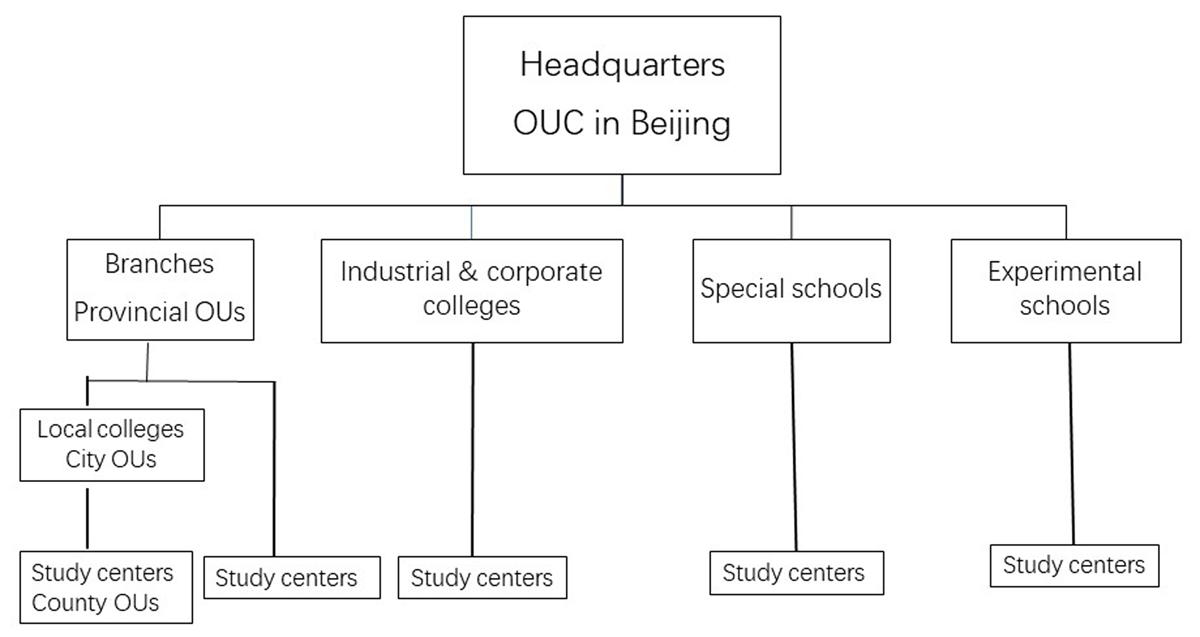
Figure 1
OUC system structure.
According to Xiao (2008):
The pyramid model is intended to guarantee quality in course design, material production, course delivery, student support, course assessment and staff development. It has also proved to be very successful in reducing discrepancies in educational resources across such a vast country and maintaining high standards of teaching (p. 171).
This is to ensure that learners in remote and marginalized areas are not left behind. Put specifically, curriculum planning, syllabus design, course material production, course delivery and continuous assessment orchestration, staff training (mainly targeting provincial OUs), and setting examinations, fall within the remit of the headquarters. Provincial OUs are responsible for ensuring adequate implementation of curriculum and syllabus, effective course delivery, continuous assessment, and training staff for local colleges and study centers in their respective provinces. Local colleges and their study centers, namely, OUs at the city and county/borough levels, enroll students, organize tutorials (face-to-face and/or online), evaluate learning outcomes at fixed assessment points, administer final examinations (in-person and/or online) as arranged by the headquarters, and provide academic and counselling support to students. An additional responsibility of local colleges is to ensure that the work of the study centers function according to the requirements stipulated by the headquarters.
All the OUC branches are independent of the headquarters except teaching and learning matters, including enrollment and qualification awarding. On the one hand, they must be aligned to the teaching and learning requirements set by OUC, enroll ODE students in the name of OUC, and award OUC diplomas and degrees. On the other hand, their funding and personnel management are the responsibilities of the local governments rather than OUC. Having said that, Beijing Open University, Shanghai Open University, Jiangsu Open University, Guangdong Open University, and Yunnan Open University present an interesting model. While they are fully independent of OUC, they are also OUC branches. Unlike their provincial counterparts, these five OUs can enroll students for their own programs and issue their own qualifications. At the same time, they can enroll students for the programs offered by OUC, where students are awarded OUC qualifications.
OUC Operating Mechanism
First, OUC has an advisory body, the University Council and a decision-making body, the University Affairs Committee. In addition, it has set up special committees for academic affairs, degree-awarding, and quality assurance. Second, it has adopted a unified operating system and hierarchical management system to achieve a synergistic effect. Third, it administers the complementary development and resource-sharing mechanism which aims to motivate branches, industrial and corporate colleges, specialized schools and experimental schools to exercise their agency in taking advantage of the network to meet their own needs and to promote the sharing of human and learning resources. Fourth, its cost-and-benefit-sharing mechanism is intended to ensure fairness in sharing revenues so that its branches, colleges, schools, and study centers stay motivated. Fifth, it carries out the policy of opt-in and opt-out whereby interested parties are welcome to join the network and quit if they want to. Details of the OUC operating mechanism are available on its English website (OUC’s system structure and operating mechanism, n.d.). Furthermore, OUC has formed support alliances with numerous campus-based universities, ministries and industry associations, enterprises, and local governments (Support alliance, n.d.).
OUC’s Contribution to Equity in Education
A study of the demographics of 2.91 million OUC students enrolled from 2013 to 2015 shows that 79% of them lived in places where HE resources were limited, with a higher percentage of students from ethnic minorities than those in campus-based universities (Liu et al., 2017). According to this study, 68% of the students had a monthly income below or slightly above the low income line and 85.5% were not in management or administration positions in their workplaces. The contribution of the OUC to equity in education is also demonstrated in its proactive efforts to cater to specific “disadvantaged” cohorts. For example, its “One College Student per Village Initiative”, launched in 2004 and awarded the 2020 UNESCO Prize for the Use of ICT in Education (UNESCO, 2022), has enrolled 1.075 million rural residents, 746,000 of whom have successfully completed their programs of study (OUC, n.d.).
Since 1979, OUC has enrolled 25.72 million students, with 19.61 million graduates who represent 8.5% of HE graduates in China. Currently, it has a student population of 4.567 million, accounting for nearly 10% of the HE student population in China. In addition, its Lifelong Education Platform has 6.8 million users and its nationwide network for older adults has 22.14 million senior learners (OUC, n.d.).
OUC Completion Rates, Dropout Rates, and Most Popular Disciplines
ODE students have a maximum of eight years to complete a program. However, no official statistics about completion rates are available to the public. An early study investigated the completion rates of students enrolled by Beijing Radio and Television University from 1999 to 2001 (Shi, 2009), showing that at the end of the eight-year duration, 70% of the students succeeded in completing their programs. This result is somewhat echoed by an estimated completion rate of OUC since 1979. As mentioned above, the total enrolment of OUC has reached 25.72 million since 1979 while the number of its graduates is 19.61 million, which translates into a completion rate of 76%. As for dropout rates, due to disparities in the criteria used for calculation, the results ranged from 8.4% (Liu et al., 2012) to 11% (Zhang, 2018), 21.89% (Chen, 2005) and 30% (Shi, 2009). Shi’s (2009) result was more rigorous because it was based on the statistics of the full eight-year duration. It is most probably due to its pyramid, hierarchical network and unique operational mechanism that OUC has such a high completion and low dropout rate.
According to a press release of OUC, the ten most popular disciplines in 2023 were: Administrative management (both undergraduate and junior college), Business and enterprise management (junior college), Mechatronics (junior college), Law (undergraduate), Civil engineering (undergraduate), Business administration (undergraduate), Construction engineering technology (junior college), Administrative management (rural management orientation) (junior college), and Pharmacy (junior college) (OUC, 2024). Regrettably, no analysis was made of these priorities.
ODE in Chinese campus-based universities
ODE students in campus-based universities
As mentioned earlier, in China, open and distance HE started with conventional HEIs’ correspondence education in 1953. HEESL, launched in 1981, is another form of China’s first-generation ODE. In 2022, 18.31% of the off-campus HE student population was HEESL takers (Zhao & Liu, 2024). From 1981 to 2023, over 70 million learners had taken HEESL (Shen, 2024).
Campus-based universities skipped second-generation ODE and leapfrogged straight to third-generation ODE through their involvement in MDEI. Of the 69 pilot HEIs, 68 were campus-based universities. Statistics show that China had about 14.38 million ODE students in 2021 (MOE, 2021), about one-third of whom were studying with OUC. The total number of ODE students in campus-based universities exceeded the numbers enrolled in the ODE ecosystem in the country.
However, after MDEI came to a close in 2022, campus-based universities were not allowed to offer purely online education programs and hence not entitled to the privilege of open admission (MOE, 2022). Although no reason was given by MOE (2022), an earlier document demanded stricter regulation of the delivery and enrolment of MDEI programs by campus-based universities, among other things, to assure quality (MOE, 2019). Now, campus-based universities can continue to offer correspondence or blended-mode programs to students who have to sit for NAEME. Only the OUC network and the other five fully independent provincial OUs are now able to offer open admissions.
Normalization of ODE in campus-based HE: openness in practice
Campus-based universities in ODE, unlike campus-based programs, have a separate ODE department that functions like a dedicated ODE institution. ODE students deal directly with this department and normally do not have to deal with other academic and non-academic departments of the university. It is interesting to note that ODE and campus-based students neither access the same course materials nor are assessed by the same criteria. From this perspective, the two systems operate in parallel and the claim that ODE is now mainstreamed in campus-based higher education may not be justified.
On the other hand, it seems that campus-based universities do not define correspondence education and HEESL as ODE. The term ODE is often reserved for purely online education (aka 网络教育in Chinese and “networked education” in English) which is, in turn, often translated as online infrastructure and resources such as (open) online courses (Wang et al., 2020; Xiao & Zhang, 2022). This interpretation is evidenced in the 13th and 14th five-year development plans of top Chinese universities. “Open, flexible, distributed, and/or disaggregated learning” was hardly mentioned in the 13th plans and appeared in only 39% of the 14th plans, with the most popular goals of digitalization focusing on educational resources, infrastructure, and management (Xiao 2019, 2023a). Before the COVID-19 pandemic, online education had already played a supplementary role in campus-based universities and is yet to be fully mainstreamed today on the post-pandemic university campus (Lan & Chen, 2020). Instead, blended learning and teaching is becoming the new normal (Gou et al., 2024). In brief, campus-based universities embrace “openness” in their conventional education to some extent. Specifically, students of one university can earn credits by studying certain designated online courses, mostly electives, on (external) online platforms. In-person teaching is open to more methods than it was in the past. Learner support and learning resources are more accessible.
However, given the governance mechanism of Chinese HE and the deeply rooted bias towards ODE not only among educators but also in the larger society (Lim, 2023), it is not surprising that ODE has not been fully normalized in campus-based education. First, the implementation of ODE has seldom been a bottom-up attempt in the first place; it has always been driven by the government (Lan & Chen, 2020; Xiao & Zhang, 2022). This may explain, to some extent, the lack of initiative and proactivity by individual universities as well as the emphasis on resources development over resources application (Chen & Fan, 2023) and the lack of enthusiasm among students (Qin & Hu, 2021). Second, ODE implementation is far more than technology adoption and utilization but requires a systems approach (Xiao 2023b). However, campus-based universities have not been ready for a systemic transformation required by holistic ODE implementation (Zhang et al., 2021). Openness in campus-based education is practiced under the conditions set by the institutions and/or educational authorities and within a relatively closed environment. It is not the same as the openness practiced by dedicated ODE institutions. Third, ODE is considered inferior to campus-based education in the eyes of campus-based educators despite their incorporation of ODE elements into their routine teaching (Lim, 2023). For example, over 20% of the 68 campus-based pilot HEIs withdrew from MDEI later by stopping enrolling “networked education” students out of concern for their reputation as elite universities (Lin et al., 2021). Due to the above reasons, inter alia, there is still a long way to go before the philosophy of openness is fully embraced in campus-based education.
ODE completion rates, dropout rates, and most popular disciplines
No official statistics have been available. Studies show that completion rates ranged between 70.31% (Luo, 2009) and 76.15% (Su, 2015). This situation is similar to OUC completion rates reported earlier. As for dropout rates, it is 7.3% according to one study (Zhou et al., 2013). Many campus-based providers of ODE programs adopt a simplified version of the OUC model, with study centres distributed around the country, either in partnership with local educational institutions or by means of CCRTVU Modern Distance Education Public Service System, which was renamed as Open Edutainment later when officially in operation. This may be a major reason for the high completion and low dropout rates. Unfortunately, no information about the most popular disciplines can be found.
Impacts of ODE on Chinese HE
Massification of HE
ODE has made a significant contribution to the massification of HE in China. As reported above, OUC alone has enrolled and produced approximately one-tenth of China’s HE student population and graduates since 1979. Unfortunately, there are no official statistics of campus-based universities’ contribution for the same period.
Given that campus-based universities stopped offering online education programs in 2022, we use the 2021 national education statistics as a testament to the significant role of ODE in democratizing China’s HE (MOE, 2021). In 2021, ODE students represented approximately one-fourth of China’s HE student population, 30% of HE graduates were ODE students, and ODE programs accounted for 31% of the total HE enrollment (see Figure 2). No doubt, ODE is a key player in the massification drive of Chinese HE.
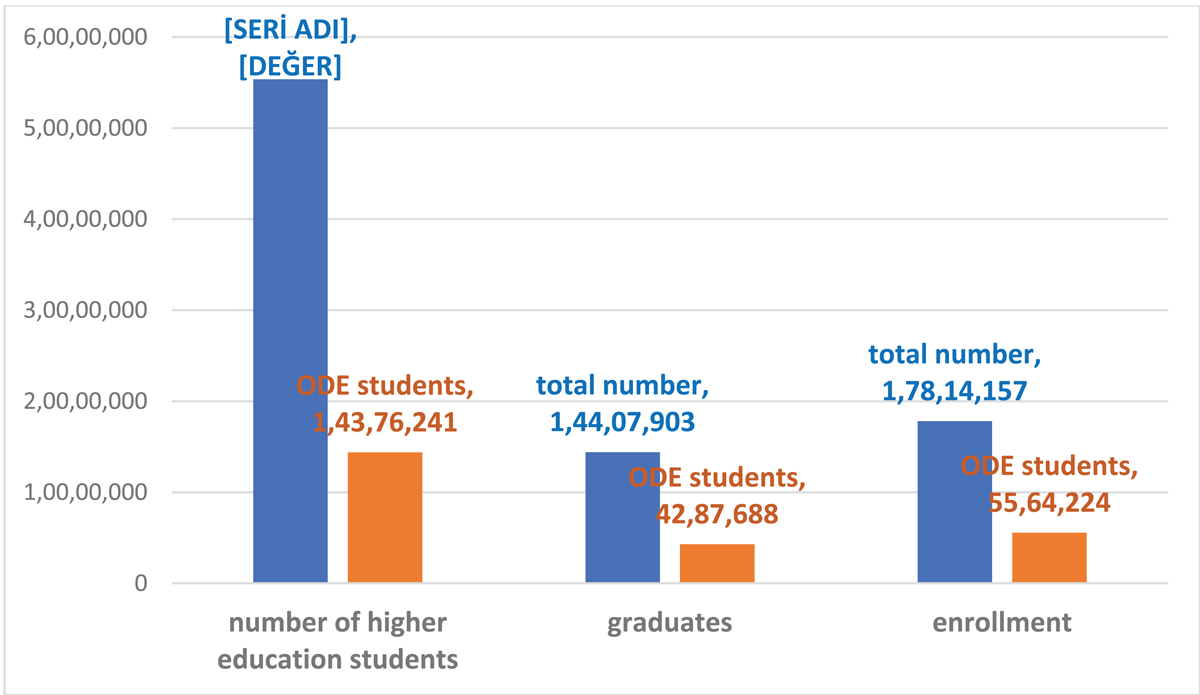
Figure 2
Statistics comparison.
Note: ODE number is composed of networked/online education students and correspondence students.
Mainstreaming openness in HE
Xiao (2018) identifies three types of convergence of ODE and campus-based education: dual-mode, added-on/blended, and full convergence. A dual-mode institution “offers both face-to-face and distance education modes of delivery to on-campus and off-campus students respectively”; added-on/blended convergence aims at “replacing certain face-to-face course components with technology-based alternatives, providing distance elements as options or even adding occasional online courses to a program”; full convergence refers to “integration of distance education as a system into campus-based education” (Xiao, 2018, p. 262). A case in point of full convergence is Deakin University which “has always served off-campus and on-campus students through the same administrative and support infrastructure; there has never been a separate unit responsible for the broad range of off-campus services” (Calvert, 2001). In China, there was a period (1986–2006) when RTVUs were practicing full convergence while campus-based universities have always been practicing dual-mode and added-on/blended.
Today, the campus-based model is no longer the only centre of HE in China; HE has transitioned from the single-centre model to the dual-centre model (Xiao 2018). Although campus-based education far outnumbers ODE in terms of student population, graduates, and enrolment, the sheer numbers of ODE students in these aspects have placed it at the centre of HE, not to mention that the blended mode of learning and teaching is increasingly popular on campus today. In this sense, openness is becoming the mainstream of HE in China. Looking back, ODE has undoubtedly played a key role in gradually mainstreaming openness in China’s HE. Nevertheless, more has to be done for openness to be fully embodied and practiced in campus-based HEIs, as argued above.
Synergistic interaction between ODE and campus-based education
ODE began as “an evolutionary offshoot of in-person education” (Dron, 2021, p. 45). ODE educators have “drawn on face-to-face instruction in some aspects”, for example, face-to-face tutorials and tutorial-in-print, residential schools, and home experiment kits in the early days (Xiao, 2018, p. 259) and later using two-way interactive systems and learning management systems to enable ‘the familiar classroom experience online’ (Shearer, 2015). Many of its quality-assurance procedures were also built on those well tried and tested measures for campus-based education (Mills, 1999). This is because campus-based education is taken to be “conventional” and ODE should be benchmarked against its “conventional” counterpart. Of course, this does not deny continuing innovations in the field of ODE which are, in turn, fed back into “conventional” education. For example, blended learning and flipped learning are “actually the norm of dedicated ODE institutions around the world” although campus-based educators tend to herald them as innovative pedagogies of their own (Xiao, 2023c).
Now that both ODE and campus-based education are the centres of higher education, the boundary between the two is increasingly blurred. However, it should be borne in mind that the interaction between ODE and campus-based education is not to convert one type of institutions into the other. Each has its irreplaceable role to play in contributing to the development of HE. Each should maintain its distinctive features rather than intend to take the place of the other. What really matters is how each learns from the other and allows fuller play to openness to facilitate the successful accomplishment of their respective missions. In other words, the purpose of interaction between the two is to produce a synergistic effect on HE.
Conclusions and recommendations: the way forward
With a 70-year journey of innovations in HE, albeit with its twists and turns, the ODE community in China, especially its ODE ecosystem – the OU network – has made impressive contributions to the country’s HE in a number of aspects critiqued above. Its lessons might be of relevance to other social, cultural, and economic contexts. That said, it is up to individual institutions to assess what implications these lessons may have for their ODE practice. This section will focus on the lessons and directions of future development for ODE in China.
Government support and university autonomy
ODE development in China has been socioeconomically and politically motivated (Xiao, 2018; Xiao & Zhang, 2022) with the central government as the biggest driving force. When new China was founded in 1949, it faced a severe shortage of high-level talents needed for its socioeconomic developments. There was only 205 HEIs with an enrolment of less than 120,000 students (Wang & Zhao, 2009). Campus-based provision alone could not possibly deal with this shortage. Correspondence education was then the most context-appropriate solution because it was less expensive and more scalable. This was why the government encouraged and supported conventional HEIs to offer correspondence programs.
The establishment of CCRTVU was also a socioeconomic and political response. The ten-year Cultural Revolution had brought the entire higher education sector to a stop, leading to an exacerbation of the talent shortage that the country needed to overcome most in its recovery efforts (Li, 2003). Hundreds of thousands who might have gone to university but for the Cultural Revolution lost their opportunity and longed for a second chance (Yang & Zhang, 2019). Against this backdrop, the government learnt from the successful experience of the OUUK and set up CCRTVU while expanding correspondence provision by launching the national external examination system- HEESL.
At the same time when campus-based HEIs started enrolment expansion in 1999, the government launched MDEI. The enrolment expansion and the decrease in birth rate have eased the tension between the supply and demand in HE. While ODE continues to cater to the less advantaged, the focus has been more on educational equity. “Due to historical and geographic reasons, social and economic development varies from one province to another, and even within a province, which results in disparities in educational development including educational opportunities, resources and quality” (Xiao & Zhang, 2022, p. 109). Ensuring equitable access to quality education for all is now a primary concern. This is probably the main reason why campus-based universities were encouraged to be a key player in ODE in the first place.
Political will is essential to fast tracking the sustainable development of ODE. This is evident from the examples of how the vision of particular leaders shaped the development of ODE in China, the UK, India and more recently Kenya, to name a few. There are several advantages to this approach where the government takes a comprehensive view of the entire education sector and develops policies within the framework of national development priorities and institutional support. However, as Zhang and Li (2019) point out ‘it has caused policy reliance without the autonomy that conventional universities enjoy, and caused reform processes to be constrained’. Therefore, how to balance government support and university autonomy is a challenge facing ODE in China.
Access and equity
SDG4 aspires to ensure inclusive and equitable quality education and lifelong learning for all by 2030. With only six years to go, the global community is far from achieving the targets set. As countries struggle to increase access to higher education, where the Gross Enrolment Ratio (GER) in Sub Saharan Africa is below 10%, China has strengthened its ODE ecosystem to massify HE at scale covering one-third of all HE enrolments. The GER in HE in China was 60.2% in 2023, comparable to that of some developed countries such as the UK. By 2050, China plans to have an inclusive education system that caters to all learners including those with disabilities and remote regions for achieving equitable access to quality education. ODE is sure to have a role to play in delivering this goal. China’s “One College Student per Village Initiative” is one of its proactive measures to reach the last person in the queue. 16% of the world’s population suffers from some form of disability (World Health Organization, 2023), yet in some developing countries such as India and South Africa, less than 1% of persons with disabilities (PWD) have access to tertiary education (Disabled get only .56% of seats in higher education, 2015; Van Der Merwe, 2017). By establishing the College for the Disabled in 2002, the OUC system has taken concrete steps to focus on equity and social justice, a commendable initiative instrumental in accomplishing the mission of ODE institutions (Makoe, 2022).
Research shows that learner support has a key role in student retention and learning outcomes. With the vast network of study centres across the country to provide effective tutorial and counselling support, enabling a “culture of care” or pedagogy of care within which learners can thrive, both OUC and dual-mode universities have succeeded in maintaining high completion rates. The role of study centres should never be underestimated even in the smart learning age.
Finally, the ODE and campus systems can interact to maximize access and equity. A case in point is the credit transfer mechanisms led by the OUC and regional OUs. They are developing credit accumulation and transfer frameworks across different institutions and programs to promote mutual recognition of credits earned outside home institutions. Learning Outcome Accreditation Centres have been set up across the country to facilitate this process. Nevertheless, these efforts are yet to be recognized by campus-based universities and put in practice.
Sustainable development
ODE was seen as the means of increasing access to education and thus has been deployed to advance national development in many countries. OUC used ODE for poverty alleviation by adopting targeted interventions to support village communities, which improved income and livelihoods for about 50,000 people from 2017 to 2020 (Ju et al., 2021). Similarly, a Lifelong Learning for Farmers program using distance learning approaches was offered by the Commonwealth of Learning (COL, 2018) to illiterate farmers in countries in Asia and Africa. Farmers learned from experts and peers using basic mobile phones in their local languages and within three years, thousands of farmers were lifted out of poverty to generating assets.
ODE providers are also in a unique position to address climate change, the biggest challenge of our time. In the past three decades, several initiatives have emerged to promote sustainability in higher education. As Caird and Roy (2019) sum up, these relate to greening the curriculum, greening the campus and using distance and online learning. Brick and mortar institutions are not going to be the answer for the future. Distance learning can provide a solution for reducing the carbon footprint of the education sector. The OUUK compared the carbon emissions of ICT-enhanced and face to-face courses and found that distance teaching models had significantly lower environmental impacts (Caird et al., 2013; Caird et al. 2015). COL conducted a similar study in Botswana, and found that the average learning-related carbon footprint of the distance learning group is nearly three times less than that of their campus counterpart (Carr et al., 2019).
Continuing commitment to sustainable development should be top on the development agenda of the Chinese ODE community. Contributions to sustainable development should be highlighted as one of the fundamental goals/missions of ODE and translate into research and practice.
Skilling and re-skilling for the future of work
ODE has an important role to play in professional development (Neves & Henriques, 2020). Not all the jobs that exist today were heard of ten years ago and the jobs of the future will need to be aligned to the green and blue economies. Providing access to higher education is no longer enough where it is imperative to prepare learners for employment and entrepreneurship.
A recent Global Education Monitoring Report indicates that there is a decline in postgraduate students in upper middle-income countries (UNESCO, 2023). Another study in the US shows that even at the undergraduate level, there is a decline in the completion rates of students in language, literature, education, and liberal arts (Rastogi, 2023). The real need and demand is in IT-related jobs, health care, and newer interests such as leisure and fitness. What do current trends indicate? First, there is a focus on skills development and shorter courses that lead to livelihoods. Second, learners need more flexibility and the option to move between academia and the world of work. Third, both staff and students need to keep learning and relearning throughout life. In all these aspects, ODE has a role to play.
In addition to giving priority to developing non-award-bearing job-oriented courses in recent years, OUC’s collaboration/partnership with the industry and corporate sector (through its industrial and corporate colleges) is another attempt in this direction. This echoes a recent report from Boston Consulting Group according to which universities need to partner with industry in offering job-specific courses, meta-skills such as critical thinking, and immersion training in the industry (Hoteit et al., 2023). This will require a balance between theory and practice, a focus on hard as well as soft skills, and a curriculum that addresses the needs of the labour market.
To make learning attractive and sustainable, there must be appropriate incentives such as accreditation of prior learning and recognition of qualifications. Micro-credentials are leading to shorter, just-in-time courses that can be taken at one’s own pace or time. As the demand for shorter qualifications increases, the OUUK offers micro-credentials on the FutureLearn platform while Athabasca University uses its own platform PowerED to offer online micro-credentials for professional development. The credit transfer mechanism currently being developed by the OU system is also intended to serve this purpose, among others.
Nonetheless, the overall curricula of ODE in China, especially those of award-bearing programs, cannot meet the needs in terms of skilling and re-skilling the workforce or preparing students for the workplace. More work needs to be done.
Lifelong learning for the third age
Catering to the needs of the third age is a major mission of OUC. Long before the central government decided that OUC was home to the Seniors University of China in 2022, it had provided education for hundreds of thousands of elderly people. Its Lifelong Education Platform has nearly seven million users and its nationwide network has 22.14 million senior learners. Education provision for the seniors is so popular that many OUs can hardly accommodate all the applicants.
However, OUC’s models largely follow the pedagogic approach where the learner depends on the teacher for what and how to learn. There is little use of andragogy, where the adult learners are more independent, learn when they need to and use their own experiences, not to mention the heutagogic approach whereby learners are independent and determine what and how to learn while the learning is not planned and can take place anywhere. Even less in use is the gerogogic approach with a focus on the elderly’s physical and psychological needs. The core principle of gerogogy is community-based learning and on building communities of practice where elders learn from peers and share their own experience and expertise with others (Kanwar et al., 2023).
How to leverage ODE to develop high-quality lifelong learning for the third age is a noteworthy direction. Can the iron triangle be broken in the case of ODE for the elderly as well? How can decades of expertise in ODE be used to inform provision of lifelong learning? Properly designed and effectively implemented, lifelong learning for the third age can become a new engine of ODE growth.
Technology in ODE
There is no ODE without technology. Each generation of ODE is driven by the technologies of its times. Technological advancements lead to reforming the curriculum and rethinking pedagogic practice, ultimately resulting in ODE’s rapid growth. The evolution of ODE in China is testimony to this observation.
Technologies, in particular digital and online technologies have been a catalyst for openness in education (Bozkurt & Gil-Jaurena, 2023). However, as is clear from the ODE history, whether technology in education can enhance quality, reduce cost, and expand access depends on for what, to whom, how, and which technology is actually used. While we are still struggling to come to grips with the scale of the social and educational implications of previous digital revolutions, we now find ourselves suddenly involved in the artificial intelligence revolution, which “may make the others look minor by comparison” (Giannini, 2023, p. 2). Although the unfolding AI revolution has a wealth of affordances for ODE (Xiao, 2024), we should be aware that affordances are not reality.
Newer technologies will definitely continue to drive changes in the way we teach and learn. Nonetheless, any decision on large-scale deployment must be based on solid research evidence which we have yet to see (Xiao, 2024). Therefore, we should be cautious until we know more about any new technology that we intend to use. A cautious and open mind-set is of critical relevance to OUC’s current digital transformation drive.
Data Accessibility Statement
Data sharing is not applicable to this article as no datasets were generated or analysed during the current study.
Competing Interests
The authors have no competing interests to declare.
Author Contributions (CRediT)
Junhong Xiao: Conceptualization, Formal Analysis, Investigation, Methodology, Resources, Supervision, Writing – original draft, Writing – review & editing; Asha Kanwar: Conceptualization, Investigation, Resources, Writing – original draft, Writing – review & editing; Ruo Du: Conceptualization, Resources, Writing – original draft, Writing – review & editing. All authors have read and agreed to the published version of the manuscript.
Sustainable Development Goals (SDGs)
This study is linked to the following SDG(s): Quality education (SDG 4), Decent work and economic growth (SDG 8), and Reduced inequalities (SDG 10).